Checked on 23 September 2026 against the Immigration Services Agency’s pages for Spouse or Child of Permanent Resident and Dependent, its document checklists, procedure pages and official Q&A, the October 2026 fee revision, the Guidelines for Permission for Permanent Residence, the e-Gov public comment page and the Immigration Control Act.
The short answer
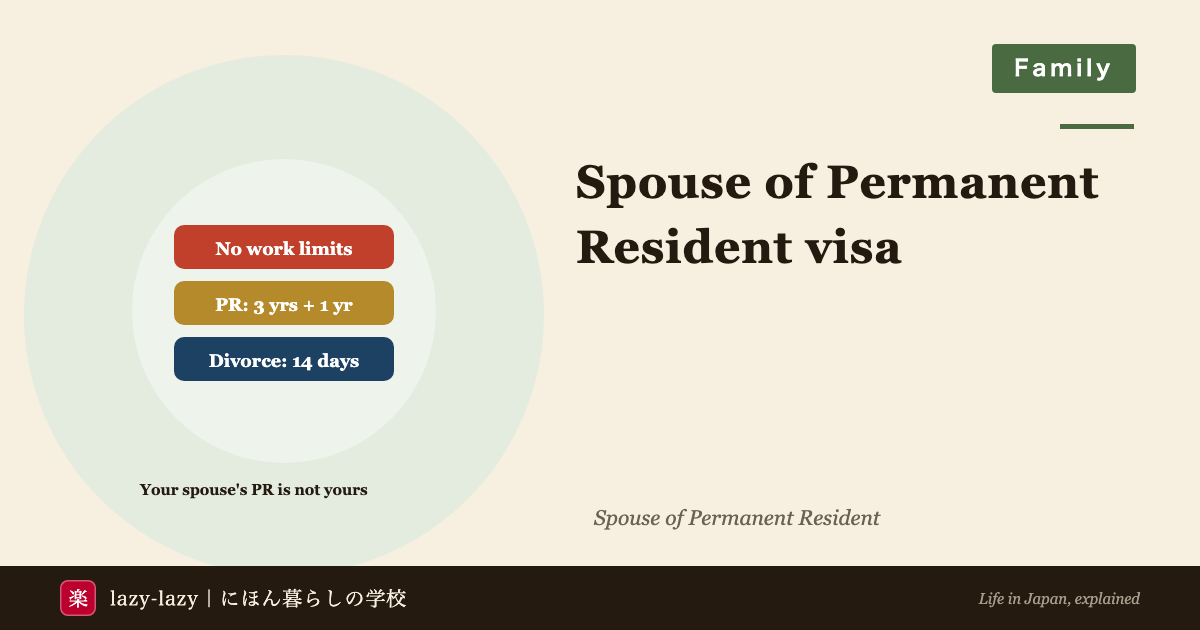
- Spouse or Child of Permanent Resident is the status for people married to a permanent resident or special permanent resident, and for their children born and still living in Japan. In Japanese it is eijusha no haigusha-to.
- There is no work restriction. Any job, any hours. No 28-hour cap like the Dependent visa.
- There are three ways in. From abroad, a Certificate of Eligibility (COE). Already in Japan, a change of status. A child born in Japan, an acquisition of status within 30 days.
- You can apply for permanent residence after three years of real married life plus one year in Japan. A draft would stretch this to five plus three from April 2027. It has not been decided.
- If you divorce or your spouse dies, notify Immigration within 14 days. Six months without life as a spouse makes your status liable to cancellation.
Knowing this, you can tell which application is yours and count the years to your own permanent residence, so you can decide whether to move before the draft rules are settled.
Your husband just got permanent residency. Does that make you a permanent resident too? Or are you still on the Dependent visa? You ask a Japanese friend and get a shrug. Japanese nationals never hold a residence status, and most have never heard that Japan has a status just for the foreign spouse of a permanent resident.
- What is the Spouse of Permanent Resident visa in Japan?
- Can a spouse of a permanent resident work in Japan?
- How long is the period of stay?
- How to get a Spouse of Permanent Resident visa: three ways in
- Spouse of Permanent Resident visa requirements: the document list
- How much does it cost?
- Permanent residency for the spouse of a permanent resident: 3 years of marriage + 1 year in Japan
- Divorce or death of your spouse: 14 days to notify, six months to cancellation risk
- Spouse of Permanent Resident vs Dependent visa: what is the difference?
- Missed a deadline, or running out of time?
- Which one are you?
- FAQ
- Summary
- Related reading
What is the Spouse of Permanent Resident visa in Japan?
Spouse or Child of Permanent Resident is a status of residence in Appended Table II of the Immigration Control Act. It is what people call the “spouse of permanent resident visa”. The legal definition is short, and it covers only two groups.
- The spouse of a permanent resident or a special permanent resident
- A child of a permanent resident or special permanent resident who was born in Japan and has lived in Japan ever since
Your spouse’s permanent residency does not pass to you automatically. It belongs to the person who applied. To get Spouse of Permanent Resident status, you apply yourself.
For children, the condition is being born in Japan. A child born abroad whom you bring over does not fit this definition. Ask Immigration which status applies before you file.
If your partner is a Japanese national, you need a different, similar status: Spouse or Child of Japanese National. The documents and the PR shortcut look alike, but the ISA page is separate.
Can a spouse of a permanent resident work in Japan?
Yes, without limits. Article 19 of the Immigration Control Act restricts work only for Appended Table I statuses, such as Engineer/Specialist in Humanities/International Services, Student and Dependent. Spouse of Permanent Resident is in Table II, so that restriction does not apply.
Immigration’s own Q&A tells company HR staff that a person with Spouse or Child of Permanent Resident status can be hired. Full-time work, several part-time jobs, running your own shop: all fine. You do not need a work permit (permission to engage in activity other than that permitted).
How long is the period of stay?
You will be granted five years, three years, one year or six months. Immigration does not publish how it decides which one.
Before it ends, apply to extend it. If your period is six months or longer, you can apply from three months before it expires. Renewal usually takes two weeks to a month. The steps are the same as any visa renewal in Japan.
The length matters later for permanent residence, because one requirement is holding the longest period available for your current status. For Spouse of Permanent Resident that is five years. The guidelines say that until 31 March 2027, three years is also treated as the longest.
How to get a Spouse of Permanent Resident visa: three ways in
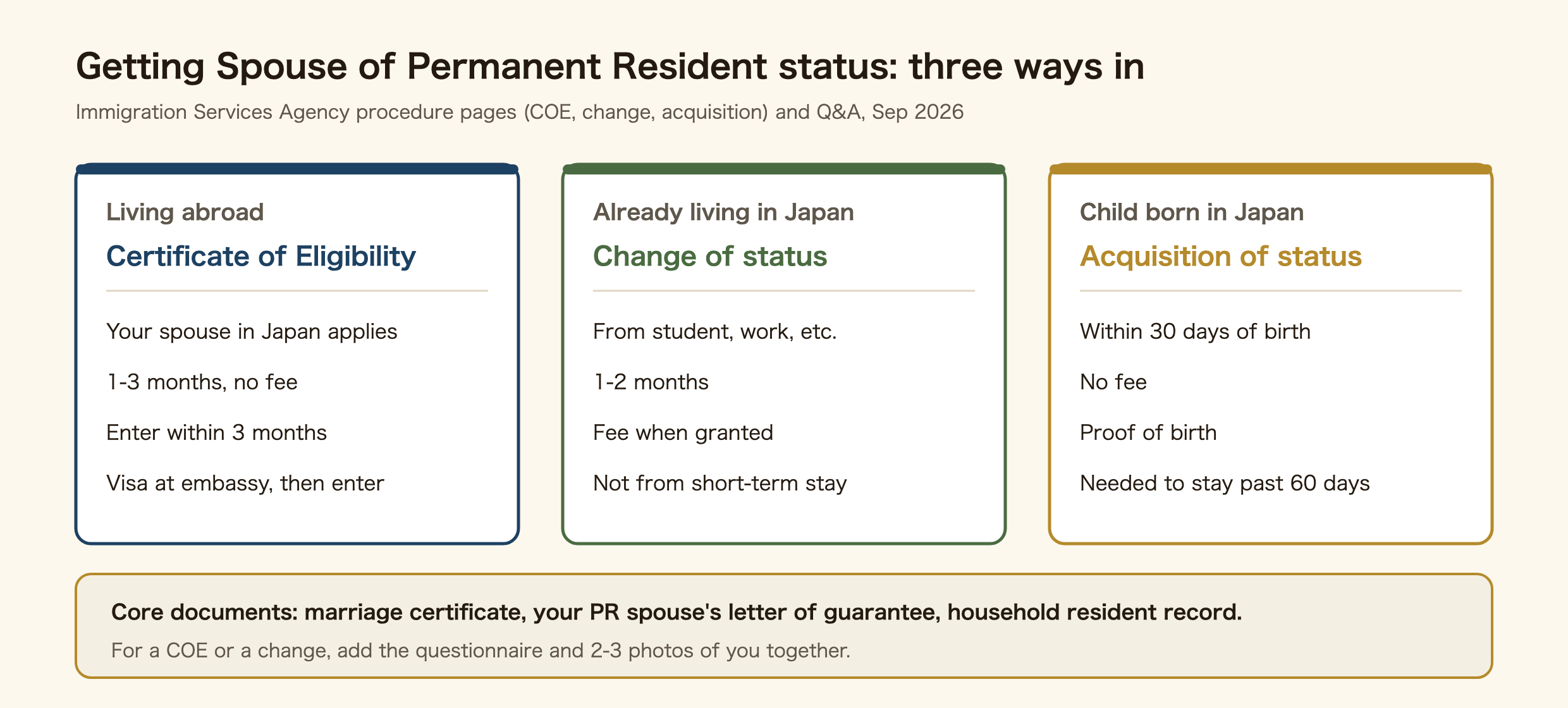
Which application you make depends on where you are now and what status you hold.
Living abroad: Certificate of Eligibility (COE)
Your spouse in Japan can apply on your behalf as a relative, at the regional immigration office for their address. Review takes one to three months and there is no fee. Once it is issued, take the COE to the Japanese embassy at home for a visa, and enter Japan within three months of issue. The full timeline is in how the Certificate of Eligibility works.
Nationals of Nepal, the Philippines and Vietnam also need a TB clearance certificate for the COE or visa (Ministry of Health, Labour and Welfare). You get it from a designated clinic at home after a chest X-ray and check-up.
Already in Japan: change of status
If you are in Japan as a student, worker or dependent, apply for a change of status. You can file from the time the reason arises (your marriage) until your current period of stay ends. Review usually takes one to two months.
Immigration’s page says that if you have stopped the activity of your current status and your family situation has already changed, you should “apply promptly”. Someone who quit their job and got married, for example, is no longer doing the activity of their work status. Move before three months pass.
If you came on a short-term visitor visa, a change is generally not possible. Immigration’s Q&A says it is not granted without special unavoidable circumstances. The standard route is to leave and come back with a COE.
A child born in Japan: acquisition of status
A baby born in Japan may stay without a status for 60 days from birth. To stay longer, you must apply for acquisition of status within 30 days of the birth (Article 22-2). There is no fee, and you attach proof of birth. The law also lets you apply for Permanent Resident status itself at this point.
This is separate from the birth registration at the city office. Registering the birth does not count as applying to Immigration.
Spouse of Permanent Resident visa requirements: the document list
Immigration publishes a document list and a checklist for each application. For a spouse, the COE and change-of-status list is:
- The application form (COE application from abroad, change of status application in Japan)
- One photo in the required format
- A marriage certificate issued by your spouse’s country and yours. If you registered the marriage at a Japanese city office, a certificate of acceptance of the marriage registration as well
- Proof of how you will pay to live in Japan: the latest year’s resident tax certificate (taxable or non-taxable) and tax payment certificate of whoever supports you. If those do not show it, for example right after a move, a copy of a bank passbook or a job offer letter
- A letter of guarantee from your permanent resident spouse, who is your guarantor
- Your spouse’s resident record (juminhyo) showing everyone in the household, with the My Number left off
- The questionnaire, available in Japanese and ten other languages including English, Chinese and Vietnamese
- Proof of your relationship: two or three snapshots of the two of you (no app-edited photos), plus social media messages or call logs if you have them
- For a COE, a return envelope with stamps for registered mail. For a change, show your passport and residence card
The renewal list is shorter. There is no questionnaire and no couple photos. Instead you submit a document proving the marriage continues. If you pay your own living costs, the tax certificates are yours.
Three things to watch. Japanese certificates must be issued within the last three months. Anything in a foreign language needs a Japanese translation. And Immigration may ask for documents that are not on the list.
How much does it cost?
| Procedure | Fee (applications from 1 October 2026) |
|---|---|
| Certificate of Eligibility (COE) | Free |
| Acquisition of status for a child | Free |
| Change or renewal granted for 6 months | Counter 18,000 yen / online 15,000 yen |
| Change or renewal granted for 1 year | Counter 33,000 yen / online 27,000 yen |
| Change or renewal granted for 3 years | Counter 64,000 yen / online 56,000 yen |
| Change or renewal granted for 5 years | Counter 75,000 yen / online 65,000 yen |
| Permanent residence | Counter 200,000 yen |
You pay change and renewal fees when the permission is granted, not when you apply, and the amount depends on the period you are granted. Online payment adds a separate processing charge. Applications received by 30 September 2026 pay the old fee (6,000 yen at the counter, 5,500 yen online) even if permission comes in October or later. Every bracket is in the October 2026 fee rise.
On top of Immigration’s fees, budget for certificates, translations, and from abroad, the visa and flights.
Permanent residency for the spouse of a permanent resident: 3 years of marriage + 1 year in Japan
Permanent residence normally needs ten years in Japan. Spouses of permanent residents, special permanent residents and Japanese nationals have a shortcut. The current Guidelines for Permission for Permanent Residence (revised 24 February 2026) say:
- Spouse: real married life has continued for three years or more, and you have lived in Japan continuously for one year or more
- Biological child and similar: you have lived in Japan continuously for one year or more
The guidelines count two separate things: three years of real married life, and one continuous year in Japan. The three years of married life carry no condition that they were spent in Japan. What is checked is whether you have actually lived as a married couple, not just the date on a certificate.
For spouses and children, the “good conduct” and “independent livelihood” requirements do not apply. You are still checked on paying tax, pension and health insurance on time, following the Immigration Act’s notification duties, and holding the longest period of stay. The full list is in permanent residency in Japan.
A draft would make it five years of marriage + three years in Japan from April 2027
On 4 August 2026, the Immigration Services Agency published draft revisions to the PR guidelines and took public comments until 4 September. The draft extends the spouse shortcut to five years of marriage plus three continuous years in Japan, and the child rule to three years. It would apply to applications made on or after 1 April 2027.
It is still a draft. As of 23 September 2026 the guidelines on the ISA site are the 24 February version, and no revision has been decided. The one clear point is that, under the draft as written, applications made by 31 March 2027 use the current rule. If you already qualify, decide early when to start gathering your documents.
Divorce or death of your spouse: 14 days to notify, six months to cancellation risk
When you divorce, or your spouse dies, file a “notification regarding your spouse” within 14 days (Article 19-16). You can file online through the e-notification system, at a counter, or by post. Not filing can bring a fine of up to 200,000 yen (Article 71-5).
Your status does not end on the day of the divorce. It becomes liable to cancellation after six months or more without life as a spouse (Article 22-4, paragraph 1, item 7). A child born in Japan to a permanent resident is outside this six-month rule.
The six months also have a “justifiable reason” exception. Immigration’s Q&A gives four examples: sheltering from domestic violence, living apart to raise children while sharing finances, a long stay abroad on a re-entry permit because a relative at home is ill, and divorce mediation or litigation in progress. Before cancelling, Immigration must consider giving you the chance to apply for a change of status or for permanent residence (Article 22-5).
There is a hearing before any cancellation, where you can explain and present evidence. If the status is cancelled, you are given up to 30 days to leave. The examples and what to do are in spouse visa and divorce in Japan.
Spouse of Permanent Resident vs Dependent visa: what is the difference?
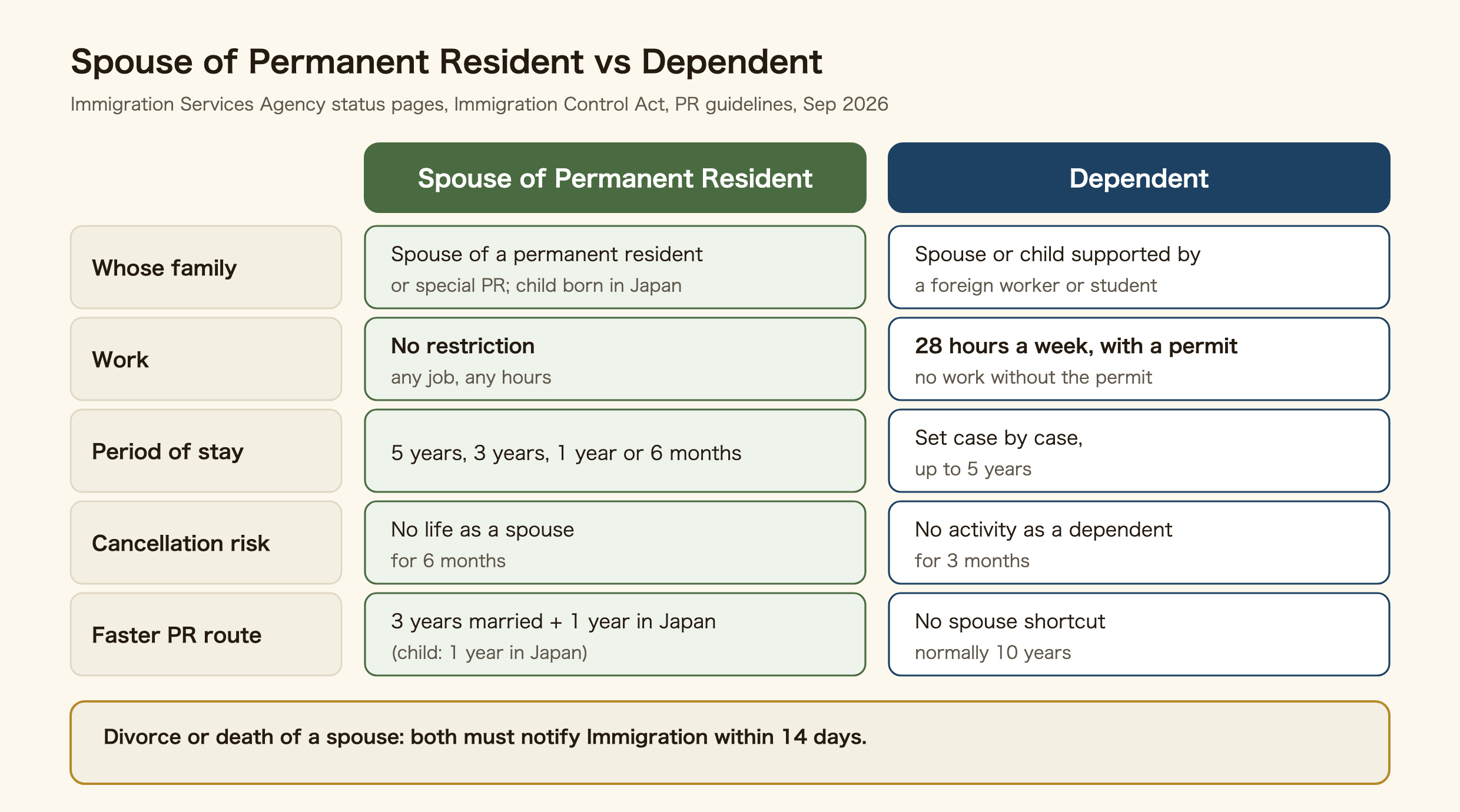
Dependent is the status for the spouse and children supported by a foreign worker or student. It is what most people use to bring family to Japan. Both are statuses for the family of a foreign resident, so they are easy to mix up.
The biggest difference is work. On Dependent, you need a work permit and then you are capped at 28 hours a week; without it you cannot work at all (the dependent visa 28-hour rule). Spouse of Permanent Resident has no cap.
The road to permanent residence differs too. A Dependent spouse has no spouse shortcut. If you came as a Dependent and your spouse later became a permanent resident, a change to Spouse of Permanent Resident is worth considering. You can work freely and you enter the three-plus-one shortcut. The change has a fee, so think about timing it with your next renewal.
Missed a deadline, or running out of time?
If you missed the 14-day notification, file it the day you notice. The maximum penalty is a fine of up to 200,000 yen. Leaving it undone causes more trouble later, because the PR guidelines list compliance with the Immigration Act’s notifications as a requirement.
If the 30 days for a newborn’s acquisition of status are running out, call the regional immigration office straight away. The law lets a baby stay without a status only until 60 days after birth.
If your documents will not be ready before your period of stay ends, go to the counter before the expiry date with what you have and ask. If the expiry date passes without an application, you are left with no status. For questions, call Immigration’s information center for foreign residents (Gaikokujin Zairyu Sogo Information Center) on 0570-013904.
Which one are you?
- Abroad, married to a permanent resident — ask your spouse in Japan to get their tax certificates and household resident record. Today, start collecting your marriage certificate and photos of the two of you.
- In Japan on Dependent, Student or a work status — check the expiry date on your residence card. Today, download Immigration’s document list and lay out the papers for a change of status.
- Just had a baby in Japan — separately from the birth registration, apply for acquisition of status within 30 days of birth. Today, write the 30th day in your calendar.
- Already on Spouse of Permanent Resident, three years married and one year in Japan — check that your tax, pension and health insurance have no late payments. Today, set a date to start gathering PR documents.
- Divorced or widowed — file the notification regarding your spouse within 14 days from today. Before six months pass, ask Immigration about your next status.
FAQ
Q. What is the Spouse or Child of Permanent Resident visa in Japan?
It is the status for the spouse of a permanent resident or special permanent resident, and for their child born and still living in Japan. It does not come automatically when your spouse gets PR, so you apply yourself.
Q. Can the spouse of a permanent resident work in Japan?
Yes, without restriction. The Immigration Control Act limits work only for Appended Table I statuses, and Spouse of Permanent Resident is in Table II. Any job, any hours, and no work permit needed.
Q. How long is the period of stay for a spouse of a permanent resident?
Five years, three years, one year or six months. Apply to renew before it ends; with six months or more, you can apply from three months before expiry.
Q. What documents do I need for a Spouse of Permanent Resident visa?
The core documents are a marriage certificate, your permanent resident spouse’s letter of guarantee, their household resident record, and proof of living costs (resident tax and tax payment certificates). A COE or change of status also needs the application form, a photo, the questionnaire and two or three photos of the couple.
Q. When can the spouse of a permanent resident apply for permanent residency?
Under the current guidelines, after three years of real married life and one continuous year in Japan. A draft would make it five years of marriage plus three years in Japan for applications from 1 April 2027, but as of 23 September 2026 it has not been decided.
Q. What happens to my status if I divorce a permanent resident?
Notify Immigration within 14 days. Six months or more without life as a spouse makes the status liable to cancellation, unless there is a justifiable reason such as divorce mediation. Immigration must consider giving you the chance to change status or apply for permanent residence.
Summary
Spouse or Child of Permanent Resident is the status for people married to a permanent resident or special permanent resident, and for their children born in Japan. There is no limit on work, and you can apply for permanent residence after three years of marriage and one year in Japan. It does not come with your spouse’s PR, though: you apply yourself, through a COE, a change of status or an acquisition of status.
Three deadlines matter. Notify Immigration within 14 days of a divorce or death, and know that six months without life as a spouse makes the status liable to cancellation. A child born in Japan needs an acquisition application within 30 days. The PR shortcut may lengthen from April 2027, so if you already qualify, start preparing without waiting to see how the draft ends.
Official sources: Immigration Services Agency, Spouse or Child of Permanent Resident (Japanese) / ISA, Dependent (Japanese) / ISA, Application for acquisition of status (Japanese) / ISA, Notification regarding your spouse (Japanese) / ISA immigration and residence Q&A (Japanese) / ISA, Fee revision from 1 October 2026 (Japanese) / ISA, Guidelines for Permission for Permanent Residence (Japanese) / e-Gov public comment on the draft PR guidelines (Japanese) / e-Gov, Immigration Control and Refugee Recognition Act / MHLW Japan Pre-Entry Tuberculosis Screening. Checked on 23 September 2026. Before you apply, check the latest document list on the ISA page.
Related reading
Found this useful? Share it
Send it to a friend who lives in Japan.
WHO WROTE THIS

mori
Japanese. I read the ministries’ own notices, orders and Q&As in the original, and I start from what my Nepalese and Sri Lankan friends in Japan actually ran into. I do not write about what I have not checked or been told.
What this site can and cannot do →Looking for something else?