Checked on 30 September 2026 against the Ministry of Land, Infrastructure, Transport and Tourism’s model lease and its Apartment Search Guidebook for foreigners, the Minor Offenses Act and Penal Code (e-Gov), Government PR Online’s page on #9110, the Environmental Dispute Coordination Commission’s guidance on pollution complaints, and the Consumer Affairs Agency’s page on 188.
The short answer
- In a Japanese apartment block, sound travels next door and to the floors above and below. The government’s guide tells tenants to be careful especially from late at night to early morning: voices, parties, TV, instruments, washing machines, running around, a bath at midnight.
- Japan’s model lease prohibits playing a TV or stereo, or a piano, at high volume. Adding someone who lives with you needs notice; subletting needs written consent. Your own lease may differ.
- One noise complaint does not end your lease. Under the model lease, the landlord can terminate after a warning with a deadline, if the problem is not fixed and the lease becomes hard to continue.
- The police offence is ignoring an official’s order to stop and staying extremely loud (Minor Offenses Act). If you are threatened or in danger, call 110. For non-urgent advice, call #9110.
- If you are the one being kept awake: management company, then your city’s pollution complaints desk, then #9110. The city desk is free.
Knowing this, on the day a complaint letter arrives you will know exactly what to ask the management company, instead of panicking or ignoring it. If you are the one bothered, you will know who to go to, and in what order.
Eleven at night. You are on a video call with friends back home when a slip of paper comes through the door: “We have received a report from another resident about loud voices late at night. — Management.” It does not say who. Your Japanese friend just says “Japanese walls are thin,” which does not tell you whether this is a warning, or what happens next.
- What causes noise complaints in Japanese apartments?
- Is noise banned in a Japanese lease?
- Can friends stay over, and can I have a party?
- Got a noise complaint in Japan? What to do first
- Can noise complaints get you evicted in Japan?
- Noise complaint and the police in Japan: is there a fine?
- Noisy neighbors in Japan: where to complain
- How much does it cost?
- Which one are you?
- FAQ
- Summary
- Related reading
What causes noise complaints in Japanese apartments?
A noise complaint in Japan almost always starts with everyday living sounds in a shared building: the sounds you make reach another flat and someone reports them to the landlord or management company.
Friends come over and you talk and laugh until late. Where you come from, that may be completely normal. In Japan, the government’s Apartment Search Guidebook for foreign residents (Ministry of Land, Infrastructure, Transport and Tourism, MLIT) says that in multi-family buildings sound travels easily to the neighbours and to the floors above and below, so be careful not to be noisy, especially late at night or early in the morning.
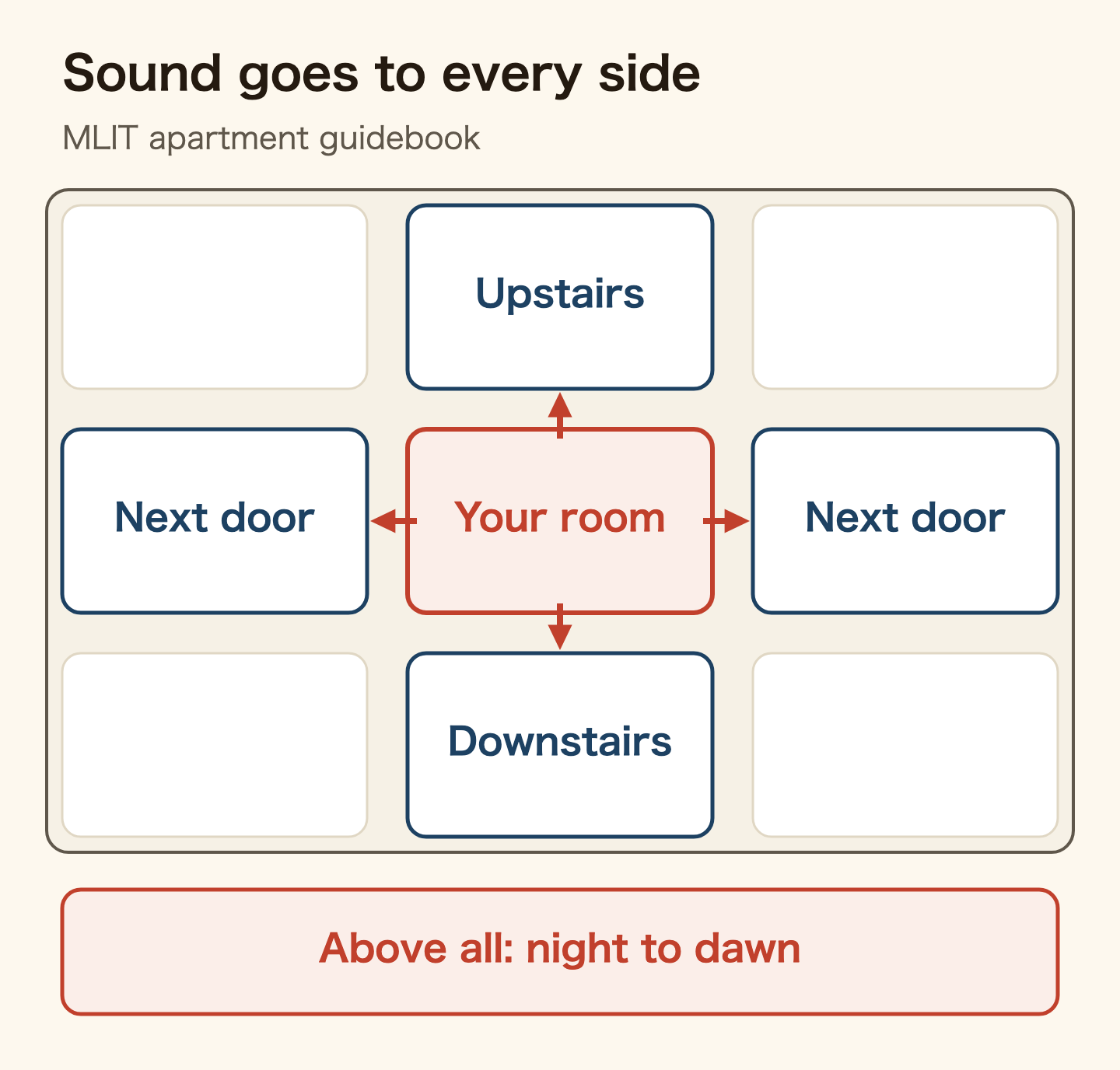
The same guidebook lists the sounds that lead to noise problems:
- loud voices and parties
- televisions, stereos and musical instruments
- vacuum cleaners and washing machines
- children running around, doors slammed shut
- taking a bath at midnight
Footsteps are a common complaint too. The guide’s own words are “running around”: sound carried through the floor reaches the flat below. Fast walking indoors or chairs dragged at night travel down the same way.
There is no single nationwide “quiet after 10 pm” rule. Even MLIT’s sample Occupant Pledge Check Sheet reads “I will refrain from making loud noises, particularly during the hours from roughly __ pm to roughly __ am”, with the times left blank to be filled in for each lease. Check your own contract and the papers you were given when you moved in.
Is noise banned in a Japanese lease?
MLIT publishes a model rental housing lease (賃貸住宅標準契約書) to prevent disputes between landlords and tenants. Using it is not required by law. But many real leases follow a similar shape, so it works as a map for reading your own.
Article 8 of the model lease sorts what a tenant may not do into three levels.
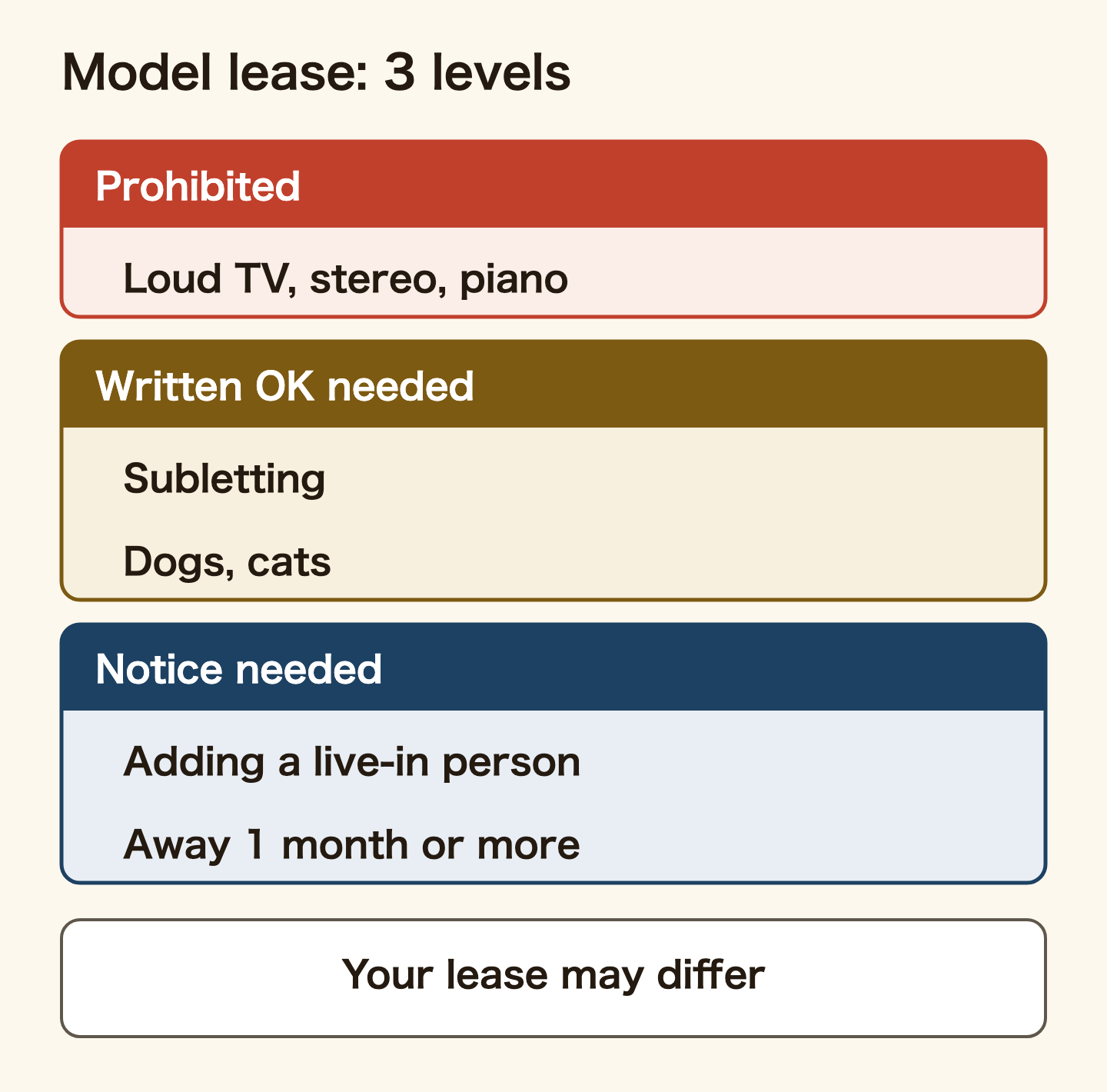
Noise is item 4 of the prohibited list (Table 1): “operating a television, stereo or similar, or playing a piano or similar, at high volume.” The same list bans keeping animals that obviously disturb the neighbours, such as dangerous beasts or venomous snakes. Dogs and cats are in the written-consent list, not the prohibited one.
These lists can be changed or added to by agreement. Your lease may ban all instruments, or set quiet hours. MLIT publishes the model lease in 14 languages, English included, on its page for foreign tenants, so you can lay it next to your Japanese contract and match the clauses. For the whole contract, from deposit to guarantor, see how renting an apartment in Japan works.
Can friends stay over, and can I have a party?
The model lease asks for notice when you add someone who will live with you (Table 3). Subletting, renting the flat to someone else, is not allowed without the landlord’s written consent (Article 8(1)). MLIT’s sample pledge sheet also has the line “No family members, relatives, friends, or others will live in the unit.”
A friend staying one night is not on the model lease’s prohibited list. What causes trouble is usually not the stay but the late voices and the party. On nights you have people over, switch to quiet time in the flat before it gets late. If a friend ends up staying for weeks, that starts to look like adding a resident, so ask the management company first.
Got a noise complaint in Japan? What to do first
Complaints usually arrive as a letter from the management company, a note in your post box, or a notice on the building’s board. It normally does not say who complained. However tempting it is to knock next door, contact the management company first. The front page of the model lease has a box for the management company next to the landlord, and that is your contact.
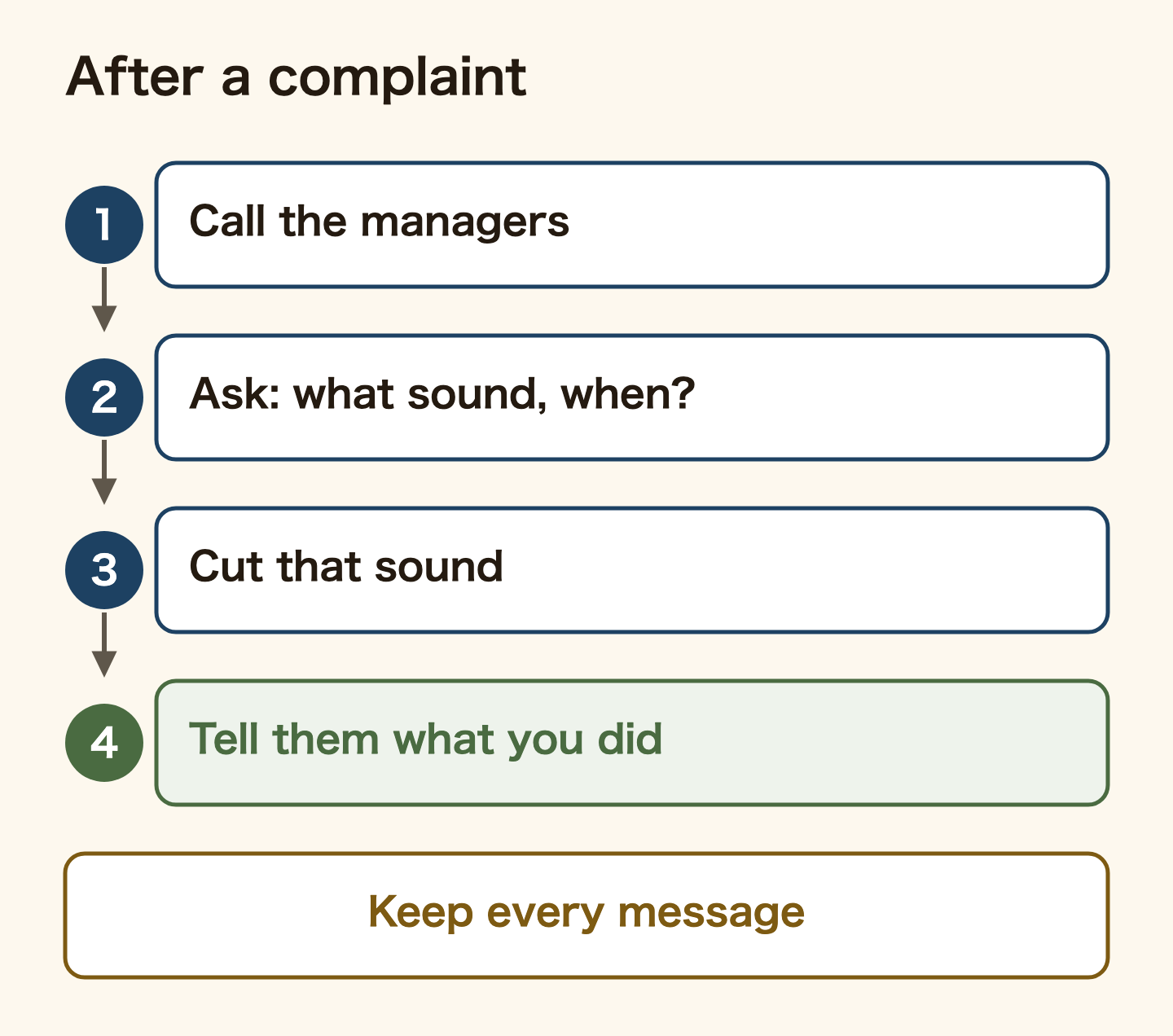
Ask two things: what sound, and at what time. Voices, the washing machine and a midnight shower each need a different fix, and it may be a sound you have not noticed yourself.
Then cut it. Use earphones and a lower voice for late calls. Do not run the washing machine or vacuum at night. Close doors gently. Then tell the management company what you changed. If the fix never reaches the other side, the complaints keep coming.
Keep the emails and letters. If it ever becomes a question about your lease, what you were told and when, and what you did about it, will matter. If dealing with it in Japanese feels hard, your city’s multilingual help desk for foreign residents can interpret. The MLIT guidebook also says local government and international association help desks give advice on housing.
Can noise complaints get you evicted in Japan?
Not in one step. Under Article 10(2) of the model lease, when a tenant breaks a duty such as the high-volume ban, the landlord cannot simply end the lease. It goes in this order:
- The landlord sets a reasonable period and demands that you fix it (a formal warning, 催告)
- It is not fixed within that period
- Because of that, continuing the lease is found to be difficult
- Only then may the landlord terminate the lease
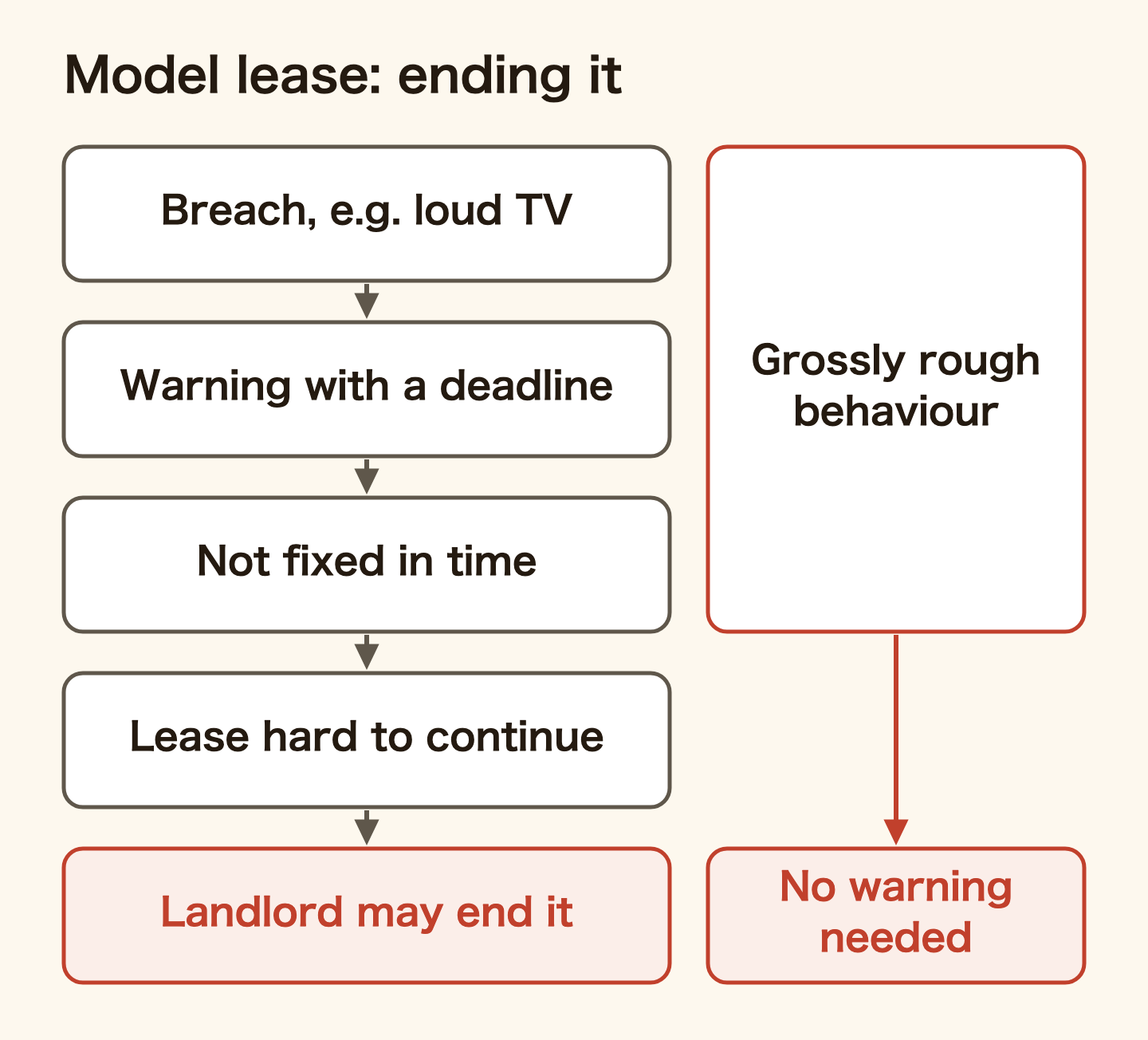
MLIT’s commentary explains that the warning requirement follows the idea behind Article 541 of the Civil Code. It adds that the courts allow termination without warning only where the tenant’s breach is so serious that it amounts to a betrayal making the lease extremely hard to continue (Supreme Court, 18 February 1972 and others: the “breakdown of trust” doctrine).
There is one exception. Grossly rough or violent words or behaviour in or around the property that make neighbours or passers-by feel unsafe (Table 1, item 7) is on the list the landlord can act on with no warning at all (Article 10(4)). Shouting back at a neighbour who came to complain can turn a noise problem into a much bigger one.
The model lease sets no number of complaints that triggers termination. So if you receive a written demand with a deadline, treat it as the last stage before the end. Contact the management company that day and reply in writing with what you will change.
If you decide to move out yourself, the model lease requires 30 days’ notice (Article 11). Before you go, read what you can be charged when you move out so the exit does not cost more than it should.
Noise complaint and the police in Japan: is there a fine?
A neighbour may call 110, and officers may come. If they tell you to stop, stop there and then. Article 1(14) of the Minor Offenses Act punishes anyone who ignores a public official’s order to stop and makes extremely loud noise with voices, instruments, a radio and so on, disturbing the peace and bothering the neighbours.
The penalty is detention (kouryu) of 1 day to under 30 days, or a petty fine (karyo) of 1,000 yen to under 10,000 yen (Penal Code, Articles 16 and 17). Both conditions must be met: ignoring the order to stop, and noise that is extremely loud. Being loud once is not this offence.
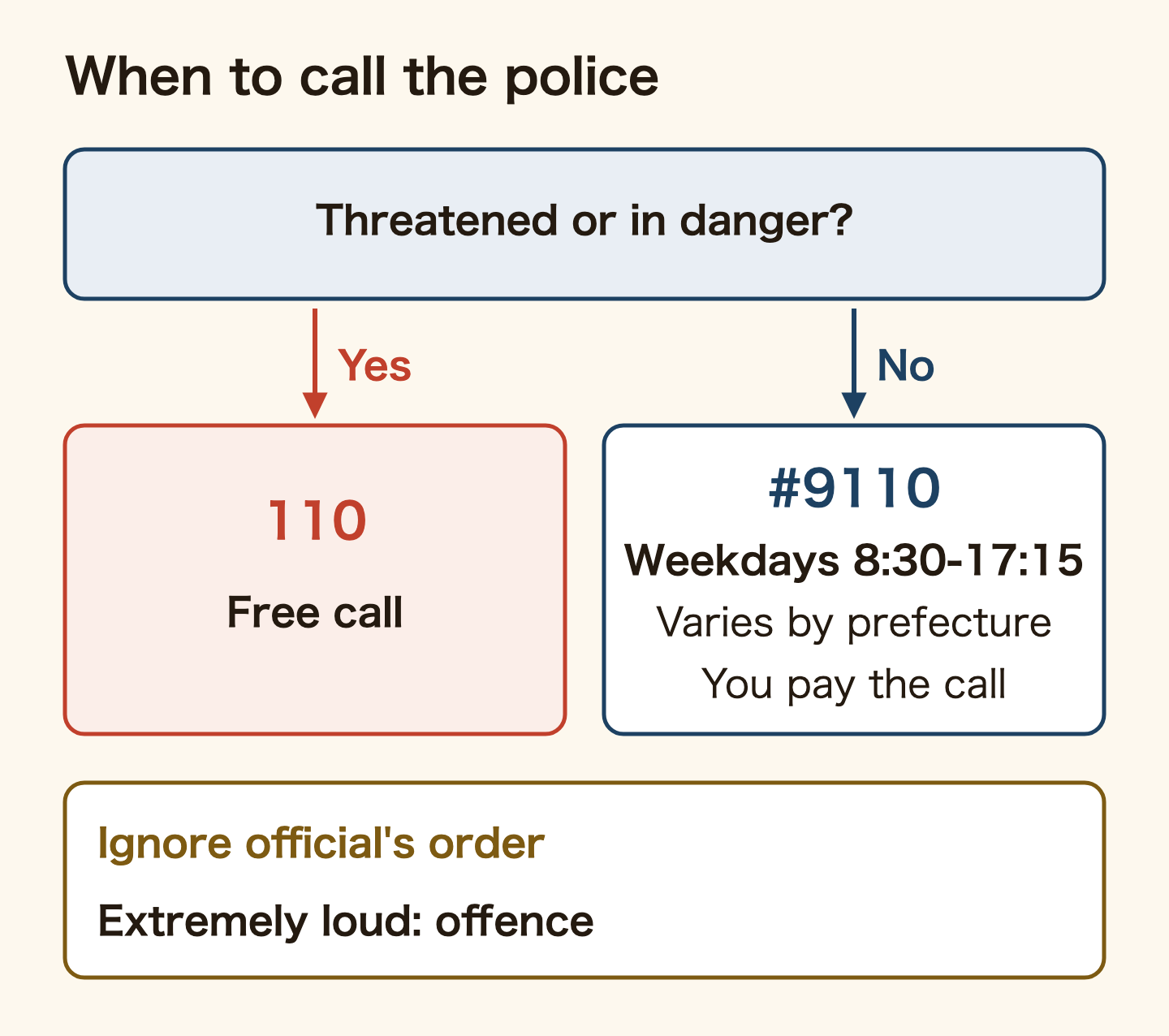
If instead a neighbour threatens you, say, to kill you or set a fire, that is no longer about noise. Threatening harm to someone’s life, body, freedom, reputation or property is intimidation under Article 222 of the Penal Code: up to two years’ imprisonment or a fine of up to 300,000 yen. If you are in danger now, call 110. It is free, and if the police cannot understand your language they connect an interpreter (Osaka Prefectural Police; see how to call the police in Japan).
For non-urgent advice, call #9110. From anywhere in Japan it reaches the police advice desk for the area you call from. Hours are mainly weekdays 8:30 to 17:15, and vary by prefecture. You pay the call charge. The police can give guidance and advice, or warn the other person.
Noisy neighbors in Japan: where to complain
You cannot sleep because of the flat upstairs. For you too, the first stop is the management company or landlord. If the noisy neighbour also rents, the landlord is the one who has a contract with them. Write down the dates, times and what you heard before you call; it makes things move faster.
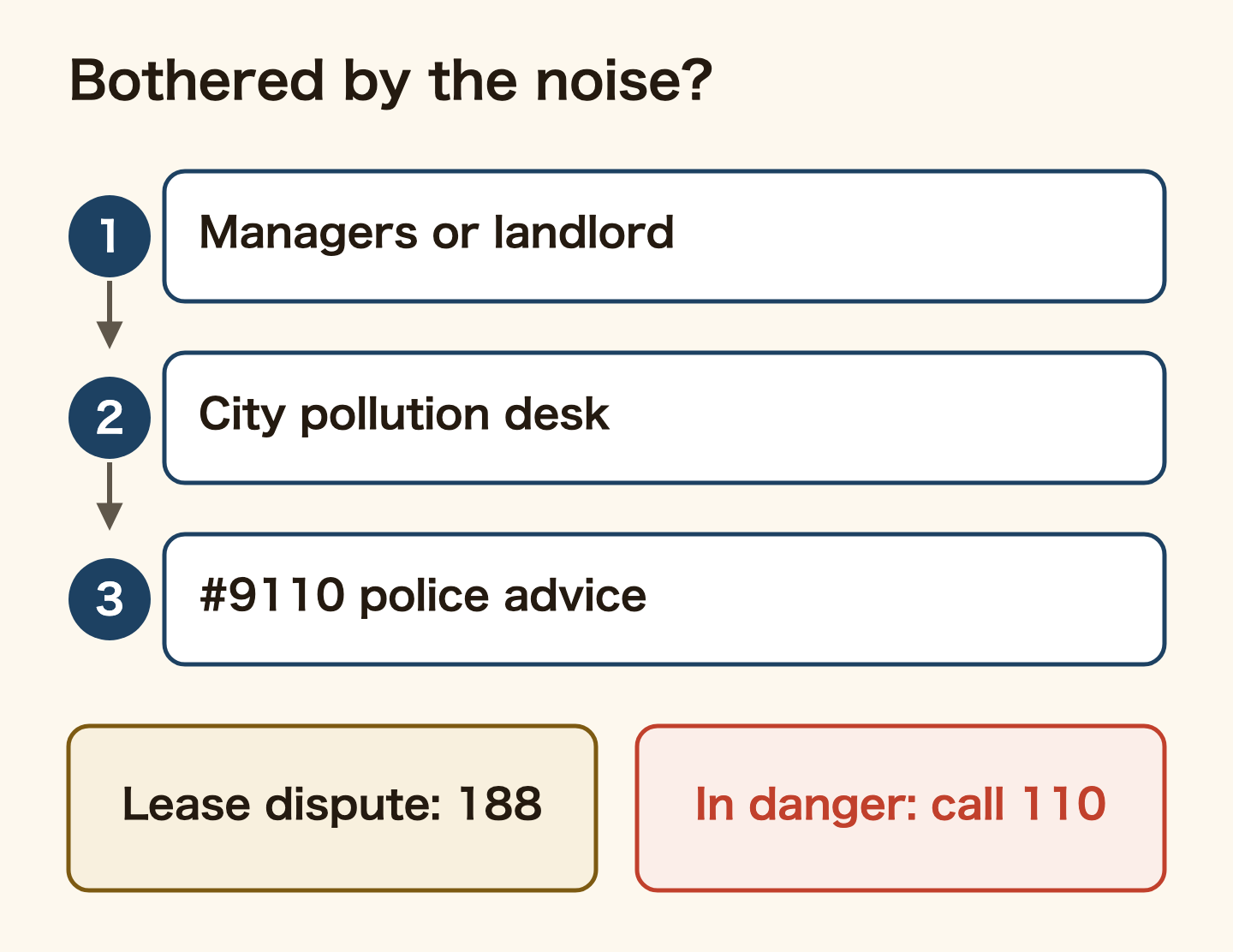
If the management company does nothing, your city or prefecture has a pollution complaints desk (公害苦情相談窓口, kougai kujou soudan madoguchi). The Environmental Dispute Coordination Commission says neighbourhood noise counts as “pollution” when it has some spread, and tells people to start at this desk. Advice is free, in person, by phone or by letter.
It has limits. Its explanation of the complaints process notes that for everyday household noise, the local government sometimes cannot instruct the person making it to change. If talking does not work, prefectural pollution review boards offer mediation. The Commission says noise from an ordinary household can qualify when the harm has some spread.
For the police, use #9110 for non-urgent advice, and 110 if you are threatened, attacked or in danger.
A dispute with your landlord or management company about the lease itself has its own door. Call the consumer hotline 188 and you are put through to a nearby consumer centre. The National Consumer Affairs Center’s page on rental restoration disputes lists 14,711 consultations in fiscal 2025, so these centres do handle tenancy disputes such as move-out charges.
How much does it cost?
| Where | Cost |
|---|---|
| Management company or landlord | Nothing (a phone call costs the usual charge) |
| City or prefecture pollution complaints desk | Free advice |
| Consumer hotline 188 | Free advice; call charges start once connected |
| #9110 police advice line | You pay the call charge |
| 110 | Free |
For 188, the call costs 9.35 yen (tax included) per 180 seconds from a landline and 11 yen per 20 seconds from a mobile (Consumer Affairs Agency). The real money comes later: ignore complaints until the lease is terminated and a whole move lands on you at once.
Which one are you?
- You got your first complaint letter — today, call or email the management company and ask what sound and what time. Fix it, then tell them what you did.
- You got a written demand with a deadline — treat it as the stage before termination. Contact the management company today, reply in writing with your fix, and reread the prohibited list in your own lease.
- A neighbour’s noise keeps you awake — start a log of dates and sounds tonight and contact the management company tomorrow. If nothing changes, phone your city’s pollution complaints desk.
- A neighbour threatened you or came to shout at you — in danger now, call 110. If things have calmed down, call #9110 today and tell the management company too.
FAQ
Q. What should I do after a noise complaint in Japan?
Contact the management company and ask what sound and at what time. Once you have cut the noise, tell them what you did. Avoid going to the neighbour’s door to argue.
Q. Can I be evicted for noise in Japan?
Under Japan’s model lease, the landlord can terminate after a warning with a deadline, if the problem is not fixed in time and continuing the lease is found difficult. One complaint does not end a lease. Grossly rough or violent conduct that makes neighbours feel unsafe can lead to termination without warning.
Q. What are quiet hours in Japan?
There is no single nationwide time. MLIT’s sample pledge sheet leaves the hours blank for each lease. The government’s guide says to take particular care from late at night to early morning. Check your own lease and move-in papers.
Q. Is there a fine for noise in Japan?
Under the Minor Offenses Act, ignoring a public official’s order to stop and making extremely loud noise that bothers the neighbours is punishable by detention or a petty fine of 1,000 yen to under 10,000 yen. If police tell you to stop, stop straight away.
Q. Can a friend stay over in my Japanese apartment?
A one-night stay is not on the model lease’s prohibited list. Adding someone who lives with you requires notice, and subletting requires the landlord’s written consent. Check your own lease, and ask the management company first if a friend will be living there.
Q. Where can I complain about noisy neighbours in Japan?
Start with the management company or landlord. If nothing happens, your city’s pollution complaints desk gives free advice. For the police, call #9110 for non-urgent advice or 110 if you are in danger.
Summary
In a Japanese apartment block, sound travels sideways and up and down. Japan’s model lease bans high-volume TV, stereos and piano playing, asks for notice when someone new lives with you, and requires consent to sublet. One complaint does not end a lease: termination comes after a warning with a deadline, if the problem is not fixed and the lease becomes hard to continue.
Whether you got the complaint or you are the one kept awake, the first contact is the management company. If you got it, find out which sound, fix it, and say so. If you are bothered, keep a log, report it, and go to your city’s pollution complaints desk if nothing changes. If you are threatened, call 110.
Official sources: MLIT, model rental housing lease / MLIT, support for foreign nationals looking for rental housing / MLIT, Apartment Search Guidebook (English) / MLIT, Occupant Pledge Check Sheet / Minor Offenses Act / Penal Code / Government PR Online, police advice line #9110 / Osaka Prefectural Police, “110” emergency calls / Environmental Dispute Coordination Commission, noise and odour problems / same, pollution complaints / same, noise from ordinary households / Consumer Affairs Agency, consumer hotline 188 / National Consumer Affairs Center, rental restoration disputes (all checked 30 September 2026). Always check the rules in your own lease.
Related reading
Found this useful? Share it
Send it to a friend who lives in Japan.
WHO WROTE THIS

mori
Japanese. I read the ministries’ own notices, orders and Q&As in the original, and I start from what my Nepalese and Sri Lankan friends in Japan actually ran into. I do not write about what I have not checked or been told.
What this site can and cannot do →Looking for something else?