Checked on 23 September 2026 against the Immigration Services Agency’s pages on special re-entry permission and renewal, its official Q&A, its guidelines for Japanese-language schools (revised 1 September 2026), official guidance for international students at the University of Tokyo, Kyoto, Osaka and others, and city-hall and Japan Pension Service pages.
The short answer
- Yes, you can leave Japan on a student visa and come back. For a trip home you keep your residence card, and the only step with Immigration is ticking a box on the re-entry ED card at the airport (special re-entry permission, free).
- You must be back within one year of leaving — or by the expiry date on your card, if that comes first. Neither can be extended or renewed from abroad. If your card expires soon, apply for renewal before you fly.
- Go home during term and the classes you miss count as absences. At a Japanese-language school, a month under 50% attendance is reported to Immigration even while you are away.
- Tell your school before you leave. Universities ask for an overseas travel form or similar.
- If you keep your resident record, health insurance and pension keep running while you are away. A stay of a year or more is a different matter.
Knowing this, you can fix “when to leave and when to be back” before you buy the ticket, instead of being stopped at the airport or called in by your school over attendance.
You found a cheap flight for the summer. Your mother keeps asking when you are coming home. But your residence card expires in December, and the school holiday ends in August. You ask a Japanese friend whether there is anything to do before a trip home. “Just your passport, right?” For them, going home is a matter of tickets. For you, it involves Immigration, your school and the city office too.
- Can you leave Japan on a student visa? Yes — tick the ED card
- How long can you leave Japan on a student visa? One year, or until your card expires
- What if your residence card expires soon? Apply for renewal before you leave
- Does attendance count while you are home?
- Can you work part-time before and after a trip home?
- Do you need to tell your school? Yes, before you leave
- Do you keep paying health insurance and pension while you are home?
- How much does a trip home cost?
- What if you cannot get back in time?
- Which one are you?
- FAQ
- Summary
- Related reading
Can you leave Japan on a student visa? Yes — tick the ED card
You usually do not need to apply for anything. If you hold a status of residence, a valid passport and your residence card, and you come back within a year of leaving, you can go on special re-entry permission. It costs nothing.
There is one thing to do, at the airport. At departure control, tick the box on the re-entry ED card that says the departure is temporary and you intend to return, show it with your residence card, and tell the officer you are leaving on special re-entry permission. Forget the tick and you leave without it: your status ends at that moment (University of Tokyo and Osaka University guidance).
There is no limit on how many times you use it (Immigration Q&A Q58), so summer and winter trips work the same way. Only if you might stay abroad for more than a year do you need an ordinary re-entry permit (4,000 yen single, issued the same day) before you leave.
How long can you leave Japan on a student visa? One year, or until your card expires
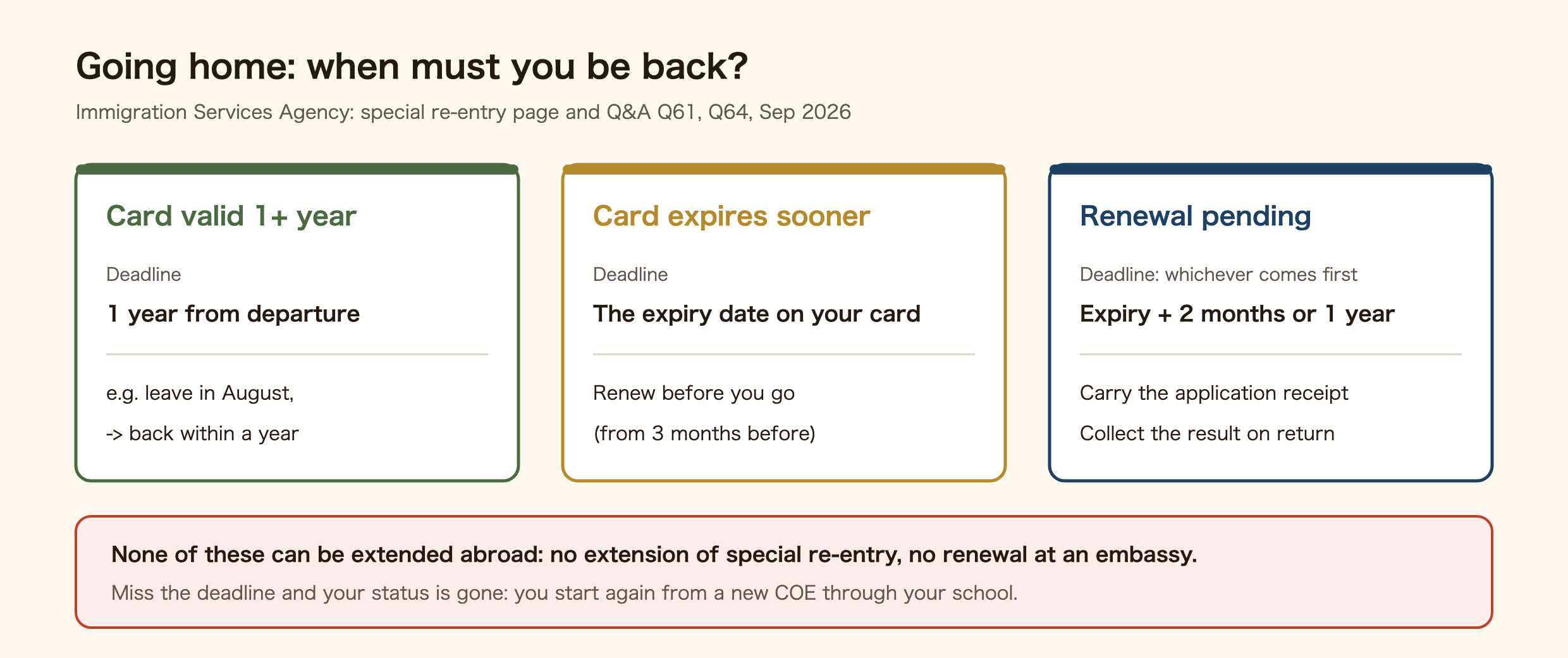
Special re-entry permission lasts one year from the day you leave. The law adds a condition (Immigration Act article 26-2 (2)): if your period of stay ends before that year is up, your deadline is the expiry date.
Look at the “period of stay (date of expiration)” on the front of your residence card. If it says December and you leave in August, you must be back by December, not next August. Check your return flight against that date before you book.
And the deadline cannot be moved from abroad. Special re-entry permission cannot be extended overseas, and you cannot apply to renew your period of stay at a Japanese embassy or consulate (Immigration Q&A Q64). Kyoto University says the same: in principle, you cannot renew your period of stay abroad.
What if your residence card expires soon? Apply for renewal before you leave
You can apply to renew from three months before your expiry date (for periods of stay of six months or more). Standard processing takes two weeks to a month. If your trip runs close to the expiry date, file the renewal before you fly.
You can leave before the decision comes. Immigration’s Q&A (Q61) confirms that you may depart on special re-entry permission while a renewal is pending. But the deadline changes.
- Be back by whichever comes first: two months after your old expiry date, or one year after you left
- Once back, collect the result at the office where you applied before those two months are up. After two months you are overstaying, even with an application pending
The University of Tokyo adds three practical points. Carry a copy of the application receipt. Immigration may ask for extra documents while you are away. And notices are posted to your registered address, so make sure someone can receive them. Immigration’s Q&A also asks you to stay reachable while abroad. The documents and timing for renewal are in the visa renewal guide.
Does attendance count while you are home?
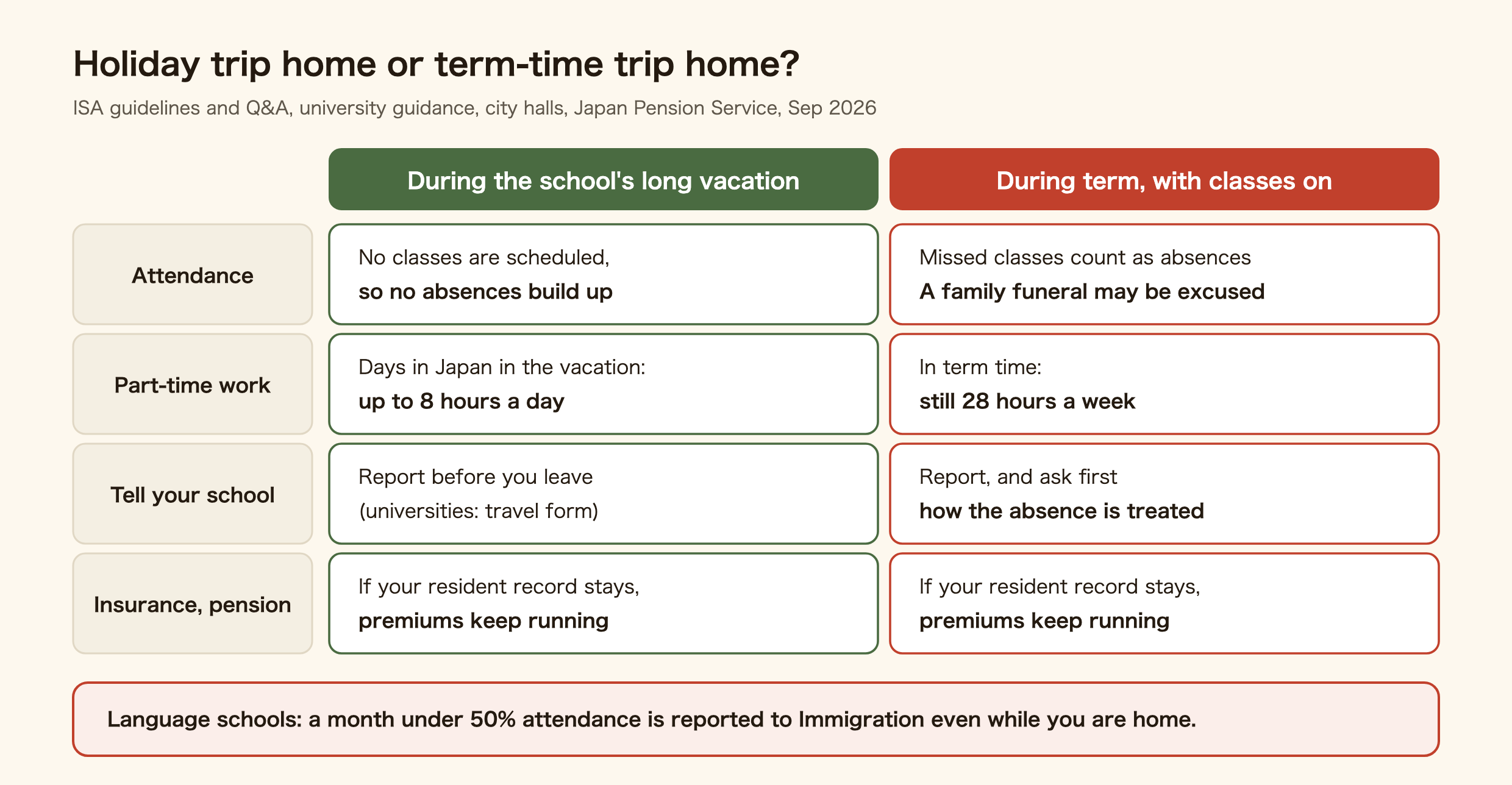
At a Japanese-language school, the attendance rate is the class hours you attended in a month divided by the class hours you were due to attend. Summer and winter vacations are “days without classes” set in the school rules. With no classes due, a trip home during the vacation adds no absences.
During term it is different. Every class you miss counts as an absence. Below 80% in a month, the school must give you guidance; below 50%, the school reports you to Immigration by the end of the following month. Immigration’s guidelines state that students on leave or temporarily back home are still covered by the 50% report as long as they hold Student status, including while abroad on re-entry permission.
Sometimes a family matter means flying home in term time. Absences for illness or other unavoidable reasons can be excluded, and the guidelines list “attending a relative’s wedding or funeral” as one example. But the school decides what counts. Before you go, explain the situation to your school and ask how the days will be treated. The details of the calculation are in the student visa attendance guide.
Universities and vocational schools have no published 80% or 50% line. But the University of Tokyo warns that if you have not carried out your Student activity for three months or more, your next renewal or change of status will ask for a reasonable explanation of the time abroad, and an explanation that does not add up can lead to refusal. If a term-time trip runs long, keep documents that show why.
Can you work part-time before and after a trip home?
The part-time work rules are about hours worked in Japan. According to Immigration’s Q&A (Q65 and Q66), a student with work permission may work up to 28 hours a week, and up to 8 hours a day during the school’s long vacations such as summer. Both apply only while you are enrolled.
Two things follow for a trip home.
- On vacation days you spend in Japan, before or after the trip, the limit is 8 hours a day. The exact vacation dates are in the school rules, so check the academic calendar
- From the day classes restart, you are back to 28 hours a week — including if your return slips into term
If you plan to pack in shifts before you fly, the Labour Standards Act also caps you at 40 hours a week on top of the 8-hour daily limit. How the 28 hours are counted (any seven days in a row) is in the 28-hour rule for student jobs.
Do you need to tell your school? Yes, before you leave
This is a school procedure, not an Immigration one. University guidance agrees on reporting before departure.
- University of Tokyo: any temporary departure needs your supervisor’s approval and a report to your faculty office
- Kyoto University: even a short trip home needs your supervisor’s approval, contact with your faculty office and an overseas travel form
- Osaka University: complete your department’s procedure and enter your departure and return dates in the overseas travel system
- Chiba University: always report a temporary departure to your faculty office
- Kanazawa University: always submit an overseas travel form; if you live in university housing and will be away a week or more, an absence notice too
Japanese-language schools and vocational schools set their own rules. Ask the office two questions: “Is there a form for a trip home?” and “How will the days I miss be counted?” Language schools are required by the national standard to keep track of each student’s period of stay and give advice, so ask them to check your expiry date against your return date too.
Do you keep paying health insurance and pension while you are home?
For a trip home of under a year, you can leave with your resident record where it is. Koto City’s guidance says that people going abroad for less than a year, keeping their base of life in Japan, do not necessarily need to file a moving-out notice. And while your resident record stays, so do your memberships as a resident.
You cannot leave National Health Insurance while keeping your resident record (Takahama City FAQ). Premiums are due for the months you are away, too. Ask the city office before you go how to pay anything that falls due while you are abroad. The same goes for the National Pension: everyone living in Japan aged 20 to 59, whatever their nationality, must be enrolled (Japan Pension Service). The premium is 17,920 yen a month for 2026. If your student deferral has been approved, it stays deferred while you are away.
Paying in does give you something back. If you fall ill or get hurt suddenly while at home and see a local doctor, National Health Insurance may refund part of the cost as an “overseas medical expense” claim. The amount is based on what the same treatment would cost in Japan, and trips made for the purpose of treatment are excluded. You claim after returning, within two years from the day after treatment. You need the original receipts and documents describing the treatment (with a Japanese translation if they are in another language), so keep them and bring them back (Fukuoka City, Chuo City). How insurance works in general is in the health insurance guide.
A year or more at home changes things. Koto City says foreign residents who plan to stay abroad for a year or more must file a moving-out notice, re-entry permit or not. Fukuoka City warns that if your life is really based abroad — for example a stay of a year or more — your National Health Insurance membership can be cancelled retroactively.
How much does a trip home cost?
| Item | Cost |
|---|---|
| Special re-entry permission | Free (tick the ED card) |
| Ordinary re-entry permit (if you may stay over a year) | 4,000 yen single / 7,000 yen multiple |
| National Pension (without the student deferral) | 17,920 yen a month (2026) |
| National Health Insurance | Set by your city and income |
| Renewal of your period of stay (if expiry is near) | From 1 October 2026, set by the length of stay granted |
| Return flights | Depends on the season |
If you are back within a year, you pay Immigration nothing. The costs people miss are the insurance and pension that keep running while they are not in Japan. If you need to renew, the new fees are in the October fee rise.
What if you cannot get back in time?
Miss the special re-entry deadline — one year, or your expiry date if sooner — and your Student status is gone. Osaka and Kanazawa universities both say so. There is no way to re-enter on the same status.
Getting back to school means repeating the route you took when you first enrolled. Your school applies for a Certificate of Eligibility (COE) on your behalf (no fee, one to three months), then you get a visa at the Japanese embassy at home and enter Japan. Nationals of Nepal, the Philippines and Vietnam also need a TB clearance certificate at that point (Ministry of Health, Labour and Welfare).
As soon as you see you might not make it, contact your school — before the deadline. If illness or family circumstances are keeping you at home, talk to them about what a leave of absence does to a student visa as well. Contacting them after the deadline will not bring the status back.
Which one are you?
- Going home for the summer or winter break, card valid for over a year — hand in your school’s travel form and tick the ED card at the airport. Today, check the last day of the vacation in your academic calendar.
- Your card expires during the trip — apply for renewal before you leave. Today, look at the expiry date on your card and put the date three months before it in your calendar.
- Going home in term time for a family reason — explain it to your school before you go and ask how the absence is counted. Today, decide which day you will visit the office.
- You might stay home for more than a year — get an ordinary re-entry permit before you leave, and plan your resident record, insurance and pension as if you were moving out. Today, book a talk with your school about a long trip.
FAQ
Q. Can you leave Japan on a student visa and come back?
Yes. If you return within a year, tick the box on the re-entry ED card at the airport — that is special re-entry permission, and it is free. If your card expires sooner, you must be back by the expiry date.
Q. Can I renew my student visa from abroad if it expires while I am home?
No. You cannot apply for renewal at a Japanese embassy, and special re-entry permission cannot be extended abroad. Renewal applications open three months before expiry, so file before you leave.
Q. Can I go home while my renewal is being processed?
Yes. But you must return by two months after your old expiry date or one year after leaving, whichever comes first, and collect the result within those two months. Carry a copy of the application receipt.
Q. Does attendance count while I am back home?
During term, missed classes count as absences. At Japanese-language schools, a month under 50% attendance is reported to Immigration even during a trip home. During the long vacation there are no classes, so no absences build up.
Q. Do I keep paying health insurance and pension while I am home?
Yes, if you keep your resident record. You cannot leave National Health Insurance alone while registered, and everyone living in Japan aged 20 to 59 must be in the National Pension. An approved student deferral stays in place.
Q. What happens if I cannot return before the deadline?
Your Student status ends. Your school has to apply for a new Certificate of Eligibility (COE), and you get a new visa at the Japanese embassy at home before entering Japan.
Summary
For a trip home, Immigration needs nothing more than a tick on the ED card. You must be back within a year of leaving, or by your card’s expiry date if that is sooner, and neither can be extended abroad. If your card expires soon, file the renewal before you buy the ticket.
The rest is your school and your city office. Tell the school before you go. If you are going in term time, ask how the absence will count. If you keep your resident record, insurance and pension keep running. Sort out those three before you fly, and you come back to the same life you left.
Official sources: Immigration Services Agency, special re-entry permission (Article 26-2) / ISA immigration and residence Q&A (Q58, Q61, Q64-66) / ISA extension of period of stay / ISA reporting under the Japanese-language school standards (including the interpretive guidelines) / University of Tokyo, temporary departure (Japanese) / Kyoto University, status procedures (Japanese) / Osaka University, re-entry (Japanese) / Koto City, moving abroad (Japanese) / Fukuoka City, overseas medical expenses (Japanese) / Japan Pension Service leaflet for people leaving and entering Japan (Japanese). Checked on 23 September 2026. Always confirm with your own school and city office before you travel.
Related reading
Found this useful? Share it
Send it to a friend who lives in Japan.
WHO WROTE THIS

mori
Japanese. I read the ministries’ own notices, orders and Q&As in the original, and I start from what my Nepalese and Sri Lankan friends in Japan actually ran into. I do not write about what I have not checked or been told.
What this site can and cannot do →Looking for something else?