Checked on 7 October 2026 against the Ministry of Health, Labour and Welfare, the Japan Health Insurance Association, the Japan Pension Service, the National Tax Agency, Japanese law on e-Gov, Tokyo’s National Health Insurance guide and the Japan Institute of Life Insurance.
The short answer
- Whether you need life insurance in Japan depends mostly on one thing: does anyone live on your income here?
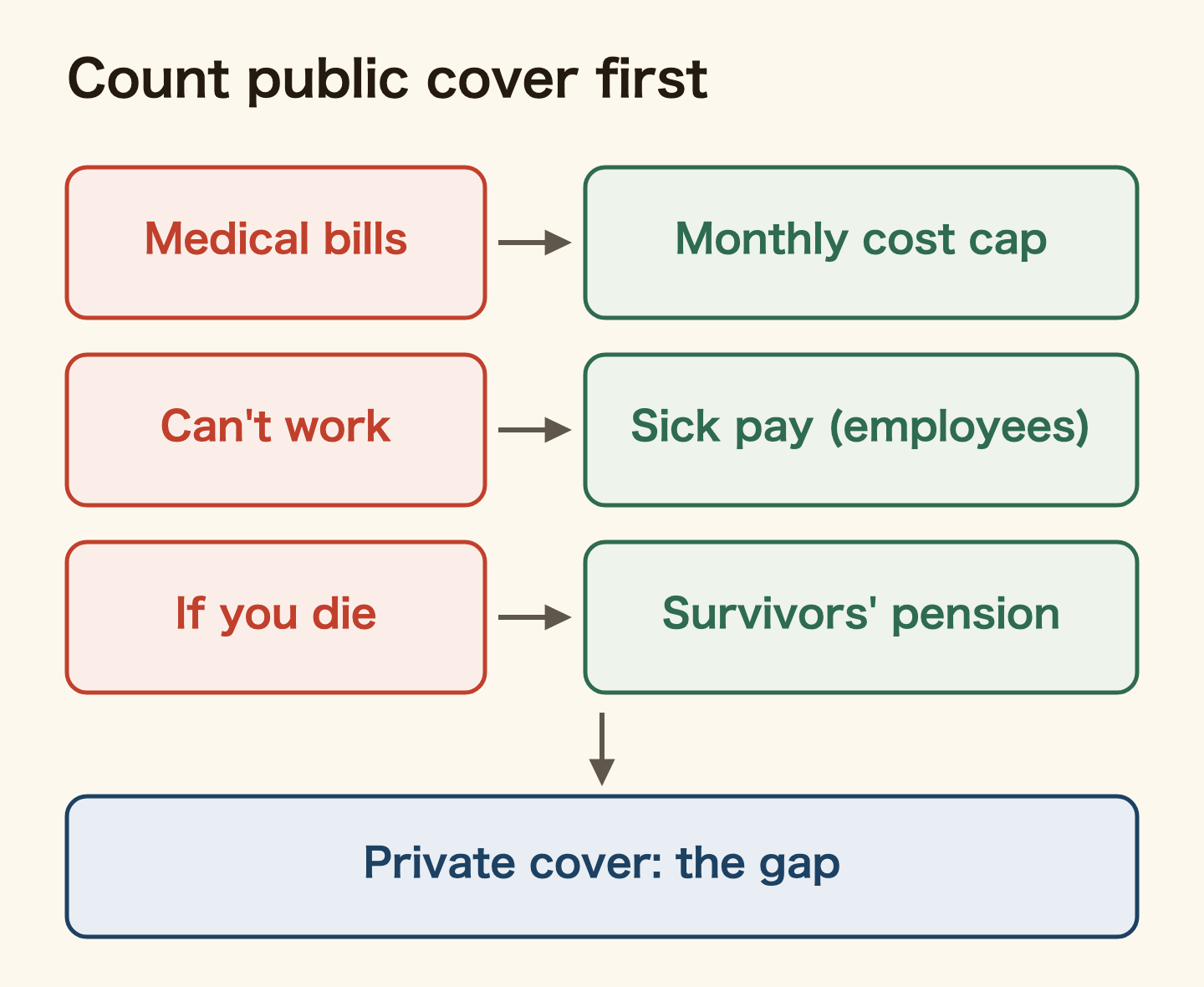
- Before buying, count three public benefits: the monthly cap on medical bills, sick pay while you cannot work, and the survivors’ pension for your family.
- Sick pay (the sickness and injury allowance) comes with employee health insurance. In National Health Insurance — the scheme most students and self-employed people are in — the law only lets each city choose to pay it, and some do not.
- A survivors’ pension goes only to family who relied on your income. The basic survivors’ pension goes only to a spouse with a child, or to the child.
- Foreigners can buy private life insurance. But some insurers require the beneficiary to live in Japan too — check that first if you want family back home to receive the money.
Knowing this, you can decide on a policy from your own family situation, not from a sales pitch — without paying for cover you already have, or missing the gap you really have.
You have just handed in your paperwork at a new job, and a colleague asks, “You haven’t got life insurance yet?” A Japanese friend says it is safer to have some. The brochure is full of words you do not know. What your friend takes for granted is what Japan’s health insurance and pension already pay — they buy insurance only for what is left over. Use the same order, and the answer becomes clear.
- Do foreigners in Japan need life insurance?
- How much does a hospital stay cost? The monthly cap
- Who pays you if you are too sick to work?
- What does your family get if you die? The survivors’ pension
- Can foreigners get life insurance in Japan?
- If you buy, what kind — and how much does life insurance cost in Japan?
- Already insured, or leaving Japan?
- Which one are you?
- Frequently asked questions
- Summary
- Related reading
Do foreigners in Japan need life insurance?
Where you come from, buying life insurance the moment you start work may be normal. In Japan, if you are an employee, your health insurance and employees’ pension already cover part of illness, time off work and death — and you pay for them from every pay slip. Students and the self-employed, on National Health Insurance and the National Pension, also have some cover.
So split the risk into three, and count what the public system pays for each.
Life insurance is mainly about leaving money to your family if you die. If nobody in Japan lives on your income, fewer people would be in trouble if you died. If someone does, count what the survivors’ pension pays first, then think about the shortfall. If your family lives in your home country, both the public pension and private insurance attach extra conditions to how they can receive money.
Across Japan, 80.0% of people have life insurance, and the average annual premium is 171,000 yen (Japan Institute of Life Insurance, 2025 survey, in Japanese). That figure includes cooperative cover sold through the post office, JA and prefectural mutual aid schemes. How many people around you have it is a different question from whether you need it.
How much does a hospital stay cost? The monthly cap
If you are in Japanese health insurance and under 70, you pay 30% of the medical bill at the counter. On top of that, what you pay in one month has a ceiling. This is the high-cost medical expense benefit, and it exists in both employee health insurance and National Health Insurance.
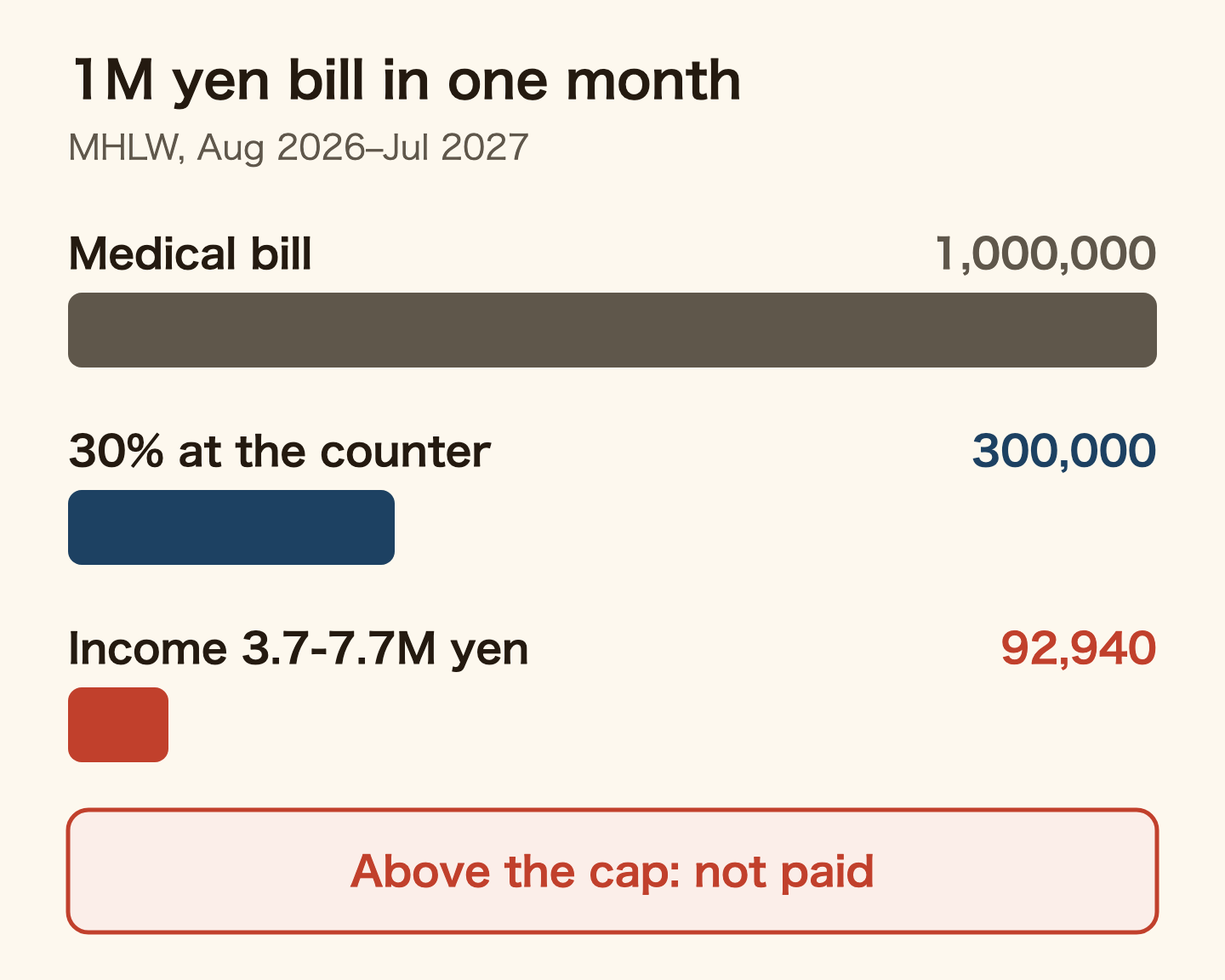
Under the rules from August 2026 to July 2027, for someone under 70 with an annual income of about 3.7 to 7.7 million yen, the cap is 85,800 yen + (medical bill − 286,000 yen) × 1%. In a month with a 1,000,000 yen bill, the 30% share would be 300,000 yen, but the cap is 92,940 yen (Ministry of Health, Labour and Welfare reference document, in Japanese). With income up to about 3.7 million yen the cap is 61,500 yen; if you are exempt from resident tax it is 36,900 yen. From August 2027 the income bands become narrower.
If you hit the cap in three or more of the last 12 months, the cap drops further from the fourth month, and from August 2026 there is also a yearly cap (MHLW, in Japanese). The full table and how to claim are in our guide to the high-cost medical expense benefit.
Hospital meals and private-room charges not covered by insurance sit outside the cap (Tokyo Metropolitan Government, in Japanese). If you are thinking of private medical cover, first ask whether your savings could pay up to the cap plus those extras.
Who pays you if you are too sick to work?
The bigger risk is usually not the bill but losing your pay. If you are in employee health insurance, you have the sickness and injury allowance.
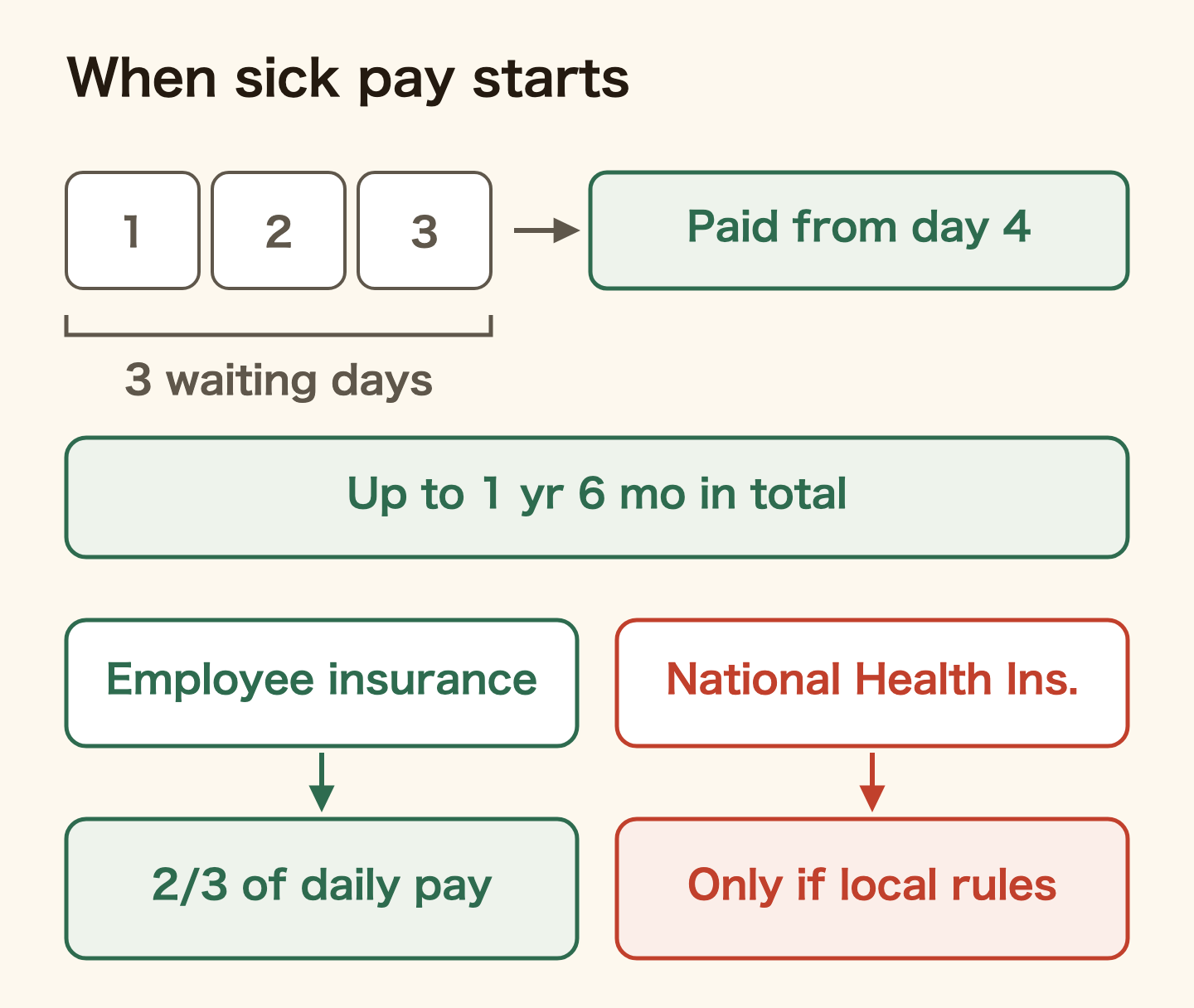
It pays when an illness or injury outside work stops you working and your employer is not paying you. After three days off in a row (the waiting period), it starts on day 4. The daily amount is two-thirds of your average standard monthly remuneration over the previous 12 months, divided by 30. With an average of 170,000 yen, that is 5,670 × 2/3 = 3,780 yen a day. It lasts up to 1 year and 6 months in total from the first day paid (Japan Health Insurance Association, in Japanese).
There are exceptions. Days when you are paid are not covered (if your pay is lower than the allowance, you get the difference). Injuries at work or on the way to work are covered by workers’ accident insurance instead. And an illness that starts while you are on voluntary continued coverage after leaving a job is not covered. For the rules if you leave a job while ill, and the calculation if you have been insured for under a year, see our full guide to the sickness allowance, including how working your last day stops it.
National Health Insurance may not have this benefit at all. The law says a municipality “may” pay a sickness allowance “as provided by ordinance or bylaws” (National Health Insurance Act, art. 58(2), in Japanese) — so each city decides. Tokyo’s list of National Health Insurance benefits, for example, does not include it (Tokyo Metropolitan Government, in Japanese).
For students and the self-employed, lost income while sick is the biggest hole in public cover. Students working short part-time hours are outside employee social insurance (why social insurance does not apply to student part-time work). To find out whether your own National Health Insurance pays it, ask your city office — our health insurance guide explains which scheme you are in.
What does your family get if you die? The survivors’ pension
A pension is not only for old age. If a member dies, the family may receive a survivors’ pension. Only family members whose livelihood the person maintained can receive it.
“Livelihood maintained” means you shared a livelihood with them and their income in the previous year was under 8.5 million yen (or income after deductions under 6.555 million yen). Living apart still counts if, for example, you sent them money or they were your health insurance dependant (Japan Pension Service glossary, in Japanese). The rules for adding family in Japan to your employee health insurance are in our guide to dependent health insurance.
Survivors’ basic pension: a spouse with a child, or the child
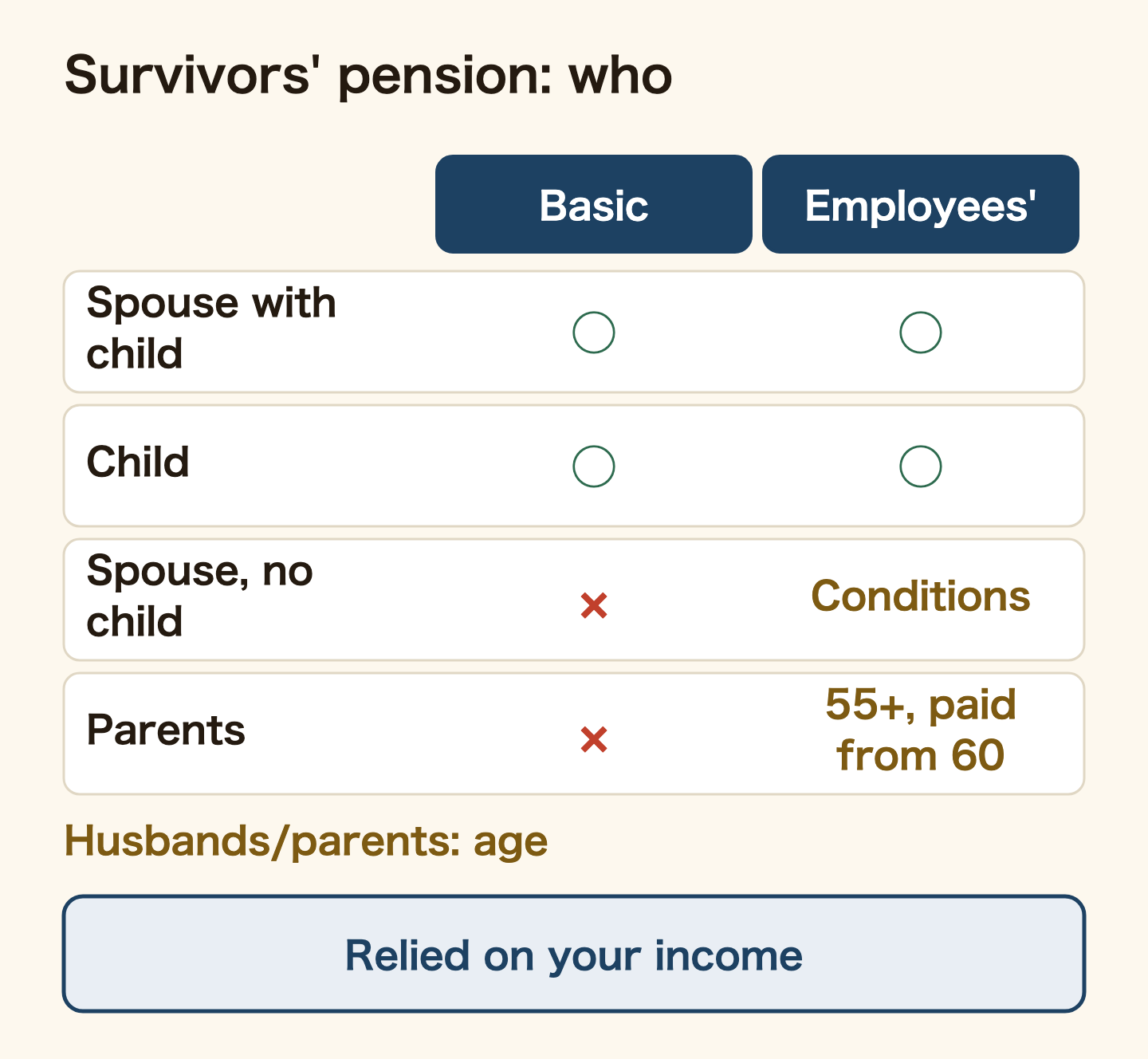
The survivors’ basic pension, from the National Pension, goes only to a spouse with a child, or to the child. A “child” means someone up to 31 March after turning 18, or under 20 with a grade 1 or 2 disability. From April 2026, a spouse with a child receives 847,300 yen a year plus a child addition (for people born on or after 2 April 1956). The addition is 243,800 yen each for the first and second child, so with one child it is 847,300 + 243,800 = 1,091,100 yen (Japan Pension Service, in Japanese). A spouse without children, or parents back home, cannot receive it.
Payment history matters too. If the member dies while insured, paid periods (including exempted ones) must cover at least two-thirds of the membership period up to the day before death. If death occurs by the end of March 2036 and the person was under 65, it is enough to have no unpaid months in the last year. For students, months under the student deferral count like paid months for this test (Japan Pension Service, in Japanese). If you cannot pay, applying for the student deferral also protects your family.
Survivors’ employees’ pension: extra for employees’ families
If the person was in the employees’ pension, a survivors’ employees’ pension is paid as well. It is three-quarters of the earnings-related part of their old-age employees’ pension. If they died while insured, the calculation treats fewer than 300 months (25 years) of membership as 300 months (Japan Pension Service, in Japanese). Even a short time working in Japan counts as 25 years while you are a member.
The order is: spouse with a child, child, spouse without a child, parents, grandchildren, grandparents. Only the highest-ranked person receives it. The exceptions:
- A wife under 30 with no child receives it for five years only.
- A husband with no child must be 55 or older, and payment starts at 60.
- Parents and grandparents must also be 55 or older, with payment from 60.
The rules for spouses without children are due to change under a reform scheduled to take effect in April 2028, moving them in principle to a five-year fixed-term benefit (MHLW, in Japanese).
Family in your home country, and the lump-sum withdrawal
The Japan Pension Service lists the survivors’ basic and employees’ pensions among the benefits people living overseas can claim (Japan Pension Service, in Japanese). Payments can go to an overseas bank account, but the currency is fixed for each country — you cannot choose it (Japan Pension Service, in Japanese).
Whether family back home can receive it depends on whether you maintained their livelihood. The official explanation is that living apart can still count if you send money. We could not find an official list of what proof is used for family abroad, so keep records of the money you send and ask a pension office. Parents back home are not eligible for the basic survivors’ pension, and for the employees’ one they come after any spouse or child, and must be 55 or older.
One more point: if you take the lump-sum withdrawal payment, all your earlier membership periods stop counting (Japan Pension Service FAQ, in Japanese). Survivors’ pensions mostly depend on dying while insured, so once you have left Japan and taken the refund, do not count on a survivors’ pension based on those years. Deadlines and steps are in our lump-sum withdrawal guide, and how the employees’ pension works is in Japan pension for foreigners.
Can foreigners get life insurance in Japan?
Some insurers accept foreign nationals who meet their conditions, and each company sets its own. We checked three insurers that publish their conditions for foreign applicants in their FAQs.
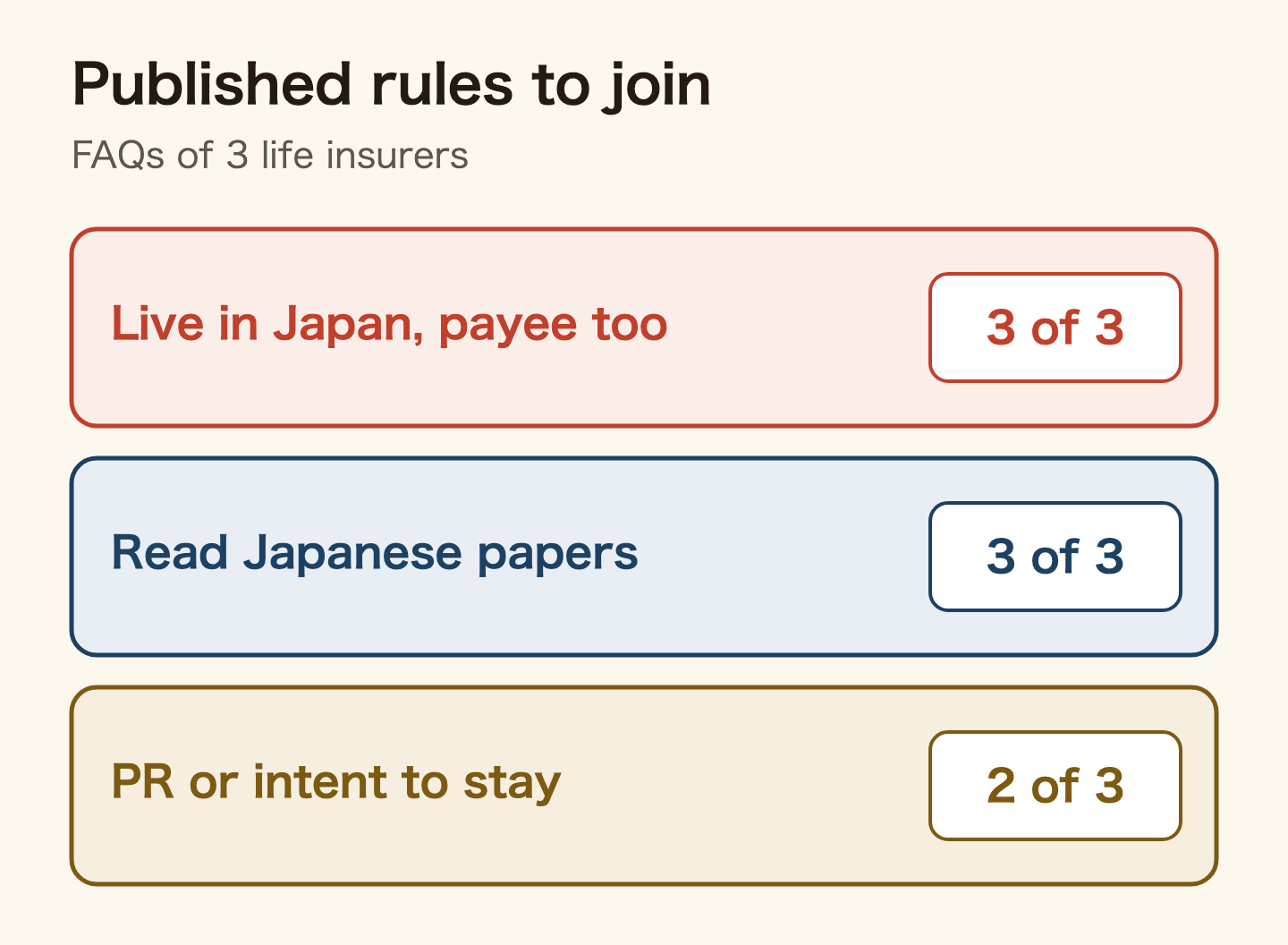
- The policyholder, the insured person and the beneficiary all live in Japan (all three).
- Enough Japanese to understand the application, the policy terms and other documents (all three).
- Permanent residency (one also requires two or more years living in Japan), or an intention to settle, or certainty of living in Japan until the policy ends (two of the three).
Three companies are not the whole market. Still, all three required the beneficiary to live in Japan and the applicant to read Japanese. If your family lives abroad and you want them as beneficiaries, ask the insurer whether a beneficiary overseas is allowed before you apply. And do not sign a contract you cannot read.
If you buy, what kind — and how much does life insurance cost in Japan?
Death cover comes in two broad shapes: term insurance, which covers a fixed period, and savings-type policies (whole life and endowment), which pay something back at maturity or on cancellation.
Term insurance gives a large payout for a small premium, but nothing is left when the term ends. Whole life pays a surrender value if you cancel; endowment pays the same amount as the death benefit at maturity. Neither is guaranteed to give back more than you put in (Japan Institute of Life Insurance, in Japanese).
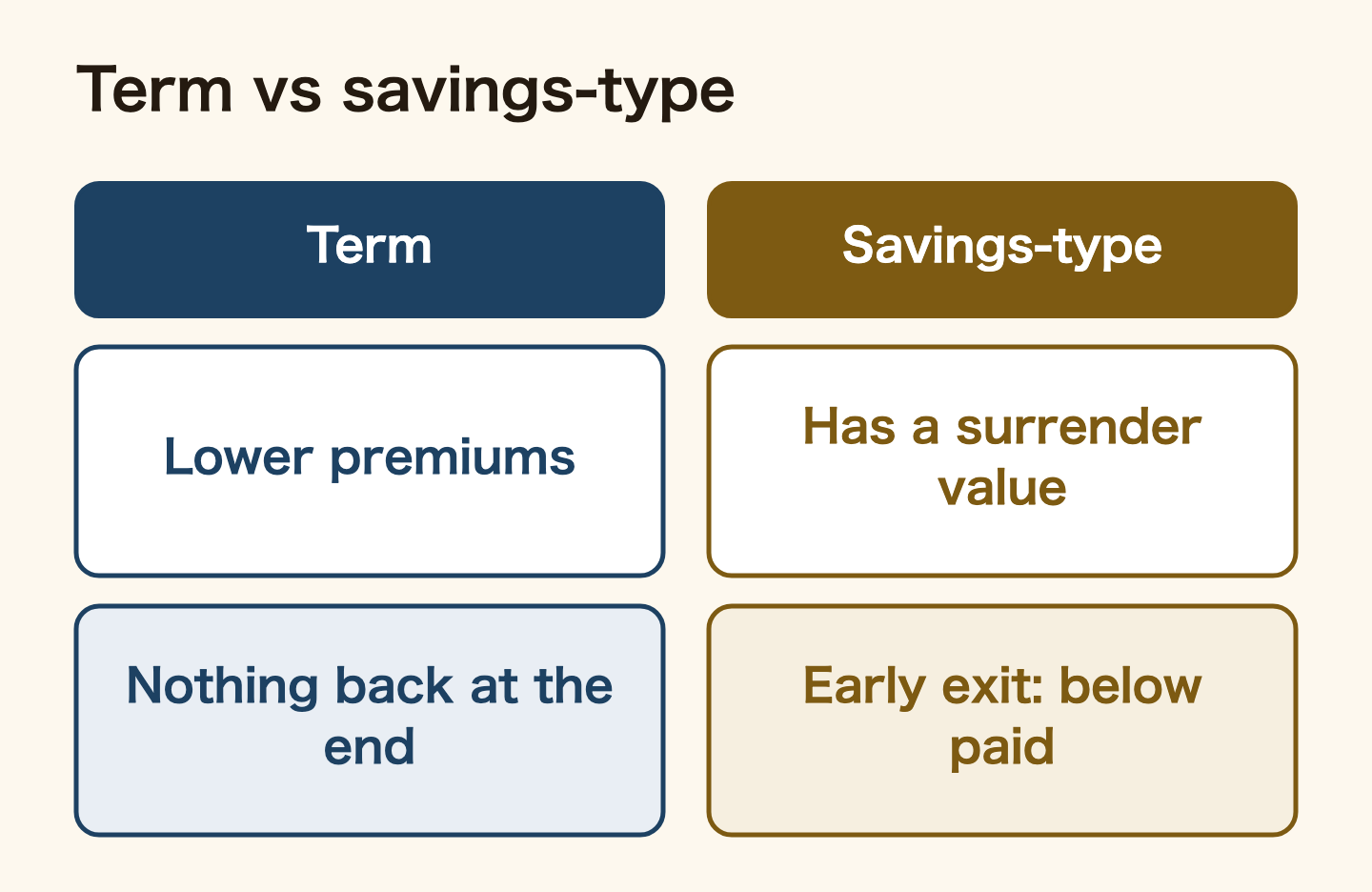
For foreigners, what matters is cancelling early. The surrender value is normally less than the total premiums paid, and if you cancel soon after starting, there may be none at all, or very little (Japan Institute of Life Insurance, in Japanese). If you do not know when you will leave Japan, a contract that assumes decades of payments can turn into a loss when you cancel on the way out. If the goal is growing money, compare it with NISA and investing, including what happens when you leave.
As for how much people pay: the national survey puts the average annual premium at 171,000 yen (including individual annuity insurance), and the most common band for both men and women is under 120,000 yen a year (Japan Institute of Life Insurance, 2025 survey, in Japanese). The survey covers people aged 18 to 79 in Japan (survey release, in Japanese); it is not a guide for a foreign household. The order for setting an amount is: count what the survivors’ pension and your savings cover, and insure only the gap.
Already insured, or leaving Japan?
Premiums lower your tax
Life insurance premiums paid in Japan qualify for the life insurance premium deduction. For contracts from January 2012, paying more than 80,000 yen a year gives a flat 40,000 yen deduction, and the total with medical-care and annuity insurance is capped at 120,000 yen. From the 2026 tax year, if you have a dependant under 23, the life insurance part goes up to 60,000 yen (National Tax Agency No.1140, in Japanese). Employees claim it in the year-end tax adjustment; others in a tax return.
Some people keep paying a policy bought in their home country. A contract signed abroad with a foreign insurer does not qualify, and all beneficiaries must be you, your spouse or other relatives (National Tax Agency No.1141, in Japanese).
When you leave: keep it or cancel it
Moving abroad does not always end a policy — you may be able to keep it by paying the premiums. You tell the insurer you are moving and arrange payment through a proxy in Japan or a Japanese account. But life insurers generally do not send payouts abroad (Japan Institute of Life Insurance, in Japanese). That guidance is written for people transferred overseas by their employer; if you are leaving Japan for good, ask your insurer directly.
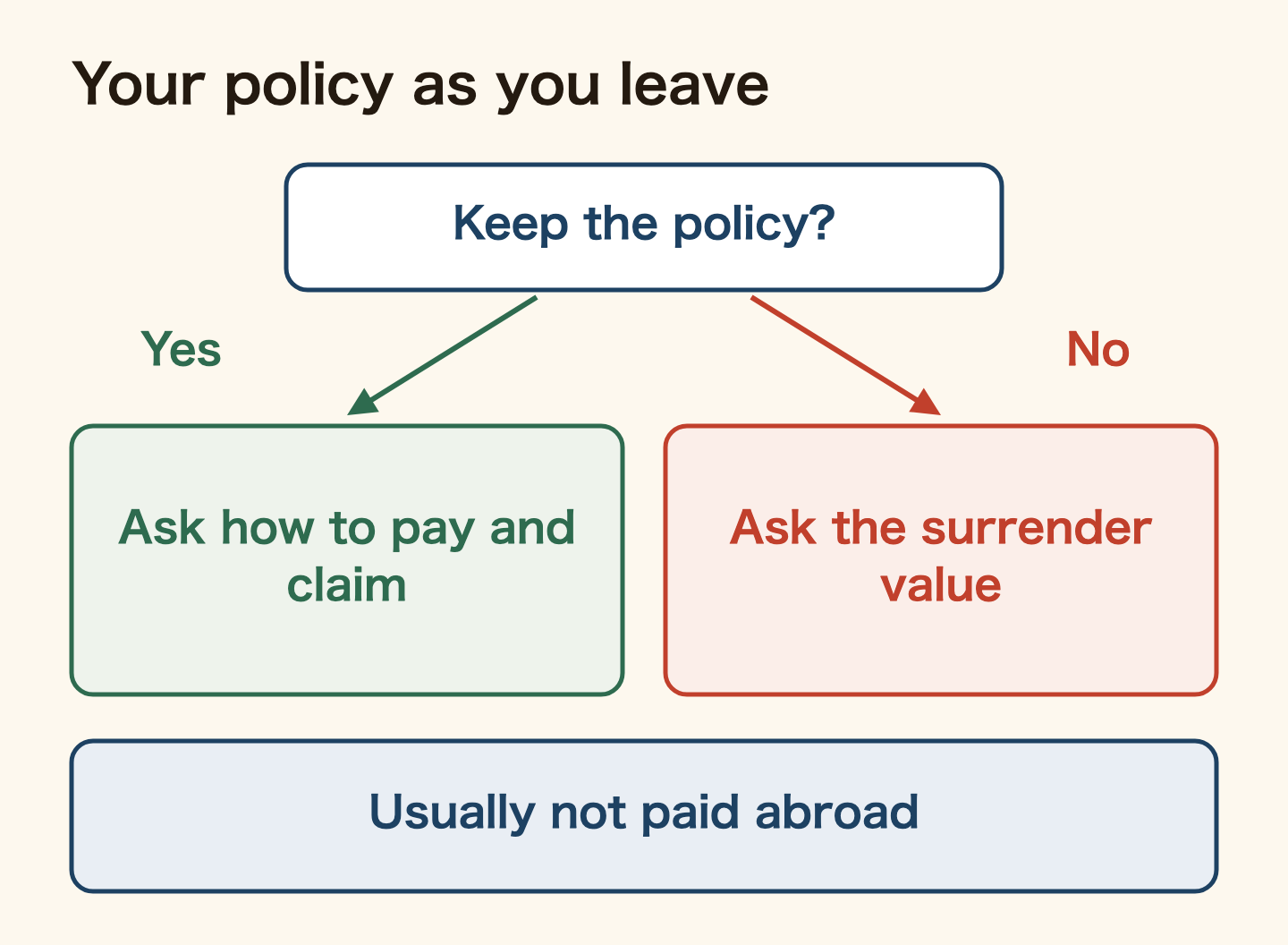
If you cancel, ask for the surrender value first. Cancellation needs a written form, and a cancelled policy cannot be restored. The order of everything else is in our leaving-Japan checklist, health insurance and pension steps when you quit are in leaving a job in Japan, and if you send a refund home, compare how much each transfer method delivers.
Which one are you?
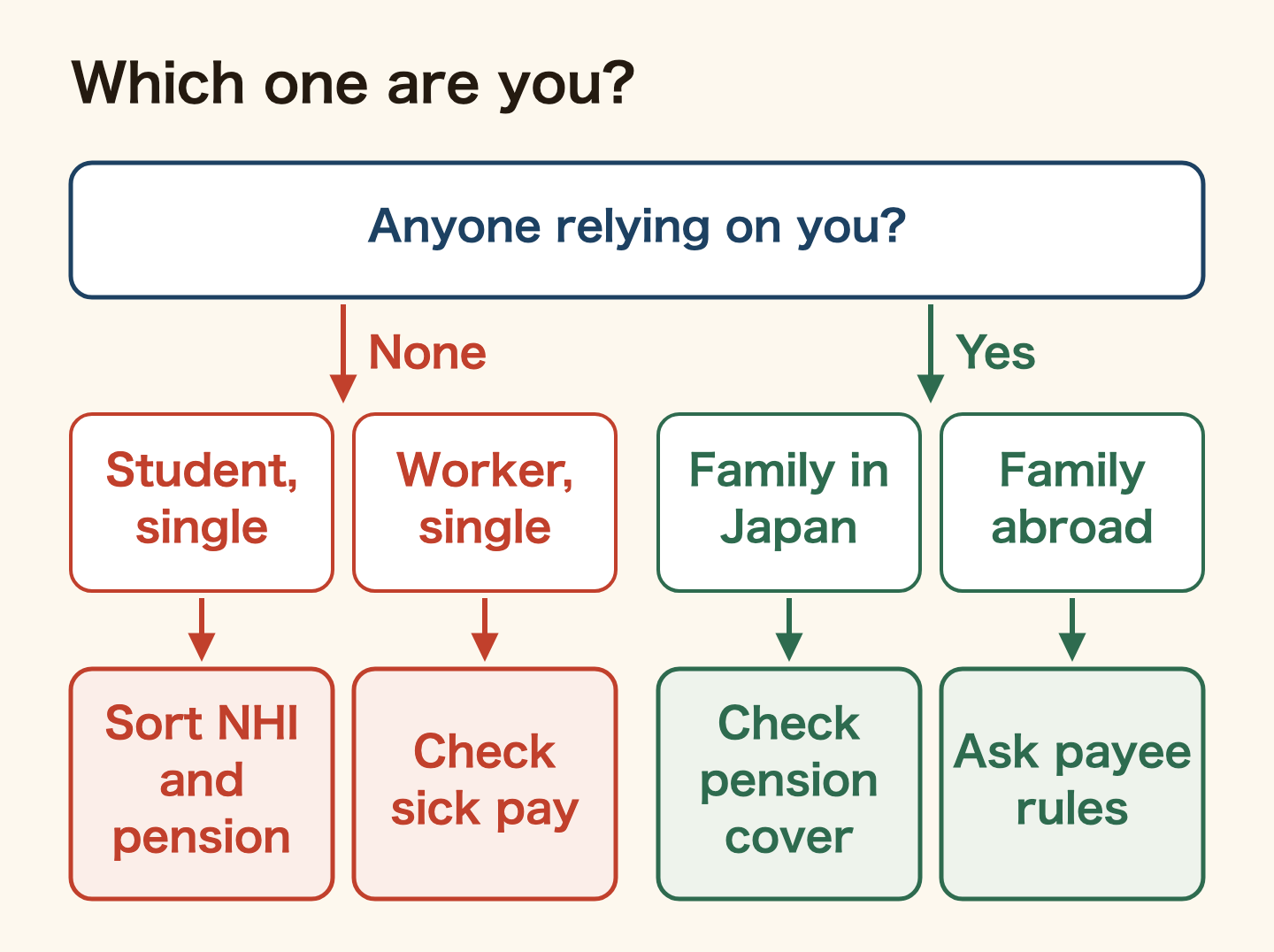
- A student with nobody living on your income — few people would be left in trouble, and medical bills are capped. Today: check that you are in National Health Insurance and that you have applied for the student pension deferral.
- Working and single — your biggest risk is lost pay while sick. Today: look at your health insurance card; if it says National Health Insurance, ask your city office whether it pays a sickness allowance.
- Living with family in Japan — count the survivors’ pension, then think only about the gap. Today: from your children’s ages and your pension membership, write down whether the basic, the employees’ or both would be paid.
- Family in your home country — both the public pension and private insurance attach conditions. Today: check that you keep records of the money you send, and ask your insurer (or the one you are considering) whether a beneficiary abroad is allowed.
Frequently asked questions
Q. Can foreigners get life insurance in Japan?
Yes, but conditions differ by company. In the three insurers’ published conditions we checked, all three required everyone including the beneficiary to live in Japan, and enough Japanese to understand the contract. Some also required permanent residency or an intention to settle.
Q. Can my beneficiary be family living in my home country?
It depends on the insurer. All three published conditions we checked required the beneficiary to live in Japan, and the Japan Institute of Life Insurance says life insurers generally do not send payouts abroad. Ask before you apply.
Q. Does National Health Insurance pay me if I am too sick to work?
It may not. Employee health insurance pays two-thirds of daily pay from day 4, for up to 1 year and 6 months in total. In National Health Insurance, the law lets each municipality pay it by ordinance. Ask your city office.
Q. Can a foreigner’s family get a survivors’ pension in Japan?
Yes, if the conditions are met; the Japan Pension Service’s eligibility rules do not mention nationality. The basic survivors’ pension goes to a spouse with a child or to the child; the employees’ one goes to a spouse, child, parents and others in order. Family abroad must also be shown to have relied on your income.
Q. How much is life insurance in Japan?
The Japan Institute of Life Insurance’s 2025 survey found an average annual premium of 171,000 yen (including individual annuities), with 80.0% of people insured. It covers people aged 18 to 79 in Japan, so work out your own amount from what the survivors’ pension and your savings would not cover.
Q. What should I do with my policy when I leave Japan?
Decide whether to keep or cancel it. To keep it, ask how to pay premiums and how to claim. To cancel, ask for the surrender value first. Cancelling a savings-type policy early may return nothing, or very little.
Summary
Whether a foreigner in Japan needs life insurance depends mostly on whether anyone here lives on your income. Count three public benefits first. Medical bills have a monthly cap. Lost pay is covered by the sickness allowance in employee health insurance, but National Health Insurance may not pay it. After death, family who relied on your income can receive a survivors’ pension.
Private insurance is only for what those three leave uncovered. Foreigners can buy it, but some insurers require the beneficiary to live in Japan and the applicant to read Japanese, and savings-type policies return less than you paid if you cancel early. Decide when you might leave Japan and where your family lives, then ask the insurer about its conditions.
Official sources: MHLW, high-cost medical expense benefit / MHLW reference document / Japan Health Insurance Association, sickness and injury allowance / e-Gov, National Health Insurance Act / Tokyo NHI benefits / Tokyo NHI high-cost medical expenses / Japan Pension Service, survivors’ basic pension / survivors’ employees’ pension / livelihood maintenance / claims from overseas / lump-sum withdrawal FAQ / student deferral / MHLW, survivors’ pension reform / National Tax Agency No.1140 / No.1141 / Japan Institute of Life Insurance 2025 survey (enrolment) / (premiums) / term, endowment and whole life / cancellation / moving abroad (all checked 7 October 2026, in Japanese). Insurers’ conditions are from their own FAQs (1, 2, 3) as of 7 October 2026. This article explains how the system works; it does not recommend any policy.
Related reading
Found this useful? Share it
Send it to a friend who lives in Japan.
WHO WROTE THIS

mori
Japanese. I read the ministries’ own notices, orders and Q&As in the original, and I start from what my Nepalese and Sri Lankan friends in Japan actually ran into. I do not write about what I have not checked or been told.
What this site can and cannot do →Looking for something else?
You may use the figures in this article, including commercially, if you credit this site with a link. How to use our figures