This article was checked on 14 October 2026 against the National Tax Agency, e-Gov law search and Customs pages. The deduction and rates can change if the law changes.
Your mother sends 500,000 yen to your Japanese account for tuition. The next spring a friend says, “I heard gift tax applies even to money from your parents.” Back home, a parent giving money to a child may never come with a tax conversation.
Here is what Japan does, and whether you have to file.
The short answer
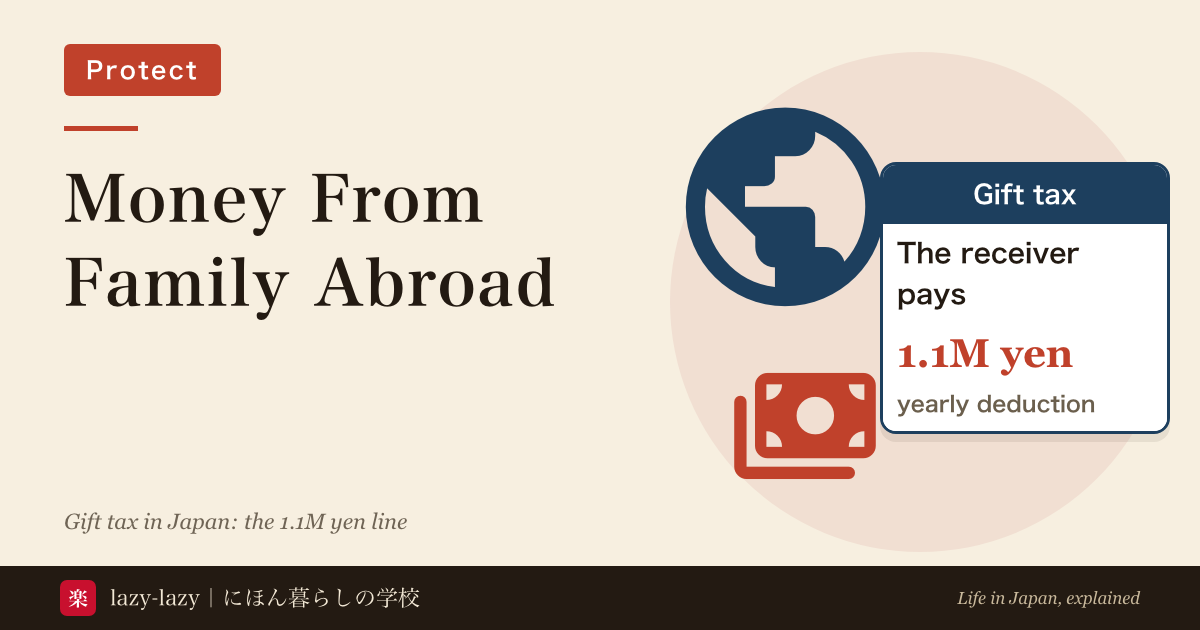
- The person who receives the money pays gift tax. The total you receive from 1 January to 31 December, minus 1,100,000 yen, is taxed.
- If the total is 1,100,000 yen or less, there is no tax and no filing.
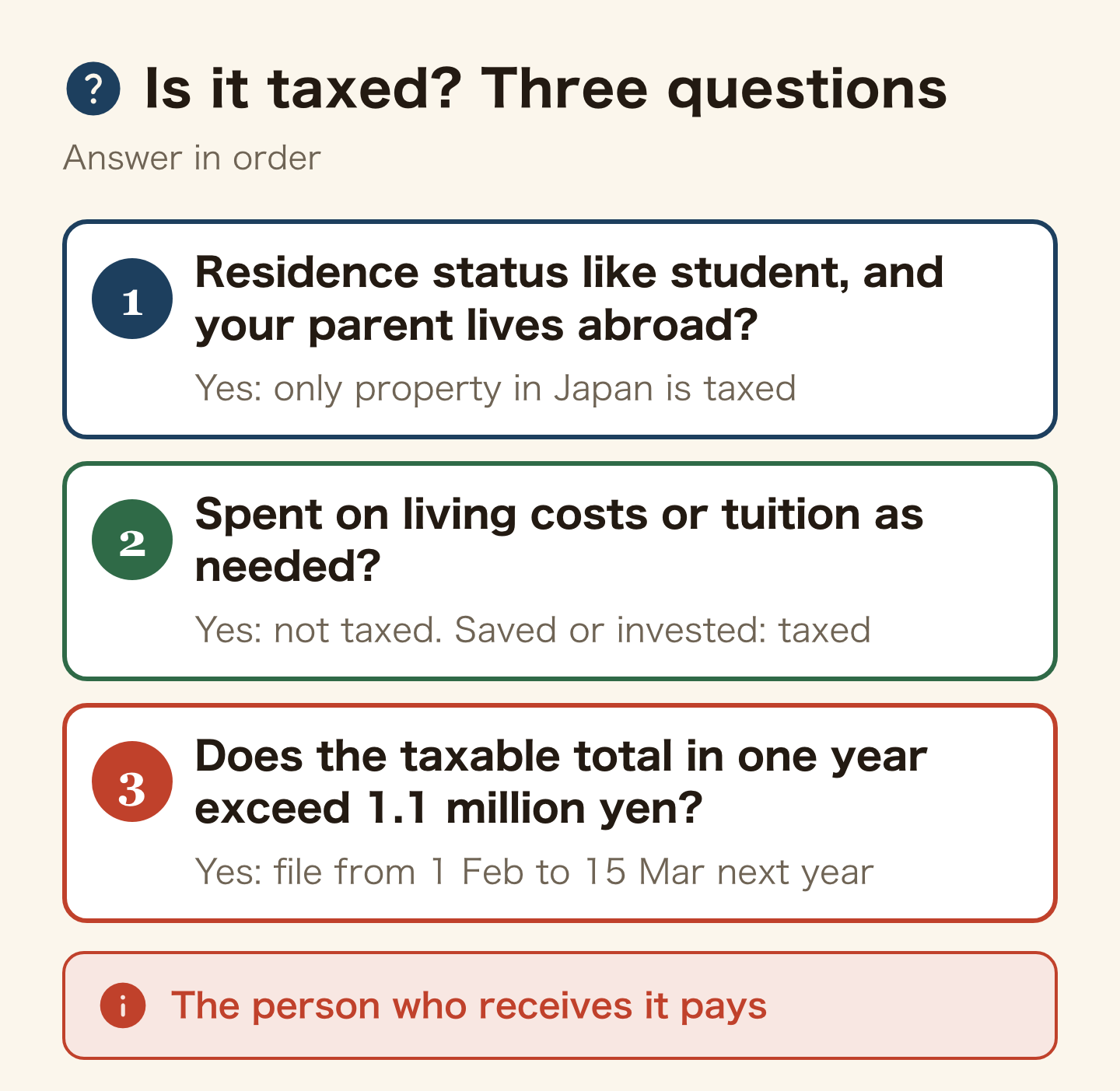
- If you live in Japan on a status like student visa and your parent lives abroad, only property located in Japan is taxed. Property abroad is not. Permanent residents do not get this protection.
- Money used as needed for living costs or tuition is not taxed. The part you save or invest is taxed.
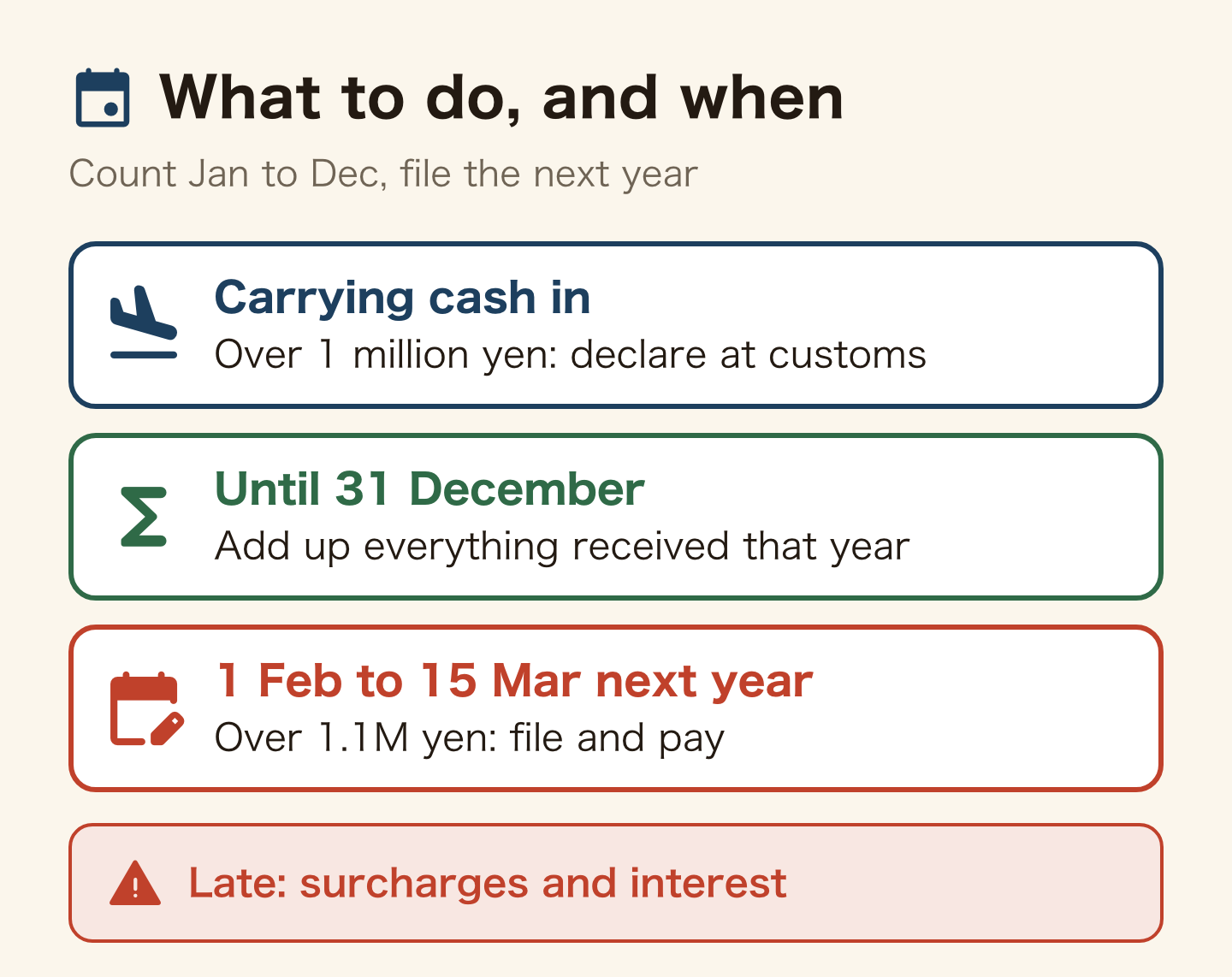
- File and pay from 1 February to 15 March of the next year. If you carry cash in, declare anything over 1,000,000 yen to customs.
Once you see this, you know how much you can receive from family each year without worry. The order is: check whether you are a temporary resident, check the living-cost exception, then compare your total with 1,100,000 yen.
Who pays gift tax, and from how much?
Gift tax applies when you receive money or property from an individual. The receiver pays, not the giver. You add up the year, subtract 1,100,000 yen (the basic deduction), and the rate applies to what is left.
| Total received in one year | Tax and filing |
|---|---|
| 1,100,000 yen or less | No tax. No filing. |
| Over 1,100,000 yen | The excess is taxed. File and pay from 1 February to 15 March of the next year. |
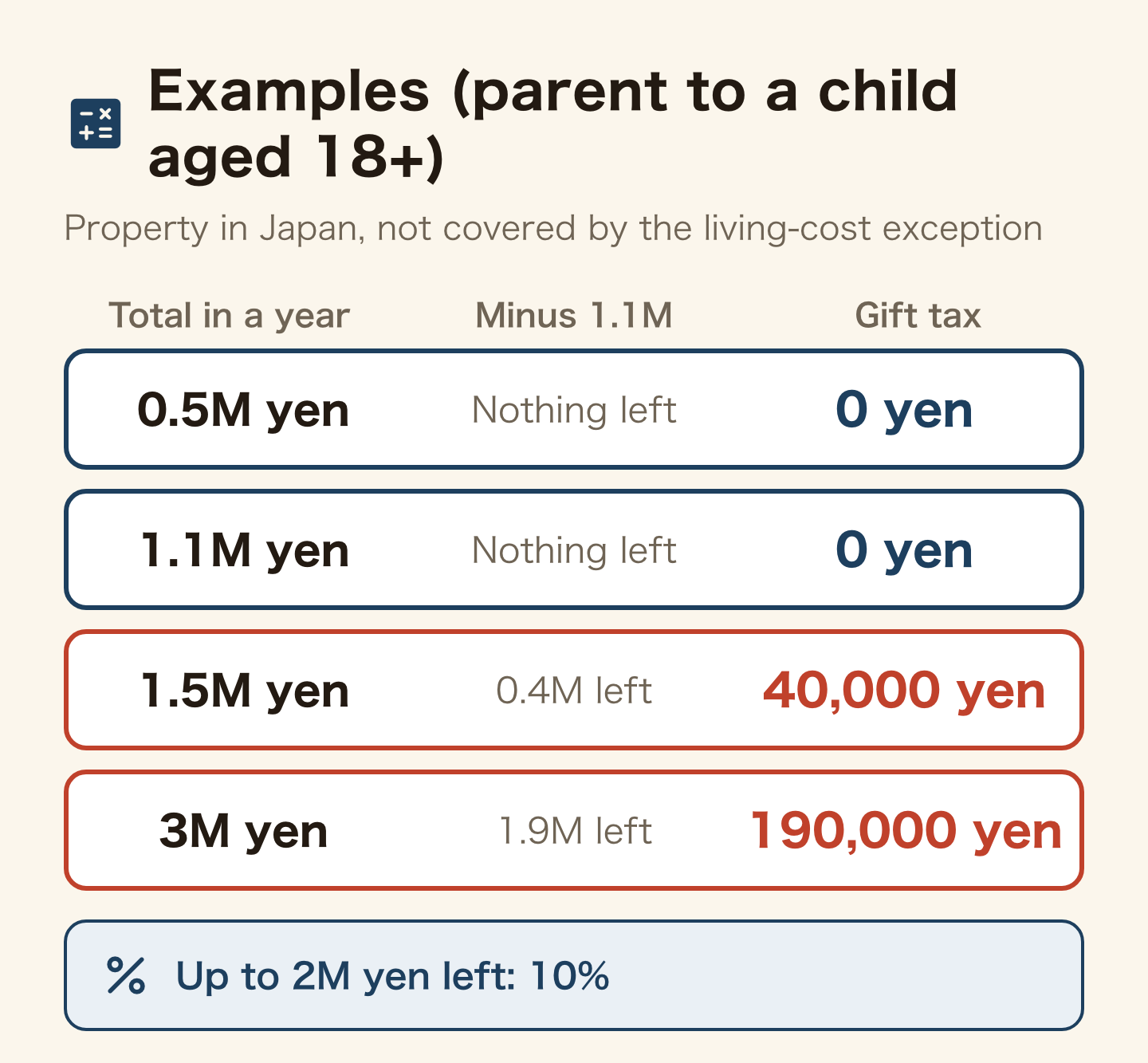
| From a parent or grandparent to someone aged 18 or older (special rate) | After subtracting 1,100,000 yen: 10% up to 2,000,000 yen, 15% up to 4,000,000 yen. |
| From anyone else (a sibling, your spouse’s parent) | General rate: 10% up to 2,000,000 yen left, 15% up to 3,000,000 yen (minus 100,000 yen). |
An example. A parent gives a child aged 18 or older 1,500,000 yen in one year. 1,500,000 − 1,100,000 = 400,000 yen is left, and 10% of that is 40,000 yen. For 3,000,000 yen, 1,900,000 is left and the tax is 190,000 yen. For 500,000 yen, the deduction covers it all and the tax is 0 yen.
In your country, a parent giving money to a child may not be taxed, or the giver may be the one who pays. Japan taxes the receiver. If your mother and father each send money in the same year, the amounts are added together (source: National Tax Agency No.4408, Japanese).
Is money from a parent abroad taxed in Japan at all?
It depends on your residence status and where your parent lives. If your status is listed in Table 1 of the Immigration Act (student, Engineer/Specialist in Humanities/International Services, Dependent and others) and you have lived in Japan for 10 years or less in total in the past 15 years, you are a “temporary resident”. A temporary resident who receives a gift from a donor with no address in Japan is taxed only on property located in Japan (Inheritance Tax Act, Article 1-4).
| You | Taxed on, if your parent lives abroad |
|---|---|
| Temporary resident (a Table 1 status such as student or work visa; 10 years or less in Japan in the past 15) | Property located in Japan only |
| Permanent resident, spouse of a Japanese national, or any status not in Table 1 | Property in Japan and abroad |
| Table 1 status, but more than 10 years in Japan in the past 15 | Property in Japan and abroad |
Two points are easy to get wrong. First, if your parent has had an address in Japan in the past 10 years, the rule is different. Check the table on National Tax Agency No.4432 (Japanese) first. Second, I do not state whether money that arrives in a Japanese bank account counts as property in Japan. The law has rules on where property is located, but I could not confirm this case from an official source. For a large amount, call your tax office before you receive it.
Is living and tuition money from my family taxed?
Often it is not. Money you receive from a family member who has a duty to support you (a spouse, parent, sibling and so on) to pay for living costs or education is not subject to gift tax, as long as it is a normal, necessary amount (National Tax Agency No.4405, Japanese). Living costs include medical and child-raising costs. Education costs include tuition, teaching materials and stationery.
There is a condition. Only money used as needed, directly for living costs or education, is exempt. If money sent as “living costs” is put in savings or used to buy stocks or property, that part is taxed. Money spent on rent and tuition is fine. Money that piles up unused in your account should be treated as taxable.
Gifts for a funeral, New Year, celebrations or illness are also exempt when they are reasonable by common social standards. An amount beyond that is not.
What happens if I do not file?
The deadline is 1 February to 15 March of the year after you received the money. You can file by e-Tax, by post, or by dropping the form in the tax office’s after-hours box. If you do not file by the deadline, or you report less than you received, a surcharge is added to the tax. If you pay late, interest is charged on the late amount (National Tax Agency No.4429, Japanese).
You can pay by Direct Payment, internet banking, credit card (under 10,000,000 yen), a smartphone payment app or at a convenience store (the last two only for tax of 300,000 yen or less), or in cash. If the tax is over 100,000 yen and you cannot pay by the deadline, you may be allowed to pay in instalments over several years if you apply by the filing deadline.
If you leave Japan before you file, you need a tax representative in Japan and must submit a notification form. This is the rule for people with no address in Japan who file (National Tax Agency No.4432). The steps are in our tax representative guide.
Do I declare cash that I carry into Japan?
Customs has its own rule, separate from gift tax. If cash, cheques, traveller’s cheques and similar items total over 1,000,000 yen (or the equivalent in foreign currency), you must declare them to customs (Japan Customs, Passenger Clearance). The rule depends on how much you carry, not on where the money came from. A bank transfer is not carrying, so this declaration does not apply to it.
Which one are you?
- A student who receives living money every month. This fits the living-cost exception. Spend it as it arrives and do not let it pile up in the account.
- A student whose parent sent a large amount at once. If it is 1,100,000 yen or less in the year, you do not file. If it is more, ask the tax office whether you are a temporary resident and whether the property counts as located in Japan.
- A permanent resident, or someone who has lived in Japan for more than 10 years. Property abroad is covered too. Over 1,100,000 yen in a year, file by 15 March of the next year.
- A parent who has lived in Japan before. Check your parent’s position first in the table at National Tax Agency No.4432.
FAQ
Q. Is money from my parents abroad taxed in Japan?
If you live in Japan on a status like student or work visa and have lived in Japan for 10 years or less in the past 15 (a temporary resident), and your parent lives abroad, only property located in Japan is taxed. A permanent resident is taxed on property anywhere.
Q. How much can I receive before gift tax applies?
The total you receive from 1 January to 31 December, minus 1,100,000 yen, is what is taxed. If the total is 1,100,000 yen or less, there is no tax and no filing.
Q. Are living and tuition money from my parents taxed?
Money from a family member who must support you, used as needed for living costs or tuition, is not taxed. The part you save, invest or use to buy property is taxed.
Q. When do I file gift tax?
From 1 February to 15 March of the year after you received the money. You both file and pay in that window.
Q. Do I declare cash I bring into Japan?
Yes, if the cash and similar items total over 1,000,000 yen. That is a customs declaration, separate from gift tax.
Q. What happens if I do not file?
You pay a surcharge on top of the tax. If you pay late, interest is added on the late amount.
Summary
The person who receives the money pays gift tax. The total for the year, minus 1,100,000 yen, is taxed. If you live in Japan on a status like student visa and your parent lives abroad, only property in Japan is taxed. Money used as needed for living costs or tuition is not taxed. If you are unsure about an amount, ask your tax office before you receive it.
Sources (official): National Tax Agency No.4402, When gift tax applies / No.4405, Gifts that are not taxed / No.4408, Calculation and rates / No.4429, Filing and payment / No.4432, Foreign property and residents / Inheritance Tax Act Article 1-4 (e-Gov) / Japan Customs, Passenger Clearance (currency). The tax pages are in Japanese.
Read next
Found this useful? Share it
Send it to a friend who lives in Japan.
WHO WROTE THIS

mori
Japanese. I read the ministries’ own notices, orders and Q&As in the original, and I start from what my Nepalese and Sri Lankan friends in Japan actually ran into. I do not write about what I have not checked or been told.
What this site can and cannot do →Looking for something else?
You may use the figures in this article, including commercially, if you credit this site with a link. How to use our figures