Checked on 30 September 2026 against Article 64 of the Broadcasting Act on e-Gov, NHK’s Receiving Contract Rules and Exemption Standards, and NHK’s official fee website and FAQ.
The short answer
- Yes, foreigners in Japan pay the NHK fee on the same rules as everyone else. If you have a TV or other device that can receive NHK, or you start using NHK ONE online, the Broadcasting Act requires a receiving contract. Owning a smartphone alone does not.
- The fee is 1,100 yen a month (terrestrial contract). If your TV can receive BS satellite, it is 1,950 yen. You pay every two months, and paying ahead is cheaper.
- Students living on their own can be fully exempt. You need to meet one of eight reasons, such as last year’s income of 1.87 million yen or less, or a pension student deferral. It only starts once you apply.
- If someone from NHK comes to your door, ask to see their ID. With no TV-type device and no NHK ONE, you have no duty to sign.
- When you leave Japan, you must cancel it yourself. NHK takes cancellations on 0120-222000 from the month before you move.
Knowing this, you can decide for yourself whether you need a contract or can apply for an exemption, instead of signing whatever is put in front of you at the door or ignoring it and hoping. You will also stop paying for months after you have left.
Two weeks after moving in, the doorbell rings in the early evening. A man says he is from NHK and asks if you have a TV. There is one: an old set the last tenant left behind, and you hardly ever watch NHK. You ask your Japanese friends later. Some pay, some do not, and nobody can tell you why. What you actually need to know is simple: is it compulsory, how much is it, and do students pay too?
- Do foreigners have to pay the NHK fee in Japan?
- How much is the NHK fee?
- When does the fee start, and what is the deadline to sign up?
- Is there an NHK student exemption for international students?
- How do I apply for the NHK student exemption?
- Someone from NHK is at my door. What do I do?
- What happens if I don’t pay the NHK fee?
- What if I can’t afford it?
- How do I cancel NHK when leaving Japan?
- Which one are you?
- FAQ
- Summary
- Related reading
Do foreigners have to pay the NHK fee in Japan?
You have a TV, but you never watch NHK. Where you come from, you may not pay a broadcaster you never watch. In Japan, the question is not what you watch. It is whether you have set up equipment that can receive NHK.
Article 64 of the Broadcasting Act says anyone who installs equipment able to receive NHK’s broadcasts, or starts receiving NHK’s online service, must conclude a receiving contract with NHK (Broadcasting Act on e-Gov, in Japanese). There is no nationality condition. NHK’s own English page on the receiving fee says a contract is required “regardless of nationality”. The only exception NHK names is diplomats and consular officers.
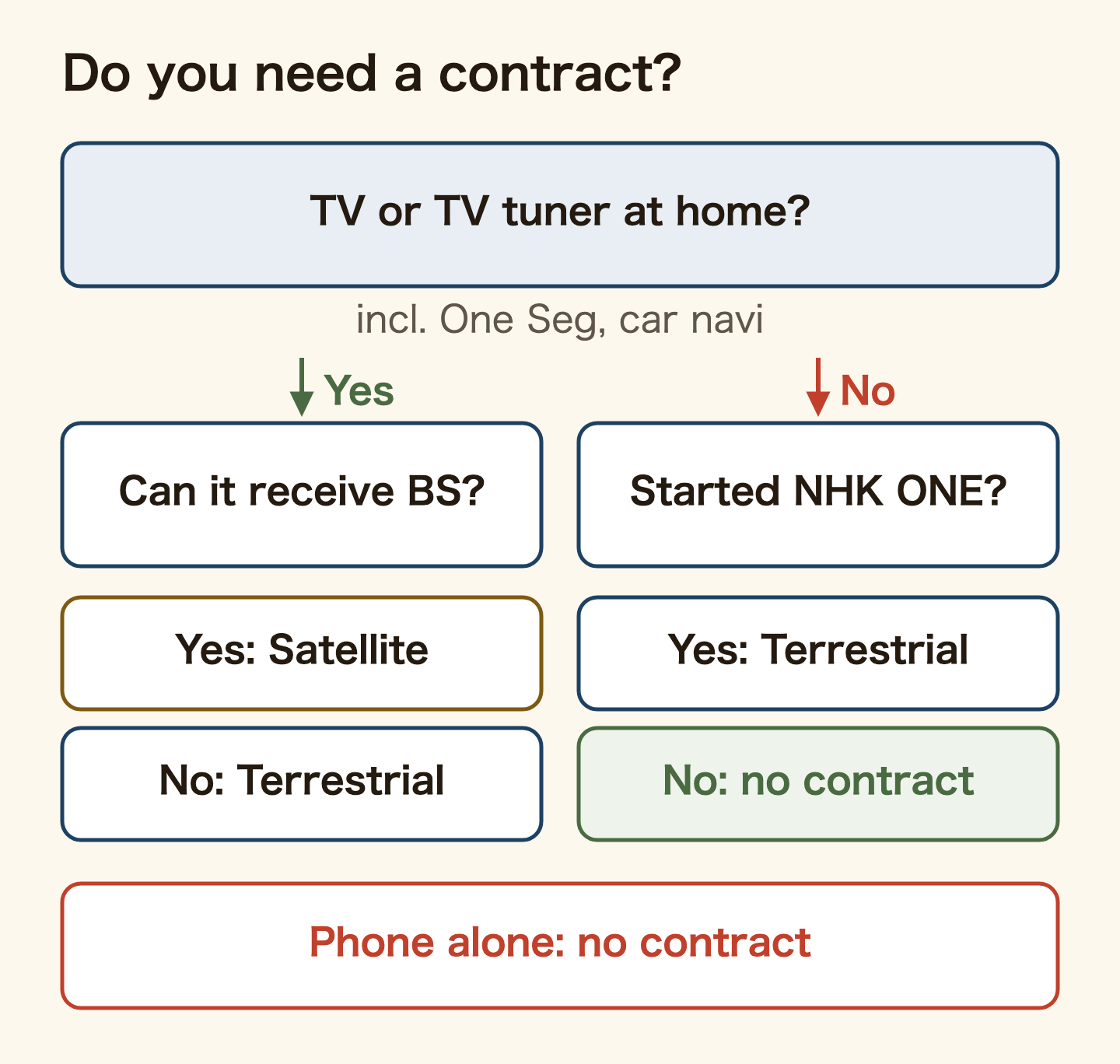
A “device that can receive NHK” is more than a TV set:
- a phone with a One Seg TV function
- a PC or car navigation system with a TV tuner
- a cable TV connection that carries NHK
A radio alone does not count. The Act excludes equipment that can only receive radio.
Do I have to pay just for owning a smartphone?
No. Since the amended Broadcasting Act took effect in October 2025, people who start using NHK’s online service are also covered. But NHK states that owning a smartphone or PC alone does not make you subject to a contract (in Japanese).
You are covered once you go through the step on the NHK ONE website or app that confirms a contract is needed, and then start using it. If your household already has a contract, no extra contract or fee is needed. NHK WORLD-JAPAN, the English service, needs no contract.
Is it one contract per person or per room?
One per household. Any number of TVs in one home is still one contract. If you rent a place and live alone, you are a household of one. NHK says students living away from their parents keep their own home and need their own contract (in Japanese).
Dormitories differ. If the dorm pays the fee for everyone, you do not need your own contract. If the dorm has each resident sign up, you do. Ask the dorm office when you move in.
How much is the NHK fee?
The amounts are set in Article 5 of NHK’s Receiving Contract Rules (in Japanese). All include consumption tax, and Okinawa has different amounts.
| Contract | Per month | 6 months ahead | 12 months ahead |
|---|---|---|---|
| Terrestrial | 1,100 yen | 6,309 yen | 12,276 yen |
| Satellite (BS) | 1,950 yen | 11,186 yen | 21,765 yen |
If your TV can receive BS, you need the satellite contract even if you never watch BS. A shared satellite antenna on an apartment building can be enough for BS to come through.
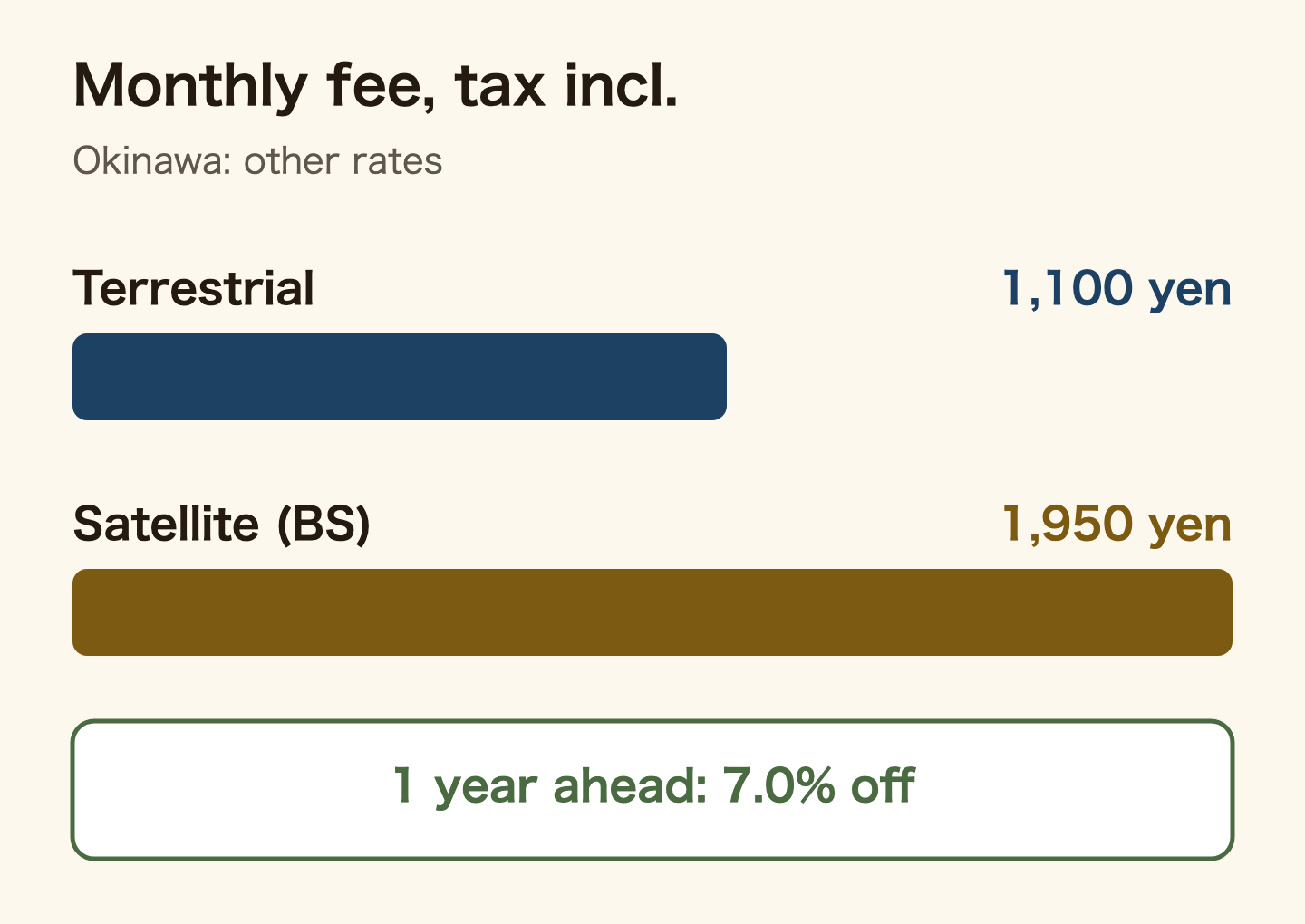
You pay every two months. The year is split into six periods (April–May, June–July and so on), and each period is paid in one go: 2,200 yen for a terrestrial contract. According to NHK’s fee page (in Japanese), paying six months ahead saves 4.4% and twelve months ahead saves 7.0%.
There are three ways to pay:
- direct debit from a Japanese bank account
- a credit card on continuous payment
- payment slips posted to you, paid at a bank, post office or convenience store
When does the fee start, and what is the deadline to sign up?
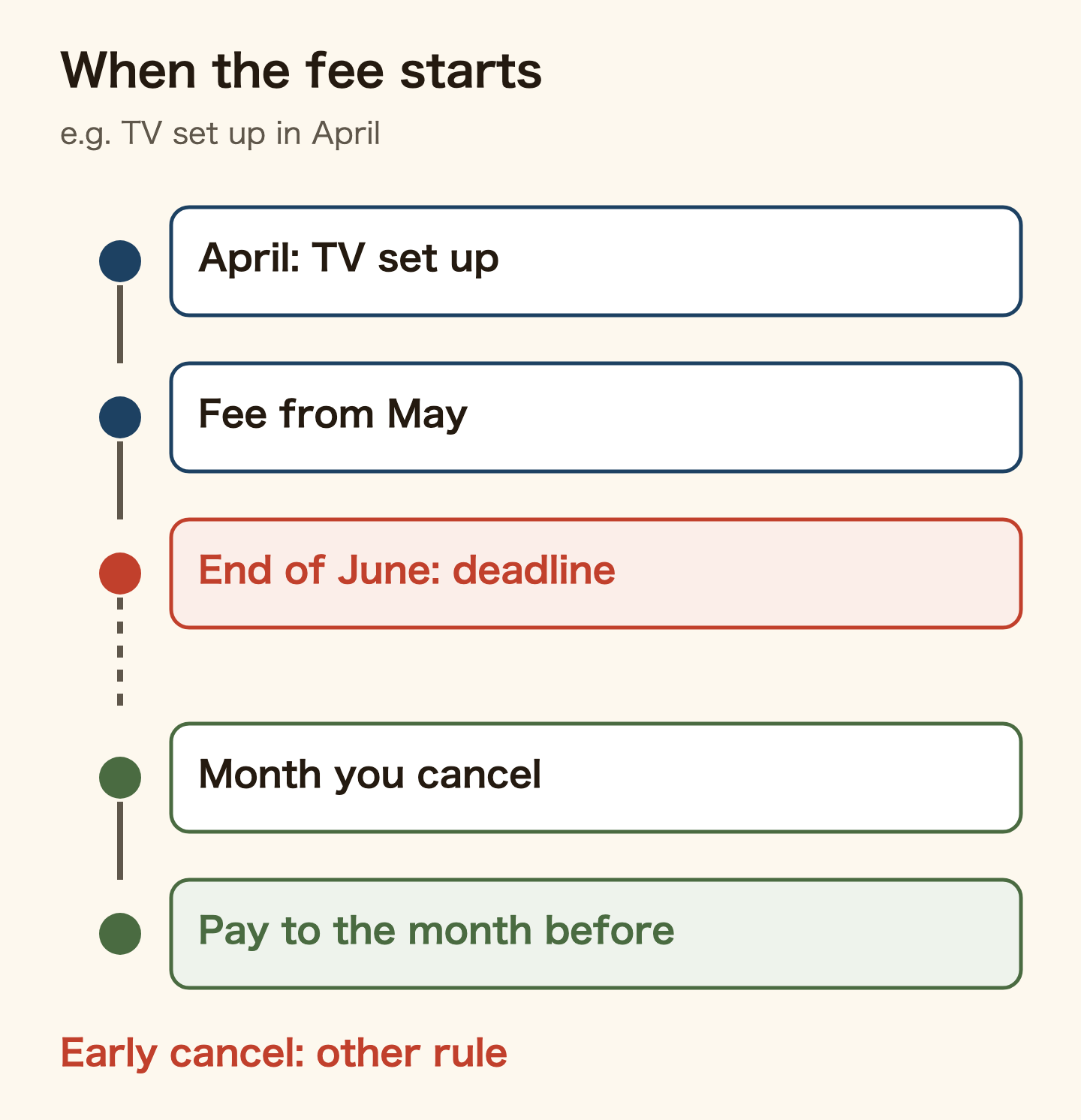
The fee starts from the month after you set up the device (or start NHK ONE). The deadline to submit the contract is the end of the second month after that. Set up a TV in April, and you pay from May, with 30 June as the deadline (Rules, Articles 3 and 5).
It ends with the month before the month you report the cancellation. The contract is cancelled on the day you report it, once NHK can confirm the facts. The one exception: if you cancel in the month you set up the device or the month after, you also pay for the cancellation month.
You can sign up on NHK’s fee website or by phone on 0120-151515 (9am–6pm, weekends and holidays included), per NHK’s list of fee phone numbers (in Japanese). NHK’s English page offers a paper form by post; the online forms themselves are in Japanese only.
Is there an NHK student exemption for international students?
Students living on their own can have the fee waived in full. International students qualify on the same terms if they meet the conditions. Under NHK’s Exemption Standards (in Japanese), you must meet all three of these:
- You are enrolled at an eligible school: a university, junior college, college of technology, high school and similar schools; a specialized training college (senmon gakko); or a miscellaneous school (kakushu gakko) with a course of one year or longer. Auditors and credited auditors are excluded
- You live apart from the family who support you, or no one shares your finances at all
- You meet any one of the eight reasons below
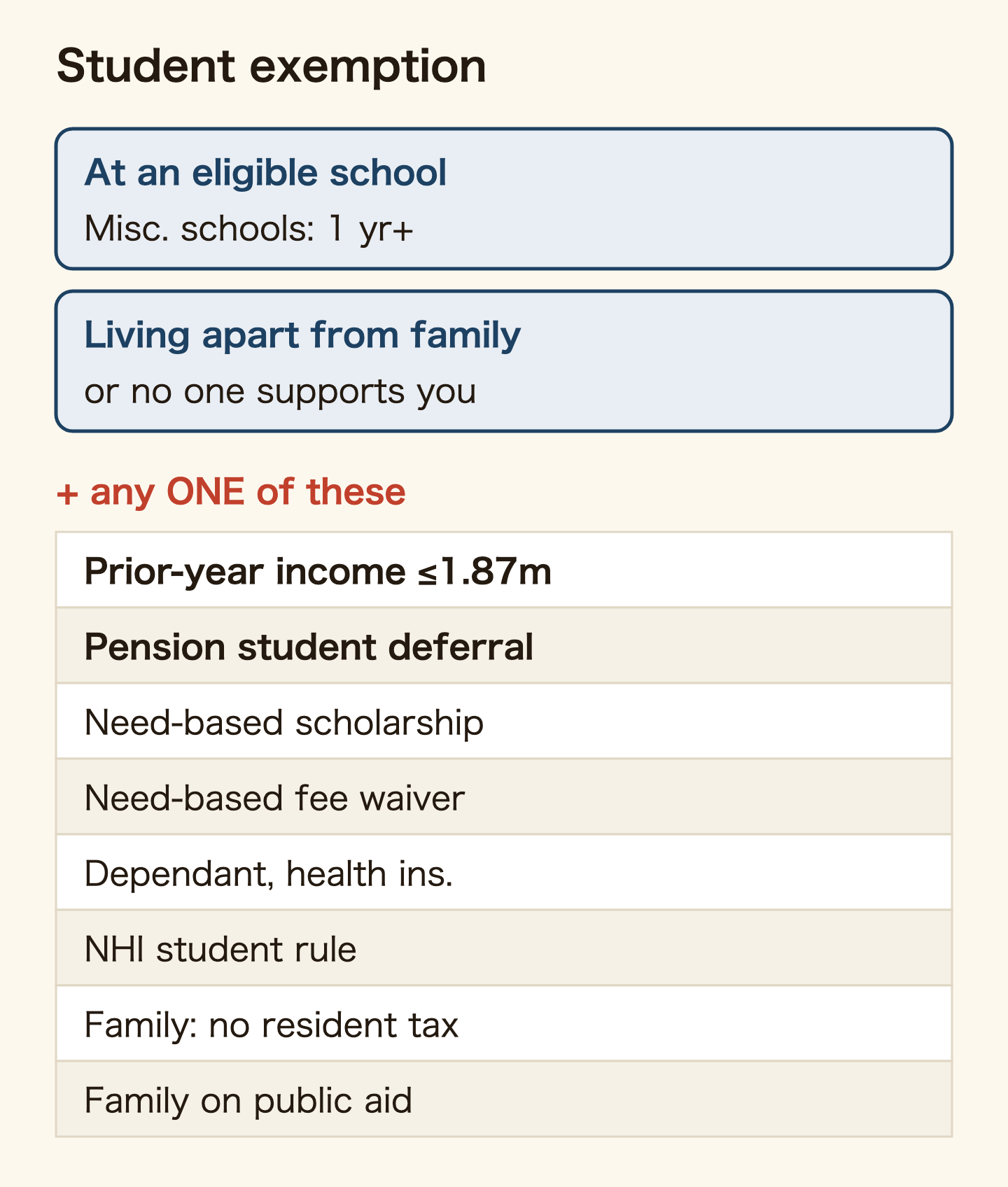
NHK’s exemption page (in Japanese) lists the eight reasons:
- your income last year was 1.87 million yen or less
- you have the National Pension student payment deferral
- you receive a scholarship selected on financial need
- you receive a tuition waiver selected on financial need
- you are a dependant on someone’s employee health insurance
- you are under the National Health Insurance student special rule
- your family household is fully exempt from municipal resident tax
- your family household receives public assistance such as welfare
For the first four, NHK states plainly that students with no family sharing their finances also qualify. If your parents are not in Japan, start with those four.
The income line changed in January 2026. NHK’s announcement of 16 December 2025 (in Japanese) raised it from 1.3 million to 1.87 million yen, following the higher income-tax thresholds. Your previous year’s income is shown on the tax certificate from your city office.
If you are 20 or over and approved for the pension student deferral, the approval notice works as proof for NHK too. If you have already done the pension paperwork, it pays off twice.
Japanese language schools depend on the school. The standards cover specialized training colleges and miscellaneous schools (one-year courses or longer) under the School Education Act. Ask your school office whether it is one of these.
If you do not qualify, there is a family discount. When someone who shares your finances holds an NHK contract at another home in Japan, your second contract is half price. It applies only if both are paid by direct debit, card or recurring payment slip.
How do I apply for the NHK student exemption?
You apply to NHK, not to the city office, in two steps. First sign a new receiving contract. Then apply through NHK’s student exemption application site (in Japanese).
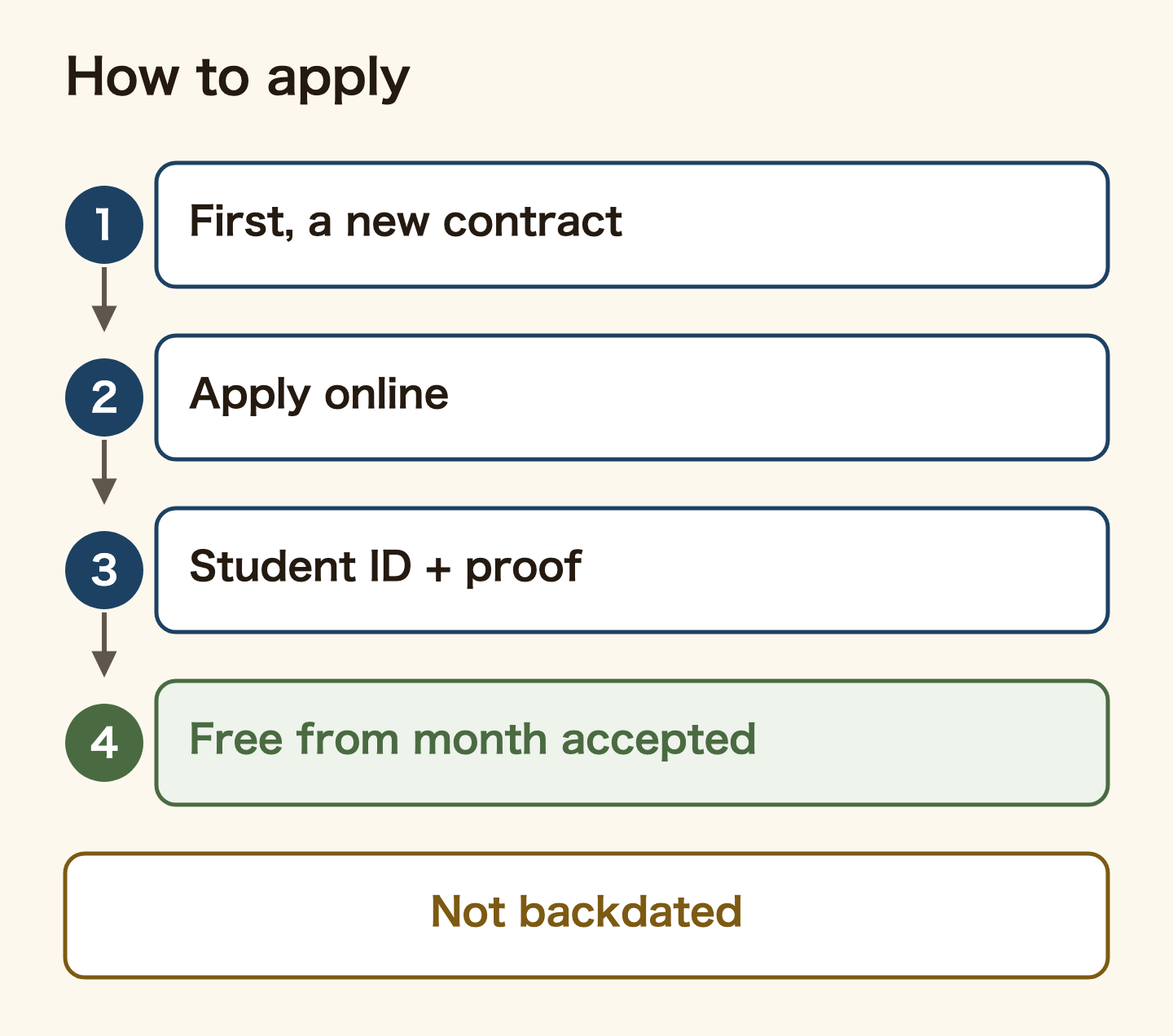
According to NHK’s FAQ (in Japanese), you need your student ID (required) plus proof matching your reason:
| Reason | Proof |
|---|---|
| Income of 1.87 million yen or less | Municipal tax (non-)taxation certificate |
| Pension student deferral | Approval notice for the deferral |
| Scholarship | Scholarship student card |
| Dependant on health insurance | Eligibility certificate showing you as a dependant |
Before enrolment, when you have no student ID yet, an admission letter showing your school works instead. The tax certificate comes from the city office where you are registered. If you had no income last year, the city may need you to go through a step before it can issue one. How residence tax works explains what the certificate is based on.
The application asks for the name and address of the family who support you. If no one does, you leave it blank.
The exemption starts from the month NHK accepts your application. It is not backdated. Anything you already paid for months from the start of the exemption is refunded. NHK checks that you still qualify in the final year of your course.
Someone from NHK is at my door. What do I do?
NHK says it makes visits about the fee every day and that its visitors carry an ID certificate (in Japanese). Besides NHK staff, NHK uses contractor companies for visits in parts of some prefectures (NHK notices of June and September 2026). Ask to see the certificate first.
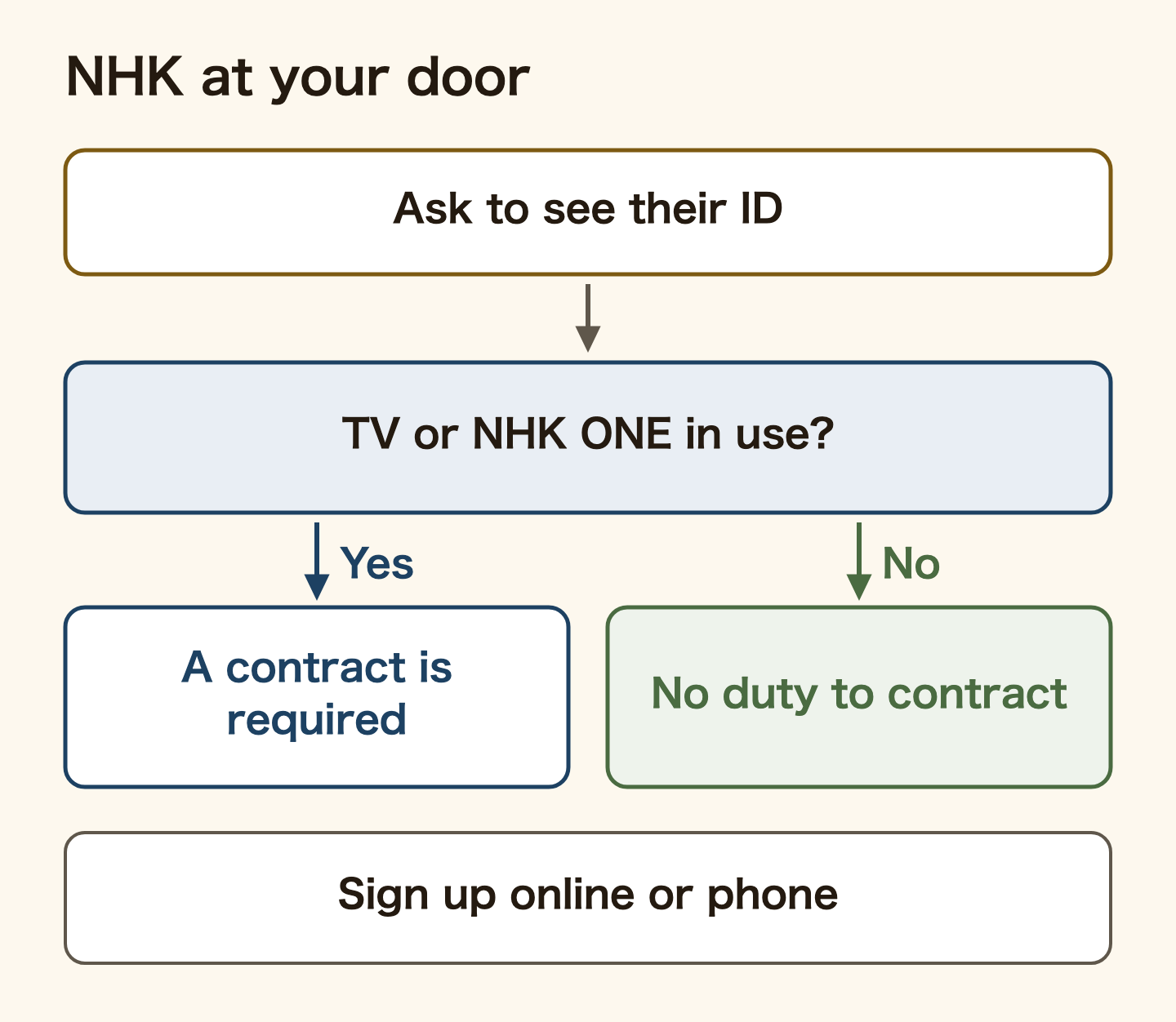
After that, your own situation decides it:
- You have a TV-type device or have started NHK ONE: you need a contract. If you are a student who may qualify, apply for the exemption after signing
- You have neither: under the Broadcasting Act you have no duty to sign. Just say so
You do not have to sign on the doorstep. You can do it yourself online or on 0120-151515. Reading the rules at home first is safer than signing papers you do not fully understand.
Sometimes it comes by post instead. NHK sends contract forms in unaddressed envelopes to addresses with no contract on record. NHK asks for the form back from people who have a TV-type device or NHK ONE and have not signed yet (NHK FAQ).
What happens if I don’t pay the NHK fee?
The Receiving Contract Rules set out three consequences.
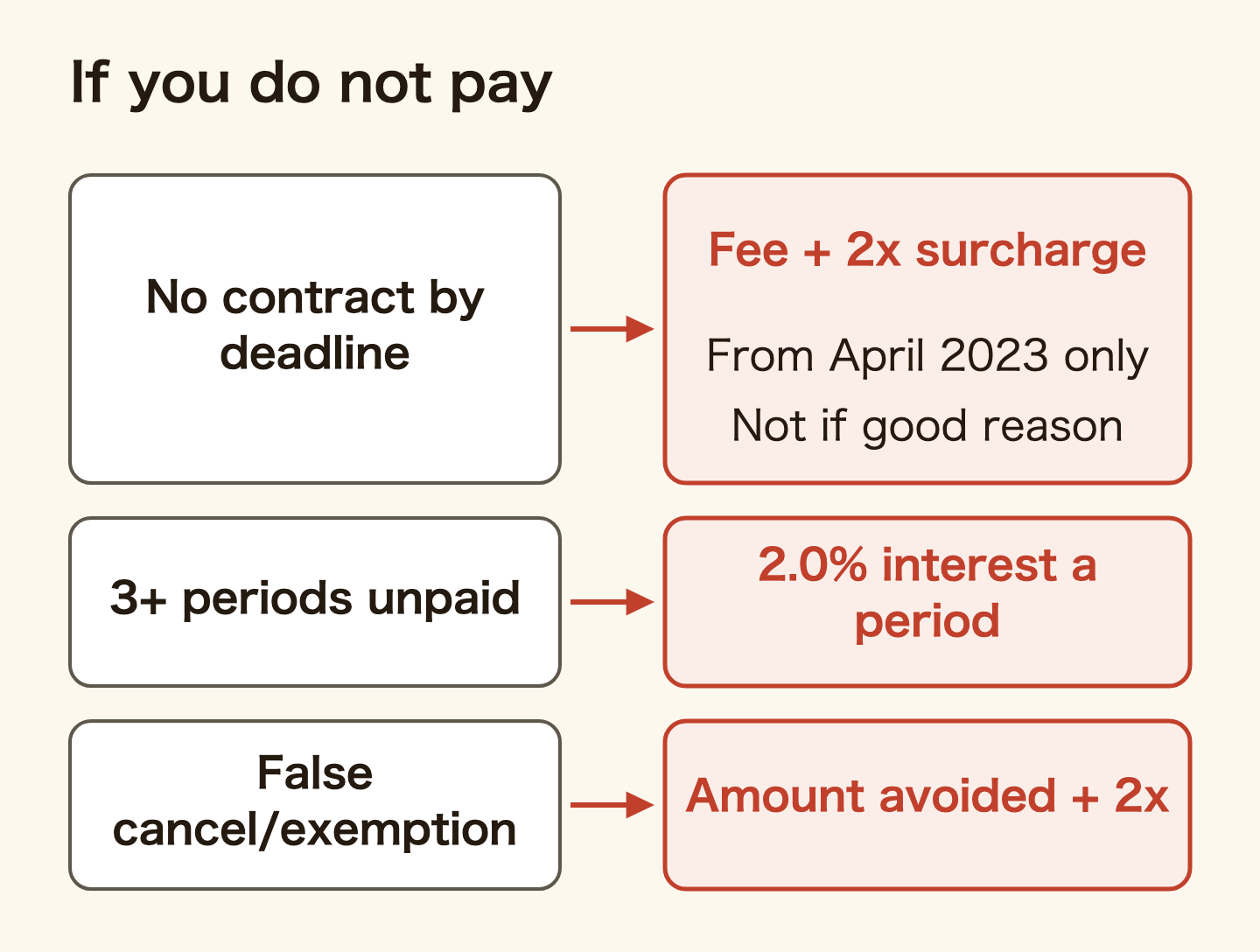
- You did not sign by the deadline without good reason: NHK can charge the fee from the month after setup to the month before you signed, plus a surcharge of twice that amount. The surcharge only covers months from April 2023
- You fall three periods (six months) or more behind: NHK can add late interest of 2.0% per period
- You avoided paying with a false cancellation or exemption claim: NHK can charge the amount avoided plus twice that as a surcharge
As examples of good reason, NHK gives a disaster, or a sudden illness or accident that made meeting the deadline extremely difficult (NHK FAQ, in Japanese).
As a last resort, when visits and letters do not lead to a contract or payment, NHK uses court payment demands and civil lawsuits.
What if I can’t afford it?
NHK says that under Article 64(4) of the Broadcasting Act it cannot exempt anyone outside the approved standards on personal grounds (NHK FAQ, in Japanese). So first check whether you fit a standard: the eight student reasons if you are a student, or a full exemption if your household receives welfare. Which visas can receive welfare is covered in welfare for foreigners in Japan.
If you do not qualify, do not just leave the bills. Late interest starts after three periods. For questions about a bill or payments, call 0570-077-077 (9am–6pm, weekends and holidays included).
How do I cancel NHK when leaving Japan?
On the day you go home, you move out, and the contract ends with the lease. Where you come from, that may be how it works. In Japan, the NHK contract carries on until you report the cancellation yourself.
NHK lists “moving abroad” among the main reasons to cancel (in Japanese). If you live alone and move abroad, you must cancel, and you can start from the month before you move (in Japanese).
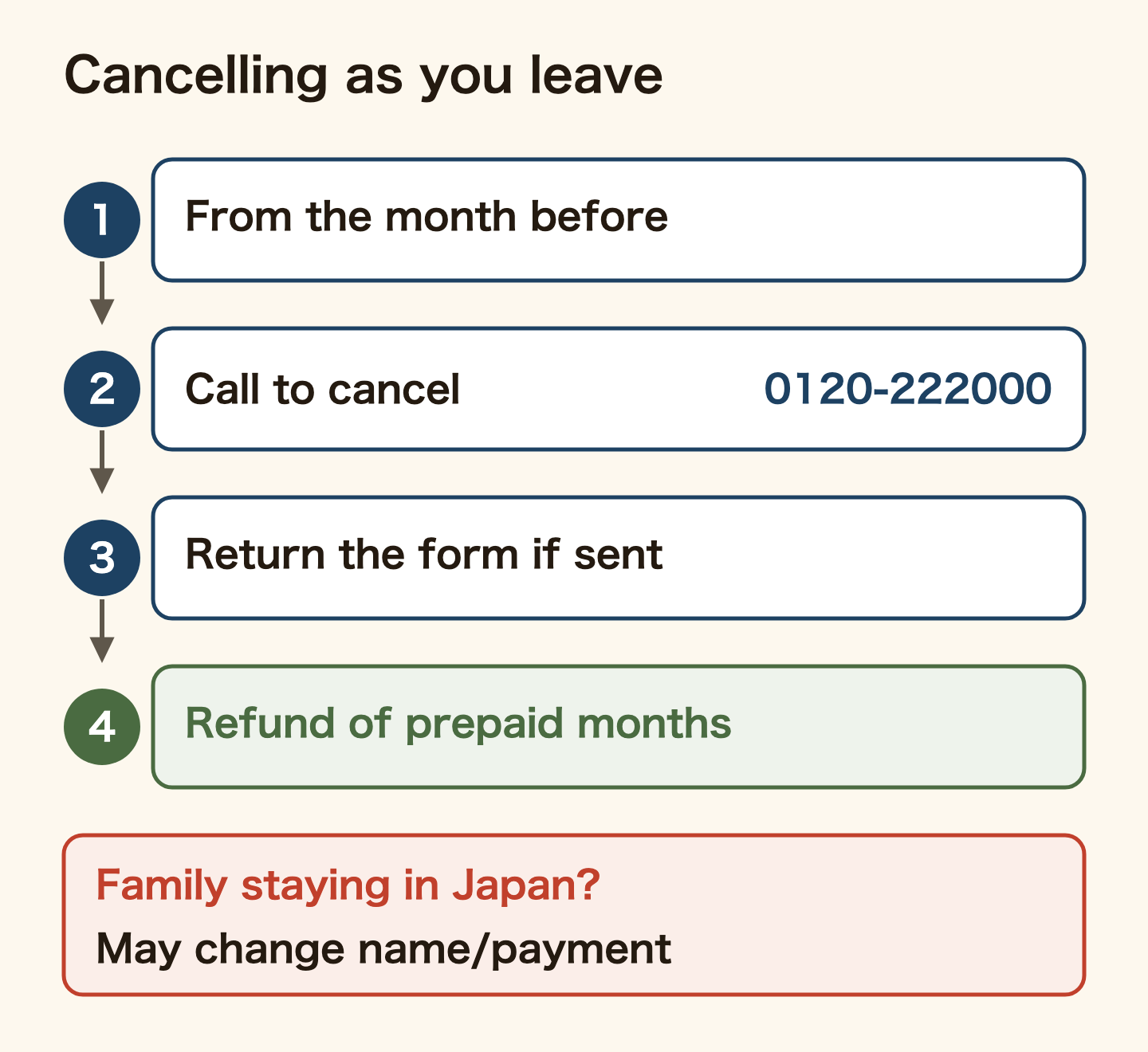
- In the month before you leave, call the cancellation line on 0120-222000 (9am–6pm, weekends and holidays included)
- If NHK sends a notification form, fill it in and send it back. Whether you need one depends on the reason
- Anything you paid ahead is refunded from the month the cancellation is accepted
Depending on timing, one more payment may still be taken from your account or card. That is refunded too, from the accepted month. Because a form may be needed, call in the month before you leave rather than on your last days.
If family members stay on in the same home, you may need to change the contract holder or the payment method instead of cancelling. Deleting the NHK ONE app or account does not cancel the contract. A false cancellation report makes you liable for a surcharge.
Cancelling NHK is one step in the same run as moving out of your residence registration and closing your bank account. The order that saves you money is in the leaving Japan checklist.
What if I am only moving within Japan?
Moving within Japan is an address change, not a cancellation. Report it on NHK’s fee website. Doing it on the same day you call to stop your utilities makes it hard to forget. The utilities guide covers those calls.
Which one are you?
- You have a TV-type device and no contract yet: the deadline is the end of the second month after setup. Today, sign up on NHK’s fee website or on 0120-151515.
- You are a student living alone, with last year’s income of 1.87 million yen or less or a pension student deferral: sign the contract, then apply for the student exemption. Today, get your student ID and your tax certificate or deferral approval notice ready.
- You have no TV-type device and no NHK ONE: you have no duty to sign. Today, just remember that “I have no TV” is all you need to say at the door or on the form.
- You are leaving Japan: call 0120-222000 in the month before you leave. Today, write “cancel NHK” in your calendar for that month.
FAQ
Q. Do foreigners have to pay the NHK fee?
Yes, if you have installed a device that can receive NHK or started using NHK ONE, whatever your nationality (Broadcasting Act, Article 64). Diplomats and consular officers are the exception. If you have neither, you do not need a contract.
Q. How much is the NHK fee?
1,100 yen a month for a terrestrial contract and 1,950 yen for a satellite contract if your TV can receive BS, tax included (Okinawa differs). You pay every two months, and twelve months ahead costs 12,276 yen for a terrestrial contract.
Q. Do I need a contract just for owning a smartphone?
No. NHK says owning a smartphone or PC alone does not make you subject to a contract. It does apply if you confirm and start using NHK ONE, or if your phone can receive TV through One Seg.
Q. Can international students get the NHK student exemption?
Yes, if you are at an eligible school, live apart from your family, and meet one of eight reasons such as last year’s income of 1.87 million yen or less. Sign a contract, apply on NHK’s website, and the exemption starts from the month NHK accepts it.
Q. What should I do when an NHK fee collector visits?
NHK’s visitors carry an ID certificate, so ask to see it. If you have a TV-type device or NHK ONE, you need a contract, but you can sign up yourself later online or on 0120-151515.
Q. How do I cancel my NHK contract when leaving Japan?
Call 0120-222000 from the month before you move. Send back the form if NHK posts one. Months you paid ahead are refunded from the month the cancellation is accepted.
Summary
The NHK fee depends on whether you have set up a device that can receive NHK or started NHK ONE, not on what you watch. Nationality makes no difference. It is 1,100 yen a month, or 1,950 yen if you can receive BS. Owning a smartphone alone does not count.
Students living alone can be fully exempt through the 1.87 million yen income line, a pension student deferral and other reasons, but only from the month they apply, never backdated. When someone visits, check their ID and answer from your own situation. When you leave Japan, cancel it yourself in the month before you go.
Reference (official): e-Gov, Broadcasting Act, Article 64 / NHK Receiving Contract Rules / NHK Exemption Standards / NHK, who is eligible for exemption / NHK, student exemption income line change / NHK fees / NHK, cancelling a contract / NHK, fair-burden efforts / NHK fee phone numbers / NHK, The Receiving Fee System (English). All in Japanese unless marked, all checked on 30 September 2026. Check NHK’s fee website for the latest before you act.
Related reading
Found this useful? Share it
Send it to a friend who lives in Japan.
WHO WROTE THIS

mori
Japanese. I read the ministries’ own notices, orders and Q&As in the original, and I start from what my Nepalese and Sri Lankan friends in Japan actually ran into. I do not write about what I have not checked or been told.
What this site can and cannot do →Looking for something else?