Checked on 17 September 2026 against the MHLW press release of 3 September 2026, its attachment listing all prefectures, and the Minimum Wage Act (e-Gov). The figures below are the amounts as answered by the prefectural councils, and the start dates are planned. Each Labour Bureau still runs an objection procedure before its director decides and publishes; until the start date, the current FY2025 amount applies.
In short
- The minimum wage is the legal floor below which no one may be paid per hour. It differs by prefecture, and foreign workers get exactly the same amount.
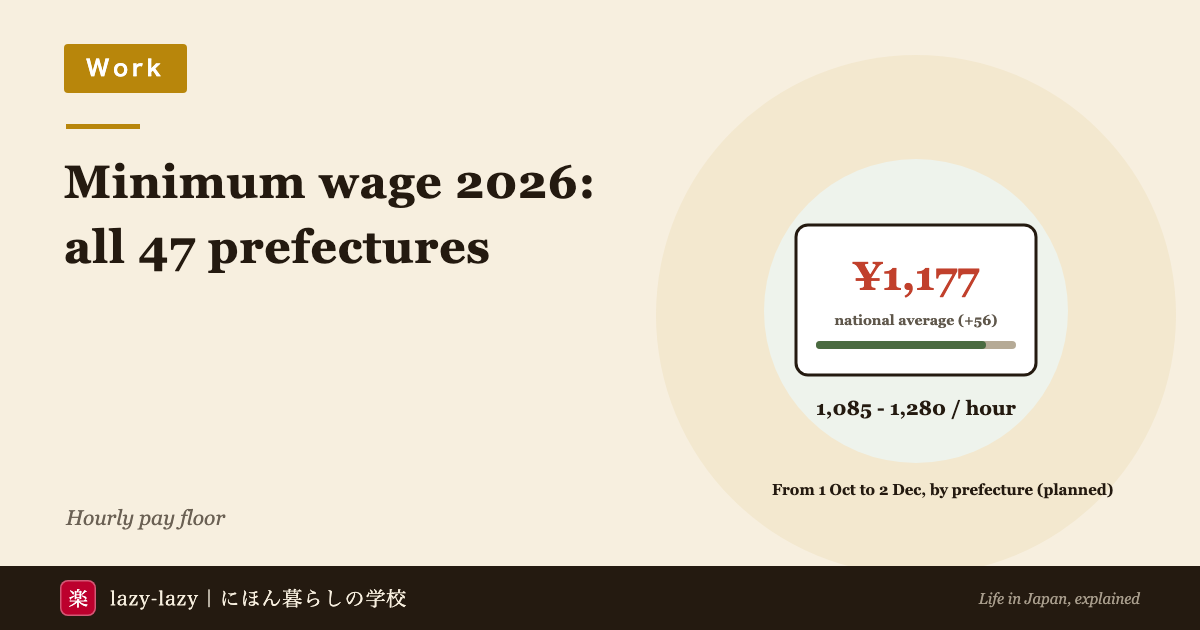
- FY2026: national weighted average 1,177 yen (+56). Tokyo 1,280, Kanagawa 1,279, Osaka 1,231; the lowest is Miyazaki at 1,085. All 47 prefectures answered on 3 September.
- Start dates run from 1 October to 2 December, depending on the prefecture. Tokyo, Osaka, Aichi and most others on 1 October; Kyoto 16 November; Okinawa 2 December. Before that date, the current amount applies.
- Compare by the hour. Monthly pay divided by scheduled monthly hours, leaving out commuting allowance and bonuses.
- Paid less? That part of your contract is void and you can claim the minimum. The employer faces a fine of up to 500,000 yen. The place to go is the Labour Standards Inspection Office.
Every autumn hourly pay goes up. How much in your prefecture, from when, and is your own wage below it? The news reports “Tokyo 1,280 yen”, but you may not work in Tokyo. Here are all 47 prefectures with their planned start dates, then how to compare your own pay, and what to do if it falls short.
FY2026 minimum wage: all 47 prefectures and planned start dates
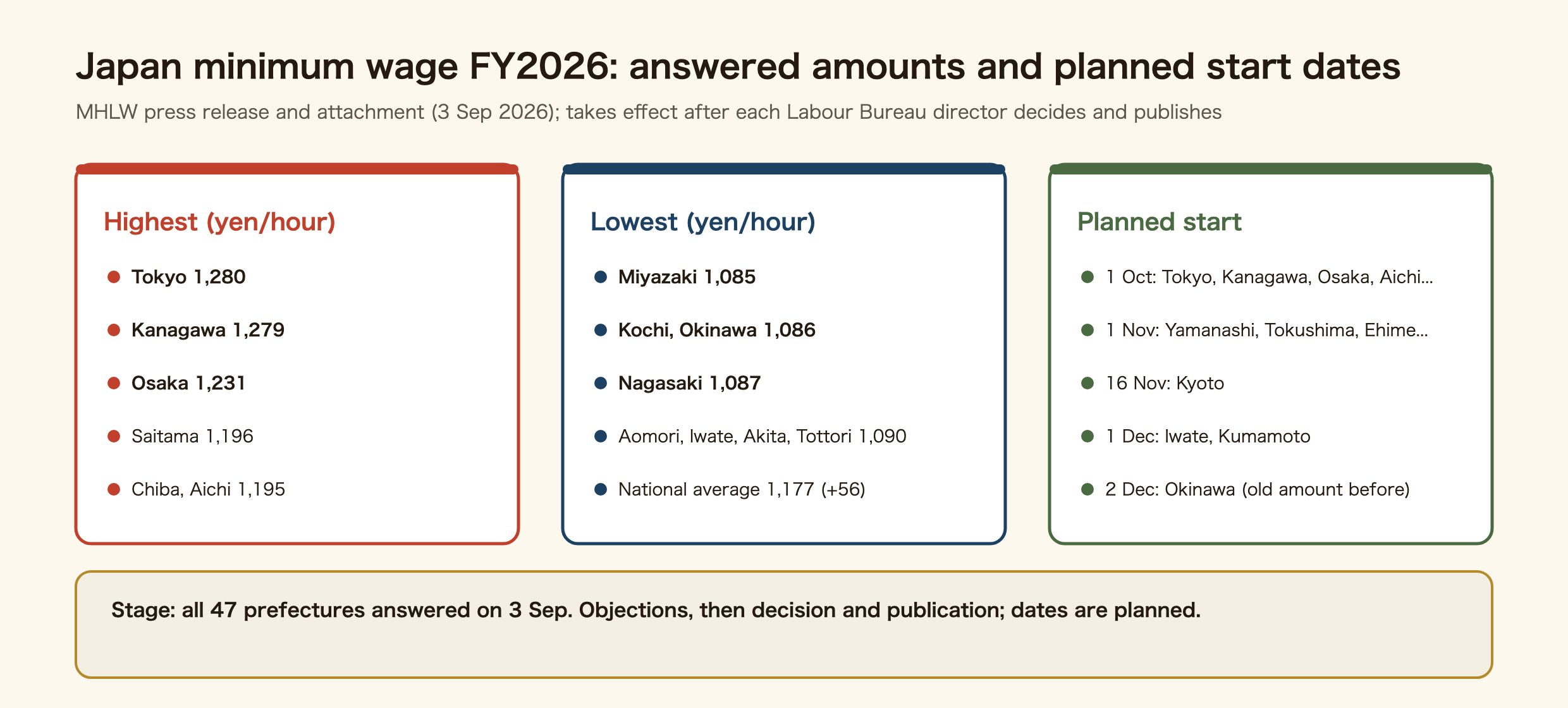
The minimum wage is the hourly amount set under the Minimum Wage Act that an employer must pay at least (Arts. 3 and 4). Each prefecture’s “regional minimum wage” is revised every autumn. For FY2026, all 47 prefectural minimum wage councils answered their revised amounts by 3 September, and the Ministry of Health, Labour and Welfare compiled and published them.
The national weighted average is 1,177 yen (up 56 yen from 1,121 in FY2025, the second-largest rise since the guideline system began in 1978). Rises range from 54 to 65 yen, and the lowest amount (Miyazaki, 1,085) is now 84.8% of the highest (Tokyo, 1,280), a gap that has narrowed for 12 years running.
| Prefecture | FY2026 (as answered) | Before | Rise | Planned start |
|---|---|---|---|---|
| Hokkaido | 1,131 | 1,075 | +56 | 1 Oct 2026 |
| Aomori | 1,090 | 1,029 | +61 | 29 Oct 2026 |
| Iwate | 1,090 | 1,031 | +59 | 1 Dec 2026 |
| Miyagi | 1,098 | 1,038 | +60 | 1 Oct 2026 |
| Akita | 1,090 | 1,031 | +59 | 14 Oct 2026 |
| Yamagata | 1,092 | 1,032 | +60 | 30 Oct 2026 |
| Fukushima | 1,094 | 1,033 | +61 | 16 Oct 2026 |
| Ibaraki | 1,136 | 1,074 | +62 | 18 Oct 2026 |
| Tochigi | 1,125 | 1,068 | +57 | 1 Oct 2026 |
| Gunma | 1,120 | 1,063 | +57 | 3 Oct 2026 |
| Saitama | 1,196 | 1,141 | +55 | 1 Oct 2026 |
| Chiba | 1,195 | 1,140 | +55 | 1 Oct 2026 |
| Tokyo | 1,280 | 1,226 | +54 | 1 Oct 2026 |
| Kanagawa | 1,279 | 1,225 | +54 | 1 Oct 2026 |
| Niigata | 1,108 | 1,050 | +58 | 1 Oct 2026 |
| Toyama | 1,119 | 1,062 | +57 | 1 Oct 2026 |
| Ishikawa | 1,113 | 1,054 | +59 | 3 Oct 2026 |
| Fukui | 1,112 | 1,053 | +59 | 4 Oct 2026 |
| Yamanashi | 1,113 | 1,052 | +61 | 1 Nov 2026 |
| Nagano | 1,117 | 1,061 | +56 | 2 Oct 2026 |
| Gifu | 1,121 | 1,065 | +56 | 1 Oct 2026 |
| Shizuoka | 1,154 | 1,097 | +57 | 15 Oct 2026 |
| Aichi | 1,195 | 1,140 | +55 | 1 Oct 2026 |
| Mie | 1,143 | 1,087 | +56 | 1 Oct 2026 |
| Shiga | 1,136 | 1,080 | +56 | 3 Oct 2026 |
| Kyoto | 1,180 | 1,122 | +58 | 16 Nov 2026 |
| Osaka | 1,231 | 1,177 | +54 | 1 Oct 2026 |
| Hyogo | 1,172 | 1,116 | +56 | 1 Oct 2026 |
| Nara | 1,107 | 1,051 | +56 | 4 Oct 2026 |
| Wakayama | 1,101 | 1,045 | +56 | 3 Oct 2026 |
| Tottori | 1,090 | 1,030 | +60 | 3 Oct 2026 |
| Shimane | 1,092 | 1,033 | +59 | 10 Oct 2026 |
| Okayama | 1,104 | 1,047 | +57 | 2 Oct 2026 |
| Hiroshima | 1,141 | 1,085 | +56 | 11 Oct 2026 |
| Yamaguchi | 1,101 | 1,043 | +58 | 8 Oct 2026 |
| Tokushima | 1,103 | 1,046 | +57 | 1 Nov 2026 |
| Kagawa | 1,092 | 1,036 | +56 | 1 Oct 2026 |
| Ehime | 1,093 | 1,033 | +60 | 1 Nov 2026 |
| Kochi | 1,086 | 1,023 | +63 | 29 Oct 2026 |
| Fukuoka | 1,114 | 1,057 | +57 | 4 Oct 2026 |
| Saga | 1,095 | 1,030 | +65 | 15 Nov 2026 |
| Nagasaki | 1,087 | 1,031 | +56 | 2 Nov 2026 |
| Kumamoto | 1,092 | 1,034 | +58 | 1 Dec 2026 |
| Oita | 1,096 | 1,035 | +61 | 1 Nov 2026 |
| Miyazaki | 1,085 | 1,023 | +62 | 24 Oct 2026 |
| Kagoshima | 1,090 | 1,026 | +64 | 25 Oct 2026 |
| Okinawa | 1,086 | 1,023 | +63 | 2 Dec 2026 |
The start dates are planned, not final. After the answer, each prefectural Labour Bureau hears objections from employers and unions, and its director then decides and publishes the amount before it takes effect. Up to the day before the start date, the amount in the “Before” column is the minimum wage. Most prefectures rise on 1 October, but Kyoto waits until 16 November, Iwate and Kumamoto until 1 December, Okinawa until 2 December. Check your own prefecture’s date.
Does it apply to foreigners? Yes, the same amount
A “worker” under the Minimum Wage Act is a worker under the Labour Standards Act, with no nationality limit (Art. 2). A student’s part-time job under a permission for activities outside status, a technical intern, a Specified Skilled Worker, a full-time employee: same prefecture, same amount. Being foreign, speaking imperfect Japanese or “still training” are not grounds for paying less. A reduced rate during a trial period exists only as a special exception that needs the Labour Bureau director’s permission (Art. 7); an employer cannot decide it alone.
As a rough guide, a student working 28 hours a week in Tokyo has a floor of 1,280 yen x 28 hours x 4.3 weeks, about 154,000 yen a month (after the start date, before tax).
How to compare your own pay: convert to hourly, strip out allowances
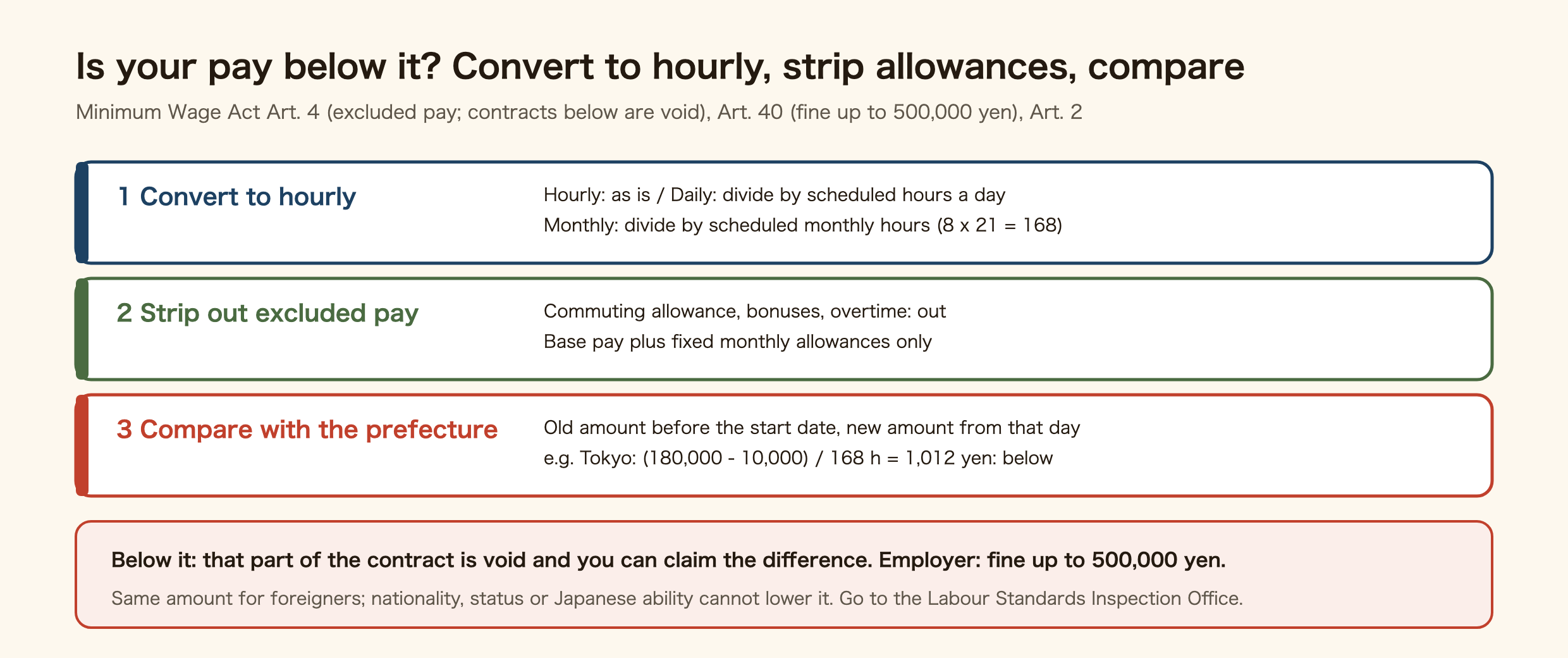
- Convert to an hourly figure. Hourly workers: as is. Daily pay: divide by scheduled hours per day. Monthly pay: divide by scheduled hours per month (8 hours x 21 days = 168 hours, for example).
- Take out the pay that does not count. Under Art. 4(3), commuting allowance, bonuses, overtime pay, holiday pay and anything other than regular pay for regular hours are excluded from the comparison. Only base pay and allowances paid every month as a fixed amount (a job allowance, say) go into the calculation.
- Compare with your prefecture’s amount. The “Before” figure until the start date, the new one from that day. Even one yen below is a breach.
Example: 180,000 yen a month in Tokyo, 168 scheduled hours, including a 10,000 yen commuting allowance. (180,000 – 10,000) / 168 = 1,012 yen. That is below today’s 1,226 and below the 1,280 due from 1 October. The employer must pay the difference.
What if you are below it?
A contract that sets pay below the minimum wage is void for that part, and is deemed to set the minimum wage instead (Art. 4(2)). A signed paper saying “1,000 yen an hour” does not matter: by law your hourly rate is the minimum, and you can claim the difference going back. An employer who fails to pay it faces a fine of up to 500,000 yen (Art. 40).
The order: (1) keep your payslips and contract to hand; (2) tell the employer that the pay is below the minimum wage; (3) if nothing changes, go to the Labour Standards Inspection Office (rodo kijun kantokusho). If you want to talk in another language, ask the office whether it has a foreign workers’ consultation corner. The employment service centres for foreigners will also listen.
The decision: what to do today
Hourly part-timers: note your prefecture’s start date and new amount, then check the hourly rate on your first payslip after that date. If it has not moved, tell the manager. Most shops raise it automatically, but some forget.
Monthly-paid workers: do the three-step conversion once. Companies with low base pay padded out by allowances are the ones that trip here.
Next year and after: the minimum wage rises every autumn. Guideline at the end of July, prefectural answers in August-September, start around October. This article will be updated at the same time next year.
FAQ
Q. What is Japan’s minimum wage in 2026?
National weighted average 1,177 yen an hour. Tokyo 1,280, Kanagawa 1,279, Osaka 1,231; the lowest is Miyazaki at 1,085 (amounts answered on 3 September). It differs by prefecture, so check the table.
Q. When does the new minimum wage start?
Between 1 October and 2 December 2026, depending on the prefecture. Tokyo, Osaka, Aichi and most others on 1 October. Until the day before, the current amount applies.
Q. Does the minimum wage apply to foreigners?
Yes. The Act has no nationality limit; student part-timers, technical interns and Specified Skilled Workers all get the same amount as anyone else in the prefecture.
Q. How do I compare a monthly salary?
Take out commuting allowance, bonuses and overtime, then divide by your scheduled monthly hours. If that hourly figure is below your prefecture’s amount, it is a breach.
Q. I signed a contract below the minimum wage.
That part is void, and by law your rate is the minimum wage. You can claim the difference going back. If the employer refuses, go to the Labour Standards Inspection Office.
Q. What is the difference between “answered” and “decided”?
An answer is the council’s conclusion; it takes effect only when the Labour Bureau director decides and publishes it. The figures here are answered amounts and the dates are planned. We will update if anything changes.
Summary
FY2026 minimum wage: national average 1,177 yen, Tokyo 1,280, lowest Miyazaki 1,085. Start dates 1 October to 2 December, by prefecture. The same amount applies to foreign workers; nationality and language are not grounds for less.
Monthly-paid? Strip out allowances, convert to hourly, compare. Below it? The contract is void for that part and you can claim the difference. Go to the Labour Standards Inspection Office. And remember the one detail people get wrong: until the start date, the old amount applies.
Sources (official): MHLW press release, revised regional minimum wages answered in all prefectures (3 September 2026) / attachment: FY2026 regional minimum wage, status of answers / MHLW, national list of regional minimum wages (current amounts) / Minimum Wage Act, Arts. 2, 3, 4, 7 and 40 (e-Gov) (all checked 17 September 2026)
Found this useful? Share it
Send it to a friend who lives in Japan.
WHO WROTE THIS

mori
Japanese. I read the ministries’ own notices, orders and Q&As in the original, and I start from what my Nepalese and Sri Lankan friends in Japan actually ran into. I do not write about what I have not checked or been told.
What this site can and cannot do →Looking for something else?