Checked on 18 October 2026 against the Ministry of Foreign Affairs pages on visas, visa exemptions, the short-term stay document checklist and visa fees; the Immigration Services Agency pages on the Temporary Visitor status, extensions and departure orders; the Ministry of Health, Labour and Welfare guidance on medical costs for visitors; and the Immigration Control Act and National Health Insurance rules (e-Gov).
The short answer
- A family visit to Japan is a “short-term stay”: up to 90 days, with no paid work. Your parents or relatives enter as Temporary Visitors.
- If their nationality is on the foreign ministry’s list of 74 visa-exempt countries and regions, they need no visa. If not, they apply at the Japanese embassy or consulate in their own country. It cannot be done from inside Japan.
- You, in Japan, write the invitation letter and the itinerary. If you pay for their trip, you add a letter of guarantee, proof of your income, your juminhyo and a copy of your residence card.
- Extensions are not granted as a rule. Immigration allows them only for truly unavoidable reasons, such as medical treatment.
- Visitors cannot join National Health Insurance. They pay the full medical bill, so they should have private medical insurance.
Knowing this, you can send your family everything they need in one go, and plan the trip around “90 days, no extension”. You will also know what happens at a hospital, so the insurance conversation happens before they fly.
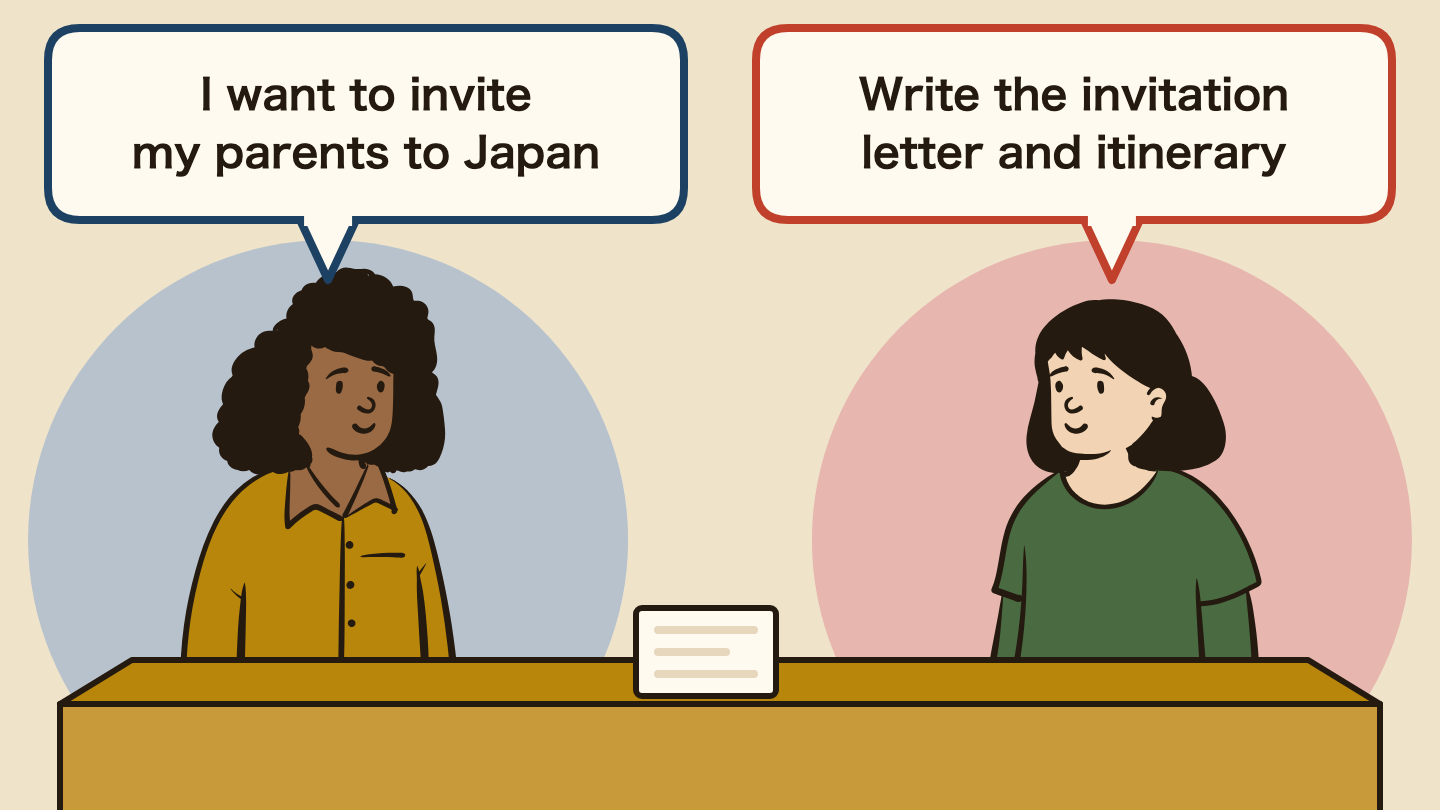
Your mother wants to meet her new grandchild. Your father wants to see the town where you work. You start looking at flights, then stop: does she need a visa? What goes in an “invitation letter”? Your Japanese colleagues cannot tell you. When a Japanese person’s family visits, nobody writes visa papers. You are the one who writes them.
- What is a family visit visa for Japan? Up to 90 days, no work
- Does your family need a visa? It depends on their nationality
- Family visit visa Japan requirements: what you send, what they bring
- How to write the invitation letter: not just “visiting relatives”
- What does it cost? About 15,000 yen for the visa
- How long can they stay? 15, 30 or 90 days
- Can a family visit visa in Japan be extended? As a rule, no
- What if they get sick in Japan? No national insurance, full bill
- Overstaying or working: deportation and a five-year ban
- If they cannot leave on time, or the visa is refused
- Which one are you?
- Frequently asked questions
- Summary
- Related guides
What is a family visit visa for Japan? Up to 90 days, no work
In immigration terms, visiting relatives is one of the activities of the Temporary Visitor status (Immigration Services Agency, Temporary Visitor, in Japanese). It sits in the same box as sightseeing and attending meetings.
The foreign ministry describes a short-term stay as “tourism, business, visiting friends or relatives, etc.” for up to 90 days (MOFA, VISA). Running a business for income or doing paid work is not allowed.
On the ministry’s checklist, “visiting relatives” means visiting a spouse, or a blood relative or in-law within the third degree. That covers parents, children, siblings, grandparents, aunts, uncles, nieces and nephews. Inviting a friend is “visiting friends”, and the proof of relationship becomes photos, emails or letters.
There is no status that lets a parent live with you long term. Dependent status covers only a spouse and children; our guide to bringing family to Japan explains why. For parents, the short-term stay is the route.
Does your family need a visa? It depends on their nationality
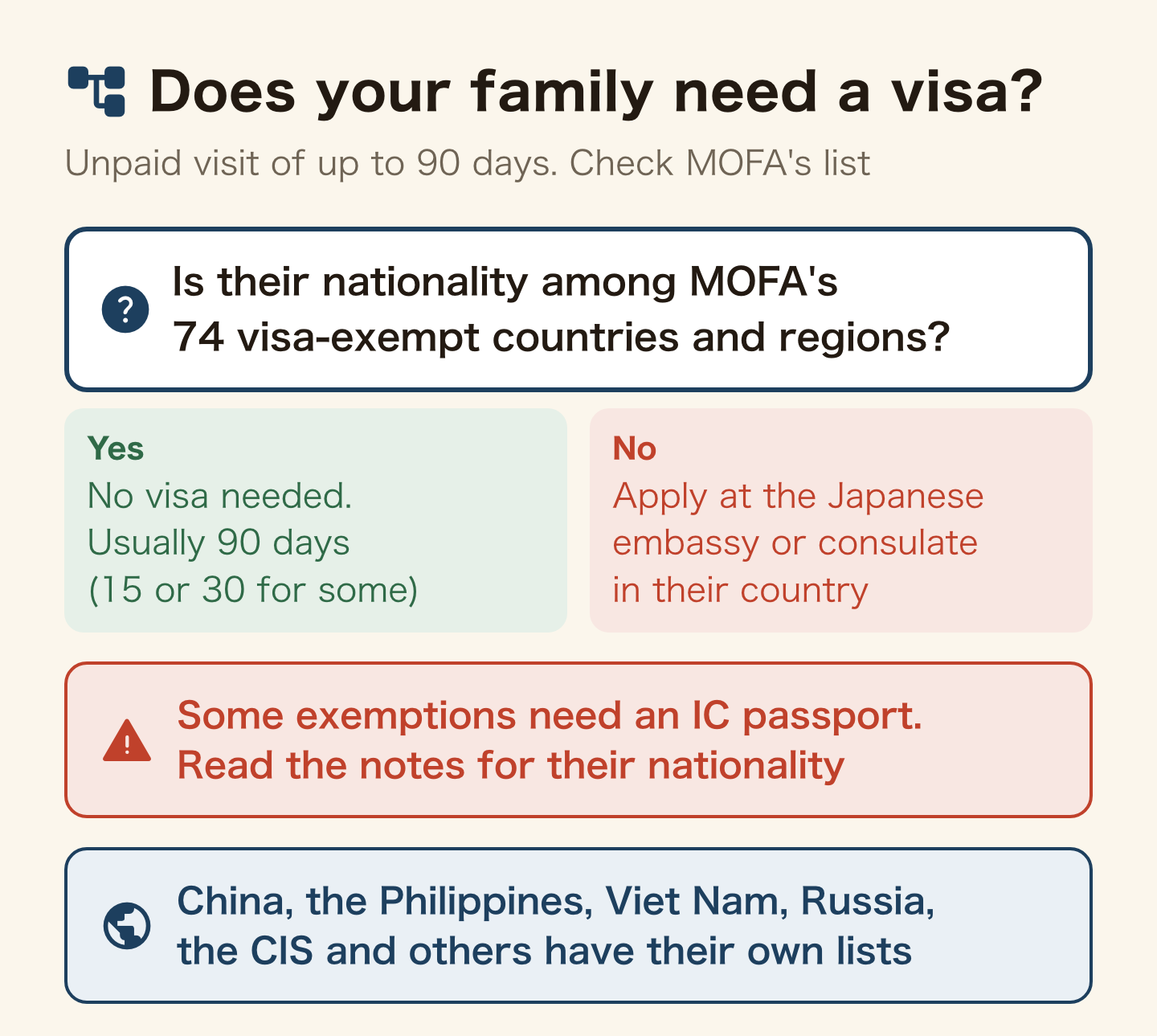
Start with the foreign ministry’s list of visa-exempt countries and regions. As of 1 September 2025 it has 74. If your family’s nationality is there, they need no visa for a short, unpaid visit.
Exempt does not mean the same number of days. The period granted on entry is 15 days for Indonesia and Thailand, 30 days for Brunei and Qatar, and 90 days for the rest. Some exemptions apply only to IC passport holders, and some require the passport to be pre-registered at a Japanese embassy. Read the notes under the table.
If their nationality is not on the list, they get a visa first. They apply at the Japanese embassy or consulate that covers the country where they live. The ministry is plain about it: a visa cannot be obtained on arrival or while in Japan. You cannot apply for them at an office in Japan either.
The documents depend on nationality. The ministry has separate pages for the Philippines, Viet Nam, China, Russia and the CIS countries (with Ukraine and Georgia). For multiple-entry visas, India, Indonesia and some others have their own checklists. Open your family’s page from MOFA’s short-term stay guide. The document list below follows the checklist for “all other nationalities”.
Family visit visa Japan requirements: what you send, what they bring
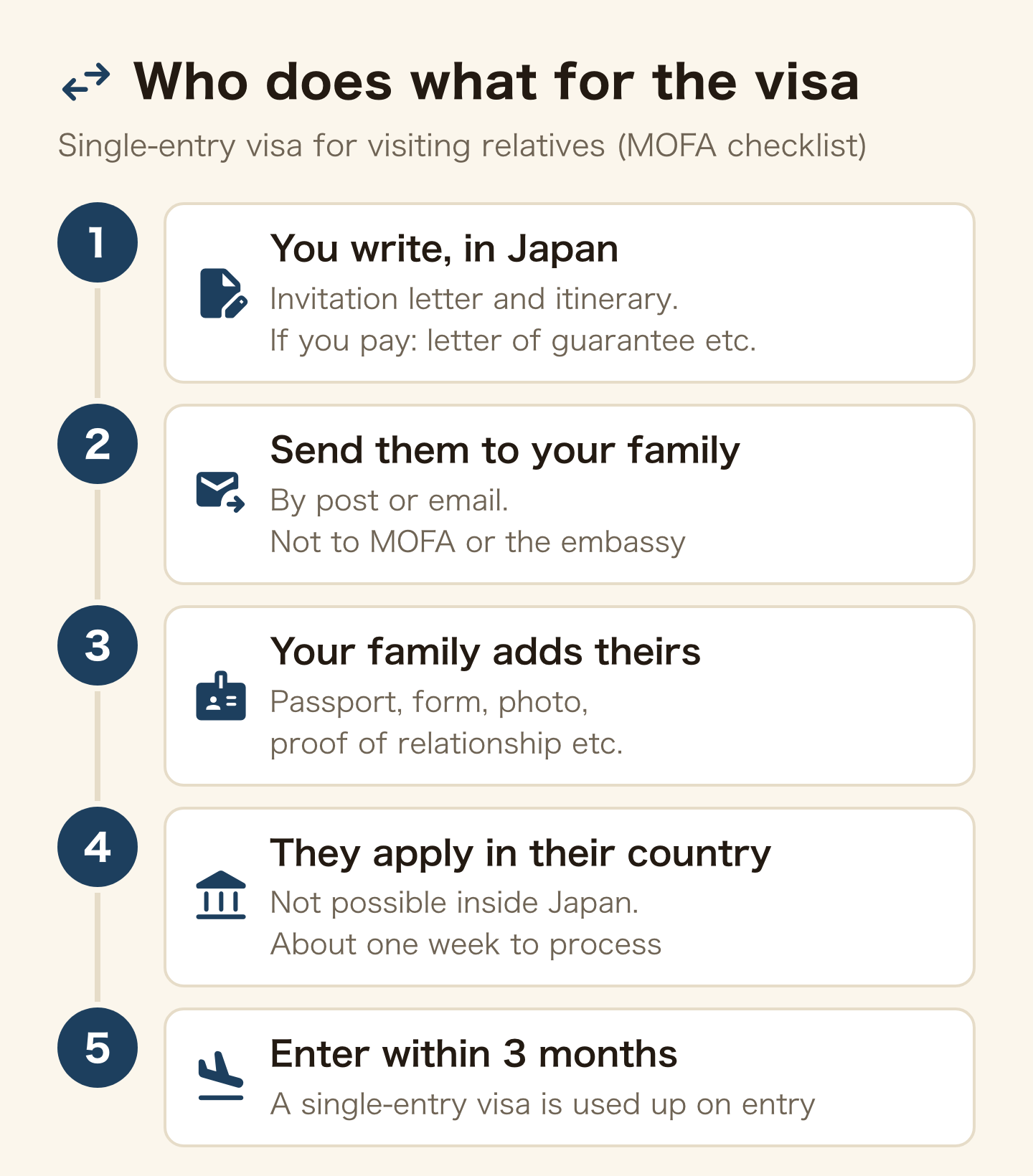
The papers come in two piles: the one you prepare in Japan, and the one your family prepares at home. When yours is ready, you send it to your family by post or email. You do not send it to the ministry or the embassy.
What you prepare in Japan
- Invitation letter (letter of reason for invitation): why you are inviting them, how it came about, and your relationship
- Supporting papers for the reason, if any: a graduation or wedding invitation showing the date, a medical certificate
- Itinerary in Japan (schedule of stay): arrival and departure dates, daily plans, where they will sleep
- List of visa applicants: when two or more people apply together, such as both parents
The forms (invitation letter, schedule of stay, letter of guarantee) can be downloaded from the ministry’s visa page. No personal seal is needed.
What you add if you pay for the trip
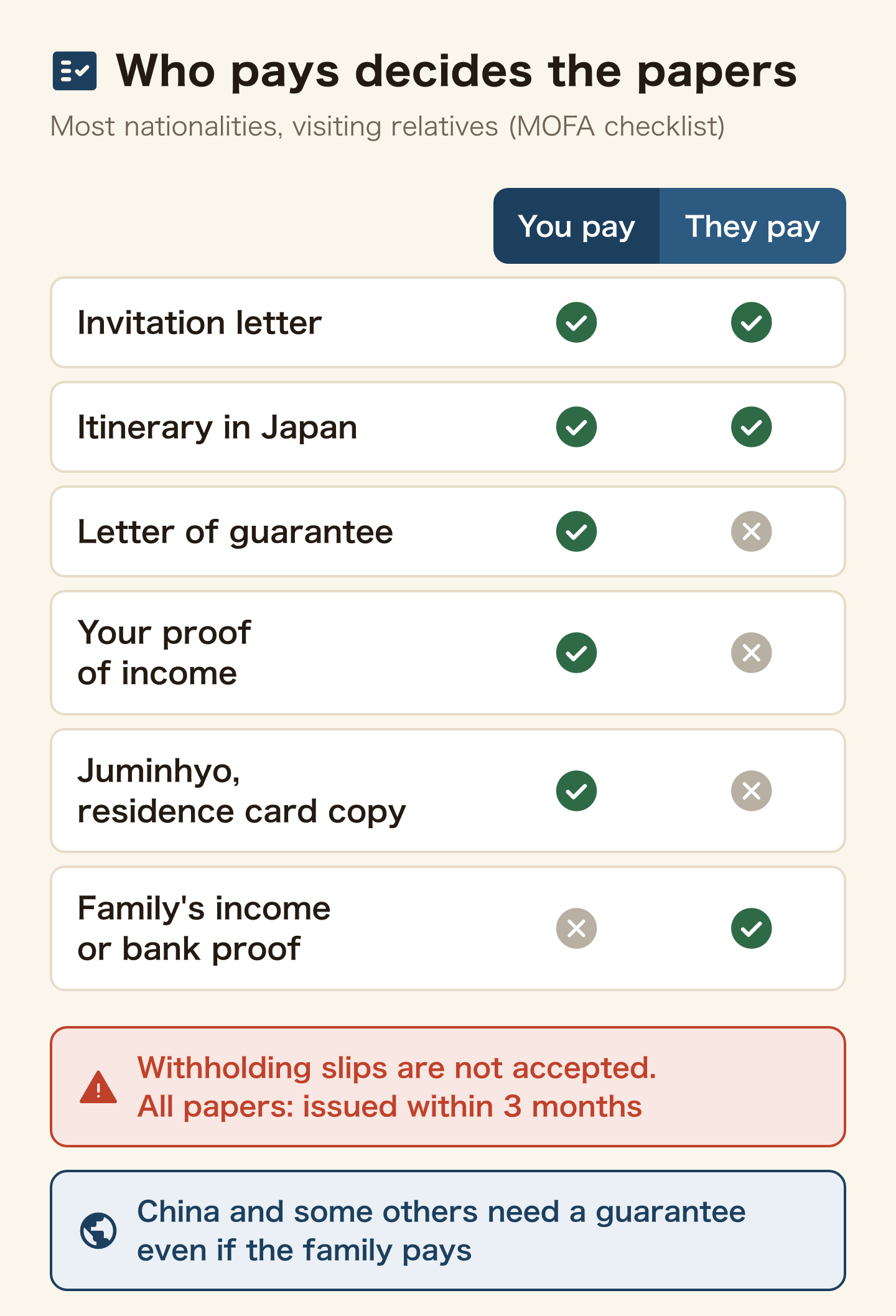
- Letter of guarantee: you guarantee three things, their living costs, their return fare, and that they obey the law. Missing any item makes it incomplete
- Proof you can pay: a certificate of income or taxation from your city office, a tax payment certificate (Form 2) from the tax office, or a bank balance certificate. At least one. A withholding slip (gensen choshu-hyo) is not accepted
- Juminhyo for your whole household, showing relationships. For foreign residents, nothing may be omitted except the My Number and resident code
- A copy of both sides of your residence card, and a copy of your passport
Every document, whether issued in Japan or at home, must be less than three months old (or within its stated validity) (MOFA single-entry checklist). Copies are accepted, though the embassy may ask for originals. How to get a juminhyo, at the counter or a convenience store, is in our residence registration guide.
Even if your family pays their own way, some nationalities still need the guarantee papers (MOFA FAQ). For example, Chinese nationals visiting relatives need a letter of guarantee and a juminhyo whoever pays (MOFA, short-term stay for nationals of China).
What your family prepares at home
- Passport, visa application form, one photo
- A document showing the planned flights, with arrival and departure dates
- Proof of the relationship: birth certificate, marriage certificate, family register and so on (copies accepted)
- If they pay their own way: an income certificate or a bank statement
Flights and hotels do not have to be booked or paid for the visa application. The ministry adds that it takes no responsibility for cancellation fees.
As for the guarantor’s liability, the ministry says it is a moral responsibility, not a legal one like a loan guarantor’s. But anyone who writes false papers about the relationship or purpose may face criminal liability.
How to write the invitation letter: not just “visiting relatives”
The most common weak spot is a purpose line that is too short. The checklist asks for specific details, and says a vague entry such as “visiting relatives” is not acceptable.
- Address it to the head of the embassy or consulate where they apply, for example the Ambassador of Japan in India
- Give your name, address and phone number. If you are both inviter and guarantor, you may write “omitted” in the inviter section
- Write the applicant’s name in the Latin alphabet, exactly as in the passport
- Explain the purpose and background: who is coming, why, and why now. If it does not fit, write “see attached” and attach a sheet
If a grandchild has just been born and your mother is coming to meet the baby and help after the birth, give the birth date and what she will do. If it is a wedding, give the date and venue and attach the invitation. Make sure the dates match the itinerary.
The itinerary lists each day’s plans and where they will stay. Days with the same plan can be grouped as one date range. If they stay with you, the accommodation is your address and phone number.
What does it cost? About 15,000 yen for the visa
| Item | Cost |
|---|---|
| Single-entry visa | About 15,000 yen (applications accepted from 1 July 2026; paid in local currency) |
| Multiple-entry visa | About 30,000 yen |
| If the visa is refused | No fee |
| Via an agency or visa centre | The agency’s own handling fee on top |
| Visa-exempt nationalities | No visa fee |
For applications accepted at an embassy from 1 July 2026, the fee is about 15,000 yen for a single-entry visa and about 30,000 yen for a multiple-entry visa (MOFA, Visa Fees). Some nationalities and purposes pay nothing or a different amount, so check the embassy’s own page.
On your side, the city office charges small fees for the juminhyo and income certificate, set by each city. The big costs are flights and medical insurance.
How long can they stay? 15, 30 or 90 days
The Temporary Visitor period is 90, 30 or 15 days (or a set number of days up to 90) (Immigration Services Agency, in Japanese). It is decided at the airport on entry and written on the landing permission stamp in the passport.
The visa itself also expires. A single-entry visa must be used within three months from the day after it is issued (MOFA, visa validity, in Japanese), and it is used up on entry. Processing takes about a week if nothing is wrong, longer if extra documents are requested or the embassy refers the case to Tokyo.
If you are unsure how to count, look at the stamp. If it says 90 days, they leave Japan by the last day shown.
Can a family visit visa in Japan be extended? As a rule, no
Your mother has arrived, and now everyone wants her to stay another month. Where you come from, extending a visit may be routine. In Japan, a short-term stay is not designed to be extended.
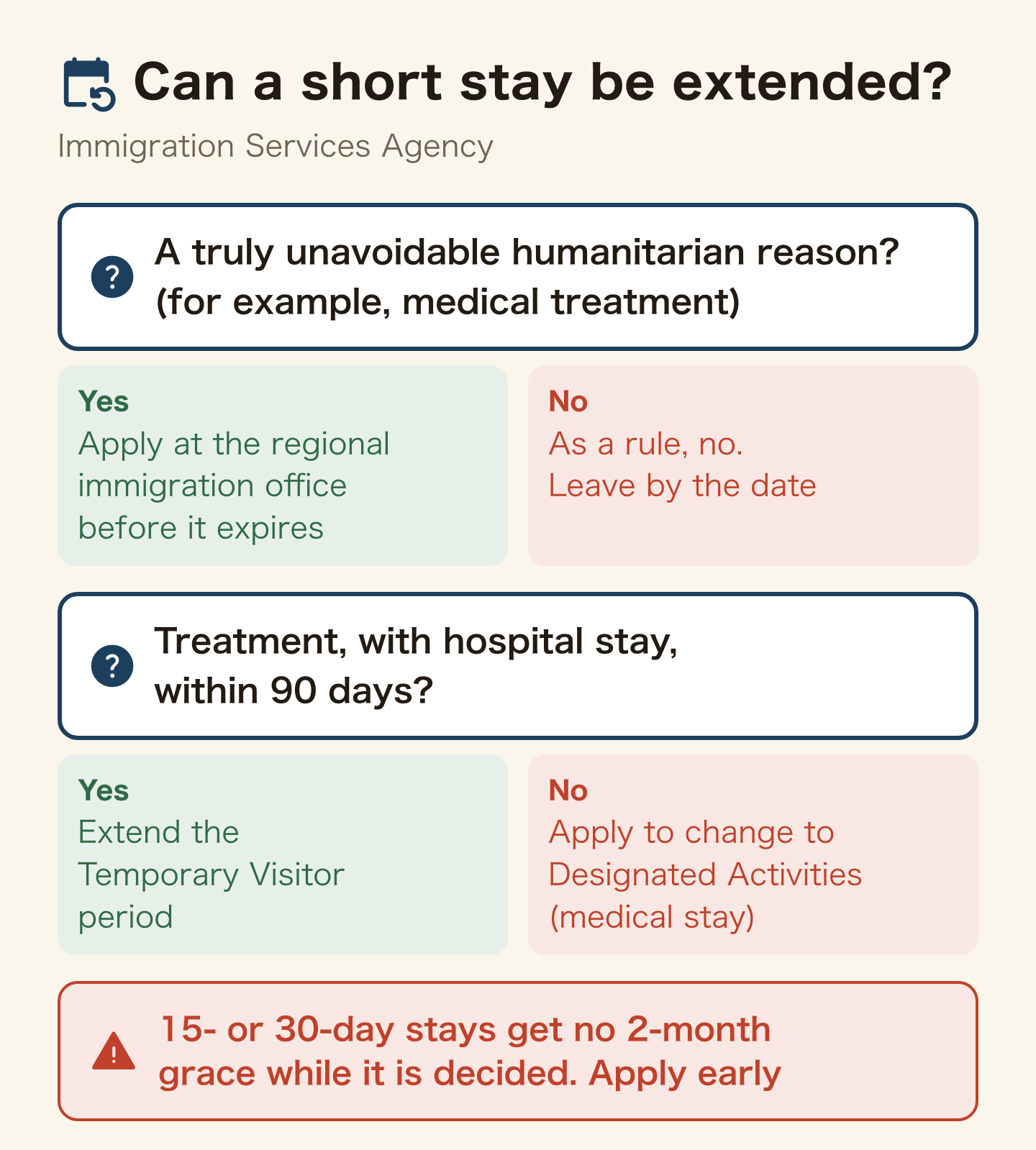
The Immigration Services Agency says an extension of a Temporary Visitor stay is granted “in principle” only when there is a truly unavoidable humanitarian reason or a comparable special reason. Its example is medical treatment. More sightseeing, or more time with the grandchildren, does not qualify.
If a visitor has to go into hospital, the route depends on how long treatment takes. Up to 90 days including the hospital stay: extend the Temporary Visitor period. Longer: apply to change to Designated Activities (medical stay) (Immigration Services Agency, hospital treatment on a short stay, in Japanese). They submit a doctor’s certificate, an account of what they have done since arriving, proof they can pay costs including medical bills, and a return ticket. If the patient cannot go in person, a relative can file.
File at the immigration office for your area before the period ends. For a permission of three months or less, the counter fee is 10,000 yen (extension of period of stay, in Japanese). The full fee table is in our guide to the new residence fees.
Visitors on 15 or 30 days need to move faster. Normally, if you apply before your period ends, you may stay while it is decided, for up to two months. The law excludes anyone granted 30 days or less (Immigration Control Act, art. 20(6)). If a hospital stay is decided, call immigration that week.
Nationals of a few countries, including Germany, the UK and Ireland, may stay up to six months under bilateral arrangements. Beyond 90 days they still have to extend at immigration before the period ends (note 8 on the visa-exemption list).
What if they get sick in Japan? No national insurance, full bill
Your father runs a fever on day ten and you take him to the local clinic. Where you come from, family may be covered by the same insurance. In Japan, relatives visiting on a short stay cannot join Japan’s public health insurance.
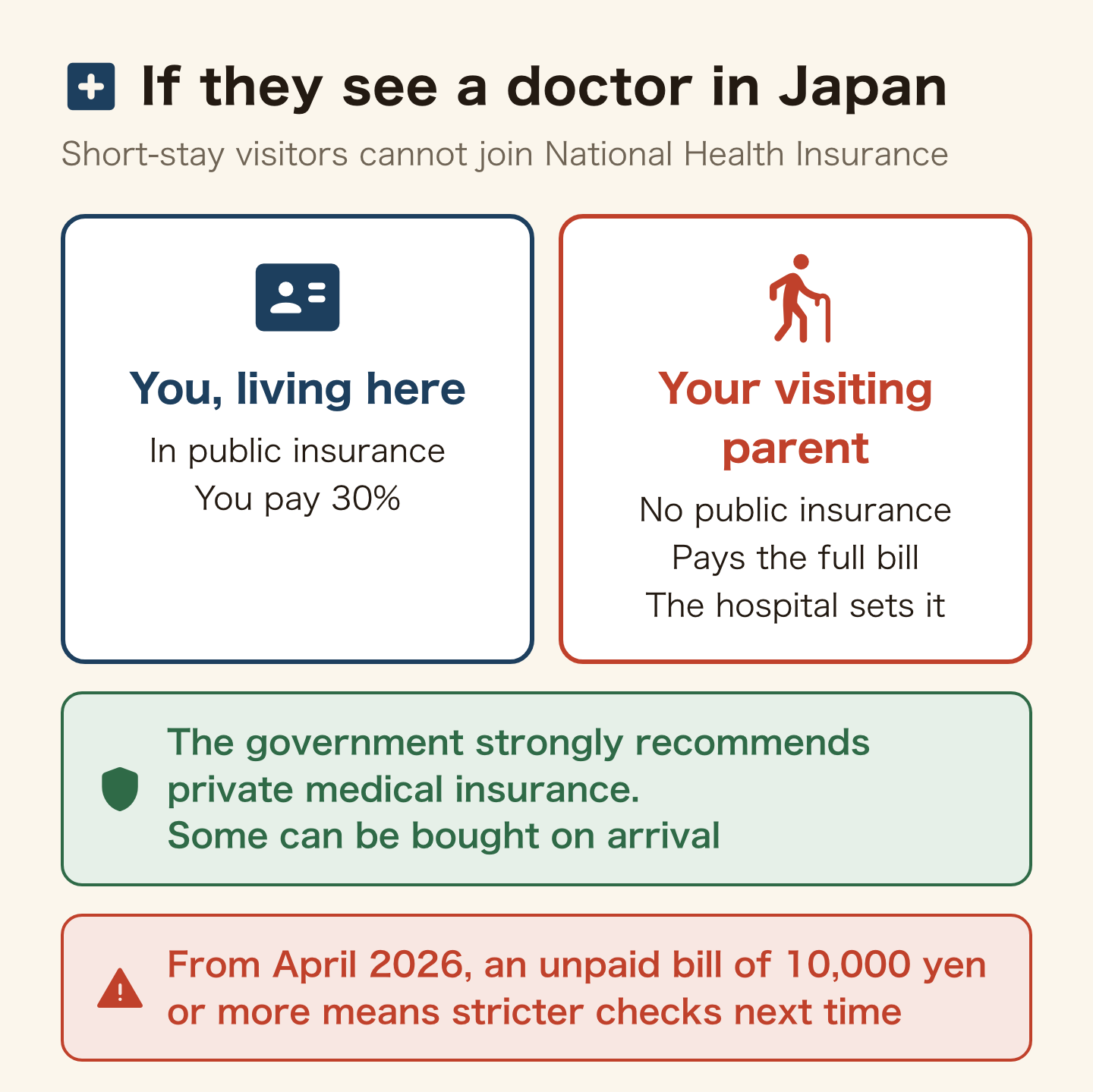
National Health Insurance is for foreign nationals registered as residents. Temporary Visitors get no residence card and no juminhyo, so they fall outside it (National Health Insurance Act Enforcement Regulations, art. 1). You cannot add them to your own National Health Insurance either.
Without insurance there is no 30% rate. The health ministry’s guide for hospitals says treatment of visitors without Japanese public insurance is “free-practice” care, and each hospital may set its own prices (MHLW guidebook for hospitals, in Japanese). The same guide notes that most travel insurance works as “pay and claim”: the patient pays the whole bill at the counter and claims it back later.
The health ministry strongly recommends that visitors have private medical insurance with enough cover, because bills can be very high (MHLW, private health insurance for visitors). The Japan National Tourism Organization notes that some policies can be bought after arriving in Japan. Its page shows cases of 7.5 million and 10 million yen for surgery, a hospital stay and transport home (JNTO).
An unpaid bill follows them. The health ministry passes details of visitors with unpaid medical bills to immigration, and their next entry is checked more strictly. For bills arising from 1 April 2026, the threshold is 10,000 yen (MHLW notice of 4 February 2026, in Japanese).
For finding a clinic and describing symptoms in Japanese, our guide to seeing a doctor in Japan works for visitors too. At reception, say first that they have no Japanese insurance but have travel insurance.
Overstaying or working: deportation and a five-year ban
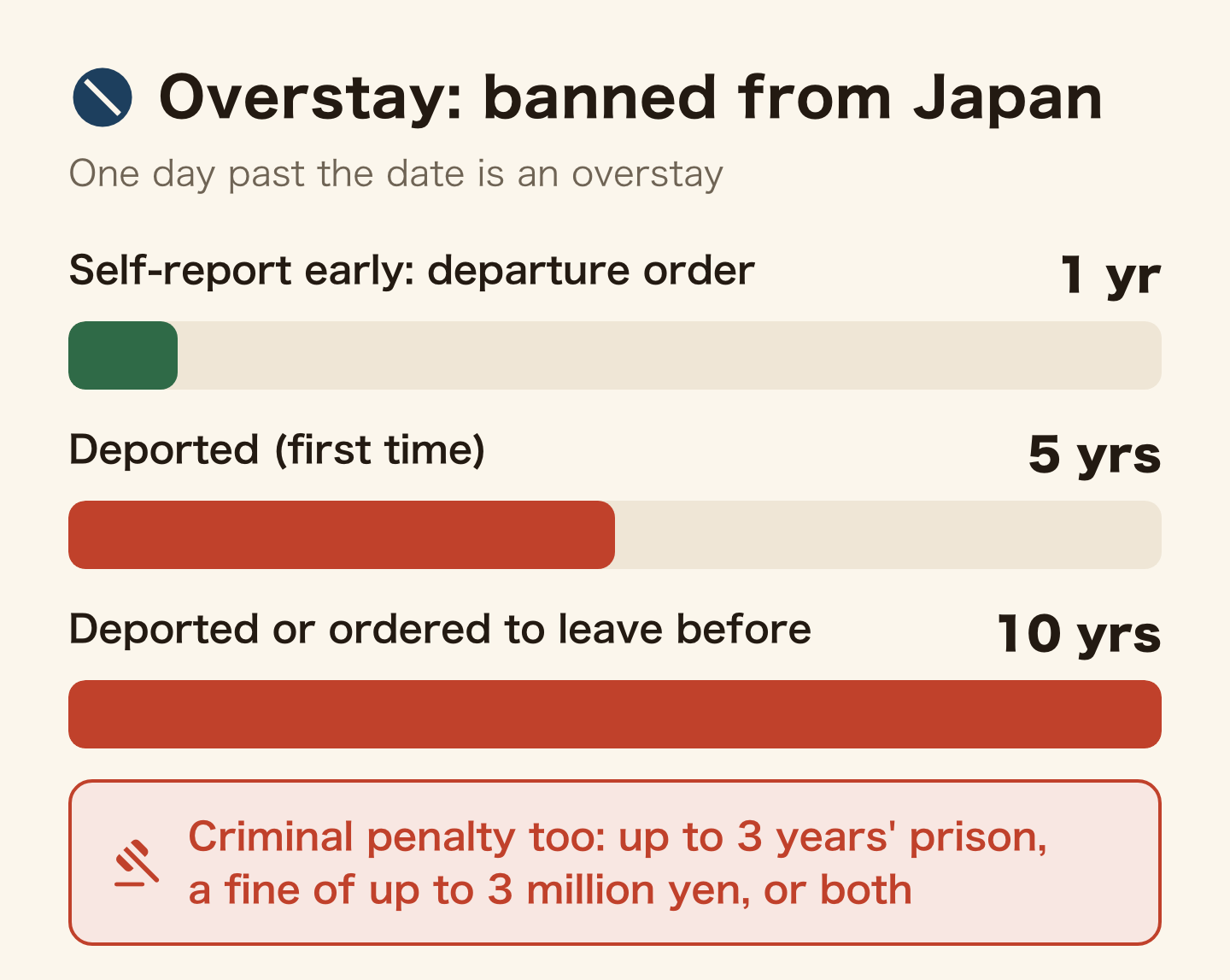
Staying even one day past the permitted period is an overstay. It is a ground for deportation, and the criminal penalty is up to three years in prison, a fine of up to 3 million yen, or both (Immigration Control Act, arts. 24 and 70).
A deported person is, in principle, barred from Japan for five years, or ten if they have been deported or ordered to leave before (Immigration Services Agency Q&A, in Japanese). A parent who came to meet a grandchild would lose the next five years of visits.
Work carries its own penalty. Paid activity on a short stay is unauthorised work, punishable by up to one year in prison, a fine of up to 2 million yen, or both (Immigration Control Act, art. 73) (if work was effectively their main activity, art. 70 applies: up to 3 years or 3 million yen).
If they cannot leave on time, or the visa is refused
A cancelled flight, a sudden illness. If your relative cannot leave by the date, contact immigration before it passes. Illness may allow an extension. Letting the date slip by in silence leads to the worst outcome.
If the date has already passed, they should report to immigration themselves. Someone who reports before any investigation starts, whose only violation is the overstay, and who meets the other conditions can leave under a “departure order” without detention. The ban is then one year (Immigration Services Agency, departure order system, in Japanese). If they ask to leave only after an investigation has begun, the ban for coming back on a short stay is five years.
If the visa is refused, the embassy will not give a reason. A new application for the same purpose within six months is normally not accepted (MOFA FAQ, section 3). Check whether anything was missing or inconsistent, and whether the invitation letter was specific, and prepare for six months later. For urgent humanitarian reasons, ask the embassy first.
Which one are you?
- Your family’s nationality is visa-exempt: no visa needed. Today, check the notes on the list for their number of days (15, 30 or 90) and any passport conditions, and talk about medical insurance.
- They need a visa and will pay their own way: today, open MOFA’s checklist for their nationality and start the invitation letter and itinerary.
- They need a visa and you are paying: today, pick a day to get your income certificate and household juminhyo from the city office. They must be less than three months old when used.
- They are already here and may not leave on time: today, gather the hospital or airline papers and call your local immigration office before the date.
Frequently asked questions
Q. What are the family visit visa requirements for Japan?
For most nationalities, you in Japan write an invitation letter and an itinerary, and your family brings a passport, application form, photo and proof of relationship. If you pay for the trip, you add a letter of guarantee, proof of income, your juminhyo and a copy of your residence card. Requirements differ by nationality, so check MOFA’s page for theirs.
Q. Can a family visit visa in Japan be extended?
As a rule, no. Immigration allows it only for truly unavoidable humanitarian reasons, such as medical treatment. If treatment including a hospital stay is within 90 days, they extend the Temporary Visitor period; if longer, they apply to change to Designated Activities (medical stay), before the period ends.
Q. What goes in the invitation letter?
Address it to the head of the embassy or consulate, and give your name, address and phone number, the applicant’s name in the Latin alphabet, the purpose and background of the visit, and your relationship. The foreign ministry asks for specific details, not a vague line such as “visiting relatives”.
Q. Can my visiting parents use National Health Insurance?
No. Temporary Visitors are not registered as residents, so they cannot join it. Their treatment is “free-practice” care paid in full, so the health ministry strongly recommends private medical insurance with enough cover.
Q. Where does my family apply for the visa?
At the Japanese embassy or consulate that covers the country where they live, or the agency it designates. A visa cannot be obtained on arrival or inside Japan, and you cannot apply on their behalf in Japan.
Q. What happens if they overstay?
It is an overstay, a ground for deportation, with a criminal penalty of up to three years in prison, a fine of up to 3 million yen, or both. Deportation usually means a five-year ban. If the date has passed, reporting to immigration before any investigation may allow a departure order with a one-year ban.
Summary
Parents and relatives come to Japan on a short-term stay for visiting relatives. If their nationality is visa-exempt they need no visa; if not, they apply at the Japanese embassy in their own country. You write the invitation letter and itinerary, and if you pay, you add the letter of guarantee, proof of income and your juminhyo.
Once they are here, an extension is possible only for reasons such as medical treatment. They cannot join National Health Insurance, so a doctor’s bill is paid in full. Plan the trip inside the permitted days, and make sure they have private medical insurance before they come.
Official sources: MOFA, VISA / MOFA, Exemption of Visa (Short-Term Stay) / MOFA, short-term stay by nationality / MOFA, single-entry short-term stay checklist / MOFA, FAQ / MOFA, Visa Fees / Immigration Services Agency, Temporary Visitor (Japanese) / ISA, hospital treatment on a short stay (Japanese) / ISA, departure order system (Japanese) / MHLW, private health insurance for visitors / e-Gov, Immigration Control and Refugee Recognition Act (Japanese) (all checked on 18 October 2026). Requirements vary by nationality and embassy: always check the page of the Japanese embassy in your family’s country before they apply.
Related guides
Found this useful? Share it
Send it to a friend who lives in Japan.
WHO WROTE THIS

mori
Japanese. I read the ministries’ own notices, orders and Q&As in the original, and I start from what my Nepalese and Sri Lankan friends in Japan actually ran into. I do not write about what I have not checked or been told.
What this site can and cannot do →Looking for something else?
You may use the figures in this article, including commercially, if you credit this site with a link. How to use our figures