Checked on 30 September 2026 against MEXT’s pages on the national higher education support scheme and its nationality and residence status table, JASSO’s eligibility rules, the ministry ordinance on national university fees, and the official guidance of the University of Tokyo, Osaka University, Kobe University, Waseda University, Ritsumeikan University and Ritsumeikan Asia Pacific University (APU).
The short answer
- A tuition fee exemption (jugyoryo genmen) is when your school waives all or part of your tuition because paying is hard for you. There is a national scheme, and there are schools’ own schemes.
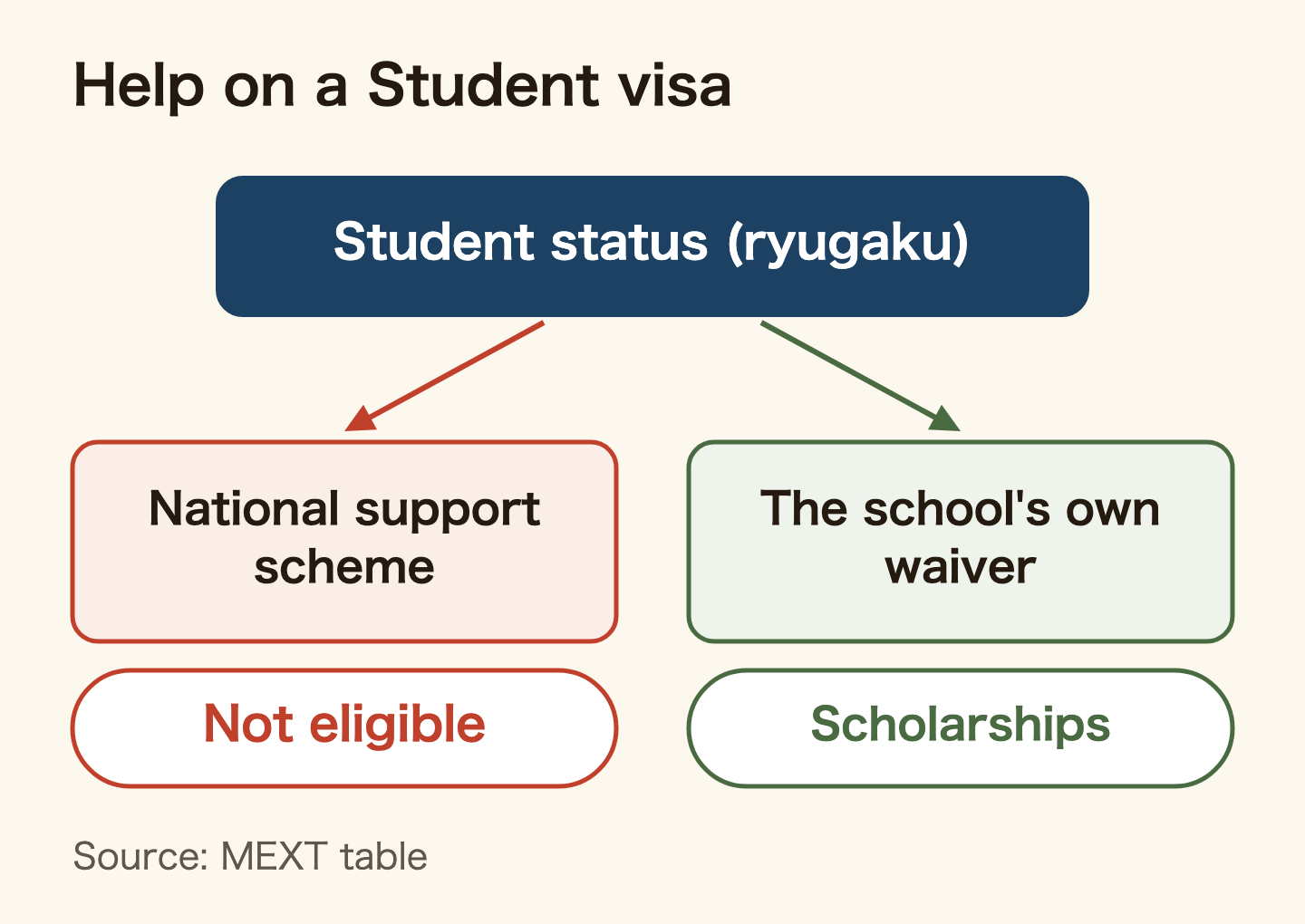
- If your residence status is Student (ryugaku), you cannot use the national “higher education support scheme”. MEXT’s eligibility table marks it with a cross.
- National universities run their own tuition waivers. At the University of Tokyo and Osaka University, international students can apply; you are judged on finances and grades, and the result is a full or half waiver, among others. At Kobe University, a waiver for financial reasons is for graduate students only.
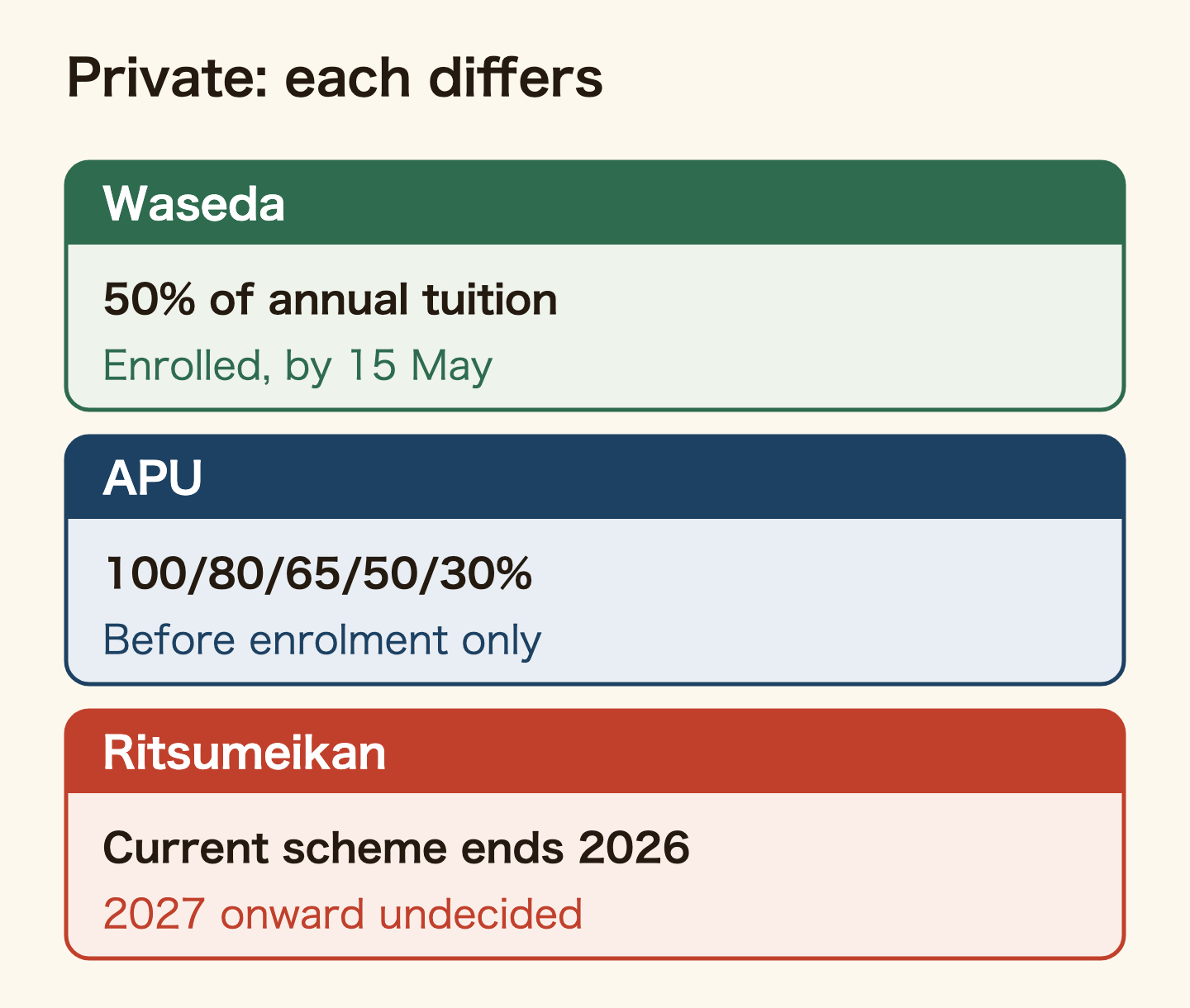
- Private universities are all different. Waseda cuts 50% of annual tuition, APU selects only before you enrol, and Ritsumeikan’s current scheme ends in the 2026 academic year.
- At some universities, paying your tuition first means you can no longer apply. Autumn 2026 deadlines: the University of Tokyo on 6 October (postmark), Osaka on 5 October (online registration).
Knowing this, you can find your school’s scheme and deadline before you pay, instead of losing a half or full waiver by paying too early. You will also know why the “free university” scheme your Japanese friends use is closed to you, so you do not waste time on it.
The payment slip for autumn tuition arrives. A Japanese friend says the government scheme made their tuition free. You ask the office for the same form, and the staff shake their heads. Your friend cannot tell you why. They never had to think about why they could apply.
The dividing line is not your nationality. It is your residence status. And there is a separate door for international students.
- Can international students get a tuition fee exemption in Japan?
- Tuition fee exemption at national universities: UTokyo and Osaka yes, Kobe undergraduates no
- Tuition reduction at private universities: Waseda, APU and Ritsumeikan compared
- What are the conditions for a tuition fee exemption?
- When and how do I apply? Autumn runs August to October, every year again
- What if I pay my tuition first?
- How much does a tuition fee exemption save?
- What if the information is wrong? Cancellation, and a check against your visa papers
- Refused, or missed the deadline? Deferral, instalments and scholarships
- Which one are you?
- FAQ
- Summary
- Related reading
Can international students get a tuition fee exemption in Japan?
You may. Just not through the same scheme as your Japanese friends.
The national higher education support scheme (Japanese) combines a waiver or reduction of tuition and entrance fees with a grant you do not repay. It started in April 2020.
In MEXT’s table of nationality and residence status requirements (PDF, Japanese), people with Student status are marked “cannot apply”. The same table adds a note: people with Student status can receive support schemes meant for international students.
JASSO’s eligibility rules (Japanese), which handle the applications, say the same. A foreign national can apply only with one of these four statuses.
- Special Permanent Resident
- Permanent Resident, Spouse or Child of Japanese National, or Spouse or Child of Permanent Resident
- Long-Term Resident who intends to settle permanently
- Dependent, if you meet conditions such as having finished elementary, junior high and high school in Japan, and intend to settle and work in Japan
Your Japanese friend applied from the top of that table. Your door is the waiver your school runs itself, plus scholarships for international students.
Tuition fee exemption at national universities: UTokyo and Osaka yes, Kobe undergraduates no
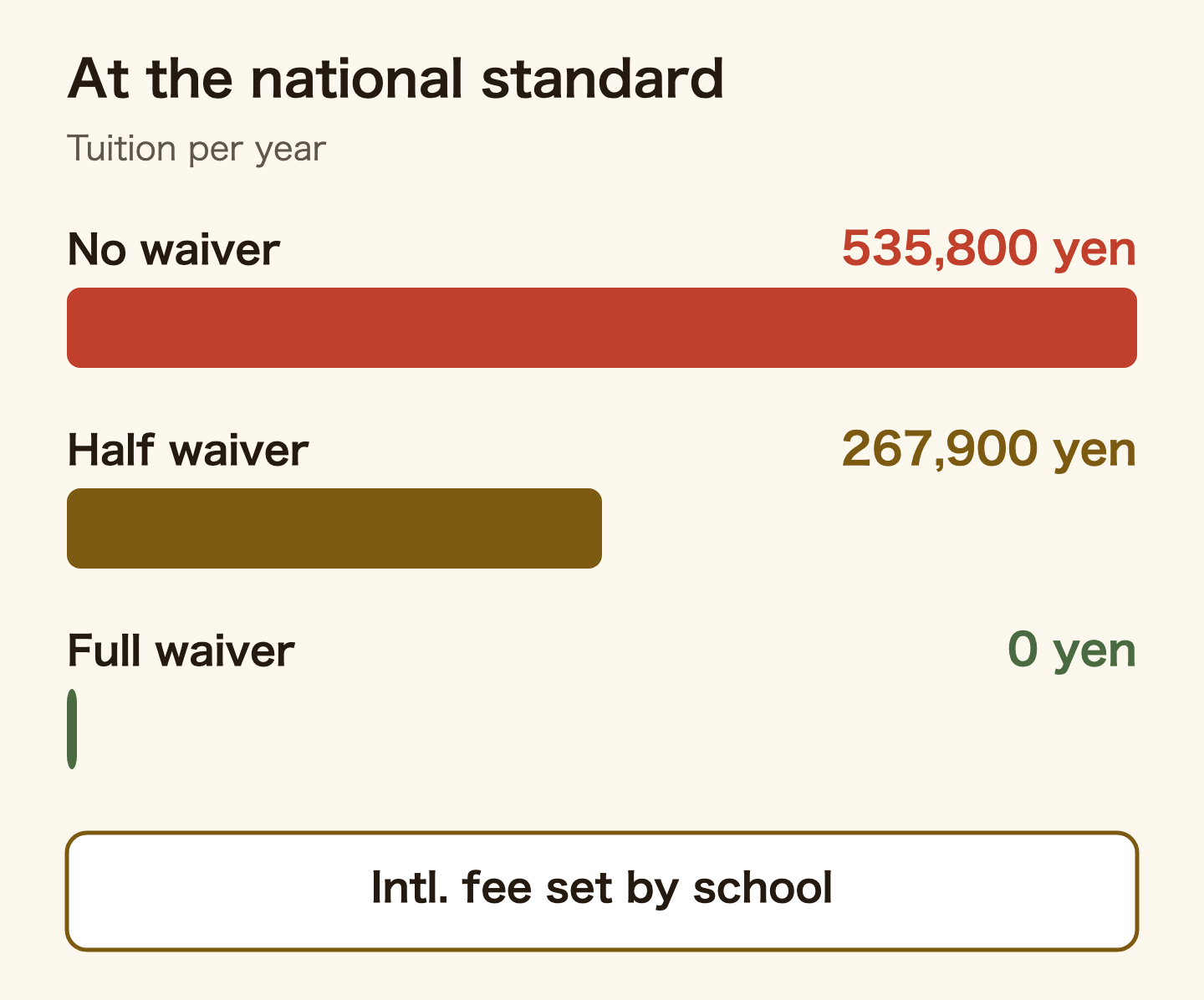
National university tuition follows a standard set by a ministry ordinance (Japanese): 535,800 yen a year for an undergraduate. The same ordinance tells national universities to take measures such as full or partial tuition waivers, or deferred payment, for people who struggle to pay for financial reasons. That is why each national university has its own waiver scheme.
Who may apply, though, differs. Here are three universities’ autumn 2026 rules side by side.
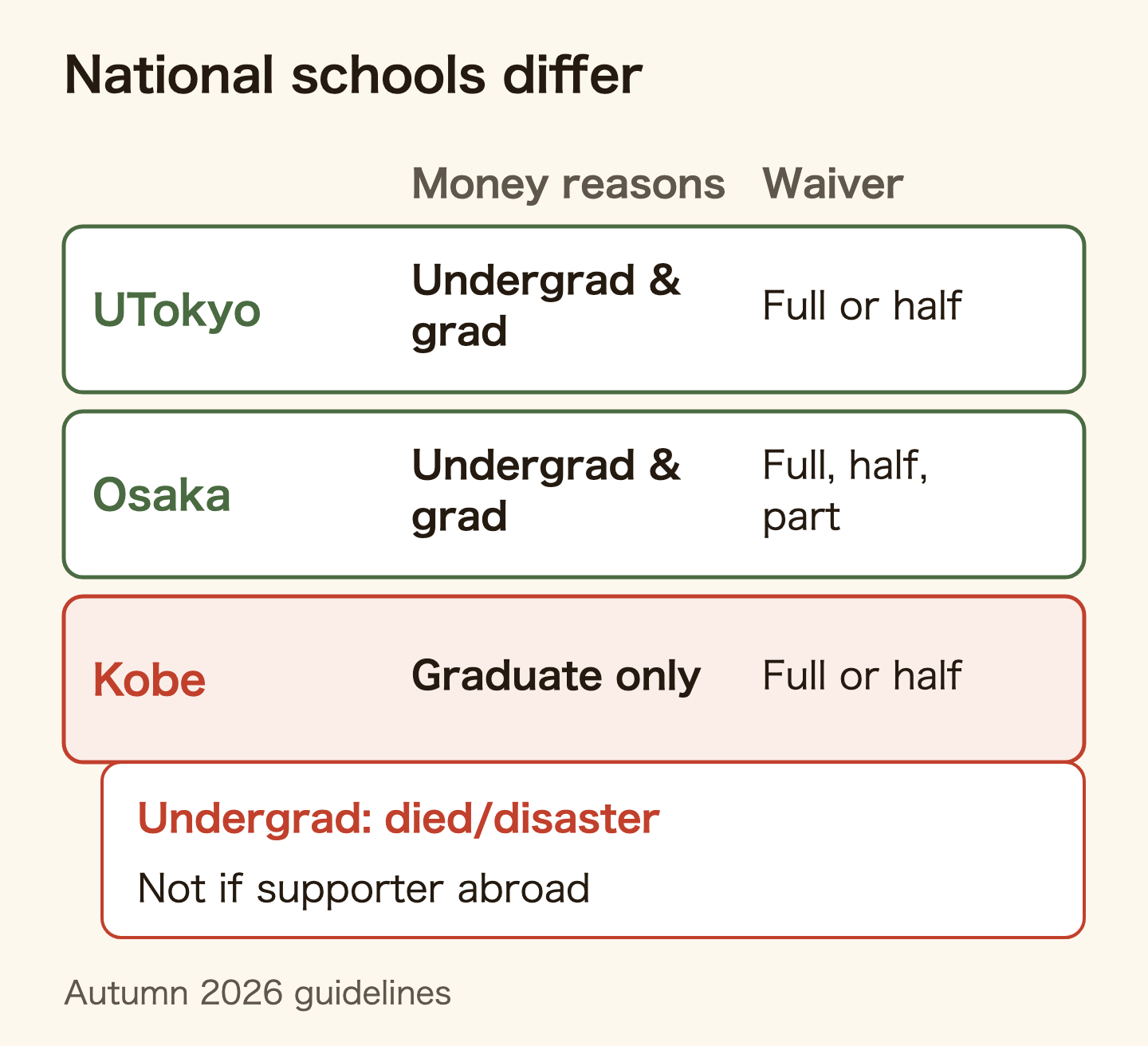
- University of Tokyo: international students apply for the university’s own waiver. You are judged on finances and grades, and within the budget you get a full or half waiver. Undergraduates and graduate students can both apply.
- Osaka University: its own scheme is, in principle, for people who cannot use the national scheme, and it names international students explicitly. The result is a full, half or partial waiver.
- Kobe University (PDF, Japanese): a waiver for financial hardship is for graduate students only. An international undergraduate can apply only if the person who supports the household has died, or after a disaster (for international students, a supporter living outside Japan does not count).
For an international undergraduate, two national universities can give opposite answers. Do not assume “national means I can apply”. Open your own university’s waiver page and check the rules for international students, and for undergraduate or graduate, first.
Tuition reduction at private universities: Waseda, APU and Ritsumeikan compared
Private universities have no common standard like the ordinance. Whether there is a reduction, how big, and when you apply are all up to the school.
- Waseda University (Japanese): the Tuition-Waiver Scholarship for self-funded international students takes 50% of annual tuition off your autumn fees. It is for self-funded students with Student status who have good grades and financial difficulty. For 2026, the Graduate School of Information, Production and Systems set the deadline at 4 pm on 15 May.
- Ritsumeikan Asia Pacific University (APU): the undergraduate Tuition Reduction Scholarship comes in five levels, 100%, 80%, 65%, 50% and 30%. Selection happens before you enrol; you cannot apply afterwards. There is a continuation review of your grades and other criteria every semester.
- Ritsumeikan University (Japanese): the current tuition reduction scheme for self-funded international students ends in the 2026 academic year. What happens from 2027 is undecided.
At a school like APU, finding out after you arrive is too late. If you are still applying, look for the tuition reduction section in the application itself.
This article did not check vocational schools or Japanese language schools. If you study at one, the quickest route is to ask the office: “Is there a tuition reduction for international students, and when is the deadline?”
What are the conditions for a tuition fee exemption?
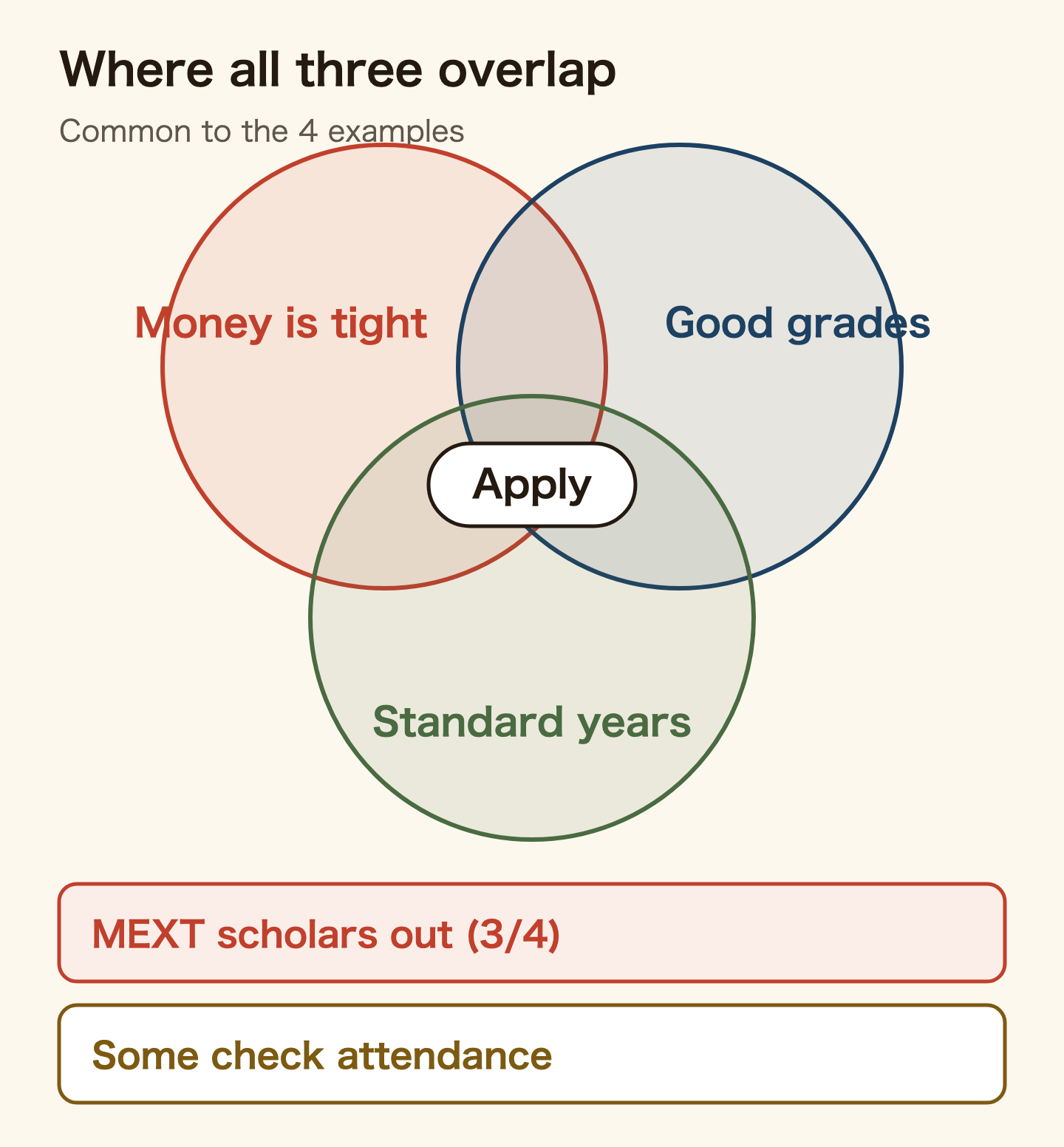
The four universities used as examples here (Tokyo, Osaka, Kobe for graduate students, and Waseda) overlap on three points.
- Finances: paying tuition is hard for financial reasons. The University of Tokyo judges this with a household formula that takes deductions off your income.
- Grades: your studies are going well. Osaka considers academic ability but does not publish the standard. The University of Tokyo says each faculty sets its own standard and some do not publish it.
- Standard years: you have not stayed beyond the standard length of your programme without a special reason.
Some schools add more. Waseda excludes students whose attendance shows no intention of continuing their studies. Government-sponsored (MEXT) scholars and students sent by a foreign government are excluded at Osaka, Kobe and Waseda.
Three ways the counting can catch you out
- The reference date: Tokyo and Osaka judge your family and finances as of 1 April for spring and 1 October for autumn. Tokyo asks you to tell them if, after you apply, a family member starts or leaves a job before that date.
- Leave counts toward your years: Kobe counts your enrolment period “from entry, including leave of absence”. A leave pushes you over the standard years sooner than you think.
- Scholarships count as income: for international students’ tuition waivers only, the University of Tokyo adds the scholarship you expect to receive that year to your income. If a scholarship is confirmed after you apply, tell them.
When and how do I apply? Autumn runs August to October, every year again
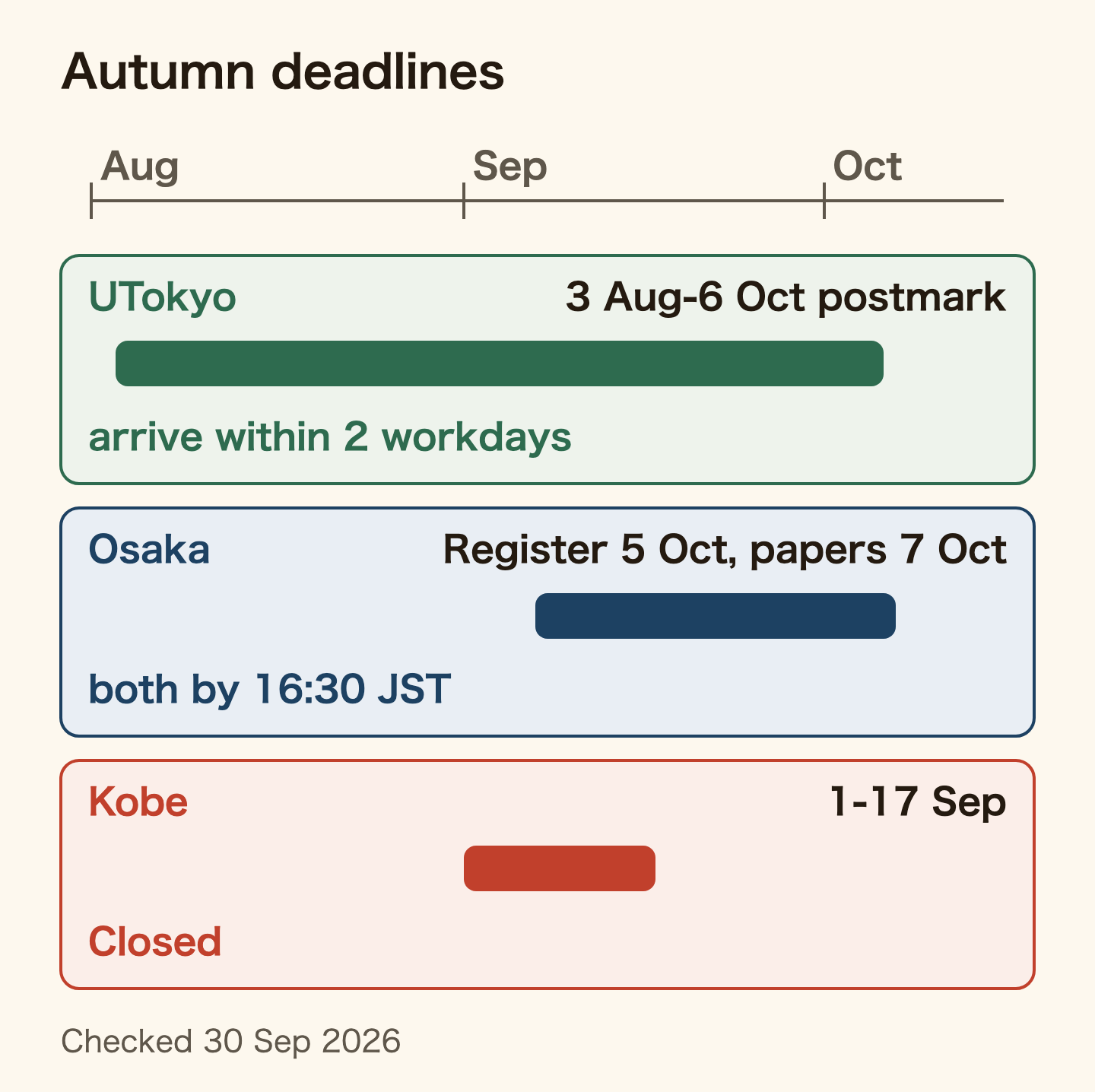
Tokyo, Osaka and Kobe judge tuition by semester, so there are two application rounds a year. At the University of Tokyo, spring ran from 13 February to 3 April and autumn from 3 August to 6 October. Here are the autumn 2026 deadlines.
| University | Autumn 2026 deadline |
|---|---|
| University of Tokyo | 6 October (postmark, and it must arrive within two working days after. In person: Hongo until 5 pm, Komaba until 4 pm) |
| Osaka University | Online registration by 4:30 pm on 5 October, documents by 4:30 pm on 7 October (Japan time) |
| Kobe University | 1 to 17 September (post only; closed) |
All three, in principle, refuse applications after the deadline (Kobe makes an exception for sudden illness or an accident on the final day, if you contact them within the period and submit a doctor’s certificate). Tokyo lets you apply for autumn alone if you missed spring. An application is “valid for that academic year only” at Tokyo and made “each semester” at Kobe. Even if it goes through, you apply again next year.
Steps and documents
- Read that semester’s guidelines on your university’s waiver page (some have an English version)
- Register in the online system if your university has one (Osaka)
- Gather the documents and submit them by post or at the counter
- Wait for the result. For autumn, Tokyo announces in mid-January, Osaka on 29 January (planned), Kobe from January (planned)
At the University of Tokyo, an international student submits the application form, a copy of the student ID, a statement of your own income, a household finance statement, a tax (or non-taxation) certificate and proof of income, among others. If you have family living in Japan, add a residence certificate (juminhyo). If you were not living in Japan on 1 January 2026, no tax certificate can be issued, so you submit a copy of your residence card instead. Documents in languages other than Japanese or English need a Japanese translation, and your own translation is fine.
At Osaka, a self-funded international student must write, on the application form, why they are applying for a waiver even though they proved they could pay their costs. You showed you could afford tuition and living costs before you came. Write specifically what has changed: money from home stopped, a parent lost a job.
What if I pay my tuition first?
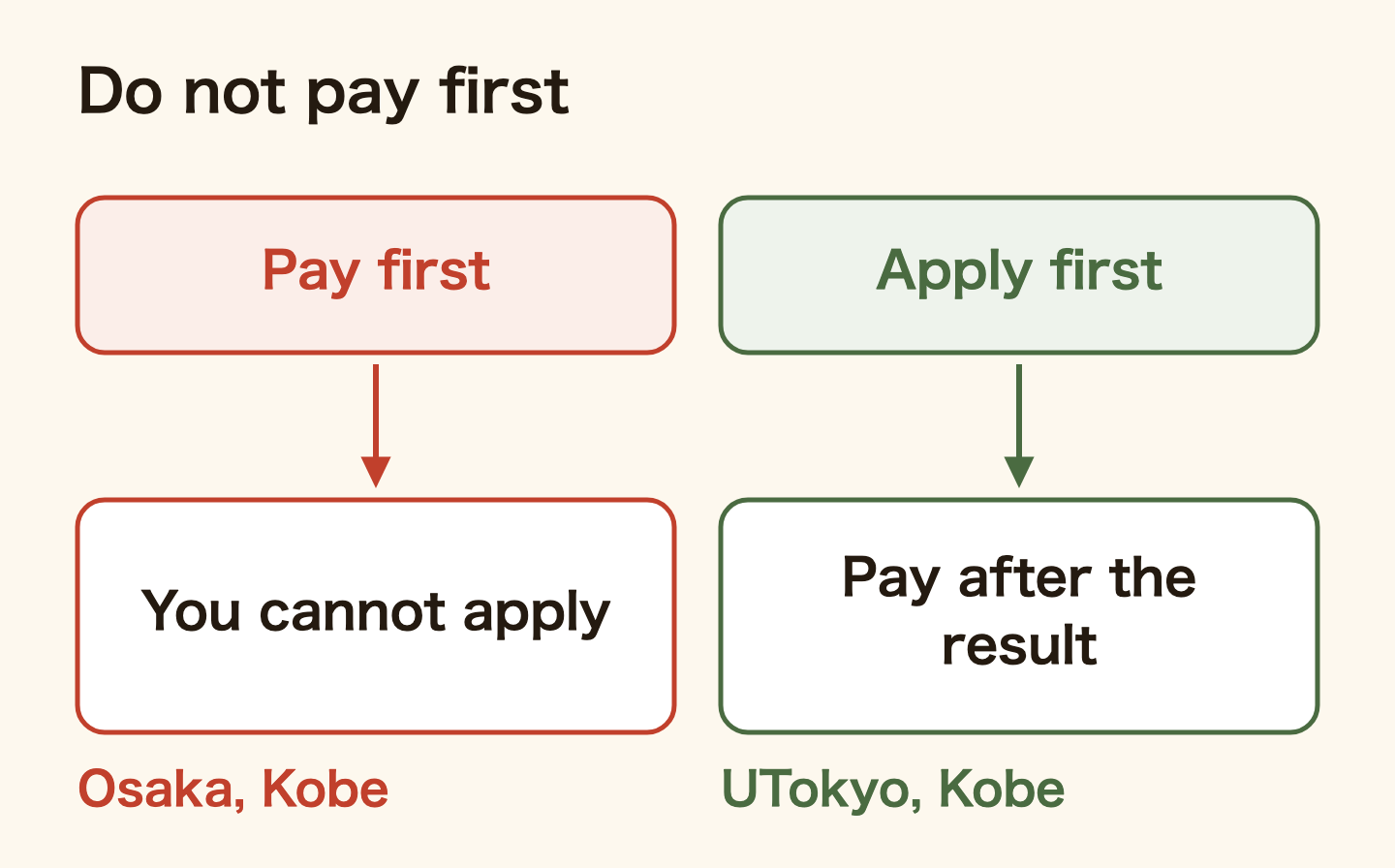
The slip arrives, so you pay by the due date and deal with any problem later. Where you come from, that may be normal. At Osaka and Kobe, the order runs the other way.
Osaka says students who have already paid “cannot apply”. Kobe excludes anyone who has already paid that year’s or that semester’s tuition. On the other hand, once you apply, you do not have to pay until the result. Tokyo defers payment until the result in mid-January, and Kobe says payment is “not required until the result is known”.
If you mean to apply for a waiver, apply before you pay. If your university collects by direct debit, it is worth asking the waiver office whether applying stops the debit.
How much does a tuition fee exemption save?
On the national standard of 535,800 yen a year, a half waiver leaves 267,900 yen and a full waiver leaves nothing. Because each semester is judged separately, in practice each semester’s tuition is waived in full or by half.
Real fees differ by university. The ordinance lets a university go up to 120% of the standard for special reasons. And a national university may set tuition for students with Student status separately from the standard. Check your university’s fee page for the international student amount before you do the sums.
At private schools, Waseda takes 50% of annual tuition and APU 30% to 100%. Fees other than tuition, such as lab fees, are not covered by Waseda’s reduction.
What if the information is wrong? Cancellation, and a check against your visa papers
If what you submit is not true, a waiver can be withdrawn even after it is granted. Kobe says false statements can cancel a waiver after approval. Waseda says it may cancel the award and ask for the money back, for example when you no longer meet the conditions.
Osaka says that if the household documents raise doubts, it may check the financial documents you gave the university when it applied for your Certificate of Eligibility (COE). The “money I can pay” you declared to come to Japan and the “reason I cannot pay” in your waiver application are read side by side, at the same university. Explain what changed, honestly, with documents that prove it.
Refused, or missed the deadline? Deferral, instalments and scholarships
A refusal does not close every door. The University of Tokyo offers deferred payment (autumn tuition until the end of February) and monthly instalments. The deadline is the same as for the waiver, though, and once it passes these are gone too. At Osaka you can apply for only one of waiver, deferral or instalments for tuition, so choose before you apply.
The other way to fill the gap is money you do not repay. The national scheme is closed to you, but international students have scholarships for international students. The University of Tokyo counts scholarships as income in the waiver review, so if you apply for both, tell the waiver office as soon as a scholarship is confirmed.
The very last resort is a leave of absence. It affects your status and your part-time work too, so read what a leave of absence does to your student visa before you decide.
Which one are you?
- At a national university and have not paid autumn tuition yet — open your university’s waiver page today and check whether international students can apply, and the deadline. Tokyo: postmarked 6 October. Osaka: online registration by 4:30 pm on 5 October.
- Holding the payment slip and unsure whether to pay — before paying, email the waiver office and ask: “If I apply, can I wait for the result before paying?”
- At a private university, vocational school or language school — ask the office today whether there is a tuition reduction for international students and when the deadline is, and write the answer down.
- Still applying to a Japanese university — look for a tuition reduction section in the application. At schools like APU, you can apply only before enrolling.
- Refused, or past the deadline — this week, ask the student office whether you can defer or pay in instalments, and when scholarships for international students open.
FAQ
Q. Can international students use Japan’s higher education support scheme (“free university”)?
Not with Student status. MEXT’s eligibility table marks it “cannot apply”, and JASSO limits foreign applicants to statuses such as Permanent Resident. Instead, you can use your school’s own waiver and scholarships for international students.
Q. Can international students apply for a tuition fee exemption at a national university?
Usually through the university’s own scheme. At the University of Tokyo and Osaka University, international students can apply and may receive a full or half waiver, among others (Osaka also grants partial amounts). At Kobe University, a waiver for financial reasons is for graduate students only (autumn 2026).
Q. What are the conditions for a tuition fee exemption in Japan?
Common to the universities checked: paying is hard for financial reasons, your grades are good, and you are within the standard years of your programme. Waseda also looks at attendance. MEXT scholars and students sent by foreign governments are excluded.
Q. When do I apply for a tuition fee exemption?
Many universities have two rounds, for spring and autumn. At the University of Tokyo, spring ran from 13 February to 3 April and autumn from 3 August to 6 October. An application is valid for one academic year, so you apply again every year.
Q. Can I apply for a waiver after paying my tuition?
Not at Osaka or Kobe: students who have already paid cannot apply. At Tokyo and Kobe, once you apply, you do not have to pay until the result. Apply before you pay.
Q. Do private universities in Japan offer tuition reductions to international students?
It depends on the school. Waseda reduces annual tuition by 50%, APU selects before enrolment for reductions of 30% to 100%, and Ritsumeikan’s current scheme ends in the 2026 academic year, with 2027 onward undecided.
Summary
The national support scheme your Japanese friends use is closed to anyone with Student status. Your route is the tuition waiver your school runs itself, plus scholarships for international students. National universities all have their own waivers, but some, like Kobe, do not cover international undergraduates for financial reasons. At private schools, whether a reduction exists, how large it is and when you apply all vary.
Wherever you study, the conditions overlap on finances, grades and standard years, and you apply again each semester or each year. At some national universities, paying first shuts you out. When the payment slip arrives, check your school’s waiver page and deadline before you pay.
Official sources: MEXT, higher education support scheme (Japanese) / MEXT, nationality and residence status requirements (PDF, Japanese) / JASSO, eligibility for the grant-type scholarship while enrolled (Japanese) / e-Gov, Ordinance on tuition and other fees of national universities (Japanese) / University of Tokyo, 2026 admission and tuition fee exemption for international students / University of Tokyo, 2026 fee exemption guide (PDF, Japanese) / University of Tokyo, fee exemption FAQ for international students (Japanese) / Osaka University tuition exemption system (Japanese) / Osaka University, autumn 2026 application guidelines (PDF, Japanese) / Kobe University, tuition exemption for current undergraduates (Japanese) / Kobe University, autumn 2026 exemption guide (PDF, Japanese) / Waseda University, 2026 Tuition-Waiver Scholarship (Japanese) / Ritsumeikan University, scholarships for international students (Japanese) / APU Tuition Reduction Scholarship for International Students (Undergraduate) (all checked on 30 September 2026). Schemes and deadlines change every semester. Always read your own school’s latest guidelines before applying.
Related reading
Found this useful? Share it
Send it to a friend who lives in Japan.
WHO WROTE THIS

mori
Japanese. I read the ministries’ own notices, orders and Q&As in the original, and I start from what my Nepalese and Sri Lankan friends in Japan actually ran into. I do not write about what I have not checked or been told.
What this site can and cannot do →Looking for something else?