Checked on 23 September 2026 against the Ministry of Internal Affairs and Communications’ furusato nozei portal (how it works, deductions, FAQ, official notices), National Tax Agency Tax Answer No.1155, the Local Tax Act and Income Tax Act on e-Gov, and the official pages of Kyoto City and Yokohama City.
The short answer
- Furusato nozei (“hometown tax”) lets you donate to any Japanese municipality and get everything above 2,000 yen back from your income tax and resident tax. There is no nationality requirement.
- It only works if you pay resident tax (the income-based part). A student whose income is too low for resident tax pays the whole donation.
- Your limit is set by 20% of your resident-tax income levy. You can estimate it from the resident-tax notice you get around June.
- The one-stop exception needs no tax return and 5 municipalities or fewer. The form must arrive by 10 January of the next year (Kyoto City’s rule; check each municipality).
- If you are leaving Japan, it depends on whether you live here on 1 January after the donation. Leave in December, and nothing comes off resident tax.
Knowing this, you can tell before you donate whether it will cost you 2,000 yen or the full amount. If you plan to leave Japan, you will also know whether this is a year to donate at all.
December at work, and your colleagues are comparing furusato nozei picks. Someone’s rice arrived; someone else is waiting for grapes. You ask whether you can do it too, and the answer is “sure, if you have a resident card.” What they do not think about is that you are going home next spring, or that until last year you were a student who paid no tax. Those two things are exactly what decide whether it pays off.
- Can foreigners do furusato nozei?
- How does furusato nozei work? You pay 2,000 yen; the rest comes off two taxes
- What is my furusato nozei limit?
- What is the furusato nozei one-stop exception?
- When do I need a tax return instead?
- Missed the 10 January deadline?
- What if I leave Japan? The 1 January rule
- Is furusato nozei worth it for international students?
- What are the rules on gifts and points?
- How much does it cost?
- Which one are you?
- FAQ
- Summary
- Related reading
Can foreigners do furusato nozei?
Yes. Furusato nozei is a system where you donate to a prefecture or municipality of your choice, and the part of the donation above 2,000 yen is, in principle, taken off your income tax and resident tax (Ministry of Internal Affairs and Communications). It does not have to be your hometown. Any municipality in Japan will do.
The law has no nationality condition. The income-tax donation deduction is for “residents” — people with an address in Japan (Income Tax Act Art. 78). The resident-tax deduction is for people who pay the income-based part of resident tax (Local Tax Act Art. 37-2). Whatever your visa, if both apply to you, you are treated exactly like a Japanese taxpayer.
The flip side: if you pay no tax, it does nothing for you. The ministry’s FAQ says the deduction is for “those who pay income tax or resident tax”. The donation also has to be in the name of the taxpayer.
Plenty of people use it. In the 2026 resident-tax year, about 11.51 million people received the furusato nozei deduction (ministry survey).
How does furusato nozei work? You pay 2,000 yen; the rest comes off two taxes
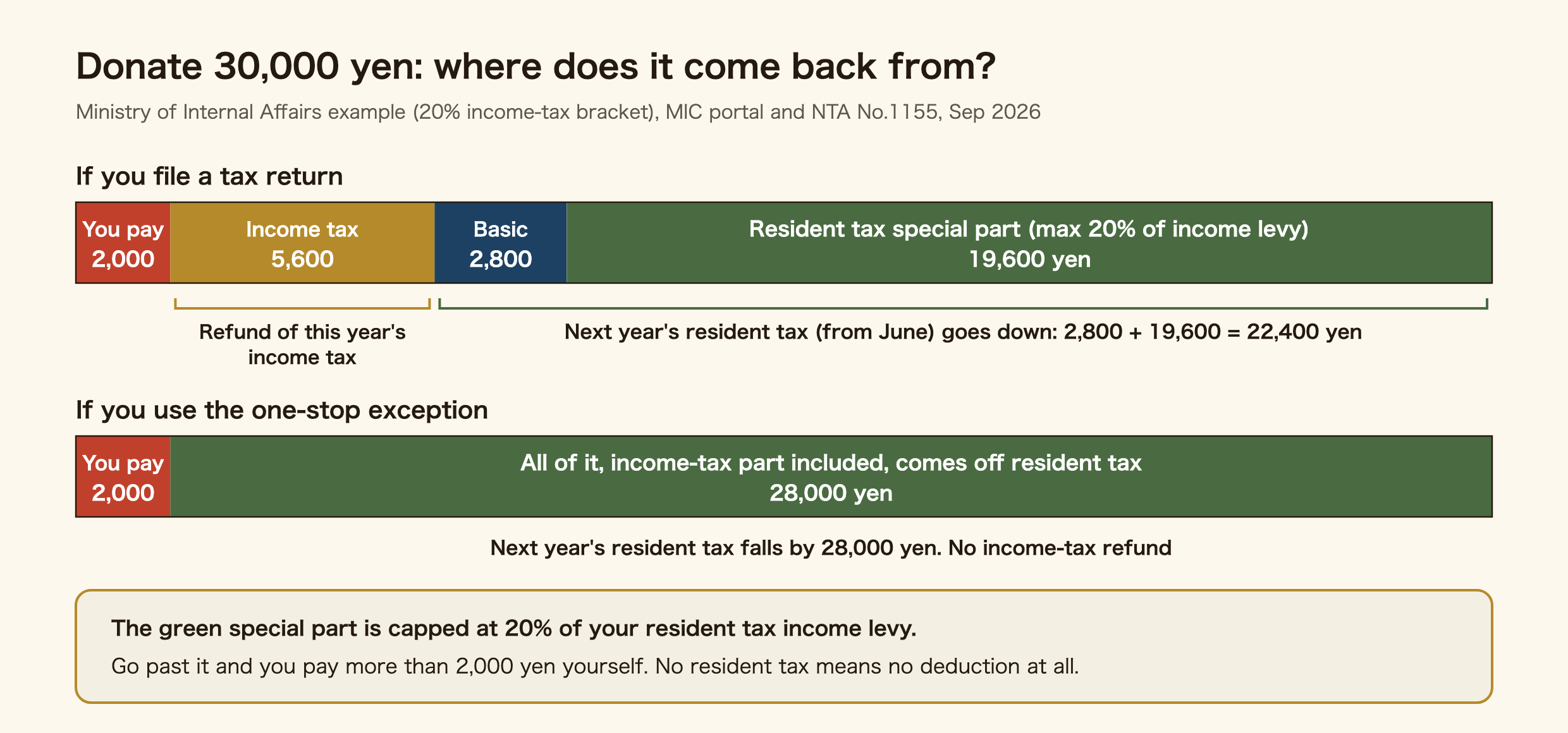
Your donation comes back from three places. The ministry and the National Tax Agency publish the formula.
- Income tax: (donation − 2,000 yen) × your income-tax rate
- Resident tax, basic part: (donation − 2,000 yen) × 10%
- Resident tax, special part: everything that is left, up to 20% of your resident-tax income levy
In the ministry’s example, a person in the 20% bracket who donates 30,000 yen gets 5,600 yen from income tax, and 2,800 plus 19,600 yen from resident tax. That is 28,000 yen back; they paid 2,000 yen. In the 5% bracket the income-tax share is smaller and the resident-tax special part is larger. The total is the same.
It comes back in two ways. The income-tax part is refunded to your bank account after you file that year’s return. The resident-tax part is not paid out: your resident tax from the following June is simply lower. The thank-you gift arrives from the municipality you donated to.
The 2,000 yen is charged once on your total donations for the calendar year, not once per donation. Donate to five places and you still pay 2,000 yen (ministry FAQ).
What is my furusato nozei limit?
It is different for everyone. What sets it is the cap on the resident-tax special part: 20% of your resident-tax income levy. Donate beyond it and the extra does not come back, so your cost rises above 2,000 yen.
The ministry publishes these guideline limits (the donation that comes back in full, minus 2,000 yen).
| Salary | Single | Couple + 1 child | Couple + 2 children |
|---|---|---|---|
| 5 million yen | 61,000 yen | 40,000 yen | 28,000 yen |
| 7.5 million yen | 118,000 yen | 87,000 yen | 76,000 yen |
| 10 million yen | 180,000 yen | 157,000 yen | 144,000 yen |
| 20 million yen | 569,000 yen | 552,000 yen | 536,000 yen |
The table starts at 5 million yen. If you earn less, estimate your own limit from your resident-tax notice.
- Find the “income levy” (shotokuwari) amount on your notice. If tax comes out of your salary, it is on the special-collection notice your employer passes on from mid-May. If you pay by slip, it is on the tax notice mailed in early June (Yokohama City guidance)
- Income levy × 20% = the cap on the special part
- Divide that by (90% − your income-tax rate) and add 2,000 yen. In the 5% bracket, divide by about 85% (5.105% including the reconstruction surtax)
Example: income levy 100,000 yen, 5% bracket. 100,000 × 20% = 20,000. 20,000 ÷ about 85% = about 23,500. Add 2,000 and the limit is roughly 25,500 yen. With an income levy of 10,000 yen, the limit drops to about 4,350 yen.
Strictly, the levy that counts is the one on the year you donate. Your notice shows last year’s, so if your income changed a lot, the estimate moves. If in doubt, stay a little below the estimate rather than right at it. Your city or ward office’s resident-tax desk can give you the exact figure (ministry FAQ).
What is the furusato nozei one-stop exception?
The one-stop exception lets you get the deduction without filing a tax return. You send a form to the municipality you donated to, and it notifies your own city.
You can use it if both apply (ministry portal; Local Tax Act Suppl. Art. 7):
- You do not need to file a tax return — for example, an employee whose taxes are settled by the year-end adjustment
- You donated to 5 municipalities or fewer in the year. Several donations to one municipality count as one (Kyoto City)
Kyoto City’s version of the steps:
- When you donate, ask for the application form (or apply online)
- Fill in your name, address, date of birth and so on
- Attach a copy of both sides of your My Number Card. Without the card: a copy of your notification card or a resident record showing your number, plus a copy of ID such as a driving licence or passport
- Send one form per municipality, arriving by 10 January of the following year
Some municipalities accept online applications on a smartphone with a My Number Card. Forms and addresses differ, so follow the instructions from where you donated. We found no official rule on how to write foreign names (middle names, registered aliases) for furusato nozei. Keep your resident record in front of you and ask the municipality you donated to.
With the one-stop exception you get no income-tax refund. The whole amount, income-tax part included, comes off next year’s resident tax from June. The total is the same as with a tax return (ministry portal).
When do I need a tax return instead?
If any of these apply, claim furusato nozei on your tax return, filed between 16 February and 15 March of the year after the donation.
- You donated to 6 or more municipalities
- You have to file anyway — side income, two jobs and so on
- You are filing to claim medical expenses or a refund
Watch the third one. Filing a tax return cancels your one-stop applications. The National Tax Agency says to include every furusato nozei donation, the one-stop ones too, on the return. If you forget and file without them, you can fix it with a request for correction (NTA No.1155).
You will need the donation receipts the municipalities send you. How to prepare and file is in the guide to filing a tax return in Japan.
Missed the 10 January deadline?
Any municipality whose form did not arrive by 10 January goes on your tax return instead. Gather the receipts and file between 16 February and 15 March. Put every donation on the return, including the ones whose forms did arrive.
Donate at the very end of December and the paperwork may not make it. Kyoto City does not even enclose the form for donations from 29 December onwards. For year-end donations, pick a municipality that takes online applications, or plan on a tax return from the start.
There is a second deadline. If your address changes after you apply, send a change notice to each municipality by 10 January (Local Tax Act Suppl. Art. 7). Without it, the one-stop exception does not apply (Yokohama City guidance).
What if I leave Japan? The 1 January rule
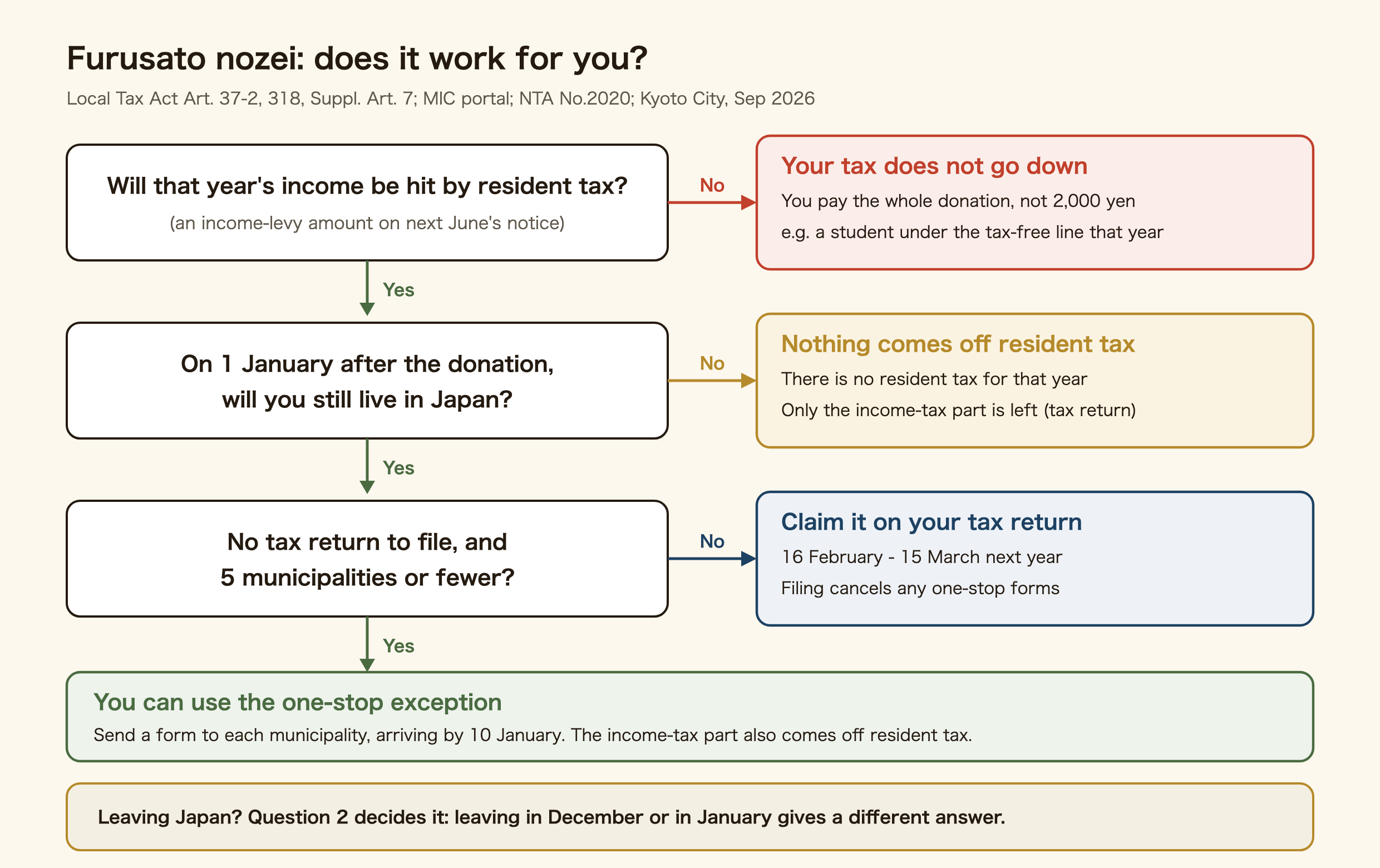
Most of the money comes back through next year’s resident tax. And resident tax is charged on people who have an address in Japan on 1 January (Local Tax Act Art. 318).
So if you leave Japan before the end of the year you donated, you have no Japanese address on the following 1 January, and no resident tax to reduce. The resident-tax parts never come back, so in the year you leave for good, furusato nozei is mostly money out of your pocket. The one-stop exception does not work either, because it runs entirely through next year’s resident tax.
What is left is the income-tax part. If you put the donation on that year’s tax return, there is a route to the (donation − 2,000 yen) × income-tax-rate part. But in the 5% bracket, a 30,000-yen donation gets you back only about 1,400 yen. A return filed around departure involves appointing a tax agent, so check with the tax office.
Leave on 2 January or later and it is different. You were here on 1 January, so that year’s resident tax applies and so does the deduction. You just have to settle that resident tax before you go. Paying it off, or appointing a tax agent, is covered in the leaving-Japan section of the residence tax guide.
Is furusato nozei worth it for international students?
For most students, no. The deduction comes off the income-based part of resident tax. If that is zero, there is nothing to take it from, and you pay the whole donation.
Students living on part-time work often pay no resident tax. In Tokyo’s 23 wards, with no dependants, a salary of roughly 1.1 million yen or less last year means no resident tax (Tokyo Bureau of Taxation; the line differs by municipality). Paying only the flat per-capita part does not help either, because the deduction only comes off the income levy.
Even students who pay a little income levy have a tiny limit. An income levy of 10,000 yen means a limit of about 4,350 yen. The law caps what a municipality spends on the gift at 30% of the donation, so anything you donate beyond your limit is mostly a loss.
While you are studying, a better use of your time is checking whether tax taken from your part-time pay can come back. Once you are working and your June notice shows an income levy, that is the time to start.
What are the rules on gifts and points?
The gifts are regulated by law. Only municipalities designated by the Minister of Internal Affairs qualify, and two of the conditions are about gifts (Local Tax Act Art. 37-2):
- The cost of the gift must be 30% of the donation or less
- The gift must be a local product or service from that municipality’s area
Points changed too. From 1 October 2025, municipalities may not collect donations through businesses that give donors points or other rewards for donating. The rule is in the ministry’s notice as revised on 28 June 2024, and it applies to designations from October 2025. So the answer to “until when do furusato nozei points work?” is September 2025. Ordinary payment points — what your card gives you on any purchase — are excluded from the ban.
The later changes, stage by stage:
- 1 October 2026: the standards for municipalities change (for example, publishing how donations are used; MIC Notice No. 145 of 2026). Nothing changes in what you, the donor, do
- Donations from 2027: the resident-tax special part gets a cap of 1.93 million yen. The law was promulgated on 31 March 2026. The ministry’s material puts it at the level of a salary around 100 million yen, so it will not touch most people
The gift itself can be taxable. It counts as “occasional income”, and occasional income above 500,000 yen a year is taxed (ministry FAQ). Normal-sized donations come nowhere near.
How much does it cost?
| Item | Cost |
|---|---|
| Your share (once a year) | 2,000 yen |
| Donations above your limit | Mostly out of your pocket |
| If you pay no resident tax | The whole donation |
| If you are not in Japan on the next 1 January | The resident-tax part (most of it) |
Furusato nozei means paying first and getting it back later. The whole donation leaves your account now. The resident-tax part returns over the twelve months from next June, so do not make a big donation in a month when money is tight.
Which one are you?
- Employee staying in Japan — find the income levy on your resident-tax notice and estimate your limit. Keep it to 5 municipalities and put “one-stop forms arrive by 10 January” in your calendar.
- Filing a tax return anyway (side income, medical costs) — donate assuming no one-stop. Keep all the receipts in one envelope and put every donation on the return from 16 February.
- Leaving Japan this year — skip furusato nozei this year, or donate knowing you will pay for it yourself. Check the order of everything else with the leaving-Japan checklist.
- Student with a part-time job — look for an income-levy amount on your resident-tax notice. If there is none, do not donate.
FAQ
Q. Can foreigners do furusato nozei?
Yes. There is no nationality requirement. If you have an address in Japan and pay income tax or resident tax, you get the same deduction as a Japanese taxpayer. If you pay no resident tax, you pay the whole donation yourself.
Q. How much does furusato nozei cost me?
2,000 yen, as long as you stay within your limit. It is charged once on the year’s total. Anything above the limit does not come back, so your cost goes up.
Q. How do I work out my furusato nozei limit?
Take the income levy on your resident-tax notice, multiply by 20%, divide by (90% − your income-tax rate) and add 2,000 yen. With an income levy of 100,000 yen in the 5% bracket, that is about 25,500 yen. Your city office can give you the exact figure.
Q. What is the deadline for the one-stop application?
In Kyoto City’s case, it must arrive by 10 January of the year after the donation. Check the deadline with each municipality. Anything that misses it can be claimed on a tax return between 16 February and 15 March.
Q. I am leaving Japan this year. Is furusato nozei still worth it?
Hardly. Without a Japanese address on 1 January after the donation, the resident-tax parts never come back. The only route left is the income-tax part, through a tax return.
Q. Is furusato nozei worth it for international students?
Not unless you pay the income-based part of resident tax. The deduction comes off that part, so a student whose part-time income is too low for resident tax pays the whole donation.
Summary
Furusato nozei is open to anyone, of any nationality, who pays the income-based part of resident tax. Within your limit it costs 2,000 yen a year. The limit comes from 20% of your income levy, which you can find on your June notice.
If you file no tax return, keep to 5 municipalities and get the one-stop forms in by 10 January. If you are leaving Japan, 1 January decides everything. And if you are a student paying no resident tax, it is not your turn yet.
Official sources: MIC furusato nozei portal, tax deductions (Japanese) / MIC portal FAQ (Japanese) / MIC notices and surveys (Japanese) / MIC guideline limits (PDF, Japanese) / NTA Tax Answer No.1155 (Japanese) / e-Gov: Local Tax Act Art. 37-2, 318, Suppl. Art. 7; Income Tax Act Art. 78 / Kyoto City, one-stop exception (Japanese). Checked on 23 September 2026. Confirm the form, address and deadline with each municipality you donate to.
Related reading
Found this useful? Share it
Send it to a friend who lives in Japan.
WHO WROTE THIS

mori
Japanese. I read the ministries’ own notices, orders and Q&As in the original, and I start from what my Nepalese and Sri Lankan friends in Japan actually ran into. I do not write about what I have not checked or been told.
What this site can and cannot do →Looking for something else?