Figures, prices and terms were checked against the MHLW Survey on Employment of Foreign Workers 2025 on 2 September 2026. They change – check the current terms yourself before you sign up or file anything.
Last updated: 18 October 2026
Summary
- A route into work is how you found the job you have now.
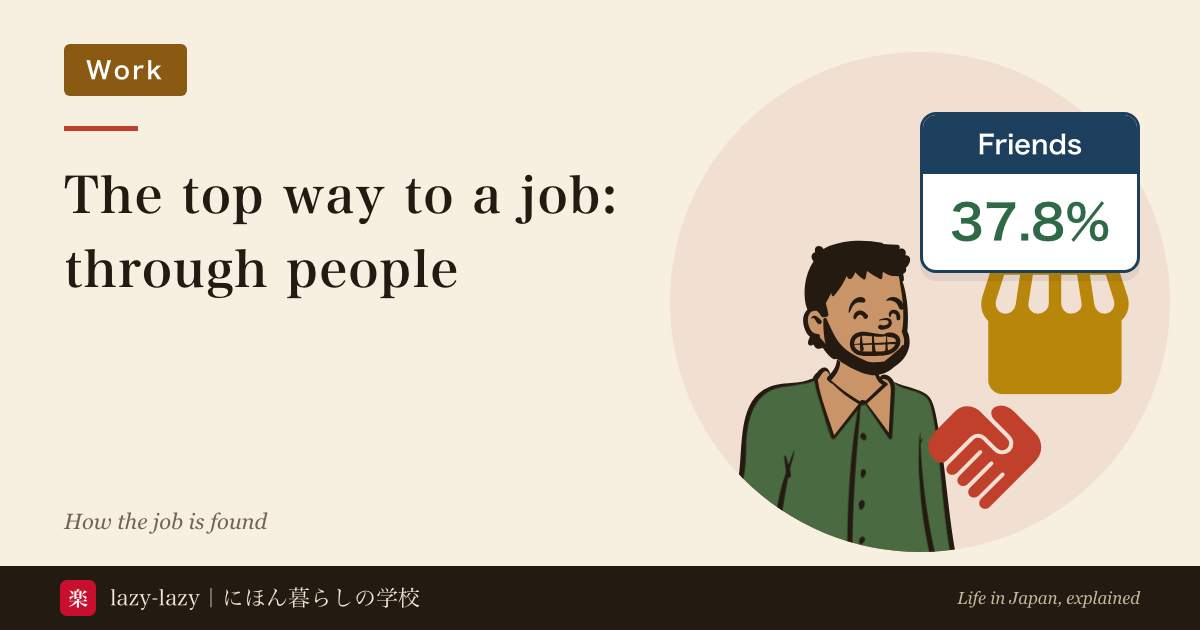
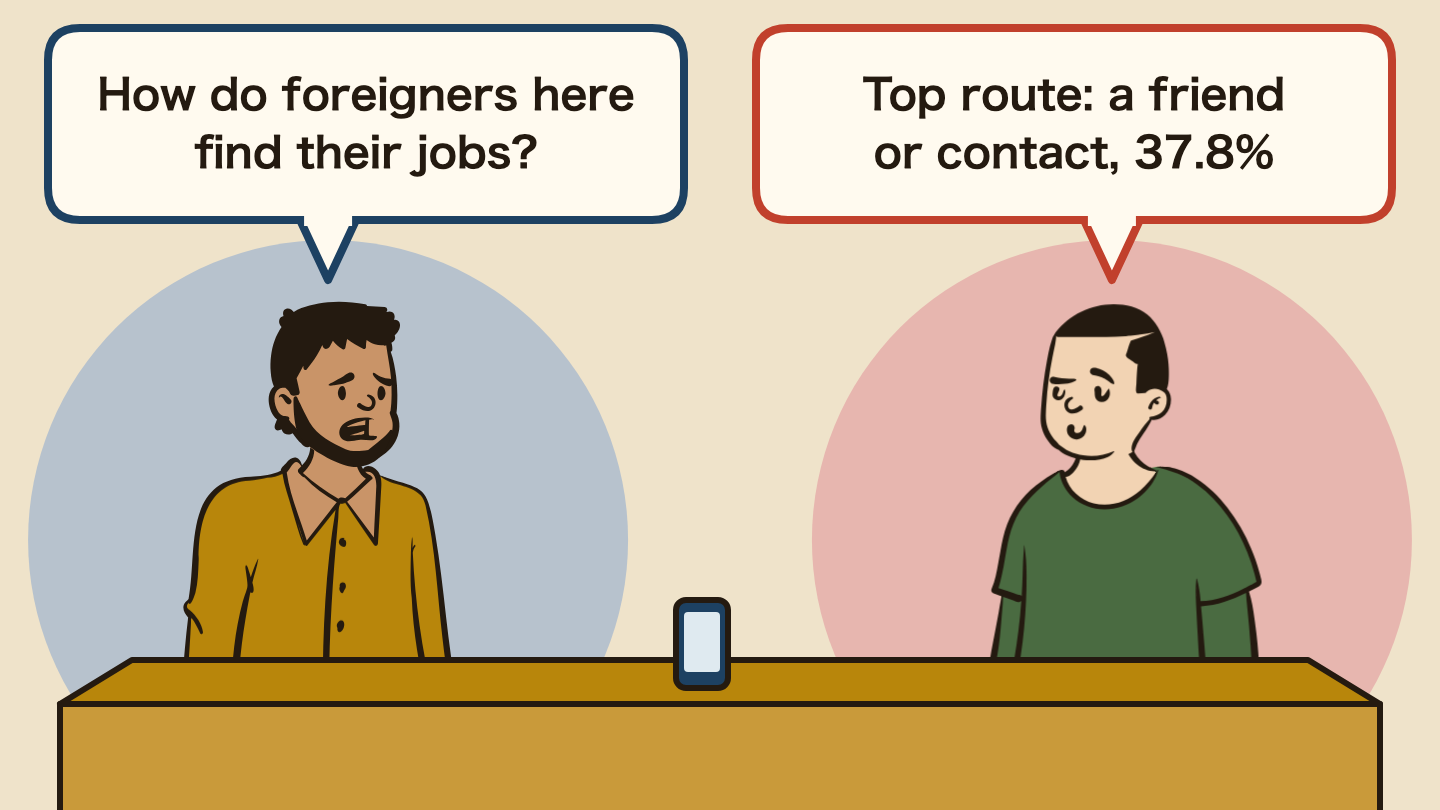
- Among foreign workers who were already living in Japan, the most common way of finding the job was a friend or acquaintance: 37.8%.
- Job adverts accounted for 19.1% – one person in five.
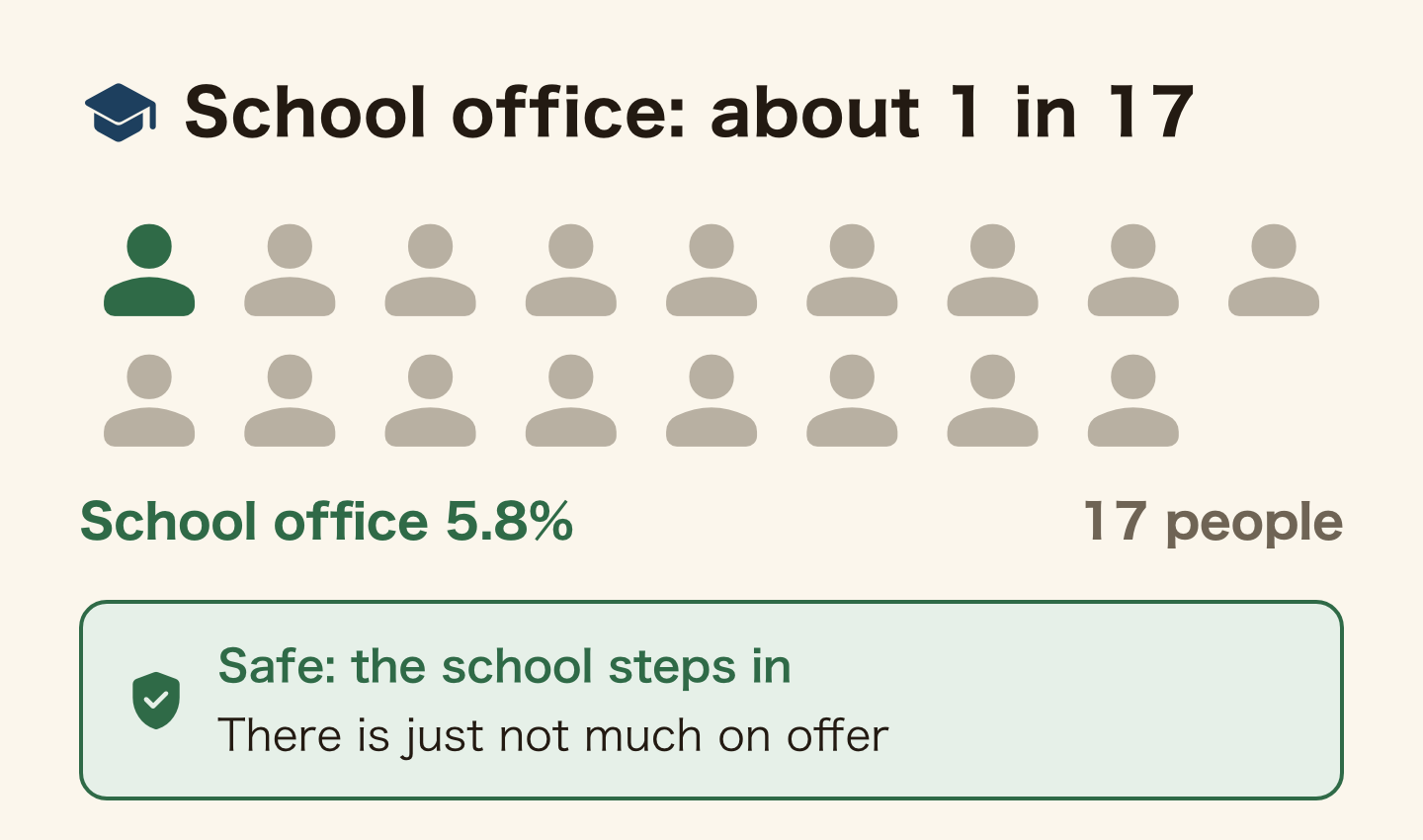
- School career offices accounted for 5.8%, about one in seventeen. You can ask the school for help if something goes wrong, but few jobs come this way.
- Hello Work, the public employment service, came to 6.3% including its website.
- Industry changes everything. In hotels and restaurants, job adverts are the top route at 30.6%.
- Word of mouth does not care where you live. Being outside Tokyo is not a disadvantage here.
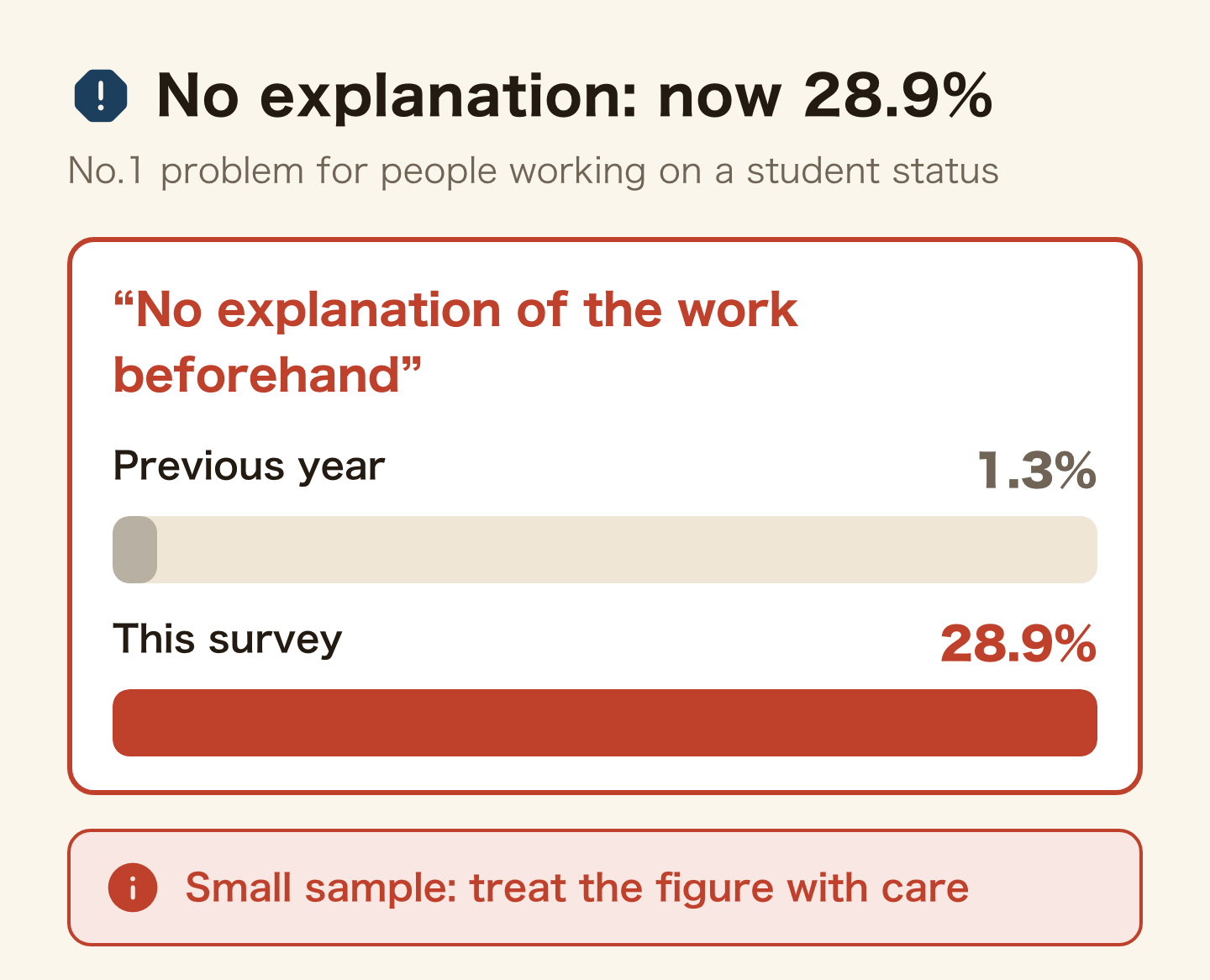
- But a friend brings you the job, not the rules. The top problem reported by people on a student status was “no explanation of the work beforehand”, at 28.9%.
What changes: you know 37.8% of jobs come through people you know – and you stop concluding ‘there is nothing’ from job sites alone.
You filter a job site for “foreigners welcome”, you apply, nothing comes back. You check the school noticeboard every day and nothing there fits. Your classmates are getting hired and you are not.
You are probably not bad at applying. You may simply not be using the entrance where most people go in.
A survey published by Japan’s labour ministry on 31 August 2026 records how people actually got their current job. The worker survey had 14,248 valid responses. The figures below cover those who were already living in Japan before they took the job. Here are the numbers as published.
- What is a route into work? The path that got you the job
- How foreigners actually find jobs in Japan
- Why you are not getting hired may be how you search
- The route that works depends on the industry
- The school office is safe, but it is about one in seventeen
- A friend brings the job, not the rules
- Living outside Tokyo is not a disadvantage
- The public service is free wherever you are
- How much Japanese is enough
- What to do this week
- FAQ
- Summary
What is a route into work? The path that got you the job
A route into work is the path by which you found the job you have now. Did you see an advert, did someone introduce you, or did your school’s office put you forward? The government survey counts each of these separately.
The figures below are for foreign workers who were living in Japan before they started the job. People recruited from overseas take different routes and are counted separately. If you are studying at a language school or a vocational school and looking for what comes next, this is your table.
How foreigners actually find jobs in Japan
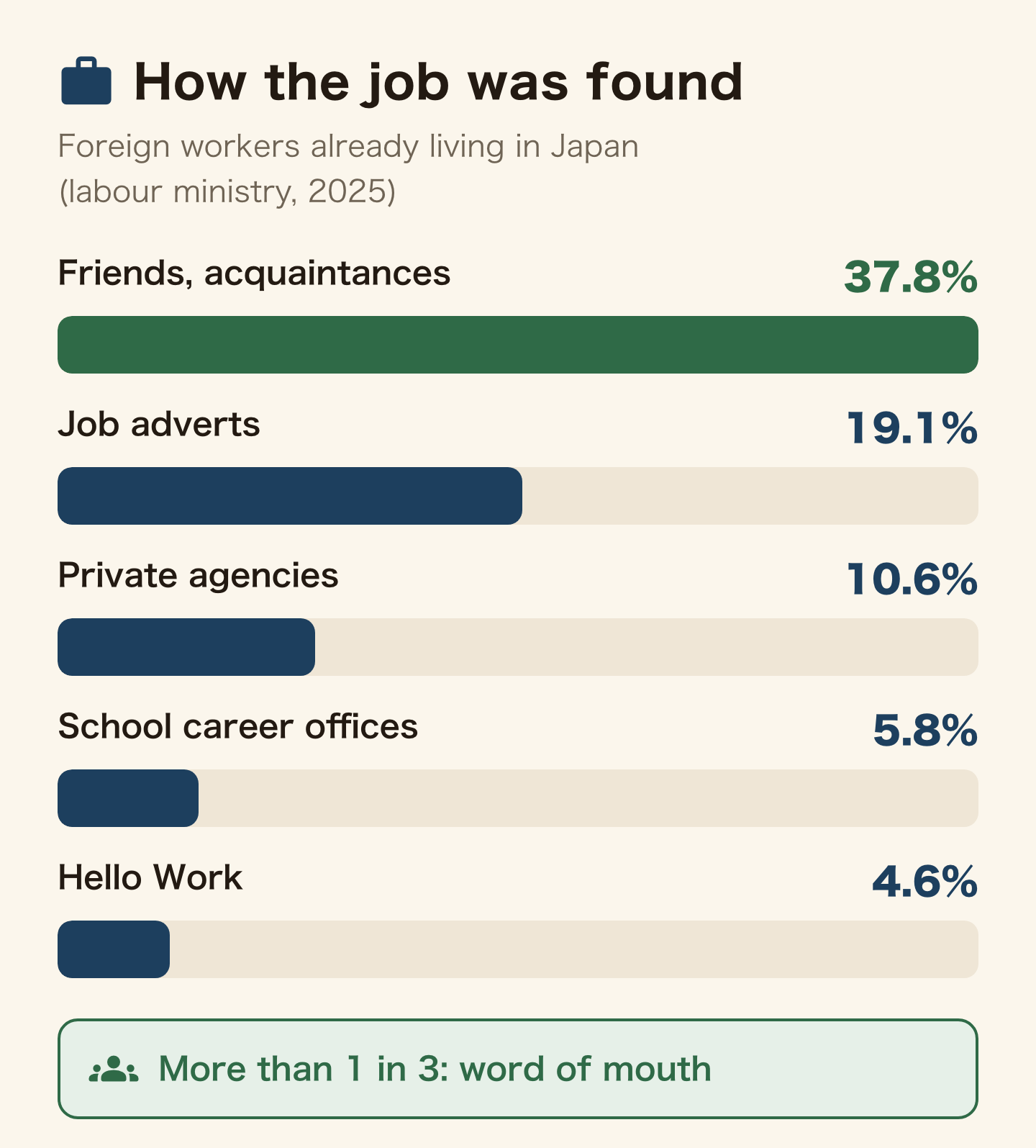
| How the job was found | Share |
|---|---|
| A friend or acquaintance | 37.8% |
| Job adverts (magazines, internet) | 19.1% |
| A private agency in Japan | 10.6% |
| A school career office in Japan | 5.8% |
| Hello Work | 4.6% |
| An agency or individual in the home country | 3.9% |
| A previous employer | 2.3% |
| Hello Work Internet Service | 1.7% |
Friends and acquaintances rose from 35.2% the previous year to 37.8%, nearly double the share of job adverts.
Why you are not getting hired may be how you search
Most people start by filtering a job site for “foreigners welcome” and checking the school noticeboard. Both are reasonable. But those two routes together add up to 24.9%.
Meanwhile more than one in three got the job because someone introduced them. Skip that and a third of the market is invisible to you.
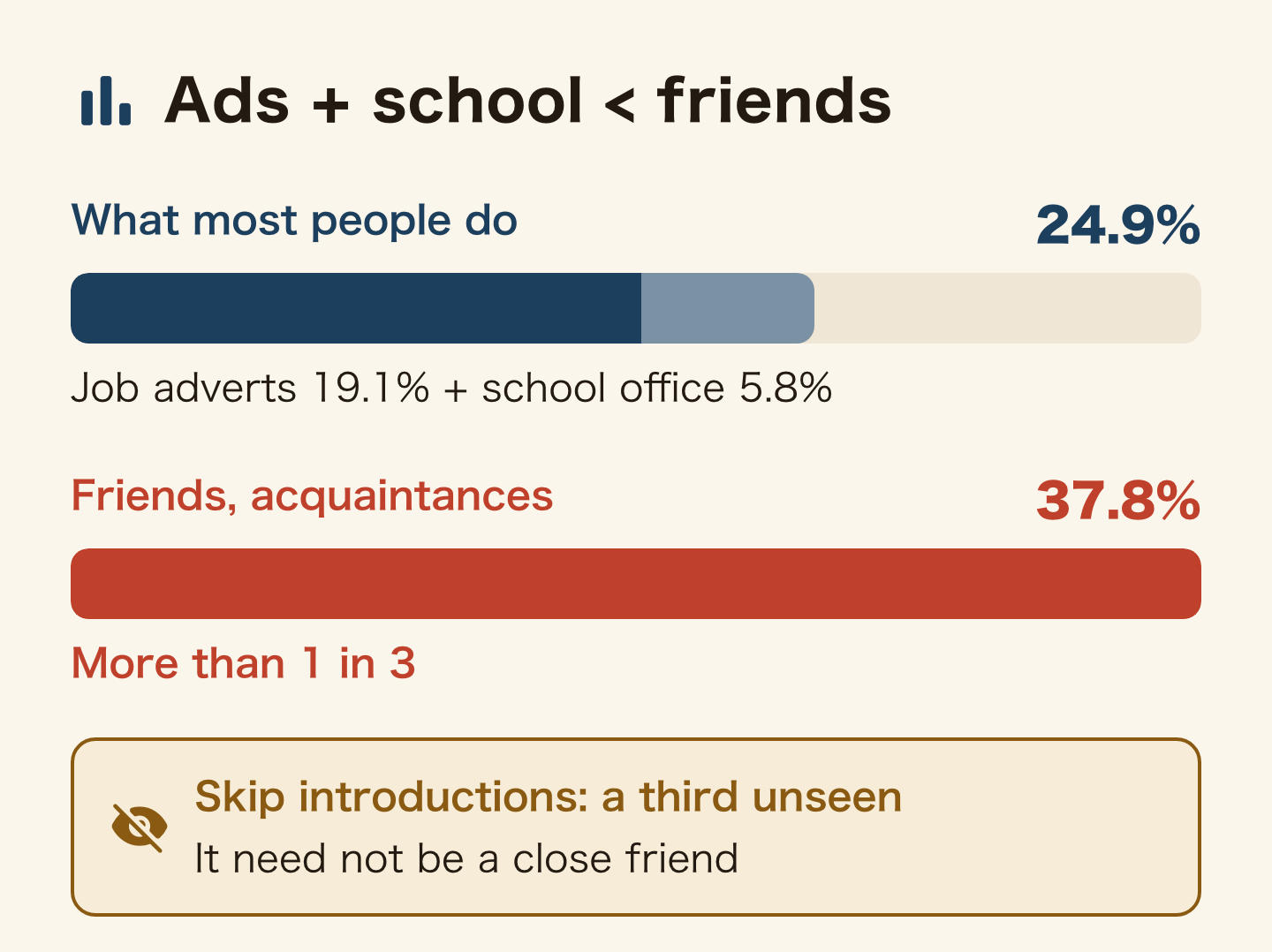
You may be thinking you have nobody to introduce you. But the survey’s “friend or acquaintance” does not mean a close friend. A senior student at your school, someone from your country’s community, a colleague at your current arubaito, someone you see at church or at the mosque. Anyone who knows that workplace counts.
The route that works depends on the industry
This is the practical part. The overall figure is 37.8%, but the ranking flips depending on the industry.
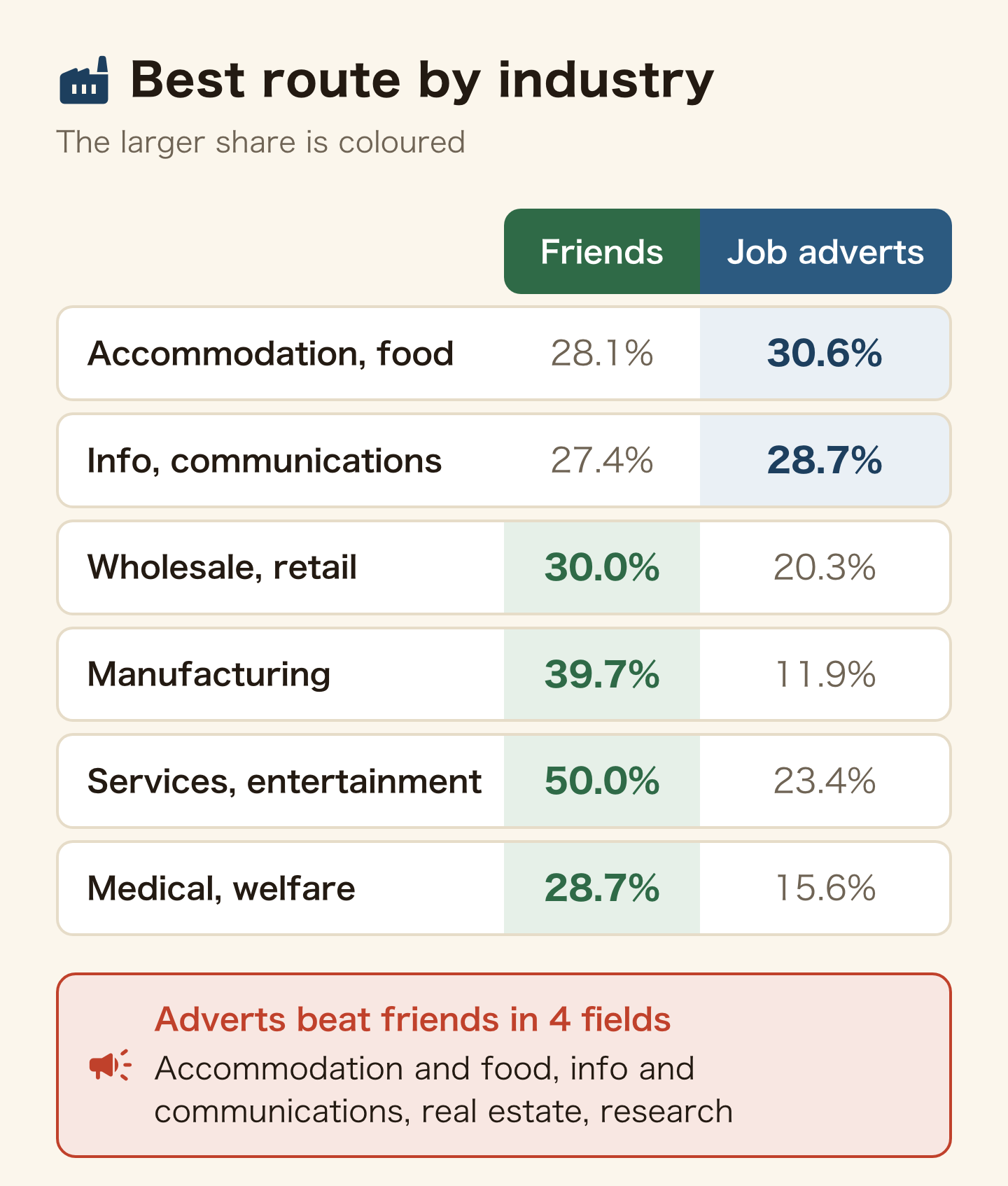
| Industry | Friends | Job adverts | School office | Private agency |
|---|---|---|---|---|
| Accommodation, food service | 28.1% | 30.6% | 4.5% | 12.6% |
| Wholesale, retail | 30.0% | 20.3% | 11.6% | 11.3% |
| Construction | 31.6% | 7.6% | 15.7% | 10.2% |
| Manufacturing | 39.7% | 11.9% | 4.0% | 10.8% |
| Personal services, entertainment | 50.0% | 23.4% | 3.0% | 4.3% |
| Information and communications | 27.4% | 28.7% | 7.8% | 17.0% |
| Medical and welfare | 28.7% | 15.6% | 9.0% | 15.8% |
How to read it:
- Looking for a restaurant or hotel arubaito? Job adverts are the biggest route there. Adverts beat word of mouth in four industries: this one, information and communications, real estate and goods rental (35.4%), and scientific research and professional services (32.1%). Keep applying
- Factory and manufacturing work runs on friends at 39.7%. Job adverts are only 11.9%, so applications alone rarely land
- In wholesale and retail, school career offices reach 11.6%, twice the 5.8% overall. For supermarket and shop work, the school office is genuinely worth using. The highest share for school offices is in construction, at 15.7%
- Information and communications rewards adverts and agencies. This is a sector where registering with a recruiter actually pays
Find the row for the industry you want, and put your time into the column with the highest number. If you first want to know which industries people on your own visa work in, Jobs Foreigners Do in Japan 2026: 2.57M Workers by Visa and Industry has a row for each visa (a different statistic from this survey).
The school office is safe, but it is about one in seventeen
As we wrote in our arubaito guide, with a job that comes through your school, you can ask the school for help if something goes wrong. That has not changed.
But the volume is small: 5.8% overall. If you only watch the noticeboard and nothing suits you, the board is not the problem. There is simply not much on it.
Why job listings do not reach language schools at all is covered in what comes after Japanese language school. Different kinds of school connect you to different things.
A friend brings the job, not the rules
Someone from home tells you their shop needs staff, and on the strength of that you start the following week. Where you come from, that may be how introductions work. In Japan, the employer must give you a written statement of working conditions. Start without one and what the job is, and how many hours a week, can turn out differently later.
This is the part that matters most.
The same survey records the problems reported by people working on a student status. The most common were:
- No explanation of the work beforehand: 28.9% (1.3% the previous year)
- Higher Japanese ability demanded than was explained: 21.3%
- The actual work differed from what was explained: 15.8%
The top item jumped from 1.3% to 28.9% in a single year. The sample for that group is small, so treat the exact figure with care, but the share saying the work was not explained beforehand rose sharply.
And one more thing. Asking a Japanese friend will not get you the rules.
The person who runs this site can confirm it. Asked questions by the international students he knows, he can rarely answer them, even though he can answer ordinary questions about life in Japan. The reason is simple: the rules that apply to foreign residents are not the rules that apply to Japanese people. Japanese people do not know rules that never touch them. The 28-hour weekly limit, the permission to work outside your status, the fact that what you may do depends on which status you hold – none of that appears in a Japanese person’s life.
So split it: jobs come from people, rules come from official sources. You do not need to distrust whoever introduced you. They just do not know.
Three things to confirm when a job comes through someone
1. What the work actually is (28.9% were never told) / 2. The hourly rate and the pay date / 3. How many hours a week. On a student status the limit is 28 hours, and going over it affects your status. Ask the employer, not the person who introduced you, and get the answers in the written statement of working conditions the employer must give you.
Living outside Tokyo is not a disadvantage
If you have been told you need to move to Tokyo to find work: the biggest route, word of mouth, runs on the people around you. Wherever you live, those relationships already exist, and using them costs no train fare.
The jobs are not all in Tokyo either. As set out in where international students get hired, the Kinki region takes about 7,700 a year, with roughly 5,900 in Osaka and Hyogo alone.
The public service is free wherever you are
In the same table, Hello Work is 4.6%. Add the Hello Work Internet Service at 1.7% and it comes to 6.3%. Not large. The Employment Service Centre for Foreigners is not counted as a separate route in that table. But free, usable while you are still studying, and with interpreters at some counters is a combination nothing else offers. It is the kind of service there is no reason not to use.
Osaka Employment Service Centre for Foreigners
16F Hankyu Grand Building, 8-47 Kakuda-cho, Kita-ku, Osaka 530-0017 (above Hankyu Umeda station)
How much Japanese is enough
The same survey records reading ability by status of residence, which turns the question into a number.
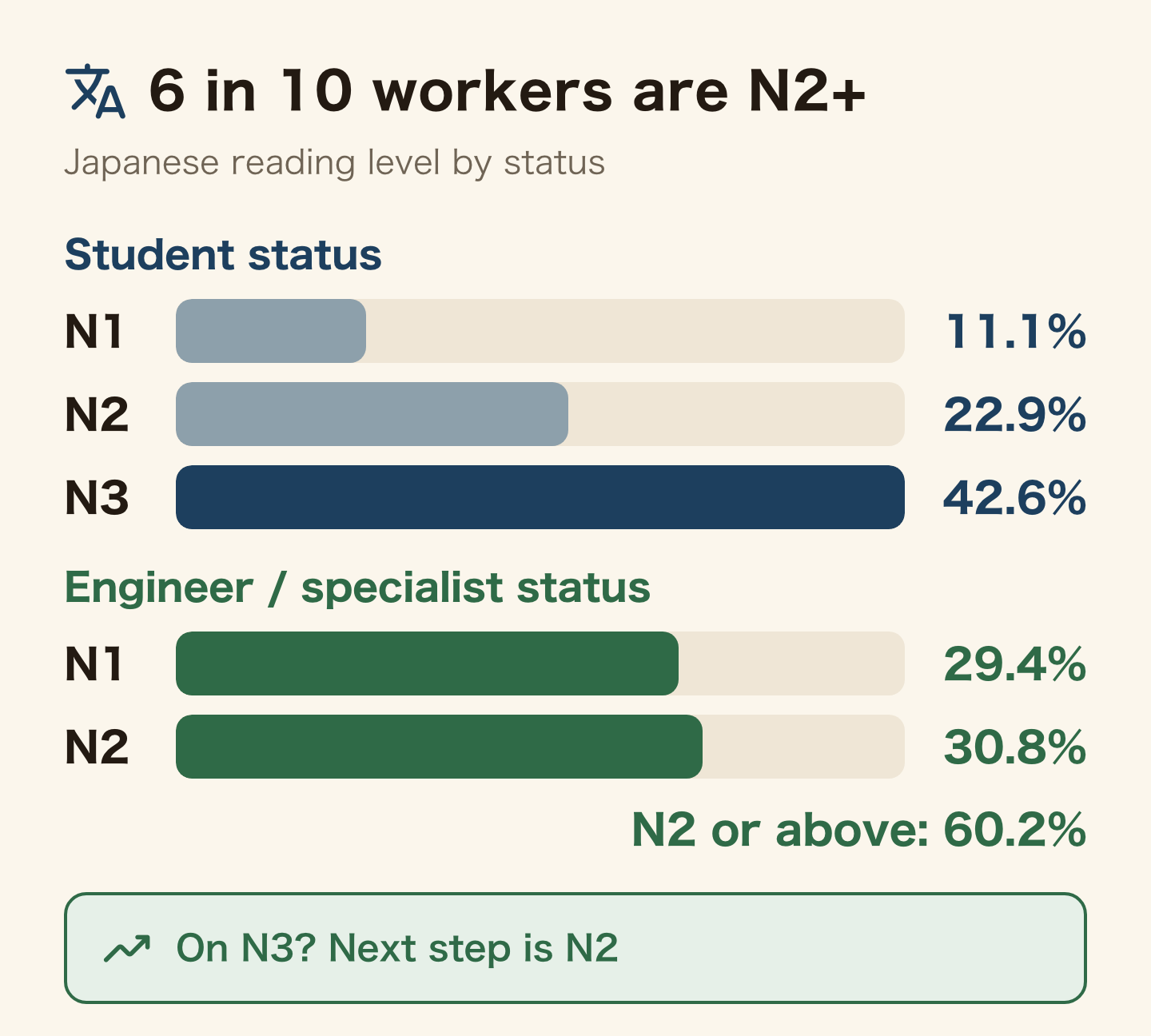
- Student status: N3 is the largest group at 42.6%, then N2 at 22.9% and N1 at 11.1%
- Work status (engineer, specialist in humanities, international services): N1 at 29.4% and N2 at 30.8%, so 60.2% are at N2 or above
If you are around N3 on a student status, the next step is N2. N2 seats have filled within a week of registration opening, so pin down the JLPT registration dates and pass marks early. Six in ten of the people already hired are there. The second most common problem, “higher Japanese ability demanded than was explained” at 21.3%, points the same way.
Plenty of people are working on it: 42.7% of those on a student status studied for their job in the past year, outside of Japanese language study itself. Kanji practice and keigo come back to you in the results of your applications.
What to do this week
- Pick one industry and read its row in the table above. Move your time to the column with the highest share
- Ask one senior student or one colleague whether anywhere is hiring. More than one in three jobs are found this way
- If you want restaurant or hotel work, keep applying to adverts. Adverts are the top route in that industry
- If an introduction is turning into an offer, ask the employer three things: the work, the rate and pay date, the weekly hours
- Book one appointment at the Employment Service Centre for Foreigners
Step 2 can happen today, and being told no costs you nothing.
If 37.8% of jobs come through people you know, the cheapest way to widen that circle is to show your work on social media before you need it.
FAQ
Q. How do foreigners find jobs in Japan?
According to the labour ministry’s 2025 Survey on Employment of Foreign Workers, among those already living in Japan, 37.8% found the job through a friend or acquaintance, 19.1% through job adverts, 10.6% through a private agency in Japan, 5.8% through a school career office and 4.6% through Hello Work.
Q. I keep applying on job sites and nothing happens. Why?
Job adverts account for 19.1% of hires, one in five, and only 11.9% in manufacturing. It may not be your applications; it may be the route. In accommodation and food service, though, adverts are the top route at 30.6%. They also beat word of mouth in information and communications, real estate, and scientific research and professional services, so in those industries it is worth continuing.
Q. I do not have anyone who could introduce me.
The survey’s “friend or acquaintance” is not limited to close friends. A senior student at your school, someone from your national community, or a colleague at your current arubaito all count. Start by asking one person where you already work.
Q. Should I avoid the school career office?
Not at all. With a job that comes through your school, you can ask the school for help if something goes wrong. But overall only 5.8% of jobs came that way, so the volume is small. It reaches 15.7% in construction and 11.6% in wholesale and retail, so in some industries it is a strong route.
Q. What should I confirm when a job comes through someone I know?
The work itself, the hourly rate and pay date, and the weekly hours – and ask the employer rather than the person who introduced you. The most common problem reported by people on a student status was “no explanation of the work beforehand”, at 28.9%.
Q. How much Japanese do I need?
Of people working on the engineer, specialist in humanities and international services status, 60.2% read at N2 or above. On a student status the largest group is N3 at 42.6%, so N2 is the next target.
Q. Do I have to move to Tokyo to find work?
The largest route, an introduction from someone you know, runs on the relationships where you already live, so being outside Tokyo is not a disadvantage. The Kinki region also takes about 7,700 hires a year, about 5,900 of them in Osaka and Hyogo.
Summary
- Among foreign workers already living in Japan, 37.8% found the job through a friend or acquaintance
- Job adverts 19.1%, private agencies 10.6%, school career offices 5.8%, Hello Work 4.6%
- Job sites and the school noticeboard together are only 24.9% of hires. More than one in three got the job through someone they know
- Industry flips the ranking: adverts lead in accommodation and food service at 30.6%, friends lead manufacturing at 39.7%
- School career offices are highest in construction at 15.7%, and reach 11.6% in wholesale and retail
- Word of mouth runs on where you already are, so living outside Tokyo is not a disadvantage
- An introduction brings the job but not the rules: confirm the work, the rate and pay date, and the hours with the employer
- Asking a Japanese friend will not get you the rules that apply to foreign residents
- 60.2% of people on a work status read at N2 or above, while the largest group on a student status is N3
Official sources: Ministry of Health, Labour and Welfare, Survey on Employment of Foreign Workers 2025 (Japanese) / Same survey, summary report: Table 16, routes into work, and response counts (Japanese) / e-Gov: Labour Standards Act, Article 15 (Japanese) / Immigration Services Agency: permission to engage in activity outside status (Japanese) / MHLW: Employment Policy for Foreign Workers (Employment Service Centres) / Osaka Employment Service Centre for Foreigners (checked 26 September 2026)
Found this useful? Share it
Send it to a friend who lives in Japan.
WHO WROTE THIS

mori
Japanese. I read the ministries’ own notices, orders and Q&As in the original, and I start from what my Nepalese and Sri Lankan friends in Japan actually ran into. I do not write about what I have not checked or been told.
What this site can and cannot do →Looking for something else?
You may use the figures in this article, including commercially, if you credit this site with a link. How to use our figures