Checked on 26 September 2026 against JASSO’s Job Hunting Guide for International Students 2027, the government’s Guidelines on Keigo (Council for Cultural Affairs), a Hyogo Labour Bureau (Hello Work) leaflet, and the Caritas employer survey of December 2025.
The short answer
- Job-hunting Japanese is a small set of fixed phrases for interviews, emails and phone calls. You can start with four swaps and the templates below.
- Call the company onsha when you speak and kisha when you write. Call yourself watashi or watakushi — never boku, jibun or ore.
- Doubled keigo is one layer too many. O-yomi ni narareru becomes o-yomi ni naru. A few doubled forms, like o-ukagai suru, are accepted by custom.
- Emails go: subject, addressee, who you are, message, signature. Anything urgent or any apology goes by phone.
- Decline a job offer by phone, not just by email. You do not have to say which company you chose (JASSO).
Knowing this, you stop re-checking “onsha or kisha?” the night before an interview and spend that time on your answers instead. The email and phone templates work as they are — change the name and the date and send.
Your first interview is tomorrow. HR has sent a list of possible times, and you are writing the reply. Do you write kisha or onsha for “your company”? You ask a Japanese friend. They think for a moment and say, “Probably kisha… I think?” They cannot tell you why. For them it is a word they half-remember. For you, it is the first Japanese the company will ever read from you.
- Which Japanese job interview phrases matter most? Onsha, and “watashi”
- Onsha vs kisha: what is the difference?
- How much keigo do I need in a Japanese job interview?
- What is doubled keigo (nijuu keigo)?
- Japanese business email template: scheduling an interview
- Should I send a thank-you email after a Japanese interview?
- How do I phone a Japanese company when job hunting?
- Running late, or said the wrong word? Call before the start time
- How do I accept or decline a job offer in Japanese?
- What does job hunting cost, and where can I practise for free?
- Which one are you?
- Frequently asked questions
- Summary
- Related guides
Which Japanese job interview phrases matter most? Onsha, and “watashi”
The words you will say most in an interview are the name for their company and the name for yourself. JASSO’s Job Hunting Guide for International Students 2027 lists the expressions that go wrong most often in job hunting, next to the ones to use.
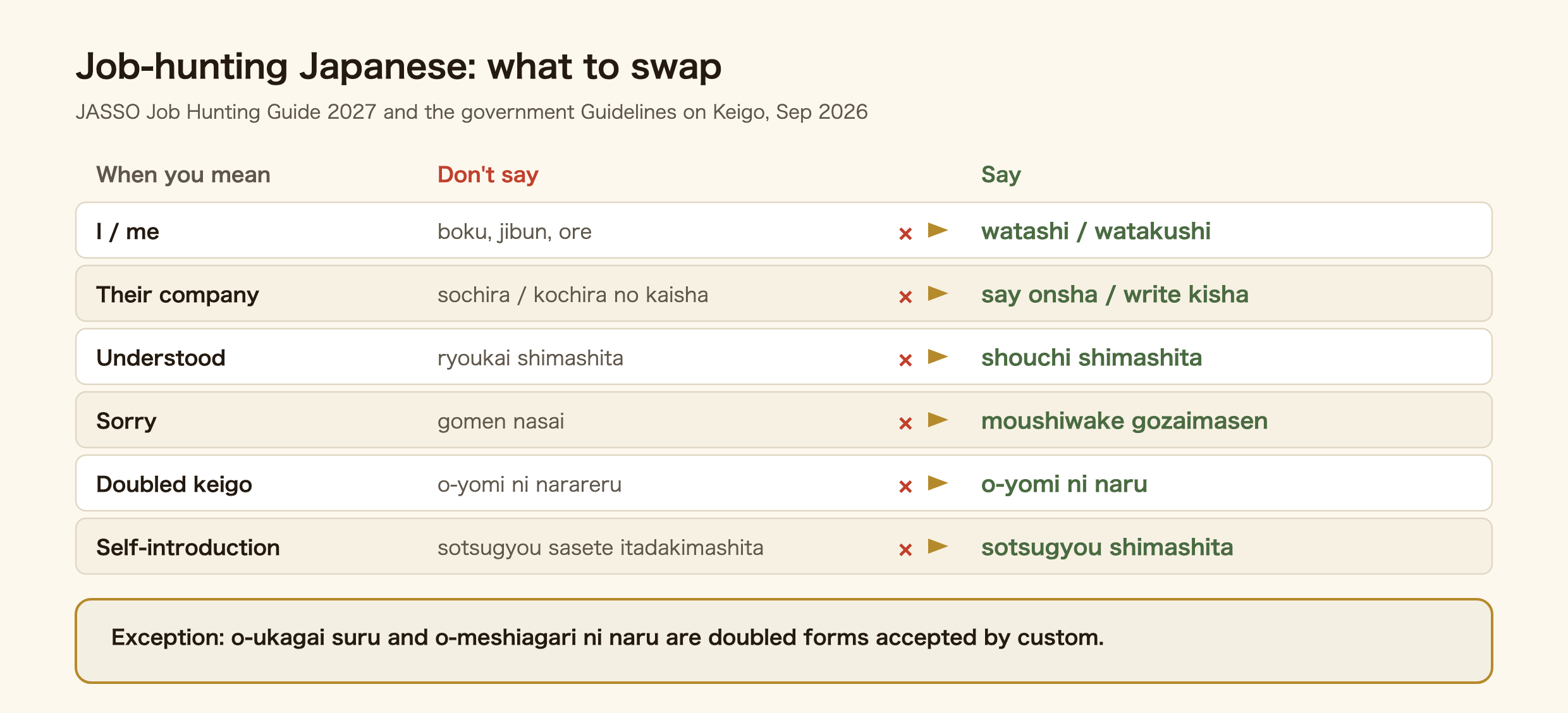
| When you mean | Don’t say | Say |
|---|---|---|
| I / me | 僕 boku, 自分 jibun, 俺 ore | 私 watashi / watakushi |
| Your company | そちらの会社 sochira no kaisha | 御社 onsha (spoken) / 貴社 kisha (written) |
| Understood | 了解しました ryoukai shimashita, わかりました wakarimashita | 承知しました shouchi shimashita, かしこまりました kashikomarimashita |
| Sorry | ごめんなさい gomen nasai | 申し訳ございません moushiwake gozaimasen |
The government’s Guidelines on Keigo (in Japanese) cover the “I” question too. Watashi is for somewhat formal situations, and watakushi for even more formal, public ones. For an interview, it says watashi or watakushi fits better than boku. It also says there is no rule you must follow. If you are unsure, watashi is enough.
If the difference between respectful and humble forms is still a blur, the diagrams in keigo vs casual Japanese make the tables here much easier to read.
Onsha vs kisha: what is the difference?
Onsha and kisha mean the same thing — “your company” — and differ only in speech versus writing. A Hyogo Labour Bureau (Hello Work) leaflet puts it in one line: kisha is the word you write, onsha is the word you say.
- Interview, phone call, a question at a company information session → 御社 onsha
- Email, rirekisho, entry sheet, cover letter → 貴社 kisha
JASSO’s sample cover letter follows the same rule and uses kisha all the way through, starting from the standard opening, kisha masumasu go-seisho no koto to o-yorokobi moushiagemasu.
The interviewer will call their own company heisha (弊社, “our humble company”). One of the sample interview questions in JASSO’s guide is exactly that: “Have you ever used heisha‘s products?” You answer with onsha: “Onsha no shouhin wa…“. Heisha lowers your own side, so it never works for someone else’s company.
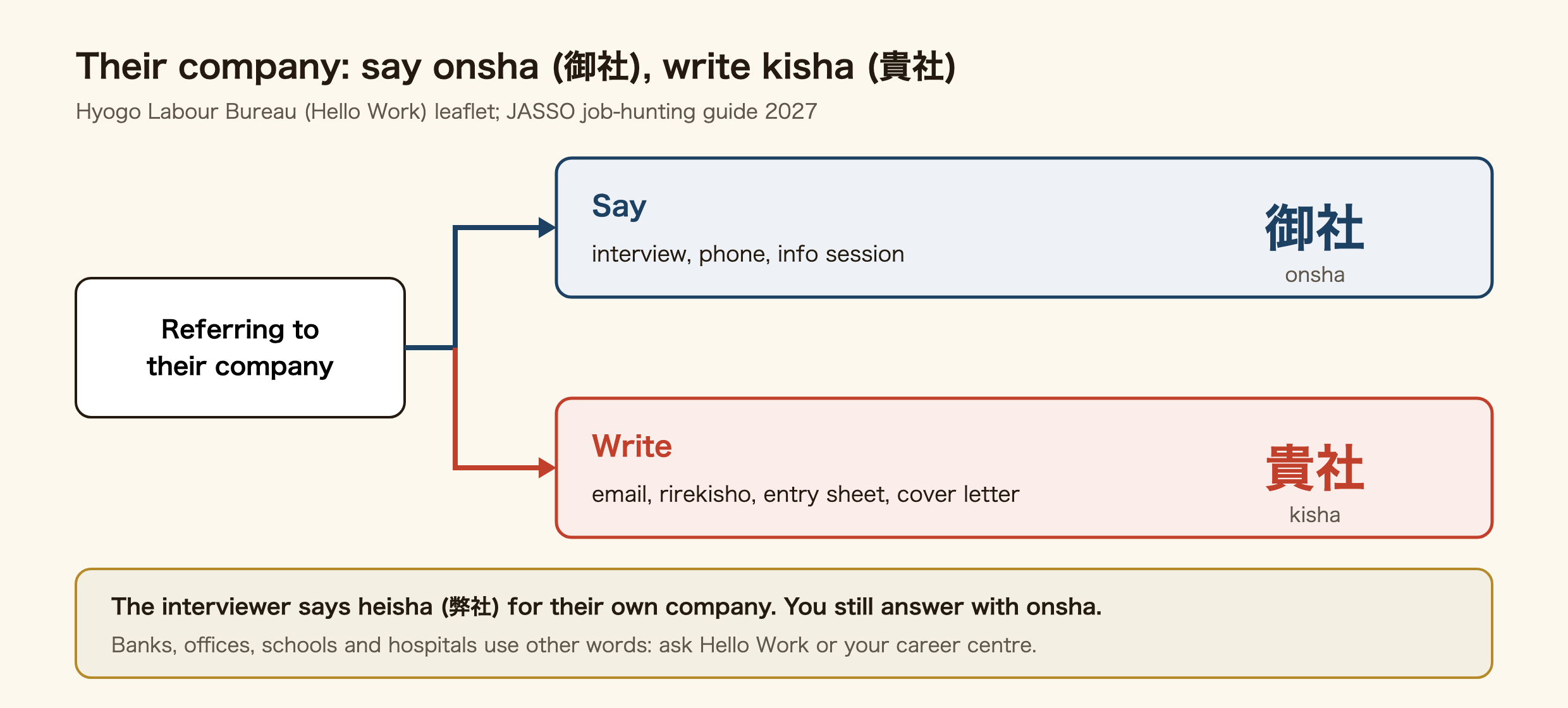
If you are applying to a bank, a government office, a school or a hospital, the word changes. The Hyogo leaflet’s advice is to check at the counter if you are not sure. Take the employer’s name to Hello Work or your school’s career centre and ask.
How much keigo do I need in a Japanese job interview?
What employers test is not perfect humble forms. It is whether you understand the question and answer in Japanese. In the Caritas employer survey (December 2025, 487 companies responding), 87.7% said they interview international students entirely in Japanese. “Japanese ability” was also the top quality they wanted: 55.6% for humanities graduates and 51.5% for science graduates (companies chose up to three).
The recruiters quoted in JASSO’s guide say the same thing: understand what you were asked and answer in Japanese. Polite desu/masu Japanese and a short, complete answer are the foundation. Fancy forms come after.
From the door to your self-introduction
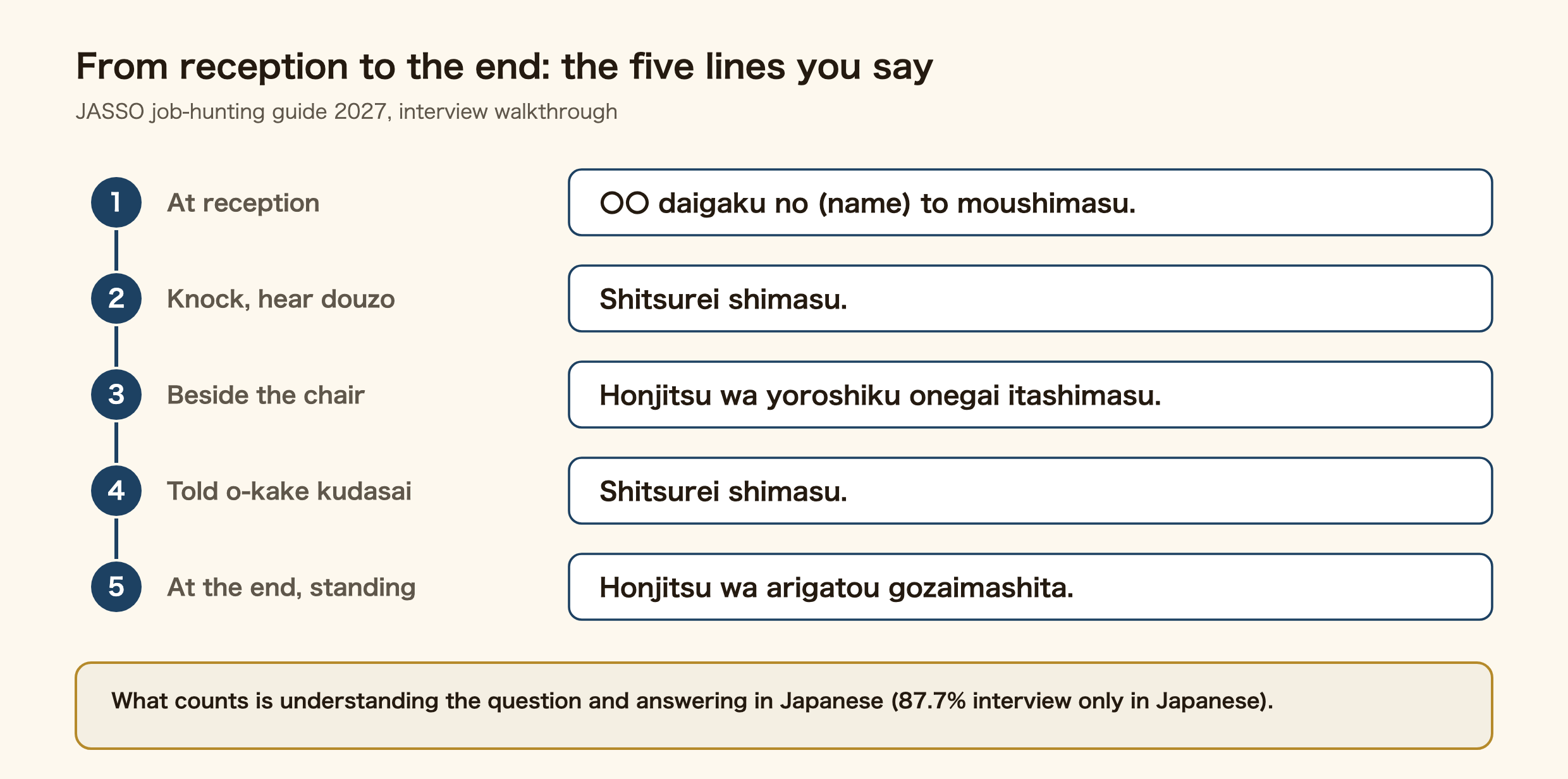
Take JASSO’s walkthrough of an interview and keep only the lines you say out loud.
- At reception: “〇〇 daigaku no (name) to moushimasu. Honjitsu 〇-ji kara mensetsu no o-yakusoku wo itadaite orimasu.” — I’m (name) from 〇〇 University. I have an interview at 〇 o’clock today.
- After you knock and hear douzo: “Shitsurei shimasu.”
- Standing beside the chair: “〇〇 daigaku 〇〇 gakubu no (name) to moushimasu. Honjitsu wa yoroshiku onegai itashimasu.”
- When told douzo o-kake kudasai: “Shitsurei shimasu.”
- At the end, standing up: “Honjitsu wa arigatou gozaimashita.”
Some people introduce themselves with “〇〇 daigaku wo sotsugyou sasete itadakimashita” (“I was humbly allowed to graduate”). The Guidelines on Keigo use this very sentence as an example that can sound wrong, because nobody gave you permission to graduate. Sotsugyou shimashita or sotsugyou itashimashita is enough.
Your motivation answer: conclusion, reason, contribution
JASSO says a motivation answer (shibou douki) needs three things: enthusiasm for that company, the work you want to do there, and what you can contribute. The order is: why this company (the conclusion), the concrete reason, then what you can do for them.
- Conclusion: “Watashi ga onsha wo shibou suru riyuu wa, 〇〇 no shigoto ni tazusawaritai kara desu.” — I’m applying because I want to work on 〇〇.
- Reason: “Daigaku de 〇〇 wo manabi, 〇〇 no keiken kara, 〇〇 ni kanshin wo mochimashita.”
- Contribution: “〇〇-go to nihongo ga hanaseru koto wo ikashite, onsha no 〇〇 de kouken shitai to kangaete orimasu.”
Interviewers ask questions while reading the rirekisho and entry sheet you sent. Re-read them before the interview so your spoken answer does not contradict what you wrote. The free ministry rirekisho template and its rules are worth checking at the same time, so the paper and the conversation match.
Changing jobs: talking about your current boss
The interviewer asks about your current job, and you speak about your manager respectfully, as you always do: “Tanaka-buchou always…”. Where you come from, that may be simple good manners. In Japan, when you talk to someone outside your company, you do not raise the people on your own side.
The Guidelines on Keigo say that when you speak to someone from another company about your own manager, you say “Tanaka” or “buchou no Tanaka” (Tanaka, our manager), and that “Tanaka-buchou” is not appropriate. An interviewer is an outsider, so the same logic applies. The easy way out is to skip the name: joushi ga (“my manager”).
What is doubled keigo (nijuu keigo)?
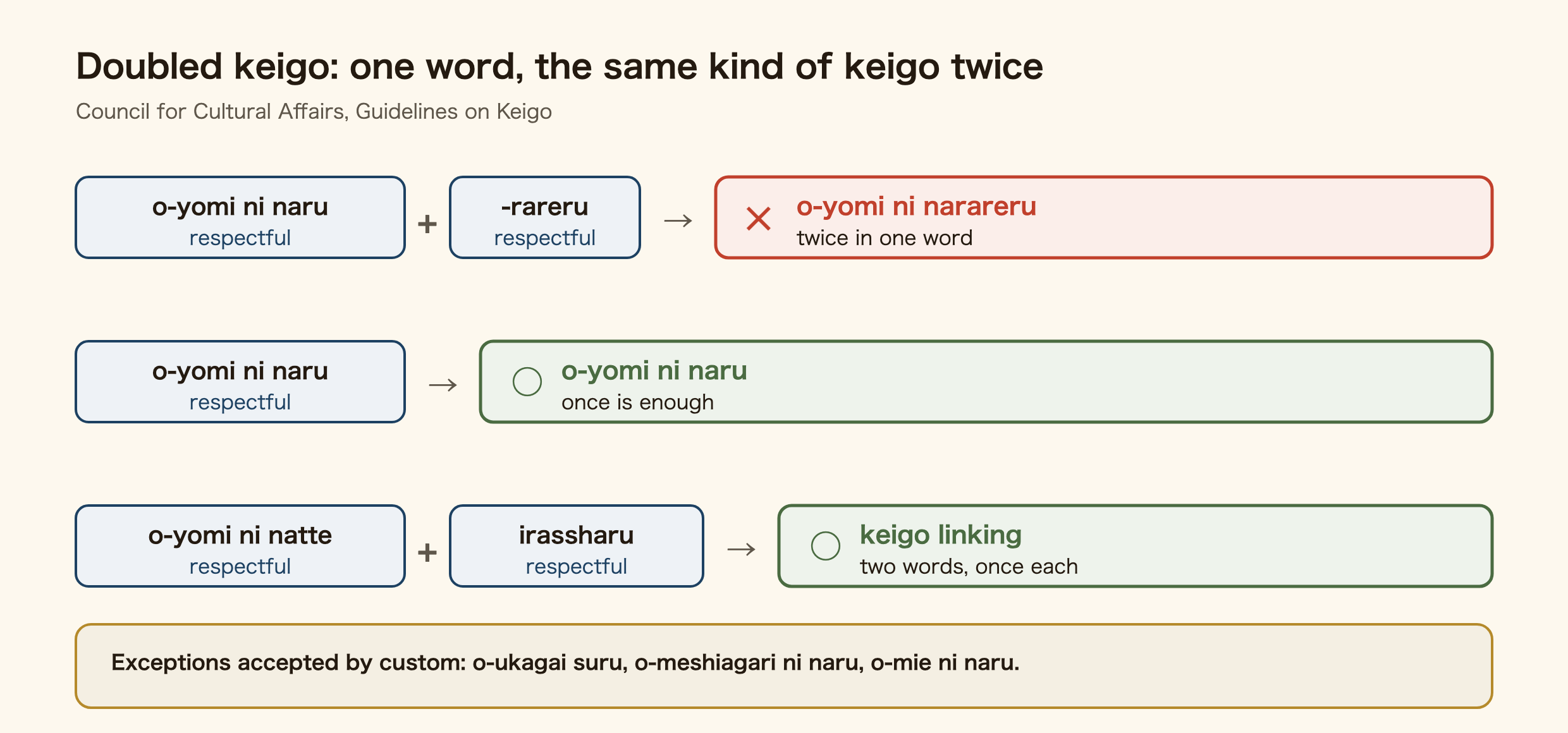
Doubled keigo is one word carrying the same kind of keigo twice. The Guidelines’ example is o-yomi ni narareru: o-yomi ni naru is already respectful, and -rareru adds a second respectful layer. The Guidelines say this is generally not appropriate. It is the mistake that comes from trying too hard.
| Doubled | Fixed |
|---|---|
| お読みになられる o-yomi ni narareru | お読みになる o-yomi ni naru |
| おっしゃられる ossharareru | おっしゃる ossharu |
| ご覧になられる goran ni narareru | ご覧になる goran ni naru |
There are exceptions. The Guidelines list o-ukagai suru, o-meshiagari ni naru and o-mie ni naru as doubled forms that custom has accepted. So both onsha ni ukagaimasu and o-ukagai shimasu (“I will visit your company”) are fine.
Two separate keigo verbs joined with -te, like o-yomi ni natte irassharu, are not doubled keigo either. The Guidelines call that “keigo linking” and say it is basically acceptable.
Japanese business email template: scheduling an interview
JASSO breaks a job-hunting email into five parts: subject, addressee (department and name), who you are, the message, and a signature with your school, name, email and phone number. It also says to reply to company emails straight away.
Here is a reply accepting one of the offered times. Change the names and dates and it is ready.
株式会社○○
人事部 ○○様
お世話になっております。○○大学経済学部4年のリン・アナです。
面接の日程をご連絡いただき、ありがとうございます。
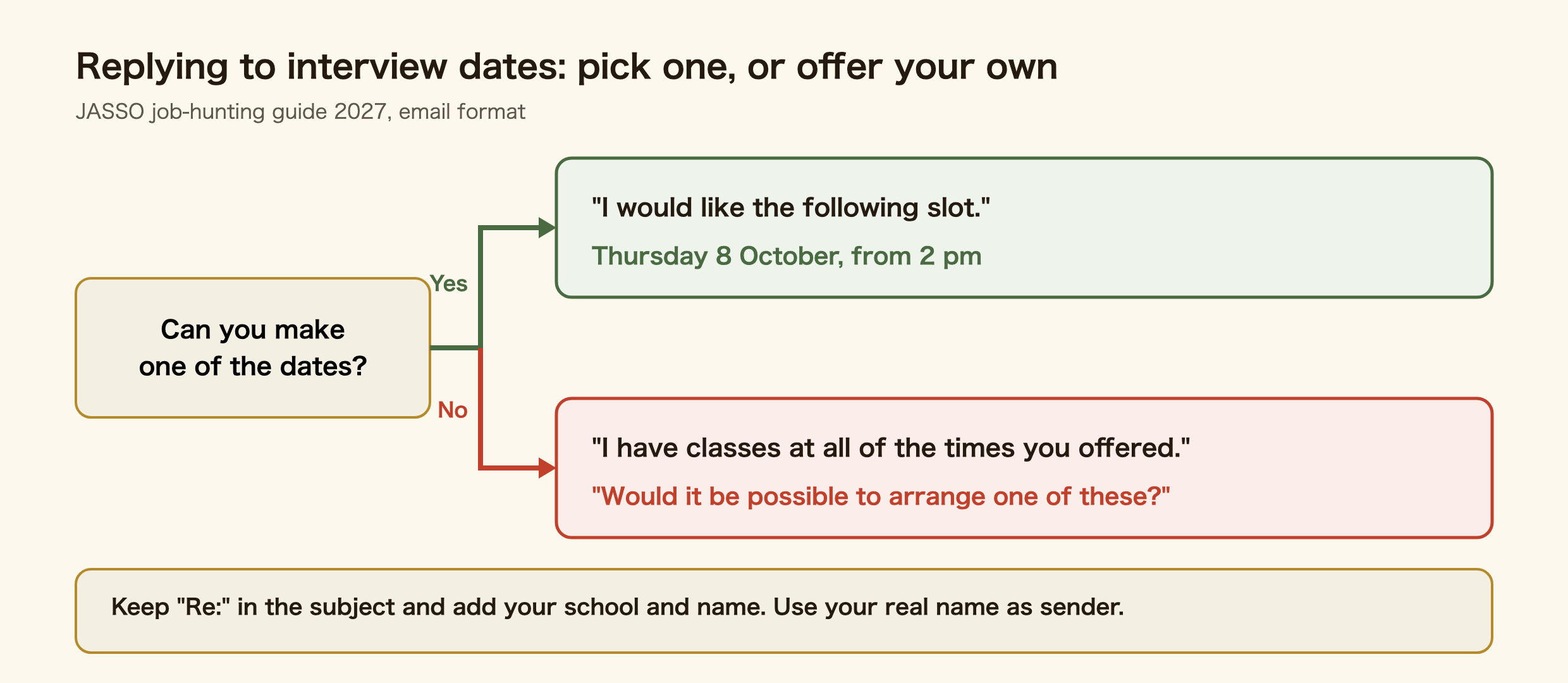
ご提示いただいた日程のうち、下記でお願いいたします。
10月8日(木)14時〜
当日は、どうぞよろしくお願いいたします。
――――――――――
○○大学 経済学部 経営学科 4年
リン・アナ
メール:○○@○○
電話:090-○○○○-○○○○
In English: “Thank you for sending the interview dates. I would like the following slot: Thursday 8 October, from 2 pm. I look forward to meeting you.” If none of the dates work, swap the middle for this:
大変申し訳ございませんが、下記の日程でご調整いただくことは可能でしょうか。
10月13日(火)10時〜17時
10月14日(水)13時〜17時
(“I have classes at all of the times you offered. I am very sorry, but would it be possible to arrange one of the following?”)
Keep the “Re:” in the subject so HR can see which message you are answering, and add your school and name at the end of it so it is easy to find among many applicants. If your sender name shows a nickname, change it to your real name before you send (JASSO).
Should I send a thank-you email after a Japanese interview?
JASSO lists “thanks after an interview” as one of the uses of email. It does not say you lose points if you skip it, or gain points if you send it. If you send one, send it the same day and keep it short.
株式会社○○
人事部 ○○様
お世話になっております。○○大学経済学部4年のリン・アナです。
本日はお忙しいところ、面接の機会をいただき、ありがとうございました。
○○様から伺った○○のお話で、貴社で○○の仕事をしたいという気持ちが強くなりました。
取り急ぎ、メールにてお礼申し上げます。
――――――――――
(署名)
(“Thank you for taking the time to interview me today. Hearing about 〇〇 from you made me want even more to work on 〇〇 at your company.”) Mention one real thing from the conversation so it is not just a formula. And because it is written, it is kisha, not onsha.
How do I phone a Japanese company when job hunting?
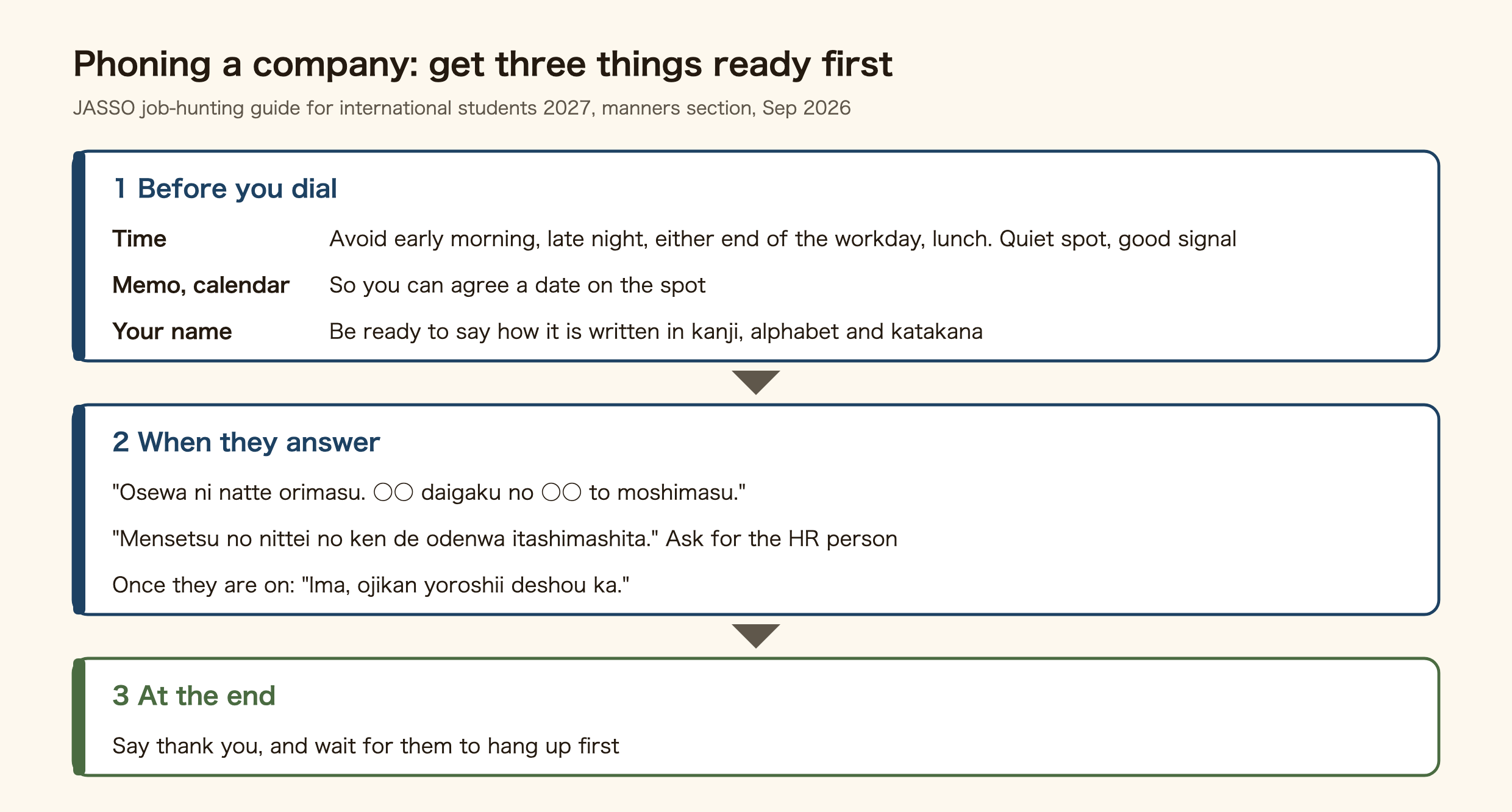
JASSO lists three uses for the phone in job hunting: being late or absent on an interview or test day, arranging interview dates, and offers. Before you dial, get three things ready.
- The time: avoid early morning, late night, just before or after office hours, and lunchtime. On a mobile, find somewhere quiet with good signal
- A memo and your calendar, so you can agree a date on the spot
- Your name, explained: how it is written in kanji, the alphabet and katakana
At the end, say thank you and wait for them to hang up first.
The opening lines of a scheduling call:
面接の日程の件でお電話いたしました。人事部の○○様はいらっしゃいますか。」
(本人に代わったら)「今、お時間よろしいでしょうか。」
(“Hello, my name is Lin Ana from the economics faculty at 〇〇 University. I’m calling about my interview date. May I speak to Mr/Ms 〇〇 in HR?” Then, once they are on the line: “Is now a good time?”) If your name is long or hard to catch in katakana, prepare one way of spelling it that the listener can write down first time: “Rin Ana — katakana de ri, n, a, na desu.”
Running late, or said the wrong word? Call before the start time
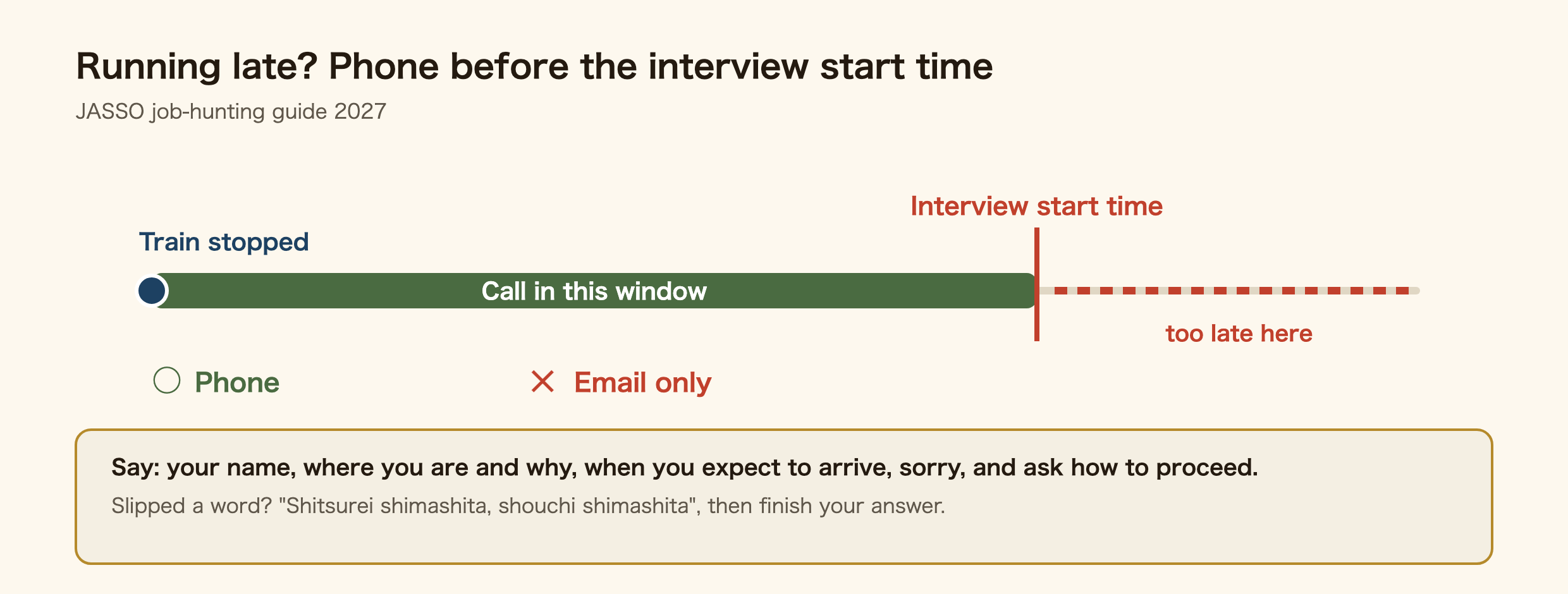
JASSO treats lateness as something you must not do. If a train delay makes it unavoidable, you must contact the company before the interview start time — by phone, not email. JASSO’s sample call, shortened:
現在○○駅におりますが、事故で電車が止まっております。
御社に到着するのは○時○分になる見込みです。誠に申し訳ございません。
いかがすればよろしいでしょうか。」
(“I have an interview with you at 〇 today. I’m at 〇〇 station, and the trains have stopped after an accident. I expect to arrive at 〇:〇〇. I am very sorry. How would you like me to proceed?”)
If ryoukai shimashita or boku slips out mid-interview, correct it when you notice: “Shitsurei shimashita, shouchi shimashita.” Then carry on and finish your answer — one slip is not a reason to stop.
How do I accept or decline a job offer in Japanese?
You have chosen another company, so you send the others a one-line email and move on. Where you come from, that may be completely normal. In Japanese job hunting, JASSO’s guide says tell the company by phone, not only by email. After several rounds of interviews, a quick email does not show good faith.
JASSO adds two more points about declining.
- If they ask which company you are joining, you have no obligation to tell them
- If you are called in, kept for hours, or pressed to sign an acceptance form, talk to your school’s career centre straight away. JASSO says that even a signed acceptance form or pledge is not legally binding
Three sentences are enough on the phone:
大変申し上げにくいのですが、検討の結果、内定を辞退させていただきたく、お電話いたしました。
選考に時間を割いていただいたにもかかわらず、申し訳ございません。」
(“Thank you for letting me know about the offer. This is hard to say, but after careful thought I am calling to decline it. I am sorry, after all the time you gave to my selection.”)
To accept: “Naitei no go-renraku wo itadaki, arigatou gozaimasu. Zehi, o-uke shitai to omoimasu.” (“Thank you for the offer. I would be glad to accept.”) Then ask which documents to send and by when, and write it down. JASSO warns that sitting on offers can affect other students’ chances and even future hiring from your school, so choose one early.
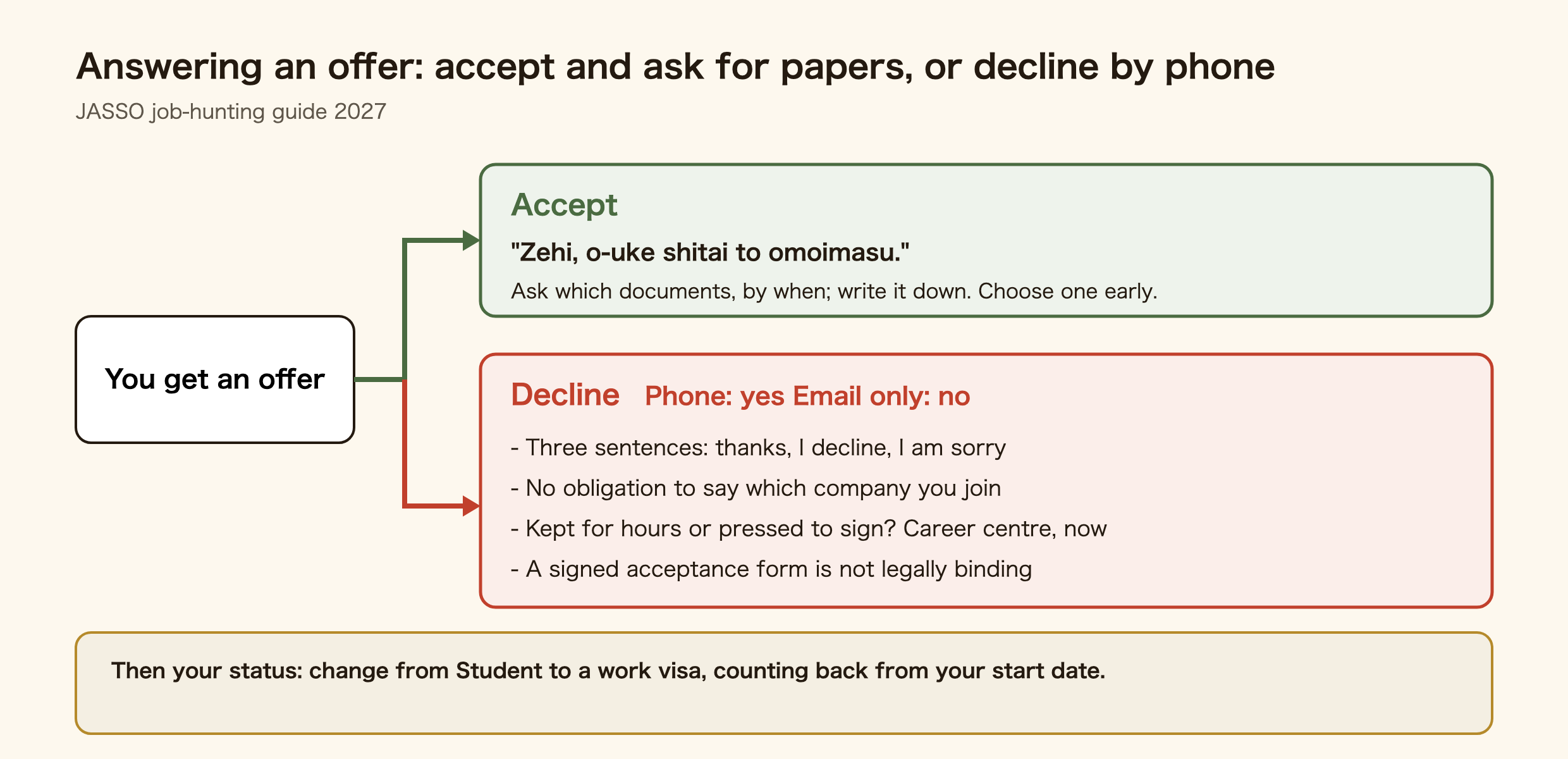
Once you have chosen, the next step is your status of residence. To start work after graduating, apply to change from a Student visa to a work visa, counting back from your start date. If graduation is close and there is no offer yet, set up the job-hunting visa that lets you stay after graduation before you graduate.
What does job hunting cost, and where can I practise for free?
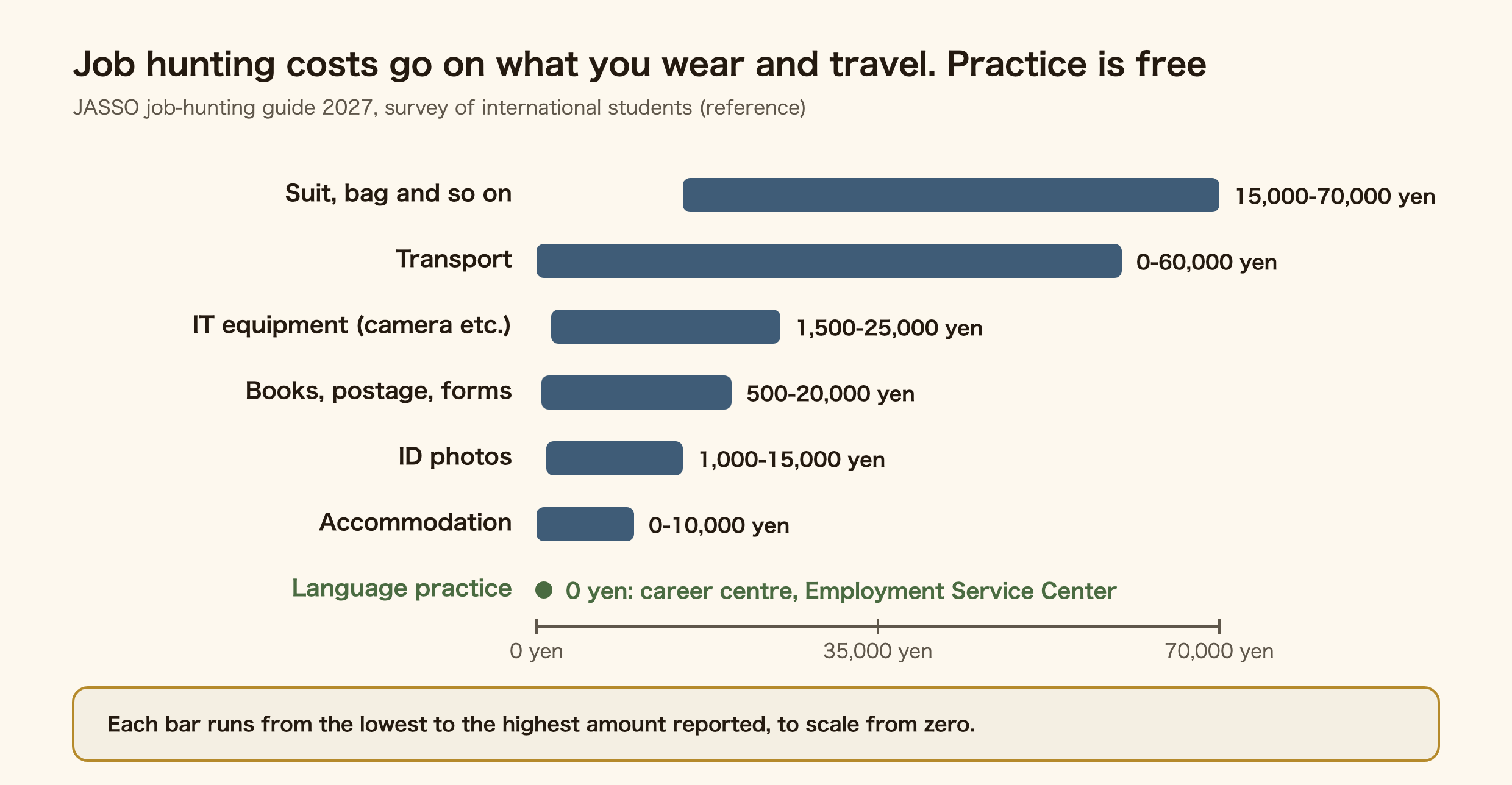
Practising the language costs nothing. The money goes on the things you wear and carry, and on travel. JASSO’s guide gives this breakdown from a survey of international students (for reference).
| Item | Cost (reference) |
|---|---|
| Suit, bag and so on | about 15,000–70,000 yen |
| Transport | 0–60,000 yen |
| Accommodation | 0–10,000 yen |
| Books, postage, rirekisho forms | about 500–20,000 yen |
| ID photos | about 1,000–15,000 yen |
| IT equipment (camera for online interviews and so on) | about 1,500–25,000 yen |
Two public places let you practise these phrases on a real person. One is your school’s career centre. JASSO’s guide itself suggests asking friends or a career counsellor to play the interviewer in a mock interview.
The other is the Ministry of Health, Labour and Welfare’s Employment Service Centers for Foreigners. The Osaka centre, for example, checks application documents and runs mock interviews for international students and foreigners with a work-eligible status. Hello Work is defined in Article 8 of the Employment Security Act as a body that serves the public free of charge. Locations and what to bring are in the four Hello Work centres for foreigners.
It helps to know the level employers expect. In the same Caritas survey, companies wanting “business advanced” Japanese or higher at the offer stage were 43.4% (humanities) and 33.0% (science). After joining, that rises to 67.7% and 63.1%. The phrases you practise for the interview are the ones you will use every day at work.
Which one are you?
- Your interview is tomorrow — say the four swaps (watashi, onsha, shouchi shimashita, moushiwake gozaimasen) out loud three times. Write your reception line and “honjitsu wa arigatou gozaimashita” on a card and take it with you.
- You have not answered the scheduling email — today, put your name and the date into the template and send it. Keep the “Re:”. Check your sender name is your real name.
- You have decided to decline an offer — call today, between the start of office hours and lunch. Keep the three sentences in front of you. If they ask where you are going, you do not have to say.
- Keigo scares you and so do interviews — this week, book a mock interview at your career centre or an Employment Service Center for Foreigners. Film yourself answering and watch for boku and ryoukai shimashita.
Frequently asked questions
Q. What is the difference between onsha and kisha?
Both mean “your company”. Onsha is spoken and kisha is written. Use onsha in interviews and on the phone, and kisha in emails, your rirekisho and entry sheets (JASSO, Hyogo Labour Bureau).
Q. What should I call myself in a Japanese job interview?
Watashi or watakushi. JASSO’s guide lists boku, jibun and ore as words not to use in job hunting, and the government’s Guidelines on Keigo say watashi or watakushi suits an interview.
Q. What is doubled keigo?
The same kind of keigo used twice on one word. O-yomi ni narareru should be o-yomi ni naru. The Guidelines on Keigo accept a few doubled forms that custom has fixed, such as o-ukagai suru and o-meshiagari ni naru.
Q. Should I send a thank-you email after a Japanese interview?
JASSO lists interview thanks as one use of email, but does not say you are marked down for skipping it. If you send one, send it the same day, keep it short, and mention one thing from the interview.
Q. Can I decline a Japanese job offer by email?
JASSO’s guide says not to rely on email alone and to tell the company by phone where possible. You have no obligation to name the company you are joining.
Q. What if I am going to be late for an interview?
Phone the company before the start time. Say where you are, why you are late and when you expect to arrive, apologise, and ask how they would like you to proceed (JASSO).
Summary
Job-hunting Japanese is not about mastering every respectful and humble form. Watashi for yourself, onsha when you speak and kisha when you write, shouchi shimashita for “understood”, moushiwake gozaimasen for “sorry” — those four, plus the habit of dropping one layer of doubled keigo, cover the base. Nearly nine in ten companies in the survey interview international students only in Japanese, so answering the question fully in polite Japanese matters more than perfect forms.
Emails run subject, addressee, who you are, message, signature. Anything urgent, and any apology, goes by phone. Declining an offer goes by phone too, and you do not have to say where you are going. If you have nobody to practise with, your career centre and the Employment Service Centers for Foreigners will run a mock interview with you.
Sources (official and original): JASSO, Job Hunting Guide for International Students 2027 / Council for Cultural Affairs, Guidelines on Keigo (2007, Japanese) / Hyogo Labour Bureau, “Do you know the difference between kisha and onsha?” (Japanese) / Caritas, employer survey on hiring international students, December 2025 (Japanese) / Osaka Employment Service Center for Foreigners (Japanese) / Employment Security Act (e-Gov). Checked on 26 September 2026.
Related guides
Found this useful? Share it
Send it to a friend who lives in Japan.
WHO WROTE THIS

mori
Japanese. I read the ministries’ own notices, orders and Q&As in the original, and I start from what my Nepalese and Sri Lankan friends in Japan actually ran into. I do not write about what I have not checked or been told.
What this site can and cannot do →Looking for something else?