Checked on 23 September 2026 against the Children and Families Agency’s pages on free preschool education and childcare and on the Children’s Universal Nursery Program, the Enforcement Regulations of the Child and Childcare Support Act (e-Gov), and the official nursery guides of Yokohama, Osaka, Shinjuku and Kawaguchi.
In short
- Foreign children can go to daycare in Japan. Nationality is not a condition. What is checked is whether both parents have a reason they cannot look after the child at home, such as work or study. This is called the “certification of need for childcare”.
- Daycare is free from the 3-year-old class. Fees for the 3-to-5 classes are zero, with no nationality condition. For ages 0 to 2 it is free only for households exempt from residence tax. Meals are charged separately.
- Fees for ages 0 to 2 are set by the parents’ residence tax (the income-based part). Osaka charges 0 to 70,600 yen a month; Yokohama 0 to 77,500 yen.
- You apply for April entry in the autumn of the year before. For April 2027 in Yokohama, the window is 1 to 28 October 2026. You apply to your city or ward office, with an employment certificate filled in by your employer.
- If one parent does not work, there are still options: kindergarten (from age 3, no parental condition) and the Children’s Universal Nursery Program, rolled out nationwide in fiscal 2026 (6 months to 2 years, up to 10 hours a month).
Knowing this, you can work out before the autumn deadline whether your family should aim for daycare, kindergarten or the universal nursery program, instead of finding out in April that you missed the only window. You will also have a rough idea of what you will pay for a child under three.
Your child is about to turn one, and you want to go back to work when your leave ends. You ask a Japanese colleague how daycare works. “Have you applied yet? It’s October.” April is six months away. And then come the questions your colleague cannot answer. Can a foreign family get a place at all? What if your husband is on a Student visa and you are his dependent? What will they check on your residence card? Your colleague never had to find out.
- Can foreigners use daycare in Japan? Yes. The test is “need for childcare”, not nationality
- Student or Dependent visa parents: both of you need a reason
- Hoikuen vs yochien: what is the difference?
- Is daycare in Japan free? From the 3-year-old class. Under 3, only for tax-exempt households
- How much is daycare in Japan for ages 0 to 2? It depends on your residence tax
- When do you apply for daycare? For April, in the autumn before
- What documents do you need? The employment certificate comes from your employer
- What is the Children’s Universal Nursery Program? Nationwide from fiscal 2026, up to 10 hours a month
- No daycare place? Second round, mid-year entry, unlicensed care, longer leave
- What happens if you break the rules?
- Which one are you?
- FAQ
- Summary
- Related guides
Can foreigners use daycare in Japan? Yes. The test is “need for childcare”, not nationality
Yes. The Children and Families Agency says the childcare system, including free preschool, covers children “regardless of Japanese nationality, family register or resident registration”, as long as they actually live in the municipality.
A licensed daycare (hoikuen, officially ninka hoikusho) looks after children from age 0 until they start primary school, when the parents cannot do it at home because of work or similar reasons. So the question is not where you are from. It is whether you have a reason you cannot care for your child at home. The city confirming that is the “certification of need for childcare” (hoiku no hitsuyosei no nintei).
The accepted reasons are listed in the Enforcement Regulations of the Child and Childcare Support Act (Article 1-5): work, pregnancy and childbirth, illness or disability, caring for a family member at home, disaster recovery, looking for a job, being enrolled at a university, vocational school or similar, risk of abuse or domestic violence, and keeping an older child in daycare during parental leave, among others.
For work, the law lets each municipality set the line somewhere between 48 and 64 hours a month. Yokohama uses 64 hours; Osaka uses 48.
Does my status of residence matter?
No national rule gives or refuses a place by visa type. But the office you apply to will look at your status.
- Shinjuku asks foreign applicants for a copy of both sides of the residence card. If your period of stay has expired, you cannot apply.
- Shinjuku and Kawaguchi check that anyone applying on the grounds of work holds a status that allows work, or a work permit. Working as a dependent without the permit does not count as a reason.
- Kawaguchi requires the parents and the child to be on the resident register.
The points used to rank applicants do not mention nationality. Osaka’s criteria for fiscal 2026 contain no item that changes points by nationality or status of residence.
Student or Dependent visa parents: both of you need a reason
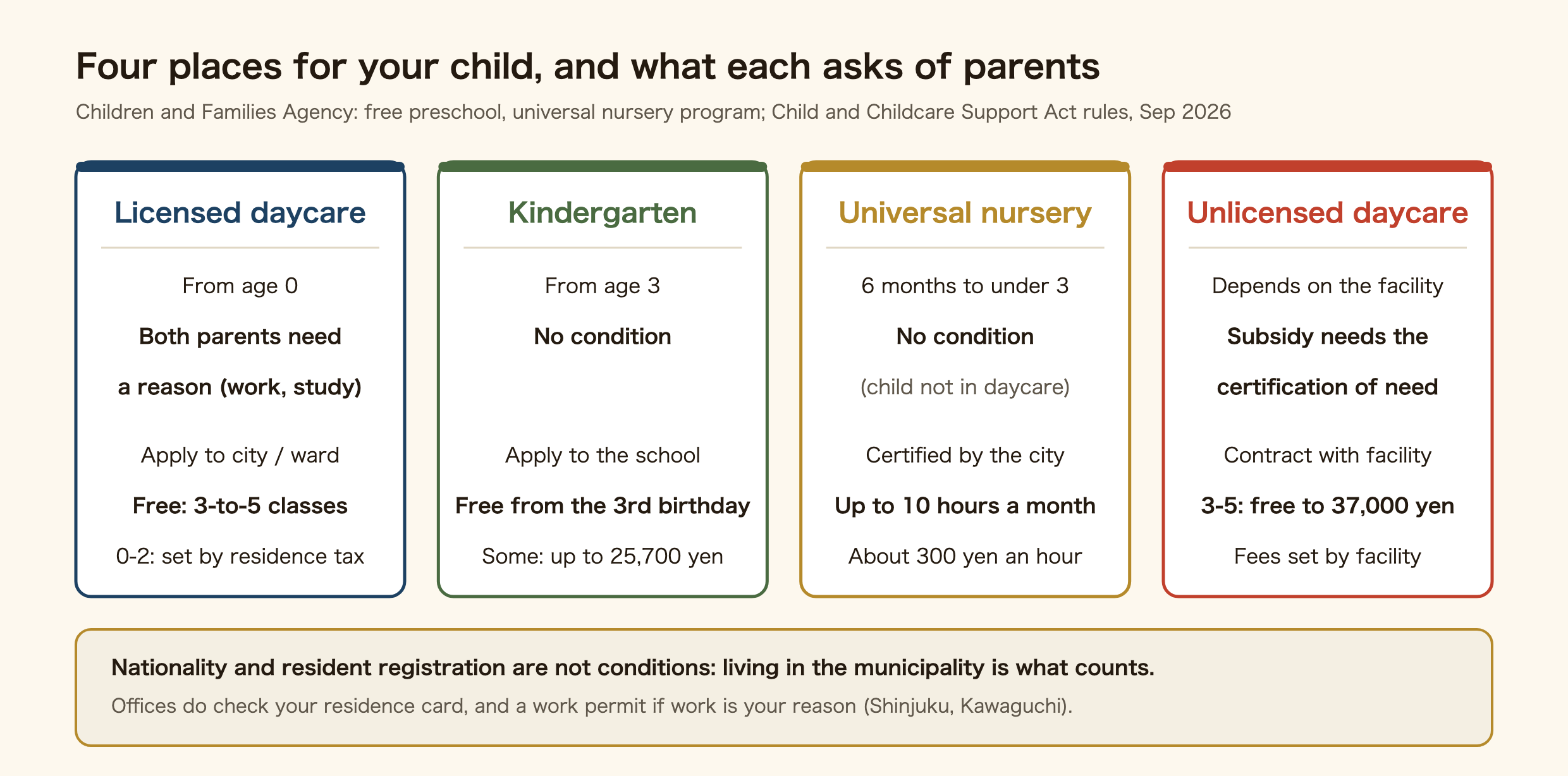
The regulation says the reason must apply to “each of the guardians”. Mother and father: both need a reason. If one parent studies and the other stays at home, the family does not meet the condition for daycare.
If a parent is an international student
Being enrolled at a school is one of the listed reasons. Osaka counts universities, vocational schools (senshu gakko), miscellaneous schools (kakushu gakko) and vocational training schools. Yokohama looks for 64 hours or more a month of attendance. Whether a Japanese language school counts depends on how that school is classified, so ask both your school office and the city.
Points differ. In Osaka, a parent working 160 hours or more a month gets 100 base points; a parent at university 16 or more days a month and 16 or more hours a week gets 60. Places go to the households with the most points first.
If the other parent is on a Dependent visa
Working needs a work permit, and even with it the limit is 28 hours a week. Twenty-eight hours a week clears a 64-hour monthly line. Get the permit, start working, then apply. How to get the permit and how the 28 hours are counted is in working on a Dependent visa.
If one of you does not work, two options remain: kindergarten from age 3, and the Children’s Universal Nursery Program from 6 months. Neither asks whether the parents work.
Hoikuen vs yochien: what is the difference?
| Where | Age | Condition on parents | Apply to |
|---|---|---|---|
| Licensed daycare (hoikuen), or a nintei kodomo-en for childcare | From 0 | Need for childcare (both parents) | Your city or ward |
| Kindergarten (yochien), or a nintei kodomo-en for education | From 3 | None | The kindergarten directly |
| Children’s Universal Nursery Program | 6 months to under 3 | None (child not in daycare) | Certification from the city, then book a centre |
| Unlicensed daycare | Depends on the facility | Certification of need, if you want the free-preschool subsidy | Contract with the facility |
For licensed daycare, the city allocates places by vacancies and points, so applying does not guarantee a place. A child can stay up to 11 or 8 hours a day. For kindergarten, you get accepted by the school first and then submit the paperwork (Yokohama).
Is daycare in Japan free? From the 3-year-old class. Under 3, only for tax-exempt households
Japan’s free preschool education and childcare scheme has run since October 2019.
- Daycare and nintei kodomo-en, 3-to-5 classes: no fee. A child who turns 3 during the school year becomes free from the next April
- Kindergarten: free from the day the child turns 3. Kindergartens outside the new system are covered up to 25,700 yen a month
- Ages 0 to 2: free only for households exempt from residence tax
- Unlicensed daycare: only with the certification of need; up to 37,000 yen a month for ages 3 to 5, and 42,000 yen for tax-exempt households aged 0 to 2
Only the childcare fee is free. Parents still pay the facility for meals (staple food and side dishes) from age 3. The side-dish charge is waived for households with an income equivalent to under 3.6 million yen a year, among others.
Some local governments go further. Since 1 September 2025, Tokyo has been funding the cities and wards that make daycare free for a first child aged 0 to 2. Osaka makes it free for the second and later children aged 0 to 2. Check your own city’s guide.
How much is daycare in Japan for ages 0 to 2? It depends on your residence tax
For ages 0 to 2, the city sets the fee from the total income-based residence tax (shotokuwari) of both parents. More income, higher fee.
| City | Monthly fee, ages 0 to 2 |
|---|---|
| Osaka (as of September 2025, first child, standard hours) | 0 to 70,600 yen |
| Yokohama (fiscal 2026 English guide) | 0 to 77,500 yen |
Watch the timing. In Osaka, April to August is charged on the previous year’s tax, and September to March on the current year’s. That is why the fee can change in September.
If you have just arrived, there is no Japanese tax record. Residence tax is charged by the municipality where you lived on 1 January, on the previous year’s income, so someone who was abroad that day has no figure. In that case Osaka asks for payslips or other proof of income, and Shinjuku asks for an annual income declaration with income documents (with a Japanese translation if they are in another language).
Not submitting costs you. Osaka says that if it cannot confirm your tax information, it provisionally charges the highest bracket.
When do you apply for daycare? For April, in the autumn before
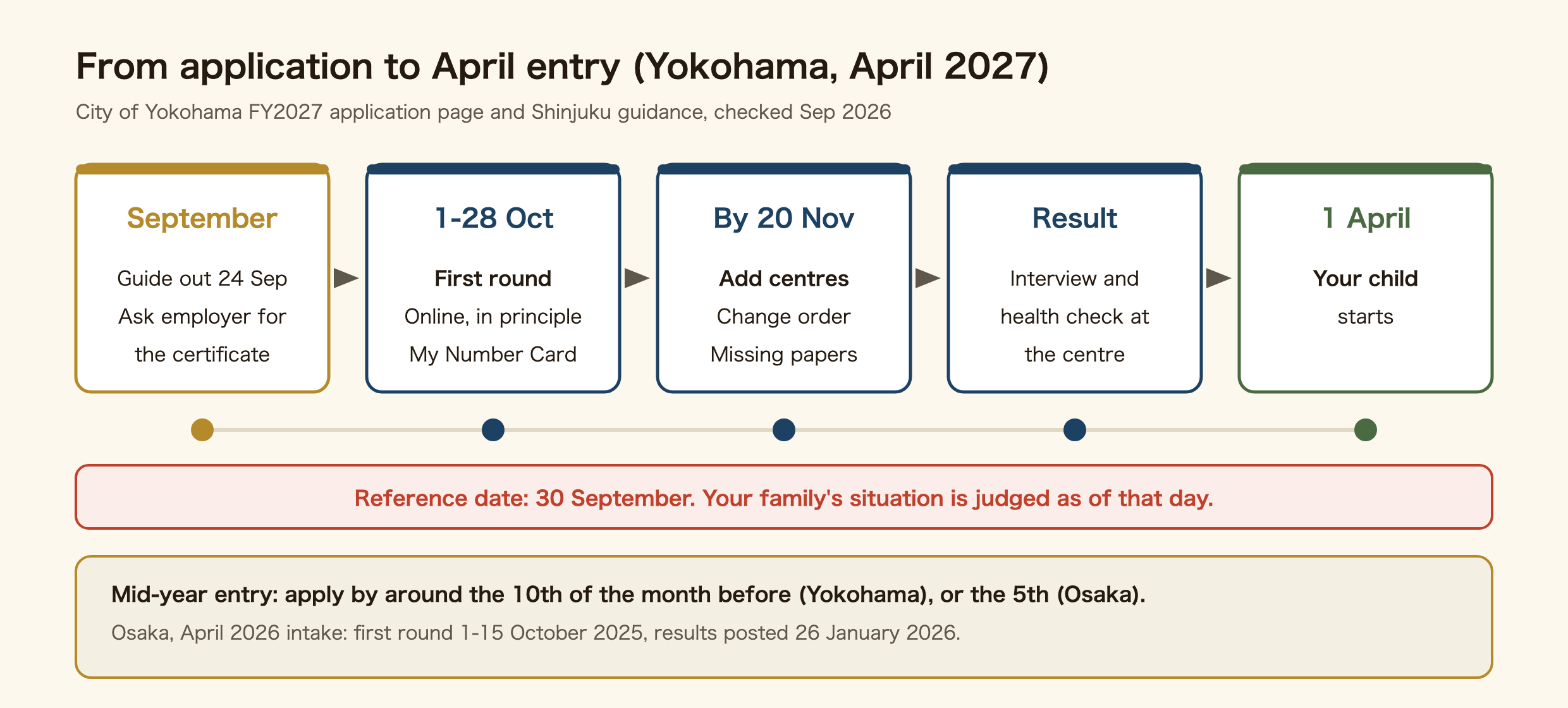
The first round for April entry takes place in the autumn of the year before.
- Yokohama (April 2027 entry): 1 to 28 October 2026, in principle online with a My Number Card. Extra preferred centres and missing documents until 20 November
- Osaka (April 2026 entry): 1 to 15 October 2025, in person at the ward health and welfare centre with an interview (bring the child). Results posted on 26 January 2026. Second round 9 January to 6 February
Deadlines differ by city. In September, look up your city or ward’s nursery guide (hoikusho riyo annai) on its website.
For entry during the year, the deadline is around the 10th of the month before in Yokohama, and the 5th of the month before in Osaka.
Yokohama’s online application needs your My Number Card PIN, and the national portal it runs on is in Japanese except for some parts. A foreign resident’s card expires with the period of stay, so check your card’s expiry date first.
What documents do you need? The employment certificate comes from your employer
The list differs by city. Across the Osaka, Yokohama and Shinjuku guides, the common items are:
- The application form (for the certification and for a place)
- Proof of the reason: an employment certificate (shuro shomeisho) filled in by your employer; a certificate of enrolment from your school; or a job-search declaration
- Your My Number and ID (a residence card works)
- For foreign nationals, a copy of the residence card; for a Dependent applying on the grounds of work, proof of the work permit (Shinjuku)
- If you did not live in that city on 1 January, a tax certificate from your previous address; if you were abroad, proof of income with a Japanese translation
Yokohama releases the employment certificate form ahead of the guide itself, because employers take time to fill it in. Ask your HR contact before the window opens.
If your Japanese is not strong
Yokohama publishes its guide in English, Chinese, Korean, Spanish, Portuguese, Vietnamese and Thai, plus filled-in examples of the forms in easy Japanese. The Yokohama City Call Center (045-664-2525) answers in English, Chinese, Spanish, Korean and Tagalog. Elsewhere, ask the ward’s childcare counter whether they have an English guide.
What is the Children’s Universal Nursery Program? Nationwide from fiscal 2026, up to 10 hours a month
The Children’s Universal Nursery Program (kodomo dare demo tsuen seido) lets a child attend a nursery for a set number of hours a month even if the parents do not work. Municipalities across Japan have been running it since fiscal 2026 (from April 2026).
- Who: children from 6 months to under 3 who are not enrolled in daycare (children at unlicensed daycare are eligible)
- How long: up to 10 hours a month. In fiscal 2026 and 2027, a city may set a limit between 3 and 10 hours by ordinance
- Cost: about 300 yen an hour as the standard, plus actual costs such as meals
- How: get certified by your city, then book a centre, for example through the national portal (tsuen portal)
Ten hours a month is not enough to cover a working day. It is support for families whatever their working pattern.
No daycare place? Second round, mid-year entry, unlicensed care, longer leave
Missing out in the first round is not the end.
- Second round: Osaka’s ran from 9 January to 6 February
- Mid-year entry: keep applying by each monthly deadline
- Unlicensed daycare: you contract with the facility directly. With the certification of need, ages 3 to 5 are free up to 37,000 yen a month
- Kindergarten extended care: some kindergartens keep children after the education hours. With the certification of need, it is free up to 11,300 yen a month
- Longer parental leave: if you are an employee on leave and there is no daycare place, leave can be extended to 18 months and then to two years. How the benefit continues is in maternity and childcare leave for foreigners
If you are worried about paying, hand in your income documents first. Fees for ages 0 to 2 follow income, and tax-exempt households pay nothing.
What happens if you break the rules?
- False statements: Shinjuku cancels the offer or the placement. Osaka warns that making or altering certificates without permission can be a criminal offence
- Getting in on a job offer and not starting: Osaka expects you to start work in the month the child starts, and to submit the employment certificate by the end of the next month. If you do not, the placement may be cancelled
- Getting in while job-hunting: Osaka’s certification lasts until the end of the month in which 90 days pass. Without a job by then, you go back into the allocation
- Turning down an offer: Osaka deducts points next time if you decline without good reason. List only centres you can actually reach
A Dependent parent who works beyond 28 hours a week to earn more points is breaking the Immigration Control Act. Risking your status of residence for daycare points is never worth it.
If you leave Japan or will be away for a long time after your child starts, tell the ward office (Yokohama).
Which one are you?
- Both parents work (or one studies): get your city’s nursery guide this month, and ask your employer for the employment certificate and your school for a certificate of enrolment. Put the first day of the autumn window in your calendar.
- One parent is a Dependent and not working yet: get the work permit before you apply. If you plan to work, fix shifts within 28 hours a week, then apply.
- One parent stays home and will not work: for a child aged 0 to 2, apply to your city for the Children’s Universal Nursery Program. If your child is nearly 3, book a visit to a local kindergarten.
- You arrived recently (you were abroad on 1 January): gather proof of last year’s income and add a Japanese translation. Without it, you may be charged the top fee provisionally.
FAQ
Q. Can foreigners use daycare in Japan?
Yes. The Children and Families Agency covers children regardless of nationality or resident registration if they live in the municipality. The condition is that both parents have a “need for childcare”, such as work or study.
Q. Is daycare in Japan free for foreigners?
From the 3-year-old class, yes. Fees for the 3-to-5 classes are free regardless of nationality. For ages 0 to 2, only tax-exempt households pay nothing. Meals are charged separately.
Q. Can an international student’s family get a daycare place?
Yes, if both parents have a reason. Being enrolled at a school counts. If the other parent is a Dependent, that parent needs a reason too, for example working with a work permit.
Q. When do you apply for daycare in Japan?
For April entry, in the autumn of the year before. Yokohama’s window for April 2027 is 1 to 28 October 2026; Osaka’s for April 2026 was 1 to 15 October 2025. Deadlines differ by city.
Q. How much does daycare cost in Japan?
For ages 0 to 2, it depends on the parents’ income-based residence tax. Osaka charges 0 to 70,600 yen a month and Yokohama 0 to 77,500 yen. If you were abroad on 1 January, submit proof of your income.
Q. Can I use childcare if I do not work?
Yes, through kindergarten or the Children’s Universal Nursery Program. Kindergarten takes children from age 3 with no condition on the parents, and the fee is free (up to 25,700 yen a month at kindergartens outside the new system). The universal program covers 6 months to under 3, up to 10 hours a month.
Summary
Foreign children are covered by Japan’s daycare, kindergarten and free-preschool systems. There is no nationality rule. Daycare looks at each parent’s need for childcare, and the office will check your residence card and, if you apply on the grounds of work, your work permit. The 3-to-5 classes are free; for ages 0 to 2 the fee follows your residence tax.
Timing matters most. The April intake has one first round, in the autumn before, and employers take time to fill in the certificate. If one parent does not have a reason, use kindergarten and the Children’s Universal Nursery Program.
Official sources: Children and Families Agency, free preschool education and childcare (incl. FAQ, July 2024) / Children and Families Agency, Children’s Universal Nursery Program / Enforcement Regulations of the Child and Childcare Support Act, Art. 1-5 (e-Gov) / Yokohama, applying for daycare in fiscal 2027 / Yokohama, 2026FY Guide to Kindergartens and Nursery Facilities (English) / Osaka, daycare application guide for fiscal 2026 / Shinjuku, applying from outside the ward or from abroad / Kawaguchi, can foreign children use childcare facilities? / Tokyo Metropolitan Government, free childcare fees. Checked on 23 September 2026. Deadlines, fees and documents differ by municipality, so always confirm with your own city or ward’s guide.
Related guides
Found this useful? Share it
Send it to a friend who lives in Japan.
WHO WROTE THIS

mori
Japanese. I read the ministries’ own notices, orders and Q&As in the original, and I start from what my Nepalese and Sri Lankan friends in Japan actually ran into. I do not write about what I have not checked or been told.
What this site can and cannot do →Looking for something else?