Checked on 21 October 2026 against the National Tax Agency’s Tax Answers (law as of 1 April 2026) and Basic Circular on income tax, and the Income Tax Act, its Enforcement Order, the Remittance Report Act and the Local Tax Act on e-Gov.
The short answer
- A non-permanent resident is a non-Japanese person living in Japan who has lived here for 5 years or less in total over the past 10 years. It is a tax category and has nothing to do with the permanent resident visa.
- Non-permanent residents pay Japanese tax on interest and dividends from home only on the part paid in Japan or sent to Japan. Leave it abroad and Japan does not tax it.
- Money you send is counted against this year’s foreign income first, even if you meant to move old savings. Send 500,000 yen in a year with 100,000 yen of interest, and 100,000 yen is taxable.
- Gains on foreign shares or funds you bought while a non-permanent resident are taxed even if the money never comes to Japan.
- From the day after your total passes 5 years, all your income worldwide is taxed. Keep your transfer records and your interest and dividend statements every year.
Knowing this, you can choose when and how much to move from home, instead of finding out later that you missed a tax return.
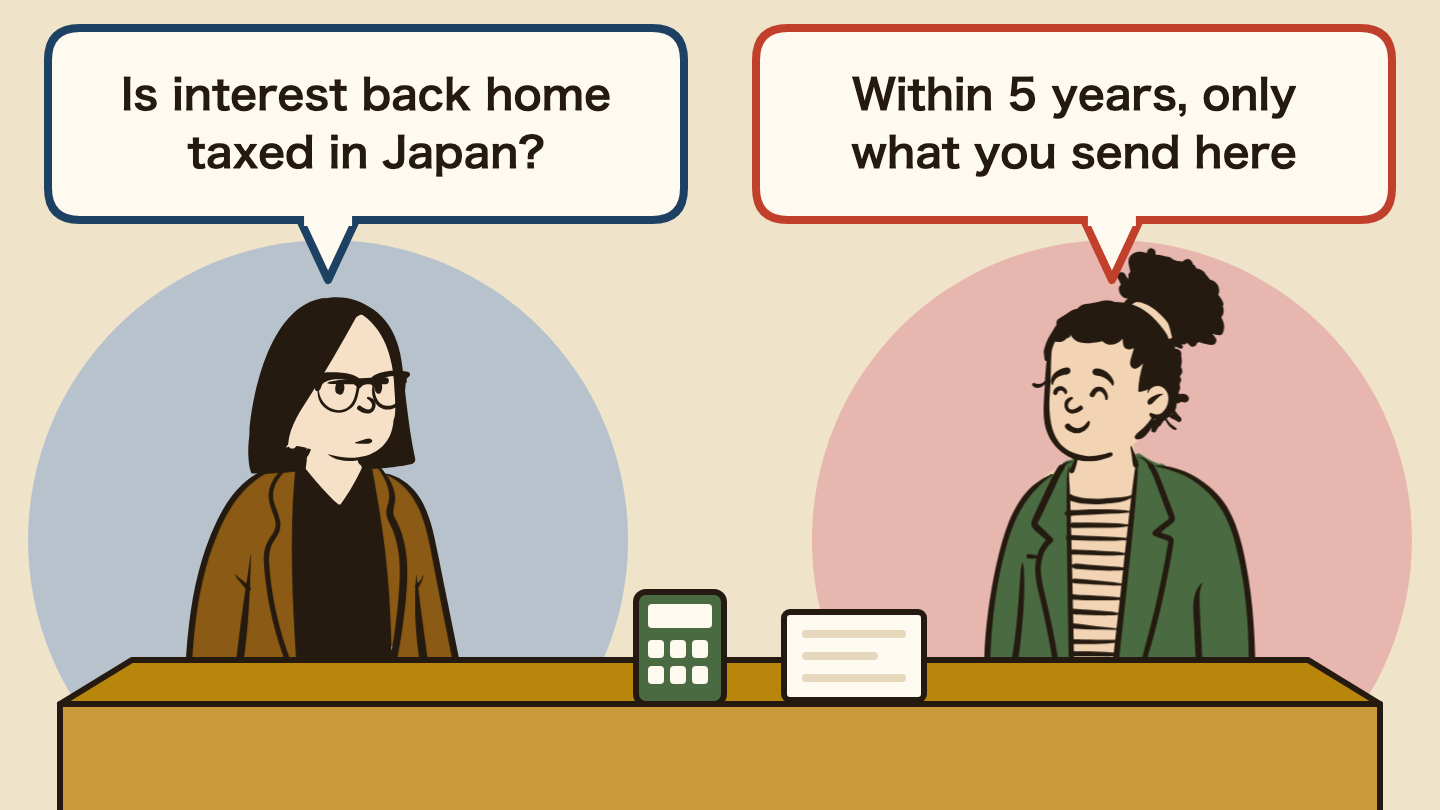
Spring of your third year at work. A fixed deposit back home has matured with interest, and you are moving flat, so you want to bring some of it to your Japanese account. You ask a Japanese colleague whether Japan taxes that. “No idea, I don’t have a bank account abroad,” they say. Every Japanese national living in Japan is taxed on worldwide income. The “only what you send” rule exists only for foreigners in their first five years.
- What is a non-permanent resident? Japan’s three tax categories
- Which one are you? Non-resident, non-permanent or permanent for tax
- What does Japan tax for non-permanent residents? Interest, dividends and rent from home
- The remittance rule: how money sent to Japan is counted
- Selling shares or funds back home: when you bought them matters
- How is the 5-year rule counted? Study years count too
- Already taxed back home? The foreign tax credit
- Do you need to file a tax return? The 200,000 yen line, and residence tax
- Does the bank tell the tax office? Remittance reports and My Number
- Realised you never declared it?
- Non-permanent resident tax on one page: numbers, deadlines, sources
- Which one are you?
- FAQ
- Summary
- Related reading
What is a non-permanent resident? Japan’s three tax categories
Japanese income tax sorts people into three groups by how they live here (National Tax Agency, Tax Answer No.2010, in Japanese).
- Non-resident: no home base in Japan and not living here for a year or more. Only income from Japan is taxed
- Non-permanent resident: a resident who is not a Japanese national and has lived in Japan for 5 years or less in total within the past 10 years
- Resident other than a non-permanent resident: every other resident. All income worldwide is taxed
In this article the third group is called “permanent resident for tax”. It is a tax label, not the visa. An Engineer/Specialist in Humanities visa holder or a Dependent visa holder moves into it too once their total time in Japan passes 5 years. The legal definitions are in Income Tax Act, Article 2(1)(iii)-(v).
Which one are you? Non-resident, non-permanent or permanent for tax
The first test: is your home base in Japan, or have you lived here for a year or more in a row? Either one makes you a resident. “Home base” (domicile) means the base of your life, judged on objective facts (NTA Tax Answer No.2875, in Japanese). Someone who comes to Japan for a job is presumed to have a domicile here, unless a contract makes it clear the stay is under a year. Someone who comes to study is treated the same way, as if studying were their job here (Basic Circular 3-2 and 3-3, in Japanese).
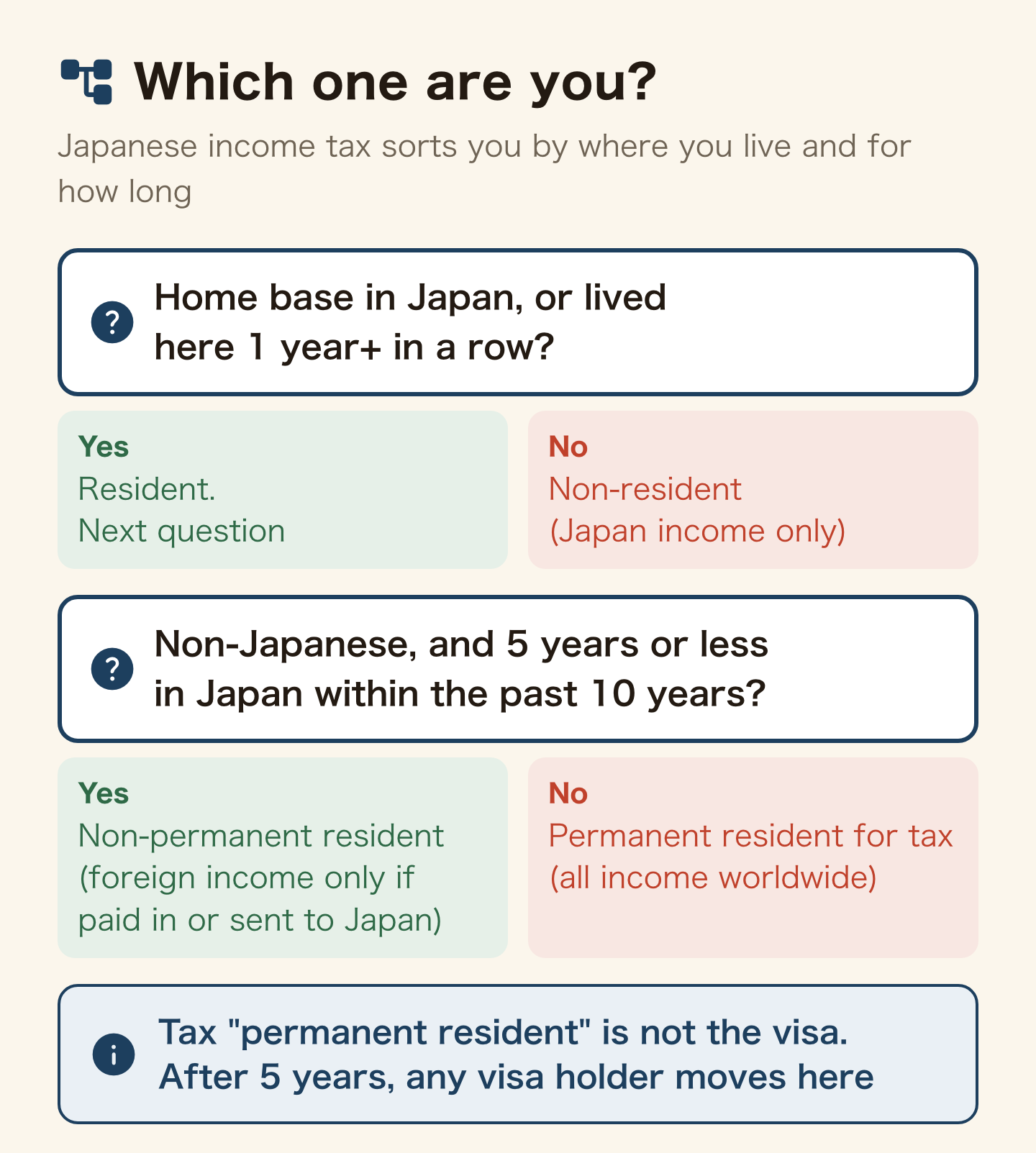
So most foreigners who work or study in Japan are residents from the start, and non-permanent residents for their first five years. If your home country’s tax law also treats you as its resident, a tax treaty between the two countries may decide. In that case, do not decide on your own; ask the tax office.
What does Japan tax for non-permanent residents? Interest, dividends and rent from home
A non-permanent resident is taxed on two things (Income Tax Act, Article 7(1)(ii)).
- Income that is not foreign-source. Japanese salary, which is most people’s main income, is here
- Foreign-source income, but only the part paid in Japan or sent to Japan from abroad
Foreign-source income is income that arises abroad: interest on a deposit at a bank branch abroad, dividends from a foreign company, rent from a house or flat you let out back home (Income Tax Act, Article 95(4)). Pay for work you did in Japan is not foreign-source, even if a company back home pays it.
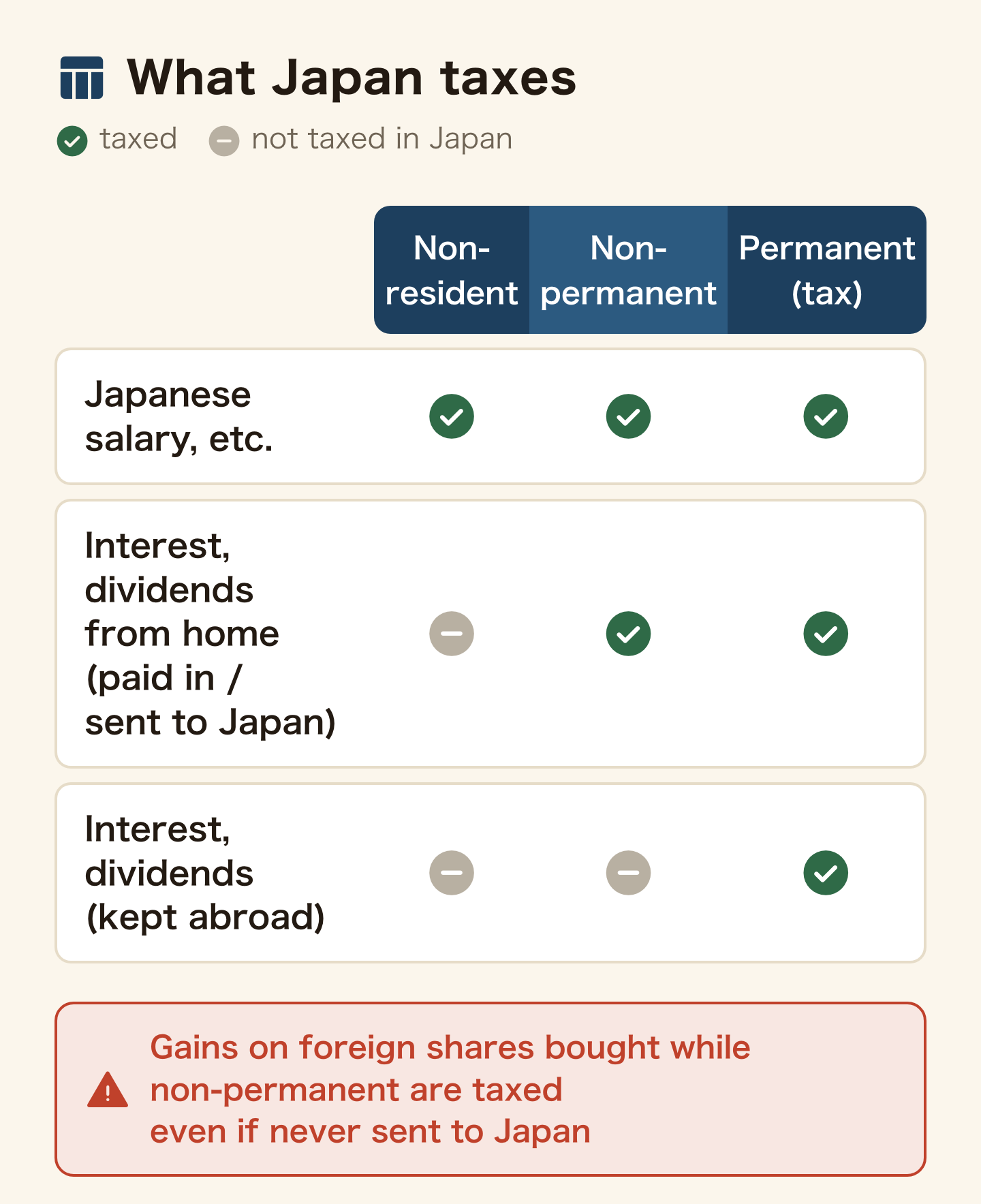
Watch the words “paid in Japan” too. If your tenant back home pays the rent straight into your Japanese bank account, that rent was paid in Japan (Basic Circular 7-4). All of it is taxable, without going through the remittance count.
The remittance rule: how money sent to Japan is counted
Moving money from your own account at home to your own account in Japan is just moving your savings. Where you come from, that may be normal. In Japan, if a non-permanent resident received income abroad that year, money sent to Japan is counted as that income first. It does not matter that the money was saved years ago.
The order is set by law (Income Tax Act Enforcement Order, Article 17(4)).
- The year’s remittances go first to income that is not foreign-source but was paid abroad
- What is left goes to that year’s foreign-source income paid abroad. The part covered here is taxed
- Anything still left over is not taxed
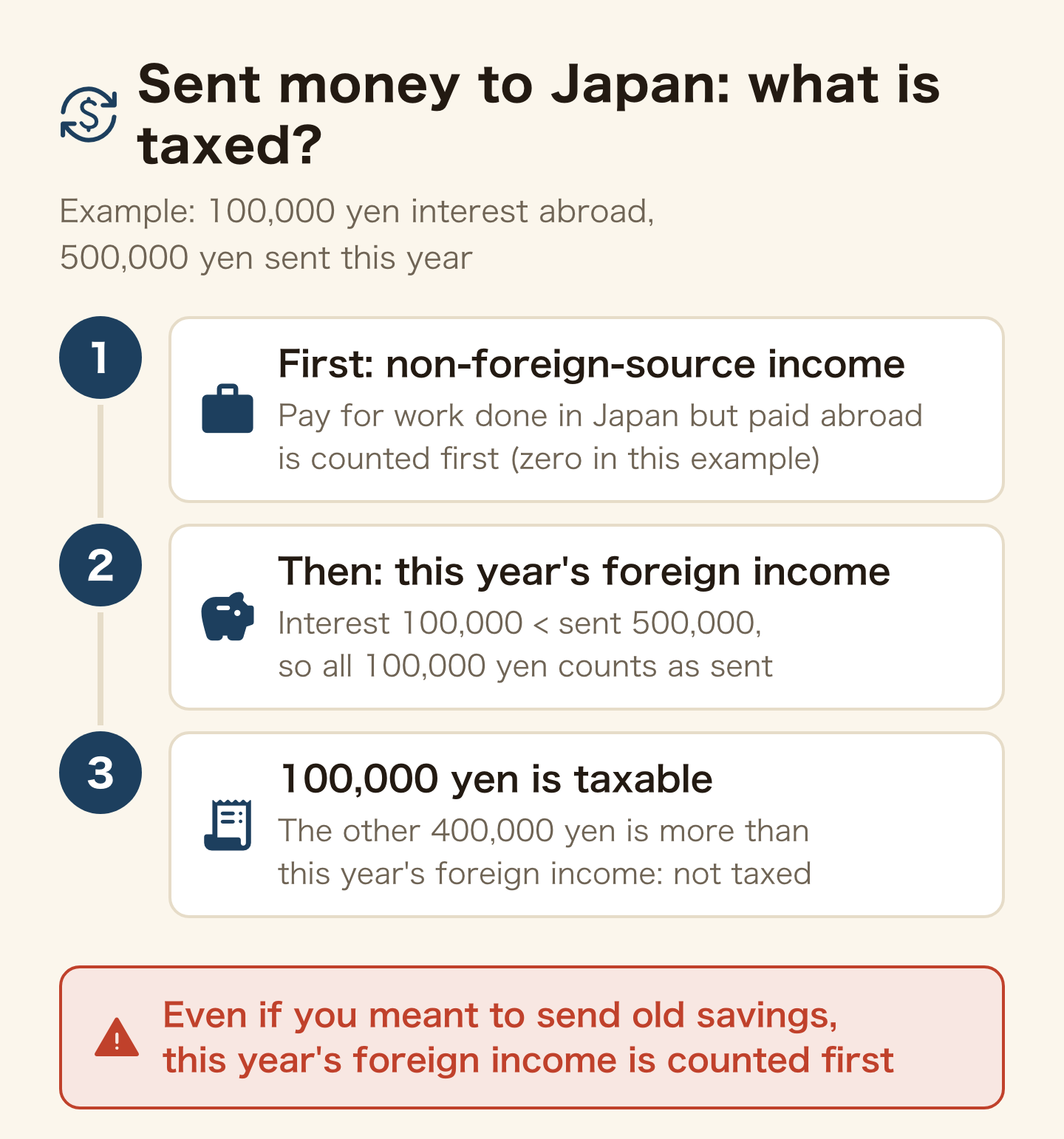
Three examples with round numbers. Each is a non-permanent resident whose deposit back home earned 100,000 yen of interest that year.
- Sent nothing that year: the 100,000 yen of interest is not taxed in Japan
- Sent 50,000 yen: that 50,000 yen counts as interest sent, so 50,000 yen is taxable
- Sent 500,000 yen: all 100,000 yen of interest is taxable. The other 400,000 yen is not
The National Tax Agency’s English guide works through the same order with numbers (NTA 2025 Income Tax Guide). The count is year by year: last year’s interest is not matched against this year’s transfers.
“Sending” is not only a bank transfer. Bringing cash into Japan counts. So does repaying a loan or a payment made for you in Japan out of your deposits abroad, when it takes the place of an ordinary transfer (Basic Circular 7-6, in Japanese). Shopping in Japan on a card from home that is paid off from your account back home can fall under this. If unsure, ask the tax office.
Selling shares or funds back home: when you bought them matters
Unlike interest and dividends, gains on foreign shares and funds have one more rule. If you bought them while a non-permanent resident, the gain on selling them is not treated as foreign-source income (Enforcement Order, Article 17(1)). It is taxable whether you send it to Japan or not.
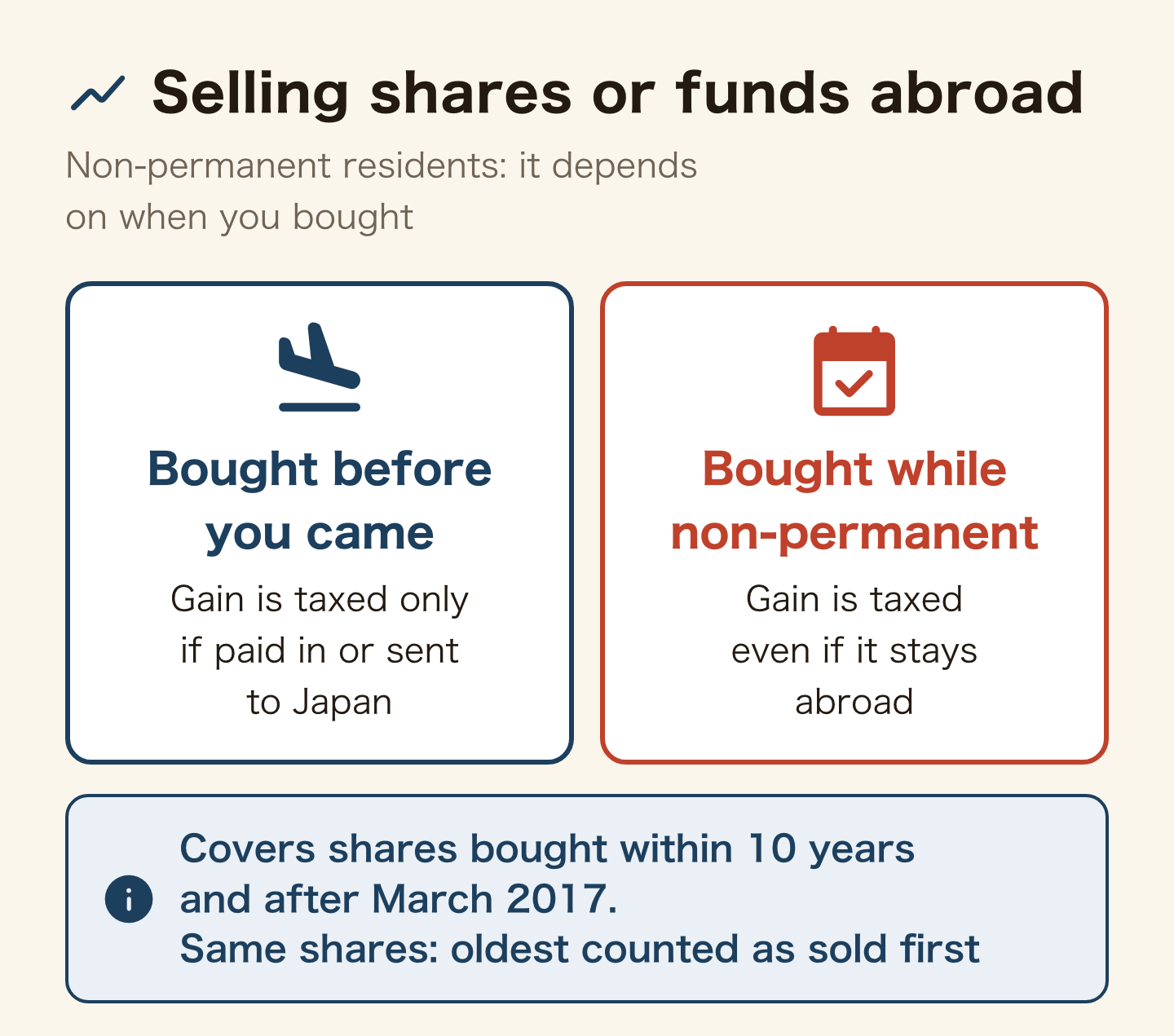
Only shares held and sold abroad (for example in a brokerage account back home) that fall in one of these groups stay under the “only what you send” rule (Basic Circular 7-1, in Japanese).
- Bought on or before the day 10 years before the sale
- Bought within those 10 years, but while you were not a non-permanent resident (for example, before you came to Japan)
- Bought on or before 31 March 2017
If you bought the same shares in several lots, the oldest are treated as sold first. If you keep investing through a brokerage account back home after moving here, the shares bought before and after you arrived are treated differently. Brokerage accounts and NISA in Japan are covered in NISA for foreigners in Japan.
How is the 5-year rule counted? Study years count too
The 5 years are the total time you had a domicile or residence in Japan within the past 10 years. You look from the same date 10 years ago up to the day before (Basic Circular 2-4-2). If your time in Japan came in several stretches, add them all together (Basic Circular 2-4-3).
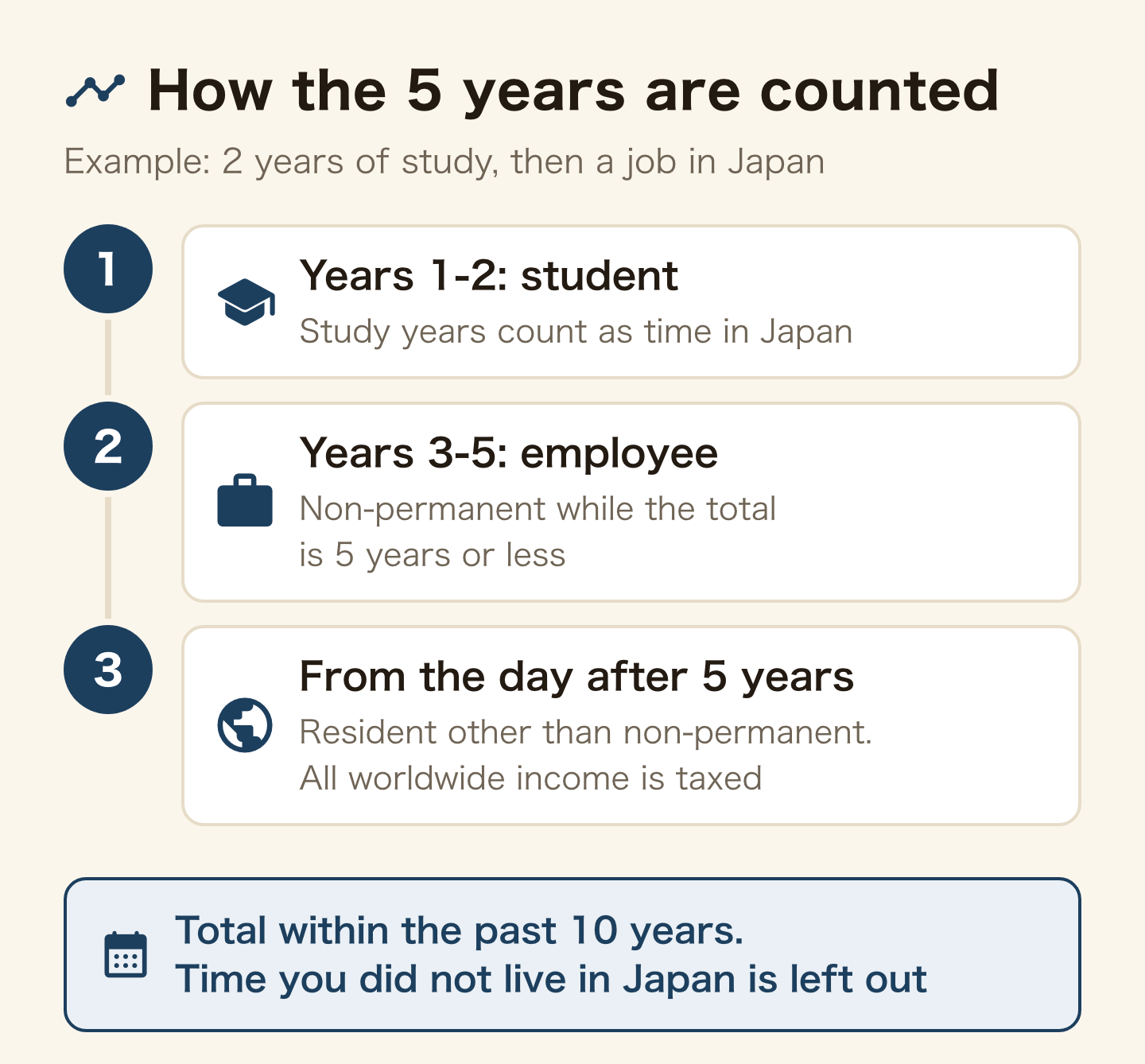
What counts is time living in Japan, not your visa type. Two years at a language school and university plus three years at a company make five. From the day after your total passes 5 years, you are a permanent resident for tax (Basic Circular 2-3, in Japanese). In that year, the remittance count applies only to income and transfers during the part of the year you were non-permanent (Enforcement Order, Article 17(4)(vi)).
After 5 years, interest, dividends and rent kept abroad, and gains on foreign shares, are all taxable in Japan. If your fifth year is close, check now whether your bank back home can give you yearly interest statements.
Already taxed back home? The foreign tax credit
If your bank back home withholds tax on interest, being taxed in Japan as well would mean paying twice. The foreign tax credit fixes that: foreign tax you paid can be deducted from Japanese income tax, up to a limit (NTA Tax Answer No.1240, in Japanese).
For a non-permanent resident, only foreign income paid in or sent to Japan goes into the calculation. To claim it, attach the “Statement on Foreign Tax Credit (for residents)” and a document showing the foreign tax was charged, among other papers, to your tax return. Check whether your bank’s interest statement shows the tax withheld.
Do you need to file a tax return? The 200,000 yen line, and residence tax
If you are an employee paid by one employer and covered by its year-end adjustment, you must file a return when your income other than salary is over 200,000 yen in total (NTA Tax Answer No.1900, in Japanese). For a non-permanent resident, interest or dividends that became taxable by being sent, and gains on shares sold, count as that “other income”.
The filing period is 16 February to 15 March of the following year. Your employer’s year-end adjustment knows nothing about your interest at home or your transfers. Unless you file, no one calculates it. The steps and the papers you need are in Kakutei Shinkoku: who must file a tax return in Japan.
Residence tax counts income in the same way as income tax (Local Tax Act, Article 313(2)). If your other income is 200,000 yen or less and you need no income tax return, ask the residence tax section of your city office what you need to do. The basics are in residence tax in Japan.
Does the bank tell the tax office? Remittance reports and My Number
Money crossing the border leaves a record. For each transfer abroad, or receipt from abroad, over 1 million yen, the bank files a “remittance report” with the tax office (Remittance Report Act, Article 4, and its Order, Article 8). For transfers to or from abroad you must also give the bank your name, address and My Number; for transfers through your own account this is done once for the account (Article 3).
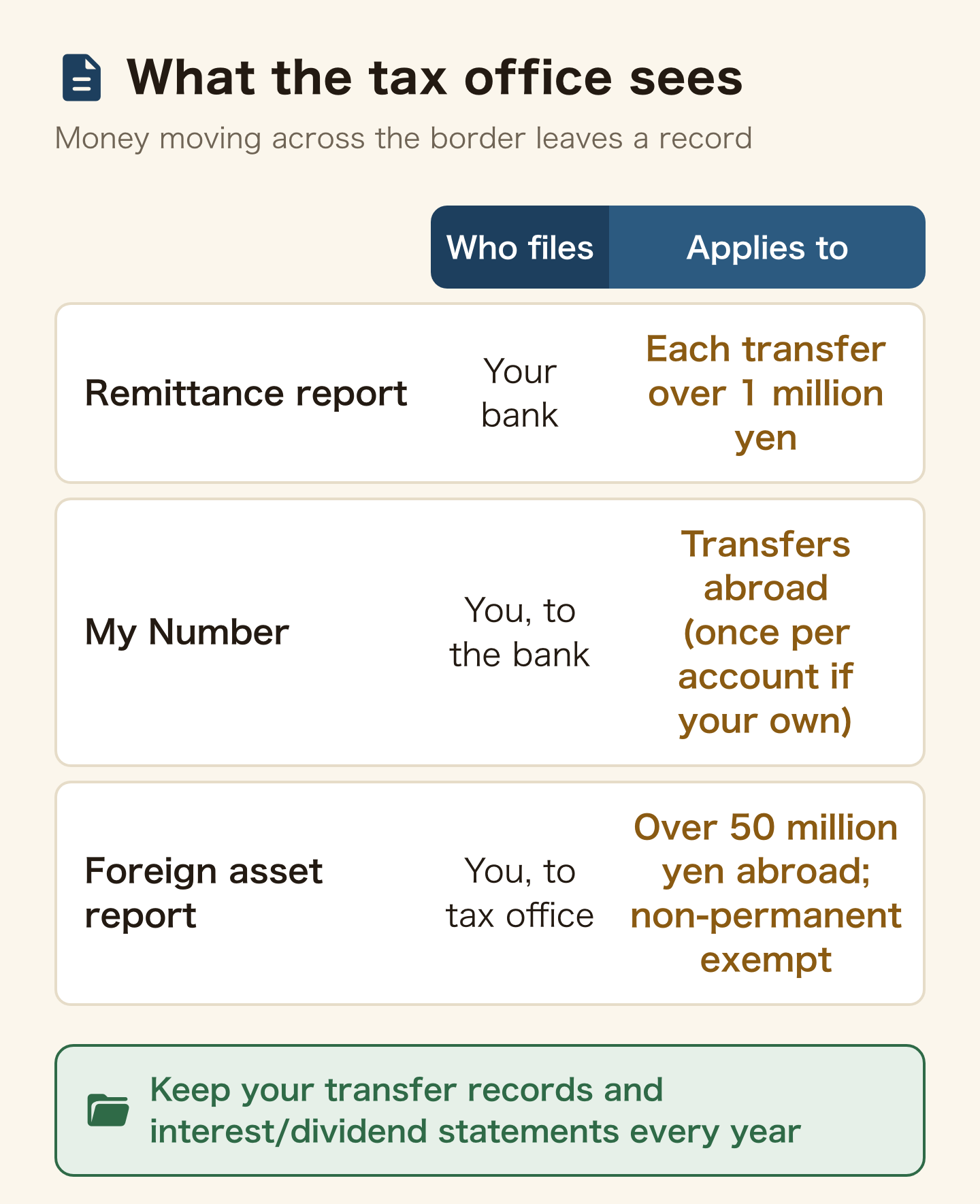
1 million yen is not the line for whether tax is due. It is the line for the bank’s report. A transfer under 1 million yen can still carry taxable income under the count above.
There is also the foreign asset report. A resident with more than 50 million yen of assets abroad on 31 December files it with the tax office by 30 June of the next year (NTA Tax Answer No.7456, in Japanese). Non-permanent residents are exempt. It can apply from the year you become a permanent resident for tax. How to cut the cost of moving money is in sending money home from Japan.
Realised you never declared it?
If you notice you never declared interest for a year when you sent money, waiting quietly is the costliest choice. If you missed a tax return, file as soon as you notice. This is called a late return (NTA Tax Answer No.2024, in Japanese).
File on your own before the tax office gives advance notice of an audit, and the penalty for not filing is 5% of the tax due. After the notice it starts at 10%, and after an audit it starts at 15%; the later, the heavier. Write down three things first: which years, how much you sent, and how much interest you earned at home. Then talk to the tax office.
The National Tax Agency’s telephone consultation centre takes calls on 0570-00-5901 (choose “1” for income tax), weekdays 8:30 to 17:00 (NTA consultation page, in Japanese). For residence tax, ask your city office.
Non-permanent resident tax on one page: numbers, deadlines, sources
Everything in this table was checked on official pages and in the law on 21 October 2026.
| Question | Official answer | Source |
|---|---|---|
| Non-permanent resident | A non-Japanese resident with 5 years or less in Japan in total within the past 10 years | NTA No.2010 / Income Tax Act Art. 2 |
| What is taxed | Income that is not foreign-source, plus foreign-source income paid in or sent to Japan | Income Tax Act Art. 7 |
| Remittance count | First non-foreign-source income paid abroad, then foreign-source income paid abroad | Enforcement Order Art. 17(4) |
| Gains on foreign shares | Shares bought while non-permanent (within 10 years, after March 2017) are taxed even if not sent | Basic Circular 7-1 |
| Tax return | One employer and other income over 200,000 yen; filing period 16 February to 15 March | NTA No.1900 / No.2024 |
| Remittance report | Bank reports each transfer to or from abroad over 1 million yen | Remittance Report Act |
| Foreign asset report | Residents (not non-permanent) with over 50 million yen abroad, by 30 June of the next year | NTA No.7456 |
Read top to bottom, two things decide it: whether you are still within 5 years, and whether this year’s income abroad or the amount you sent to Japan is larger.
Which one are you?
- Within 5 years, with almost no interest or dividends at home — nothing to worry about. Today, write down the date you arrived in Japan.
- Within 5 years, with interest, dividends or rent at home — in a year you send money, that year’s income abroad is taxable up to what you sent. Today, put last year’s transfers next to your interest statement and see whether you pass 200,000 yen.
- Still buying shares or funds through an account back home while non-permanent — gains on them are taxed even if never sent. Today, start keeping separate records of what you bought before and after you arrived.
- Your total time in Japan has passed 5 years, or soon will — all worldwide income becomes taxable. Today, work out the date you pass 5 years, and find out how to get yearly statements from home from then on.
Once you leave Japan and become a non-resident, interest and dividends from home are no longer taxed in Japan. That is where this worry ends. What to sort out before you go is in the leaving Japan checklist.
FAQ
Q. What is a non-permanent resident in Japan?
A non-Japanese person living in Japan who has lived here for 5 years or less in total within the past 10 years. It is an income tax category and has nothing to do with the permanent resident visa.
Q. What is the difference between a non-permanent resident and a non-resident?
A non-resident has no home base in Japan and has not lived here for a year or more, and is taxed only on income from Japan. A non-permanent resident lives in Japan and is taxed on Japanese income plus the part of foreign income paid in or sent to Japan.
Q. Is money I send from my savings back home taxed in Japan?
For a non-permanent resident, money sent is counted first as that year’s income paid abroad. If you earned no interest or other income abroad that year, the transfer is not taxed. Send 500,000 yen in a year with 100,000 yen of interest, and 100,000 yen is taxable.
Q. Do non-permanent residents need to file a tax return?
An employee with one employer must file when income other than salary, including interest or dividends that became taxable by being sent, is over 200,000 yen. You also file to claim the foreign tax credit.
Q. From what amount does the tax office learn about overseas transfers?
For each transfer to or from abroad over 1 million yen, the bank files a remittance report with the tax office. 1 million yen is the reporting line, not the line for whether tax is due.
Q. What happens after 5 years?
From the day after your total time in Japan within the past 10 years passes 5 years, you become a resident other than a non-permanent resident. All income worldwide is taxed in Japan, including interest, dividends and rent kept abroad.
Summary
A non-permanent resident is a foreigner with 5 years or less in Japan in total. Interest and dividends from home are taxed only on the part paid in Japan or sent to Japan. Money sent is counted as that year’s income abroad first. Gains on foreign shares bought while non-permanent are taxed even if never sent.
After 5 years, all income worldwide is taxed. Keep your transfer records and your interest and dividend statements every year, and file a return in any year your income other than salary passes 200,000 yen. When in doubt, the surest route is to show your transfers and statements to the NTA telephone consultation centre or the tax office.
Official sources: NTA Tax Answer No.2010 (taxpayers) / No.2875 (residents and non-residents) / No.1240 (foreign tax credit) / No.1900 (employees who must file) / No.2024 (late returns) / No.7456 (foreign asset report) / Basic Circular 2-3 to 2-4-3 / Basic Circular 3-2 and 3-3 / Basic Circular 7-1 to 7-6 / NTA consultation page / NTA 2025 Income Tax Guide (English) / e-Gov: Income Tax Act / e-Gov: Income Tax Act Enforcement Order / e-Gov: Remittance Report Act / e-Gov: Local Tax Act (all checked 21 October 2026). Japanese-language pages unless marked. Always confirm your own return with the tax office or the NTA telephone consultation centre.
Related reading
Found this useful? Share it
Send it to a friend who lives in Japan.
WHO WROTE THIS

mori
Japanese. I read the ministries’ own notices, orders and Q&As in the original, and I start from what my Nepalese and Sri Lankan friends in Japan actually ran into. I do not write about what I have not checked or been told.
What this site can and cannot do →Looking for something else?
You may use the figures in this article, including commercially, if you credit this site with a link. How to use our figures