Checked on 13 September 2026 against the Immigration Services Agency’s Specified Skilled Worker Q&A and the text of articles 19-16 and 22-4 of the Immigration Act on e-Gov. Job categories differ by field. Check your own field’s page on the agency’s site.
In short
- You can change jobs on a Specified Skilled Worker visa. Within the same job category, or between categories whose skills are recognised as shared.
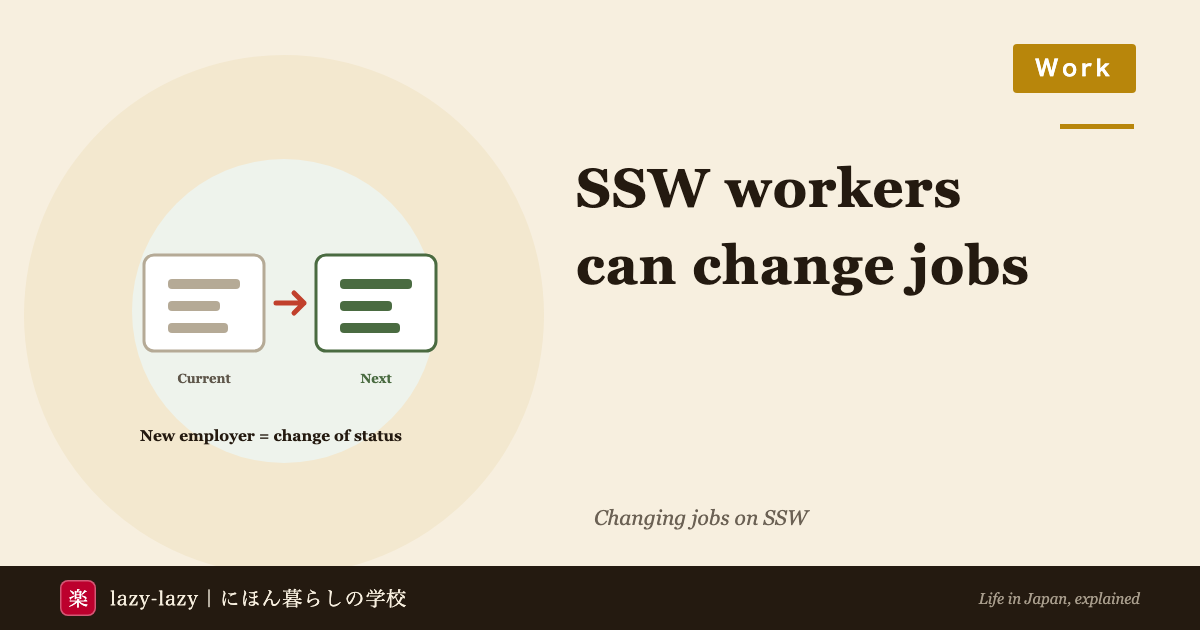
- If the company changes, you must apply for a change of status of residence. Standard processing is 1-2 months. A notification alone is not enough.
- Notify Immigration within 14 days when your contract ends, and again when the new one is signed.
- Losing your job does not mean leaving Japan. If you are job-hunting you may stay within your period of stay, and unemployment insurance applies.
- The line is three months. Three months or more without SSW work and without good reason can cost you the status.
Some people were told by a sending agency, or by a senior worker, that a Specified Skilled Worker cannot change jobs. That is wrong. The right to change employers has been part of the system since it began. But the procedure is nothing like a Japanese employee’s job change, and quitting without knowing it walks you straight into the three-month wall.
- What is the Specified Skilled Worker status?
- Can you change jobs? Yes – and what changes decides the paperwork
- What do you do, and when?
- Lost your job? You do not leave at once. The line is three months
- Dismissed through no fault of your own? The employer has duties, and there is a fallback
- Does changing jobs count against you?
- When to move, and when to stop
- Frequently asked questions
- Summary
What is the Specified Skilled Worker status?
Specified Skilled Worker (SSW) is a status of residence for work requiring a considerable degree of knowledge or experience in designated fields with serious labour shortages. There are two tiers, (i) and (ii); most people hold (i), capped at five years in total. Each field is divided into job categories, and you work in the category whose exam you passed.
Unlike technical intern training, SSW was designed from the start as a status you can change employers on. Not freely, though – the move has to fit one of the three patterns below.
Can you change jobs? Yes – and what changes decides the paperwork
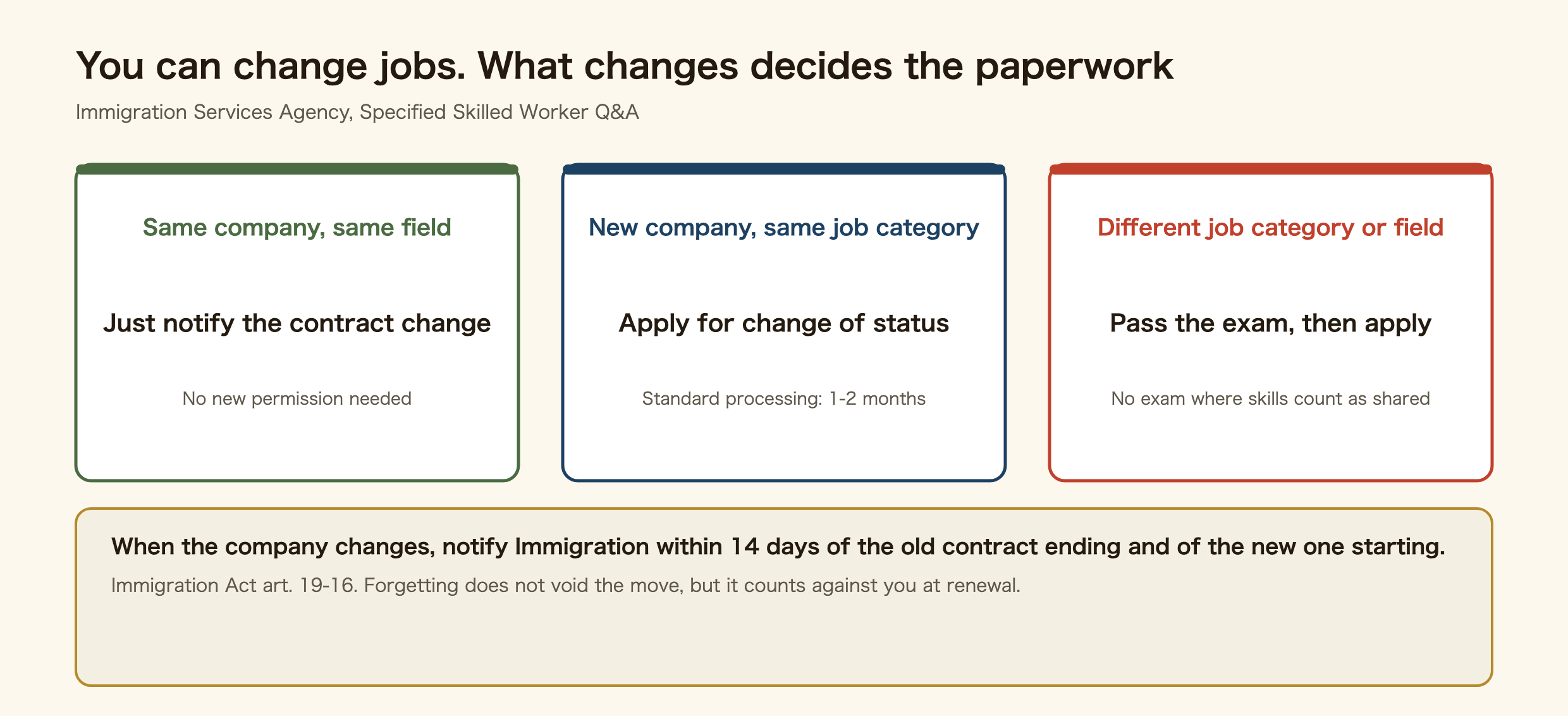
The agency’s Q&A defines the permitted range as “within the same job category, or between job categories whose skill levels have been confirmed as shared through exams and the like.” In procedural terms that becomes three patterns.
- Same company, different duties in the same field. A notification of the contract change. No new permission.
- New company, same job category. An application for change of status of residence. Whenever the accepting organisation changes, this is required. Standard processing: 1-2 months.
- Different job category or field. Pass that category’s exam first, then apply. Where two categories are recognised as sharing the same skills, no exam is needed.
The second pattern is where people go wrong. They assume “same work, so a notification is enough”, resign, and then cannot start at the new company. When the employer changes, you cannot work there until the permission is granted – that is the decisive difference from a Japanese employee’s job change.
What do you do, and when?
- Secure the next employer first – before you resign. The new company must meet the SSW acceptance requirements and belong to the field’s council.
- When your current contract ends, notify Immigration within 14 days. Article 19-16 of the Immigration Act requires notification of the end of a contract and of a new contract, each within 14 days.
- Sign with the new company and apply for change of status. This takes 1-2 months, during which you cannot work for the new company.
- Once granted, notify the new contract within 14 days.
Step 3 is a gap with no income, so you need savings to cover it. That is why step 1 comes first. Resign and then search, and that gap starts eating into the three months.
Lost your job? You do not leave at once. The line is three months
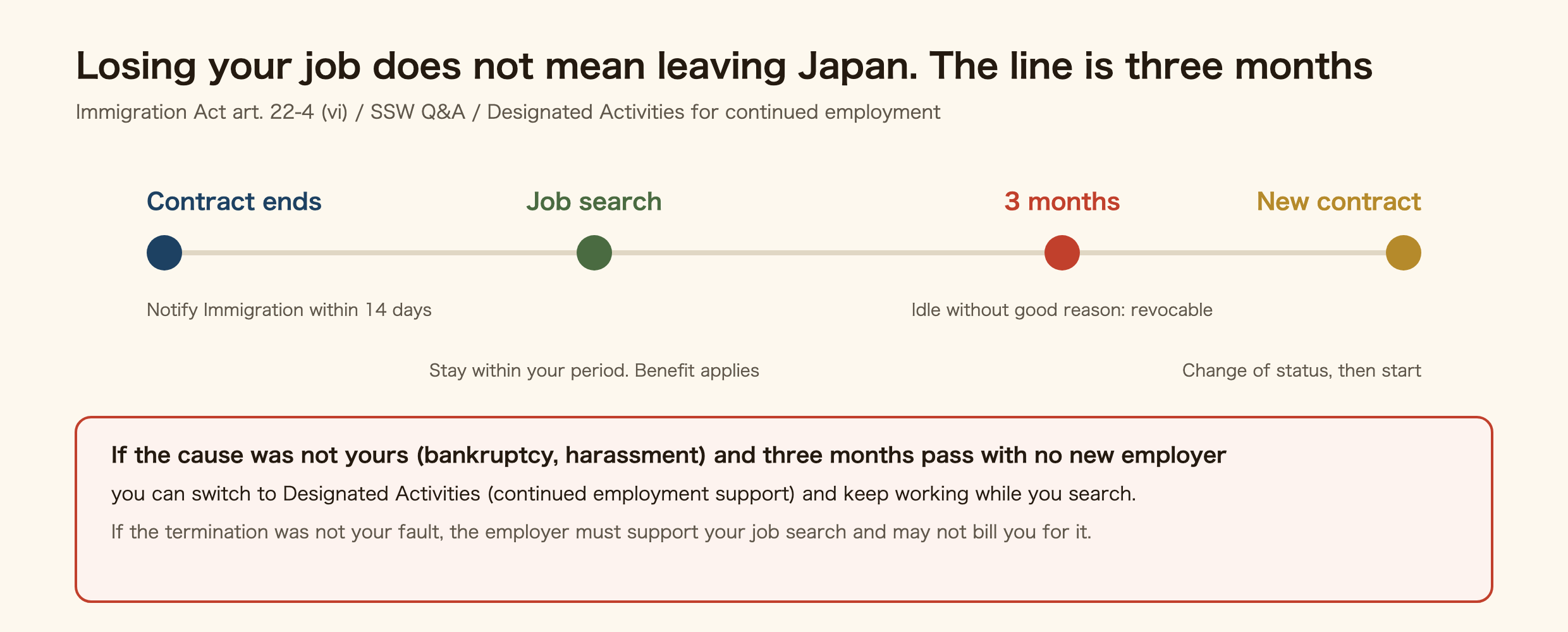
The agency’s Q&A is explicit: losing your job does not mean you must leave immediately; if you are looking for work you may stay at least within your period of stay. Unemployment insurance is paid in the same way as to Japanese nationals – the procedure is at Hello Work, and the Employment Service Centers for Foreigners have interpreters.
There is a line, though. Article 22-4 (vi) of the Immigration Act allows revocation where the holder has gone three months or more without carrying out the status’s activity, without good reason. The Q&A gives the example of “staying three months or more without looking for a job”.
The words that matter are “without good reason”. If you are applying, interviewing and visiting Hello Work, and you have the records to show it, passing the three-month mark does not automatically cost you the status. Sitting idle for three months does.
Dismissed through no fault of your own? The employer has duties, and there is a fallback
Bankruptcy, downsizing, assault or harassment, serious legal violations by the company. When a contract is ended for reasons not attributable to you, the employer is obliged to support your job change. Job-change support in such cases is part of the mandatory support for SSW(i) workers, and the cost may not be charged to you.
If three months pass and there is still no new employer, there is a status called Designated Activities for continued employment support. It is for mid-to-long-term residents whose work became impossible for unavoidable reasons and who have no new employer three months on, and it lets you keep working while you search. The conditions are detailed; check the agency’s page or call the Foreign Residents Support Center on 0570-013904.
Does changing jobs count against you?
The change itself does not. The system permits it. What counts against you are these three things.
- Missing the notification. The 14-day notification is a legal duty. Missing it does not void the move, but it works against you at your next extension.
- Starting before the permission. Working for a new employer before the change of status is granted is activity outside your status.
- Three idle months. As above.
One more. SSW(i) is capped at five years in total. Changing jobs does not reset the clock. Before you use the five years up, plan the move to SSW(ii) or to another status.
When to move, and when to stop
If the next employer is already lined up, you can resign now. Just keep the order: notify the end of contract, apply for change of status, notify the new contract once granted.
If nothing is lined up, search before you resign. Job-hunting while employed is not prohibited, and it spares you the one-to-two-month gap.
If you are already out of work and the three months are close, build a paper trail. Hello Work registration slip, interview dates, application emails. That is your “good reason”. And go to a counter with an interpreter – this is not a time to handle it alone.
Frequently asked questions
Q. Can a Specified Skilled Worker change jobs in Japan?
Yes. Within the same job category, or between categories whose skills are recognised as shared. If the company changes you must apply for a change of status of residence.
Q. How long does the job-change procedure take?
Standard processing for a change of status is 1-2 months. You cannot work for the new company during that time.
Q. What do I notify when I leave a company?
The end of the contract, to Immigration, within 14 days. When you sign a new contract, notify that within 14 days too (Immigration Act article 19-16).
Q. If I lose my job, do I have to leave Japan immediately?
No. If you are job-hunting you may stay within your period of stay, and unemployment insurance applies as for Japanese nationals. But three months or more without activity and without good reason makes the status revocable.
Q. Can I move to a different field?
Yes, but you must pass that field’s or category’s exam first, then apply for change of status. No exam is needed between categories recognised as sharing skills.
Q. My employer let me go for its own reasons.
The employer must support your job change and may not charge you for it. If three months pass with no new employer, Designated Activities for continued employment support is a route to keep working while you search.
Summary
You can change jobs on a Specified Skilled Worker visa – within the same job category, or between categories recognised as shared. A new employer means an application for change of status (1-2 months), and the end and start of contracts are each notified within 14 days.
Losing your job does not mean leaving. Keep searching and you may stay within your period, with unemployment insurance. Three months without good reason is the only line you must not cross.
Sources (official): Immigration Services Agency, Specified Skilled Worker Q&A / the same, status of residence “Specified Skilled Worker” / the same, Designated Activities where activity cannot continue for unavoidable reasons / Immigration Control and Refugee Recognition Act (e-Gov), articles 19-16 and 22-4 (all checked 13 September 2026)
Found this useful? Share it
Send it to a friend who lives in Japan.
WHO WROTE THIS

mori
Japanese. I read the ministries’ own notices, orders and Q&As in the original, and I start from what my Nepalese and Sri Lankan friends in Japan actually ran into. I do not write about what I have not checked or been told.
What this site can and cannot do →Looking for something else?