Checked on 30 September 2026 against the surveys and etiquette pages of the All Japan Kankonsosai Mutual Aid Association (Zengokyo), Japan’s Postal Act, Japan Post, the Bank of Japan and the National Tax Agency. There is almost no law or government rule on wedding and funeral money, so the amounts here are survey results from an industry body, given with the conditions they were measured under.
The short answer
- Goshugi is money given as a wedding gift. Koden is money offered at a funeral in place of incense and flowers.
- For a coworker’s wedding reception you attend, the most common amount is 30,000 yen. For the funeral of a coworker’s family member, the most common amount is 5,000 yen.
- Wedding money goes in crisp new notes; funeral money does not. Avoid 4, 9 and even amounts (20,000 and 2,000 yen are fine).
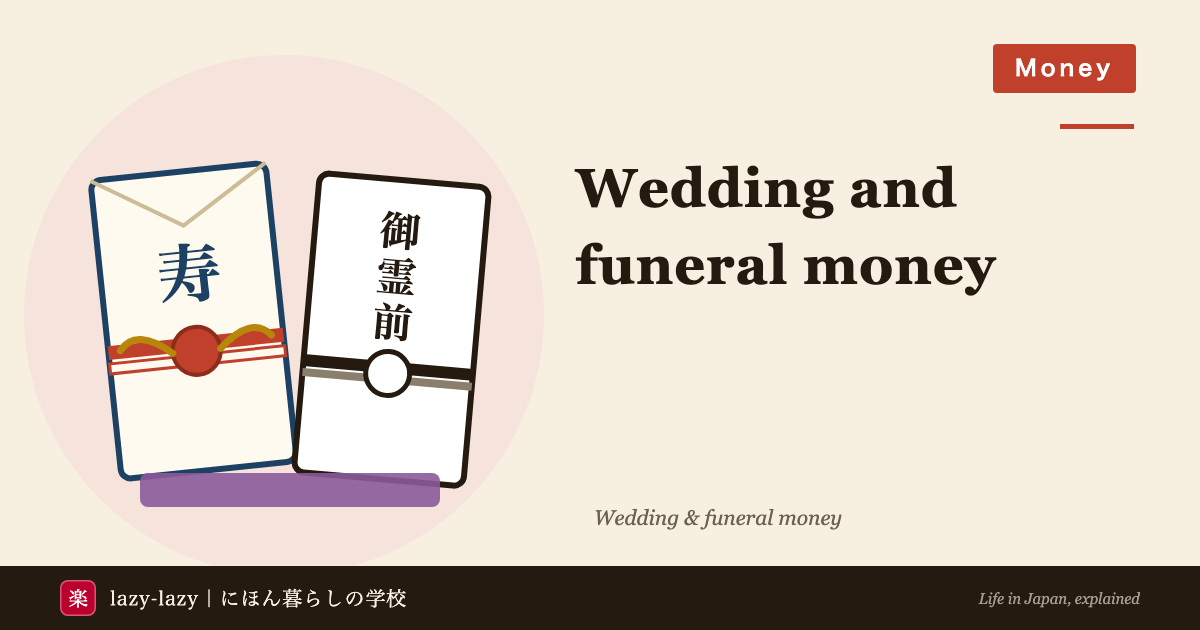
- Use a wedding envelope with a gold-silver or red-white knotted cord marked 寿, and a funeral envelope marked 御霊前. Write your full name.
- If you cannot go, post the envelope inside a cash registered-mail envelope. Sending cash by ordinary post is not allowed under the Postal Act.
Knowing this, you can decide how much, which envelope and which notes on the day you hear the news, without asking coworkers one question at a time, and hand it over at the reception desk without panic.
In the morning someone at work says a colleague is getting married next month. The same week, word goes round that another colleague’s father has died. Your Japanese coworkers quietly get out white envelopes or ones with gold decorations, without discussing anything. Ask a Japanese friend how much to put in and the answer is “about the usual” or “it depends”. For them it is a custom they have watched since childhood.
- How much money do you give at a Japanese wedding for a coworker? 30,000 yen is most common
- How much koden for a coworker’s family funeral? 5,000 yen is most common
- Which amounts should you avoid? 4, 9 and even numbers
- New bills or used bills? New for weddings, not for funerals
- What to write on a koden or goshugi envelope
- When and how do you hand it over? Wrapped in a fukusa, at the reception desk
- Can’t attend? Send it by cash registered mail
- Short of money, or no new notes?
- What happens if you get it wrong? No penalty, except for how you post cash
- Which one are you?
- FAQ
- Summary
- Related reading
How much money do you give at a Japanese wedding for a coworker? 30,000 yen is most common
Goshugi (ご祝儀) is money given to celebrate a wedding. The All Japan Kankonsosai Mutual Aid Association (Zengokyo), the national body of wedding and funeral cooperatives, notes that wedding gifts used to be goods but that cash is now the norm.
No law or government office sets the amount. The best guide is Zengokyo’s wedding survey, run every five years. The FY2023 round asked guests at receptions in member halls, plus an online panel of people who had attended a wedding in the past year, and got 3,178 responses (3,137 valid).
For gifts to a coworker, the most common amount was 30,000 yen and the average was 31,696 yen. Over 80% of those giving to a coworker gave 30,000 yen. For a boss, the most common amount was also 30,000 yen, with a slightly higher average of 37,505 yen.
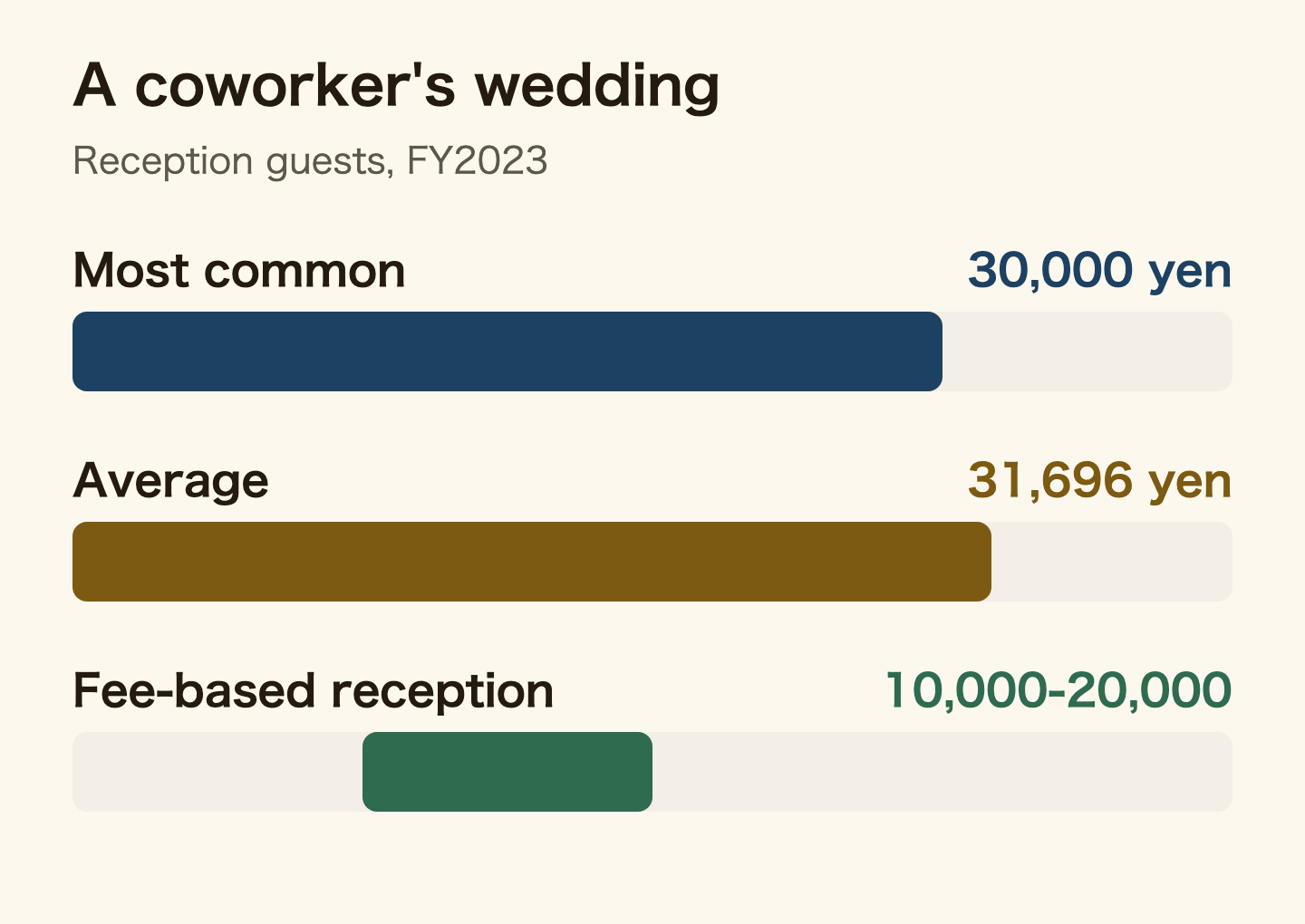
Read the figure with one condition in mind. Everyone surveyed attended the reception, so the amount covers both the gift and the meal. Zengokyo says this makes it higher than what people give when they do not attend. For a fee-based reception (kaihisei), it puts the going rate at 10,000 to 20,000 yen. If the invitation states a fee, that fee is your answer.
The average and the most common amount differ because a few large gifts pull the average up. When deciding what to give, the most common amount is the better guide.
How much koden for a coworker’s family funeral? 5,000 yen is most common
Koden (香典) is money offered at a funeral in place of the incense and flowers once brought for the deceased. Zengokyo adds that it also carries a sense of everyone helping to cover the heavy cost of a funeral.
You might bring flowers and a card to a coworker’s family funeral. Where you come from, that may be normal. In Japan, the custom is to bring money in a funeral envelope and hand it in at the reception desk of the wake or the funeral.
For amounts, the guide is Zengokyo’s koden survey. The FY2021 round handed questionnaires to mourners at individual funerals run by member cooperatives and got 5,177 responses.
When the person who died was a family member of someone at your workplace, the most common koden was 5,000 yen and the average was 5,336 yen. When the coworker themself had died, the most common amount was also 5,000 yen (average 6,204 yen). Among respondents in their teens and twenties, the average for a coworker’s family member was 3,467 yen.
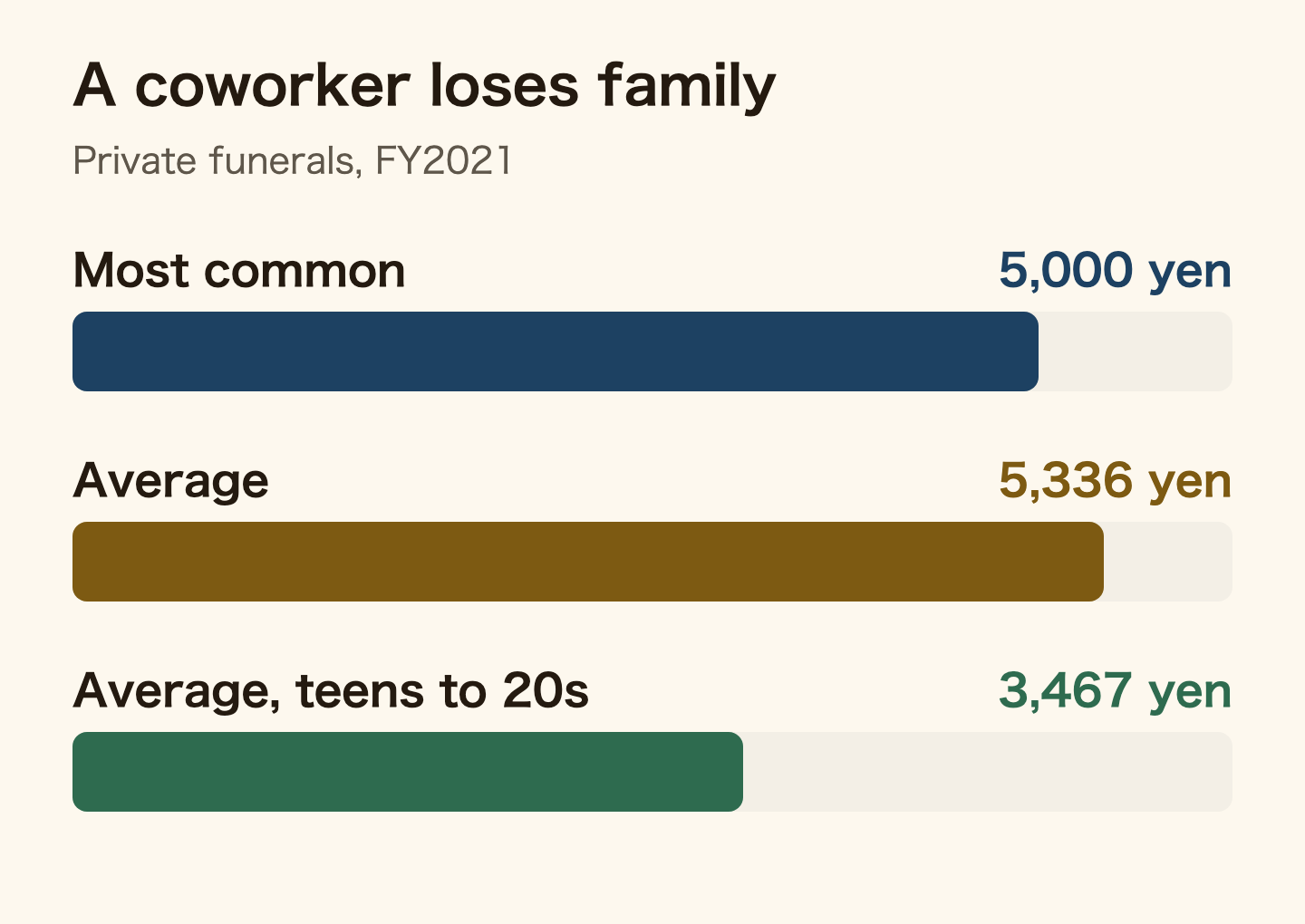
Workplaces sometimes give as a group. The survey report says answers of 2,000 or 3,000 yen can be read as amounts several people in the same relationship gave together. Zengokyo’s etiquette page also says that for workplace funerals you can go by past records. Before you prepare your own envelope, ask whoever is organising, or your manager, whether the team is giving together.
There is no tax worry for the family either. The National Tax Agency says koden and celebration gifts from individuals that are within socially accepted amounts are not subject to gift tax.
Which amounts should you avoid? 4, 9 and even numbers
Once you have an amount, check the number. Zengokyo’s pages give slightly different rules for weddings and funerals.
- Wedding: avoid even amounts such as 40,000 or 60,000 yen, because they “split”. 20,000 yen is said to be fine because it suggests a pair (Zengokyo, wedding gift amounts). The wedding survey report adds that 9 is avoided at celebrations because it sounds like the word for suffering.
- Funeral: 4, 9 and even amounts are taboo, except that 2,000 and 20,000 yen are fine (Zengokyo, how much koden).
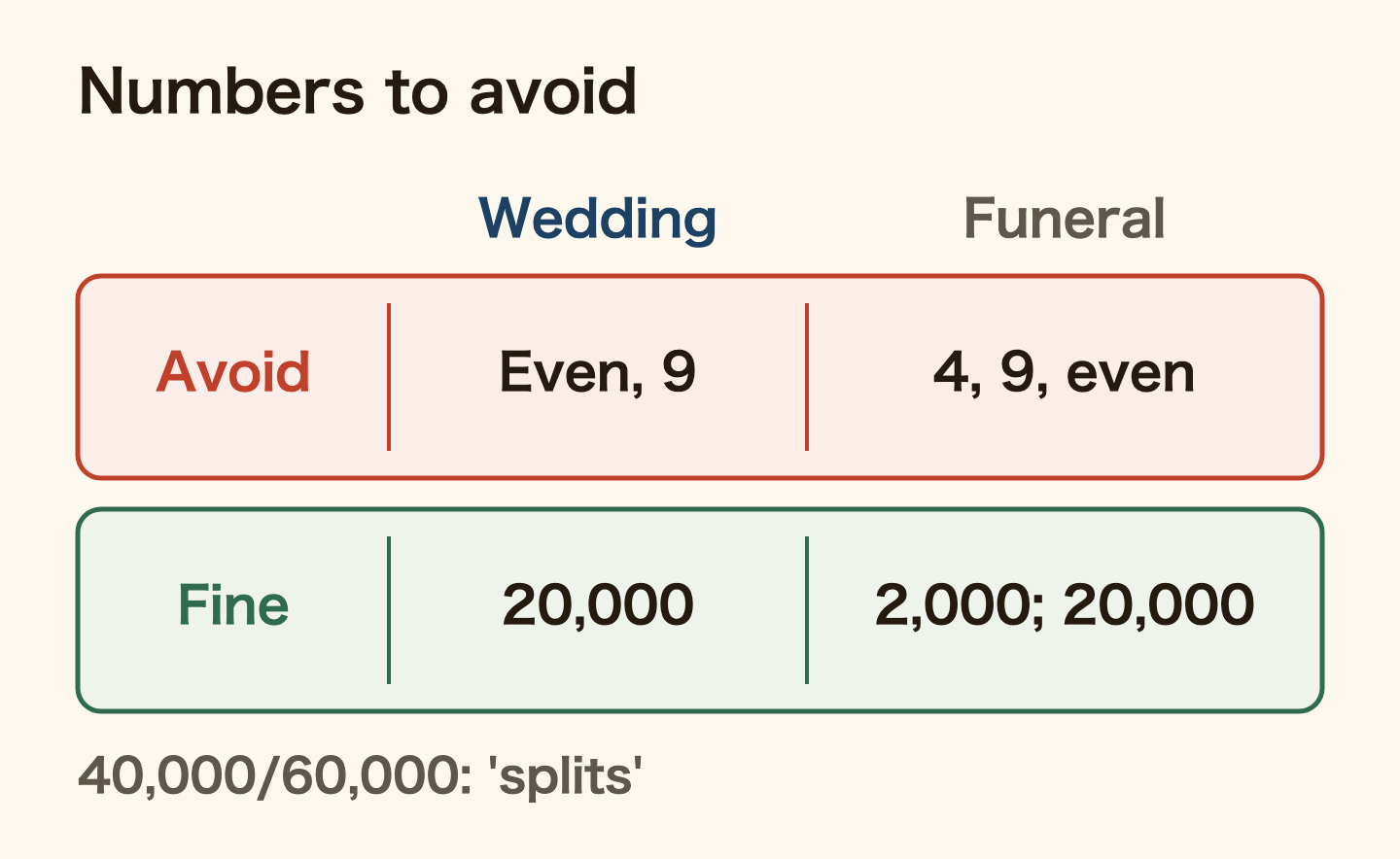
Neither 30,000 nor 5,000 yen falls on a number to avoid. The most common amounts in the surveys are also safe amounts.
New bills or used bills? New for weddings, not for funerals
You take notes out of the ATM and put them straight in the envelope. Where you come from, that may be normal. In Japan, even the condition of the notes depends on the occasion.
For wedding money, clean new notes without creases are the etiquette. Zengokyo says your bank will prepare new notes if you ask (Zengokyo, forgot new notes). If you do not have an account yet, start with what a foreigner needs to open a bank account.
The opposite applies at funerals: koden is not given in new notes. Zengokyo’s funeral page says so plainly.
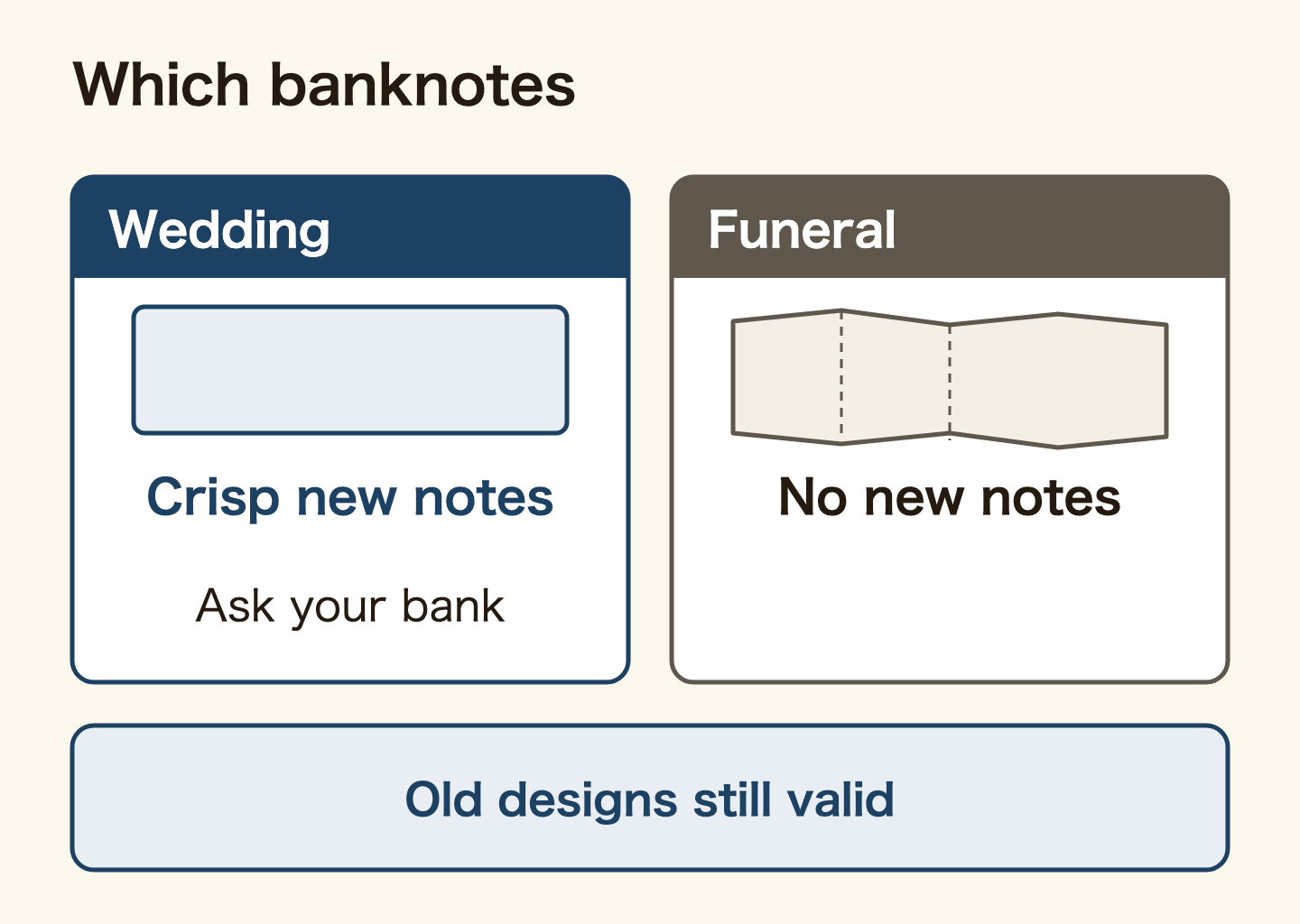
“New” here means uncreased, not the new designs issued from 3 July 2024. The Bank of Japan says older notes remain valid after the new ones came out and need not be exchanged.
What to write on a koden or goshugi envelope
Ready-made envelopes are what people use. Two things tell them apart: the mizuhiki (the decorative cord) and the words printed or written at the top (omotegaki).
For a wedding, choose a red-white or gold-silver cord. Avoid a bow that comes undone easily and choose a tied knot (musubikiri). The custom is a bow for things that may happen many times, such as a birth, and a knot for things that should happen only once (Zengokyo, choosing a wedding envelope). The top reads 寿 (kotobuki) or 御祝 (oiwai).
For a funeral, the cord can be white, black-and-white or silver. The top reads 御霊前 (goreizen), which can be used from the wake up to the 35th-day memorial, whatever the religion. Envelopes printed with a lotus are for Buddhist funerals only, and a cross is for Christian ones, so if you do not know the family’s religion, choose a plain one (Zengokyo, goreizen or gobutsuzen).
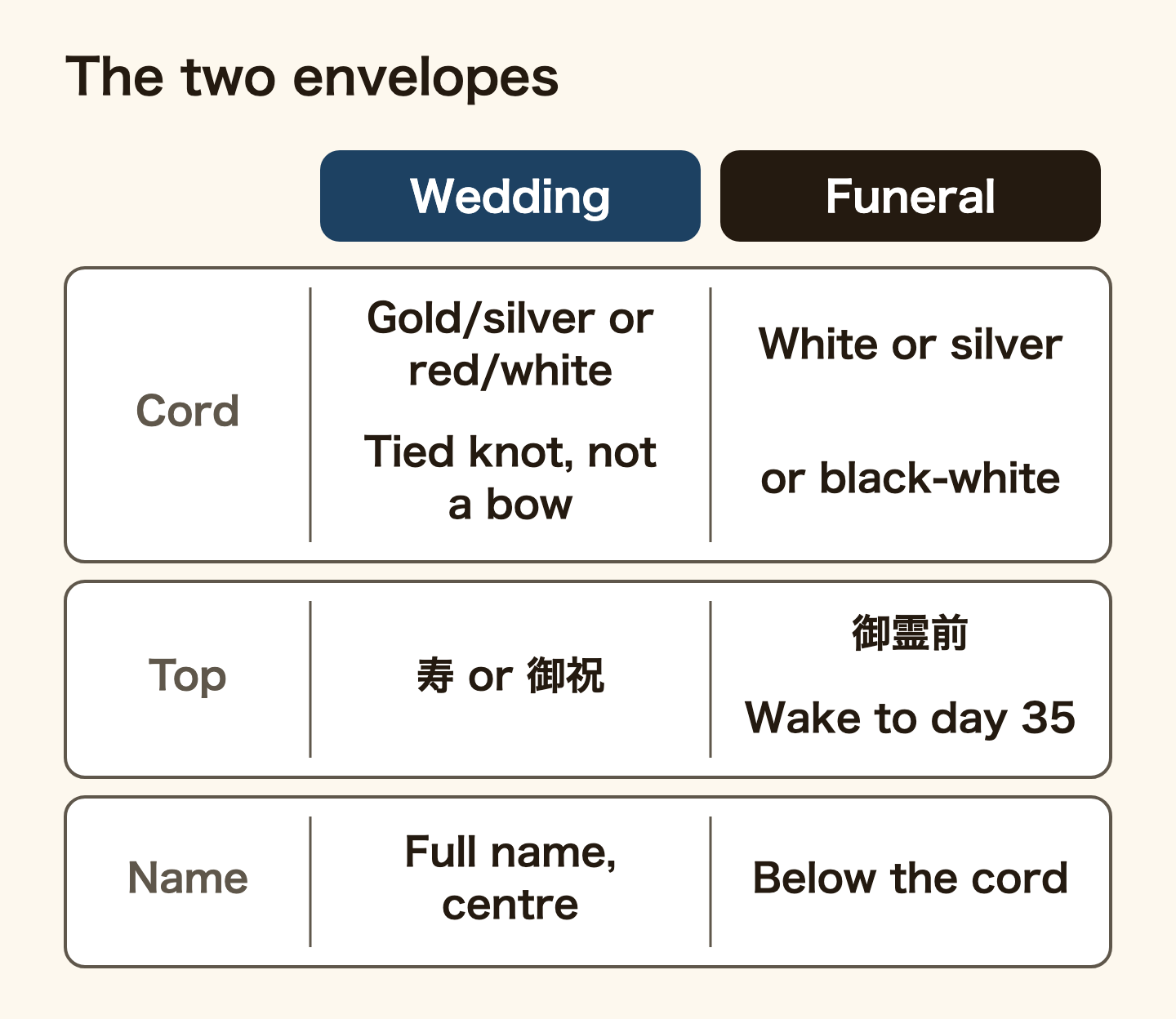
Write your full name below the cord. Zengokyo says a brush is standard on formal occasions and a brush pen is easier if you are not used to one. The amount goes vertically in the centre of the front of the inner envelope (Zengokyo, writing the amount and name).
We found no official rule on whether a foreign name should be written in katakana or in Roman letters. The family may look at who gave what and send a return gift (koden-gaeshi) later. Write it in a way your coworkers will recognise at once.
When several coworkers give together, write all the names. On a wedding envelope, the most senior person’s name goes directly below the top word and the others follow to the left. With four or more, write the representative’s name in the centre with 他一同 (“and all others”) beside it, and put everyone’s names on a separate sheet inside. On a funeral envelope, too, joint names run from the most senior, starting on the right.
When and how do you hand it over? Wrapped in a fukusa, at the reception desk
Do not carry the envelope bare. Wrap it in a fukusa (a small cloth) or a small furoshiki. A plain purple fukusa works for both happy and sad occasions. The folding order is reversed: fold from the left for a wedding, from the right for a funeral (Zengokyo, wrapping in a fukusa).
At a wedding you hand the gift in at the venue’s reception desk. At a funeral you hand in the koden at the reception desk and sign the book. In the survey, 74.2% brought their koden to the wake and 24.2% to the funeral. If you were not especially close to the person who died, Zengokyo says attending the funeral alone is enough.
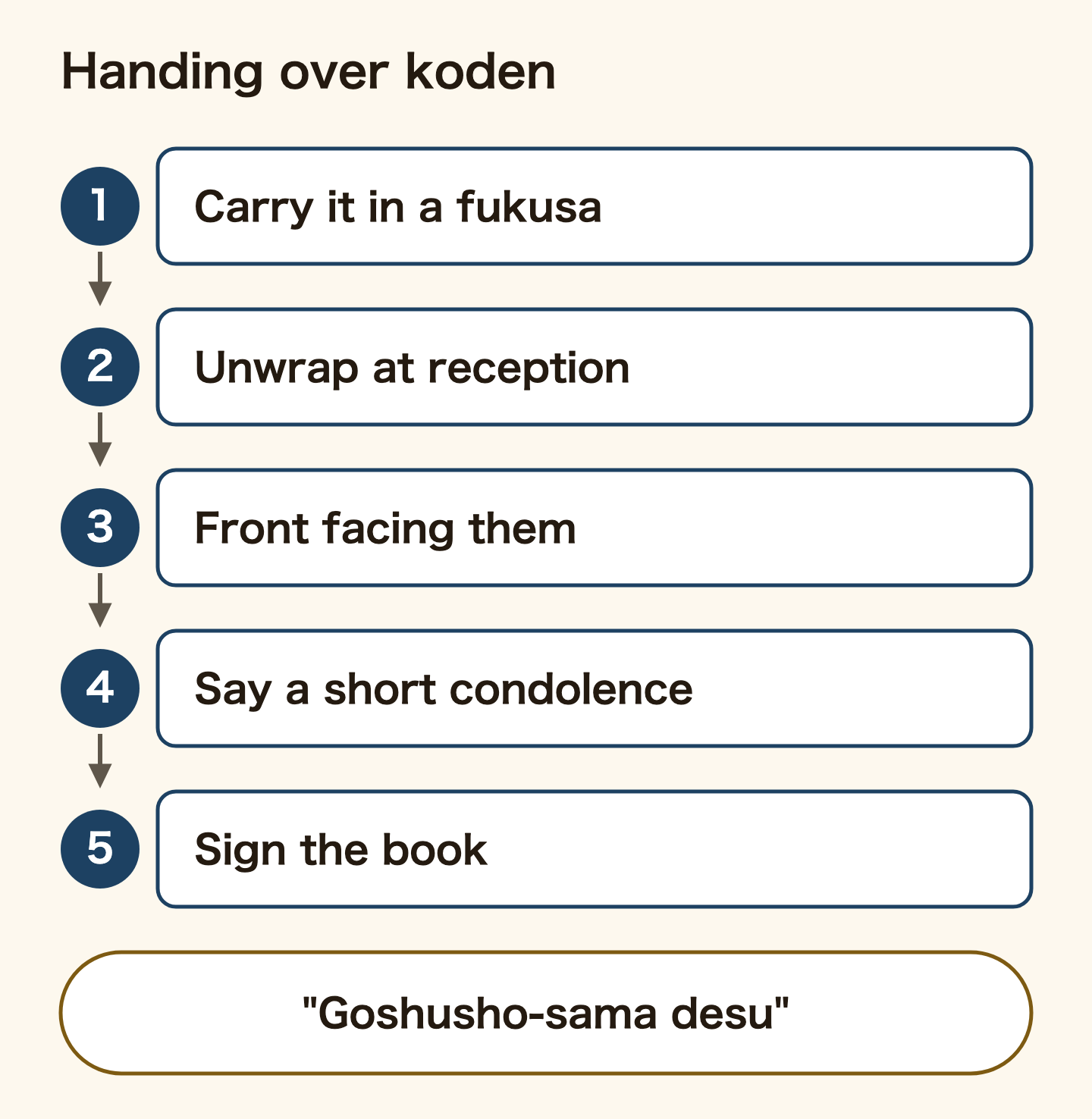
Unwrap the fukusa, take out the envelope and turn it so the other person can read the top. Keep your words short. Zengokyo says set phrases such as kono tabi wa goshusho-sama desu (“my condolences”) or kokoro kara okuyami moushiagemasu (“my heartfelt sympathy”) are fine (Zengokyo, words of condolence). Avoid doubled words such as kasanegasane (“again and again”), and do not ask how the person died. For everyday polite phrases at work, see the Japanese phrases for work.
On the way out you may be handed a small gift. This is a same-day return gift, and Zengokyo says items of around 2,000 to 3,000 yen are typical. You do not need to send thanks for it.
If you rush to the family’s home right after hearing of the death, do not bring koden. Zengokyo says wearing mourning clothes or bringing koden at that point looks as if you had expected the death, which is impolite.
Can’t attend? Send it by cash registered mail
You were invited to the wedding but cannot go. The funeral falls on a shift you cannot move. You can post the money, but only one way. Article 17 of the Postal Act says cash sent by post must go as registered mail.
Japan Post’s cash registered mail envelope (genkin fūtō, 21 yen) is big enough for a gift envelope. Put the money in the wedding or funeral envelope first, then put that whole envelope inside the cash envelope. The fee is the normal postage plus 480 yen, which covers up to 10,000 yen; each further 5,000 yen adds 11 yen, up to 500,000 yen.
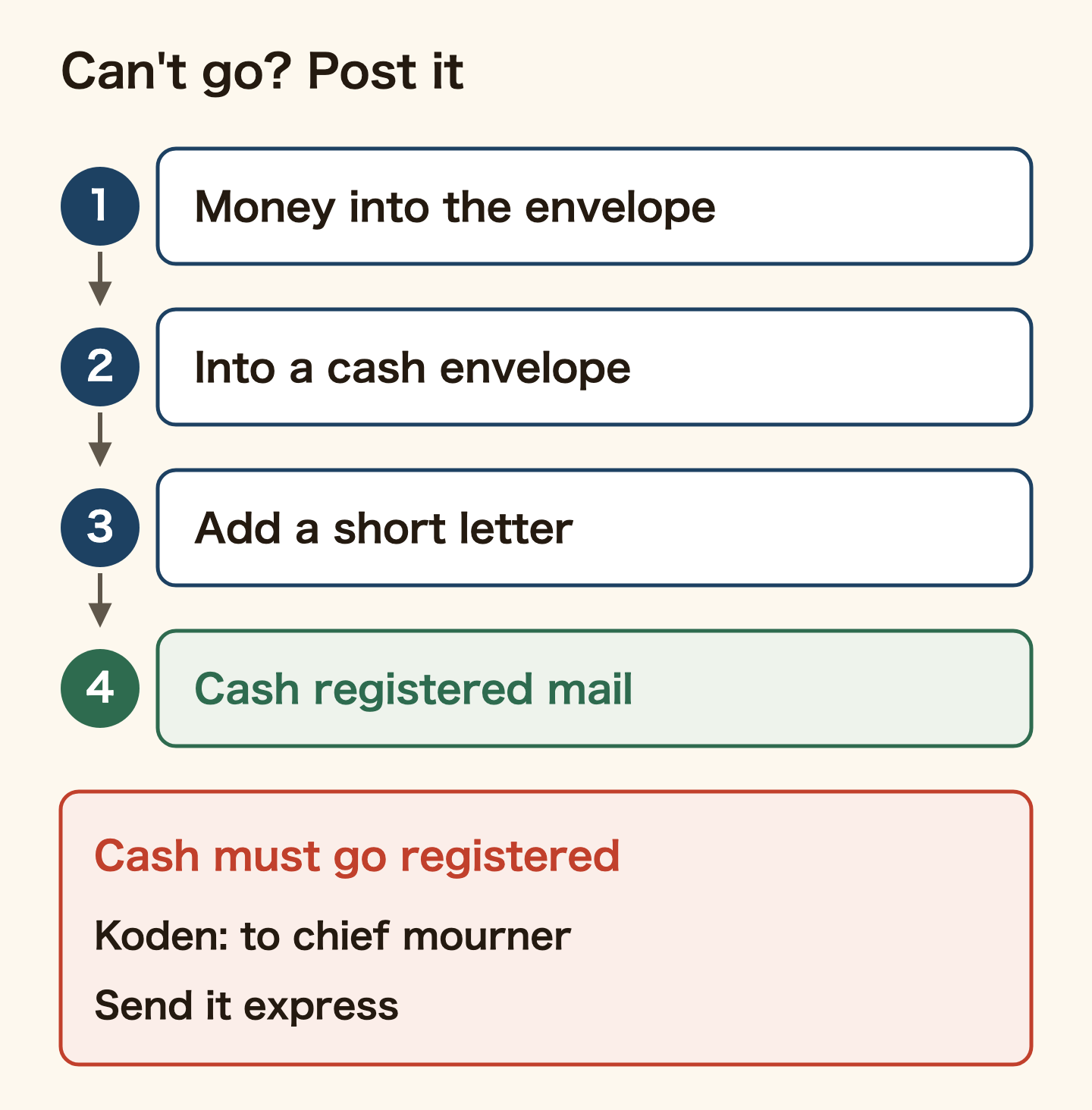
For a wedding you will miss, send your reply first, then post the gift as soon as you can with a message of congratulations (Zengokyo, sending a wedding gift). For a funeral, send the koden by express to the chief mourner with a letter of condolence (Zengokyo, if you cannot attend). The address is written in Japanese order, so keep how to write a Japanese address open while you fill it in.
Short of money, or no new notes?
30,000 yen is a lot for some people. For koden, Zengokyo says there is no rule that it must be a set amount. In the survey, respondents in their teens and twenties gave a coworker’s family member 3,467 yen on average, below the overall figure. A fee-based wedding reception is 10,000 to 20,000 yen. You do not have to stretch to the highest amount.
If giving alone is too much, you can give jointly with coworkers.
If you could not get new notes for a wedding, Zengokyo suggests ironing out the creases as best you can. If you only learn of a death after the funeral, give a smaller koden and add a line on the inner envelope saying the family need not send anything back (Zengokyo, learning of a death afterwards).
Some notices say the family declines koden. Zengokyo advises families who decline to state it in the death notice. If you are unsure, ask the person who passed the news round at work.
What happens if you get it wrong? No penalty, except for how you post cash
Amounts, numbers, new notes and envelope writing are customs, not law. Nothing happens to you for getting them wrong. Zengokyo also says local customs can differ. If your coworkers know “how it is done around here”, that is the best answer.
One thing is law. Cash sent by post must go by registered mail. Putting notes in an ordinary envelope does not meet Article 17 of the Postal Act.
Which one are you?
- Invited to a coworker’s wedding and attending: take the survey’s most common 30,000 yen as your baseline, or the fee on the invitation if it is fee-based. Today, ask your bank for new notes and buy a red-white or gold-silver knotted envelope.
- Invited but not attending: send your reply, then post the gift with a message by cash registered mail. The survey’s 30,000 yen includes the meal, so ask a coworker today how much to send.
- A coworker’s family member has died: ask the organiser today whether the team is giving together. If giving alone, put 5,000 yen in notes that are not new into a 御霊前 envelope and hand it in at the wake or funeral reception.
- You cannot go to the wake or the funeral: put the koden envelope inside a cash envelope with a letter of condolence and post it today by express cash registered mail to the chief mourner.
FAQ
Q. How much money do you give at a Japanese wedding for a coworker?
In Zengokyo’s FY2023 survey of reception guests, the most common gift to a coworker was 30,000 yen and the average was 31,696 yen. For a fee-based reception, Zengokyo says 10,000 to 20,000 yen can be seen as the going rate.
Q. How much koden do you give when a coworker’s parent dies?
In Zengokyo’s FY2021 survey, when the deceased was a family member of someone at the respondent’s workplace, the most common koden was 5,000 yen and the average 5,336 yen. Teams sometimes give together, so ask the organiser first.
Q. Can I use new bills for koden?
Zengokyo’s etiquette page says new notes are not used for koden. Wedding money is the opposite: clean new notes without creases are the etiquette.
Q. Can I use old-design banknotes for a wedding gift?
The Bank of Japan says older notes remain valid after the new designs were issued from 3 July 2024 and need not be exchanged. For wedding money, what matters is that the notes are clean and uncreased, not the design.
Q. How should a foreigner write their name on the envelope?
We found no official rule on katakana versus Roman letters. Zengokyo says to write your full name. Write it in a way your coworkers will recognise at once.
Q. Can I send wedding or funeral money by post?
Yes. The Postal Act requires cash to go by registered mail, so put the money in the gift envelope and post it inside Japan Post’s cash envelope as cash registered mail. Koden goes to the chief mourner by express, with a letter of condolence.
Summary
No law sets the amount for wedding or funeral money. The best guide is Zengokyo’s surveys: 30,000 yen was the most common gift for a coworker’s wedding reception you attend, and 5,000 yen for the funeral of a coworker’s family member. Neither falls on a number to avoid (4, 9 or even).
What differs is the notes and the envelope. Wedding money goes in crisp new notes, in a knotted gold-silver or red-white envelope. Funeral money goes in notes that are not new, in a 御霊前 envelope. If you cannot attend, post the envelope by cash registered mail. When in doubt, first ask whether your team is giving together.
Sources: Zengokyo, 6th Wedding Survey (FY2023) and results / 6th Koden Survey (FY2021) and results / Zengokyo etiquette pages / Postal Act (e-Gov) / Japan Post, registered mail / Bank of Japan, exchange after new notes / National Tax Agency No.4405 (all checked 30 September 2026, pages in Japanese). The amounts are survey results, not rules.
Related reading
Found this useful? Share it
Send it to a friend who lives in Japan.
WHO WROTE THIS

mori
Japanese. I read the ministries’ own notices, orders and Q&As in the original, and I start from what my Nepalese and Sri Lankan friends in Japan actually ran into. I do not write about what I have not checked or been told.
What this site can and cannot do →Looking for something else?