The form, the fields and the notification rules below were checked against the Ministry of Health, Labour and Welfare’s own documents on 10 September 2026. Forms change. Check the date before you download.
In short
- The template is free. The ministry publishes the rirekisho form as Excel and PDF. No sign-up, no payment.
- There is no official standard form any more. The JIS form was withdrawn in July 2020.
- Gender is optional. You may leave it blank. Spouse, dependants and commuting time are not on the ministry’s form at all.
- Being asked for your residence card is not discrimination. The employer must check it and report the hire, or face a fine of up to 300,000 yen.
- But your registered domicile, birthplace and family must not be asked. That is a different matter entirely.
Search for a rirekisho template and you get sites that want you to register, or pay. The Japanese government gives the form away for nothing. Your Japanese friends probably do not know this either — most of them job-hunted before the form changed.
- What is a rirekisho?
- Where do you get the template?
- Why is there no standard form any more?
- What size should the photo be?
- Do you put your status of residence on it?
- What may they not ask you?
- How do you write education from your home country?
- Can someone check it for you, free?
- When should you stop rewriting the resume?
- Frequently asked questions
- Summary
What is a rirekisho?
A rirekisho is a single sheet holding your name, date of birth, address, education, work history and qualifications, which you send to the company you are applying to. Japanese companies read it to decide whether to interview you. It does the job of a CV, but because the fields are fixed, you have far less room to present yourself.
There is a second document, the shokumu-keirekisho (work history). That one describes what you actually did in each job and what you learned. It has no fixed form. For a first job out of school, companies usually ask only for the rirekisho.
Where do you get the template?
From the Hello Work website, free, as Excel or PDF. No account, no fee. This is the form the Ministry of Health, Labour and Welfare itself created and offers as the model.
The fact that an Excel version exists means you may type it. The ministry’s form carries no writing instructions of any kind.
Why is there no standard form any more?
There used to be one: the form example published by the Japanese Standards Association as part of the JIS standard, which the ministry recommended. Then in July 2020, following a request to remove the gender field, the JIS resume form example was withdrawn in its entirety.
The ministry published its own in 2021. It differs from the JIS form in only two ways.
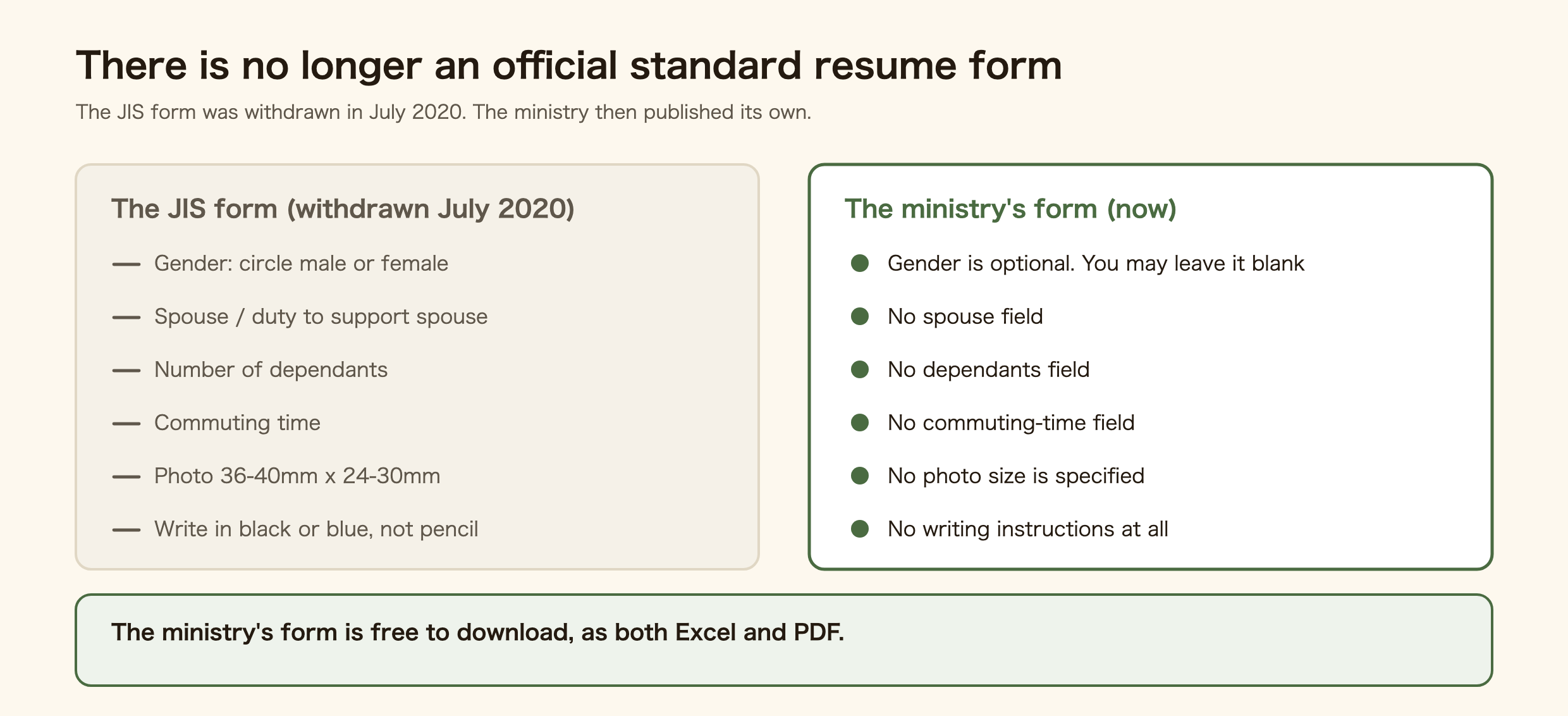
The first is gender. Instead of circling male or female, it is now a field you fill in as you wish. The ministry’s own document says plainly that it may be left blank.
The second is that four fields were deleted: spouse, duty to support a spouse, number of dependants, and commuting time. None of them appear on the ministry’s form.
One caveat. The form has no legal force — the ministry’s document says so itself, and each company decides whether to use it. Some employers will still hand you the old layout.
What size should the photo be?
Be careful here. The figures 36-40mm by 24-30mm come from the JIS form that was withdrawn. The ministry’s form gives no size at all.
We could not find a size in any current official document. Which means that unless the company specifies one, there is no basis on which a size could count against you. If you want a number, keeping inside 36-40mm by 24-30mm — the only figure any public document ever carried — is at least a choice with a reason behind it.
On the photo itself, the ministry’s English booklet for foreign job seekers is worth knowing: the photo is there so the interviewer can confirm that the person who came is you, and your appearance is not part of the selection.
Do you put your status of residence on it?
The ministry’s form has no field for it. But the employer has a duty to check your status of residence and period of stay, and to report the hire to Hello Work.
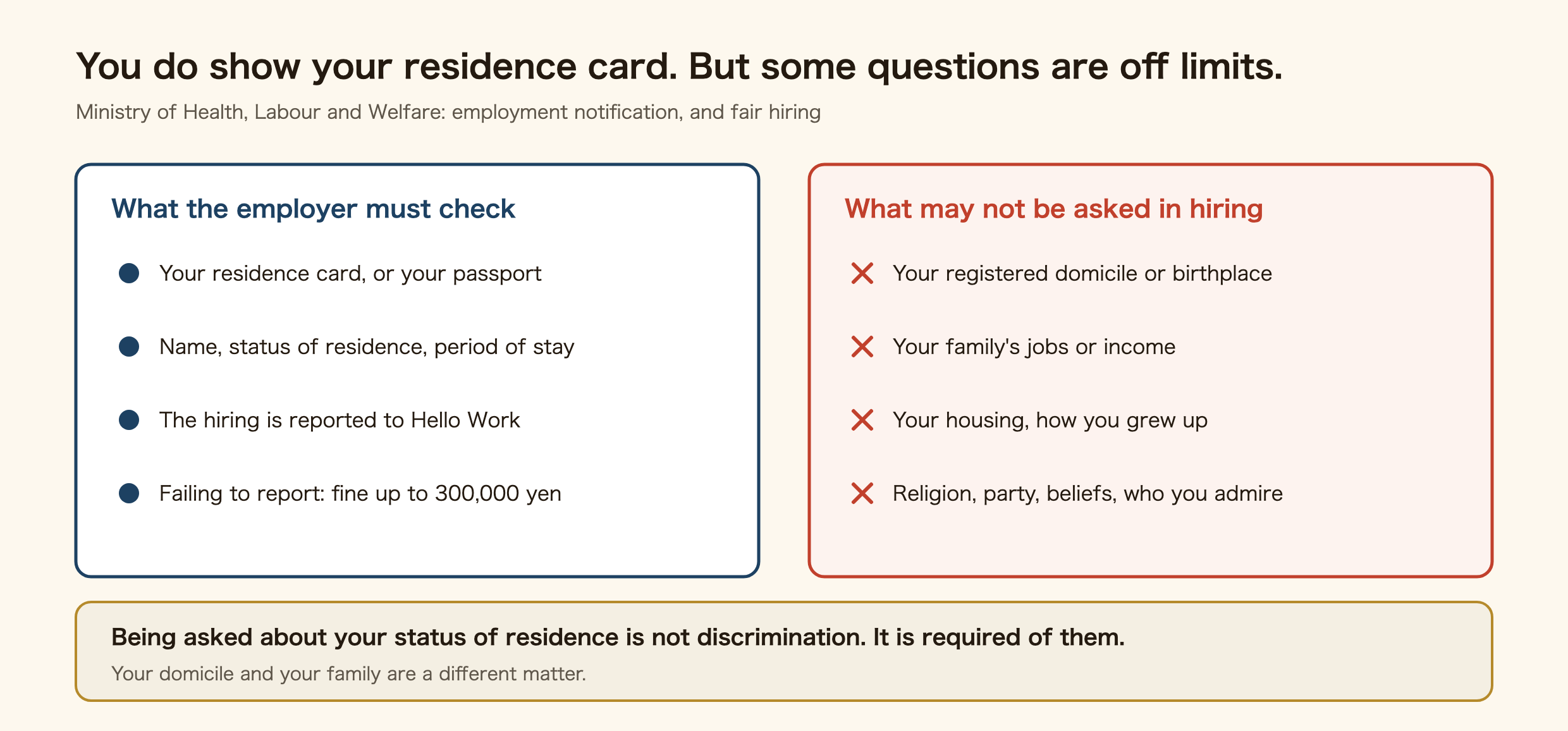
The scheme is called the Employment Status Notification for Foreign Nationals. The employer asks to see your residence card or passport, checks the details, and files the report — by the 10th of the following month if you join employment insurance, by the end of the following month if you do not. Failing to report, or reporting falsely, carries a fine of up to 300,000 yen.
So being asked to show your residence card is not suspicion of you. Having it ready saves everyone a step.
What may they not ask you?
Quite a lot. Under the ministry’s fair hiring guidance, these must not be asked in selection:
- Matters you are not responsible for — registered domicile and birthplace, family (occupation, relationship, income), housing, the environment you grew up in
- Matters that should be free — religion, political party, philosophy of life, who you admire, thought, trade unions and social movements, the newspapers, magazines and books you read
Being asked about your status of residence and being asked about your family are two different things. The first is a duty placed on the employer. The second is something they should not do. Knowing which is which changes how you sit in an interview.
How do you write education from your home country?
The ministry’s form says only “education and work history, grouped separately”. There are no detailed rules. So write it so that the reader can follow it.
- Use the school’s full official name. Giving the romanised name with a short Japanese gloss is kind to the reader.
- Include the country. A school with the same name may exist in Japan.
- Say how many years the course was. School systems differ, and a graduation date alone does not convey it.
- Your Japanese language school counts. Give the dates and whether you are enrolled or have graduated.
Write your name exactly as it appears on your residence card and passport. That is the spelling the employer will use in the notification. The furigana line is written in katakana.
Can someone check it for you, free?
Yes. Hello Work will correct a resume or work history you have written, at the counter. They also run seminars on writing them. Both are free.
For foreign residents there are the Employment Service Centers for Foreigners, where an interpreter comes with it. If none is near you, ordinary Hello Work offices with interpreters exist across Japan and the ministry publishes the list.
For the interview day itself, the ministry’s booklet says to arrive 15 minutes early and bring the letter of introduction and your resume.
When should you stop rewriting the resume?
If three applications in a row fail at the paper stage, the resume is not the problem. The ministry’s form has no rules about how to fill it in, so it is unlikely you are being rejected on formatting. The likelier cause is a mismatch with your status of residence.
Are you applying for work that would need a change from a student to a work status without a realistic route to it? If it is part-time work, does the advertised schedule fit inside 28 hours a week? Checking that pays off faster than retaking the photo.
And one more thing. In the ministry’s survey, the most common route into a job was friends and acquaintances, at 37.8%, against 19.1% for job advertisements. Polishing paperwork is not the channel that carries most people.
Frequently asked questions
Q. Do I have to pay for a rirekisho template?
No. The Ministry of Health, Labour and Welfare publishes it as Excel and PDF on the Hello Work site. No registration is needed.
Q. Do I have to state my gender?
No. On the ministry’s form the gender field is optional, and the ministry’s document states explicitly that it may be left blank.
Q. Does it have to be handwritten?
The ministry’s form contains no requirement to handwrite it. It has no instructions section at all, and an Excel version is published. The “black or blue, not pencil” line was on the withdrawn JIS form. We could not establish how many employers still ask for handwriting — if a company specifies it, follow that.
Q. What size photo?
The ministry’s form specifies none. The withdrawn JIS form said 36-40mm by 24-30mm. We could not find a size in any current official document, so unless the company specifies one, keeping inside that old range is the only figure with a source behind it.
Q. A company asked to see my residence card. Can I refuse?
This is not the place to refuse. The employer must check your status of residence and period of stay and report the hire, with a fine of up to 300,000 yen for failing to. It is not suspicion of you.
Q. They asked about my family and where I am from. Do I have to answer?
Those are matters that must not be asked in selection — registered domicile and birthplace, family occupation and income, housing, religion and beliefs. If it happens, Hello Work and the Employment Service Centers for Foreigners will take the question.
Summary
The rirekisho template is free, from the Ministry of Health, Labour and Welfare. Excel and PDF, no account, no payment.
The standard form disappeared in July 2020. Gender is optional; spouse, dependants and commuting time are gone; no photo size is specified.
Your residence card is something they must check. Your domicile and your family are things they must not ask. Hold those two apart and interviews get easier. And if the writing itself defeats you, there is a counter that will read it with you, with an interpreter, for nothing.
Sources (official): MHLW, on the creation of the resume form example (Labour Policy Council, 16 April 2021; the annex compares it with the JIS form) / Rirekisho form example (Excel) / Hello Work Internet Service, writing a resume and work history / MHLW, Employment Status Notification for Foreign Nationals / MHLW, the basics of fair hiring / MHLW, Hello Work (English, July 2020) (all checked 10 September 2026)
WHO WROTE THIS

mori
Japanese. I read the ministries’ own notices, orders and Q&As in the original, and I start from what my Nepalese and Sri Lankan friends in Japan actually ran into. I do not write about what I have not checked or been told.
What this site can and cannot do →Looking for something else?