Checked on 20 September 2026 against the Labour Standards Act, the Childcare and Family Care Leave Act and the Employees’ Pension Insurance Act (e-Gov), Kyokai Kenpo’s maternity allowance page, and the MHLW leaflet on childcare leave benefits (revised 1 August 2026). The benefit caps are the figures valid until 31 July 2027.
In short
- Maternity and childcare leave are legal rights to stay employed while off work around a birth and until the child turns one, and foreigners have exactly the same rights. Six weeks before and eight after (Labour Standards Act); childcare leave to age one (up to two if no nursery place).
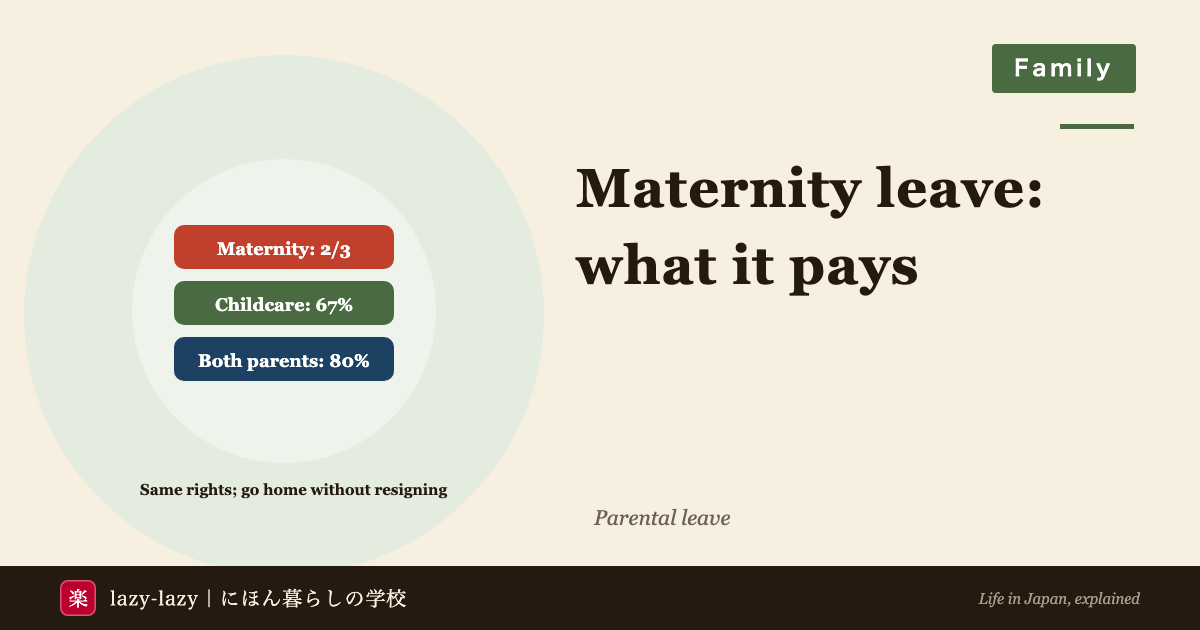
- While off, you are paid benefits, not salary. Maternity: the maternity allowance (two-thirds of pay, employer health-insurance members only). Childcare leave: the childcare leave benefit (67% for 180 days, then 50%).
- Since April 2025, if both parents take 14 days or more, the first 28 days pay 80% – roughly full take-home. Benefits are tax-free and social insurance premiums are waived.
- Conditions: 12 months in employment insurance, and for fixed-term contracts, no clear end before the child is 18 months. Student part-time jobs are outside.
- Resign and go home, and the benefit stops that day. Going home while still employed is different from quitting.
Once you know this, on the day you learn you are pregnant you can say, in numbers, how many months you can be off and what will land in your account. And when you talk to your employer, you are the one who knows what the rules say.
You are pregnant. Telling the company feels frightening. Maybe they will say “foreigners cannot take childcare leave”. If they do, the law is on your side, not theirs. Japanese colleagues say “everyone takes it” but cannot tell you what it pays. Here is how long you can be off, what money arrives while you are, the conditions, and the one problem only foreigners have – going home – using nothing but the law and the Ministry’s own figures.
- What are maternity and childcare leave? Legal rights, the same for foreigners
- What arrives while you are off? Two-thirds during maternity leave, 67% then 50% on childcare leave
- Can fathers take it? Yes – up to 28 days of post-birth leave
- The conditions: 12 months in employment insurance, and a contract that runs to 18 months
- What if you go home? Staying employed and quitting are two different things
- The decision: once you know you are pregnant, in this order
- FAQ
- Summary
What are maternity and childcare leave? Legal rights, the same for foreigners
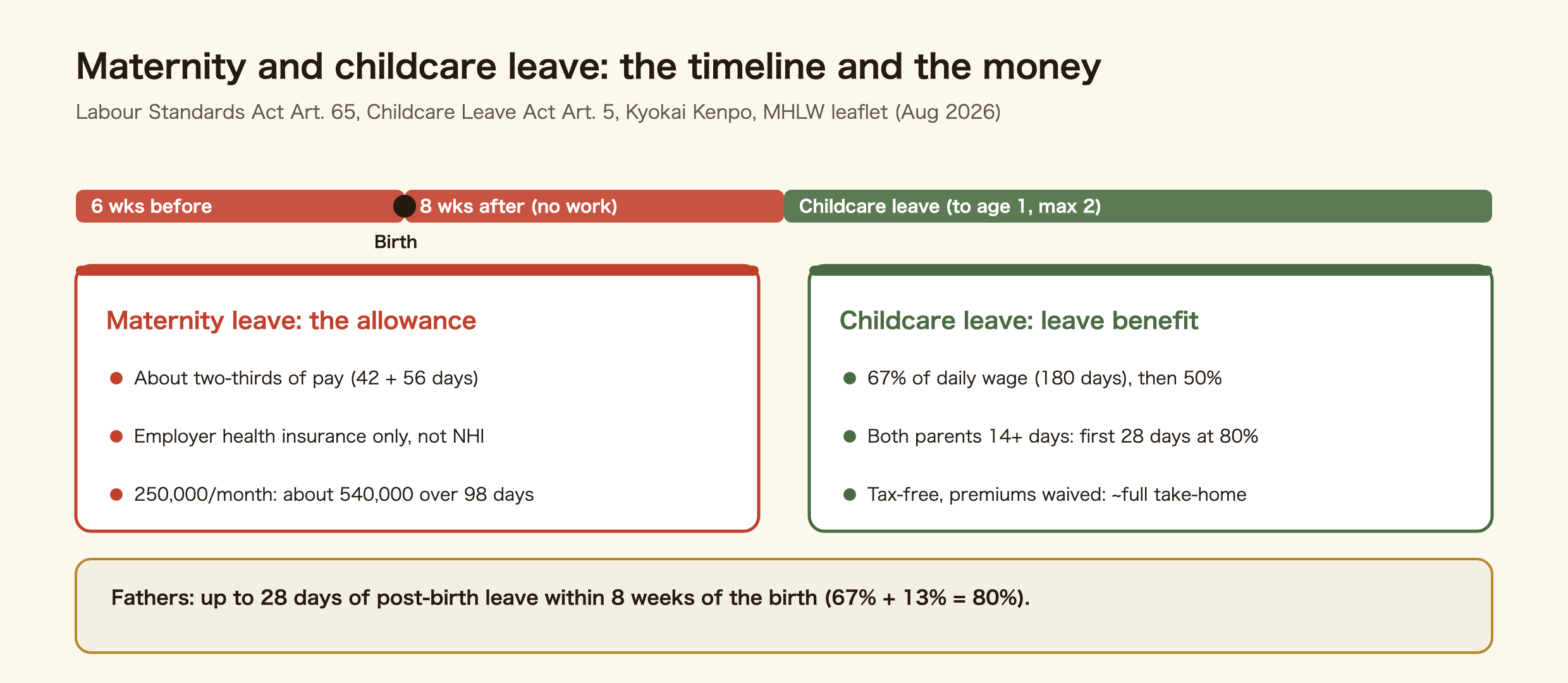
Maternity leave (sankyu) is the right, under the Labour Standards Act, for the person giving birth to be off work for six weeks before the birth (14 for multiples) and eight weeks after (Art. 65). Before the birth the employer must release her on request; for eight weeks after, the employer may not have her work even if she asks (after six weeks, work a doctor approves is allowed at her request).
Childcare leave (ikukyu) is leave a worker raising a child under one can take by applying to the employer (Childcare and Family Care Leave Act, Art. 5). Mothers and fathers alike. If there is no nursery place, it can be extended to 18 months and then to two years.
Neither article has a nationality condition. “Because you are foreign” or “we have never done it here” is not a lawful reason to refuse.
What arrives while you are off? Two-thirds during maternity leave, 67% then 50% on childcare leave
The employer owes no salary while you are on leave. Two benefits take its place.
- Maternity allowance (during maternity leave) – for the person giving birth who is a member of employer health insurance (Kyokai Kenpo or a company plan). For days off without pay from 42 days before the birth (98 for multiples) to 56 days after: per day, the average standard monthly remuneration of the last 12 months / 30 x two-thirds. On 250,000 yen a month, about 5,600 yen a day, roughly 540,000 yen over the full 98 days. National Health Insurance has no such benefit.
- Childcare leave benefit (during childcare leave) – for people insured under employment insurance. Daily wage at the start of leave x days x 67% for up to 180 days, then 50% (MHLW leaflet, August 2026 edition). The daily wage is capped (16,540 yen, until 31 July 2027), so a 30-day payment tops out at 332,454 yen (67%) or 248,100 yen (50%).
Then the top-up added in April 2025. If, within eight weeks of the birth (for the mother, eight weeks after her post-natal leave), you take 14 or more days of childcare leave and your spouse also takes 14 or more, the first 28 days carry a 13% “post-birth leave support benefit”, for 80% in total. The spouse’s leave is not required if the spouse is not employed, self-employed, on post-natal leave, or you are a single parent.
The benefits are tax-free, and health-insurance and pension premiums are waived while you are on leave (Employees’ Pension Insurance Act, Arts. 81-2 and 81-2-2; the employer files). That is why the Ministry describes 80% as “roughly 100% of take-home”. Even 67% comes to about 80% of your usual take-home, since nothing is deducted.
Can fathers take it? Yes – up to 28 days of post-birth leave
A father can take up to 28 days of “post-birth paternal leave” within eight weeks of the birth, in up to two blocks. It pays 67% as the post-birth childcare leave benefit, and since the mother is on post-natal leave the spouse condition is met, so the 13% supplement applies: 80%. Ordinary childcare leave to age one can follow.
This applies equally to families where the working parent is a foreigner. Read it with the baby’s residence status and the 500,000 yen grant.
The conditions: 12 months in employment insurance, and a contract that runs to 18 months
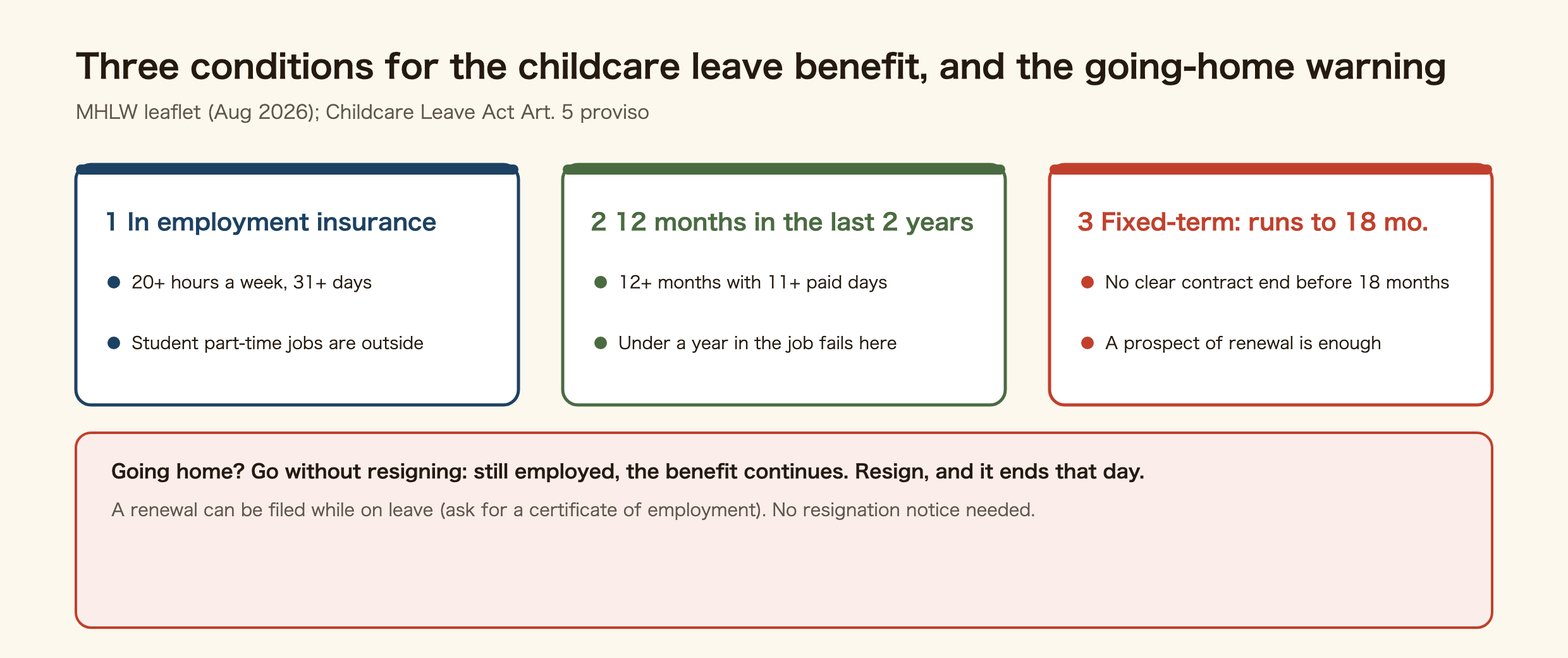
- Insured under employment insurance – 20 or more hours a week, 31 or more days. A student’s part-time job is not enrolled, so no childcare leave benefit (maternity leave itself is Labour Standards Act and still applies).
- Twelve or more months with 11 or more paid days (or 80 or more hours) in the two years before the leave starts – under a year in the job in Japan, and this is where it fails.
- On a fixed-term contract (contract or agency staff), it must not be clear that the contract ends before the child turns 18 months (Art. 5 proviso). A realistic prospect of renewal is enough. “Fixed-term, so no” is wrong.
For the maternity allowance the only condition is membership of employer health insurance (the plan you are in together with the Employees’ Pension).
What if you go home? Staying employed and quitting are two different things
This is the problem only foreigners have. Many want to go home during the leave so their parents can help.
- Go home temporarily while still employed – the leave continues, and as long as the conditions hold (still insured, few working days), so does the benefit. Back within a year, you leave on the deemed re-entry permit.
- Resign and go home – on the day you leave the company you stop being insured, and the childcare leave benefit ends there. The maternity allowance after resignation continues only under conditions. In benefit terms, “I’ll quit first, then go home” loses money.
On the status side, because you remain employed while on leave, the notification you file when you quit is not needed. If your period of stay expires during the leave, the renewal can be filed while on leave (ask the employer for a certificate of employment).
The decision: once you know you are pregnant, in this order
- Check your payslip for both employer health insurance and employment insurance. Both deducted means both the maternity allowance and the childcare leave benefit apply to you.
- Tell the employer. The request for maternity leave and the application for childcare leave are yours to make. If you hear “no precedent”, show Art. 65 of the Labour Standards Act and Art. 5 of the Childcare Leave Act.
- Talk to your partner about 14 days. If you both take leave, the first 28 days pay 80%.
- If you go home, go without resigning. The benefit stops the day you quit.
FAQ
Q. Can foreigners take maternity and childcare leave in Japan?
Yes. The Labour Standards Act (6 weeks before, 8 after) and the Childcare Leave Act (to age one) have no nationality condition.
Q. How much is childcare leave paid?
The childcare leave benefit pays 67% of your daily wage for 180 days, then 50%. If both parents take 14 days or more, the first 28 days pay 80%. Tax-free, premiums waived.
Q. What do I get during maternity leave?
Members of employer health insurance get the maternity allowance, about two-thirds of pay (42 days before to 56 after the birth). National Health Insurance has none.
Q. Can I take childcare leave on a fixed-term contract?
Yes, unless it is clear your contract ends before the child is 18 months. A prospect of renewal is enough.
Q. What happens to the benefit if I go home during leave?
Still employed and visiting home: it continues. Resign and go home: it ends the day you resign.
Q. Can fathers take leave?
Yes. Up to 28 days of post-birth paternal leave within eight weeks of the birth (67% + 13% = 80%), then ordinary childcare leave to age one.
Summary
Maternity and childcare leave are the same rights for foreigners: 6 weeks before, 8 after, and leave to age one (up to two). The money is the maternity allowance (two-thirds, employer plans only) and the childcare leave benefit (67% then 50%; 80% for the first 28 days if both parents take leave), tax-free with premiums waived.
Conditions: 12 months in employment insurance, and for fixed-term contracts a run to 18 months. Going home? Do not resign first – the benefit stops the day you quit. Check the payslip, tell the employer: that is step one.
Sources (official): Labour Standards Act, Art. 65 (e-Gov) / Childcare and Family Care Leave Act, Art. 5 (e-Gov) / Japan Health Insurance Association, maternity allowance / MHLW, childcare leave benefits: content and application procedure (revised 1 August 2026) / Employees’ Pension Insurance Act, Arts. 81-2 and 81-2-2 (e-Gov) (all checked 20 September 2026)
Found this useful? Share it
Send it to a friend who lives in Japan.
WHO WROTE THIS

mori
Japanese. I read the ministries’ own notices, orders and Q&As in the original, and I start from what my Nepalese and Sri Lankan friends in Japan actually ran into. I do not write about what I have not checked or been told.
What this site can and cannot do →Looking for something else?