Checked on 30 September 2026 against the Ministry of the Environment and Ministry of Economy, Trade and Industry (METI) pages on appliance recycling and electrical safety, the Home Appliance Recycling Ticket Center fee list, the Antique Dealings Act on e-Gov, the reuse pages of Sagamihara and Nagoya cities, and the National Consumer Affairs Center.
The short answer
- There are three cheap ways to furnish a flat: second-hand shops, your city’s reuse furniture, and people giving things away. Second-hand shops hold an antique-dealer (kobutsusho) licence.
- City reuse furniture costs 350 to 1,300 yen an item in Sagamihara, for example. You must live in the city (and meet other conditions), win a lottery, and carry it out yourself.
- Check the PSE mark before buying used electronics. Shops may not sell electrical appliances without it or another legal marking.
- Fridges, washing machines, TVs and air conditioners cost money to get rid of. Under the Home Appliance Recycling Act they cannot go out as oversized rubbish; you pay a recycling fee (a fridge over 170 L: 4,730 yen, for example) plus a collection fee.
- Do not hand anything to a “free pickup” truck. Only firms licensed or contracted by your city may collect household waste.
Knowing this, you can choose furniture and appliances by what they cost to buy and what they cost to get rid of. No panic in front of the fridge the week you move out or leave Japan.
You get the keys and open the door: no fridge, no washing machine, no curtains. You ask a Japanese friend where to buy cheap furniture. “I brought mine from my parents’ place.” And when it is time to get rid of things? “Oversized rubbish, I guess.” But a fridge cannot go out as oversized rubbish. Someone furnishing a flat from zero, for a few years, is on a different path from your friend.
- How do you furnish an apartment in Japan cheaply?
- Buying at a recycle shop in Japan: check the dealer licence
- What is city reuse furniture? Sagamihara from 350 yen, Nagoya first come, first served
- Giving and receiving things person to person: if it goes wrong, you settle it
- What is the PSE mark on second-hand electronics in Japan?
- Fridges, washing machines, TVs, air conditioners: not oversized rubbish
- How much is the recycling fee? A fridge is 3,740 or 4,730 yen (example)
- Can I give things to a “free pickup” truck? Some are unlicensed
- Don’t know the shop, or short on time? Sell, give away, or ask your city
- Which one are you?
- FAQ
- Summary
- Related reading
How do you furnish an apartment in Japan cheaply?
Rented flats in Japan usually come without furniture or appliances. Without buying everything new, there are three routes.
- Buy second-hand from a recycle shop (reuse shop)
- Buy or receive “reuse furniture” that your city has repaired from oversized rubbish
- Take things from people who are moving or leaving Japan
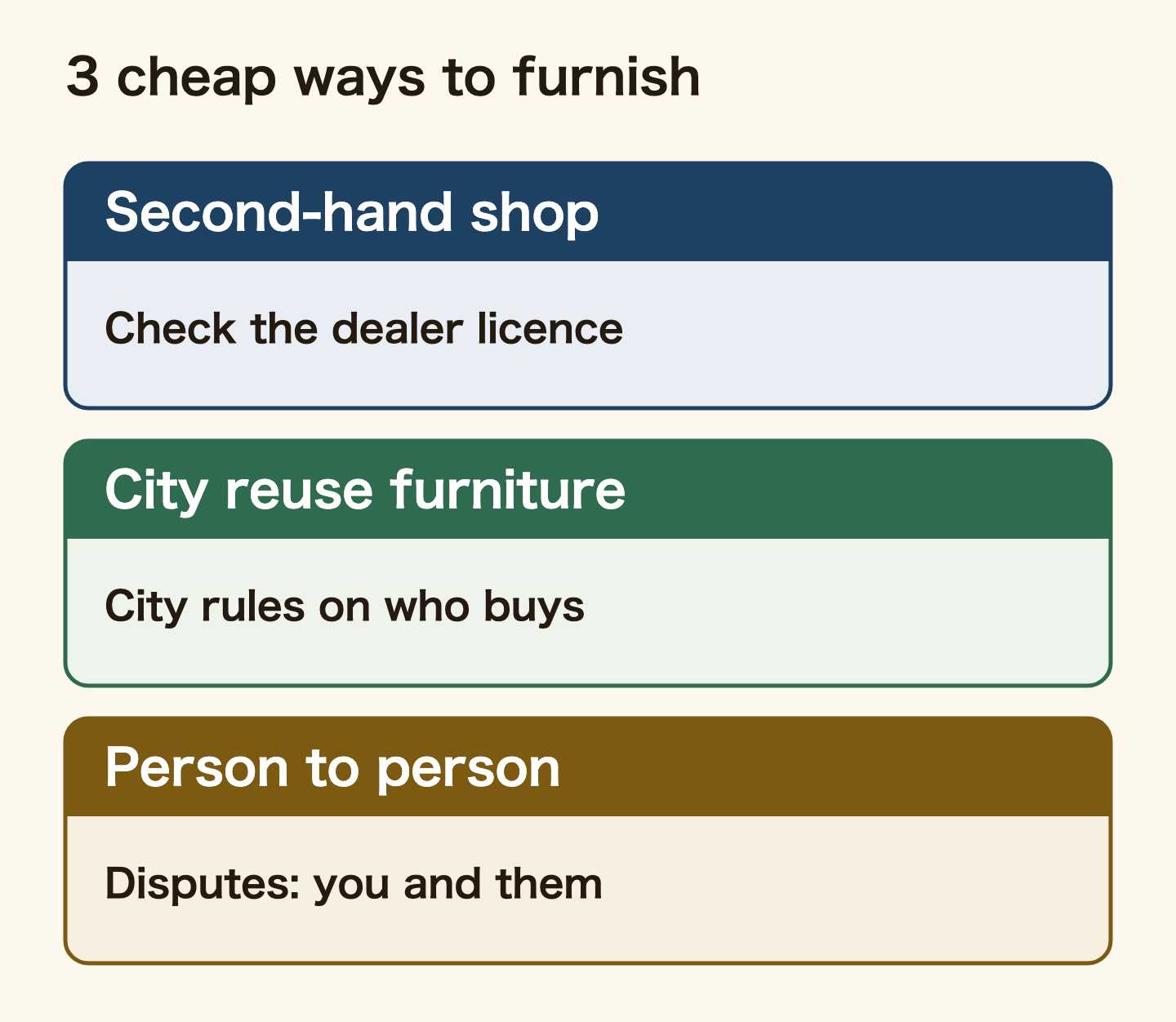
Which one depends on how soon you need it. Need bedding tonight? A shop. Can wait a month? City reuse furniture. Know someone leaving Japan? Ask them. Furniture (desks, beds, shelves) comes through any of the three. For appliances such as fridges and washing machines, read the two rules below first.
You can also start somewhere that is already furnished. If you want to cut the deposit, key money and furniture bill in one go, the share house guide compares the costs.
Buying at a recycle shop in Japan: check the dealer licence
Under the Antique Dealings Act, a business that buys and sells used goods needs a licence from the prefectural public safety commission (Antique Dealings Act, Article 3). A licensed shop must display a sign in a place the public can see, at each branch (Article 12).
The Ministry of the Environment tells people with appliances that still work to sell them as used goods to a reliable reuse shop that holds an antique-dealer licence. Buy from such a shop and you already know where to sell things back before you leave.
When you go to sell, bring something that shows who you are. A dealer buying goods must check the seller’s address, name, occupation and age (Article 15). There are exceptions, such as small purchases.
What is city reuse furniture? Sagamihara from 350 yen, Nagoya first come, first served
City reuse furniture is furniture your city picks out of oversized rubbish, cleans and repairs, and passes on to residents. Not every city does it. Search your city’s name with “リユース家具” (reuse furniture). Here are two cities whose official pages we read.
Sagamihara shows furniture at its recycling centres from the 1st to the 15th of each month (5th to 15th in January) and holds a lottery on the 16th when several people want the same piece. You can apply if you live in the city, are of junior-high-school age or older, and will use it yourself. One item per person per month. You apply in person at the centre; not by phone.
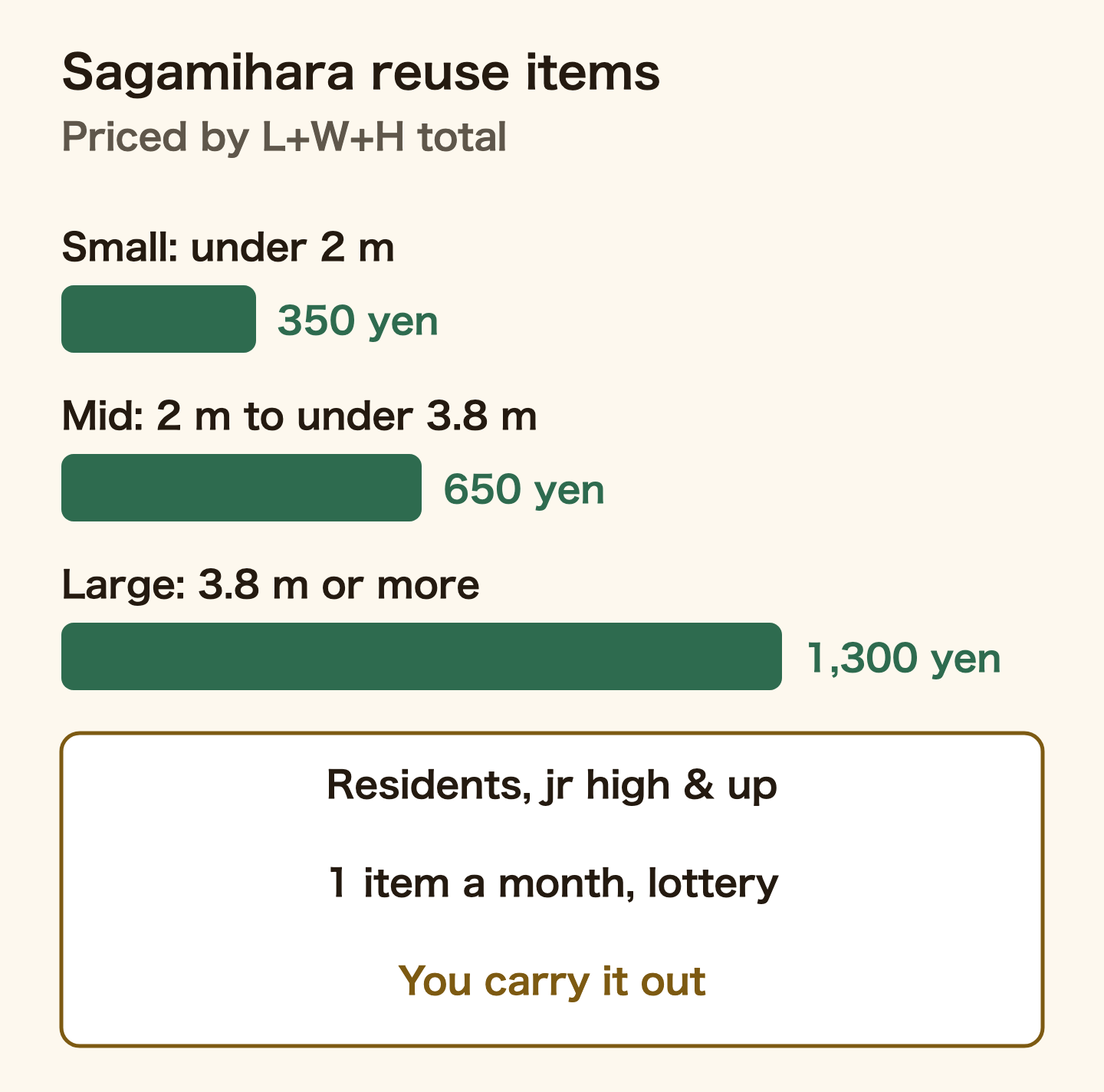
You pay part of the cleaning and repair cost. Add up length, width and height: under 2 m is 350 yen, 2 m to under 3.8 m is 650 yen, 3.8 m or more is 1,300 yen. If you win, you collect it yourself within the set period. The city says it will not take items back, refund, or repair them again if damage or dirt shows up later.
Nagoya sells furniture from oversized rubbish on a city-run Mercari Shops page, first come, first served. Buyers must live, study or work in Nagoya and use it themselves. Nothing is posted: you collect from the Minami Recycle Plaza. You can cancel before collection, not after.
Giving and receiving things person to person: if it goes wrong, you settle it
A desk from a friend who is leaving. A “free to a good home” post on a local board or app. It is the cheapest route. Nagoya has an agreement with Jimoty, a person-to-person listings service, and runs three “Jimoty Spot Nagoya” drop-off points where you can bring usable items for free (Nagoya reuse guide).
The catch is that the other side is not a shop. The National Consumer Affairs Center warns that on flea-market services, disputes are in principle to be settled between the two people involved. Before you take something, check with your own eyes that it works and is not damaged.
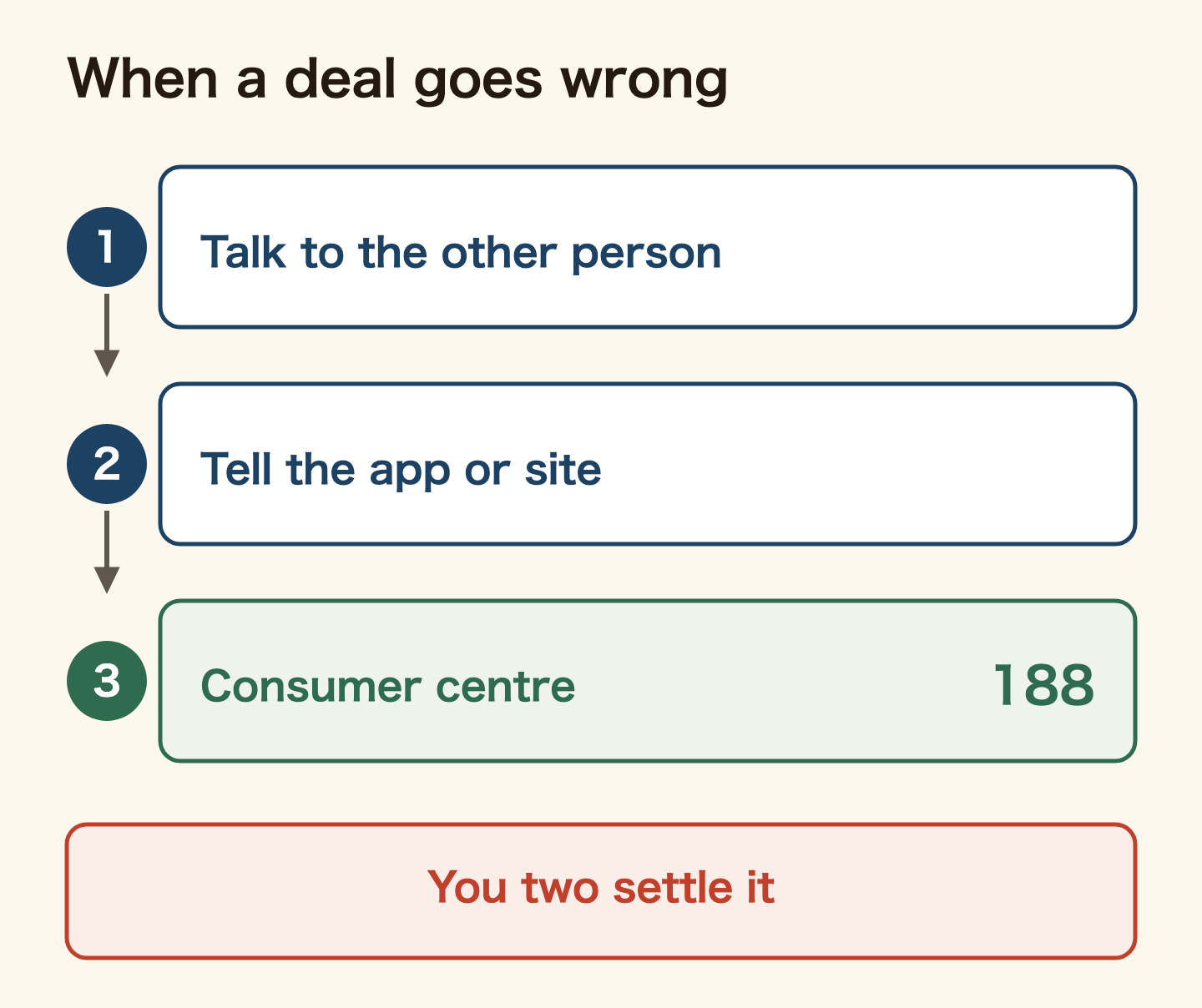
The Center also gives the order of steps. Talk to the other person first. If that fails, explain to the service operator and ask whether a compensation scheme applies. If it still goes nowhere, call the consumer hotline 188 to reach your local consumer centre. Help lines that work in other languages are in our list of help desks.
What is the PSE mark on second-hand electronics in Japan?
The PSE mark is the safety marking set by the Electrical Appliances and Materials Safety Act. It covers 457 designated “electrical appliances”, including fridges, washing machines, TVs, microwaves, air conditioners, vacuum cleaners, fans and rice cookers.
A business selling electrical appliances may not sell them, or display them for sale, without the PSE mark or other legal marking (Act, Article 27). METI asks sellers to check that the mark and the registered maker’s name are shown correctly.
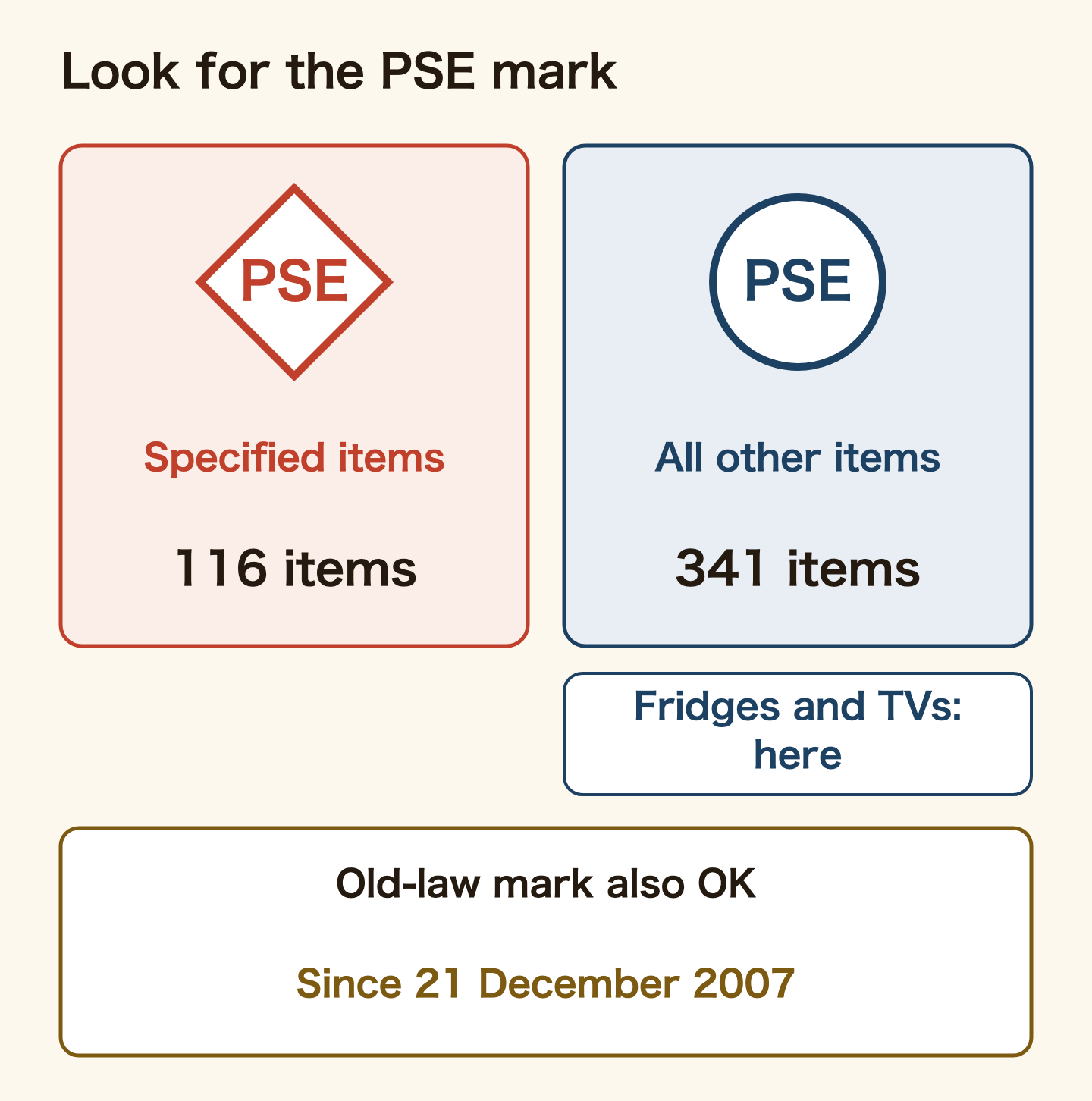
There are two shapes. The diamond is for 116 “specified” items, judged higher risk. The circle is for the other 341. Fridges, washing machines, TVs and microwaves take the circle. Look on the rating plate or label, where the mark sits next to the company name.
Older second-hand items may carry the marking of the previous law instead. Shops used to have to inspect such items themselves and add a PSE mark before selling. After an amendment, from 21 December 2007 the old marking counts as a PSE marking, and those items can be sold as they are. If you cannot find either marking on an appliance in a shop, ask the staff before you buy.
Fridges, washing machines, TVs, air conditioners: not oversized rubbish
You take a fridge from a friend, and when you no longer need it, you put it out with the big rubbish. Where you come from, that may be normal. In Japan, a fridge cannot go out even as oversized rubbish.
The Home Appliance Recycling Act (the Act on Recycling of Specified Kinds of Home Appliances) requires shops to take back, and makers to recycle, four kinds of household appliance. It has applied since April 2001 (Ministry of the Environment overview).
- Air conditioners
- TVs (CRT, LCD, OLED, plasma)
- Fridges and freezers
- Washing machines and clothes dryers
Whoever throws one out pays a recycling fee and a collection and transport fee. Shinjuku lists these four among the things it cannot collect as oversized rubbish, and Osaka says it does not take or collect them.
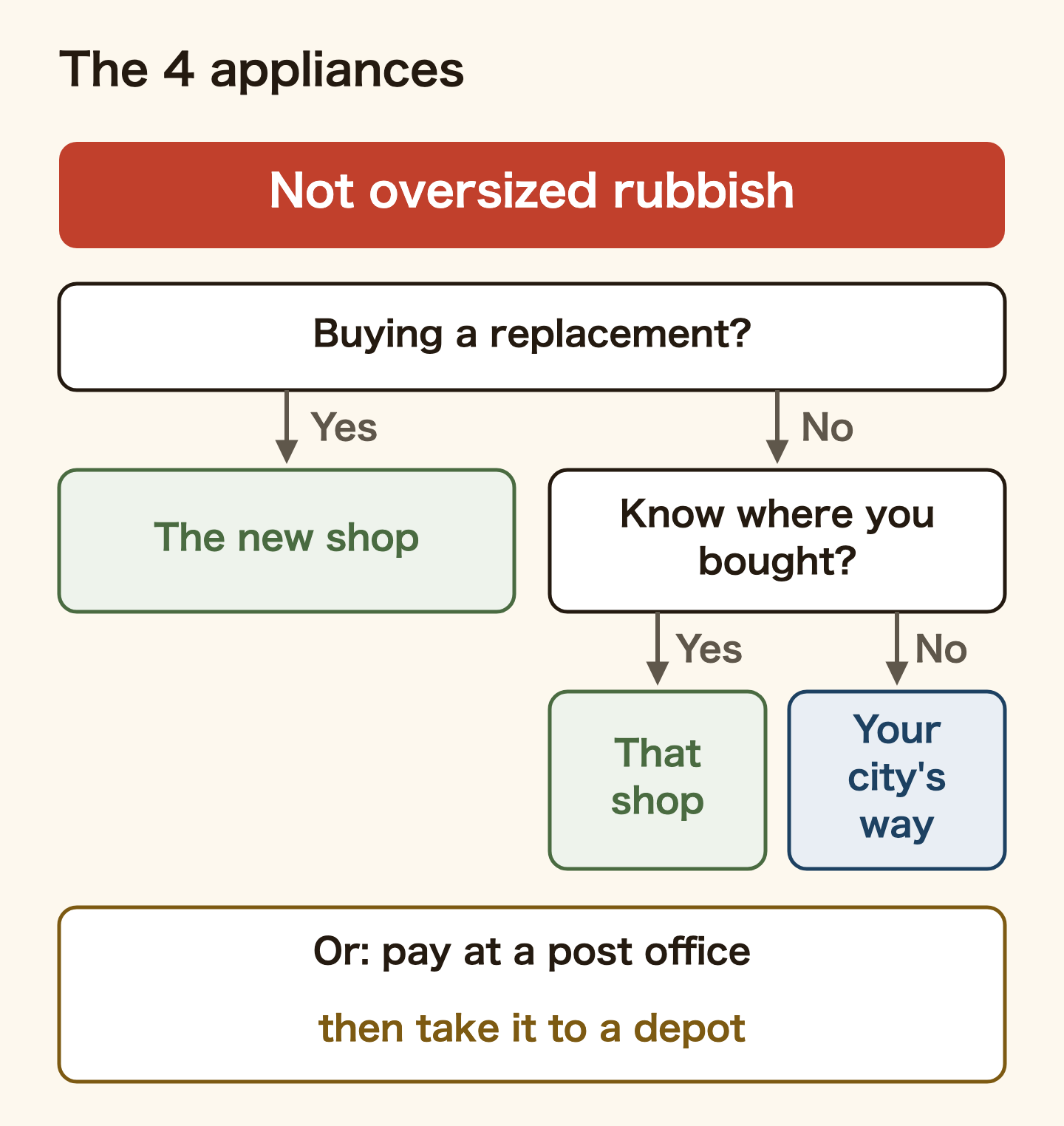
METI’s guide gives the routes in this order.
- Buying a new one of the same kind: ask the shop selling you the new one to take the old one
- Just getting rid of it: ask the shop you bought it from
- Do not know where it was bought: follow your city’s method
- Or: pay the fee at a post office and take it to a designated drop-off site yourself
At collection you fill in a Home Appliance Recycling Ticket and keep the copy, which lets you check later that it reached the maker. A second-hand or gifted appliance often fails route 2, because you do not know the shop. Keep your receipt when you buy one. City-by-city details are in the garbage disposal guide.
How much is the recycling fee? A fridge is 3,740 or 4,730 yen (example)
The recycling fee is set by maker and item; the collection fee by each shop (METI). From the Home Appliance Recycling Ticket Center fee list, here are Sharp, Mitsubishi Electric and Hitachi (tax included).
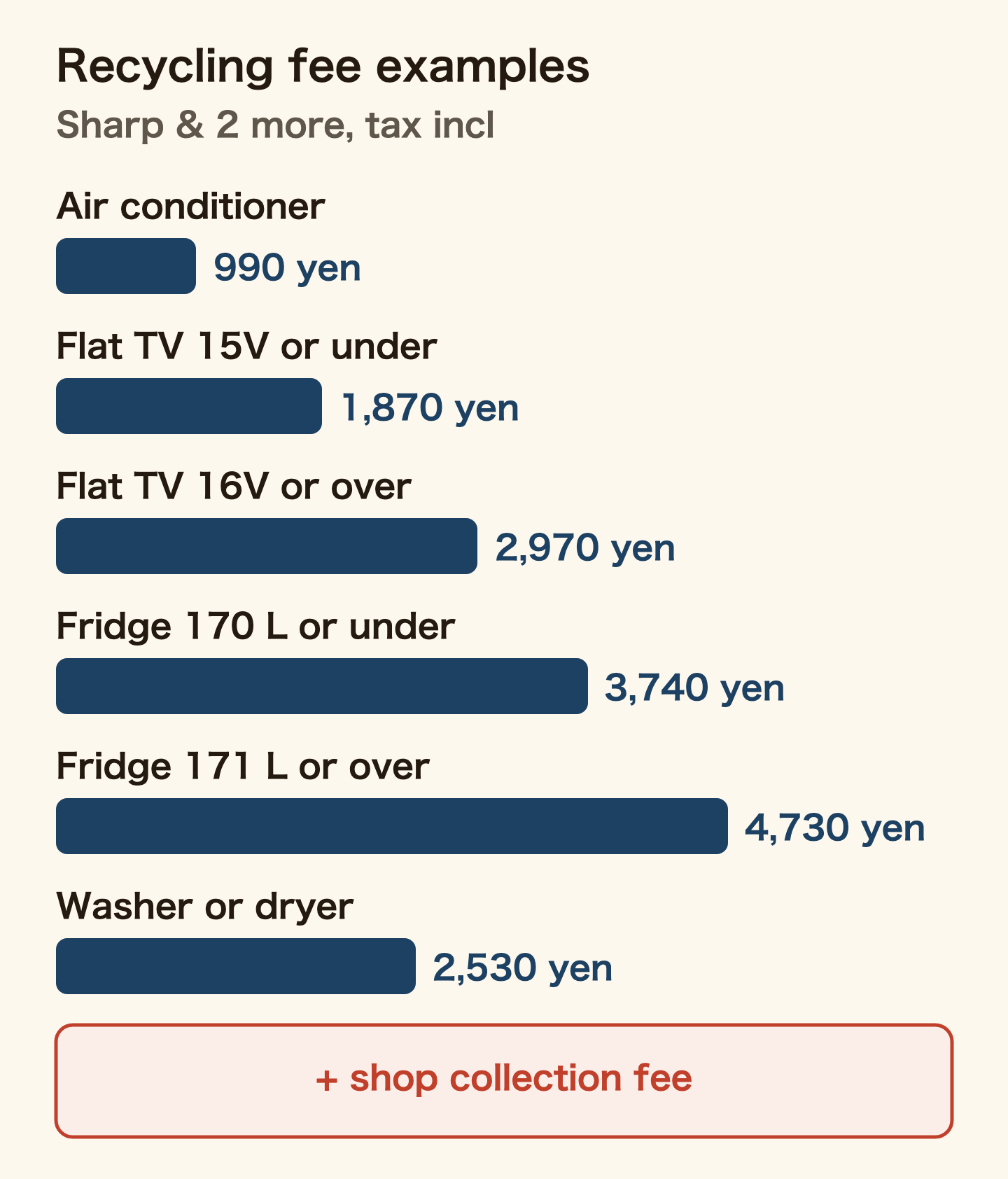
| Item | Recycling fee (example) |
|---|---|
| Air conditioner | 990 yen (Panasonic: 550 yen) |
| LCD, OLED or plasma TV | 15V or under 1,870 yen / 16V or over 2,970 yen |
| Fridge or freezer | 170 L or under 3,740 yen / 171 L or over 4,730 yen |
| Washing machine or clothes dryer | 2,530 yen |
Another maker, another price. Haier Japan Sales, for example, charges 3,784 and 4,774 yen for fridges and 2,574 yen for washing machines. Find yours in the fee list by the maker’s name or model number printed on the appliance.
The size bands are what to count. TVs split at 15V or under and 16V or over; fridges at 170 L or under and 171 L or over. Get rid of a fridge over 170 L and a washing machine, and the Sharp-type example comes to 4,730 + 2,530 = 7,260 yen in recycling fees alone, plus the shop’s collection fee for two items.
So when you look at a second-hand fridge, add that figure to the price tag, especially if you plan to leave Japan in a year or two. The full order of things to do before you go is in the leaving-Japan checklist.
Can I give things to a “free pickup” truck? Some are unlicensed
A truck circling with a loudspeaker, a collection on an empty lot, a flyer in the letterbox, an online ad. METI and the Ministry of the Environment both warn that some businesses offering “free collection” have no licence.
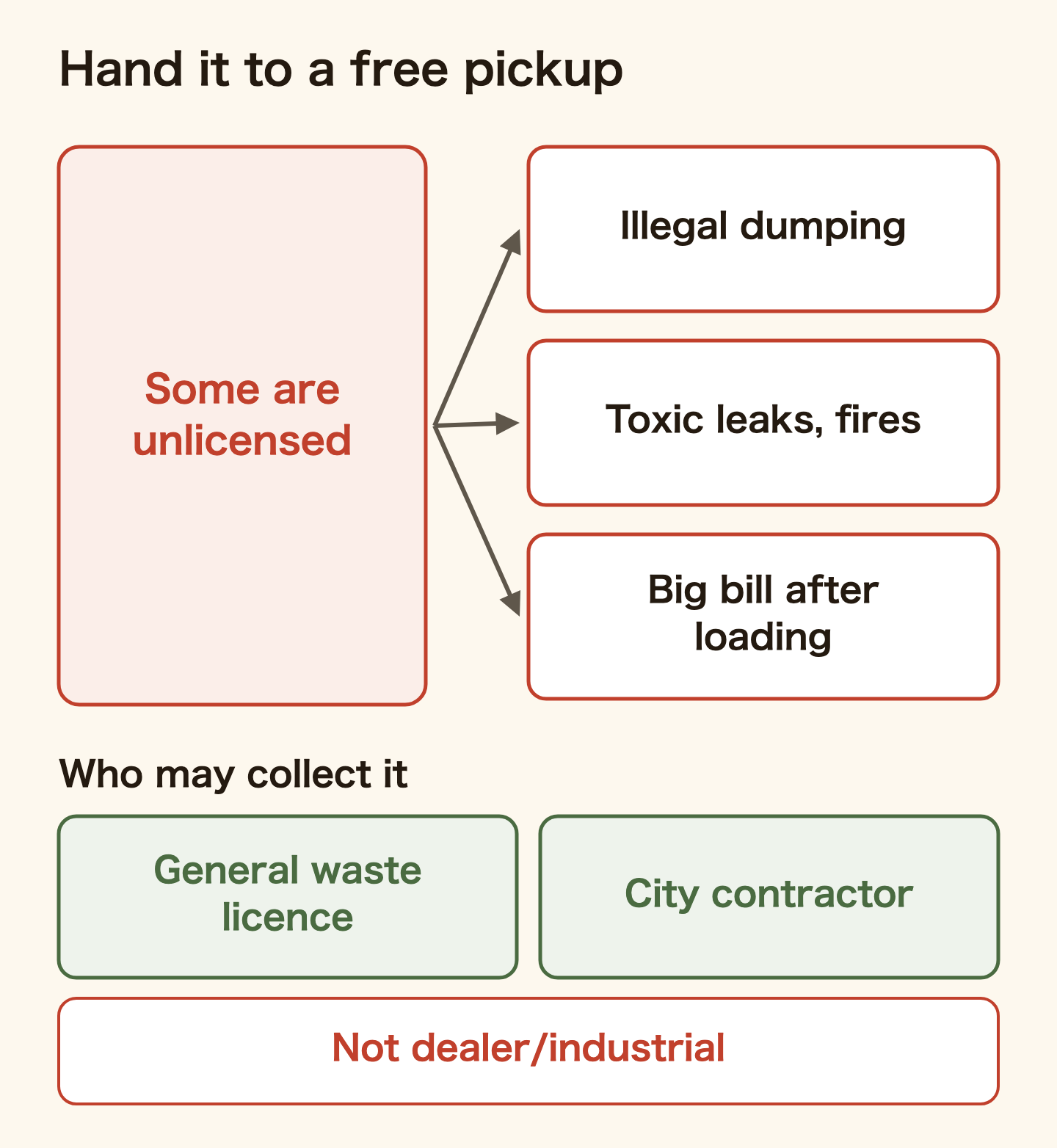
Household waste may be collected only by a firm with your city’s general waste licence, or one contracted by the city. The Ministry of the Environment states that an industrial-waste licence or an antique-dealer licence does not allow a firm to collect household waste. A flyer full of licence numbers still needs a second look: licence for what?
Hand things to an unlicensed firm and there is no way to confirm they were dealt with properly. Reported cases include collected appliances and furniture being dumped, CFCs and lead released by careless breaking, and fires at storage yards. There are also cases where “free” turned into a large bill once everything was on the truck. The ministry’s advice: ask your city’s waste department. If you have already been pressured into paying, the scams guide lists where to get help.
Don’t know the shop, or short on time? Sell, give away, or ask your city
Your flight is close and the fridge still has nowhere to go. You still have options.
- If it still works, sell it to a shop with an antique-dealer licence (the Ministry of the Environment’s advice)
- Give it to the next tenant or someone you know
- For one of the four appliances with no known shop, follow your city’s method
- Pay at a post office and take it to a designated drop-off site yourself
In some cities oversized-rubbish collection comes days or weeks after you book. Book desks and beds counting back from the day you move out or fly. The whole moving sequence is in the moving house guide.
Which one are you?
- Just arrived and need bedding tonight — buy only the basics at a nearby second-hand shop and look for its dealer-licence sign. Today, check where the PSE mark is before you pay for any appliance.
- Can wait a month — search your city’s name with “リユース家具”. Today, check the conditions: address, age, where to apply.
- About to buy a used fridge or washing machine — note the model number and capacity and look up the recycling fee. Today, add that to the price before you compare.
- Moving out or leaving Japan — the four appliances go to the shop you bought them from or through your city’s method; everything else is booked as oversized rubbish. Today, open your city’s page, not the number on a “free pickup” flyer.
FAQ
Q. Where can I buy cheap furniture in Japan?
Three places: second-hand shops (licensed antique dealers), your city’s reuse furniture, and people giving things away. In Sagamihara, for example, reuse furniture costs 350 to 1,300 yen an item, for residents of junior-high-school age or older, by lottery.
Q. Can foreigners get city reuse furniture?
The two cities whose pages we checked, Sagamihara and Nagoya, set conditions on where you live (Nagoya also accepts people who study or work there) and on using the item yourself, not on nationality. Conditions differ by city, so check your own city’s page.
Q. Do second-hand electronics need a PSE mark?
A business may not sell electrical appliances without the PSE mark or other legal marking. Items with the old law’s marking have counted as PSE-marked since 21 December 2007 and can be sold as they are. When buying in a shop, look for the mark on the appliance.
Q. Can I put a fridge or washing machine out as oversized rubbish?
No. Air conditioners, TVs, fridges and freezers, and washing machines and dryers fall under the Home Appliance Recycling Act. The shop selling you a replacement or the shop you bought it from takes it, or you follow your city’s method. You pay a recycling fee and a collection fee.
Q. How much is the home appliance recycling fee in Japan?
It depends on maker and item. For Sharp, Mitsubishi Electric and Hitachi: fridges 3,740 yen (170 L or under) or 4,730 yen (171 L or over), washing machines 2,530 yen, flat TVs 16V or over 2,970 yen, air conditioners 990 yen, tax included. The shop’s collection fee comes on top.
Q. Is it OK to give my appliances to a “free collection” truck?
The Ministry of the Environment and METI warn that some firms offering free collection are unlicensed. Only firms with a municipal general-waste licence or a city contract may collect household waste. There have been cases of large bills after loading.
Summary
You can furnish a flat cheaply through second-hand shops, city reuse furniture, and people giving things away. Know the rule for each before you start: the dealer licence at a shop, the application conditions at the city, and “you settle it yourselves” between individuals. Buy used electronics only after finding the PSE mark or the old law’s marking.
Fridges, washing machines, TVs and air conditioners cannot go out as oversized rubbish, and getting rid of them costs a recycling fee plus a collection fee. Add that to the price when you buy, and moving out or leaving Japan stops being a scramble. Skip the “free pickup” truck and follow your city’s instructions.
Official sources: Ministry of the Environment, Home Appliance Recycling Act overview / Ministry of the Environment, do not use unlicensed collectors (Q&A) / METI, correct disposal of the four appliances / Home Appliance Recycling Ticket Center, recycling fees by maker / METI, Electrical Appliances and Materials Safety Act overview / METI, products with the old law’s marking / e-Gov, Antique Dealings Act / Sagamihara City, reuse furniture / Nagoya City, reuse furniture sales / Nagoya City, reuse guide / Shinjuku City, oversized rubbish / Osaka City, how to put out rubbish / National Consumer Affairs Center, flea-market service troubles (all in Japanese, checked 30 September 2026). Fees and conditions can change; check each page before you act.
Related reading
Found this useful? Share it
Send it to a friend who lives in Japan.
WHO WROTE THIS

mori
Japanese. I read the ministries’ own notices, orders and Q&As in the original, and I start from what my Nepalese and Sri Lankan friends in Japan actually ran into. I do not write about what I have not checked or been told.
What this site can and cannot do →Looking for something else?