Checked on 9 October 2026 against the Ministry of Health, Labour and Welfare’s foreign-worker notification report (end of October 2025, text and tables) and the Immigration Services Agency’s pages on residence status and permission for work outside your status.
The short answer
- 2,571,037 foreigners work in Japan, and manufacturing is the biggest industry. It holds 24.7%, followed by other services at 15.2%, wholesale and retail at 13.3%, and hotels and restaurants at 12.4%.
- The order is very different for each visa. Technical interns sit in manufacturing (44.5%) and construction (24.0%), students in hotels and restaurants (34.8%), and Engineer/Specialist in Humanities holders spread across manufacturing, trade, services and IT. Look at the row for your own visa.
- “Industry” here means what your employer’s business is. It is not what you do all day. You can work for a manufacturer and still be outside the visa if your job is something anyone can start without experience.
- The table shows eight industries, which cover 86.4% of workers. The other 13.6% work in industries with no column. The Specified Skilled Worker count can come out low because of how notifications work.
- The numbers show where people are, not how easy a field is to enter. A big industry is not an easy one, and a small one is not a hard one.
Knowing this, you can check which industries people with your own visa work in, in your own row. You can pick the industry for your next job from numbers, not from what people around you say.
You have worked in Japan for three years. One friend from your country is in a factory, another in a hotel, a third in an IT company. Someone asks, “Where do foreigners usually work here?” and you can only answer for three people. Japanese statistics answer by one question: what business is the employer in?
An industry is what the employer’s business earns money from, such as manufacturing, trade, or hotels and restaurants. An occupation is the work you do each day, such as office work, cooking or design. The foreign-worker notification (gaikokujin koyou joukyou todokede) is the report that every employer must file with Hello Work when it hires or loses a foreign worker. The Ministry of Health, Labour and Welfare’s summary for end of October 2025 adds these reports up. It leaves out special permanent residents and people with a diplomatic or official status.
- What industries do foreigners work in? Manufacturing leads at 24.7%
- Which industries do Engineer/Specialist in Humanities holders work in? They spread out
- Which industries do Specified Skilled Workers and technical interns work in? Manufacturing first
- Which industries do students work part-time in? Hotels, restaurants and shops are over half
- Which industries do permanent residents, spouses of Japanese and long-term residents work in?
- Four ways to misread this table
- Which one are you?
- FAQ
- Summary
- Related reading
What industries do foreigners work in? Manufacturing leads at 24.7%
At the end of October 2025, employers had reported 2,571,037 foreign workers. That is 268,450 (11.7%) more than a year earlier. They work at 371,215 workplaces.
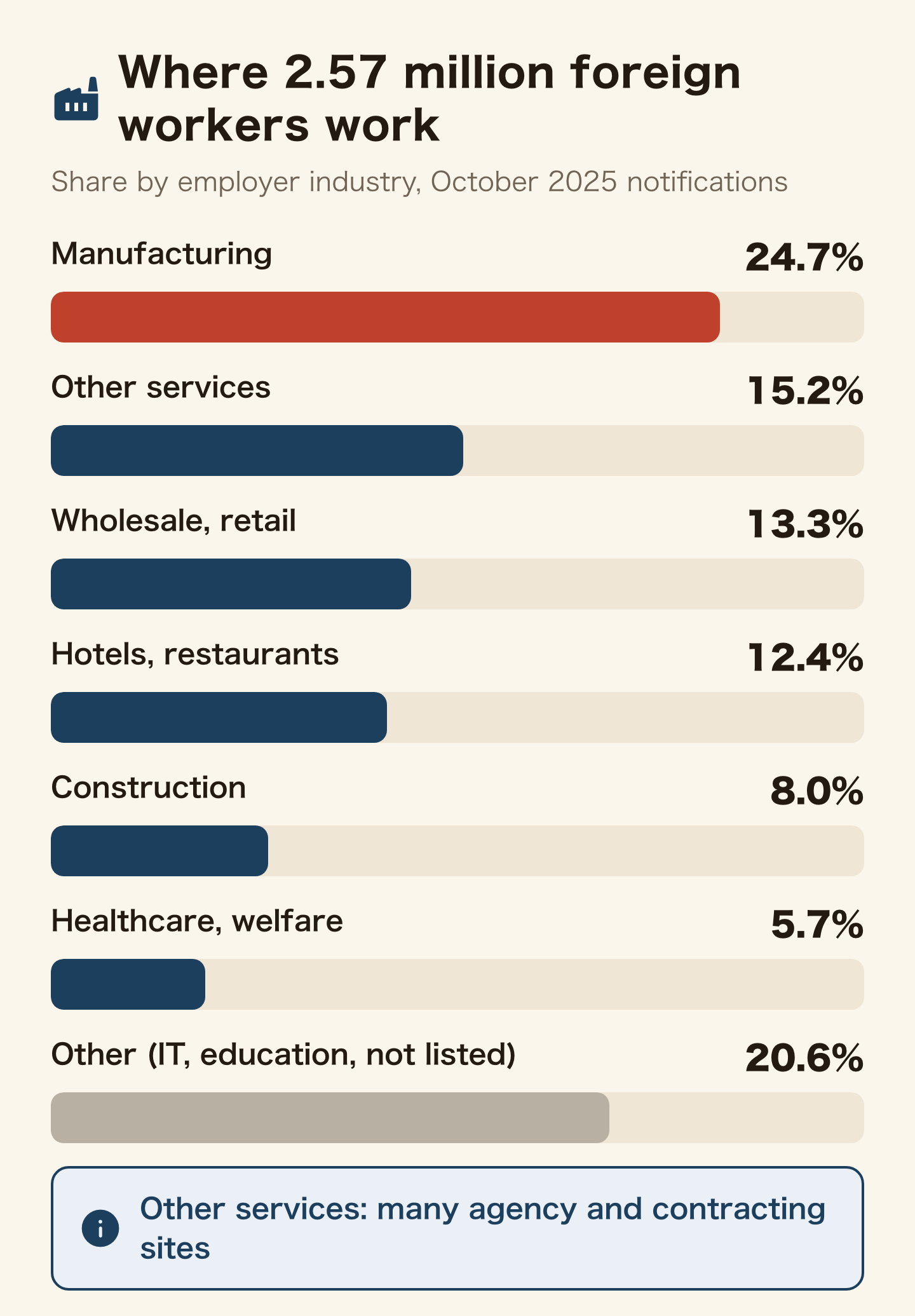
IT is 3.8% and education is 3.2%. The eight industries together make 86.4%. The other 13.6% work in industries that the ministry’s table has no column for.
“Other services” is a catch-all for services that fit nowhere else. In the same set of tables, 391,946 foreigners are in it, and 257,633 of them (65.7%) work at a dispatch or contracting workplace. The ministry adds that not everyone at such a workplace is a dispatched worker.
From here, look visa by visa. The all-workers figure is an average of very different groups.
Which industries do Engineer/Specialist in Humanities holders work in? They spread out
There are 468,068 workers on the Engineer/Specialist in Humanities/International Services visa.
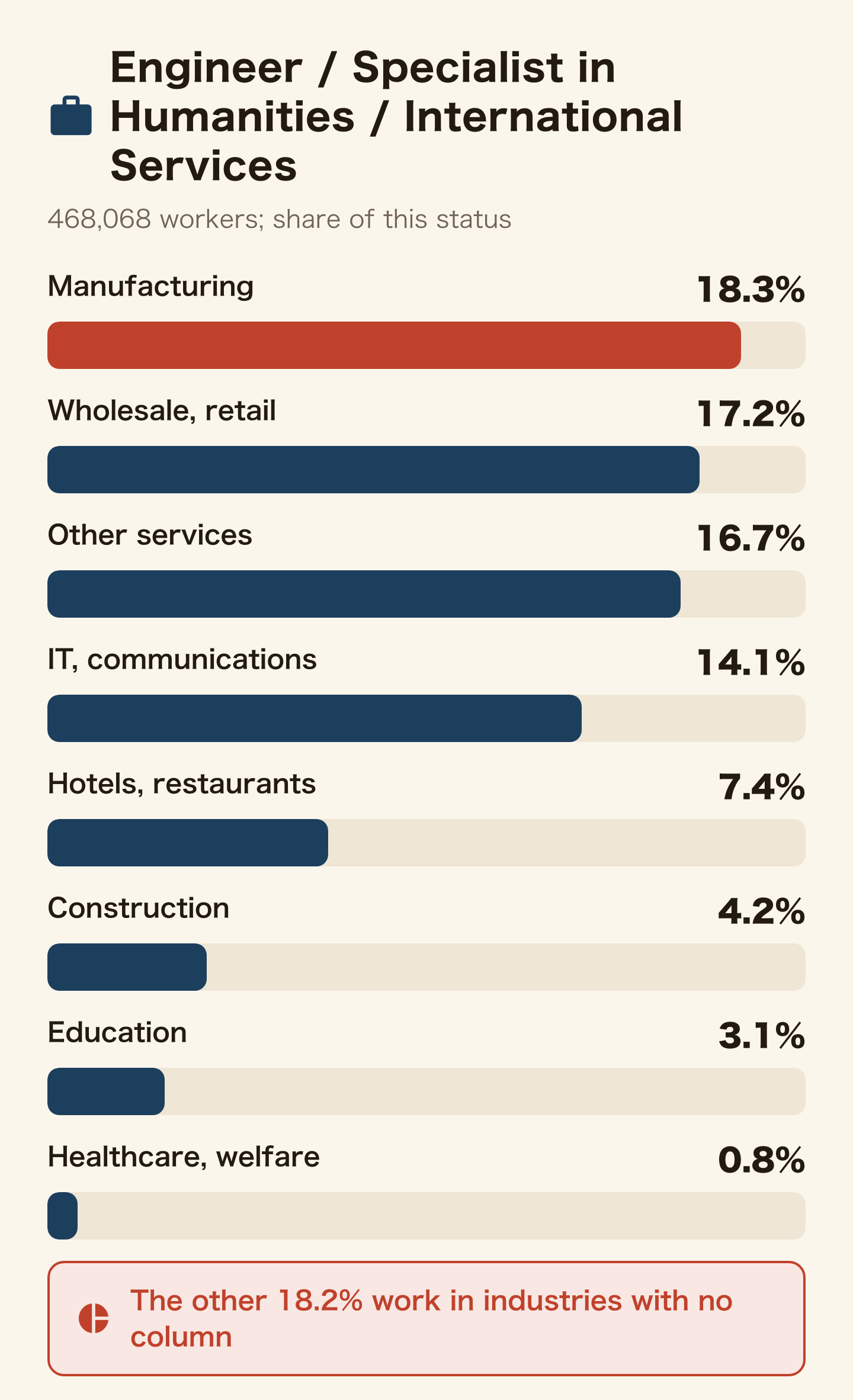
Manufacturing is 18.3%, wholesale and retail 17.2%, other services 16.7% and IT 14.1%, so four industries are close together (the chart shows all eight). Another 18.2% work in industries with no column, which is more than the 13.6% for all workers. People on this visa spread widely, including into industries the table does not show.
The likely reason is that this visa is tied to the work, not the business. The Immigration Services Agency’s examples are engineers in fields such as mechanical engineering, interpreters, designers, language teachers at private companies, and marketing staff. Companies in every industry have jobs like these.
A common misreading is “manufacturing is the biggest, so I can work in a factory.” A holder of this visa who works for a manufacturer works within the visa’s scope as an engineer or similar. The Immigration Services Agency guidelines say that work advertised as “no experience needed, you’ll pick it up quickly”, and work that Japanese employees without the required education or experience commonly do, is not covered (the guidelines, in Japanese). Japanese employees also take the same training when they join, and training needed for your future Engineer/Specialist work is allowed under conditions. The scope, and what happens if you work outside it, are laid out in our article on what the Humanities visa allows. It explains why the work you do, not the industry, decides the question.
Which industries do Specified Skilled Workers and technical interns work in? Manufacturing first
There are 286,225 Specified Skilled Workers and 499,394 technical intern trainees.
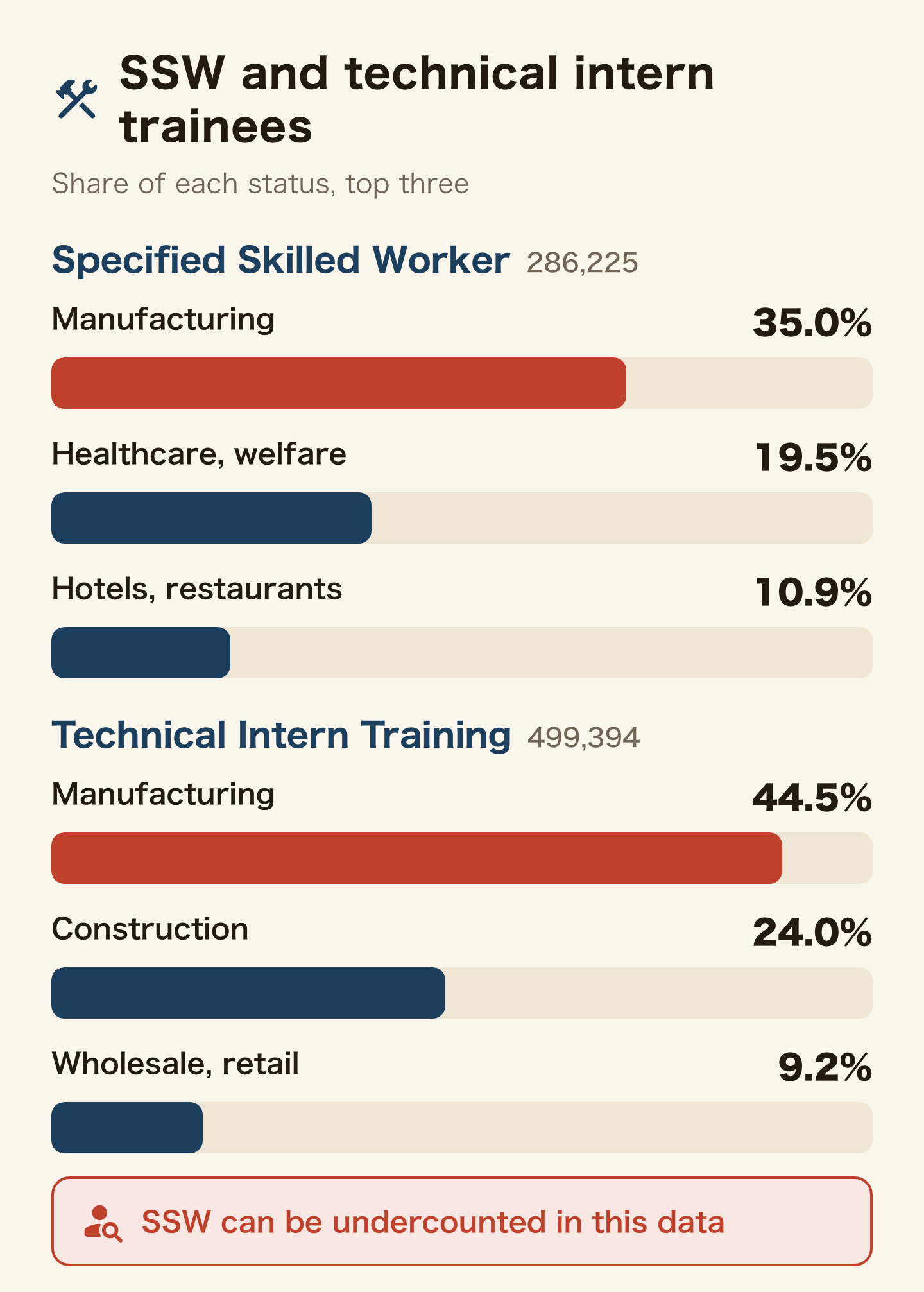
For Specified Skilled Workers, manufacturing is first at 35.0%, then healthcare and welfare at 19.5% and hotels and restaurants at 10.9%. For technical interns, it is manufacturing at 44.5%, construction at 24.0% and wholesale and retail at 9.2%. Other industries follow below those three.
One caution applies to the Specified Skilled Worker figures. When an intern moves to the Specified Skilled Worker status and stays with the same employer without a break, no foreign-worker notification is required. So the count can be lower than the real number, and the industry shares may be affected too.
Also, the “industry” in this table is the employer’s business. It is not the same as the “fields” of the Specified Skilled Worker system, such as nursing care or food service. The fields and exams are covered in our Specified Skilled Worker visa article, which is where to check how to choose a field and its test.
Which industries do students work part-time in? Hotels, restaurants and shops are over half
352,791 people work on a student visa. They are part of the people who hold permission to work outside their status, a group of 449,324.
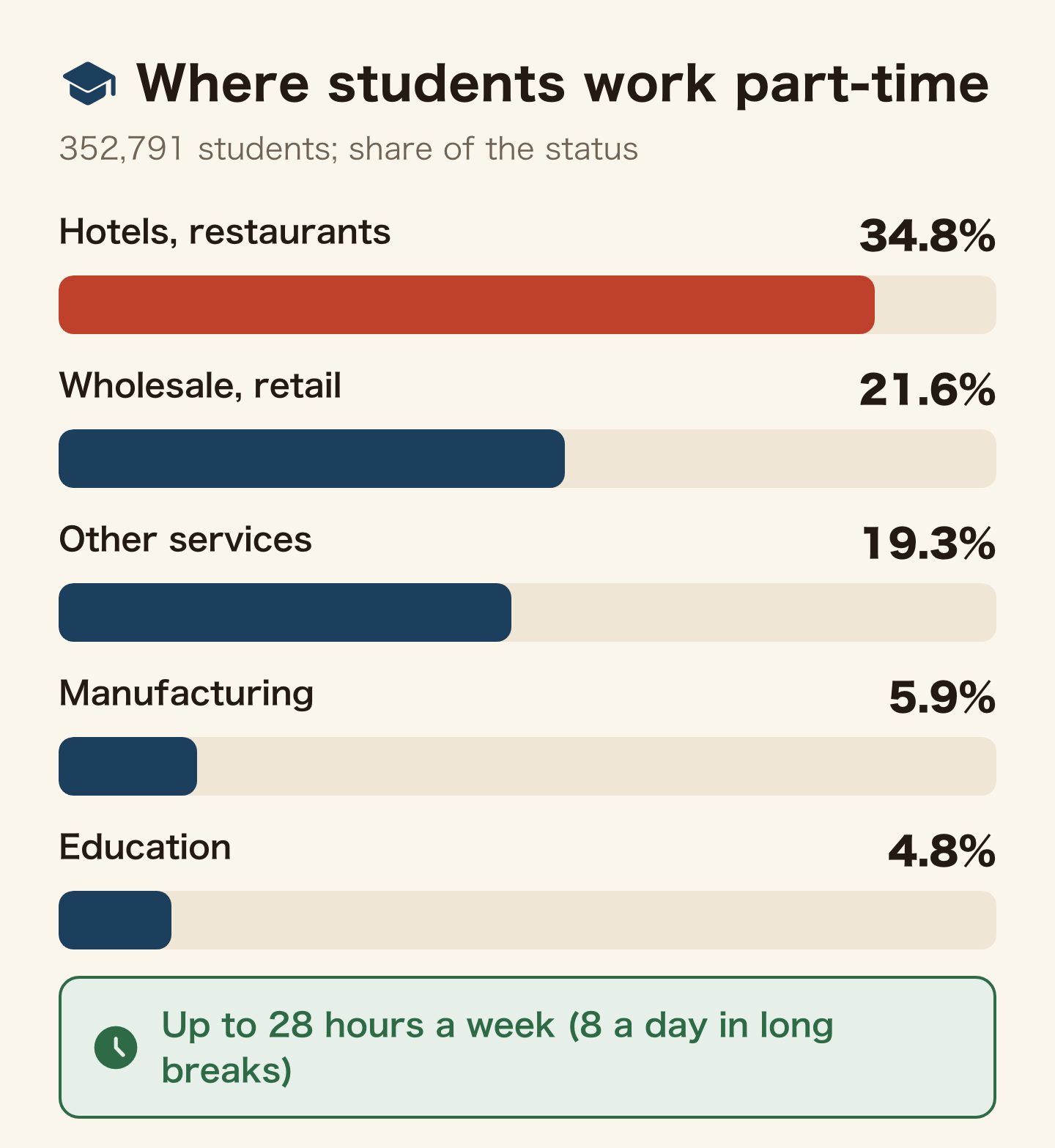
Hotels and restaurants take 34.8%, wholesale and retail 21.6%, and other services 19.3%. The first two add up to 56.4%. Manufacturing is 5.9% and education is 4.8%.
In your country, a student’s part-time job may have been free of rules. In Japan, a student visa holder needs permission to work outside the status. According to the Immigration Services Agency, with that permission you may work up to 28 hours a week (8 hours a day during long school breaks). Work beyond that, or outside that scope, needs a separate permission. How the 28 hours are counted, and the total across several jobs, is covered in our part-time job guide for students.
The figures change after graduation. The Immigration Services Agency’s 2024 report on students who found jobs in Japan (published November 2025) counts the industries of approved job changes separately. Manufacturing is first at 13.6%, then retail at 10.2% and IT at 9.3%. That is a different measure, so do not read it together with the table above. Our article on where students get hired covers it.
Which industries do permanent residents, spouses of Japanese and long-term residents work in?
The status-based residence statuses are large and do not fix the kind of work in the residence status.
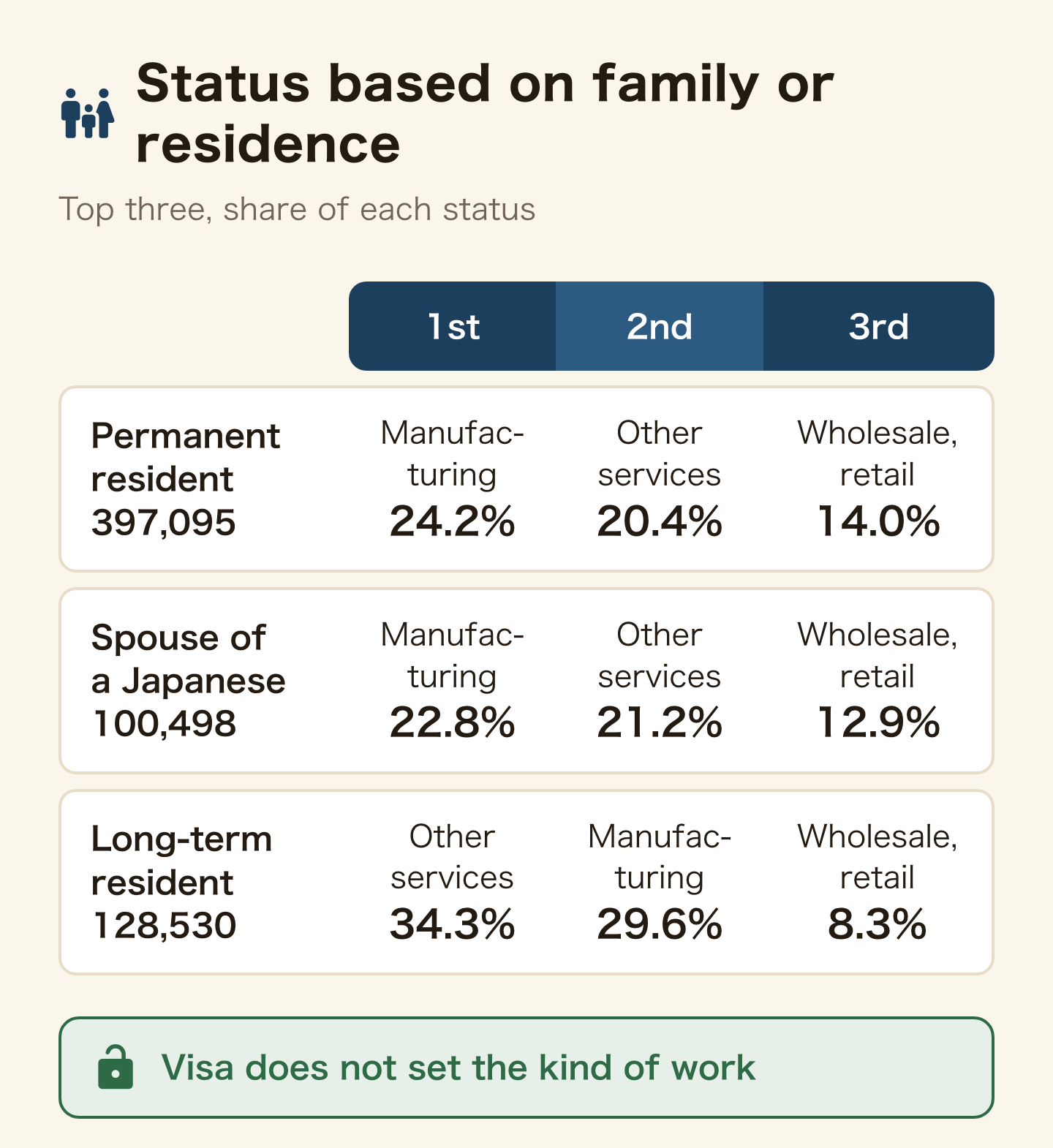
There are 397,095 permanent residents, 100,498 spouses of Japanese nationals and 128,530 long-term residents. Permanent residents are in manufacturing at 24.2%, other services at 20.4% and wholesale and retail at 14.0%. Spouses of Japanese nationals show the same three. Only long-term residents differ: other services is first at 34.3%, then manufacturing at 29.6%. Article 2-2 of the Immigration Control Act describes these statuses as activity “as a person with the status or position” and, unlike the work visas, does not fix a type of activity (the Act on e-Gov, in Japanese), so people can choose from a wider range of industries than on other visas. Within that range, many are in manufacturing and other services.
If you have no degree and want to compare the status-based, Engineer/Specialist and Specified Skilled Worker routes, our article on working without a degree sets them side by side.
Designated Activities has 111,074 people: other services 20.5%, manufacturing 17.2% and hotels and restaurants 17.1%. But that row holds many different activities, such as working holidays, in one line. You cannot read your own industry from it, so this article does not split it.
Four ways to misread this table
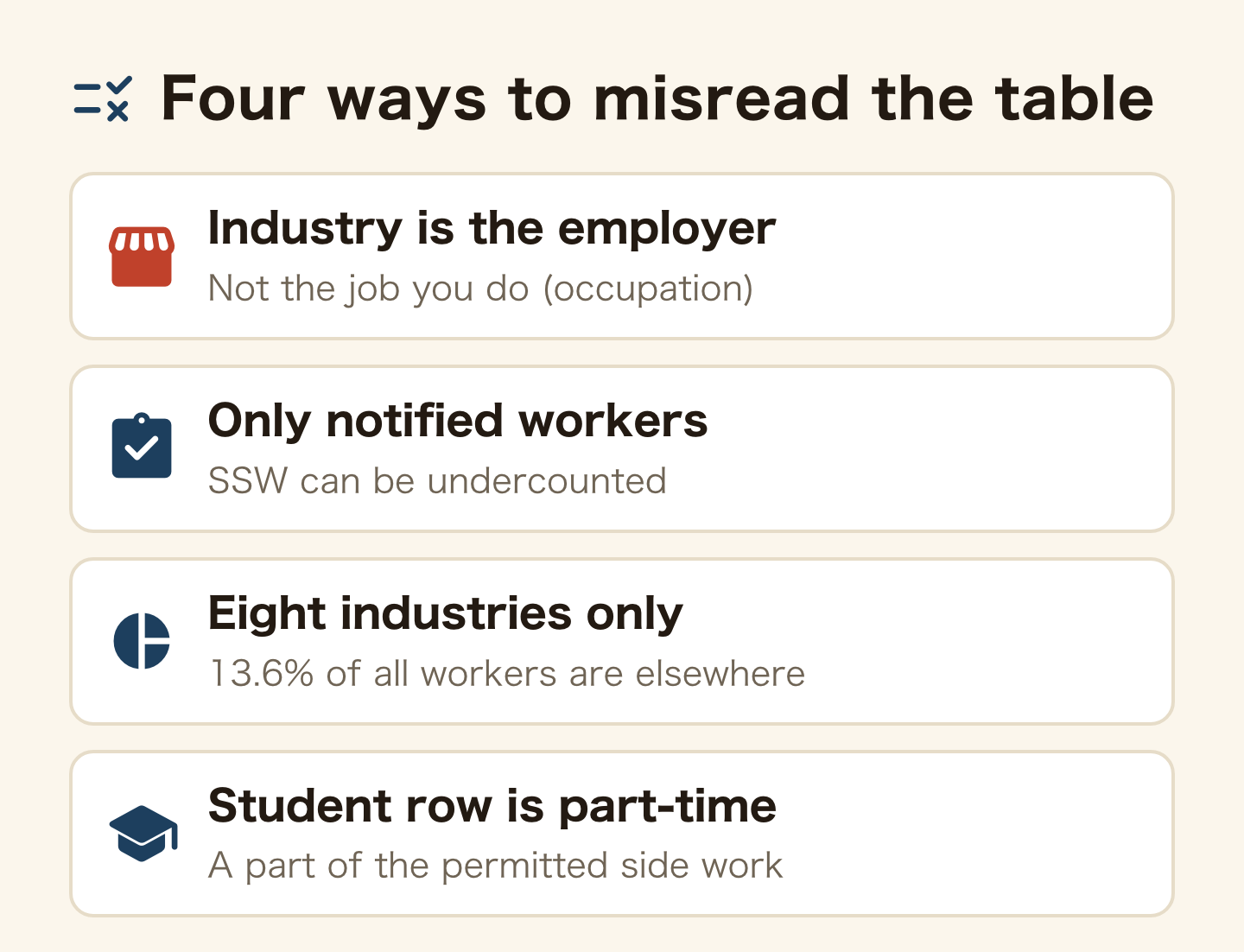
- Industry is set by the business the workplace does, not by your job. The industry names in the table follow the Japan Standard Industrial Classification, which classifies by the economic activity at the establishment (Ministry of Internal Affairs, general principles, in Japanese).
- Only people whom employers reported are counted. Specified Skilled Worker can come out low because some moves need no notification.
- The table has eight industries. 13.6% of all workers, and 18.2% on the Engineer/Specialist visa, are in industries with no column.
- The student row is part-time work. It is counted separately from the industries of jobs after graduation.
All this table can tell you is which industries have people in them. It cannot tell you which industry hires easily or gives a visa easily. Ease depends on the number of openings and their conditions.
Pay is covered by separate statistics for each visa. Our article on salary by visa gives monthly pay by visa and the equal-pay rule. After you settle on an industry, our article on how foreigners find jobs sums up a survey of how people actually got their jobs. That is a different survey and measures things differently from the 2.57 million here.
Which one are you?
- On the Engineer/Specialist visa, or aiming for it: people with this visa spread across manufacturing, trade, services and IT. Today, write your current (or target) job in one line and check whether it matches the examples: engineer, interpreter, designer, language teacher, marketing.
- Specified Skilled Worker or technical intern, thinking about the next workplace: both are concentrated in manufacturing and construction, and the Specified Skilled Worker figures run low. Today, write down which business your field belongs to, by the employer’s line of business.
- A student looking for a part-time job: over half work in hotels, restaurants and shops, and there is a 28-hour cap. Today, write down the tasks and weekly hours of a job you like, and count whether it fits the cap.
- Permanent resident, spouse of a Japanese or long-term resident, wanting to change jobs: the status does not fix the kind of work, and manufacturing and other services are the biggest. Today, pick one industry you want and open three real listings in it.
FAQ
Q. What industry do the most foreigners work in in Japan?
Manufacturing. In the notifications for the end of October 2025 it holds 24.7% of the 2,571,037 foreign workers. Next are other services at 15.2%, wholesale and retail at 13.3%, and hotels and restaurants at 12.4%.
Q. Which industries are most common for my own visa?
It differs by visa. Technical interns: manufacturing 44.5% and construction 24.0%. Specified Skilled Workers: manufacturing 35.0% and healthcare and welfare 19.5%. Students: hotels and restaurants 34.8% and wholesale and retail 21.6%. Engineer/Specialist holders are spread over manufacturing 18.3%, wholesale and retail 17.2%, other services 16.7% and IT 14.1%.
Q. Can an Engineer/Specialist visa holder work in a factory?
Industry and the work you do are different things. 18.3% of this visa’s holders work for manufacturers, but the work has to fit the visa, like an engineer in mechanical engineering. Work advertised as “no experience needed”, or that Japanese staff without the required education or experience commonly do, is not covered (Immigration Services Agency guidelines). Japanese employees also take the same training when they join, and training needed for your future Engineer/Specialist work is allowed under conditions.
Q. Is the Specified Skilled Worker count accurate?
It may be low. If an intern becomes a Specified Skilled Worker with the same employer and no break, no notification is required, and the ministry notes this in the report.
Q. What do students mostly do for part-time work?
Hotels and restaurants take 34.8%, wholesale and retail 21.6% and other services 19.3%. Students can work only with permission to work outside their status, up to 28 hours a week (8 hours a day in long school breaks).
Q. Do people work in industries that are not in the table?
Yes. The eight industries make 86.4% of all workers, and the other 13.6% work in industries with no column. On the Engineer/Specialist visa the share outside the eight is 18.2%.
Summary
Of Japan’s 2,571,037 foreign workers, most are in manufacturing (24.7%), other services (15.2%), wholesale and retail (13.3%) and hotels and restaurants (12.4%). But the order differs by visa: interns are in manufacturing and construction, students in hotels, restaurants and shops, and Engineer/Specialist holders spread out. What matters is your own visa’s row, not the total.
The industry in this table is the employer’s business, not your job. The Specified Skilled Worker count can run low, and 13.6% of workers are in industries with no column. Do not read it as “big industries are easy to enter.” Use your row to see where you stand, and as one input when you decide the industry of your next job.
Sources (official): Ministry of Health, Labour and Welfare, summary of foreign-worker notifications (end of October 2025) (text, tables) / Immigration Services Agency, Engineer/Specialist in Humanities/International Services / Immigration Services Agency guidelines for the Engineer/Specialist status / Immigration Control Act (e-Gov) / Japan Standard Industrial Classification, general principles / permission to engage in activity outside the status / work by students / 2024 report on international students who found jobs in Japan. Checked on 9 October 2026. The figures will change with the next release.
Related reading
WHO WROTE THIS

mori
Japanese. I read the ministries’ own notices, orders and Q&As in the original, and I start from what my Nepalese and Sri Lankan friends in Japan actually ran into. I do not write about what I have not checked or been told.
What this site can and cannot do →Looking for something else?
You may use the figures in this article, including commercially, if you credit this site with a link. How to use our figures