Checked on 30 September 2026 against JR East’s Suica pages, IC card rules, passenger rules and designated-school guidance, PASMO’s purchase and refund pages and PASMO rules, JR West’s ICOCA pages, and the Yokohama City Transportation Bureau’s commuter pass page.
The short answer
- Foreigners can buy a Suica or PASMO at a station ticket machine. If you live in Japan, choose the registered (named) card.
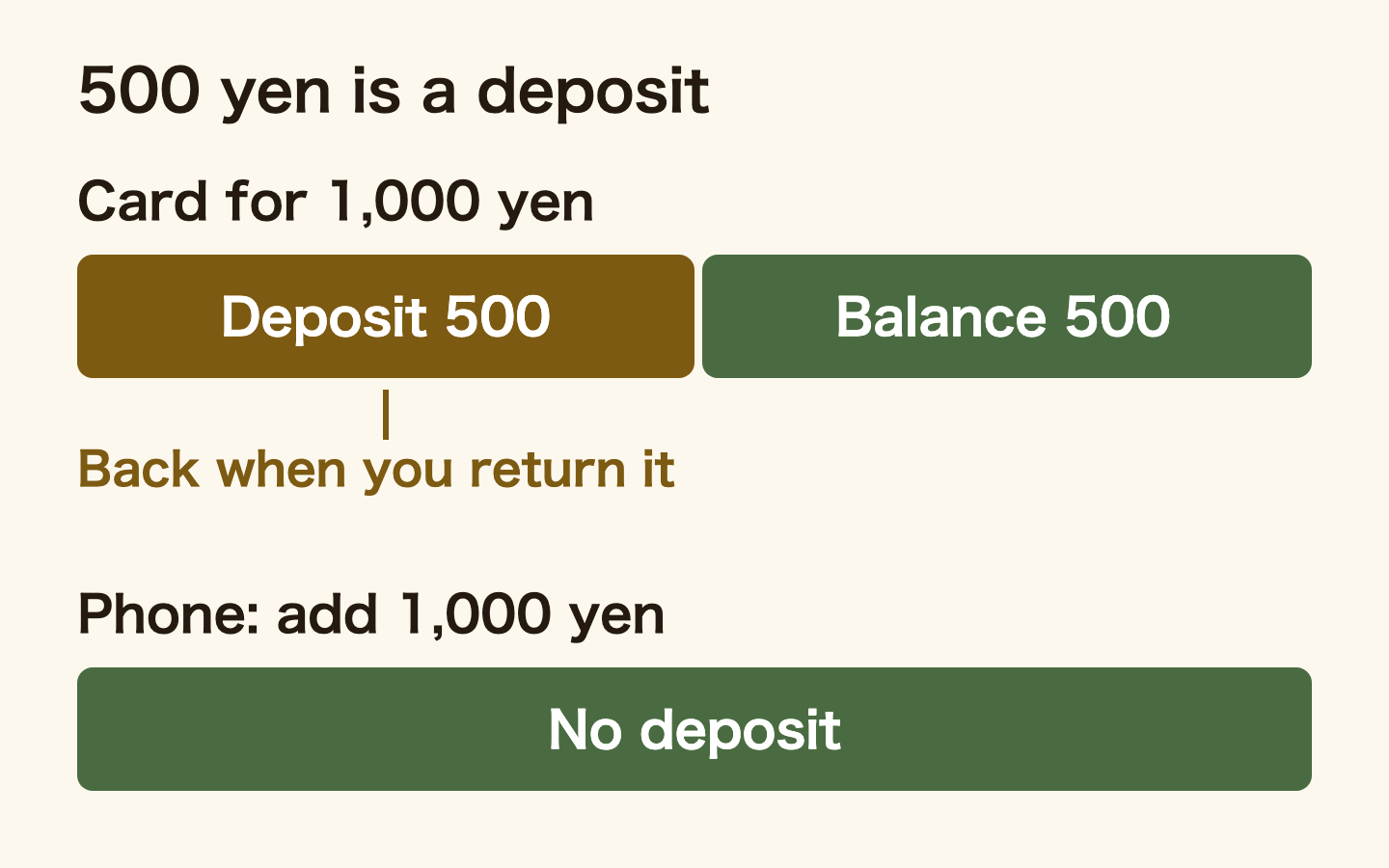
- Every card holds a 500-yen deposit. Buy a card for 1,000 yen and you can spend 500. You get the deposit back when you return the card. Suica and PASMO on your phone have no deposit.
- A student ID alone does not get you a student commuter pass. Only students of a school designated by JR can buy one. A Japanese language school qualifies only if it is licensed as a senshu gakko or kakushu gakko and your course is designated by JR.
- Refunds happen at the issuing company’s stations. You get the balance minus a 220-yen fee, plus the 500-yen deposit.
- Leaving Japan? Refund Mobile Suica before you close your bank account. The money reaches the account 2 weeks to 1 month later.
Knowing this, you can get the right card on day one and ask your school office for the one certificate that cuts your fare. Before you fly home, you will know the order that gets your deposit and balance back.
Your first week in Japan, you freeze in front of the ticket machine. There is a Suica button and a PASMO button. A Japanese friend says, “They’re the same.” Someone mentioned that student commuter passes are cheap, so you ask whether a language school counts. This time your friend has no answer. Most Japanese students go to high school or university and have never had to ask whether their school is “designated” by the railway.
- How do foreigners get a Suica or PASMO card?
- What is the 500-yen deposit, and what does a card cost?
- Who can buy a student commuter pass in Japan? Language schools need JR designation
- How do I buy a student commuter pass?
- What happens if I break the rules? The pass is taken and you pay three times the fare
- Where do I get a refund, and how much comes back?
- Leaving Japan? Refund Mobile Suica before closing your bank account
- Lost the card, or ran out of time for the refund?
- Which one are you?
- FAQ
- Summary
- Related reading
How do foreigners get a Suica or PASMO card?
A transit IC card is a card you tap on the ticket gate to pay your fare. Suica is sold at JR East stations in the Suica area: at multifunction ticket machines, the ticket office (midori no madoguchi) and “talking” reserved-seat machines. It costs 1,000, 2,000, 3,000, 4,000, 5,000 or 10,000 yen. The ordinary reserved-seat ticket machines do not sell it. The only credit card accepted is a JR View card.
PASMO is sold at the ticket machines of PASMO railway companies: press “PASMO”, then “new PASMO”. Credit cards are not accepted. In the Kansai area, ICOCA costs 2,000 yen at JR West ticket offices and machines (some machines also sell 1,000-yen and other cards).
Any of them works on most trains and buses across Japan. PASMO says that one card out of ten — Suica, Kitaca, ICOCA, PiTaPa, TOICA, manaca, Hayakaken, nimoca, SUGOCA or PASMO — works in the Tokyo area and around the country (a few lines are excluded). So the real difference is not where the card works but where you can get your money back.
JR East and PASMO do not list showing a passport or residence card as a step for buying an adult card. For a registered card, the machine asks for your name, date of birth and gender (PASMO also asks for a phone number). If these are wrong, the company may not be able to reissue or refund the card. Enter your name as it appears on your residence card.
You pass one card or one commuter pass around the family, or lend it to a friend. Where you come from, that may be normal. In Japan, a registered card or commuter pass can only be used by the person registered on it. An unregistered card works for anyone, but if you lose it, it is gone.
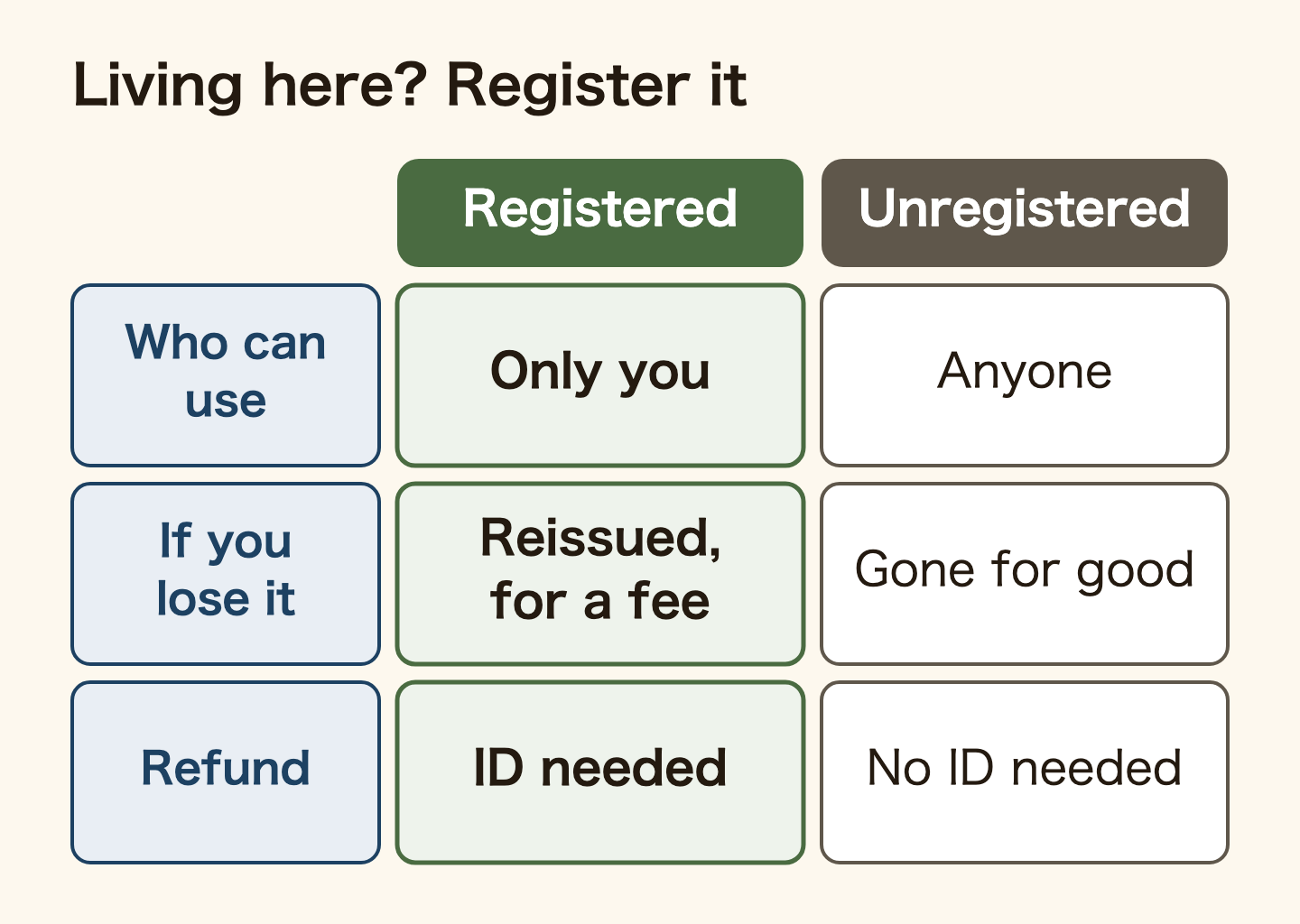
The reason to register is losing the card. A registered card can be stopped and reissued with its balance. The fee is 520 yen, plus a new 500-yen deposit. You can register an unregistered Suica later, but you cannot turn a registered one back into an unregistered one.
You can also use Suica on your phone. JR East’s pages point Android users to Mobile Suica and iPhone users to Suica in Apple Pay.
Why do people say you “can’t buy a Suica”? Sales came back in March 2025
Suica and PASMO cards stopped selling in 2023 because of a chip shortage. Registered cards returned on 1 September 2024, and unregistered cards on 1 March 2025.
Welcome Suica, the card you see at airports, is made for visitors to Japan. It is valid for 28 days including the first day of use, and its balance cannot be refunded. For anyone living here, a regular Suica is the card to keep.
What is the 500-yen deposit, and what does a card cost?
The deposit is 500 yen held when you buy a card, so that cards are reused rather than thrown away. It cannot pay fares or shopping. You get it back when you return the card.
| Item | Cost |
|---|---|
| Card deposit (Suica, PASMO, ICOCA) | 500 yen, returned with the card |
| Suica card price | 1,000 to 10,000 yen, including the deposit |
| PASMO card price | 1,000 yen, including the deposit |
| Suica, PASMO or ICOCA on a phone | No deposit |
| Refund fee | 220 yen (or the whole balance if it is under 220) |
| Reissuing a lost registered card | 520-yen fee plus a 500-yen deposit |
A Suica can hold up to 20,000 yen. You can hold only one Suica, and a balance cannot be moved to another Suica. If you are starting now and have a smartphone, Mobile Suica or Mobile PASMO avoids the deposit altogether (JR East and the PASMO Association), and you can buy commuter passes on the phone too.
Who can buy a student commuter pass in Japan? Language schools need JR designation
A student commuter pass (tsugaku teiki) is a pass for students of designated schools, valid only between the station nearest your home and the station nearest your school.
Show a student card at the counter and you pay the student price. Where you come from, that may be normal. In Japan, a student card is not enough for a commuter pass. JR East says student commuter passes and student discount tickets are only for students enrolled at a “designated school”. A designated school is one of these:
- A school under Article 1 of the School Education Act (university, junior college, technical college, high school and so on). Non-degree students such as auditors and research students are excluded
- Any other school that JR has designated. Designation is given course by course, not to the whole school
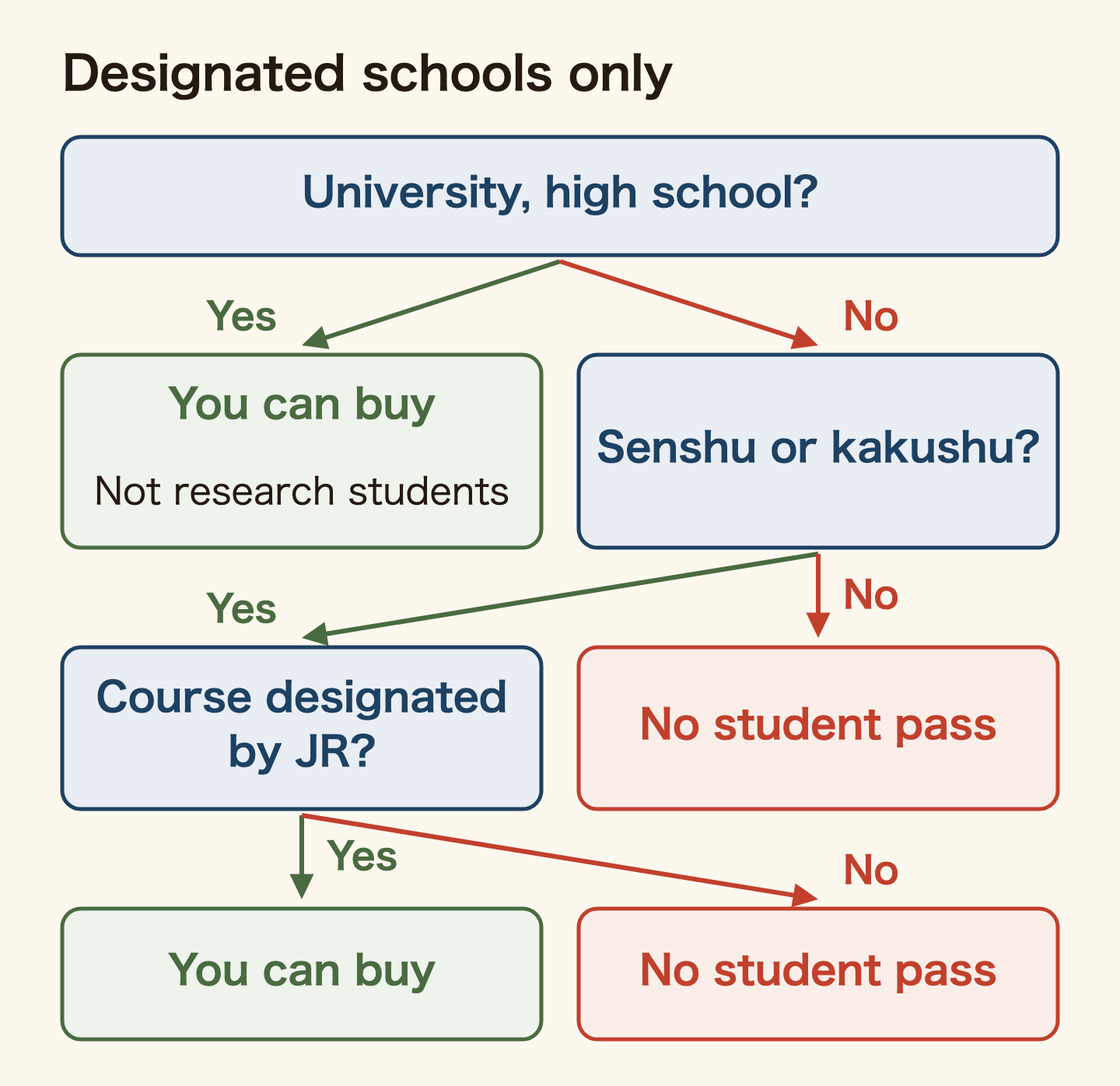
A Japanese language school outside a university is not an Article 1 school, so it falls under the second route. Under JR East’s rules on designating schools, a private school can only be designated if it is licensed as a senshu gakko (specialised training college) or kakushu gakko (miscellaneous school). A language school that is neither cannot be designated, so its students cannot buy a student commuter pass.
Even a licensed school has to meet JR’s conditions. The rules list eight:
- The course runs for 12 months or more without a break
- At least 700 class hours a year
- A capacity of 40 or more students in the course (20 for special education)
- At least three teachers
- Fixed entry and graduation periods, no more than twice a year (three times for special education)
- No entry or graduation outside those periods
- Classes at least five days and 18 hours a week
- No short courses and no studying only part of a course
A kakushu gakko must also be at least a year past both its approval date and its opening date. You do not need to check all of this. Ask your school office: “Is my course designated by JR? Can you issue a commuter certificate?”
Designated language schools say so openly. Tokyo’s Naganuma School issues the certificate on request and puts the discount at about 40 percent. Osaka YMCA says about 50 percent, and that students on a temporary visitor visa and one of its courses cannot use it. Within one school, the answer can differ by course.
The student discount on long trips (gakuwari) is for the same designated-school students: 20 percent off JR fares for journeys over 100 km. Hand the school’s discount certificate in at the ticket office, and carry your student card when you travel.
How do I buy a student commuter pass?
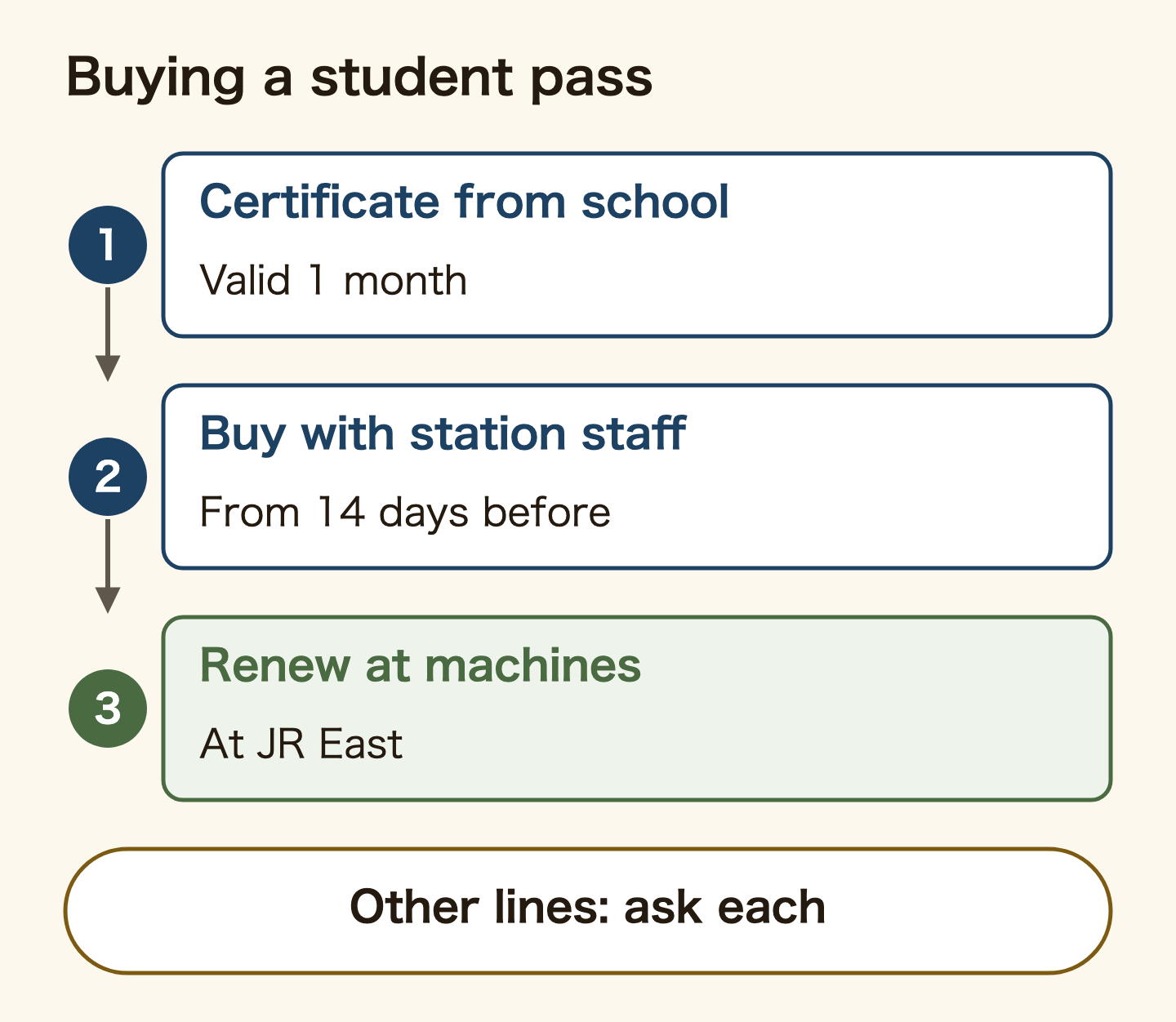
- Ask the school office for a commuter certificate (tsugaku shomeisho). It names your home station and school station. It is valid for one month from the day it is issued. If your student card is the combined “commuter certificate” type, it works instead.
- Buy the first pass at the station. At JR East that means the ticket office, a “talking” reserved-seat machine, or a reserved-seat or multifunction machine with staff present. Fill in the commuter pass application form kept at the station. You can buy from 14 days before the start date, for 1, 3 or 6 months.
- Since 1 April 2024, once you buy with a certificate that shows your expected graduation date, you can renew at ticket machines until you graduate. With Mobile Suica you upload the certificate in the app for the first purchase and renew in the app.
Three things catch people out.
- Digital student IDs in an app do not count at JR East. Carry a paper or plastic student card when you ride.
- If you move and your route changes, you buy a new pass with a new certificate.
- For a PASMO student pass, the first purchase and any renewal across school years can only be done at a station window.
Private railways, subways and buses may approve schools separately from JR. The Yokohama City Transportation Bureau sells student passes to students of vocational and miscellaneous schools only if the school is registered with the city. Even if JR or another company sells you one, you cannot buy a Yokohama subway or city bus student pass without that registration. If your route uses more than JR, check with each company.
What happens if I break the rules? The pass is taken and you pay three times the fare
The most common mistake is to keep using a student pass after leaving or graduating because it has not expired yet. Under JR East’s passenger rules, a student pass used after you lose eligibility is void and taken from you. The same applies if someone else uses it, or if you are riding without your student card.
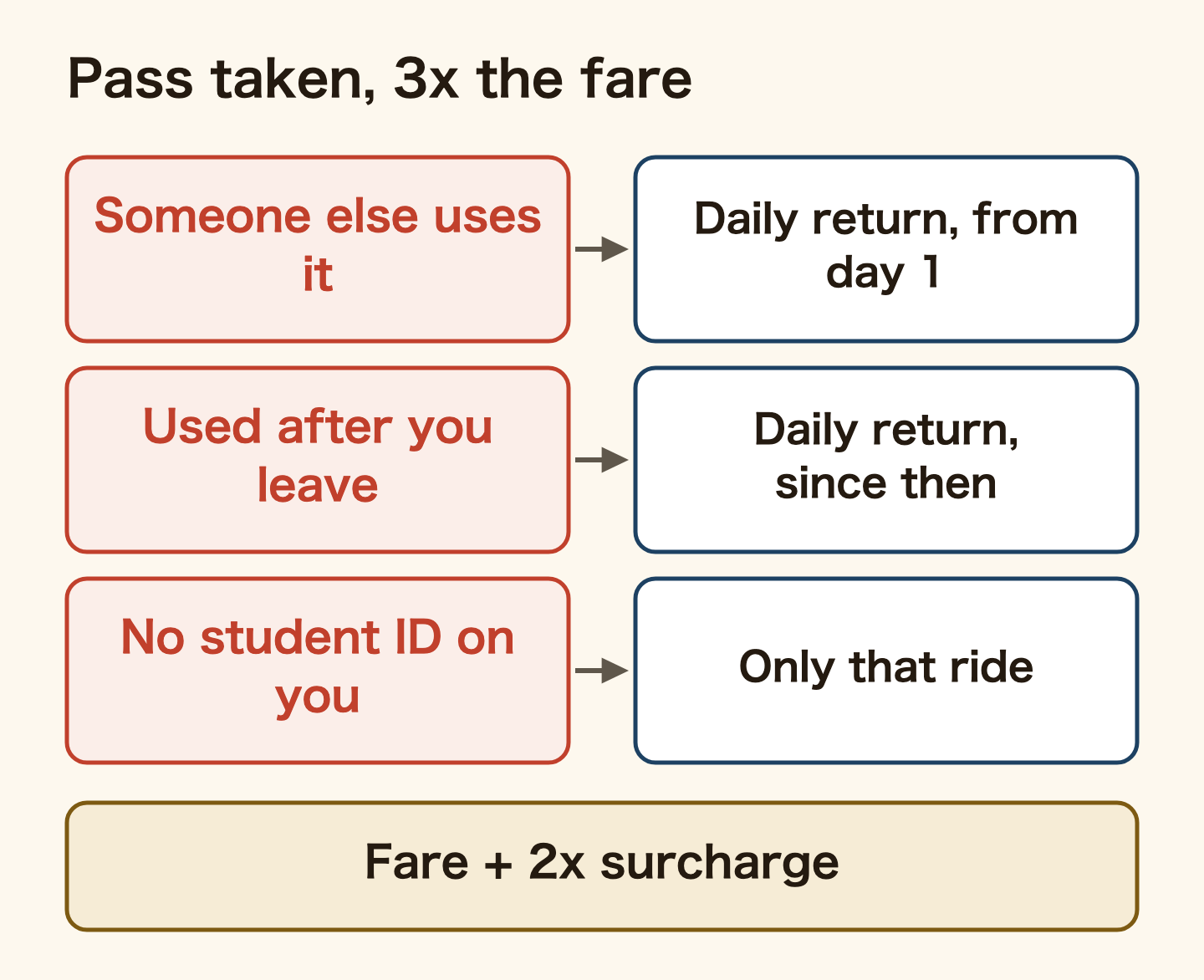
You pay the normal fare plus a surcharge of twice that fare. If someone else used the pass, it is counted as one return trip a day from the day the pass took effect; if you used it after losing eligibility, from the day you lost it — in both cases up to the day it was found. Without your student card, you pay for that ride only.
When you graduate or leave, the right move is to have the remaining period refunded. A commuter pass is refunded by the company that sold it.
Where do I get a refund, and how much comes back?
A Suica is refunded at a JR East ticket office in the Suica area. Stations of other companies and bus offices cannot do it. The reverse also holds: PASMO, ICOCA, TOICA, manaca, Kitaca, SUGOCA and the others cannot be refunded by JR East and go back to the company you bought them from. A Suica bought in Tokyo cannot be refunded at a JR West station in Osaka.
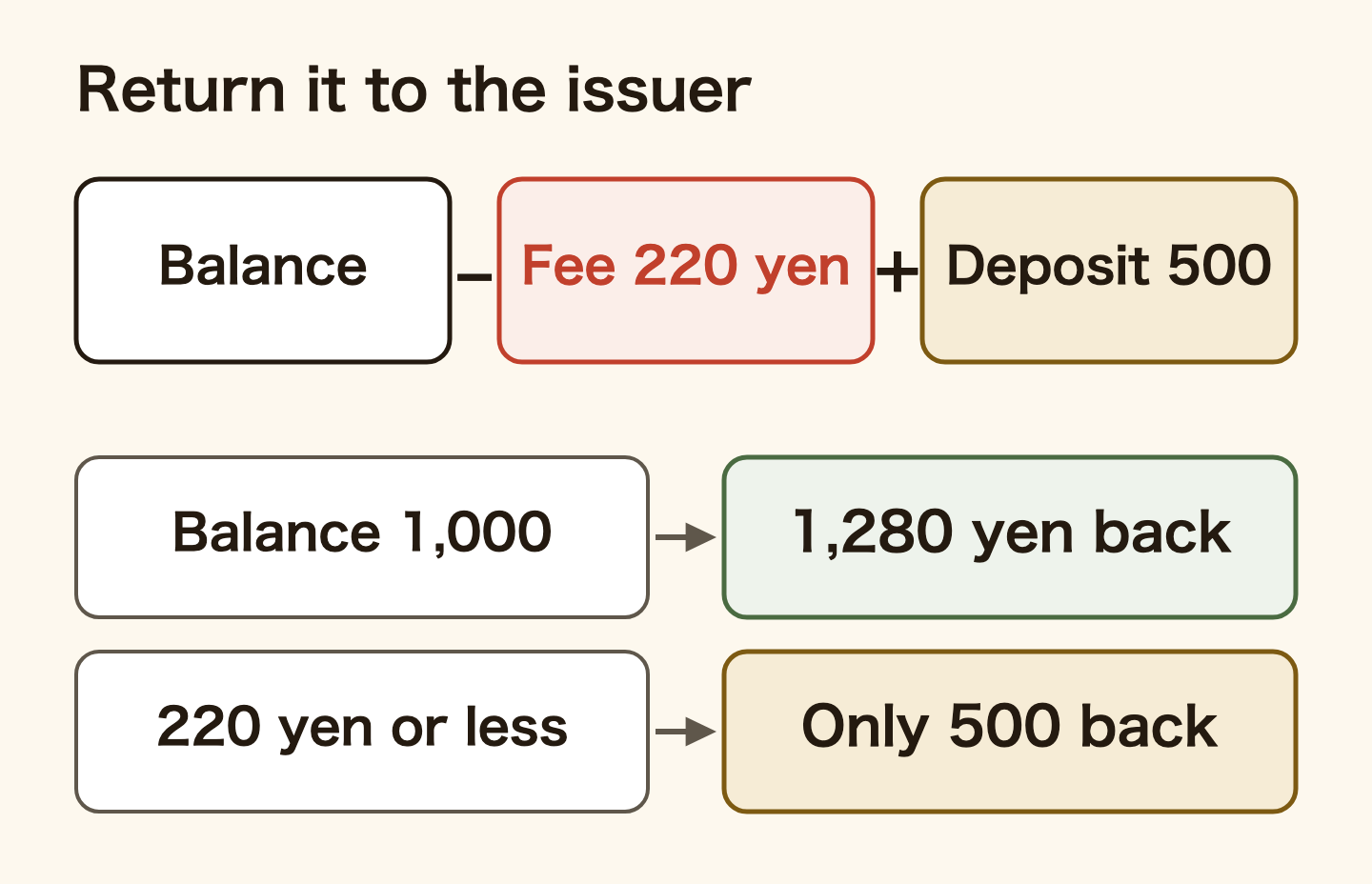
You get the balance minus a 220-yen fee, plus the 500-yen deposit. With 1,000 yen on the card, that is 780 plus 500, so 1,280 yen. With 220 yen or less, you get only the 500-yen deposit. PASMO (PASMO rules) and ICOCA also charge 220 yen and return a 500-yen deposit.
A registered card or a commuter pass needs official ID for a refund. JR East and PASMO give a driving licence as the example. Take your residence card and passport and show them at the window. If you cannot go yourself, someone else can with a letter of authorisation from you and their own ID (JR East).
Leaving Japan? Refund Mobile Suica before closing your bank account
A plastic card can be used until your last day and handed in at a station. The one to plan is Suica on your phone. A Mobile Suica refund has to be done in the app before you cancel your phone contract. The balance is paid into the Japanese bank account you enter, usually 2 weeks to 1 month after the procedure is complete.
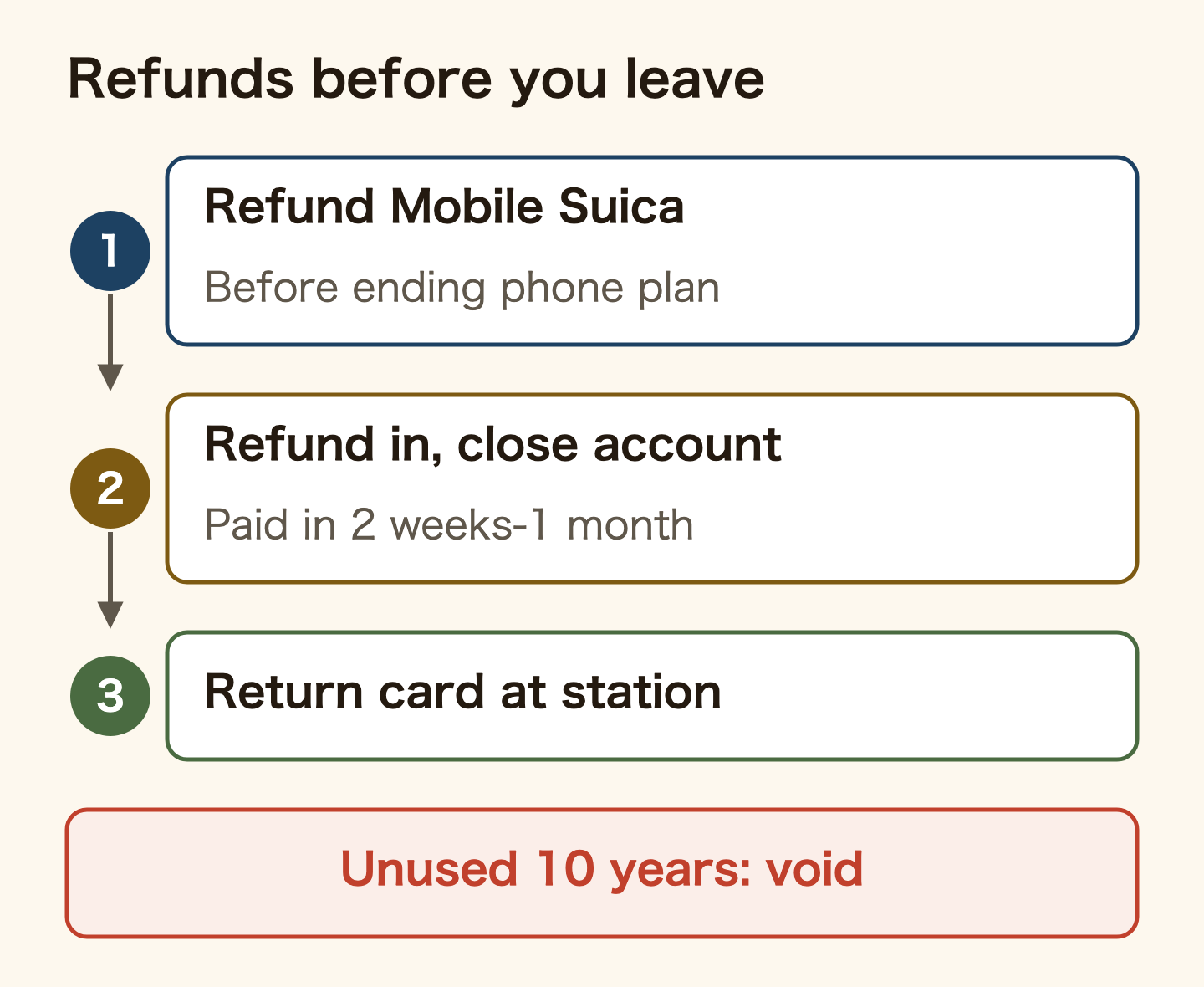
You should close your bank account before you leave. So do the Mobile Suica refund at least a month before the day you close the account. If the balance is 220 yen or less there is nothing to refund, and no account details are needed.
If you take a card home without returning it, it does not vanish at once. Suica and PASMO become void after 10 years with no use, counted from the day after the last charge, ride or similar use; after that the deposit and balance are lost. If you expect to come back, keeping it is an option.
Lost the card, or ran out of time for the refund?
- Lost a registered card — tell a station and the card can be stopped. Reissue costs a 520-yen fee plus a 500-yen deposit, with official ID. An unregistered card cannot be reissued.
- No time to go to the window before your flight (unregistered card) — no ID is needed, so a friend staying in Japan can return it for you.
- No time (registered card) — someone else needs a letter of authorisation from you and their own ID. Write the letter before you leave.
- Leaving school with a student pass still running — it stops being valid from that day. Get the rest refunded by the company that sold it.
Which one are you?
- Just arrived and have no card yet — today, buy a registered card at a station machine, or start Mobile Suica or Mobile PASMO on your phone with no deposit. Use the name on your residence card.
- At a language school or vocational school — today, ask the school office: “Is my course designated by JR? Can you issue a commuter certificate?” If yes, switch to a student pass at your next renewal.
- Your route includes a private railway or subway — today, ask that company’s commuter pass office, giving your school and course name, whether you can buy a student pass.
- Leaving Japan — today, fix the date you will close your bank account and put the Mobile Suica refund in your calendar at least a month before it. Return plastic cards at the issuing company’s station on your last day.
FAQ
Q. Can foreigners get a Suica or PASMO?
Yes. You buy one at a station ticket machine or ticket office like anyone else. If you live in Japan, choose a registered card with your name, date of birth and gender, so it can be reissued if you lose it.
Q. Suica or PASMO: which is better?
Both work on most trains and buses across Japan. The difference is the refund: Suica only at JR East stations, PASMO only at PASMO rail and bus companies. Buy the one run by the company of your usual station.
Q. When do I get the Suica deposit back?
When you return the card for a refund, you get the 500-yen deposit plus the balance minus a 220-yen fee. If the balance is 220 yen or less, you get only the 500 yen.
Q. Can Japanese language school students get a student commuter pass?
Yes, if the school is licensed as a senshu gakko or kakushu gakko and your course is designated by JR. Ask your school office whether it can issue a commuter certificate. Private railways and subways may need their own approval.
Q. Can I keep using my student pass after graduating, until it expires?
No. A student pass used after you lose eligibility is void and taken, and you pay the normal fare for one return trip a day from the day you lost eligibility, plus a surcharge of twice that. Have the remaining period refunded instead.
Q. What should I do with my Suica or PASMO when I leave Japan?
Return plastic cards at the issuing company’s station to get the balance and deposit back. Refund Mobile Suica in the app before cancelling your phone, and close your bank account only after the money has arrived.
Summary
Foreigners can buy a transit IC card at any station machine. If you live in Japan, register it with the name on your residence card. A card carries a 500-yen deposit that you get back when you return it, and a phone-based card has none.
A student commuter pass depends on your school’s designation, not your student card. At a language school, start by asking the office for a commuter certificate. Before leaving Japan, refund Mobile Suica before closing your bank account, and return plastic cards at the issuing company’s station.
Official sources: JR East: types of Suica card / buying My Suica and Suica cards / Suica refunds / IC card rules, part 1 / Welcome Suica rules / resumption of unregistered card sales / designated schools / rules on designating schools / student commuter pass guide / passenger rules Art. 168 and Art. 265 / Mobile Suica refund / PASMO: buying a card / PASMO refunds / PASMO rules / JR West: ICOCA refunds / Yokohama City Transportation Bureau: student pass approval (all checked 30 September 2026). Commuter pass prices depend on the route; check them at the station.
Related reading
Found this useful? Share it
Send it to a friend who lives in Japan.
WHO WROTE THIS

mori
Japanese. I read the ministries’ own notices, orders and Q&As in the original, and I start from what my Nepalese and Sri Lankan friends in Japan actually ran into. I do not write about what I have not checked or been told.
What this site can and cannot do →Looking for something else?