Last updated: 30 August 2026
Summary
- iDeCo is Japan’s private pension where you contribute, invest and collect in old age. Foreign nationals can join – the condition is public pension enrolment, not nationality.
- The catch: you cannot withdraw before 60. If your employer suggests it and there is any chance you will leave Japan, do not sign up on the spot.
- There is an exit. After you leave, meeting all seven conditions gets you a lump-sum withdrawal payment.
- Two of those conditions are ones only foreign nationals meet automatically. Japanese citizens abroad can still enrol voluntarily, which locks them out of this route.
- The real gate is “5 years or less, or 250,000 yen or less” and “within 2 years.” The longer you contribute, the more the exit closes.
What changes: you know the money is locked until 60 – so when your employer suggests iDeCo, you answer after thinking about going home, not before.
Once you start a job and join the company insurance scheme, a colleague may ask whether you are doing iDeCo. For a Japanese employee it is usually a good deal.
For someone who might go home one day, the terms are different. This guide covers only that difference.
- What iDeCo is, and whether foreign nationals can join
- Locked until 60 – and that collides with going home
- The exit: seven conditions for the lump-sum withdrawal
- Conditions 3 and 4 favour foreign nationals
- The real gate is conditions 6 and 7
- This is not the same as the pension lump-sum withdrawal
- So how should you decide?
- What to do today
- Frequently asked questions
- Summary
What iDeCo is, and whether foreign nationals can join
iDeCo (individual-type defined contribution pension) is a private pension where you pay the contributions, you choose the investments, and you collect the result in old age. It sits alongside the public pension, and joining is voluntary.
The official site puts it this way:
Broadly, people aged 20 to under 65 who are insured under the public pension may join… contributions can be made until age 65… and as a rule, assets cannot be withdrawn until you turn 60.
iDeCo official site (National Pension Fund Association) – translated from the Japanese original
The condition is being insured under the public pension. Nationality is not mentioned. If you work in Japan and are enrolled in Employees’ Pension Insurance, you can join.
Contributions are fully deductible from income, and investment gains are untaxed. As a scheme it is well built. That is not where the problem is.
Locked until 60 – and that collides with going home
This is the part that matters.
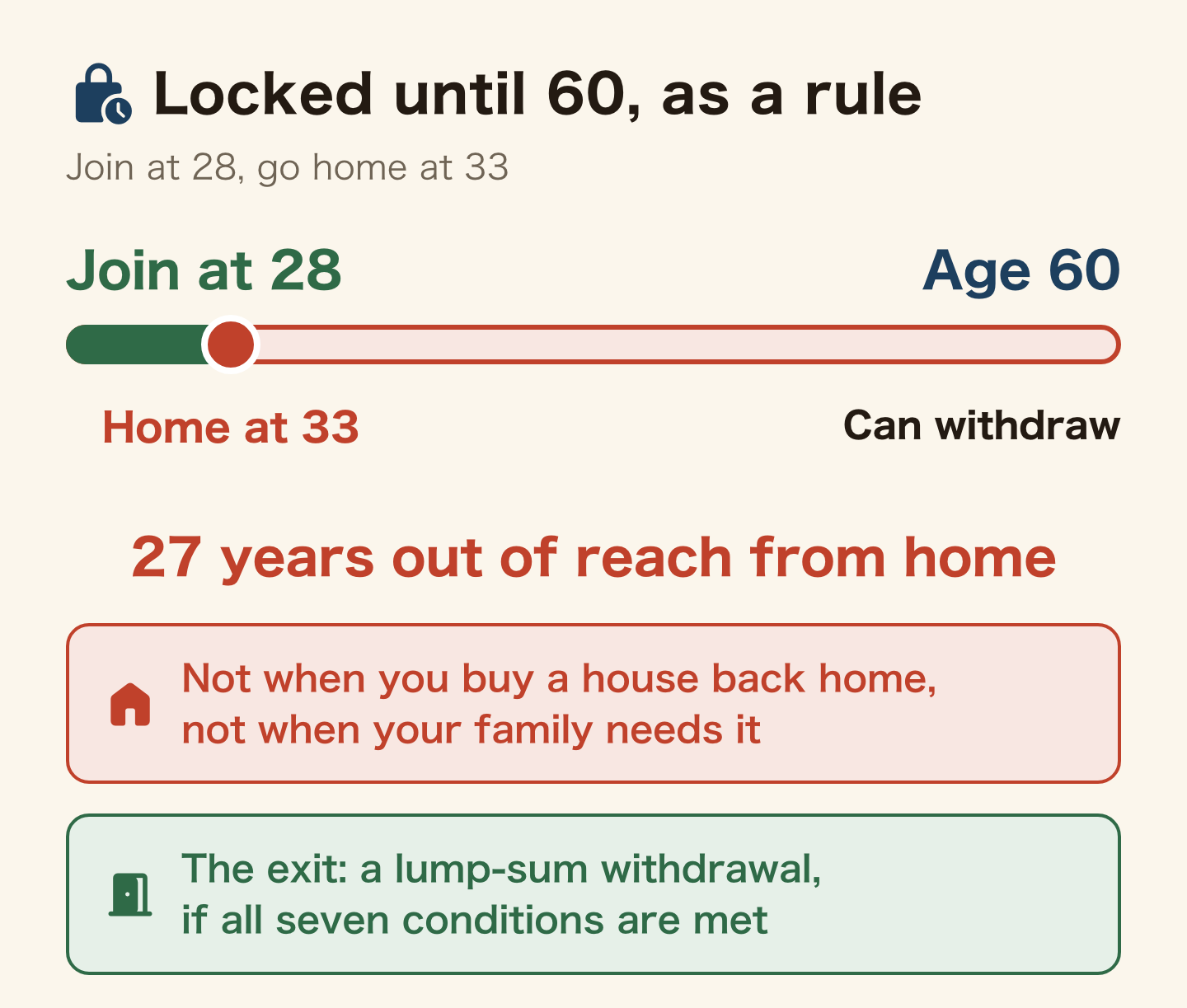
Say you start iDeCo at 28 and move home at 33. That money stays in a Japanese account, untouchable as a rule, until you are 60. Twenty-seven years.
Not when you buy a house back home. Not when something happens to your family. “Locked until retirement” and “locked on the other side of the world for 27 years” are not the same sentence.
What to ask when it is suggested at work
Say: “I may return to my country in future – is that still fine?” The person recommending it may simply not have thought about this. Declining is not rude. The scheme is voluntary.
The exit: seven conditions for the lump-sum withdrawal
Leaving Japan does not freeze the money forever. There is a lump-sum withdrawal payment. But you must satisfy all seven conditions.
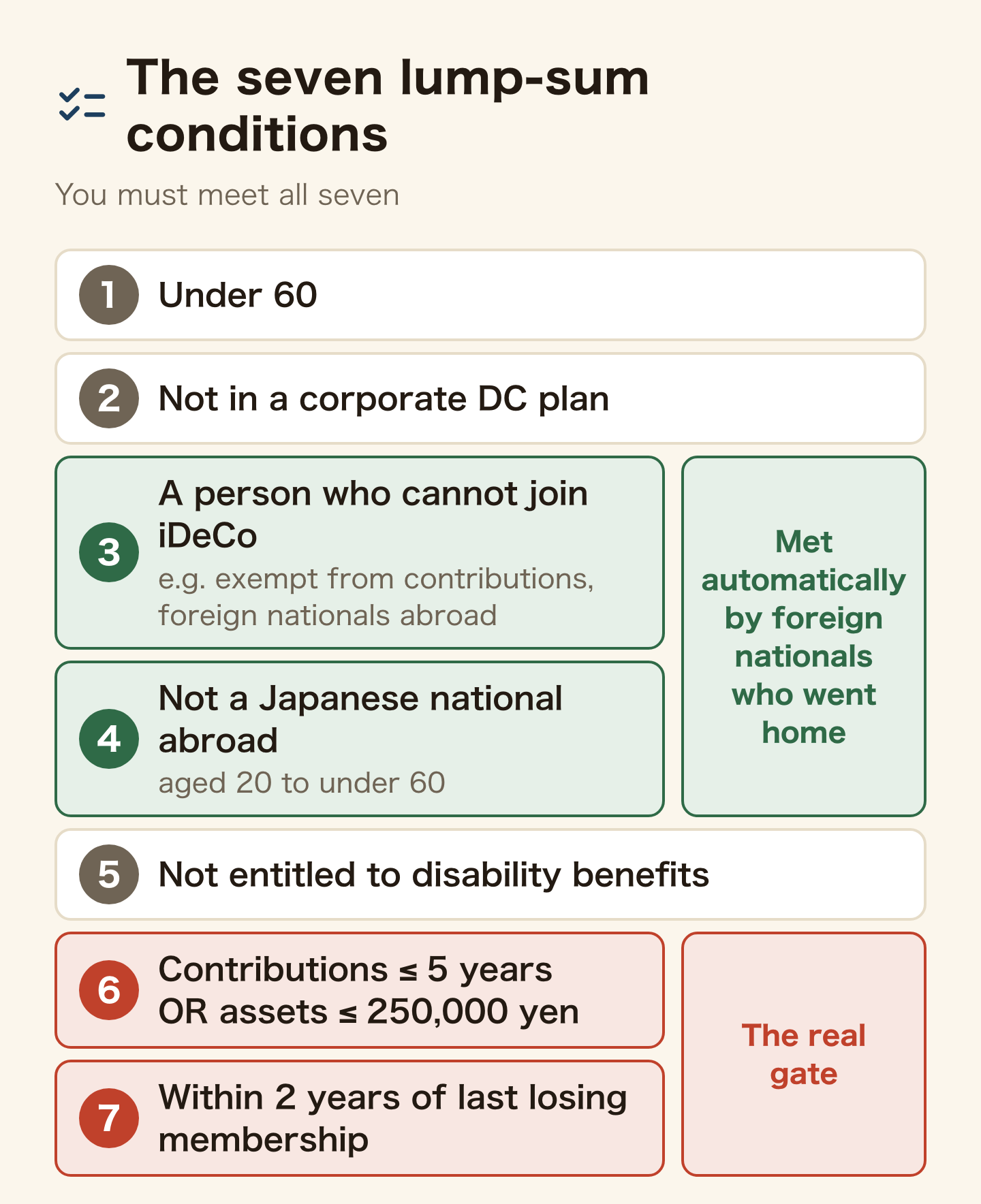
As published by iDeCo (the legal basis is Article 3(1) of the Supplementary Provisions of the Defined Contribution Pension Act):
- Under 60
- Not a member of a corporate defined contribution plan
- Being a person who cannot join iDeCo (such as those exempt from National Pension contributions, or foreign nationals living abroad)
- Not a Japanese national living abroad (aged 20 to under 60)
- Not entitled to disability benefits
- A total contribution period of 5 years or less, OR assets of 250,000 yen or less
- Within 2 years of the date you last lost membership
iDeCo numbers and conditions at a glance
| Item | Details |
|---|---|
| Who can join | Broadly, people aged 20 to under 65 who are insured under the public pension. Nationality is not a condition |
| Contributions | From 5,000 yen a month. You can contribute until age 65 |
| Withdrawal | As a rule, not possible until you turn 60 |
| Lump-sum withdrawal conditions | All seven must be met. A foreign national who has left Japan meets conditions 3 and 4 automatically |
| Amount line | Total contribution period of 5 years or less, or assets of 250,000 yen or less |
| Deadline | Within 2 years of last losing membership |
| Claim from | Submit the lump-sum withdrawal claim form to the record-keeping institution |
Conditions 3 and 4 favour foreign nationals
This is a genuinely unusual piece of design. Here, foreign nationals have the advantage.
Eligibility for iDeCo requires being insured under the public pension, and leaving Japan normally ends that. But the National Pension Act allows voluntary enrolment, and it is written like this:
Persons of Japanese nationality and others specified by Cabinet Order, aged 20 to under 65, who do not have an address in Japan
National Pension Act, Supplementary Provisions Article 5(1)(iii) – who may enrol voluntarily. Translated from the Japanese original
Voluntary enrolment is, as a rule, for Japanese nationals. Which produces this split:
- A Japanese national living abroad: can still enrol voluntarily, so remains “a person who can join” – fails conditions 3 and 4 – cannot claim the lump sum
- A foreign national who has gone home: outside voluntary enrolment, so meets 3 and 4 automatically – can claim the lump sum
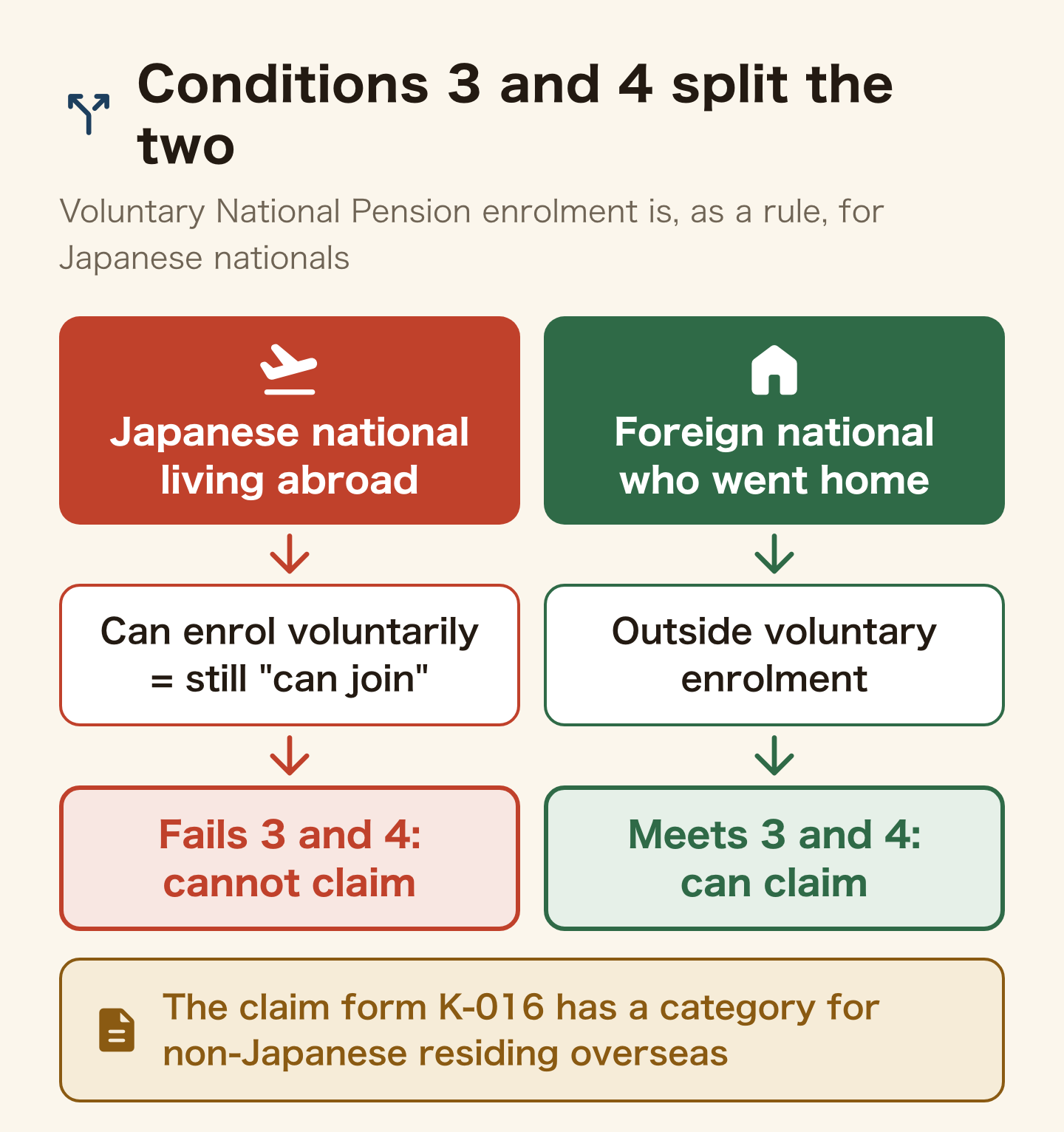
The claim form (K-016) carries a category reading “other (persons without Japanese nationality residing overseas, etc.)” along with fields for an overseas address and country name. The scheme was built expecting foreign residents to use this route.
The real gate is conditions 6 and 7
Meeting 3 and 4 automatically still leaves two hard ones.
The longer you contribute, the more the exit closes
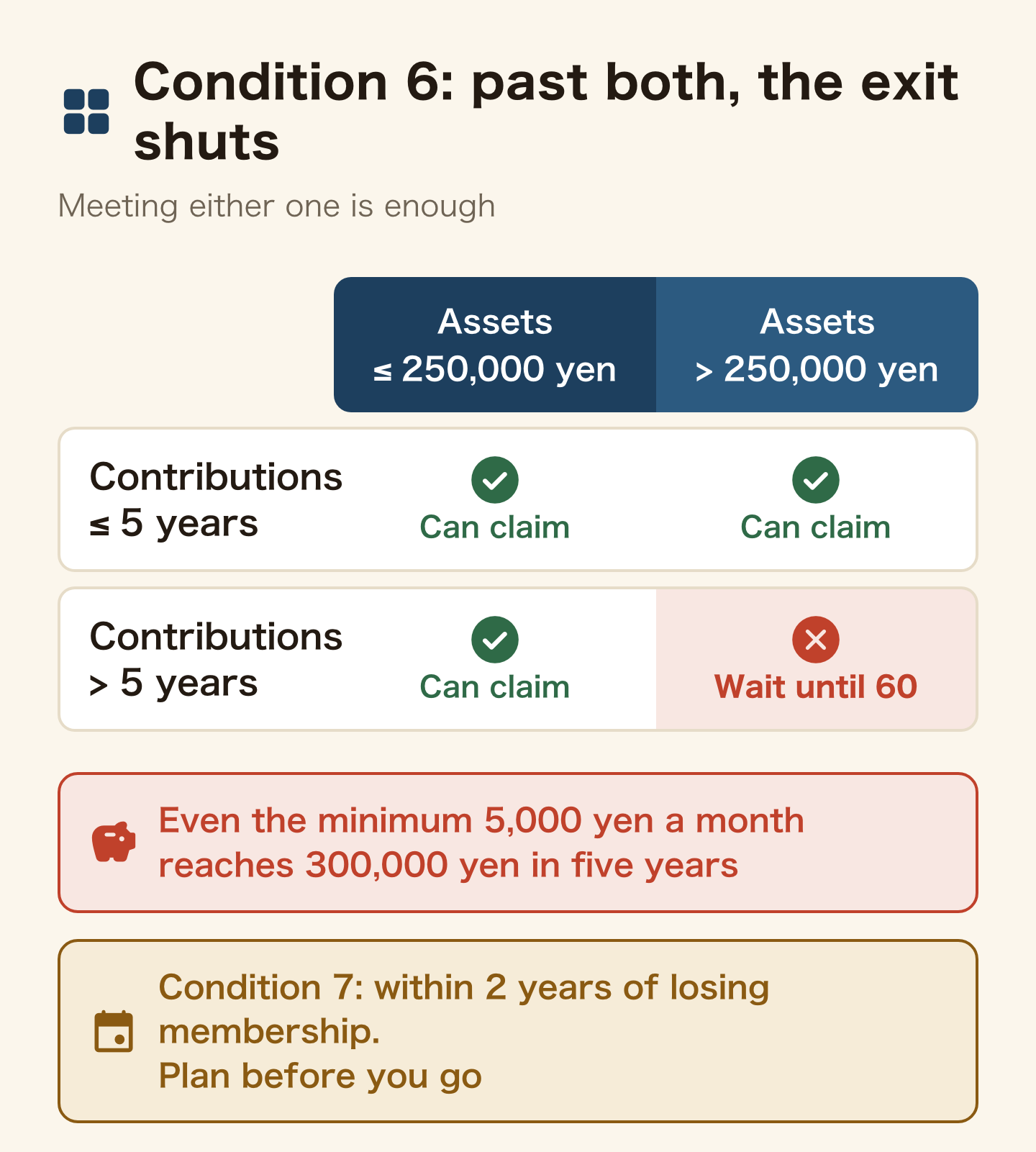
Condition 6: 5 years or less, OR 250,000 yen or less. Either satisfies it – which also means that once you pass five years AND 250,000 yen, this exit shuts and you wait until 60.
Condition 7: within 2 years of losing membership. That is the window after you leave, and it passes while you are rebuilding your life back home. Plan the paperwork before you go.
The minimum contribution is 5,000 yen a month. Even at the minimum, five years reaches 300,000 yen. “It is only a small amount” does not hold.
This is not the same as the pension lump-sum withdrawal
Two different schemes share almost the same name. Keeping them apart matters.
| Public pension lump sum | iDeCo lump sum | |
|---|---|---|
| Covers | National / Employees’ Pension contributions | Assets you built in iDeCo |
| Claim from | Japan Pension Service | Record-keeping institution |
| Deadline | 2 years from departure | 2 years from loss of membership |
| Cap | Capped number of contribution months | 5 years or less, or 250,000 yen or less |
If both apply to you, claim both separately. Doing one does not cover the other. The public pension side is covered in our guide to the lump-sum withdrawal payment.
So how should you decide?
We will not tell you to join or not to join. Here are the materials.
If you know you are going home. Start from whether it makes sense to park money in Japan that you cannot touch until 60. NISA is also a residents-only scheme, but NISA can be sold for cash at any time. That difference is large.
If you intend to stay long term. With permanent residence or naturalisation in view, the age-60 lock weighs the same on you as on anyone else, and the income deduction works the same way.
If you do not know yet. That is most people. “Not starting while it is unclear” is a real decision, not indecision. iDeCo can be started later – after your income rises with a job and life settles down.
What to do today
- If iDeCo has been suggested at work and you might leave Japan, put it on hold. Declining is not rude
- If you are already enrolled, check your contribution period and your asset total. While either stays under 5 years or 250,000 yen, the exit is open
- Once your departure is decided, arrange the claim before you fly. The window is 2 years
Frequently asked questions
Q. Can foreigners join iDeCo in Japan?
Yes. The condition is being aged 20 to under 65 and insured under the public pension. Nationality is not a condition, so working in Japan with Employees’ Pension Insurance qualifies you.
Q. What happens to my iDeCo if I leave Japan?
As a rule you cannot withdraw before 60, but meeting all seven conditions allows a lump-sum withdrawal payment. Two of them – being someone who cannot join iDeCo, and not being a Japanese national abroad – are met automatically by foreign nationals who have gone home.
Q. Why can Japanese citizens not claim the iDeCo lump sum?
Because voluntary enrolment in the National Pension (Supplementary Provisions Article 5(1)(iii)) is written for persons of Japanese nationality. Still being able to enrol means still being “a person who can join,” which fails the conditions.
Q. Is the iDeCo lump sum the same as the pension lump-sum withdrawal?
No. They are separate schemes with different claim routes – the Japan Pension Service for the public pension, the record-keeping institution for iDeCo. If both apply, claim each one.
Q. I have contributed for more than 5 years. Can I still withdraw?
Condition 6 is 5 years or less OR assets of 250,000 yen or less, so meeting either one works. If you are past both, you wait until 60 as a rule.
Q. iDeCo or NISA if I might go home?
As schemes: NISA can be sold and converted to cash at any time, while iDeCo is locked until 60 as a rule. Which suits you depends on your circumstances, and NISA is also limited to people resident in Japan.
Summary
- iDeCo has no nationality condition. The requirement is public pension enrolment
- Locked until 60 as a rule. If you might leave Japan, do not sign up without thinking it through
- The exit is the lump-sum withdrawal. Of the seven conditions, 3 and 4 are met automatically by foreign nationals (Japanese citizens can enrol voluntarily, so they cannot use this)
- The gate is condition 6 (5 years or 250,000 yen) and condition 7 (2 years). Contributing longer closes the exit
- Separate from the public pension lump sum. If both apply, claim both
Official sources: iDeCo official site (National Pension Fund Association), eligibility and contributions / benefits and the lump-sum withdrawal conditions / e-Gov, Defined Contribution Pension Act, Supplementary Provisions Article 3 / National Pension Act, Supplementary Provisions Article 5
Rules and conditions were checked on 8 October 2026. This guide explains the scheme; it is not a recommendation to enrol or a recommendation of any product. For calculations and your own situation, ask your financial institution or record-keeping institution, and the tax office for tax questions.
Found this useful? Share it
Send it to a friend who lives in Japan.
WHO WROTE THIS

mori
Japanese. I read the ministries’ own notices, orders and Q&As in the original, and I start from what my Nepalese and Sri Lankan friends in Japan actually ran into. I do not write about what I have not checked or been told.
What this site can and cannot do →Looking for something else?
You may use the figures in this article, including commercially, if you credit this site with a link. How to use our figures