Checked on 8 October 2026 against the Japan Housing Finance Agency’s Flat 35 conditions, the National Tax Agency’s Tax Answers (registration tax, stamp duty, mortgage tax credit), the Tokyo Metropolitan Bureau of Taxation, the Ministry of Internal Affairs, the Ministry of Justice’s property registration pages, the Cabinet Office’s key-land law pages, the Cabinet Secretariat’s expert panel, the land ministry’s housing market survey, and each bank’s official eligibility page.
The short answer
- Yes, foreigners can own land and homes in Japan in their own name. The Civil Code gives foreigners private rights unless a law or treaty forbids it. The land-purchase “restrictions” in the news are a proposal from 2 October 2026; the law has not changed.
- Your residence status decides which mortgages are open. Flat 35 lends only to Japanese nationals, permanent residents and special permanent residents. MUFG and Mizuho also require permanent residency. Some banks accept you without it, with other conditions such as income.
- Four taxes come on top of the price. Registration tax, acquisition tax and stamp duty are paid once; the fixed asset tax comes every year. The agent’s fee is capped at 1,056,000 yen (tax included) on a home priced at 30 million yen before consumption tax.
- The mortgage tax credit has no nationality condition. But a new home you move into in 2026 gets nothing unless it meets the energy-efficiency standard.
- If you may leave Japan, decide before you fly: keep, sell or let. Keeping means a tax agent and your own address filings; selling has a three-year window. A Flat 35 home can be let only if a transfer or similar keeps you away for a while and you will return.
Knowing this, you can check which mortgage you can apply for, and how much you need on top of the price, before you visit a single property. Whether to keep renting becomes a comparison of four things, not a feeling.
Your child is starting primary school. The flat is a two-bedroom, and the renewal notice has arrived again. A colleague says, “Why pay rent when you could buy?” Then you ask him whether a foreigner can even get a mortgage here, and he has no idea. For a Japanese buyer, a mortgage is about salary and employer. For you, there is a question before that: your residence status.
A mortgage (jutaku loan) is money borrowed from a lender to buy a home, secured on the home and the land, and repaid over many years. Flat 35 is a mortgage offered by private lenders together with the Japan Housing Finance Agency, with an interest rate fixed for the whole term.
- Can foreigners buy property in Japan? Yes, land and buildings alike
- Are there new restrictions in 2026? A proposal, not a law
- Mortgage in Japan for foreigners: can you borrow without permanent residency?
- How much does buying a house in Japan cost? Four taxes and fees on top of the price
- Can foreigners get the mortgage tax credit? The 2026 amounts
- Documents for buying a home: juminhyo, seal certificate, Roman-letter name
- Deadlines, notices and penalties: two years, the key-land notice, 30 days
- Buying or renting: four things to compare, in this order
- Leaving Japan: keep, sell or let the house?
- What if you cannot pay the mortgage? Ask about changing the repayment first
- Which one are you?
- FAQ
- Summary
- Related reading
Can foreigners buy property in Japan? Yes, land and buildings alike
Yes. Article 3(2) of the Civil Code says foreigners enjoy private rights except where a law or treaty prohibits it. Owning land or a building is one of those private rights.
The registration system expects foreign owners. Since 1 April 2024, the Ministry of Justice asks foreign buyers to write their name in Roman letters on the application, and that name is recorded next to the owner’s name in the register.
No residence status makes buying itself impossible. What your status changes is how you can borrow, which the mortgage section covers.
Are there new restrictions in 2026? A proposal, not a law
If you saw headlines about “restricting land purchases by foreigners”, here is what is in force and what is only a plan, as of 8 October 2026.
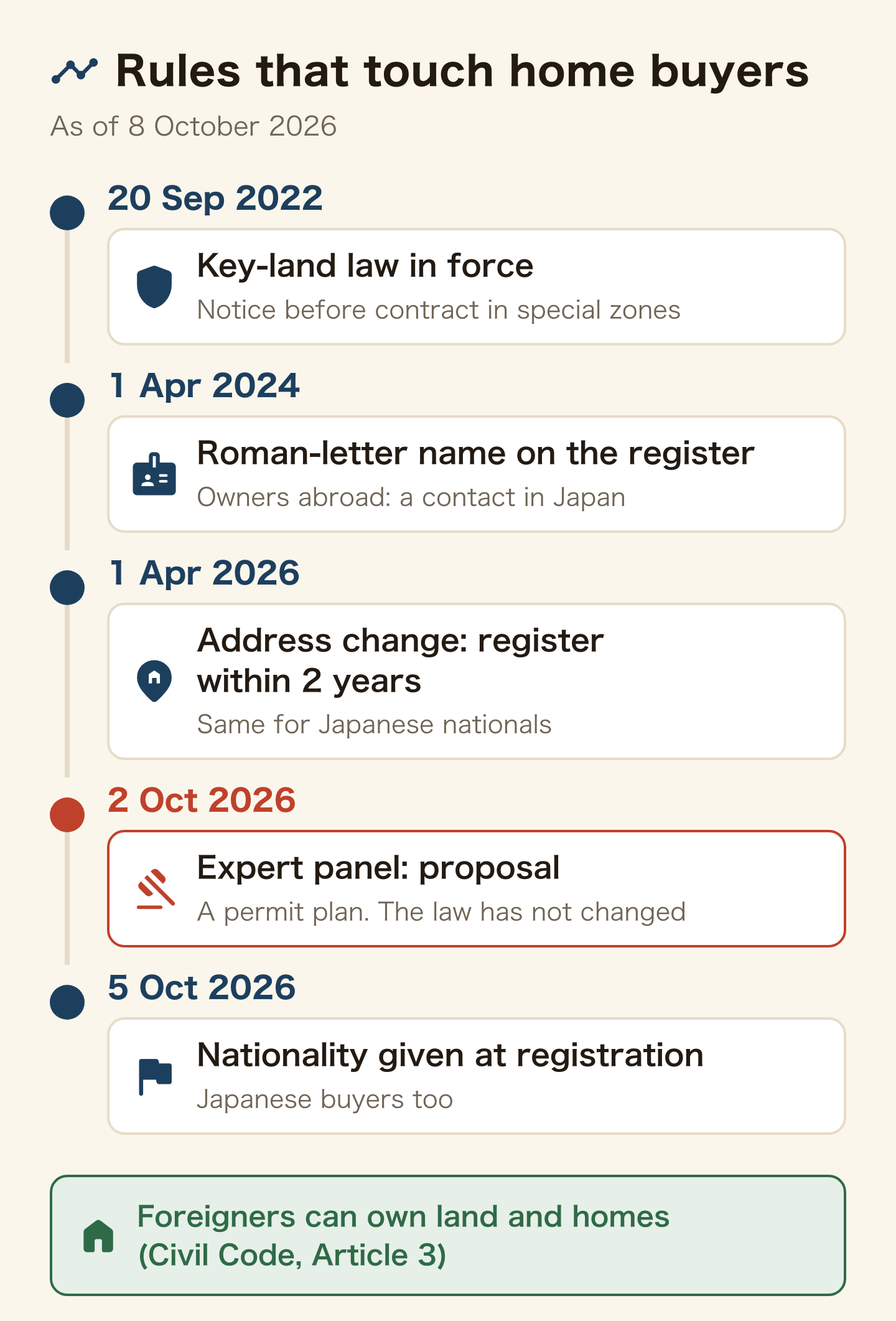
- Already in force: buying or selling land or a building of 200 m² or more in a “special monitoring zone” around key facilities needs a notice before the contract (fully in force since 20 September 2022). Both seller and buyer file it, whatever their nationality.
- Since 5 October 2026: when you register a home, the new owner states their nationality. The Ministry of Justice says this applies to Japanese nationals too. A residence record (juminhyo) that shows your nationality is enough proof.
- Only a proposal: on 2 October 2026, an expert panel at the Cabinet Secretariat proposed a permit system for buying land within roughly 1,000 m of facilities vulnerable to drone attack and on uninhabited border islands. It would cover Japanese people and companies too, not only foreigners.
A proposal is advice to the government. No bill has been submitted, so there is no start date. Whether today’s notice rule applies to a home you are looking at, you can check yourself on the key-land web map linked from the Cabinet Office’s notice page.
Mortgage in Japan for foreigners: can you borrow without permanent residency?
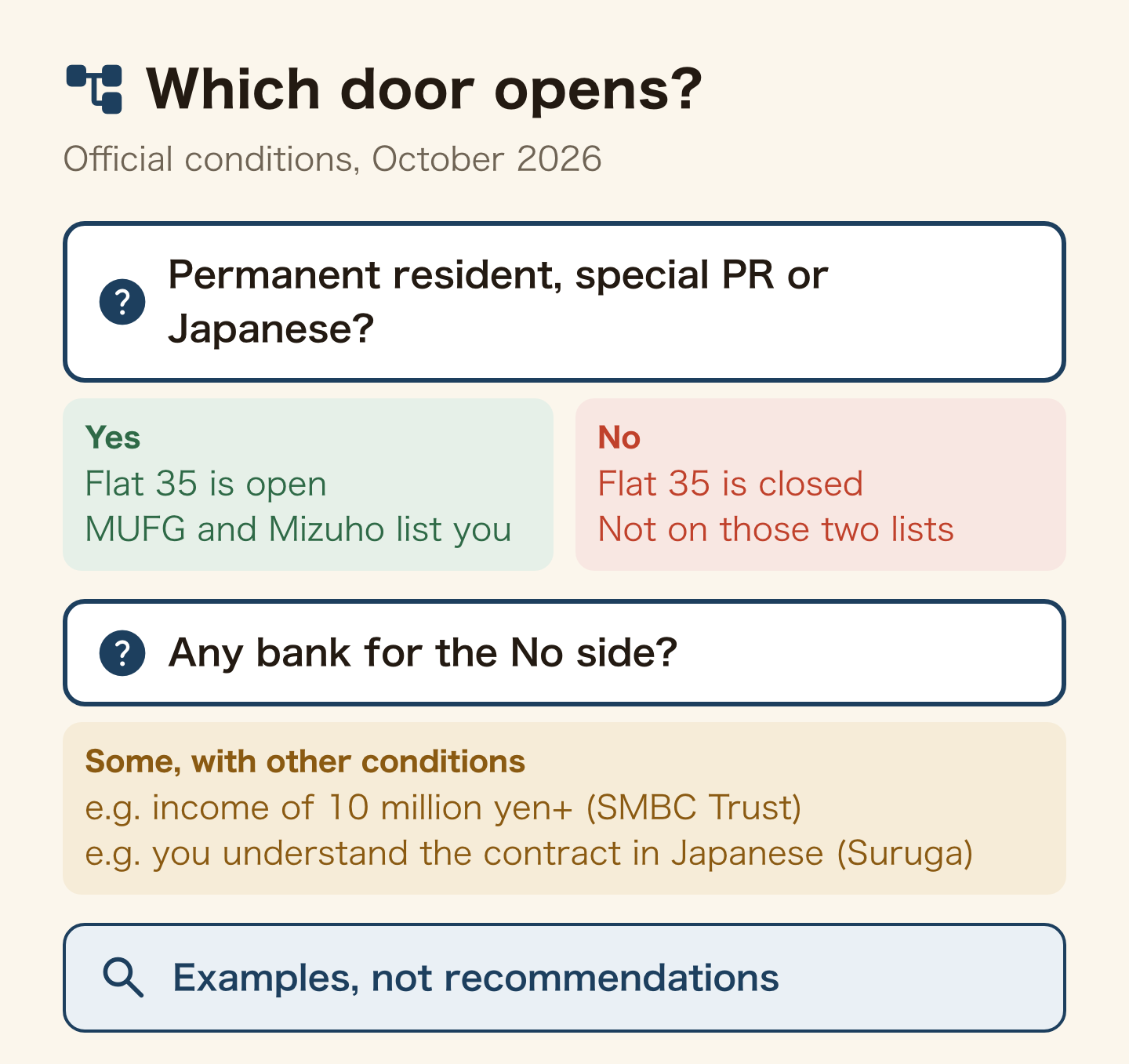
Start with Flat 35. Its official conditions (as of 1 April 2026) limit applicants to Japanese nationals, permanent residents and special permanent residents. If it later turns out you did not hold permanent resident status, you must repay the whole loan at once.
Private banks set their own rules. These are the ones confirmed on each bank’s official page:
- MUFG Bank: “Japanese nationals, or foreign nationals with permission for permanent residence” (product summary, as of 1 October 2026)
- Mizuho Bank: “in principle, Japanese nationals or foreign nationals with permanent residence permission or similar” (official FAQ)
- SMBC Trust Bank (PRESTIA): accepts applications without permanent residency if you hold any status other than Temporary Visitor, but asks for last year’s income of 10 million yen or more, among other conditions (official FAQ)
- Suruga Bank: will discuss a loan without permanent residency, but only if you can understand the product and contract explanation in Japanese (mortgage page for foreign customers)
These are examples of conditions, not recommendations. Some banks review their rates every month, so rates are not compared here. What the list does show: without permanent residency, your first job is finding a bank that will take your application at all. The requirements for permanent residency, and what changes in April 2027, are in the permanent residency guide.
Whichever loan you use, income caps how much you can borrow. Under Flat 35, your yearly repayments on all loans must stay at or below 30% of income (under 4 million yen a year) or 35% (4 million yen or more). Car loans and card instalments count. The term runs to whichever is shorter: 80 minus your age at application, or 35 years.
How much does buying a house in Japan cost? Four taxes and fees on top of the price
The land ministry’s FY2025 housing market survey found that households in the three big metropolitan areas who bought a used condominium between April 2024 and March 2025 spent a median of 27.5 million yen. Their own money (not borrowed) made up 40.0% of the purchase funds. Buyers of new condominiums in the same areas spent a median of 55 million yen, with 39.9% of their own money.
Taxes and fees come on top of that.
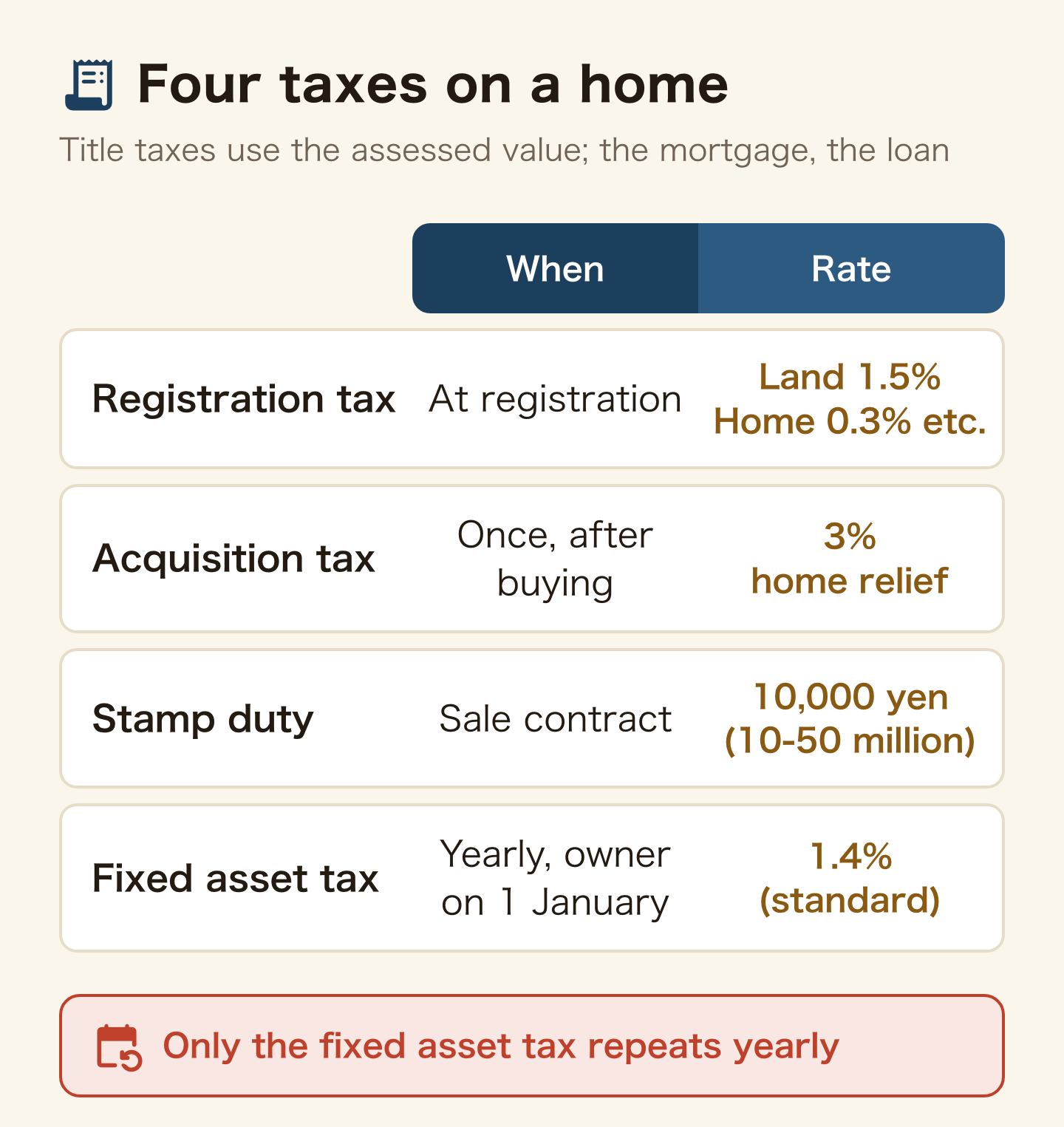
- Registration tax (at registration): 2% for buying land, reduced to 1.5% until 31 March 2029. For a home you live in, the building is 0.3% on a purchase, 0.15% on first registration of a new build, and 0.1% on the mortgage registration. The building reductions run until 31 March 2027 and need at least 50 m² of floor space and registration within a year of buying, among other conditions (National Tax Agency No.7191). The city’s certificate must go in with the registration; filing it later does not get you the lower rate.
- Acquisition tax (once, after buying): 3% for land and homes until 31 March 2027, and residential land is taxed on half its value. Homes and their land have relief schemes. In Tokyo you notify the metropolitan tax office within 30 days of buying, unless you applied for registration within those 30 days (Tokyo Bureau of Taxation).
- Stamp duty (sale contract): 10,000 yen for a contract over 10 million and up to 50 million yen, 30,000 yen over 50 million and up to 100 million (reduced rates until 31 March 2027, No.7108).
- Fixed asset tax (every year): charged to the owner on 1 January at a standard 1.4%. For the land under your home, the value of up to 200 m² is cut to one sixth (Ministry of Internal Affairs).
Registration tax on the title and acquisition tax use, in principle, the value in the city’s fixed asset register, not the price you pay. For a new build not yet in the register, the registrar’s assessed amount or a value set by the assessment standards is used. Registration tax on the mortgage is charged on the amount borrowed (Legal Affairs Bureau mortgage example). So you cannot work these out from the advertised price. Ask the agent for the “fixed asset assessed value” (kotei shisan hyoka-gaku) and have them calculate it.
The agent’s fee is capped by law: 5.5% of the first 2 million yen of the price before consumption tax, 4.4% of the part from 2 to 4 million, and 3.3% of the rest, tax included (ministry notice, full text on the Osaka Prefecture site). On a home priced at 30 million yen before consumption tax, that is 110,000 + 88,000 + 858,000 yen: a cap of 1,056,000 yen.
The loan has costs too. With Flat 35, you pay for registering the mortgage (registration tax, the judicial scrivener’s fee and so on). Fire insurance is required until the loan is repaid, for at least the amount borrowed. Look at what your renters insurance covers today, so you can see what an owner’s policy adds.
Can foreigners get the mortgage tax credit? The 2026 amounts
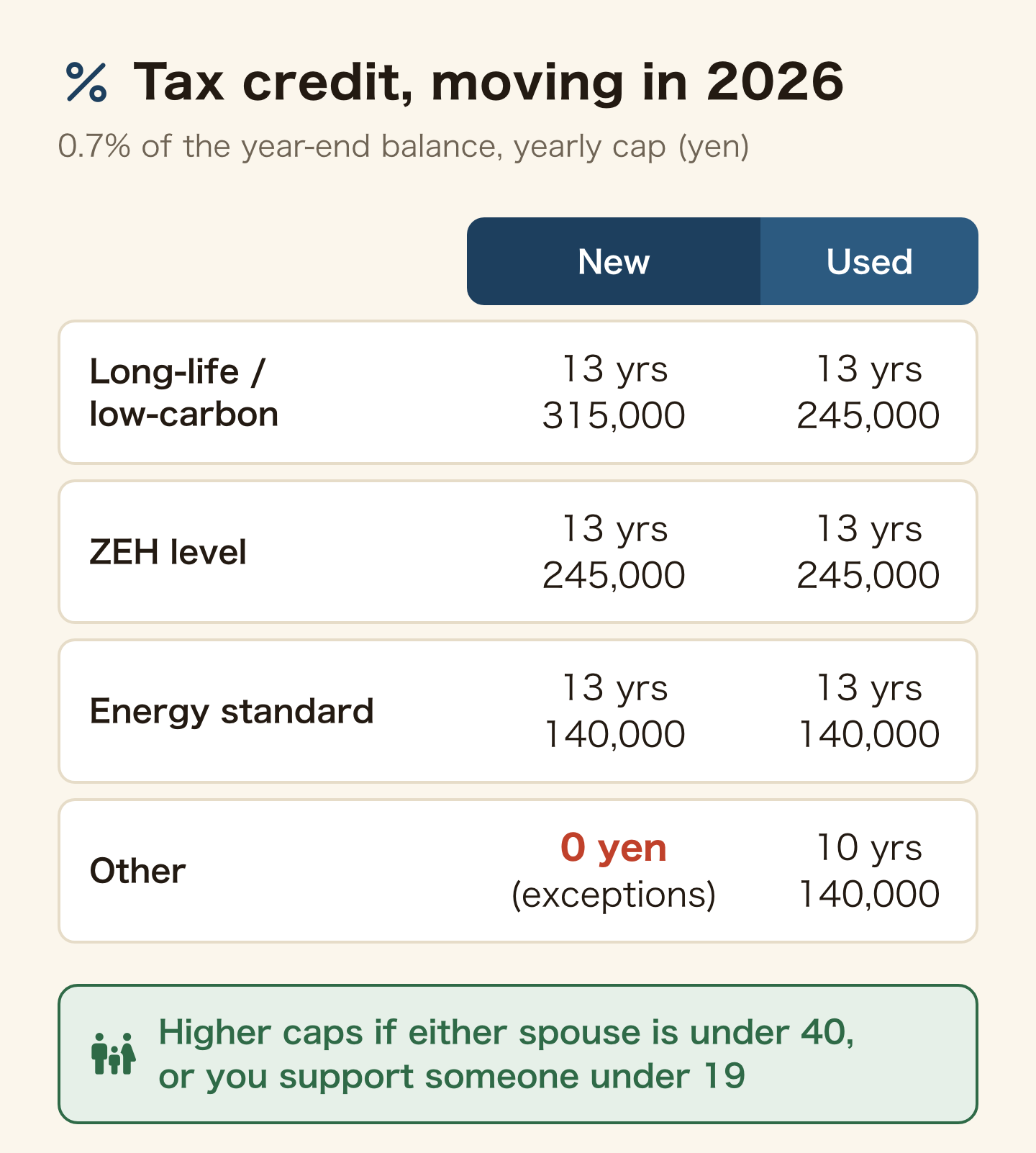
Yes. The conditions in National Tax Agency No.1211-1 say nothing about nationality or residence status. The credit (jutaku loan kojo) takes 0.7% of your year-end loan balance off that year’s income tax. For a move-in in 2026, the yearly cap is 315,000, 245,000 or 140,000 yen depending on the type of home.
The main conditions:
- You move in within six months of buying and still live there on 31 December
- Floor space is at least 50 m², and at least half is your own home
- Your total income that year is 20 million yen or less
- The loan is repaid in instalments over at least 10 years (loans from relatives or friends do not count)
- A used home was built on or after 1 January 1982, or meets other conditions (No.1211-3)
The trap is new builds. A new home you move into in 2026 that does not meet the energy-efficiency standard gets no credit at all (homes with building confirmation by the end of 2023 are among the exceptions). If you buy new, ask the seller before signing whether the home will come with an energy-standard certificate.
Families get more. If you are under 40 with a spouse, 40 or over with a spouse under 40, or you support a dependant under 19, a higher cap applies in some categories. If all those family members live outside Japan, you also submit proof of the relationship and of money sent to them.
The first year needs a tax return. Employees can claim from the second year through year-end adjustment at work. The steps are in the tax return guide.
Documents for buying a home: juminhyo, seal certificate, Roman-letter name
You sign contracts with a signature. Where you come from, that may be normal. In Japan, registering a home and taking a mortgage can call for a seal registered at your city office (jitsuin) and its certificate.
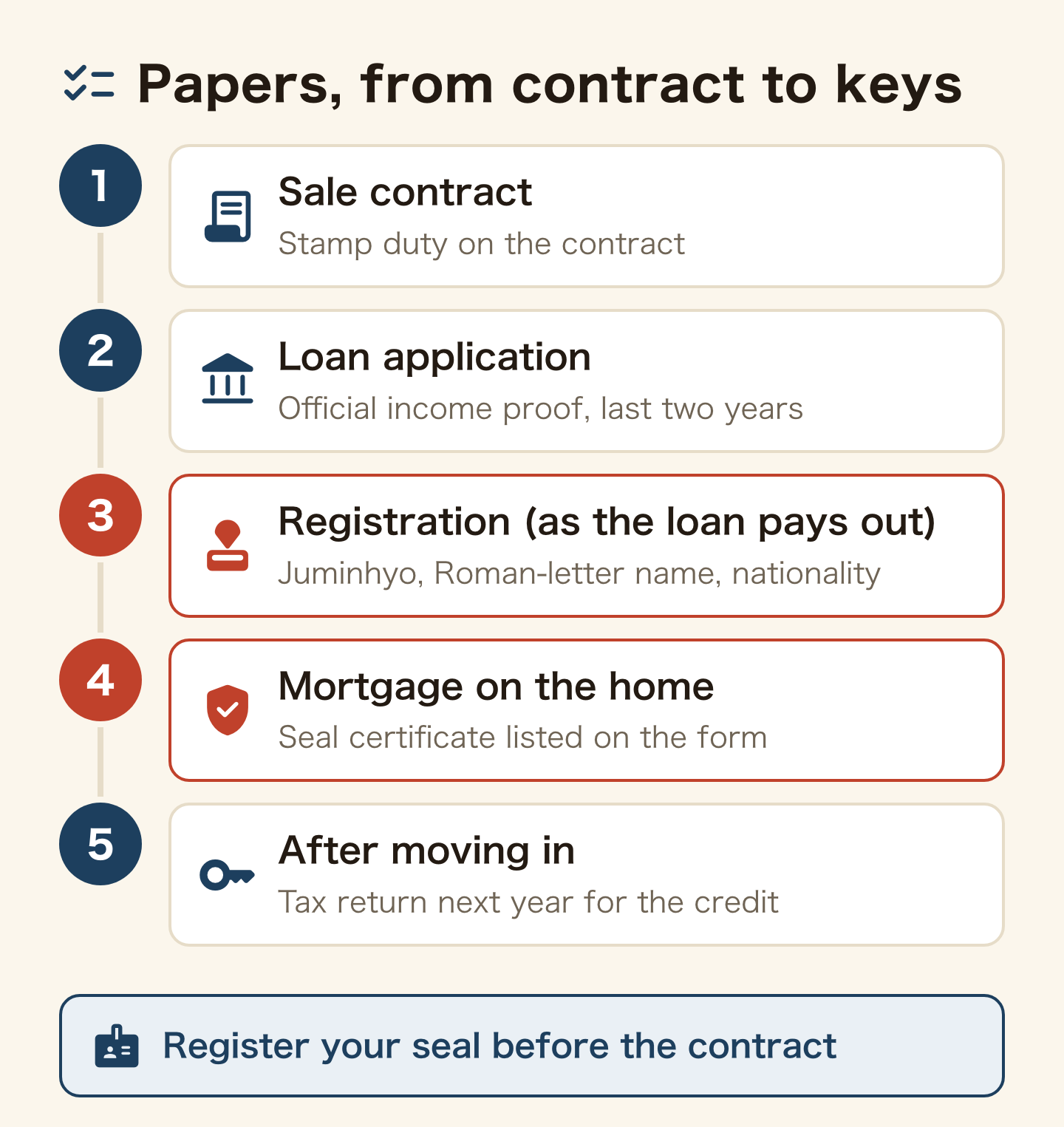
- Copy of your residence record (juminhyo): proves the buyer’s address and name for the register (Legal Affairs Bureau). Get one without your My Number on it (Legal Affairs Bureau sale example). If it shows your Roman-letter name and nationality, the same sheet proves those too. Check what your juminhyo shows and how to get it first.
- Seal certificate (inkan shomeisho): in the sale registration, the seller provides it and the buyer can use an ordinary seal. But the application form for registering a mortgage lists a seal certificate among its attachments (Legal Affairs Bureau forms), and the one putting the home up as security is you, the new owner. Certificates must be under three months old.
- Income proof: a Flat 35 application needs official income certificates for the last two years (such as the residence tax certificate), a copy of the sale contract and the property register extracts (procedure for used homes). A juminhyo may also be asked for. The result comes in about one to two weeks.
Registering a seal after the deal is agreed is a rush. Whether you can register one in katakana or Roman letters, and how, is in the hanko guide.
Deadlines, notices and penalties: two years, the key-land notice, 30 days
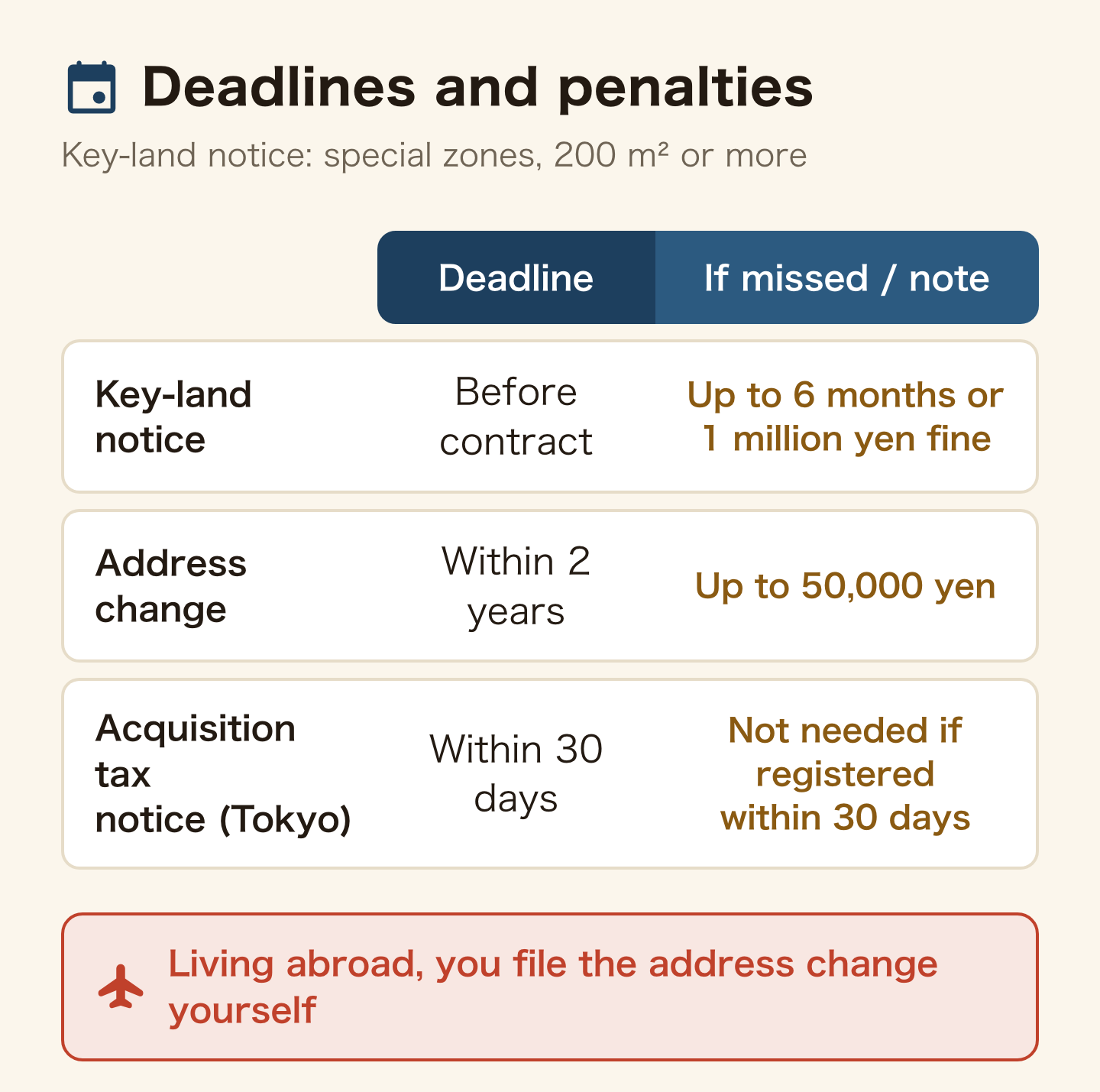
If you move after buying, the register needs your new address. Since 1 April 2026, owners must register a change of address or name within two years of the change. Changes made before April 2026 that are still unregistered must be registered by 31 March 2028. Failing to do so without good reason can lead to a non-penal fine of up to 50,000 yen (Ministry of Justice). If you gave your date of birth and other search details at registration, the Legal Affairs Bureau can update your address for you (“smart change registration”). People living abroad are not covered.
Signing without the key-land notice, or filing a false one, can lead to up to six months’ imprisonment or a fine of up to 1 million yen (Cabinet Office). If you could not file before the contract for some reason, the Cabinet Office asks you to call its call centre (0570-001-125).
Buying or renting: four things to compare, in this order
This page will not tell you whether to buy. The answer depends on your visa outlook, your family and your savings. Here are the things to compare, and the order to check them.
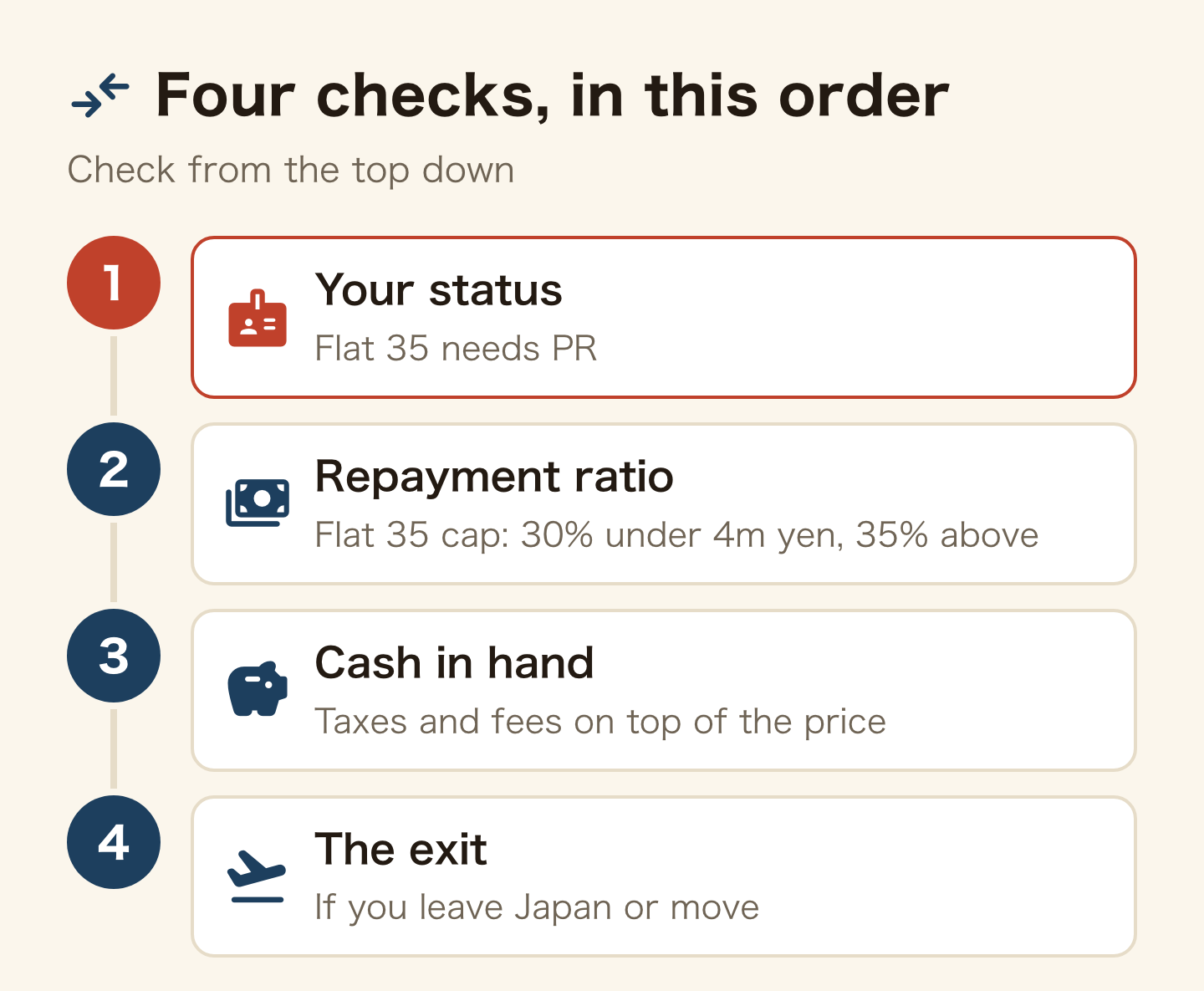
- Your status: do you have permanent residency? Without it, fewer mortgages are open to you.
- Repayment ratio: the question is not whether you can pay the same as your rent. It is whether all your repayments, car loan included, stay within 30-35% of your income.
- Cash in hand: taxes, the agent’s fee, loan costs and the move all come on top of the price. After you buy, the fixed asset tax arrives every year.
- The exit: what happens if you leave Japan or are transferred. As the next section shows, the options depend on the loan you chose.
Renting has numbers of its own. Public housing and UR rentals depend on your status and income. If you can get into a cheaper home, renting and saving is another path. Put who can apply for public and UR housing next to the purchase figures.
Retirement money is still needed while you repay a home. A home is somewhere to live; a bigger monthly repayment leaves less to put aside. Put what savings alone lose over time and how ten years of employees’ pension becomes a lifetime pension in the same comparison.
Leaving Japan: keep, sell or let the house?
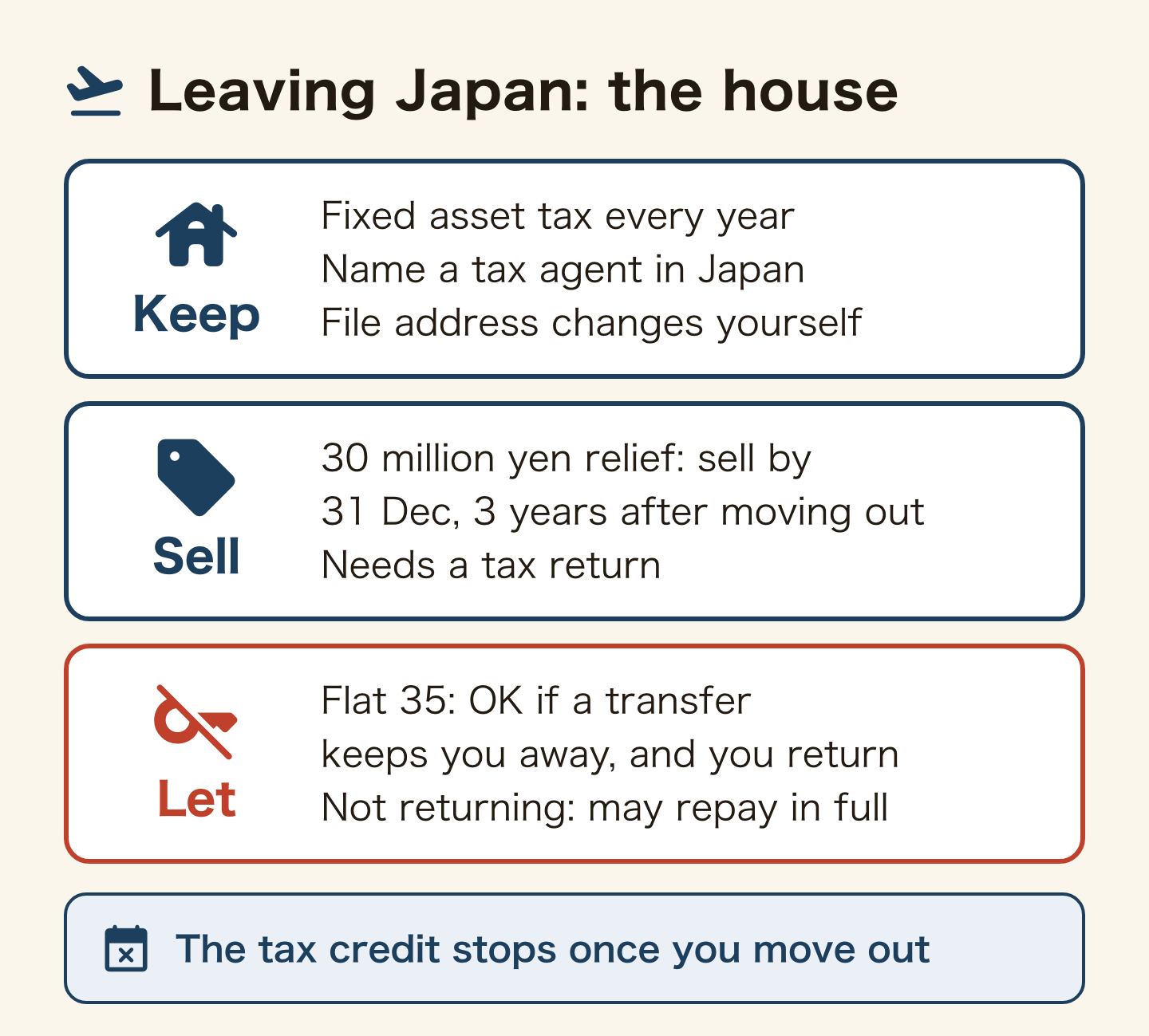
If you keep it, the fixed asset tax bill keeps coming every year. Tokyo asks people moving abroad to file a tax agent notice (nozei kanrinin) with the metropolitan tax office, so the bill goes to an agent in Japan (Tokyo Bureau of Taxation). Living abroad, you are outside smart change registration, so you file address changes yourself, and an overseas address on the register also needs a contact in Japan. Who can be your tax agent and how to register one is covered separately.
If you sell, a home you lived in qualifies for a deduction of up to 30 million yen from the gain. It applies if you sell by 31 December of the year in which three years have passed since you moved out, and you must file a tax return (National Tax Agency No.3302).
If you let it and the loan is Flat 35, there are conditions. According to the Japan Housing Finance Agency’s FAQ, if a transfer or other unavoidable reason keeps you away for a while and you will move back, you can let the home, after updating your address with your lender. If it turns out you are using it as an investment, letting it to others with no plan to return, you may be asked to repay the whole loan at once. The mortgage tax credit also stops from the year you no longer live there. Whichever you choose, your residence, insurance and pension procedures still need closing. Add one line about the house to your leaving-Japan checklist.
What if you cannot pay the mortgage? Ask about changing the repayment first
If illness or job loss cuts your income, talk to your lender before you miss a payment. Flat 35 has repayment change options: a longer term, smaller payments for a while, or reduced bonus-month payments. There is a review, and you may not get what you ask for. Some changes increase the total you repay.
If other debts make it impossible to continue, the Japan Housing Finance Agency points to personal civil rehabilitation, a court process to reorganise debts, and suggests consulting a lawyer. If it is the fixed asset tax you cannot pay, the tax office side has instalment options too; see what happens with unpaid taxes and what you can do before seizure.
Which one are you?
- Permanent or special permanent resident, looking for a family home: Flat 35 and banks that require PR are open to you. Today, get last year’s residence tax certificate and write down 35% of your income (30% if under 4 million yen) next to your current yearly loan repayments.
- No permanent residency yet, planning to apply: Flat 35 is closed, and the banks that accept you add conditions. Today, write down one PR requirement you do not meet yet, and read one bank’s official conditions for applicants without PR.
- You may leave Japan in a few years: if you buy, decide the exit first. Today, write down with your family how many more years you expect to stay, and check the three-year window for selling and, for letting, whether Flat 35’s “away for a while, then returning” condition fits you.
- You have almost chosen a home: today, look up its address on the key-land web map and register your seal at the city office. If it is a new build, ask the seller whether it will have an energy-standard certificate.
FAQ
Q. Can foreigners buy property in Japan?
Yes. Article 3(2) of the Civil Code gives foreigners private rights unless a law or treaty forbids it. No residence status makes buying impossible. The land restrictions discussed on 2 October 2026 are only a proposal; the law has not changed.
Q. Can I get a mortgage in Japan without permanent residency?
Not Flat 35. MUFG and Mizuho also require permanent residency. Some banks accept applicants without it, but with other conditions, such as last year’s income of 10 million yen or more (SMBC Trust Bank) or understanding the contract in Japanese (Suruga Bank).
Q. Can foreigners use Flat 35?
Permanent residents and special permanent residents can. You meet the same conditions as Japanese nationals, plus your status must be Permanent Resident or Special Permanent Resident. If it later turns out you were not, you must repay the loan in full.
Q. Can foreigners get the mortgage tax credit?
Yes. The National Tax Agency’s conditions do not mention nationality. You must move in within six months, live there at year end, have at least 50 m² of floor space and total income of 20 million yen or less, among other conditions. A new home you move into in 2026 that misses the energy standard gets no credit.
Q. Do I need a seal certificate to buy a house?
In the sale registration, the seller provides the seal certificate. But the application form for registering a mortgage on the home lists a seal certificate among its attachments. If you are taking a mortgage, register your seal before the contract.
Q. When will restrictions on foreign property purchases start?
Nothing has been decided. On 2 October 2026, a Cabinet Secretariat panel proposed requiring a permit to buy land within roughly 1,000 m of key facilities and in some other areas, for Japanese buyers too. No bill has been submitted, so there is no start date.
Summary
Foreigners can buy homes in Japan. The real fork is not whether you can buy but how you can borrow. Flat 35 and some big banks require permanent residency; without it, you start by finding a bank that will take your application, on its conditions.
On top of the price come four taxes, the agent’s fee and loan costs. A new home you move into in 2026 gets no mortgage tax credit unless it meets the energy standard. If you might leave Japan, decide whether you would keep, sell or let the house before you choose one.
Official sources: Civil Code (e-Gov) / Cabinet Secretariat, expert panel on land acquisition rules / Cabinet Office, key-land law notices / Japan Housing Finance Agency, Flat 35 conditions, FAQ for foreign nationals and repayment difficulties / MUFG Bank product summary / Mizuho Bank FAQ / SMBC Trust Bank FAQ / Suruga Bank / National Tax Agency No.7191, No.7108, No.1211-1, No.1211-3, No.3302 / Tokyo Bureau of Taxation, acquisition tax and moving / Ministry of Internal Affairs, fixed asset tax / agent fee notice (Osaka Prefecture) / MLIT, FY2025 housing market survey / Ministry of Justice, registrations from April 2024, search information, mandatory address change registration, smart change registration / Legal Affairs Bureau forms. Checked on 8 October 2026. Mortgage conditions differ by bank and change over time; check the bank’s latest product summary before you apply.
Related reading
Found this useful? Share it
Send it to a friend who lives in Japan.
WHO WROTE THIS

mori
Japanese. I read the ministries’ own notices, orders and Q&As in the original, and I start from what my Nepalese and Sri Lankan friends in Japan actually ran into. I do not write about what I have not checked or been told.
What this site can and cannot do →Looking for something else?
You may use the figures in this article, including commercially, if you credit this site with a link. How to use our figures