Checked on 30 September 2026 against TEPCO Energy Partner’s rate tables, fuel cost adjustment notice and 1 November price revision, METI’s renewable surcharge announcement, the Agency for Natural Resources and Energy’s energy-saving portal and bill-support pages, and kerosene heater warnings from the Tokyo Fire Department and the Consumer Affairs Agency.
The short answer
- Winter bills jump because heating raises how much you use, and on many plans each kWh gets dearer as you use more. On TEPCO’s Meter-Rate Lighting B, the first 120 kWh cost 29.85 yen each and anything over 300 kWh costs 40.54 yen (from November 2026).
- Your bill is basic charge + energy charge + renewable surcharge. The fuel cost adjustment is added to or taken off the energy charge every month.
- The government’s guideline is a room temperature of 20°C when heating in winter. Turning an air-con down from 21°C to 20°C saves about 1,650 yen a year under the conditions the agency sets out.
- Always turn a kerosene heater off before refuelling. Even a little petrol can start a fire, and you need to open a window regularly while it runs.
- The government’s bill discount covered electricity used up to September 2026. Nothing had been announced for October onwards as of 30 September.
Knowing this, you can read where every number on your bill comes from and decide before winter what to cut. If you use a kerosene heater, you also learn the one routine that prevents fires and carbon monoxide poisoning.
It is December. Your flat has one air conditioner, the hallway and bathroom are freezing, and getting out of the futon is a battle. You leave the air-con on, and the next bill is far bigger than autumn’s. You ask a Japanese friend why. “Winter is just like that,” they say. They have never looked at what each line on the bill means either.
- Why is my electricity bill in Japan so high in winter?
- How is the electricity bill calculated in Japan?
- What temperature should I set my air-con heating to?
- How do Japanese people stay warm without a big bill?
- Is a kerosene heater safe indoors?
- Can a kerosene heater cause carbon monoxide poisoning?
- Are there Japan energy subsidies in 2026 for winter?
- What if I cannot pay my electricity bill in winter?
- Which one are you?
- FAQ
- Summary
- Related reading
Why is my electricity bill in Japan so high in winter?
Two things stack up. First, heating makes you use more. The Agency for Natural Resources and Energy, using the government’s Household Survey, puts average use in homes of two or more people at 529 kWh in January, 527 kWh in February and 452 kWh in March (averages for January 2022 to July 2025).
Second, the price per kWh climbs in steps. On TEPCO’s Meter-Rate Lighting B (Juryo Dento B), from 1 November 2026 the first 120 kWh cost 29.85 yen each, 120 to 300 kWh cost 36.45 yen, and everything over 300 kWh costs 40.54 yen (tax included, before the fuel cost adjustment).
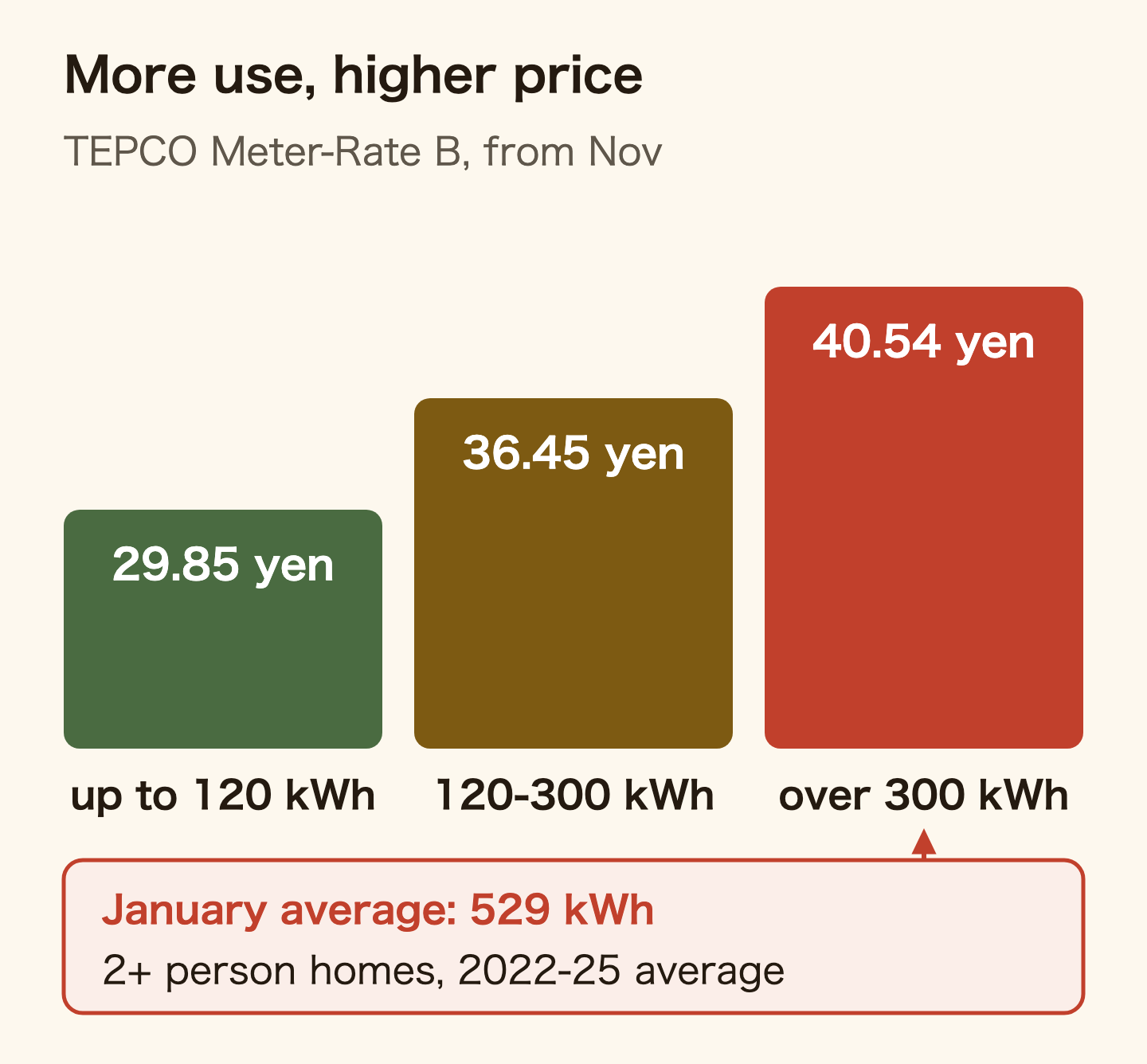
A home using 529 kWh in January pays the top price on the 229 kWh above 300. That is why the winter bill leaps rather than creeps.
How is the electricity bill calculated in Japan?
You open the bill expecting one price per kWh. Where you come from, that may be normal. In Japan, plans like TEPCO’s Meter-Rate Lighting B charge different prices depending on how much you use, so first find the plan name printed on your bill.
TEPCO’s calculation formula for Meter-Rate Lighting B adds up three parts:
- Basic charge: a fixed monthly amount set by your contract amperage. From November, 1,176.18 yen for 30A and 784.12 yen for 20A
- Energy charge: the kWh you used times the three step prices, plus or minus the fuel cost adjustment
- Renewable energy surcharge: the kWh you used times 4.18 yen
The fuel cost adjustment passes changes in oil, LNG and coal prices through to your bill. TEPCO sets each month’s rate from three months of import prices and applies it two months later. It can be negative. For November 2026 in the Kanto area it is minus 5.33 yen per kWh, taken off according to how much you use.
The renewable energy surcharge is what every electricity user pays toward buying power from renewable sources. METI set it at 4.18 yen per kWh for fiscal 2026, applied to bills from the May 2026 meter reading to the April 2027 reading.
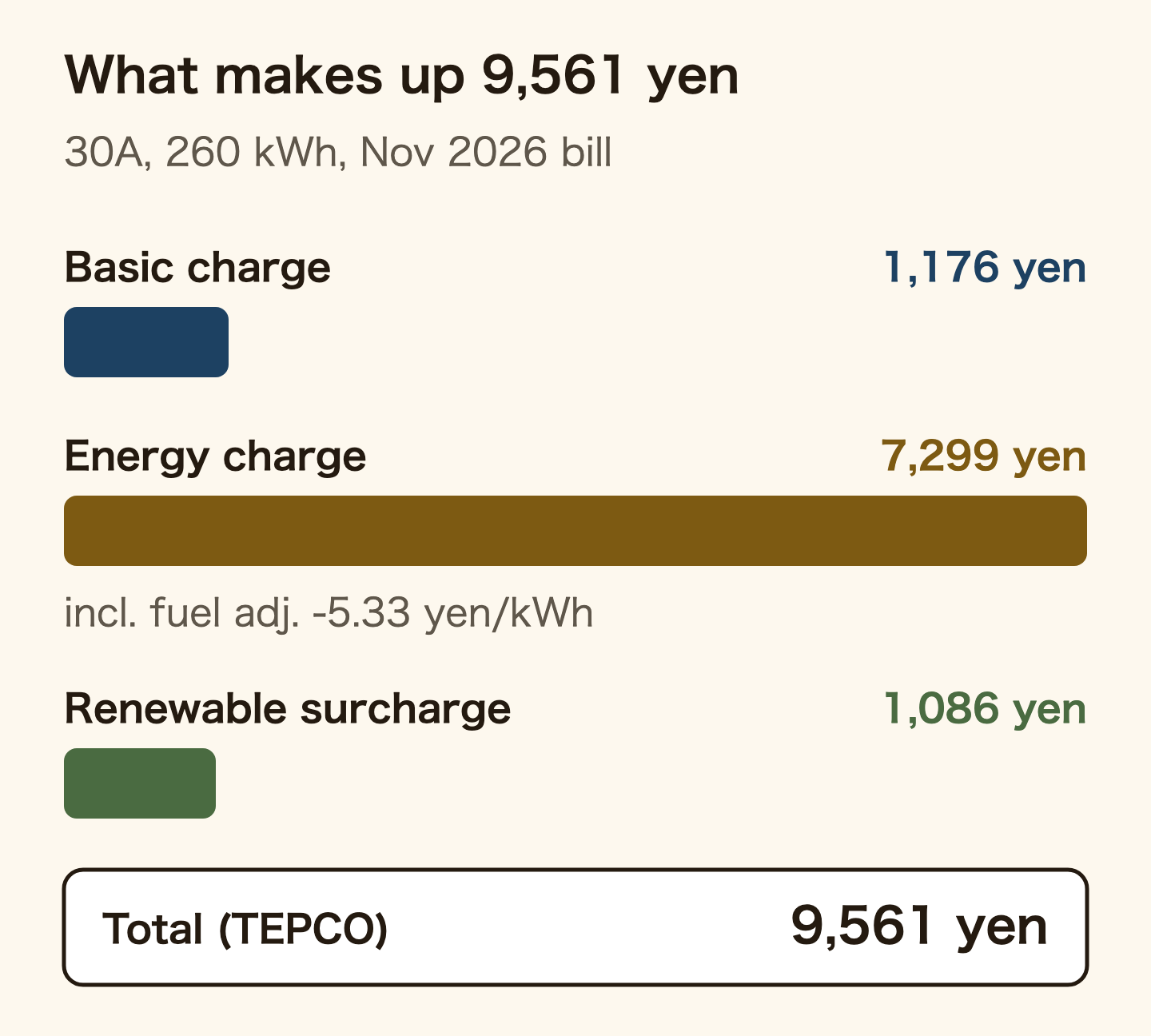
TEPCO’s average model (30A, 260 kWh a month) comes to 9,561 yen for November 2026. October’s bill, with the government discount, was 8,275 yen. The end of the discount and the price revision land together, so the same usage costs 1,286 yen more. Other companies and plans have other prices, so run the same sum with your own rate table.
A lower contract amperage cuts the basic charge, but it also limits how much you can run at once, so the breaker may trip if the air-con and microwave are on together. You can also switch power company. The steps, and the government’s point that power quality is the same whoever you buy from, are in our guide to setting up utilities.
What temperature should I set my air-con heating to?
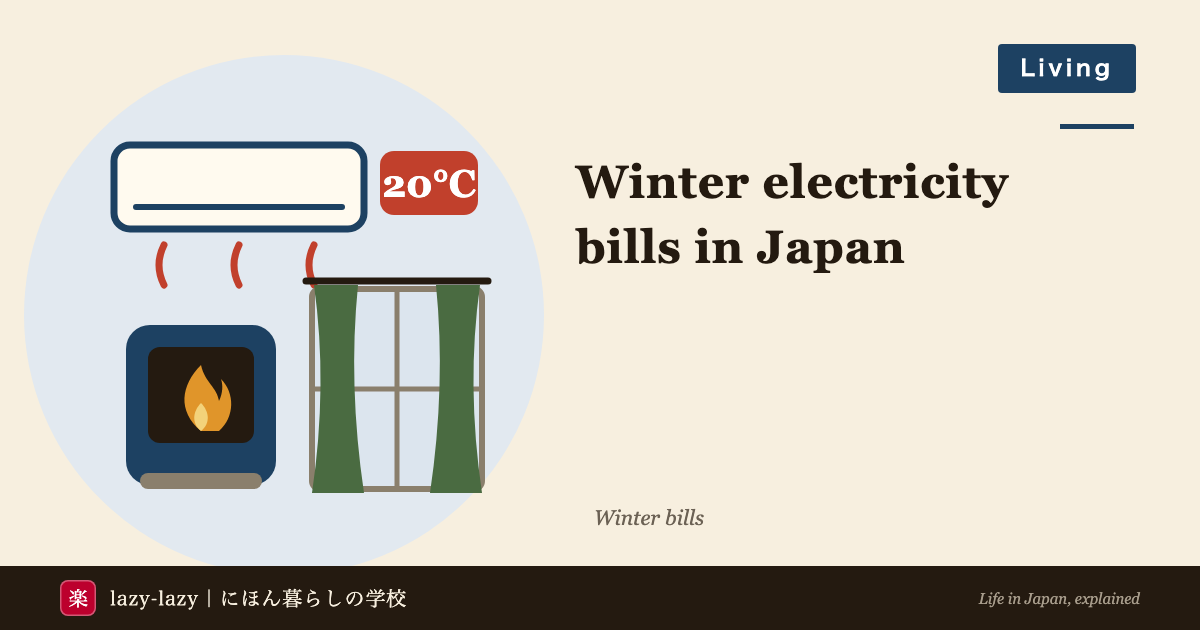
The energy-saving portal of the Agency for Natural Resources and Energy says to aim for a room temperature of 20°C when heating in winter. It also puts a yearly figure on each habit.
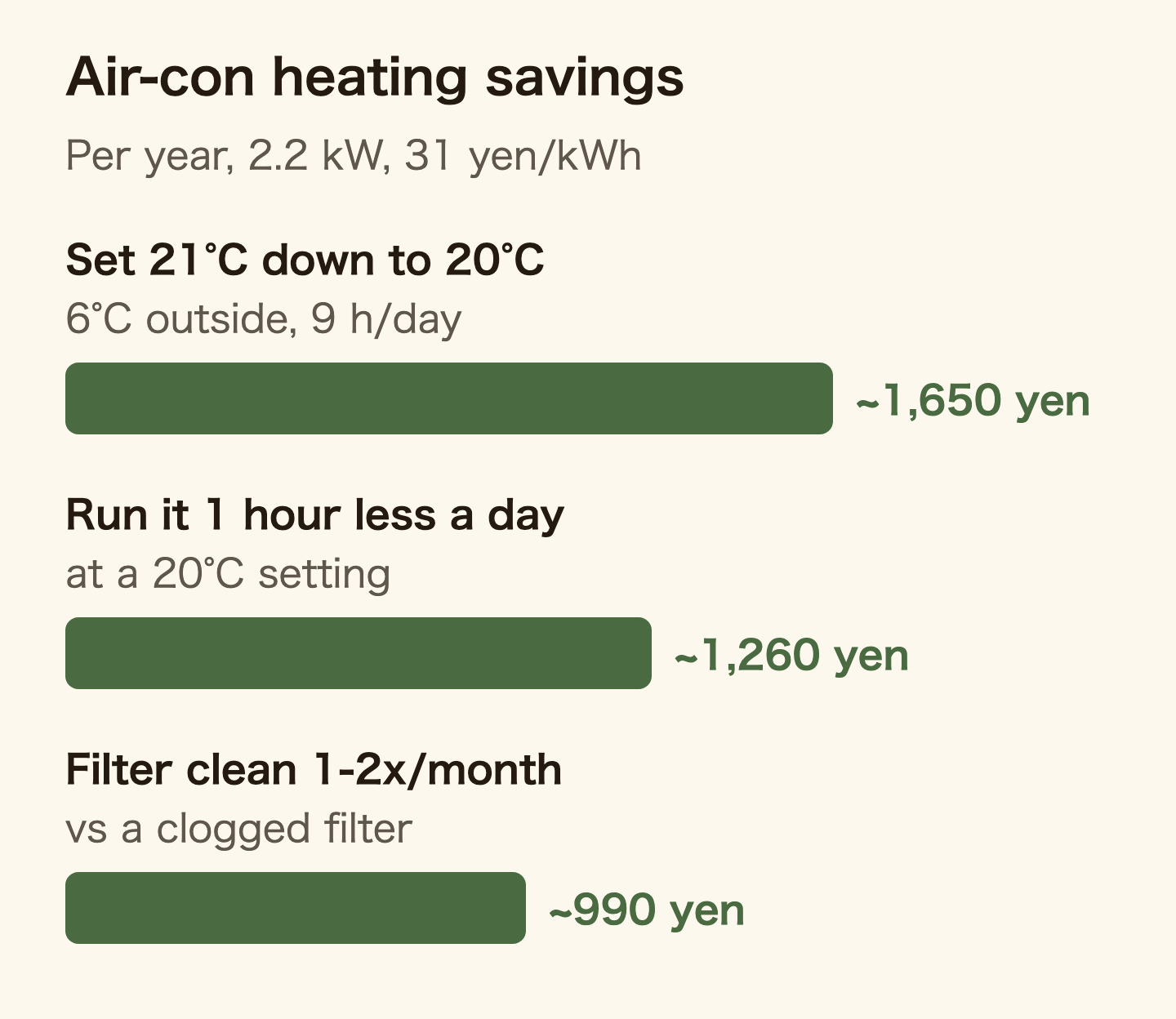
These figures come with conditions: a 2.2 kW air-con, and electricity counted at 31 yen per kWh. TEPCO’s current top step is higher than that, so your real saving depends on your plan and habits. Read the order rather than the exact yen. Turn it down one degree. Then run it for less time. Clean the filter once or twice a month.
The same page says to open and close doors and windows less, to keep things away from the outdoor unit’s vent, and to run a fan to move the warm air around. It also suggests putting on another layer before turning the temperature up.
How do Japanese people stay warm without a big bill?
Knowing where the heat goes shows you the cheap fixes. According to the agency’s energy-efficient housing page, about 60% of the heat lost from a room while heating in winter goes out through windows and other openings.
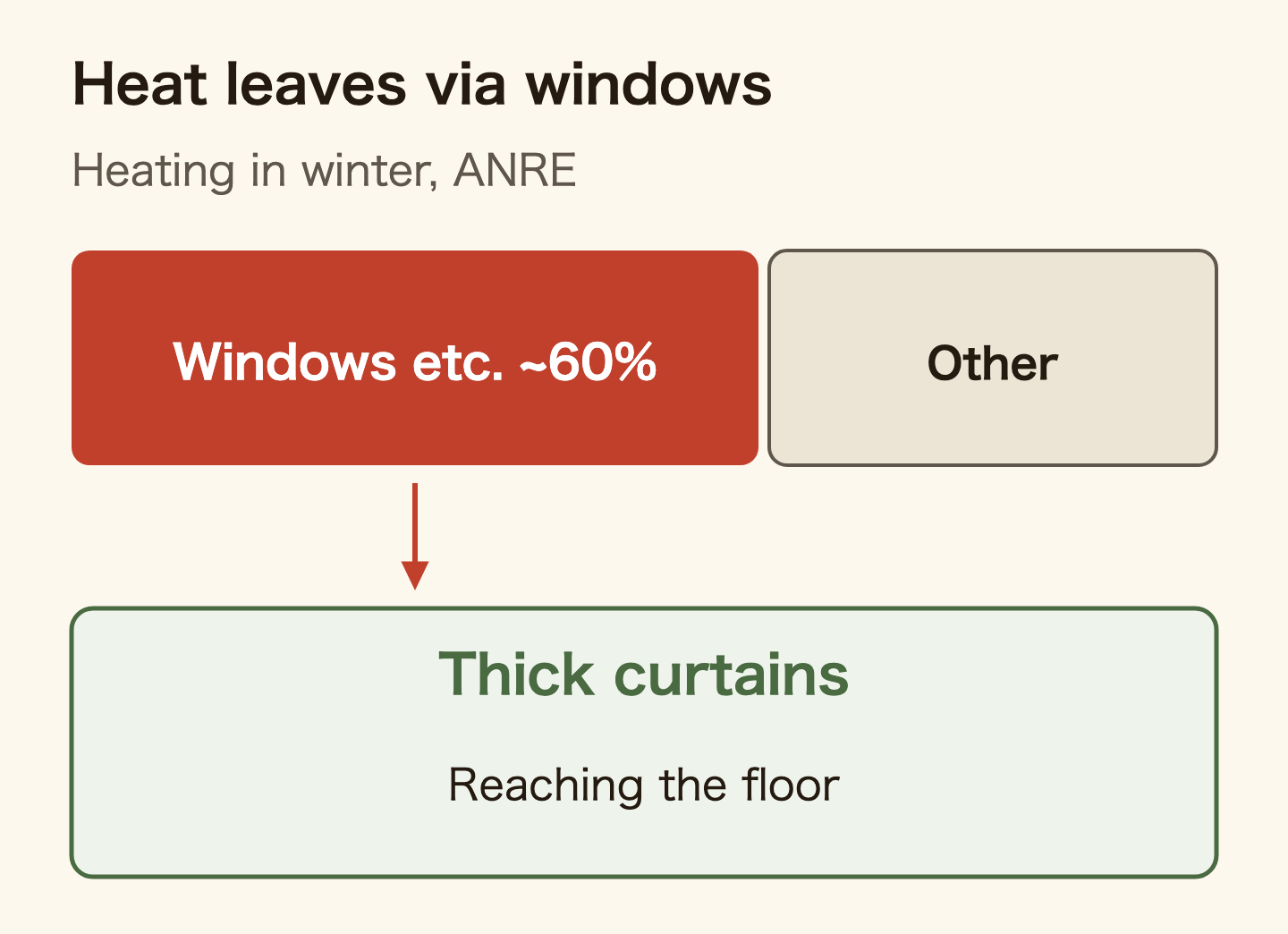
Renters cannot replace windows, but they can hang curtains. The portal recommends thick curtains when heating, and says floor-length ones work better.
The portal has numbers for kotatsu tables and electric carpets too:
- Kotatsu: adding a top cover and an under-futon saves about 1,010 yen a year, and turning it from “high” to “medium” about 1,520 yen (both at 5 hours a day)
- Electric carpet: a 3-tatami carpet turned from “high” to “medium” saves about 5,770 yen a year (5 hours a day). Put an insulating mat under it rather than laying it straight on the floor
A kotatsu mainly warms you from the waist down, so the portal suggests an extra layer on top. If you use it with another heater, keep both settings low.
Is a kerosene heater safe indoors?
Kerosene heaters and fan heaters burn kerosene inside the room. The Tokyo Fire Department counted 20 fires caused by them in its area in 2022, over half of all fires from oil-burning equipment. Some started when people pumped kerosene in without turning the heater off.
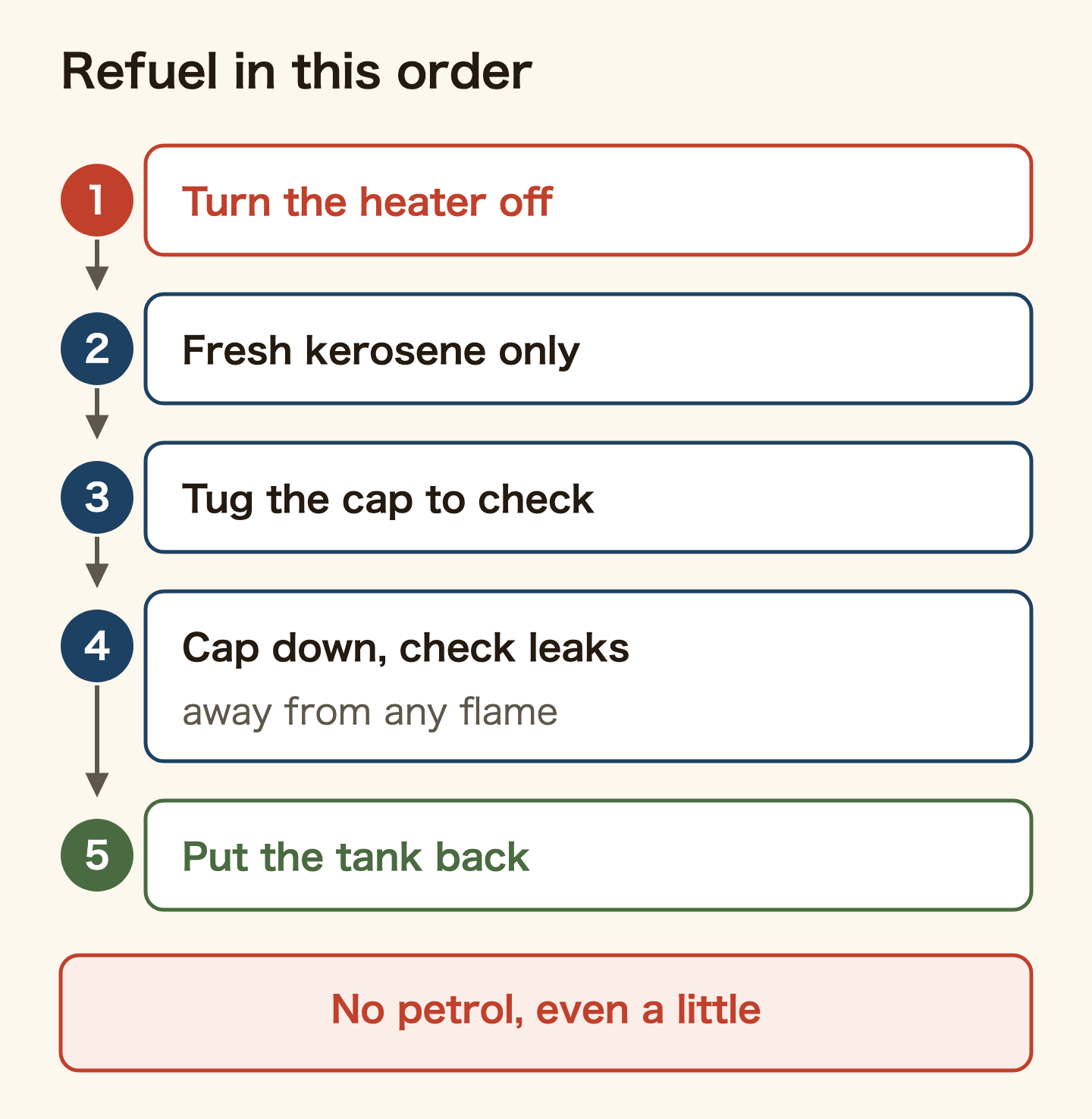
The Consumer Affairs Agency asks you to check these before the season and each time you refuel:
- Turn the heater off before refuelling
- Do not use last winter’s kerosene. Old kerosene can burn badly and give off more carbon monoxide
- Petrol or mixed fuel can start a fire even in small amounts. Keep kerosene in a kerosene tank and petrol in a metal can, in different places
- After refuelling, tug the cap to check it is shut, then hold it cap-down away from any flame to check for leaks
- Keep the heater the distance given in the manual from walls, furniture, curtains and bedding
Accidents rise from around November. NITE, the product safety agency, was notified of 269 accidents with kerosene heaters in fiscal 2018 to 2022. The safest time to make this routine automatic is the first week you use the heater.
Whether you may use one in a rented flat depends on your lease, so check it or ask the management company first. If a fire did happen, our renters insurance guide explains what you owe the landlord and which cover pays it. There are rules on storage too: in Tokyo, keeping 200 litres or more of kerosene needs notice to the fire department, and 1,000 litres or more needs a permit.
Can a kerosene heater cause carbon monoxide poisoning?
It is cold, so you shut every window and leave the heater running for hours. Where you come from, that may be normal. In Japan, when you heat with a flame, you open a window regularly to let air in.
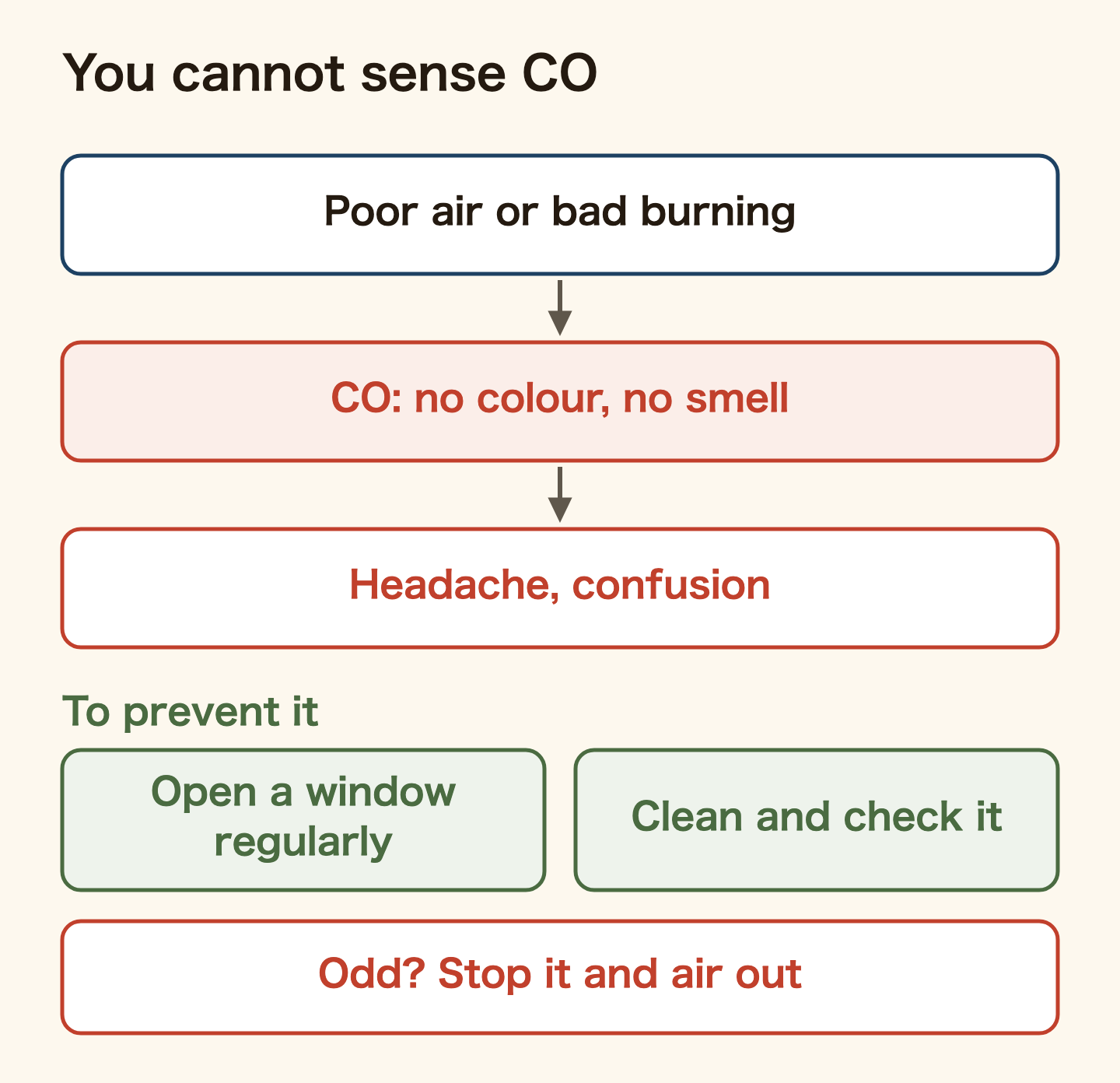
Carbon monoxide has no colour and no smell, so you cannot notice it. In the Tokyo Fire Department area there were 30 carbon monoxide poisoning accidents in homes from 2020 to 2024, the most (8) in January. More than half of those taken to hospital needed admission. One case was a person in their twenties who worked near a kerosene fan heater for nearly two hours, got a headache and was diagnosed as serious.
The fire department’s advice: run the extractor fan or open windows regularly, inspect and clean the heater, and fit a carbon monoxide alarm. If anything feels wrong while it is on, turn it off and air the room. If someone is confused or drowsy, call an ambulance; our guide on how to call 119 in English walks you through it.
Are there Japan energy subsidies in 2026 for winter?
The government has run discounts taken straight off electricity and gas bills for set periods. You do not apply; your power company deducts it.
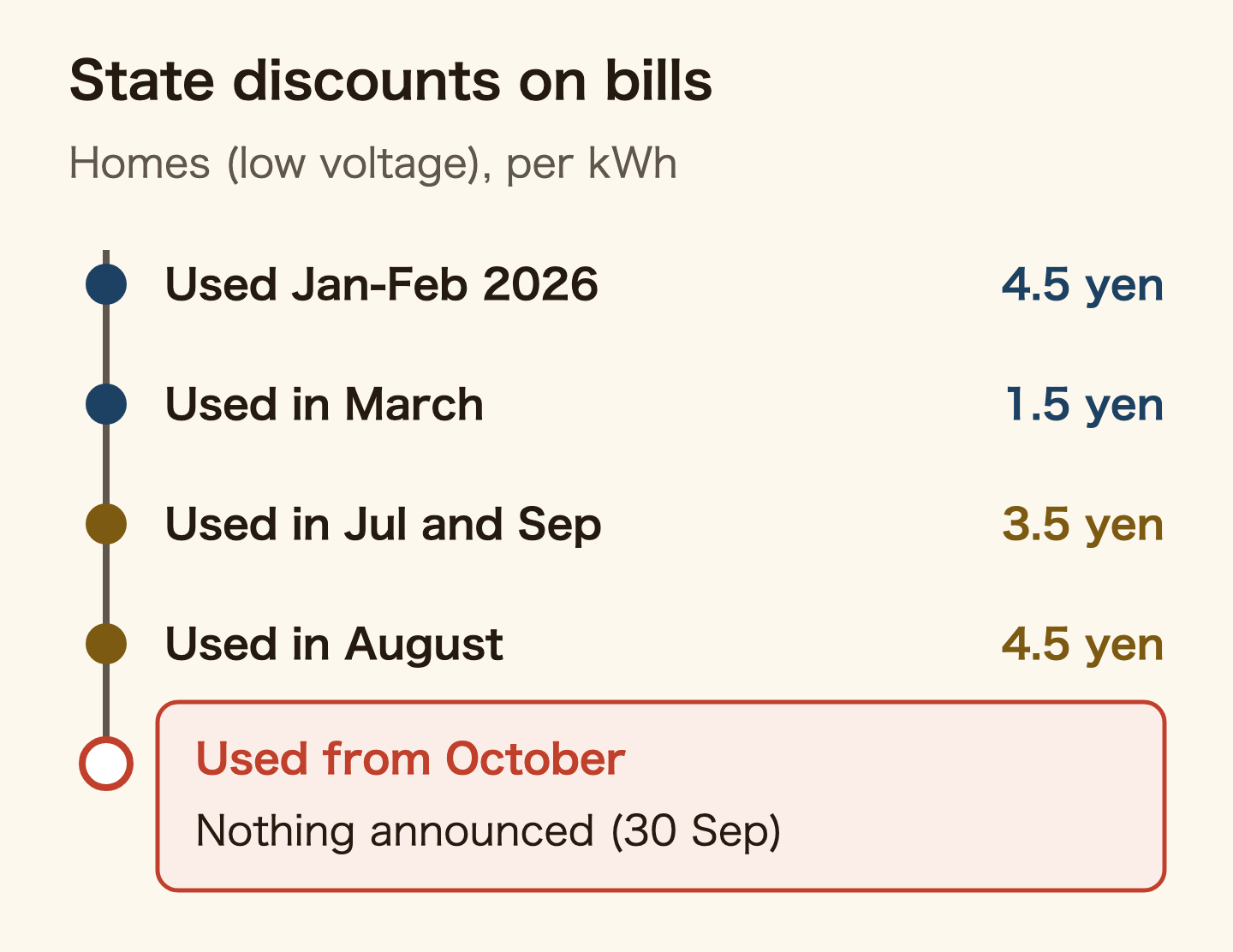
Electricity used in January and February 2026 was discounted 4.5 yen per kWh, and March 1.5 yen (ANRE). In summer it was 3.5 yen for July and September and 4.5 yen for August (ANRE energy price support). As of 30 September 2026, no discount had been announced for electricity used from October. Plan this winter’s budget without one.
Propane (LP gas) is not covered. The government lets local authorities support LP gas users through a grant, so check your city’s notices. There have also been suspicious calls asking for personal details or fees in the name of the discount. The discount needs no paperwork, so do not answer them.
Kerosene has separate support. Since 19 March 2026, the agency has paid oil wholesalers a subsidy to bring fuel prices down, kerosene included. From 17 September the rate for kerosene is 51.0 yen per litre. The page did not give an end date as of 30 September.
What if I cannot pay my electricity bill in winter?
The power does not go off straight away. METI’s guideline for electricity retailers expects about 15 days’ notice before a contract is ended for non-payment, and the grid company gives about 5 days’ notice of the cut-off date.
Call your power company before any notice arrives and tell them when you can pay. On TEPCO’s Meter-Rate Lighting B, payment is due on the 30th day counting from the day after the meter reading. The full path to a cut-off and where to get help is in the “cannot pay” section of our utilities guide.
Which one are you?
- Getting through winter with one air-con — set it to 20°C and clean the filter. Today, measure whether your windows can take thick, floor-length curtains.
- Planning to use a kerosene heater — ask the management company whether your lease allows it. Do not use leftover kerosene from last year; ask the shop that sold it how to dispose of it. Today, store kerosene and petrol in separate places.
- Your bill jumped compared with last year — find four lines on it: plan name, contract amperage, kWh used and fuel cost adjustment. Today, check whether any month went over 300 kWh.
- You may not be able to pay a winter bill — call your power company before the due date. Today, put the due date from your bill in your calendar.
FAQ
Q. Why is my electricity bill higher in winter in Japan?
Heating makes you use more electricity, and on plans like TEPCO’s Meter-Rate Lighting B each kWh costs more as you use more. Homes of two or more people average 529 kWh in January, and the part over 300 kWh is charged at the top price.
Q. What is the fuel cost adjustment on a Japanese electricity bill?
A per-kWh amount added to or taken off your bill each month to follow fuel prices. TEPCO sets it from three months of import prices and applies it two months later. For November 2026 in Kanto it is minus 5.33 yen per kWh, so it is deducted.
Q. How much is the renewable energy surcharge in 2026?
4.18 yen per kWh, applied to bills from the May 2026 meter reading to the April 2027 reading. On TEPCO’s average model of 260 kWh a month it comes to 1,086 yen.
Q. What temperature should I set my heating to in Japan?
The Agency for Natural Resources and Energy recommends a room temperature of about 20°C when heating in winter. For a 2.2 kW air-con with 6°C outside and 9 hours a day, setting it at 20°C instead of 21°C saves about 1,650 yen a year, counted at 31 yen per kWh.
Q. Is it safe to use a kerosene heater indoors?
It can be, if you turn it off before refuelling, never put petrol in it, do not use last year’s kerosene, check the tank cap is shut, and open a window regularly for ventilation.
Q. Are there energy subsidies in Japan for winter 2026?
As of 30 September 2026, no electricity discount had been announced for electricity used from October. In 2026 there were discounts for January to March and July to September use. Kerosene has had a subsidy paid to wholesalers since 19 March 2026.
Summary
Winter bills jump because you use more and, on stepped plans, each extra kWh costs more. The bill is basic charge plus energy charge plus renewable surcharge, with the fuel cost adjustment added to or taken off the energy charge. TEPCO’s average model comes to 9,561 yen for November.
The government’s guideline is 20°C. Turn it down a degree, run it for less time, clean the filter and hang thick curtains. With a kerosene heater, turn it off before refuelling, keep petrol well away and keep the air moving. No bill discount had been announced for October onwards.
Sources (official, Japanese): TEPCO Energy Partner, rate table (lighting) / calculation formulas / low-voltage price revision (29 September 2026) / fuel cost adjustment, November 2026 / fuel cost adjustment system / METI, fiscal 2026 renewable surcharge / ANRE energy-saving portal, heating and cooling / energy-efficient housing / winter bill support Q&A / energy price support / fuel-oil emergency measures / Tokyo Fire Department, petrol and kerosene in winter / carbon monoxide in homes / Consumer Affairs Agency, kerosene heater safety (PDF) / METI guideline for electricity retailers (PDF) (all checked 30 September 2026). Prices differ by company, plan and area; check your own rate table.
Related reading
Found this useful? Share it
Send it to a friend who lives in Japan.
WHO WROTE THIS

mori
Japanese. I read the ministries’ own notices, orders and Q&As in the original, and I start from what my Nepalese and Sri Lankan friends in Japan actually ran into. I do not write about what I have not checked or been told.
What this site can and cannot do →Looking for something else?