Checked on 6 October 2026 against the Statistics Bureau’s consumer price index, the Bank of Japan’s deposit rates and its flow of funds comparison, the Ministry of Health, Labour and Welfare’s wage statistics and pension valuation, the Japan Pension Service and the Financial Services Agency. Prices and interest rates change every month — check the period before you rely on a number.
The short answer
- Yes, foreigners can invest in Japan. If you live here, you can open a brokerage account whatever your nationality — though some brokers refuse if your residence card is close to expiring.
- In Japan, prices are rising faster than savings interest. Prices were up 1.9% in August 2026; ordinary savings accounts paid 0.322% a year in September.
- Pay has not kept up either. Real wages fell four years in a row, 2022 to 2025.
- If you leave, the pension refund stops at five years’ worth. If you stay, pensions are projected to shrink relative to workers’ pay.
- Where to start depends on how many years you have before you leave Japan. If you have no cash for emergencies yet, that comes first.
Knowing this, you can answer “is investing even for me?” from your own plans to stay or go — and start now, or wait, for a reason you can name.
You open your bank app and look at the interest line: a single small number, a few digits long. You ask a Japanese friend whether you should invest, and the answer comes back, “Japanese people just save.” That is true — Japanese households keep nearly half their money in cash and deposits. But your friend is answering as someone who will grow old in Japan. You may not. That one difference changes the order of everything below.
- Can foreigners invest in Japan, and do they need to?
- Why does working alone rarely build wealth?
- Won’t a pay rise do the job? Real wages fell four years in a row
- Do foreigners pay social insurance from their salary?
- Will the pension be enough? It depends on whether you leave or stay
- What is the savings account interest rate in Japan?
- What is different for foreigners? NISA, the pension refund and money sent home
- Where should you start? Count the years until you leave Japan
- Which one are you?
- FAQ
- Summary
- Related reading
Can foreigners invest in Japan, and do they need to?
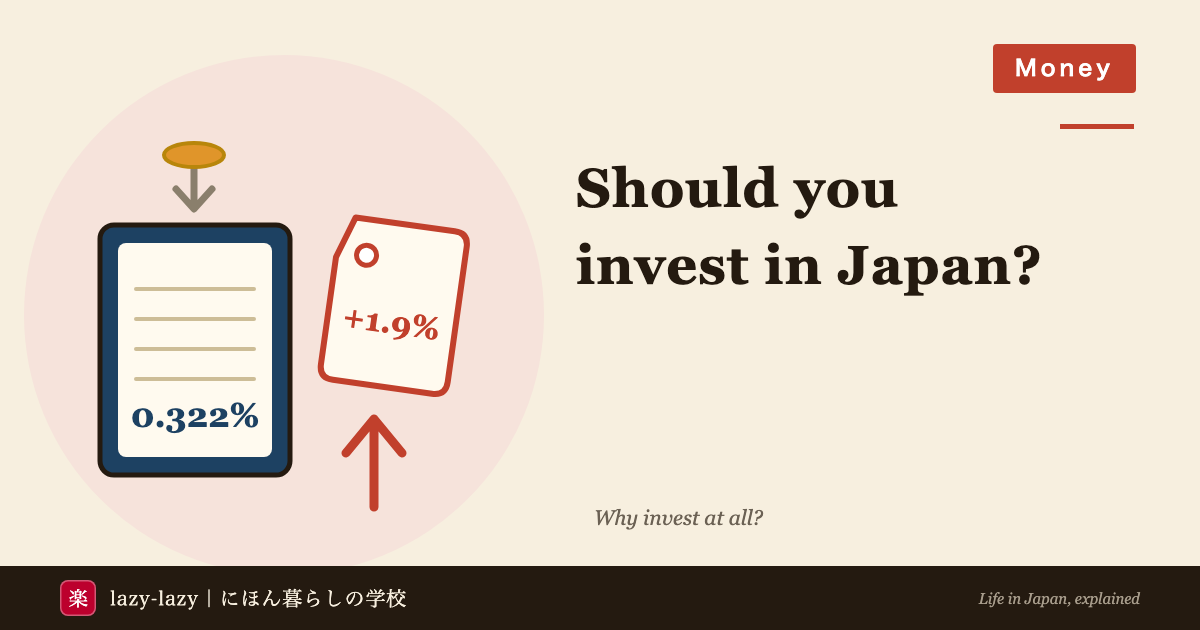
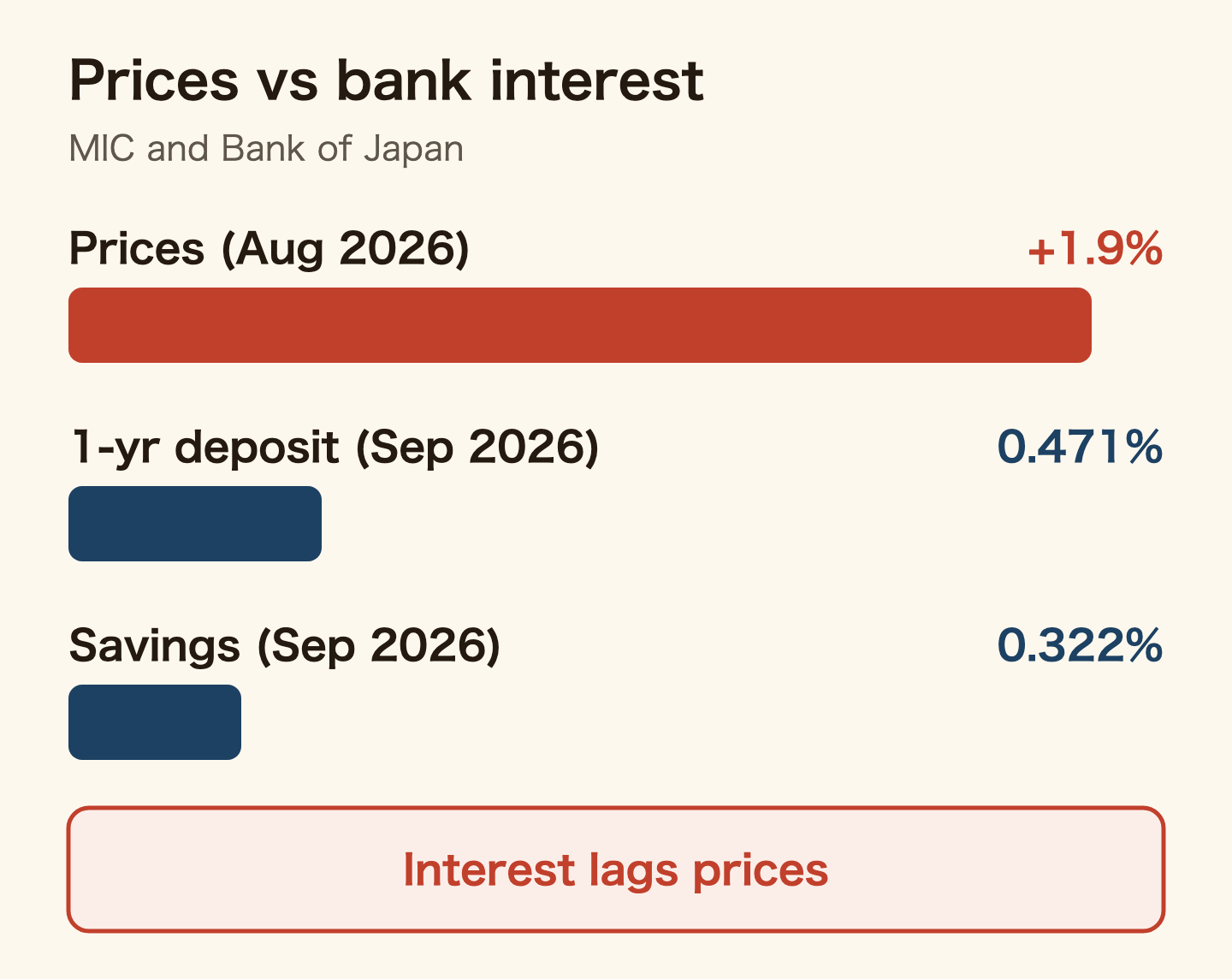
You can, and the reason it matters fits in one comparison: how fast prices rise against how much interest your savings earn. In August 2026 the consumer price index was 1.9% higher than a year earlier (Statistics Bureau of Japan, in Japanese). Around the same time, an ordinary savings account paid 0.322% a year (Bank of Japan, September 2026). The number in your account goes up; what it can buy goes down.
The Financial Services Agency defines investing simply: putting money out in the expectation of a profit. The ideal flow of money has four steps:
- Earn by working
- Keep what you do not need to spend
- Move the rest into assets
- Let the assets earn — and put those earnings back in
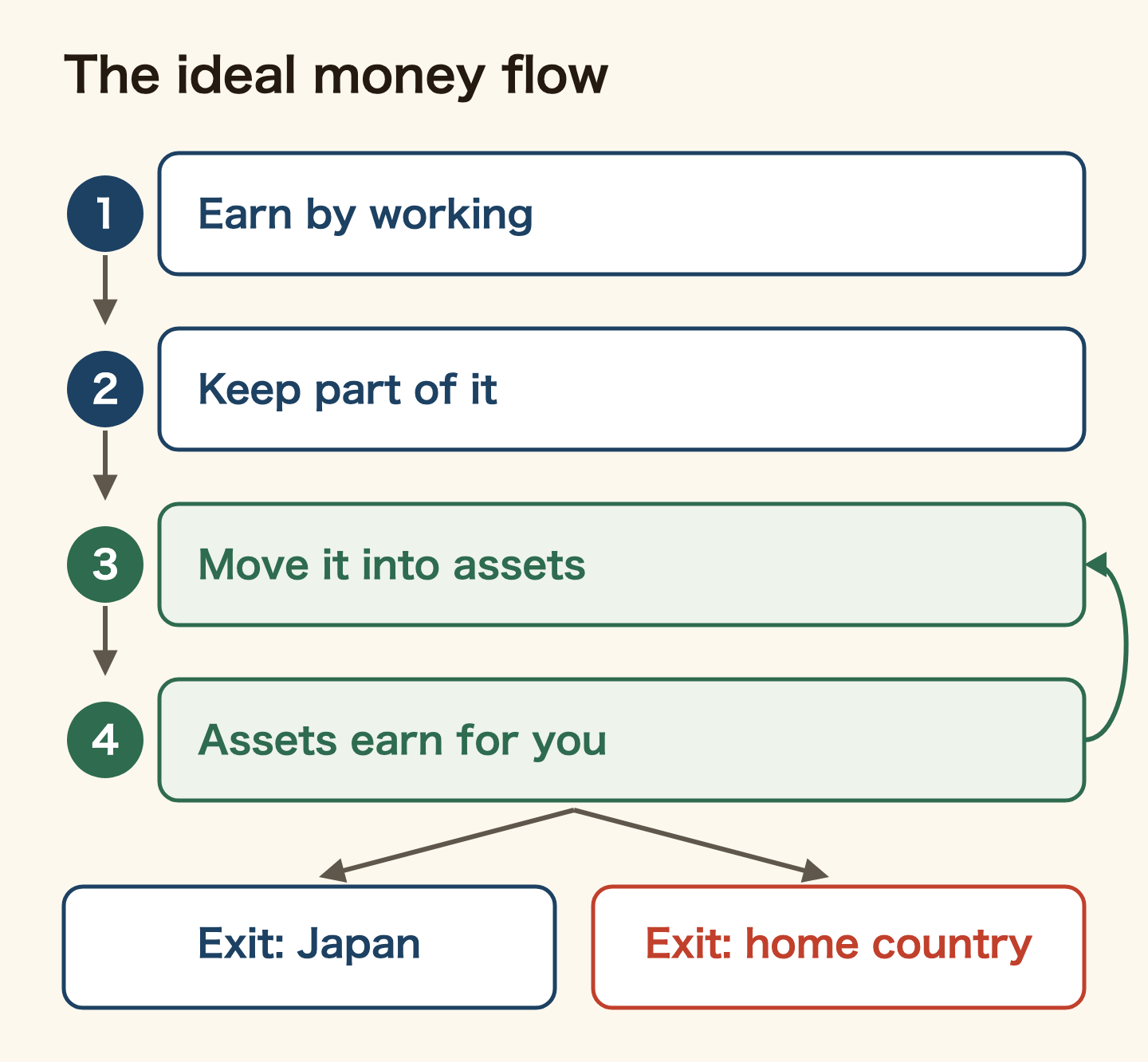
Japanese households leave close to half their money sitting at step 2. As a foreigner you also have an exit after step 4: will you spend this money in Japan, or take it home? If the exit is Japan, you can use Japanese systems for a long time. If it is home, the timing and route for moving the money become part of the plan. Each of the five reasons below reads differently depending on that exit.
Why does working alone rarely build wealth?
In Capital in the Twenty-First Century, the French economist Thomas Piketty argued that, over long periods, the return on capital — shares, land, businesses — tends to grow faster than income from work, which grows with the economy. That is one economist’s theory, not a law you can check against a single Japanese table. But the idea behind it is a useful starting point: people who only work and people who also own assets tend to drift apart.
So how do people in Japan hold their money? In a comparison the Bank of Japan published in August 2026, Japanese households held 47.2% of their financial assets in cash and deposits, 16.7% in shares and 6.9% in investment trusts (Bank of Japan flow of funds comparison, end of March 2026, in Japanese). In the same table, US households held 10.7% in cash and deposits and euro-area households 31.1%.
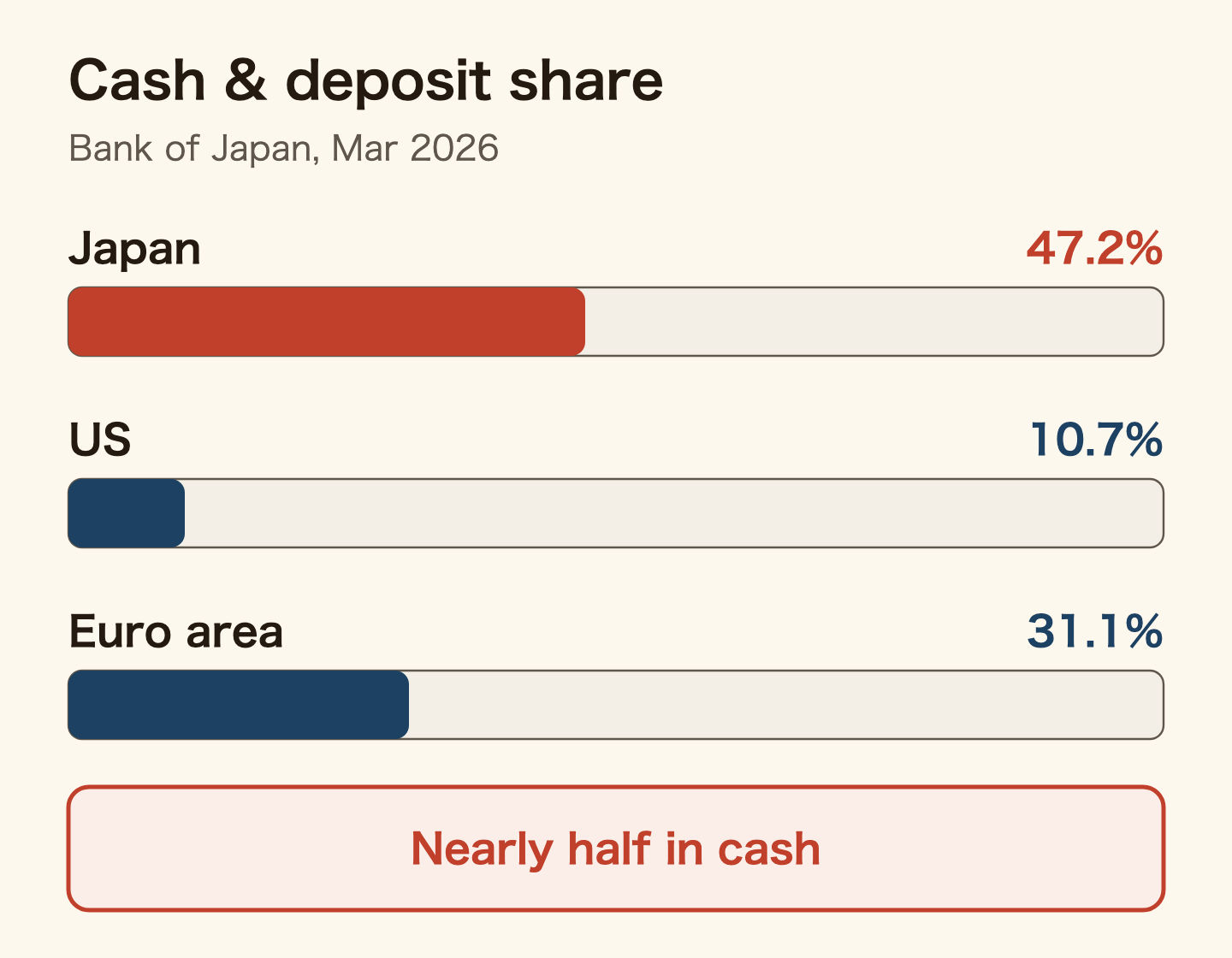
Your friend’s “Japanese people just save” is backed by the numbers. But deposits, as you just saw, are not keeping up with prices. Holding half your money in deposits means only a small part of it is on the side that grows. If you will leave Japan, the tax-free account (NISA) may not stay usable after you go, so decide where you will hold assets before you decide what to hold.
Won’t a pay rise do the job? Real wages fell four years in a row
Pay in yen does go up every year — total cash earnings rose 2.3% in 2025. The problem shows when you subtract price rises. “Real wages” fell 1.0% in 2022, 2.5% in 2023, 0.3% in 2024 and 1.3% in 2025 (MHLW Monthly Labour Survey, 2025 final results, in Japanese). Taking 2020 as 100, the 2025 real wage index was 98.0.
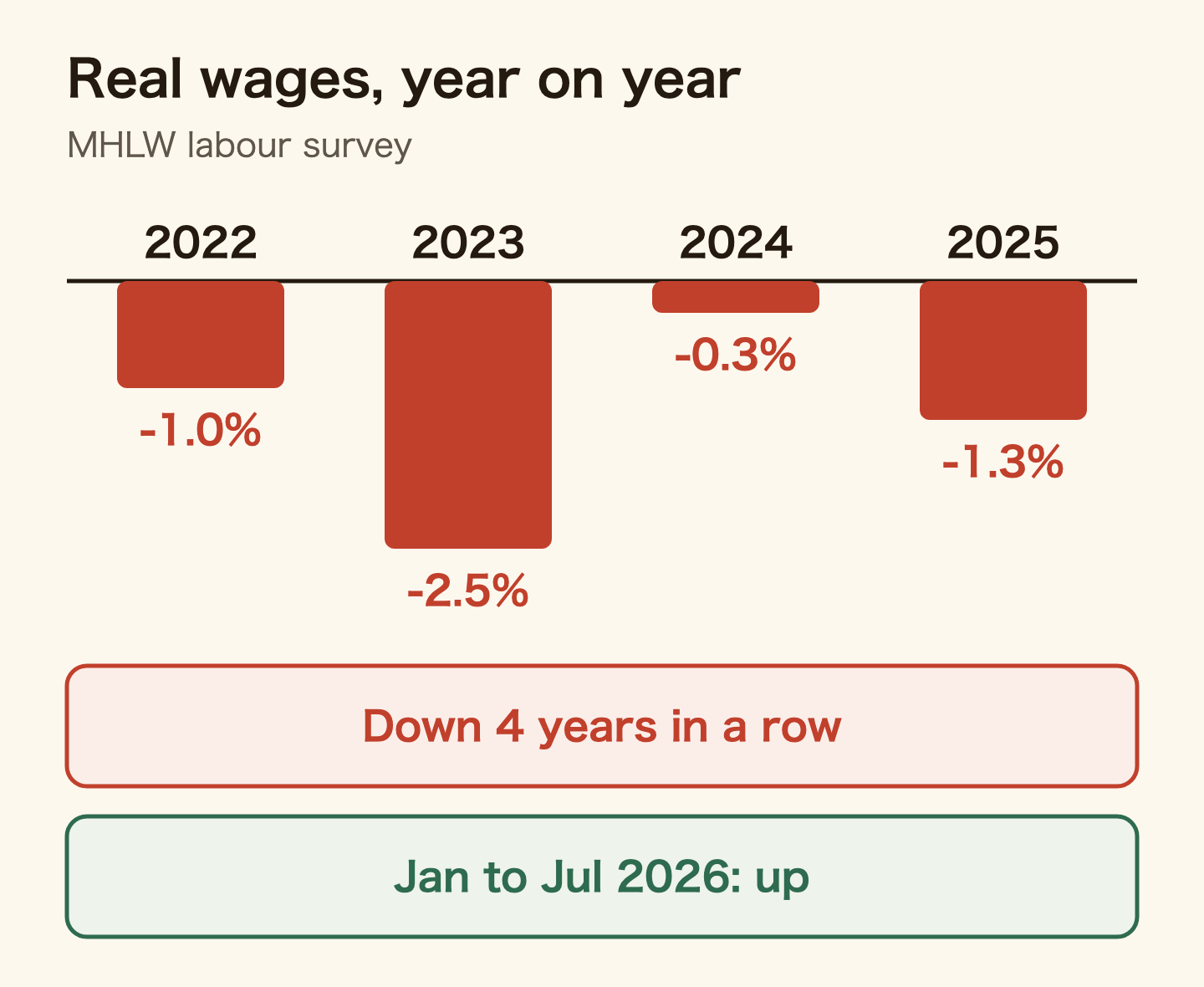
Since January 2026, every month through July has been higher than the same month a year before; July was up 2.0% (MHLW, July 2026 final results, in Japanese). Whether that has made up for four years of losses, these figures alone cannot tell you.
And income from work has a ceiling made of hours. Students may work part-time for no more than 28 hours a week (Immigration Control Ordinance, art. 19(5)(i), in Japanese). At Tokyo’s minimum wage of 1,280 yen (Tokyo Labour Bureau, in Japanese), four weeks at the limit is 1,280 x 28 x 4 = 143,360 yen. A higher hourly rate does not add hours. Check what each visa lets you earn before you plan around more work. If you will leave Japan, the years you can work here are limited too, and so is the time you can wait for pay to catch up.
Do foreigners pay social insurance from their salary?
Yes — the same way as everyone else. If you are enrolled in your employer’s health insurance and employees’ pension (as most full-time employees are), it comes out of your pay whatever your nationality. The employees’ pension rate is 18.3%, split half and half with your employer, so you pay 9.15% (Japan Pension Service, in Japanese). Health insurance comes on top.
From April 2026 there is one more item: the child-rearing support levy. The Japan Pension Service says it is collected together with health insurance, according to income. The Children and Families Agency describes it as money gathered from every generation and from companies to fund child-rearing support (Children and Families Agency, in Japanese).
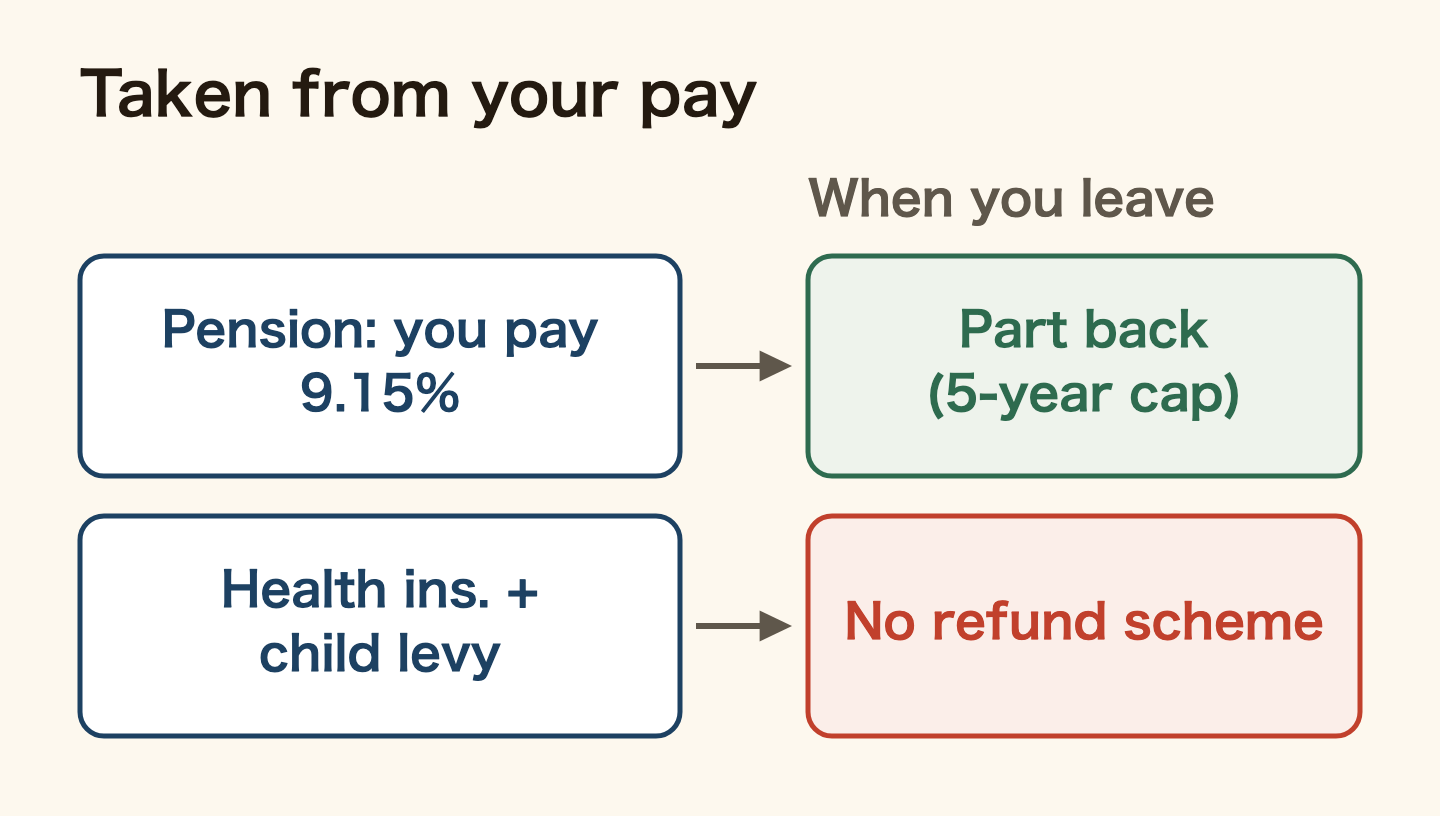
The lump-sum withdrawal payment, which returns part of what you paid when you leave, belongs to the national pension and the employees’ pension (Japan Pension Service, in Japanese). Health insurance and the levy have no such scheme. Why your take-home pay is lower than your salary is explained in Japan’s pension for foreigners. If you are a student or on a low income and cannot pay the national pension, apply for an exemption or deferral first. If you will leave Japan, the only part of these deductions that can come back is the pension, and even that has a cap.
Will the pension be enough? It depends on whether you leave or stay
Read the part that matches your plan.
If you leave Japan: at most five years come back
A foreign national who paid into the pension for six months or more can claim the lump-sum withdrawal within two years of no longer having an address in Japan. If you have ten years or more in Japan’s pension in total, you cannot claim it — instead you qualify for a Japanese old-age pension. The months counted are capped at 60 — five years (Japan Pension Service, in Japanese). For the national pension, if your last payment falls between April 2026 and March 2027, 60 months or more pays 537,600 yen. At this year’s premium of 17,920 yen, 60 months comes to 1,075,200 yen, so half comes back.
In other words, if you leave, your old age cannot rest on Japan’s pension. It will come from assets you build yourself. How to claim, and how to recover the tax taken from the employees’ pension part, is in the lump-sum withdrawal guide.
If you stay: the pension’s share of pay is projected to fall
The level of Japan’s pension is measured by the “replacement rate”: a couple’s basic pensions plus the husband’s employees’ pension, divided by the average take-home pay of working men. In the MHLW’s 2024 actuarial valuation it was 61.2% in FY2024. If the economy moves to growth and stays there, it is projected to fall to 57.6% (FY2037). If the economy continues as in the past 30 years, it falls to 50.4% (FY2057) (MHLW 2024 actuarial valuation summary, in Japanese).
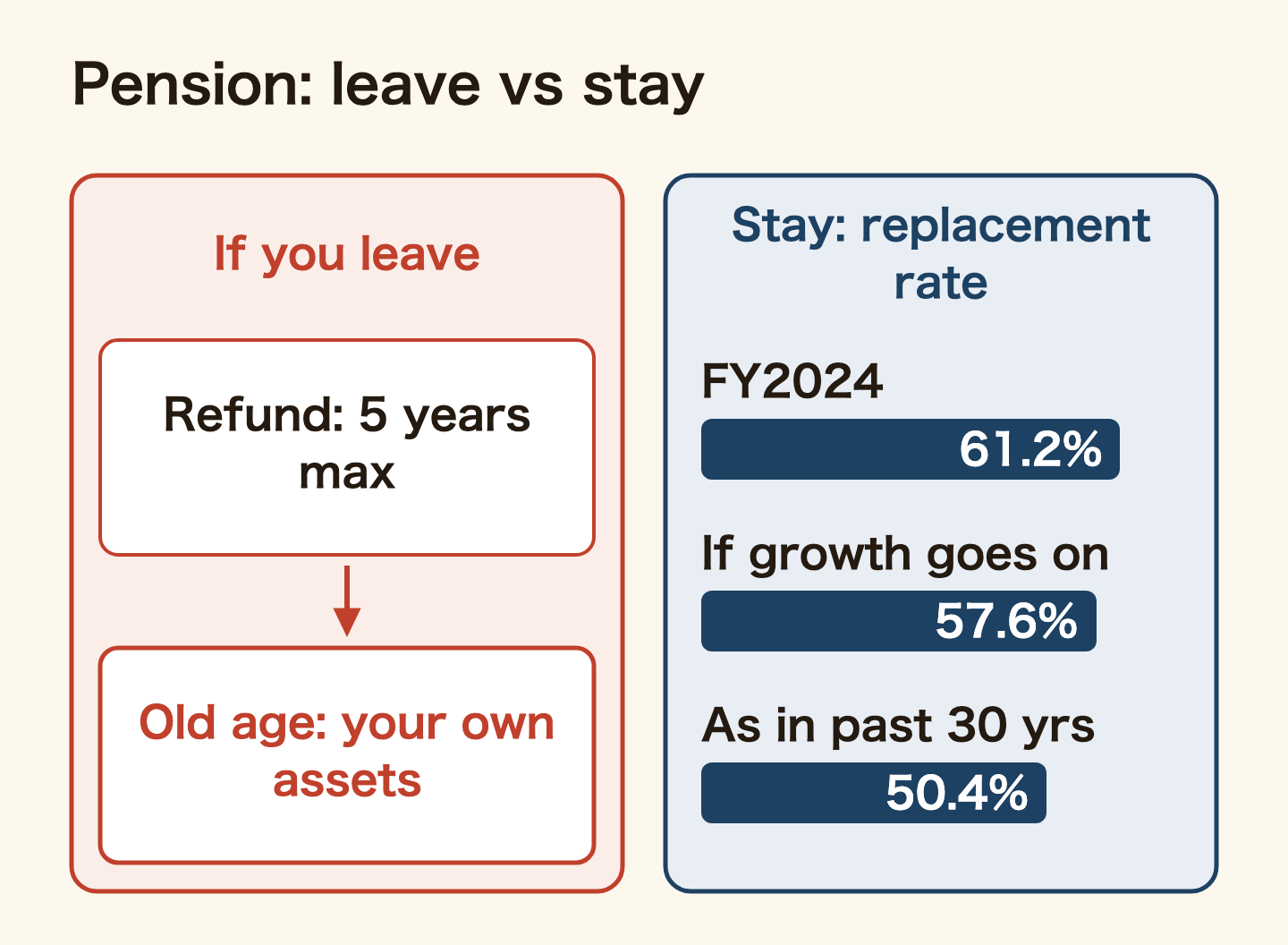
The pension does not disappear. It pays a smaller share compared with what workers take home, and the gap is filled by assets you hold yourself. If you will leave Japan, every year you pay beyond five does not come back, so plan for that part of your old age yourself as well.
What is the savings account interest rate in Japan?
Leave money in the bank and it slowly grows with interest. Where you come from, that may be normal. In Japan, an ordinary savings account pays 0.322% a year on average, and a one-year time deposit under 3 million yen pays 0.471% (Bank of Japan, average posted deposit rates, September 2026). The ordinary rate was 0.097% in January 2025, so it has risen — but not as fast as prices.
Prices rose 3.2% over 2025 as a whole (Statistics Bureau, 2025 average, in Japanese), and in August 2026 they were 1.9% higher than a year before. While interest stays below inflation, money left in the bank buys a little less each year.
If you send money home, there is a second yardstick: the exchange rate between the yen and your home currency. When you earn in yen and spend in another currency, a weaker yen means the same yen delivers less. For your family, it works just like a price rise. Nobody knows which way the rate will move next, and this guide makes no forecast. If you will leave Japan, how the yen moves against your home currency matters more to what you keep than Japan’s own inflation.
What is different for foreigners? NISA, the pension refund and money sent home
The five reasons apply to anyone living in Japan. Foreigners have three more things on top.
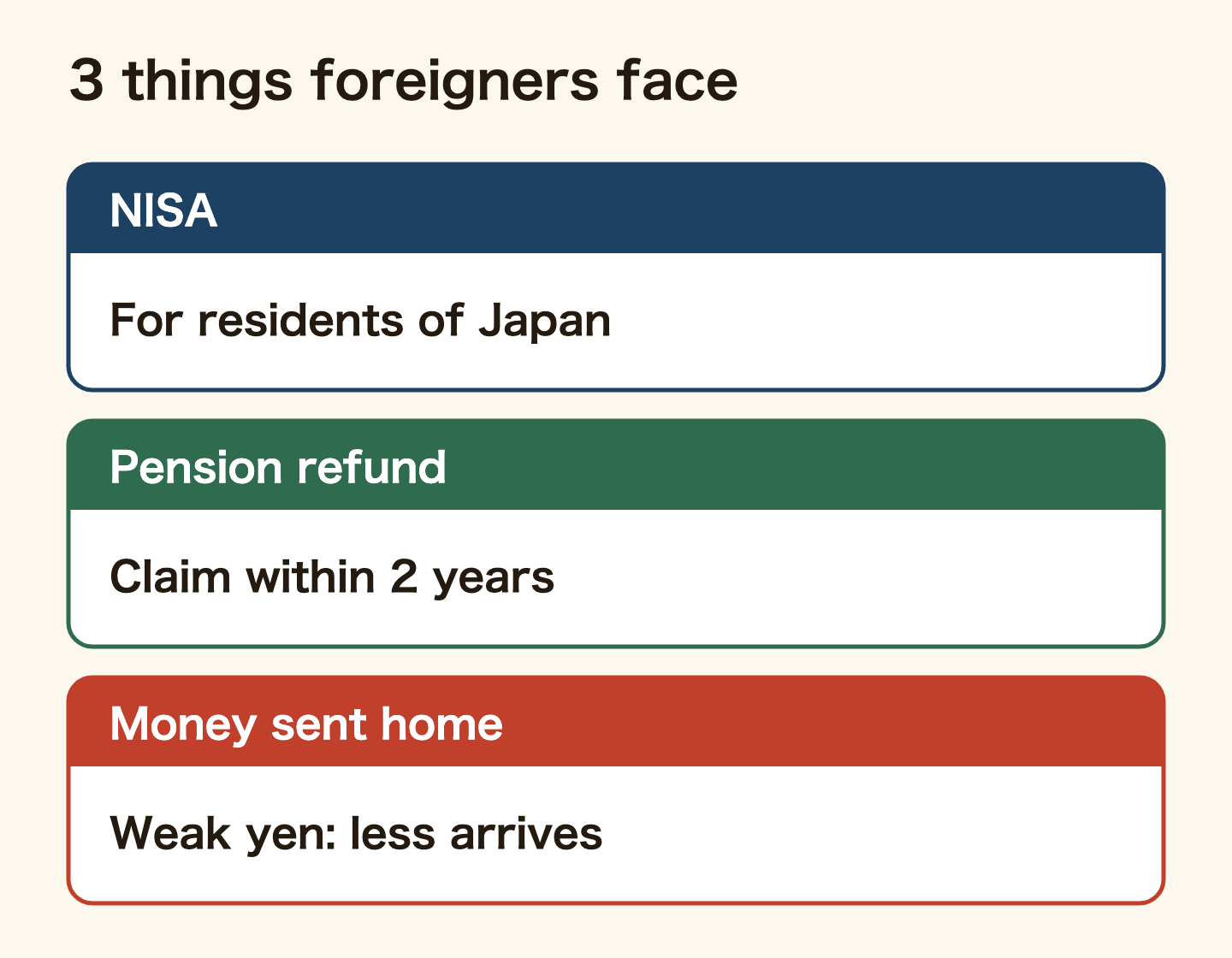
NISA is for people who live in Japan. Unless you leave on your employer’s transfer order, you cannot keep it tax-free after you go. The Financial Services Agency says anyone aged 18 or over living in Japan can open one (FSA NISA site, in Japanese). What happens when you leave is not the same as for a Japanese investor, so read the exit in NISA for foreigners first.
The lump-sum withdrawal has to be claimed within two years of no longer having an address in Japan. If you do nothing, it never arrives. Check how to claim it before you fly.
What reaches your family depends on both the exchange rate and the fees. You cannot move the rate, but you can choose the fees. Compare how much arrives with each way of sending money and look again at how you send it now.
Where should you start? Count the years until you leave Japan
The first practical step is a brokerage account, which you can open with your residence card and My Number. The documents and the points where foreigners get refused are covered in NISA and brokerage accounts for foreigners.
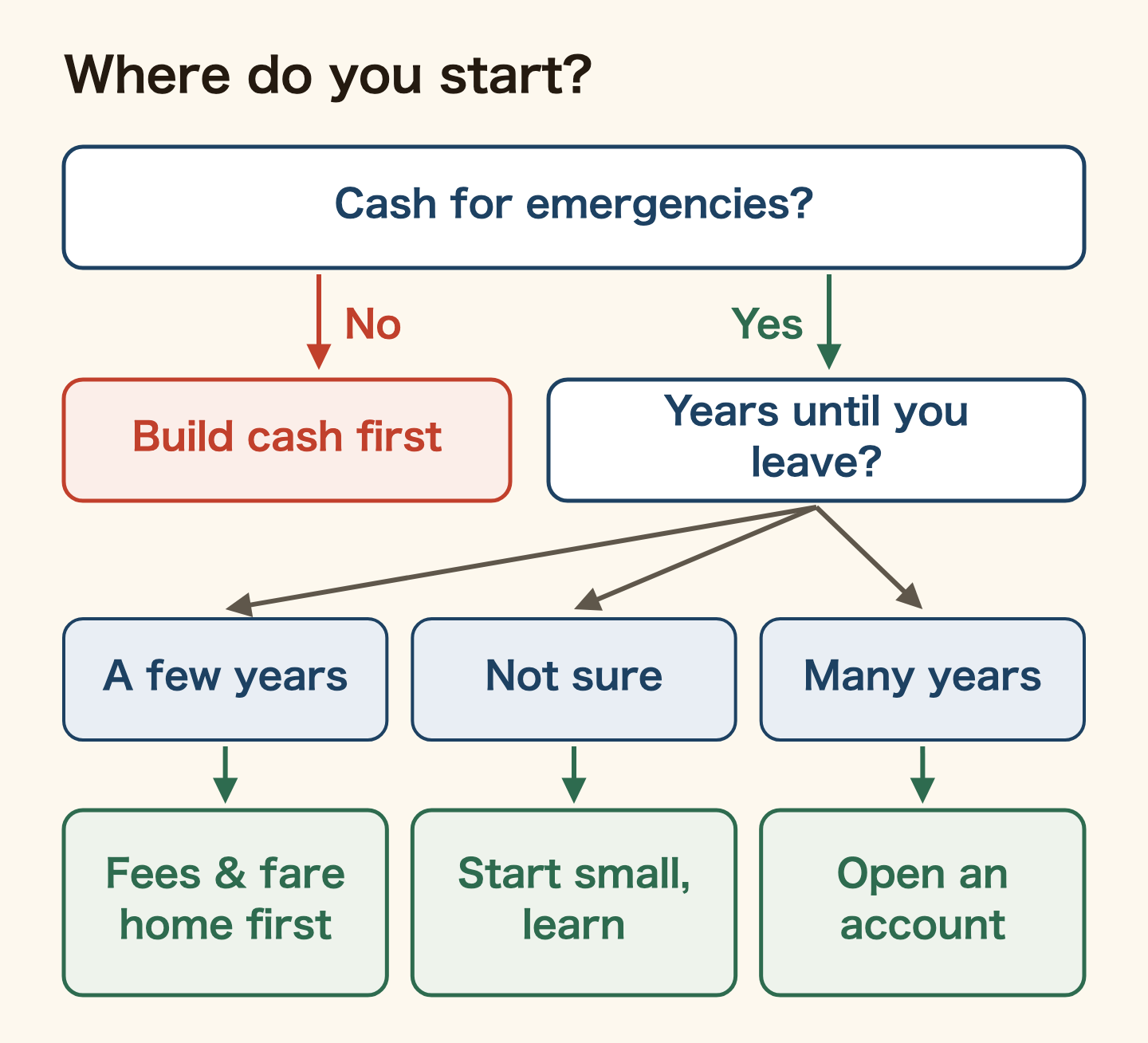
Before that, count the years until you leave Japan. If your leaving date is fixed, the date you will have to sell or move your assets is more or less fixed too — and if prices are down that week, you may not be able to wait. The Financial Services Agency puts it plainly: investing lets you expect higher returns than deposits, but you can also lose principal (FSA, asset-building basics, in Japanese). The shorter your time to the exit, the less reason to rush in.
This guide does not say what to buy or how much to put in. The answer changes with your years in Japan and your life. One warning, though: if someone you met on social media invites you to an investment that “always goes up”, that is how scams begin. The tricks and where to report them are in scams that target foreigners in Japan.
Which one are you?
- No cash for emergencies yet — investing can wait. This month, set aside money you will not touch in a separate account.
- Leaving Japan in a few years — before investing, fix your remittance fees and the cost of going home. Today, compare what arrives on two services before your next transfer.
- Not sure when you will leave — open an account and learn with a small amount. Today, read what happens to NISA when you leave.
- Staying long term, maybe for permanent residence — be on the side that fills the pension gap with your own assets. Today, gather the documents for a brokerage application.
FAQ
Q. Can foreigners invest in Japan?
Yes. If you live in Japan you can open a brokerage account regardless of nationality, though some brokers refuse if your residence card is close to expiring. The Financial Services Agency says anyone aged 18 or over living in Japan can open a NISA account. What happens when you leave is different from a Japanese investor, so check the exit first.
Q. What is the savings account interest rate in Japan?
In the Bank of Japan’s figures for September 2026, ordinary savings accounts paid 0.322% a year and one-year time deposits under 3 million yen paid 0.471%. Both are below the 1.9% rise in prices in August 2026.
Q. Can I lose money by investing?
Yes. The Financial Services Agency says investing lets you expect higher returns than deposits but carries the risk of losing principal. It also says no financial product is top-rated on safety, return and ease of cashing out all at once.
Q. Is investing worth it if I am leaving Japan in a few years?
There is less reason to rush. With a fixed leaving date you may have to sell on a set date even if prices are down. Sort out your remittance fees and the cost of going home first.
Q. If I pay into the pension, will my old age be covered?
If you leave, the lump-sum withdrawal counts at most 60 months (five years). If you stay, the replacement rate is projected to fall from 61.2% in FY2024 to 57.6% (FY2037) or 50.4% (FY2057) in the MHLW’s two central scenarios (2024 actuarial valuation). Either way, assets you hold yourself fill the gap.
Q. Why does a weak yen matter to me?
If you earn in yen and send money home, the same yen delivers less. For your family it is the same as prices going up. Nobody knows where the yen will go next, so start with what you can control: the fees on the money you send.
Summary
In Japan, prices are rising faster than savings interest. Real wages fell four years running, social insurance comes out of your pay, and if you leave, the pension refund stops at five years’ worth. If you stay, the pension’s share of pay is projected to shrink. Money held only in deposits has nothing filling that gap.
The order, though, is personal. No emergency cash yet? Save first. Leaving in a few years? Fees and your fare home come first. Staying long term? Open an account and get on the side that owns assets. What decides it is the number of years you have before you leave Japan.
Official sources: Statistics Bureau, CPI August 2026 / CPI 2025 average / Bank of Japan, average posted deposit rates / Bank of Japan, flow of funds comparison (31 August 2026) / MHLW Monthly Labour Survey, 2025 / July 2026 / e-Gov, Immigration Control Ordinance / Tokyo Labour Bureau, minimum wage / Japan Pension Service, contribution tables / Children and Families Agency / Japan Pension Service, lump-sum withdrawal / MHLW 2024 actuarial valuation / FSA, NISA / FSA, asset-building basics (all in Japanese; checked 6 October 2026).
Related reading
Found this useful? Share it
Send it to a friend who lives in Japan.
WHO WROTE THIS

mori
Japanese. I read the ministries’ own notices, orders and Q&As in the original, and I start from what my Nepalese and Sri Lankan friends in Japan actually ran into. I do not write about what I have not checked or been told.
What this site can and cannot do →Looking for something else?