The Japanese-system parts of this article were checked on 9 October 2026 against pages from the Financial Services Agency, JASSO, the National Police Agency, MLIT, MHLW and the Immigration Services Agency. The book parts are my own summary.
The short answer
- The Richest Man in Babylon is a parable set in ancient Babylon. George S. Clason wrote it in early 20th-century America and borrowed a setting thousands of years old. It is not backed by Japanese rules or statistics.
- Its seven lessons map onto this site’s 5 Skills. Lessons 1 and 2 are Save, 3 is Grow, 4 is Protect, 5 is Save and Protect, 6 is Protect, and 7 is Earn.
- In Japan the order is different from the book’s. Protect, Save, Earn, Grow, Spend well, with Protect first.
- Each lesson has an official Japanese counterpart you can check yourself.
- Book claims and Japanese facts sit in separate paragraphs below.
Once you see this, you can turn the seven famous lessons into the one article you should read first for your life in Japan. You do not have to do all seven at once.
Many people read the book and then wonder what to do with a Japanese bank account and a Japanese rent. The better the story, the harder it is to get back to your own wallet. This article is a map from each lesson to an entry point in Japan.
- What is The Richest Man in Babylon? A parable set thousands of years ago
- Mapping the seven lessons to the 5 Skills
- 1. Save a tenth of your income: Save
- 2. Control spending and rank your wants: Save
- 3. Make your savings work: Grow
- 4. Guard your money from risk and predators: Protect
- 5. Make your home an asset: Save and Protect
- 6. Prepare for the future from today: Protect (insurance and pension)
- 7. Make yourself your greatest asset: Earn
- The order in Japan is not the book’s order
- When to stop: which one are you?
- FAQ
- Summary
- Related reading
What is The Richest Man in Babylon? A parable set thousands of years ago
The Richest Man in Babylon was written by George S. Clason. In the story, poor craftsmen and merchants learn how to handle money from a wealthy old man in ancient Babylon.
It is a parable, not a record of real merchants. Its numbers and methods cannot be read as Japanese law or statistics.
Two rules for this article. Book content is my summary, in the form “the book explains that…”. Japanese systems and statistics go in separate paragraphs and use only what an official page confirms.
Mapping the seven lessons to the 5 Skills
This site organizes money and daily life into five skills, stacked from the bottom: Protect, Save, Earn, Grow, Spend well (see the 5 Skills).
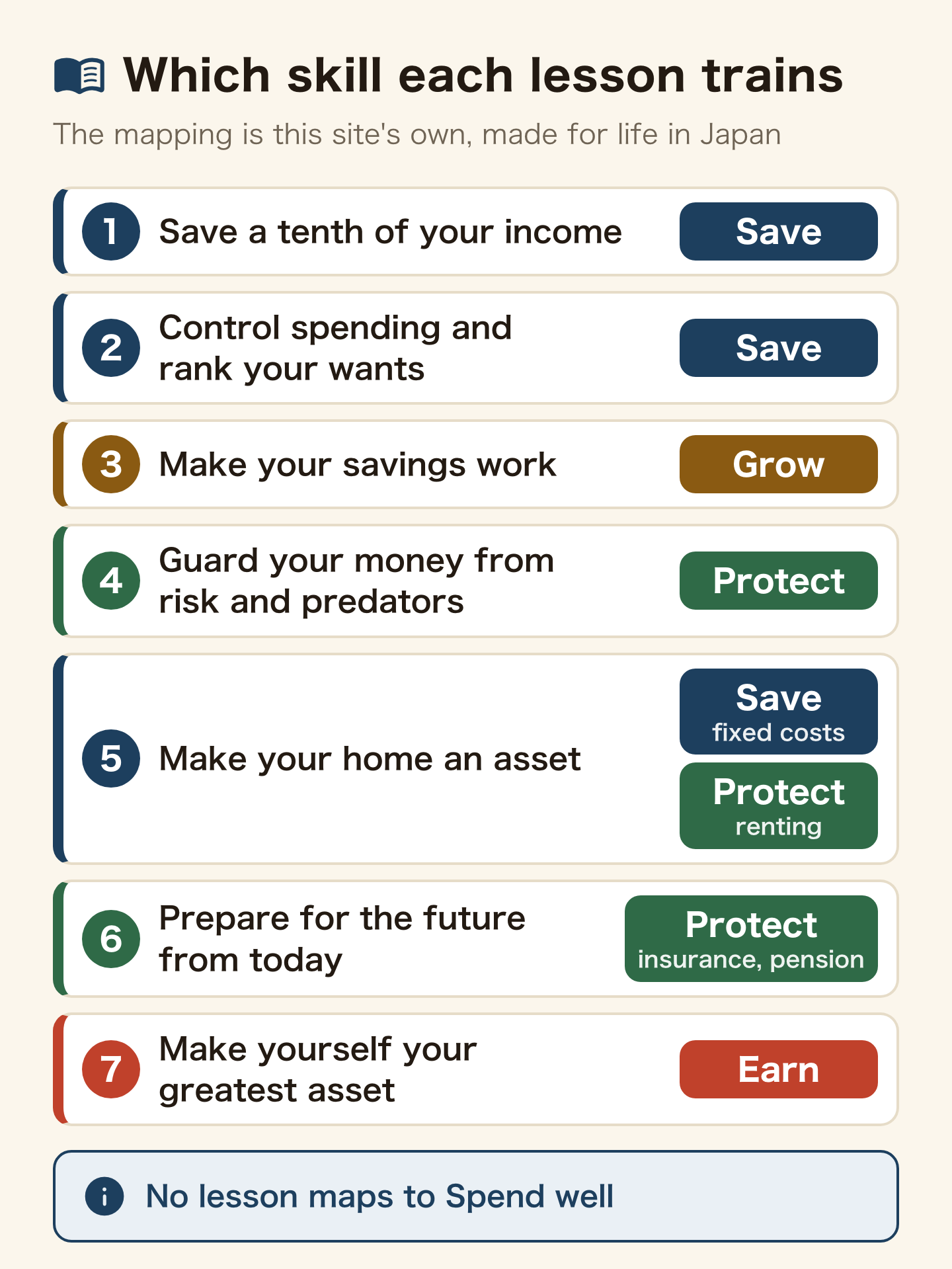
| Lesson (our wording) | Skill |
|---|---|
| 1. Save a tenth of your income | Save |
| 2. Control spending and rank your wants | Save |
| 3. Make your savings work | Grow |
| 4. Guard your money from risk and predators | Protect |
| 5. Make your home an asset | Save (fixed costs) and Protect (renting) |
| 6. Prepare for the future from today | Protect (insurance and pension) |
| 7. Make yourself your greatest asset | Earn |
No lesson maps to Spend well, which is about what the money is for once it is protected, saved, earned and grown (see Spend well). The mapping is this site’s own, made for life in Japan. The book does not assign skills. Wording differs by edition, and lesson 5 is closer to “make your home an asset (own it)” in the English original, which does not apply directly if you rent in Japan.
1. Save a tenth of your income: Save
The book explains that you should set aside part of what you earn, roughly a tenth, before you spend. You do not save what is left over. You put some aside first and live on the rest.
In Japan, the Financial Services Agency’s page on the basics of asset building describes household budgeting as tracking income and spending, keeping the balance in surplus and saving the surplus. It also recommends moving a fixed amount to a savings account on payday and living on the rest. The one-tenth figure is the book’s rule of thumb, not an official Japanese standard.
Your country may differ here. Setting money aside first needs an account. The bank account guide covers the Japan Post Bank rule on remaining residence period. To pick the share, look at real spending in the student living cost article first.
2. Control spending and rank your wants: Save
The book explains that you should separate needs from wants and keep spending inside income. It does not say to remove every want, only to put them in order.
In Japan, JASSO’s FY2023 survey of privately funded international students reports that the largest spending item is study and research, followed by housing and then food. The big lumps are fixed categories, not small purchases.
Rank by what works every month after one procedure. For your phone, the SIM guide shows what you can sign up for without a credit card. For furniture and appliances, the second-hand guide covers the recycling fee on four appliance types before you buy used.
3. Make your savings work: Grow
The book explains that saved money should not sit idle, and that you should put it where the principal is unlikely to be lost.
One Japanese form of this is NISA, the tax-free investment scheme. According to the Financial Services Agency, gains are tax-free, there is an annual investment limit and a lifetime tax-free holding limit, and the holding period has no end date. There is no duty to fill the limits. Investments can fall below what you paid in, and suitability differs by person, so this article only introduces the mechanism.
Grow comes after Protect and Save. What happens when you open an account and when you leave Japan is in the NISA guide. To ask whether savings alone are enough, read the article on why foreigners should consider investing. If you are wary of locking money until age 60, the iDeCo guide shows the exit first.
4. Guard your money from risk and predators: Protect
The book explains that saved money must be protected from loss. Choose places where the principal is unlikely to be lost, and take the advice of experienced people before putting money at risk.
In Japan, the way foreigners most often lose money is fraud. The National Police Agency’s anti-fraud page says that if you feel “this might be a scam,” you can call the consultation line #9110. A number you can call before you pay is itself the first step of Protect.
The scam guide covers fake police and immigration calls. If you have already signed something, the cooling-off guide lists the periods for door-to-door and phone sales. Your visa is also something to protect: the visa cancellation article shows how people drift into cancellation by doing nothing.
5. Make your home an asset: Save and Protect
Some Japanese editions summarize this as “live in a better place.” The English original, though, centers on turning your dwelling into an asset, that is, owning your home. Where you live is the base of daily life and a large share of spending.
Where you come from, buying may be the norm. While you rent in Japan, the book’s ownership point does not apply directly. For tenants, MLIT’s guideline on restoration to original condition says it does not mean returning the room to its state when you moved in, and that repair costs for ordinary aging and normal use are covered by the rent.
Rent is a fixed cost, so it belongs to Save. What entry costs include is in the rental contract guide, and how not to overpay when leaving is in the move-out costs article. If you want to buy, the house purchase and mortgage guide answers whether you need permanent residence and how taxes work.
6. Prepare for the future from today: Protect (insurance and pension)
The book explains that you should prepare for old age and for accidents by building future income now. The earlier you start, the lighter it is.
In Japan, public cover comes first. The Ministry of Health, Labour and Welfare’s high-cost medical expense system pays back the part of your medical bill at the counter that exceeds a monthly cap, and the cap depends on age and income. Before adding private insurance, find out what you are already covered for.
Whether you need private life insurance is argued from the gaps in public cover in the life insurance article. For pensions, the pension guide explains what happens to what you paid when you leave. If a large hospital bill is coming, the high-cost medical expense guide shows the application steps first.
7. Make yourself your greatest asset: Earn
The book explains that you should sharpen your skills and knowledge to grow your earning power. Before putting money to work, you are the biggest source of capital.
In Japan, earning has a frame: your residence status. The Immigration Services Agency’s page on permission to engage in activities outside the status of residence says you must apply before doing paid work such as a part-time job outside the activities your status allows, and the application carries no fee. You build your earning power inside that frame.
How much a student can earn is in the part-time job guide, from the weekly hour limit to job hunting. Salary expectations after graduation, by visa type, are in the salary article. The next step is the student-to-work visa guide, which lists how people fail.
The order in Japan is not the book’s order
The book runs from 1 to 7. To decide what to do now in Japan, the order of the 5 Skills is easier to use.
- Protect: fraud, contracts, residence status, insurance (lessons 4, 6, and renting in 5)
- Save: set money aside first, lower fixed costs (1, 2, 5)
- Earn: grow within your status (7)
- Grow: only once the above is in place (3)
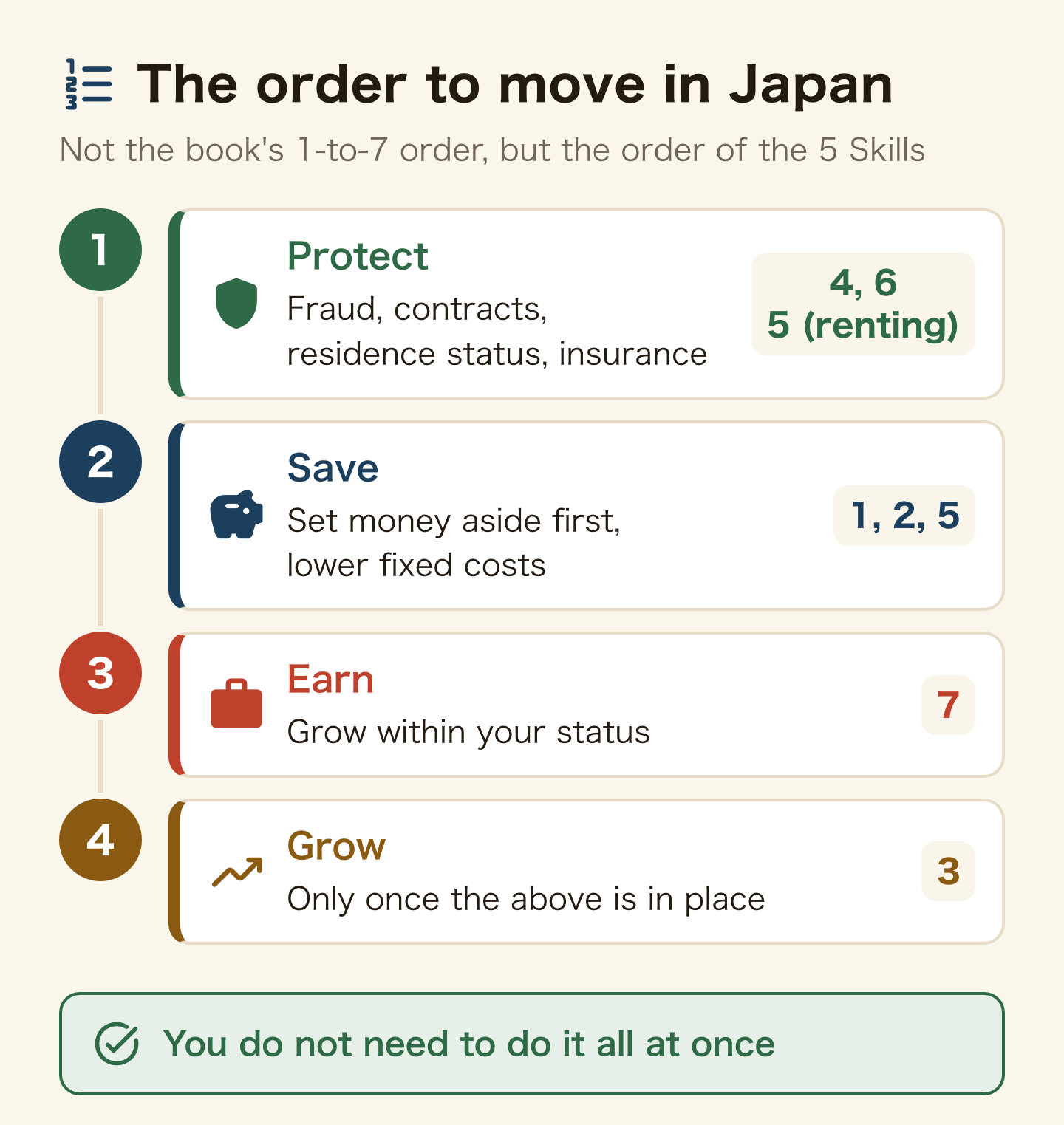
Start with Save or Protect. The others are Earn and Grow.
When to stop: which one are you?
- You just arrived and have no account or contracts: start with lessons 4 and 5. Open the Protect page today and check one scam article and one renting article. Stop there, and leave saving until the account exists.
- Life works but little money is left: start with 1 and 2. Write a payday date in your notes for moving a fixed amount. Decide the share after you review fixed costs.
- You have some left and are thinking about growing it: check 4 and 6 before 3. Stop at reading the NISA article. Decide whether to start after you understand how it works.
- You want a higher income: start with 7. Check what your current status allows in the part-time job or job-hunting article.
FAQ
Q. Is The Richest Man in Babylon a true story?
No. It is a parable set in ancient Babylon that teaches money habits through a story. The author is the American George S. Clason. It is not backed by Japanese rules or statistics.
Q. What are the seven lessons?
This article uses: save a tenth of your income, rank your wants, make your savings work, guard your money from risk, live in a better place, prepare for the future from today, and make yourself your greatest asset. Translations word them differently, and lesson 5 is closer to owning a home in the English original.
Q. What should a foreigner in Japan watch out for when using the book?
Read the book’s lessons and Japanese systems as separate things. The one-tenth rule is the book’s, not Japanese law or an official standard. Check Japanese procedures and numbers on official pages.
Q. Which lesson should I start with?
By the order of the 5 Skills, Protect comes first. Check the scam, renting and insurance articles, then move to Save, Earn and Grow.
Q. Does this article recommend investing?
No. For lesson 3 it only introduces the book’s idea and the NISA mechanism the Financial Services Agency describes. Investments can lose money, and whether to start is your decision once you understand the mechanism.
Summary
The seven lessons split into Save (1, 2, 5), Grow (3), Protect (4, 5, 6) and Earn (7). The book is an old parable, not evidence about Japan. For Japan, check the official pages separately: paying yourself first and NISA (Financial Services Agency), the restoration guideline (MLIT), the high-cost medical expense system (MHLW), and permission for activities outside status (Immigration Services Agency).
The order of action is Protect, Save, Earn, Grow. You do not need to do it all at once. Read the one article that fits you now and call it done for today.
Sources (official and primary), all checked on 9 October 2026: FSA, Basics of Asset Building / JASSO, FY2023 Survey of Privately Funded International Students / FSA, About NISA / NPA, SOS47 anti-fraud page / MLIT, Guideline on restoration to original condition / MHLW, High-cost medical expense system / Immigration Services Agency, Permission to engage in activities outside status. Systems change. The book parts summarize George S. Clason’s The Richest Man in Babylon and are not a source for Japanese systems.
Related reading
Found this useful? Share it
Send it to a friend who lives in Japan.
WHO WROTE THIS

mori
Japanese. I read the ministries’ own notices, orders and Q&As in the original, and I start from what my Nepalese and Sri Lankan friends in Japan actually ran into. I do not write about what I have not checked or been told.
What this site can and cannot do →Looking for something else?
You may use the figures in this article, including commercially, if you credit this site with a link. How to use our figures