Last updated: July 2026
Figures, prices and terms were checked against the Immigration Services Agency’s guidance, the MHLW minimum wage list and NTA Taxanswer on 6 August 2026. They change – check the current terms yourself before you sign up or file anything.
In short
- To work part-time as a student, you need Permission to Engage in Activity Other Than That Permitted – it is free and you can apply the moment you land.
- You can work up to 28 hours a week while classes are in session. Add up every job you have – the limit is 28 hours total, not per job. During the school’s long vacation periods Immigration allows 8 hours a day; the Labour Standards Act separately caps you at 40 hours a week.
- Breaking this rule risks a denied visa renewal or deportation. Losing your ability to study in Japan over a part-time job is the worst possible trade.
- Find work through your school, a friend, a major job site, or a free government window. Never apply to a “high pay, same-day cash” job posted on social media.
- The minimum wage is the law everywhere. Since the FY2025 revision, every prefecture pays at least 1,000 yen an hour (Tokyo pays 1,226 yen).
With the counting rule and the wage floor clear, you keep the job without ever putting the visa at risk – the one loss that cannot be undone.
- The big picture: 4 steps to your first part-time job
- The work permit: what it is and how to get it (free)
- The 28-hour rule: the single most important number
- When does the week start? (counting the 28 hours)
- Jobs you cannot take, and what happens if you break the rules
- Four safe ways to find a job
- Popular jobs, typical pay, and how much Japanese you need
- Getting paid: taxes, and building the basics
- If something goes wrong (unpaid wages, sudden firing)
- Frequently asked questions
- Q. What happens if I work without the permit?
- Q. If I go over 28 hours just once, do I get deported right away?
- Q. Can I work two part-time jobs at once?
- Q. Are there jobs available if my Japanese is still around N4?
- Q. I was offered less than minimum wage.
- Q. How much can I work during long school breaks?
- Summary
- Related guides
The big picture: 4 steps to your first part-time job
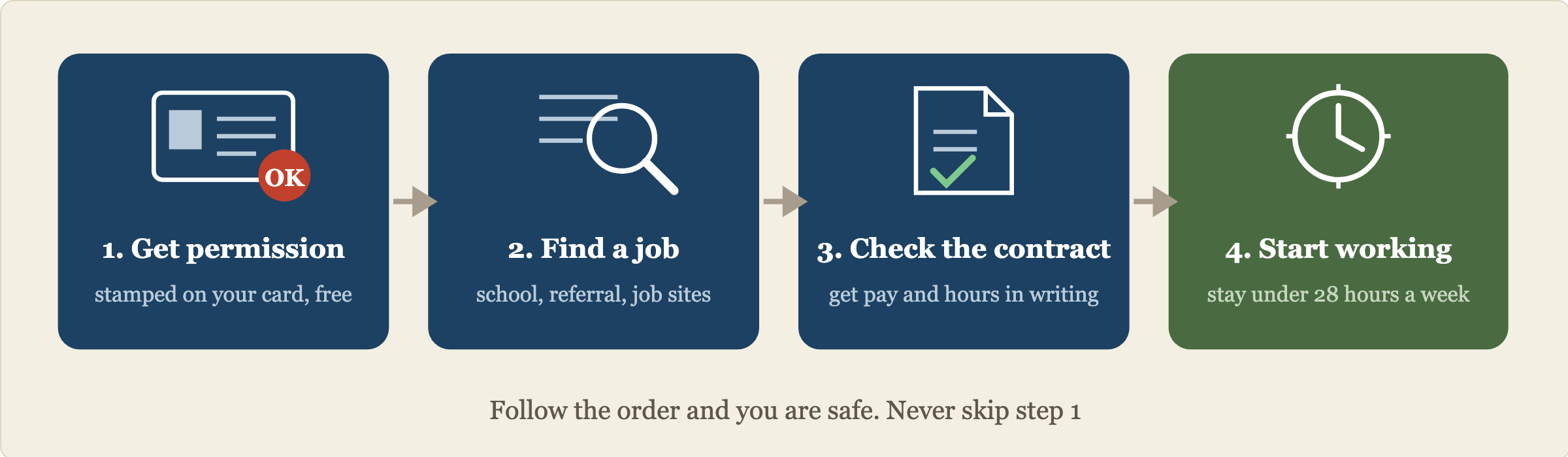
Starting a part-time job (arubaito) in Japan follows a simple order. Follow it and you stay legal without having to think twice.
The work permit: what it is and how to get it (free)
Permission to Engage in Activity Other Than That Permitted Under the Status of Residence Previously Granted is what Immigration calls the work permit that lets a student visa holder take a part-time job. A student visa is issued for studying, so working legally requires this separate authorization.
There are two ways to get it, and both are free:
- On arrival: apply at the airport when you receive your residence card. This is the easiest route for new students
- After arrival: submit the application form at your local immigration office. Some schools handle this for you, so check with your school office first
Once approved, your residence card gets a stamp on the back reading something like “Permitted: up to 28 hours per week, in principle.” Employers check for this stamp during interviews.
Full procedures are on the Immigration Services Agency official page.
The 28-hour rule: the single most important number
Student visa holders can work up to 28 hours a week. Here are the most common misunderstandings, cleared up.
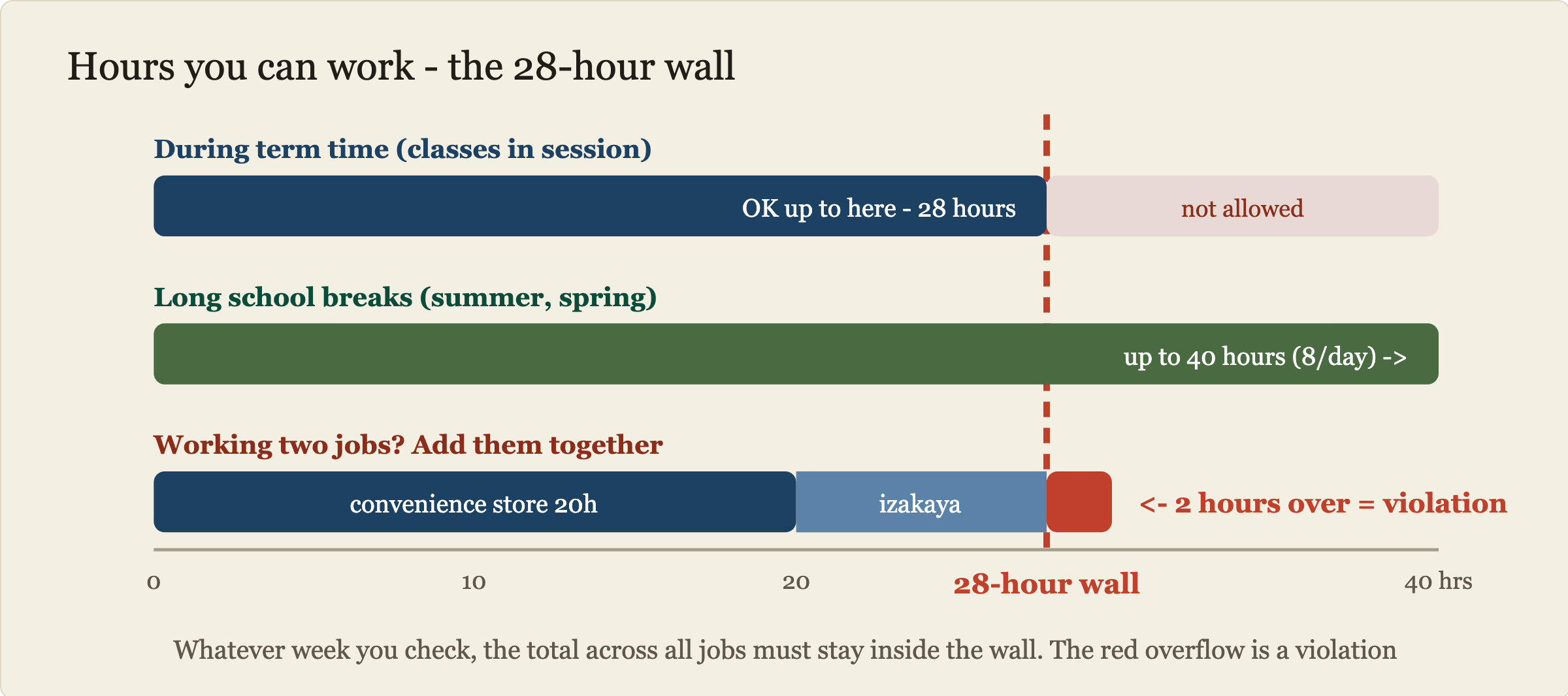
- “Just 30 hours this one busy week” is still a violation: every single week has to stay at or under 28 hours
- Overtime counts too: if your normal shifts already add up to 28 hours, a little overtime pushes you over. Leave yourself some margin
- You cannot work while on leave of absence or after graduating: the permit assumes you are actively enrolled and studying
When does the week start? (counting the 28 hours)
People know the number and still trip here. “One week” does not mean Sunday to Saturday.
Immigration looks at any consecutive seven days. Whichever day you start counting from, the total across those seven days must not exceed 28 hours. Fit exactly 28 hours into Monday-to-Sunday and you can still be over: count Wednesday to the following Tuesday and it might come to 32.
In practice the safest approach is to pick your own start day and keep it fixed. Decide that your week begins on Monday, add up each week, and do the adding before you accept a shift. Counting afterwards changes nothing.
Watch out if you hold two jobs. The 28 hours cover everything you work, added together. Twenty hours at one place and twelve at another is 32 hours, and you are over. Neither employer can see the other’s rota. You are the only person who can track the total.
And going over is not treated lightly. Exceeding by even a few hours counts as a violation. “It was only a little” is not a defence.
Jobs you cannot take, and what happens if you break the rules
Even if your hours are fine, some workplaces are off-limits entirely.
- Anything connected to the adult entertainment industry is banned outright: hostess clubs, snack bars, pachinko parlors, game centers (arcades), mahjong parlors. Even “indirect” jobs there like serving or dishwashing are prohibited
- “High pay, same-day cash” jobs advertised on social media are crimes: “just receive a package” or “just lend us your bank account” for tens of thousands of yen – this is a front for organized crime (yami baito, or dark part-time jobs), and taking one gets you arrested as a criminal. Plenty of Japanese students have fallen for these too. Never apply, and warn your friends about it
If a rule violation is found – too many hours, a banned industry, or no permit at all – here is what can happen:
- Your visa renewal can be denied (meaning you have to leave Japan)
- In serious cases, you can face deportation
- The employer who hired you can also be punished (for aiding illegal work)
Losing your entire study-abroad plan over part-time pay is the biggest possible loss. The hour limit is the one rule you cannot bend.
Four safe ways to find a job
1. Your school bulletin board or career office
Language schools and universities regularly receive job postings from companies that specifically want to hire international students. Jobs found through your school are the safest option – if a problem comes up, the school can step in on your behalf.
2. A referral from a friend or senior student
A referral from someone from your own country lets you ask about pay, duties, and workplace atmosphere before you apply. The downside is it can feel awkward to quit later. Always confirm the terms yourself, regardless of who introduced you.
3. Job sites and apps
Major job sites (Townwork, Mach Baito, Baitoru) screen listings before publishing them, so the risk of a scam job is close to zero. You can filter for “foreigners welcome” or “students welcome,” and apply entirely from your phone.
4. Free government support for foreigners
The Employment Service Center for Foreigners run by the Ministry of Health, Labour and Welfare (in Tokyo, Nagoya, Osaka, and Fukuoka) and regular Hello Work offices help foreign residents find work for free. Some locations have interpreters available.
Popular jobs, typical pay, and how much Japanese you need
By law, hourly pay must meet or exceed the prefectural minimum wage. Since the FY2025 revision, every single prefecture pays at least 1,000 yen an hour (national weighted average 1,121 yen, lowest 1,023 yen). Effective dates ran from October 2025 to the end of March 2026 and differ by prefecture (Tokyo is 1,226 yen). You can check the exact rate for your area on the Ministry of Health, Labour and Welfare list.
| Job type | Typical hourly pay | Japanese level | Good fit for |
|---|---|---|---|
| Convenience store | 1,100 to 1,300 yen | Conversational (N3+) | Using Japanese daily to improve fast |
| Restaurant, front of house | 1,100 to 1,400 yen | Service Japanese (N3+) | Practicing keigo, often comes with a staff meal |
| Restaurant, kitchen | 1,100 to 1,300 yen | Light (N4+) | Starting even if you lack confidence in Japanese |
| Cleaning, hotel | 1,100 to 1,400 yen | Light (N4+) | Short morning shifts around classes |
| Warehouse, factory | 1,200 to 1,500 yen | Just enough to follow instructions | Physical work, earning quietly |
| Interpreter, language tutor | 1,500 yen+ | High (N2+) | Turning your native language into an asset |
There is really only one rule of thumb: choose by pay and by how much it improves your Japanese, together. A customer-facing job pays more than the wage suggests, because every shift is a free Japanese lesson. Learning when to use polite versus casual Japanese also helps at the interview stage.
Getting paid: taxes, and building the basics
Income tax is withheld automatically (source withholding) from your pay. For 2025 income, employment income up to 1.6 million yen a year carries no income tax (950,000 basic deduction + 650,000 minimum employment income deduction); for 2026 income the line is 1.78 million yen (1,040,000 + 740,000, in force from 1 December 2026 and applied in the December adjustment; NTA No. 1199, checked September 2026). The old “1.03 million yen” figure is pre-reform. Year-end adjustment or a tax return can get the overpaid amount back. See our full breakdown in income tax for foreigners in Japan.
Once the money is in your account, three basics protect and grow it:
- Lower your fixed costs: a cheap SIM plan can take your phone bill down to around 1,000 yen a month
- Lower your transfer fees: Wise is the cheapest way to send money home
- Earn points on what you already spend: get a credit card you can actually get approved for as a foreigner
If something goes wrong (unpaid wages, sudden firing)
“My pay never arrived,” “the hourly rate is different from what I was told,” “I was told to quit with no warning” – these are legal problems, not your fault. Do not deal with this alone; here is where to go.
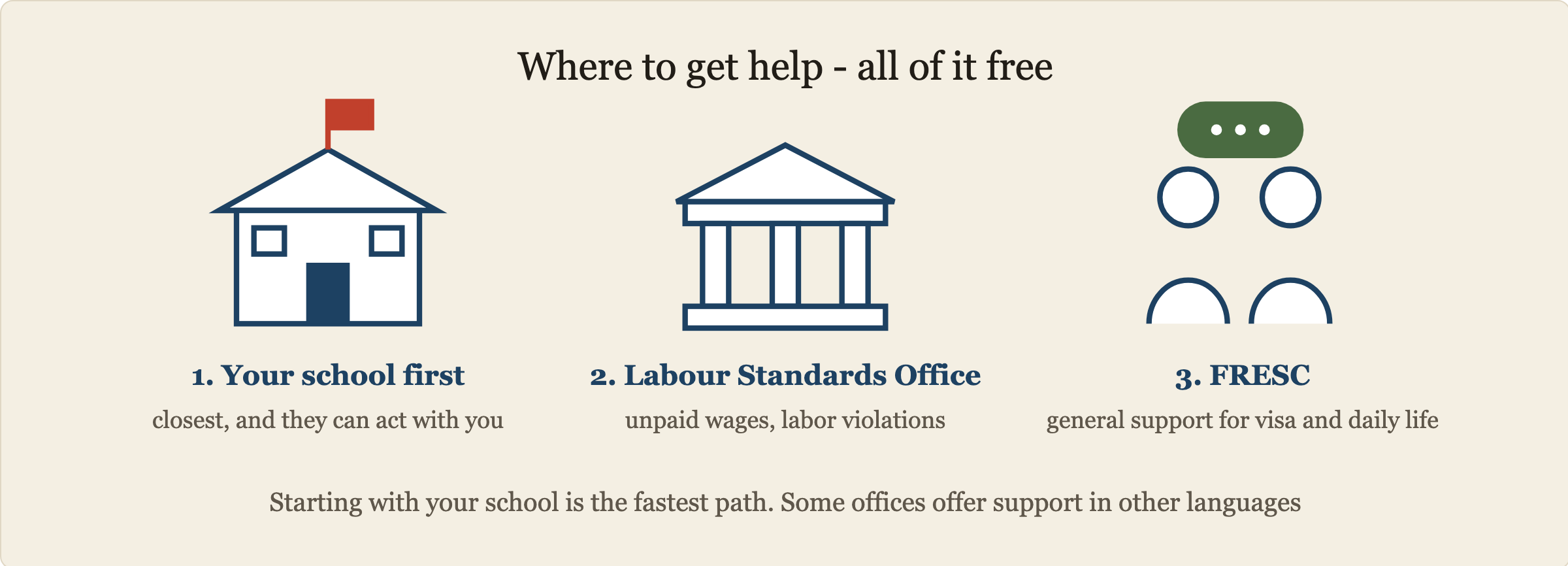
The best prevention is upfront: always get a written statement of working conditions (pay rate, shifts, duties, on paper). If a workplace tells you “there is no paper for that,” it is safer to work somewhere else.
The 28-hour cap also decides your insurance. Joining employer health insurance and the employee pension needs 30 hours a week, so the cap keeps you out of it. That is why nothing is deducted from your pay (student part-time work and social insurance).
Frequently asked questions
Q. What happens if I work without the permit?
It counts as illegal work, which can lead to a denied visa renewal or deportation. Always get the permit before you start working – it is free to apply.
Q. If I go over 28 hours just once, do I get deported right away?
One small overage will not trigger immediate deportation, but it is recorded and can count against you at your next visa renewal. The dangerous mindset is thinking “just once is fine.”
Q. Can I work two part-time jobs at once?
Yes. But the combined hours across every job must stay within 28 hours a week – the limit is not 28 hours per job.
Q. Are there jobs available if my Japanese is still around N4?
Yes. Kitchen work, cleaning, hotel bed-making, and warehouse or factory jobs need less Japanese to start. A common path is starting there, building your Japanese on the job, then moving into a higher-paying customer-facing role.
Q. I was offered less than minimum wage.
That is illegal. Minimum wage applies to foreign workers exactly the same as anyone else. Decline the offer and report it to the Labour Standards Inspection Office or your school.
Q. How much can I work during long school breaks?
During official long vacation periods set by your school (summer, spring, and so on), Immigration allows up to 8 hours a day. Separately, the Labour Standards Act caps you at 40 hours a week. Remember to drop back to 28 hours once the break ends.
Summary
- Get your work permission (free) before you take a single shift
- Stay within 28 hours a week, counting every job combined
- Adult-entertainment jobs and “easy money” social media offers can end your time in Japan – avoid both completely
- Search through your school, a referral, a major job site, or the free government center
- Minimum wage is at least 1,000 yen nationwide by law. Choose by pay and by how much your Japanese improves
- Never handle a workplace problem alone – go to your school, the Labour Standards Office, or FRESC
Related guides
Found this useful? Share it
Send it to a friend who lives in Japan.
You need an account for your wages. Which bank will take you depends on how long your visa still has to run.
Bank Account in Japan as a Foreigner →WHO WROTE THIS

mori
Japanese. I read the ministries’ own notices, orders and Q&As in the original, and I start from what my Nepalese and Sri Lankan friends in Japan actually ran into. I do not write about what I have not checked or been told.
What this site can and cannot do →Looking for something else?