Checked on 23 September 2026 against the Immigration Services Agency’s internship guidance and its pages on permission to work for students, the internship agreement of the education, labour and industry ministries, the Cabinet Secretariat’s hiring schedule, and official pages from the Osaka and Nagoya Employment Service Centers for Foreigners and JASSO.
The short answer
- A paid internship needs permission to work. On a Student visa, pay turns an internship into “activity for reward”, the same as a part-time job.
- Up to 28 hours a week (8 hours a day during your school’s long breaks), the standard work permit for students covers it. If you already have it, there is nothing new to apply for.
- Over 28 hours a week, you need a separate individual permit. It is mainly for final-year undergraduates who have about 90% of their graduation credits, and final-year graduate students. A practicum you need for credit, closely tied to your major, can also qualify. Review takes two weeks to two months and there is no fee.
- An unpaid internship needs no permission to work. Immigration says so directly.
- Coming from a university abroad? Paid means Designated Activities (No. 9). Unpaid means Cultural Activities for over 90 days, or Temporary Visitor for 90 days or less.
Knowing this, you can ask “Is it paid?” and “How many hours a week?” the moment a company invites you, and know on the spot whether you need a permit and when to apply. You avoid starting an internship that quietly breaks the work rules.
Your professor introduces you to a company. “Come and intern with us for two weeks in February. We will pay by the hour.” Nine to six, Monday to Friday. Your Japanese friends say, “Great, go for it.” But is that over 28 hours a week? Has your spring break started, or are classes still on? Your friends have never had to count. Japanese students have no cap on their working hours.
- Can international students do an internship in Japan?
- Paid internships: are you under 28 hours a week?
- Over 28 hours a week: who can get the individual permit?
- What about a practicum you need for credit?
- Do I need a visa or permit for an unpaid internship in Japan?
- Internship visa for students at universities abroad: Designated Activities No. 9
- Where to find an internship in Japan as an international student
- How much does it cost?
- Does an internship lead to a job offer in Japan?
- What if I break the rules?
- Which one are you?
- FAQ
- Summary
- Related reading
Can international students do an internship in Japan?
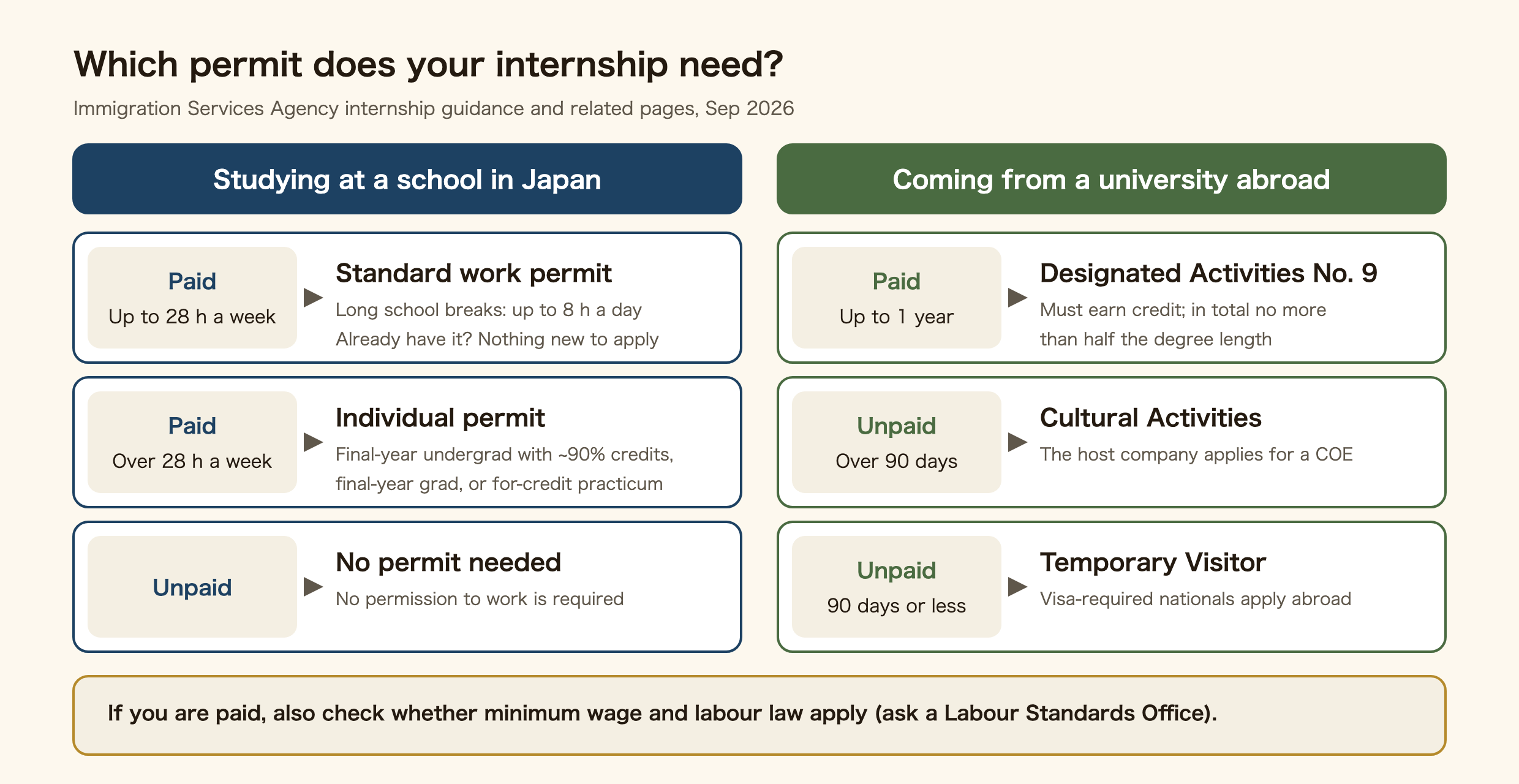
Yes. What you need depends on two questions: is it paid, and how many hours a week?
The Student status (ryugaku) is for studying at a school. Anything else you do “for reward” needs permission to engage in activity other than that permitted, usually called the work permit for students (Immigration Control Act, Article 19). Calling it an internship does not change this. If you are paid, it is activity for reward.
The Immigration Services Agency has a guidance page for students thinking about internships. It sorts them into three cases:
- Paid, up to 28 hours a week — the comprehensive (standard) work permit, the same one you use for a part-time job
- Paid, over 28 hours a week — an individual permit, on top of the standard one
- Unpaid — no permission to work needed
The same guidance also covers people on the post-graduation job-hunting status and people on the status for those waiting to start a job after an offer.
Paid internships: are you under 28 hours a week?
Up to 28 hours a week, a paid internship falls inside the standard permit. If the back of your residence card shows the work permit (in principle up to 28 hours a week), Immigration says you do not need to apply again for the internship.
Three things to watch when you count:
- The 28 hours cover all paid activity. If you keep your part-time job during a paid internship, add both together
- During the long breaks set in your school’s rules (summer, winter, spring), the limit is 8 hours a day instead
- Whether you are “on a break” depends on the dates in your school’s rules — not on the company’s plans or how light your timetable is
Take the February example. If spring break has started, check the 8-hour daily limit: nine to six with an hour’s lunch is 8 hours, so it fits. If classes are still on, five days of 8 hours is 40 hours, and the standard permit does not cover it. The finer points of counting the week are in the 28-hour rule for student jobs.
Pay has its own rules too. Immigration’s internship guideline explains that if you do the company’s work under its direction, you count as a worker under the Labour Standards Act even when the internship has an educational side, and minimum wage applies. Check the hourly rate against the minimum wage in your prefecture before you start.
Over 28 hours a week: who can get the individual permit?
An internship over 28 hours a week needs an individual permit, separate from the standard one. Immigration says it is, in principle, for:
- Students at a university (not a junior college) who will finish their final year at the end of the academic year of the internship and have nearly all the credits they need to graduate. Immigration has in mind “fourth-year students with 90% or more of their credits”
- Graduate students who will finish their final year at the end of that academic year (second-year master’s or third-year doctoral students)
This permit is for internships that are work experience as part of job hunting, which is why it is limited to students close to graduating. A third-year student doing a 40-hour week during term is, in principle, outside it.
You apply with:
- The application form (the same form for the standard and individual permits)
- A document from the company certifying the activity, or your contract with it, showing the work, period, hours, place and pay
- A certificate of enrolment
- For undergraduates, a document showing the credits needed to graduate and the credits you have (such as a transcript)
You apply at the regional immigration office for where you live, and there is no fee. The standard review time is two weeks to two months, so apply at least two months before the internship starts. You cannot start work before the permit is granted.
What about a practicum you need for credit?
If you are not in your final year, there is still a way. Immigration says that where the internship is closely tied to your major, such as a practicum you need to earn credit, you can get the individual permit for over 28 hours.
Think of a company placement built into your department’s curriculum and counted as credit. If it is paid and runs over 28 hours a week, confirm with your school whether it fits this exception, and apply with the practicum plan and documents showing the credit.
Immigration decides each case individually. The type of school or your year alone does not settle it. Do not decide for yourself; go through your international office or careers centre.
Do I need a visa or permit for an unpaid internship in Japan?
Not if you are already here on a Student visa. Immigration’s guidance says a student doing an internship without pay does not need permission to work in advance. The permission exists for activity for reward, and there is none.
In fact, public internship programmes are mostly unpaid. The Osaka Employment Service Center for Foreigners says its internships carry “no pay”, and Nagoya says companies “do not need to pay” students. JASSO’s job-hunting guide notes that in most cases interns receive no pay from the company.
One catch: “unpaid” may still come with help towards travel or lunch. The Nagoya centre mentions companies that consider this. Nothing official draws a general line on whether such help counts as reward. If any money changes hands, ask your school or Immigration before you start.
Internship visa for students at universities abroad: Designated Activities No. 9
This section is for people not enrolled at a school in Japan. If you are studying at a university at home and want to intern at a Japanese company, your status depends on pay and length.
| Pay | Length | Status of residence |
|---|---|---|
| Paid | Up to 1 year | Designated Activities (Public Notice No. 9) |
| Unpaid | Over 90 days | Cultural Activities (the host company applies for the COE) |
| Unpaid | 90 days or less | Temporary Visitor (visa-required nationals apply before coming) |
No. 9 comes with conditions. You must be enrolled in a degree programme. The internship must be part of your university’s curriculum, for example by earning credit. It can last up to one year, and in total no more than half the length of your degree (two years in total for a four-year degree). Immigration’s guideline adds that you must be 18 or over when you enter, and that work mainly made up of repeating the same task, or work at a company you are dispatched to, is not allowed.
It starts with a Certificate of Eligibility (COE) before you travel. You need the contract between your university and the company, your university’s approval or recommendation, a plan showing how it links to your credits, and more. You can use an agency, but the guideline says an agency cannot act as the proxy for the COE application.
Where to find an internship in Japan as an international student
On the public side, the Ministry of Health, Labour and Welfare’s Employment Service Centers for Foreigners run internships for international students. This is what their official pages said in September 2026:
- Osaka: for international students at universities and graduate schools in Japan. Summer (July to September) and spring (February to March), about one to two weeks (at least five days). You need an entry sheet and a recommendation from your university. The 2026 summer round has ended, and the next one will be announced on the page
- Nagoya: spring 2027 runs for five to ten days between 25 January and 19 March. For international students at universities and graduate schools, in principle at JLPT N2 level or above. Student recruitment is planned from early October, with an online briefing on 9 October
Neither pays, and the labour bureau covers accident insurance. Osaka asks you to start by contacting your own university’s careers centre. The centres’ addresses and interpreter languages are in the guide to the four Employment Service Centers.
There are other doors. JASSO’s guide sorts internships into those run as university courses (for credit), those posted through your careers centre, and those companies advertise on job sites or their own websites, which may involve document screening or interviews. Some chambers of commerce also take internship applications.
Knowing which companies hire international students helps you pick where to intern. In where international students actually get hired, more than half went to companies with under 100 employees.
How much does it cost?
| Item | Cost |
|---|---|
| Permission to work (standard or individual) | Free |
| Employment Service Center internships | No fee listed; insurance paid by the labour bureau / the state |
| COE (students from abroad) | Free |
| Travel and lunch | Depends on the company |
Immigration charges nothing for internships. What costs you is travel, and the part-time pay you lose while interning. If you do a two-week unpaid internship, budget for two weeks with less income from your job.
If you come from abroad on No. 9, housing or utilities may be deducted from your pay. The guideline requires companies to spell out in the contract what is deducted and how much. Read the contract for any deduction that is not written down before you sign.
Does an internship lead to a job offer in Japan?
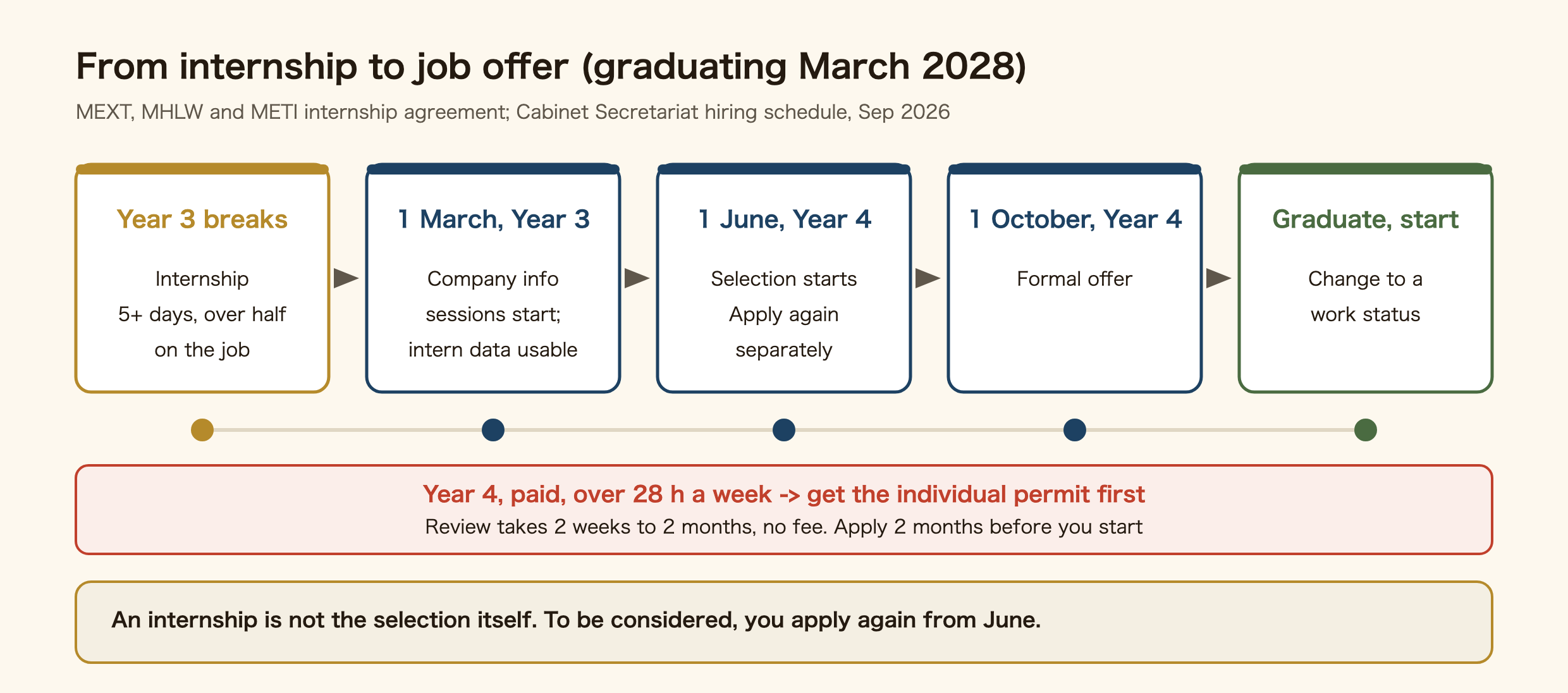
In June 2022, the education, labour and industry ministries revised their shared rules on internships. The change applies to internships from the 2023 academic year, starting with students graduating in March 2025.
The biggest change: companies may now use what they learn about students in internships that meet set standards (Type 3). The standards are:
- More than half the days are spent working in the workplace
- Staff supervise the student and give feedback at the end
- At least five days for the general-skills type, at least two weeks for the specialist type
- Held during the long breaks of years 3 and 4 (or master’s years 1 and 2)
- The recruitment notice says the company will use student information in hiring
But companies may use it only after information sessions and selection officially begin. For students graduating in the 2027 academic year (March 2028), the government asks for information sessions from 1 March, selection from 1 June, and formal offers from 1 October. Students judged highly skilled through a specialist internship of two weeks or more held from spring break onward can move into selection before June. An internship is still not hiring in itself: to be considered, you apply again. The Nagoya centre says its own programme “does not aim at direct hiring”.
Once you have an offer, the next step is your status. To start work after graduating, apply for a change from Student to a work visa. If you graduate from a university or similar without an offer, you can keep looking on the job-hunting visa after graduation. Immigration says paid internships during that time also need permission to work, and the individual permit is available above 28 hours.
What if I break the rules?
A paid internship without permission, or going over 28 hours a week on the standard permit, breaks Article 19 of the Immigration Control Act. The penalty is up to one year’s imprisonment or a fine of up to 2 million yen, or both (Article 73). If you are clearly found to be mainly doing unpermitted paid work, it rises to up to three years or 3 million yen (Article 70), and it is also a ground for deportation (Article 24).
“It’s an internship, not a job” is not a defence. Immigration looks at whether you are paid and for how many hours, not at the name. If you realise mid-way that you will go over 28 hours, talk to the company and your school that same week, and either cut the hours or apply for the individual permit.
Which one are you?
- Paid, up to 28 hours a week (or up to 8 hours a day on a long break) — check the back of your residence card for the work permit. If it is there, nothing new to apply for. Today, write down your total weekly hours, part-time job included.
- Paid, over 28 hours a week during term — check whether you are a final-year undergraduate with about 90% of your credits, a final-year graduate student, or on a for-credit practicum. If so, ask the company today for a contract or certificate and apply at least two months before the start. If not, ask the company to bring the hours under 28.
- Unpaid — no permit needed. If travel or lunch money is offered, ask your international office today whether it counts as reward.
- At a university abroad, wanting to intern in Japan — pick the status by pay and length, and confirm with your university that it earns credit. Today, ask the host company whether it will apply for your COE.
FAQ
Q. Do international students need permission for a paid internship in Japan?
Yes. A paid internship is activity for reward, so you need permission to work. Up to 28 hours a week (8 hours a day during long breaks), the standard work permit for students covers it, and if you already have it there is nothing new to apply for.
Q. Can I do an internship of more than 28 hours a week?
Yes, with an individual permit. It is mainly for final-year undergraduates with nearly all their graduation credits (Immigration has 90% or more in mind) and final-year graduate students. A practicum closely tied to your major, such as one needed for credit, can also qualify.
Q. Do I need permission for an unpaid internship in Japan?
No, not on a Student visa. The Immigration Services Agency says unpaid internships do not need permission to work in advance. If travel or other money is offered, ask your school or Immigration whether it counts as reward.
Q. How long does the individual permit take?
The standard review time is two weeks to two months, and there is no fee. You cannot work until it is granted, so apply at least two months before the internship starts.
Q. What visa do students from universities abroad need for an internship in Japan?
If paid, Designated Activities (Public Notice No. 9): up to one year, no more than half your degree length in total, and part of your curriculum, such as earning credit. If unpaid, Cultural Activities for over 90 days, or Temporary Visitor for 90 days or less.
Q. Does an internship lead to a job offer in Japan?
Companies may use information from internships that meet set standards once information sessions and selection begin. But an internship is not hiring in itself, and you need to apply again to be considered.
Summary
For an internship in Japan as an international student, check two things first: is it paid, and how many hours a week? Paid and up to 28 hours, your standard work permit covers it. Over 28 hours, you need an individual permit, mainly for final-year students or for-credit practicums. Unpaid, you need no permit.
From a university abroad, paid means Designated Activities No. 9, and unpaid means Cultural Activities or Temporary Visitor depending on length. An internship can bring you closer to an offer, but it is not the selection, and you apply again. The individual permit can take two months, so when an offer to intern comes, count the hours first.
Official sources: Immigration Services Agency, guidance for those seeking internships (Japanese) / ISA, permission to work for Student status (Japanese) / ISA, application for permission to work (Japanese) / ISA, Designated Activities: internship, summer job, cultural exchange (Japanese) / MEXT, internship promotion and the three-ministry agreement (Japanese) / Cabinet Secretariat, 2027 graduates hiring schedule (Japanese) / Osaka Employment Service Center for Foreigners / Nagoya Employment Service Center for Foreigners / JASSO, job-hunting guide for international students. Checked on 23 September 2026. Always confirm with your school and Immigration before you apply.
Related reading
Found this useful? Share it
Send it to a friend who lives in Japan.
WHO WROTE THIS

mori
Japanese. I read the ministries’ own notices, orders and Q&As in the original, and I start from what my Nepalese and Sri Lankan friends in Japan actually ran into. I do not write about what I have not checked or been told.
What this site can and cannot do →Looking for something else?