ABOUT
A practical guide to money, housing, work and visas
for people living in Japan.
Every guide is written twice, in English and in Japanese, with the same content.
What this site writes about
It does not stop at explaining the rules. The 28-hour work limit, the word NISA, the five years on a residence card: the rules change within a few years. And once you leave Japan, some of them stop applying at all.
So before any individual technique, this site fixes the order in which to build your footing: Protect, Save, Earn, Grow, Spend well. These are the “five skills.” The techniques go out of date. The order does not.
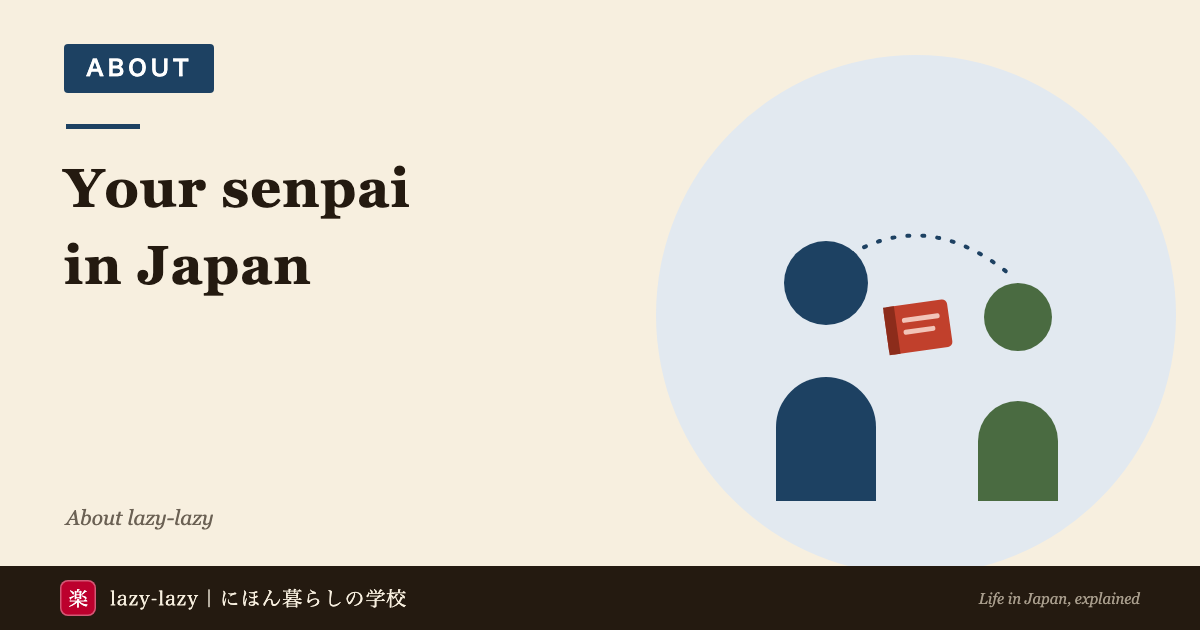
You just have no senpai
I am Japanese. When I was a university student, my senpai (a senior) told me things like “that restaurant is cheap” and “this will be on the test,” and it helped me again and again. He had been taught by his own senpai. Japanese people receive knowledge this way, so nobody looks it up.
Someone who has just arrived from abroad has no such senpai. Nobody explains the difference between deposit and key money, the 28-hour work limit, or that you can refuse a move-out charge.
On top of that, the information is split in two. Japanese articles are full of kanji and technical terms. English articles are written for a stay of a few months, with no tax, no pension and no visa renewals. People who live in Japan for years fall into the gap between them.
This is not about your ability or your Japanese. So this site writes down what a senpai would have done: telling you before you have to ask.
Why you can trust it
Numbers and procedures are checked against official sources before I write them
The Immigration Services Agency, the National Tax Agency, the Ministry of Land, the Ministry of Health, Labour and Welfare and others. I open the original document, not a roundup of it. When something is still undecided, I write that it is under discussion.
Every guide is written in English and in Japanese, with the same content
Read it in English, then read it again in Japanese, and it doubles as Japanese practice. Every guide has diagrams, so the key points stay with you even if you do not read every line.
The Japanese is simple, but never less accurate
The Japanese versions are written at about JLPT N2. Simple is not the same as sloppy.
Who writes this?
This site is run by mori, a Japanese person. It started with problems I heard from friends from Nepal and Sri Lanka living in Japan. Far too many of them ended with “if you had asked me, I could have told you.”
I have never lived in Japan as a foreigner. So I do not invent experiences. Rules and numbers are checked against official sources, and the problems come from what people actually told me.
The order to build your footing (the five skills)
The order is fixed because if your defence is weak, you lose as much as you earn.
- 1. Protect: keeping your visa status, contract trouble, health (top priority)
- 2. Save: fixed costs, remittance fees, tax refunds
- 3. Earn: part-time work, Japanese, changing your visa
- 4. Grow: brokerage accounts, NISA, pension refunds
- 5. Spend well: family, culture, the life you build here
Your first step (five minutes today)
You do not need to read everything. Pick the one guide closest to your situation now.
- Just arrived → registering your address and national health insurance. Everything else starts here
- Nothing left at the end of the month → remittance fees. You send again and again, so the difference adds up
- Sending money to family → the dependent deduction. How you send changes how much you can claim
- Your residence card says a 3-year period of stay → the permanent residency guide. From April 2027, the period of stay required for permanent residency changes
- Not sure → start with Protect. The order begins there
Browse the archive (English) →
One request
If this helped, pass it to a friend or to someone who arrived after you. Every time you tell someone one of these things, that person does not lose the money you almost lost. Senpai to kohai is not a Japanese-only thing.
Frequently asked questions
Who runs lazy-lazy?
mori, a Japanese writer. The site plays the role of the senpai you do not have yet, with facts checked against official sources such as the Immigration Services Agency and the tax office.
Is lazy-lazy free to read?
Yes, everything is free (as of 2026). Some guides contain clearly marked affiliate links, and they never change the advice.
Can I read the guides in Japanese?
Yes. Key guides have Japanese versions in simple JLPT N2 Japanese. Use the language badge at the top of each guide to switch.
Is this only useful while I live in Japan?
The guides explain current Japanese rules, and those rules change within a few years. Some stop applying once you leave Japan. What stays useful is the order the five skills are built in: Protect, Save, Earn, Grow, Spend well. Start from whichever guide fits your situation now.
Found this useful? Share it
Send it to a friend who lives in Japan.
WHO WROTE THIS

mori
Japanese. I read the ministries’ own notices, orders and Q&As in the original, and I start from what my Nepalese and Sri Lankan friends in Japan actually ran into. I do not write about what I have not checked or been told.
What this site can and cannot do →Looking for something else?