This article contains affiliate links.
Last updated: 18 October 2026
Figures, prices and terms were checked against MUFG Bank’s foreign exchange fee schedule and Wise’s official pages on 18 October 2026. They change — check the current terms yourself before you sign up or file anything.
In short
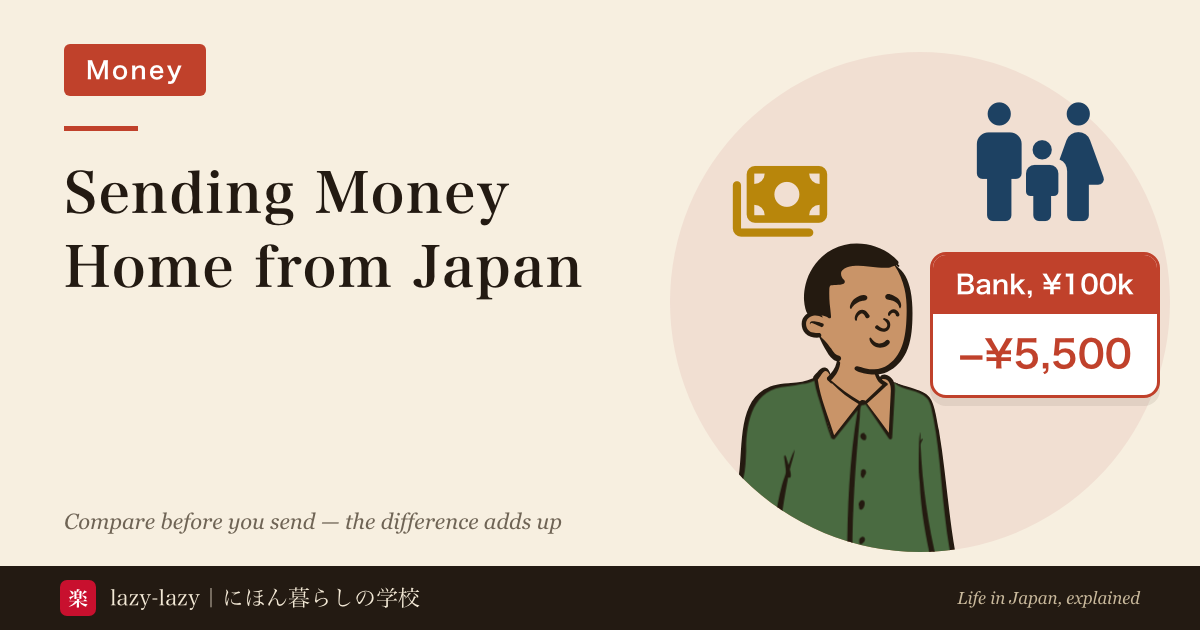
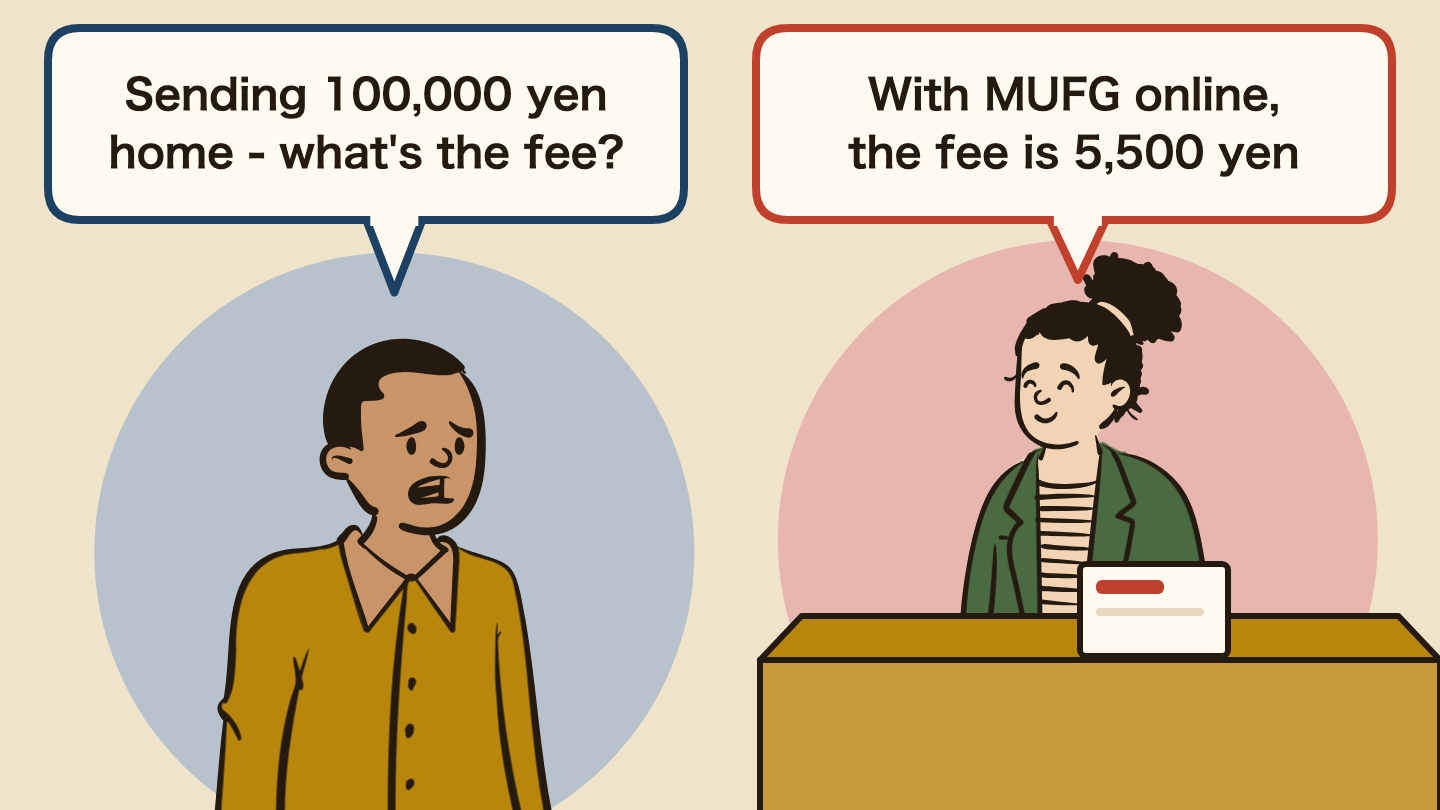
- Banks cost more than people think. Sending 100,000 yen in yen online with MUFG Bank costs 5,500 yen in fees (3,000 yen sending fee + 2,500 yen handling fee for yen-denominated transfers). Online transfers are recipient-pays only, so the receiving bank’s fee falls on your family’s side. At a branch counter it is 9,500 yen (7,000 yen sending fee + 2,500 yen), or 12,500 yen if you also pay the paying bank’s 3,000 yen fee (published fee schedule, checked 18 October 2026).
- The cost of converting yen into local currency comes on top of this. It is not in any fee table, so you do not notice it.
- If your family can receive into a bank account, Wise is a strong option. It uses the real exchange rate and shows the fee as a number before you send, so you know what will arrive.
- If your family wants cash, use IME or Prabhu (Nepal-focused remittance companies) or Western Union.
- Which one is cheapest changes with the amount, the currency and that day’s rate. Do not take the numbers here on trust; compare what arrives with your own amount before you send.
- Before you send, check what will arrive on two services. That alone can be worth tens of thousands of yen a year.
Knowing this, you see the 5,500 yen the bank takes from every 100,000 yen you send – and from your next transfer, that money reaches your family.
- Your monthly transfer is losing money without you noticing
- Only know the bank, or still using a friend’s method? Worth a second look
- Send 100,000 yen – how much arrives?
- Four main ways to send (comparison)
- Which one is for you? Choose by how your family receives the money
- How to send with Wise (4 steps)
- Traps to avoid
- Frequently asked questions
- Do I need a credit card to send money home?
- Can I use Wise if my period of stay is short?
- Which banks in Nepal and Sri Lanka can I send to?
- My family has no bank account and wants cash. What should I use?
- Is there tax on money I send home?
- How long does it take to arrive?
- What is the cheapest way to send money home from Japan?
- Why do banks deliver less?
- Summary: compare what arrives, just once
- Related guides
Your monthly transfer is losing money without you noticing
Working in Japan and sending money to family at home is an important monthly job for many people from Nepal and Sri Lanka. But every transfer loses money to fees and the exchange rate, and most people never see how much.
Fees alone are 5,500 to 12,500 yen for every 100,000 yen. The cost of converting yen into local currency comes on top of this. If you send every month, the choice of method is worth tens of thousands of yen a year – close to one month’s rent. Separately from fees, when the yen weakens, the same yen delivers less. For anyone who earns in yen and sends money home, a weak yen works like inflation.
Only know the bank, or still using a friend’s method? Worth a second look
Most people use whatever a senior or a friend showed them when they arrived, and keep using it. That is natural – but it is worth comparing once, properly, because the difference is larger than most people expect.
And there is a hidden reason why banks cost more.
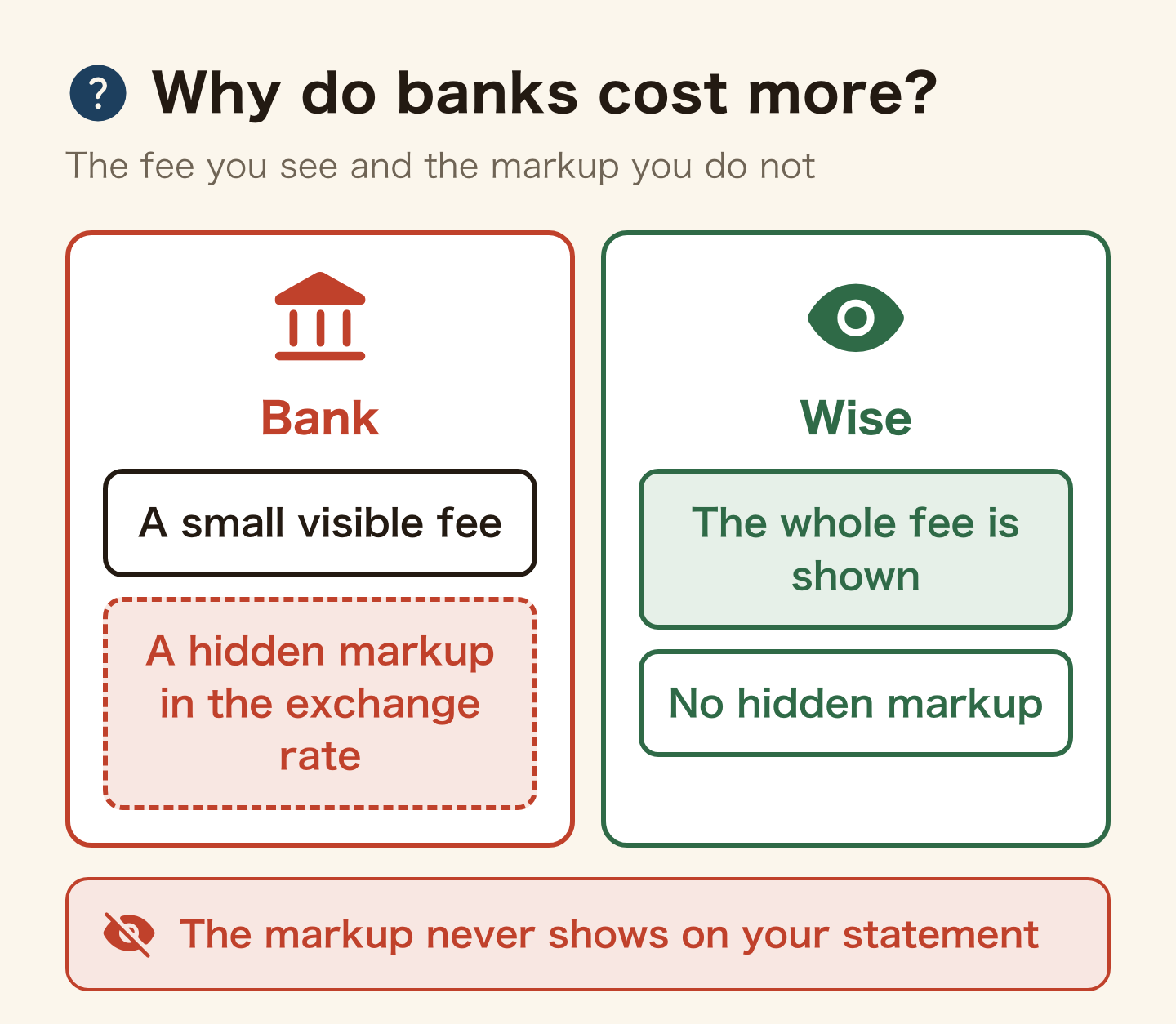
Banks advertise a low sending fee, then add a mark-up to the exchange rate instead. That mark-up never appears on your statement – it is why less money seems to arrive than you expected.
Wise uses the mid-market rate, the same real rate you see when you search on Google, and charges its fee separately as a number (Wise official page). You still pay, but you can see what you are paying for.
Send 100,000 yen – how much arrives?
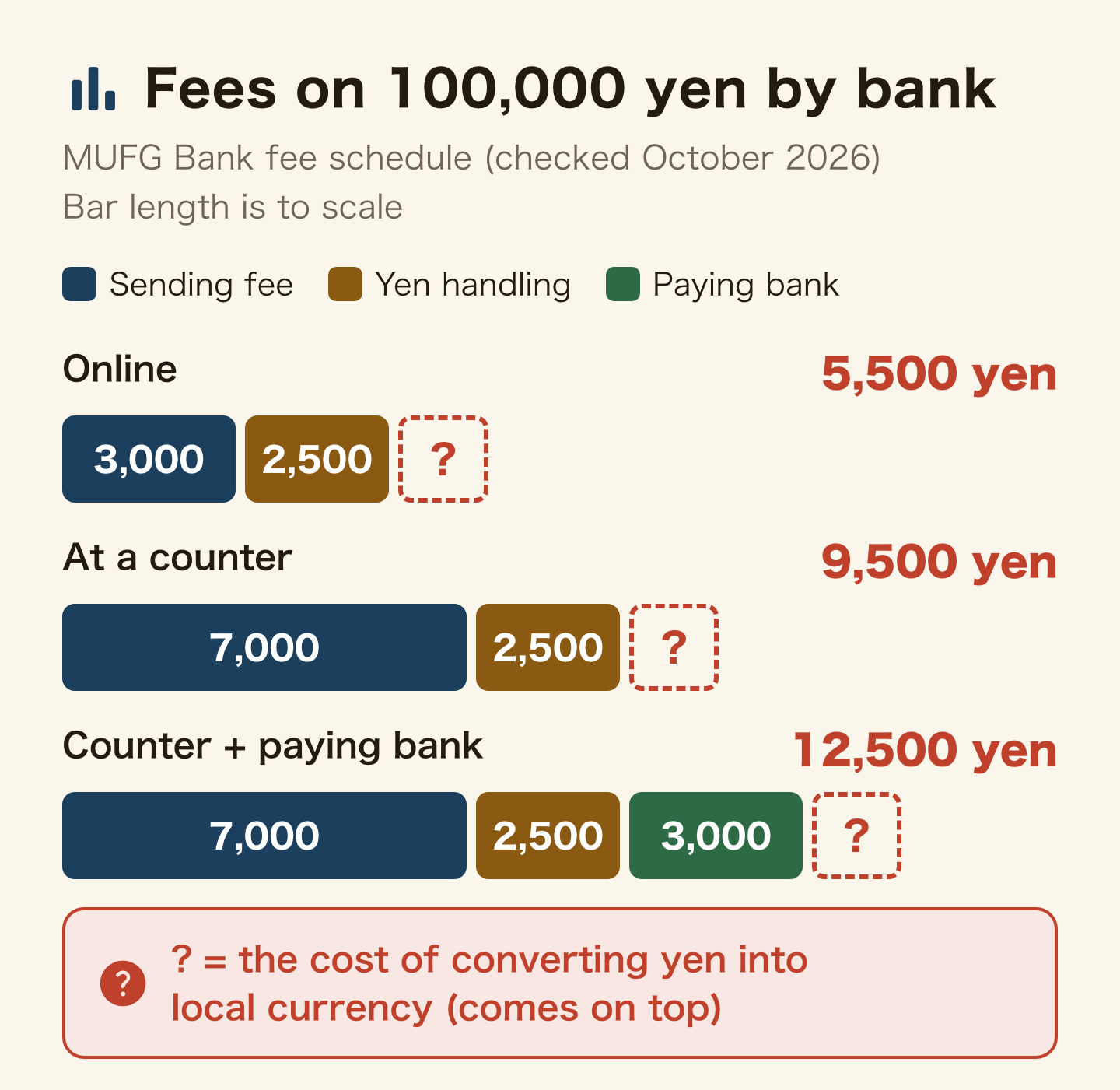
These amounts are a guide and change with the rate and the amount. That is exactly why you should check “how much will arrive” before every transfer.
Four main ways to send (comparison)
| Method | Cost | Speed | Recipient gets it | Good for families who |
|---|---|---|---|---|
| Wise | Low (shown as a number before you send) | Usually within seconds (Wise’s past average) | Bank account | Have a bank account |
| IME / Prabhu | Varies – check | Fast | Cash or bank | Want cash |
| Western Union | Varies by amount and country – check | Same day-few days | Cash at a shop | Have no bank account |
| Bank transfer | High (MUFG Bank: 5,500-12,500 yen per 100,000 yen, plus the conversion cost) | Depends on the bank and country | Bank account | (Not recommended – expensive) |
Wise (formerly TransferWise)
Wise uses the real exchange rate (the rate between banks) and shows its fee as a number before you send. Its biggest strength is that you see exactly how much your family will get before you confirm. Everything is done online, and your family receives the money in their own bank account. It supports both Nepal (NPR) and Sri Lanka (LKR).
We do not print Wise’s fee here, because it changes with the amount, the currency and the rate that day. Check the real number with your own amount before you send – being able to do that is the point of the service.
It has two weak points. It is online only, with no shop counter. And your family needs a bank account.
IME and Prabhu (Nepal-focused remittance companies)
Nepal-focused remittance companies, some with counters in Japan. Before using one, check it appears on the FSA list of registered fund transfer providers (Japanese). Your family can collect cash. If your family has no bank account or lives far from a bank, this is often the practical choice. Fees change with the amount and promotions, so check on the day you send.
Western Union and bank transfer
Western Union offers cash pickup worldwide, and your family does not need a bank account. Its fees vary with the amount and country, so check on the day you send. A bank transfer goes from a Japanese bank such as MUFG, SMBC or Mizuho straight into your family’s account. It feels safe, but the published fee schedule alone shows 5,500-12,500 yen for every 100,000 yen. The cost of converting yen into local currency also comes on top of this. For a bank transfer, the time depends on the bank and country. It tends to be expensive. The larger the amount, the more it pays to compare.
Which one is for you? Choose by how your family receives the money
Do not choose by fee alone. Decide by how your family can receive the money.
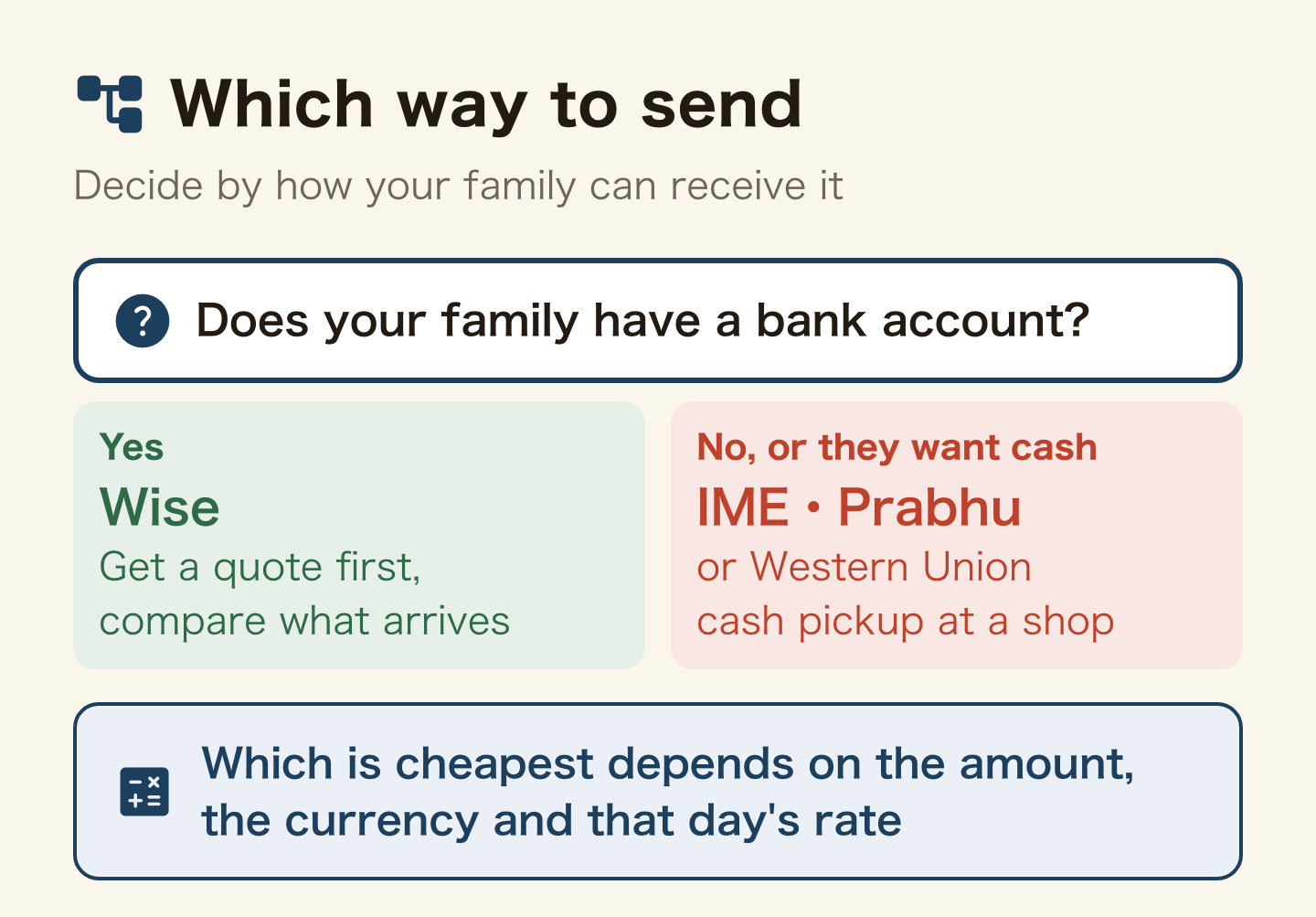
If your family can receive into a bank account, start with a Wise quote, because you see what arrives before you send. Then compare that amount with other methods before you decide.
Bonus when you sign up through this site
Starting from an invite link gives you a fee-free transfer offer (check Wise’s terms for the conditions).
How to send with Wise (4 steps)
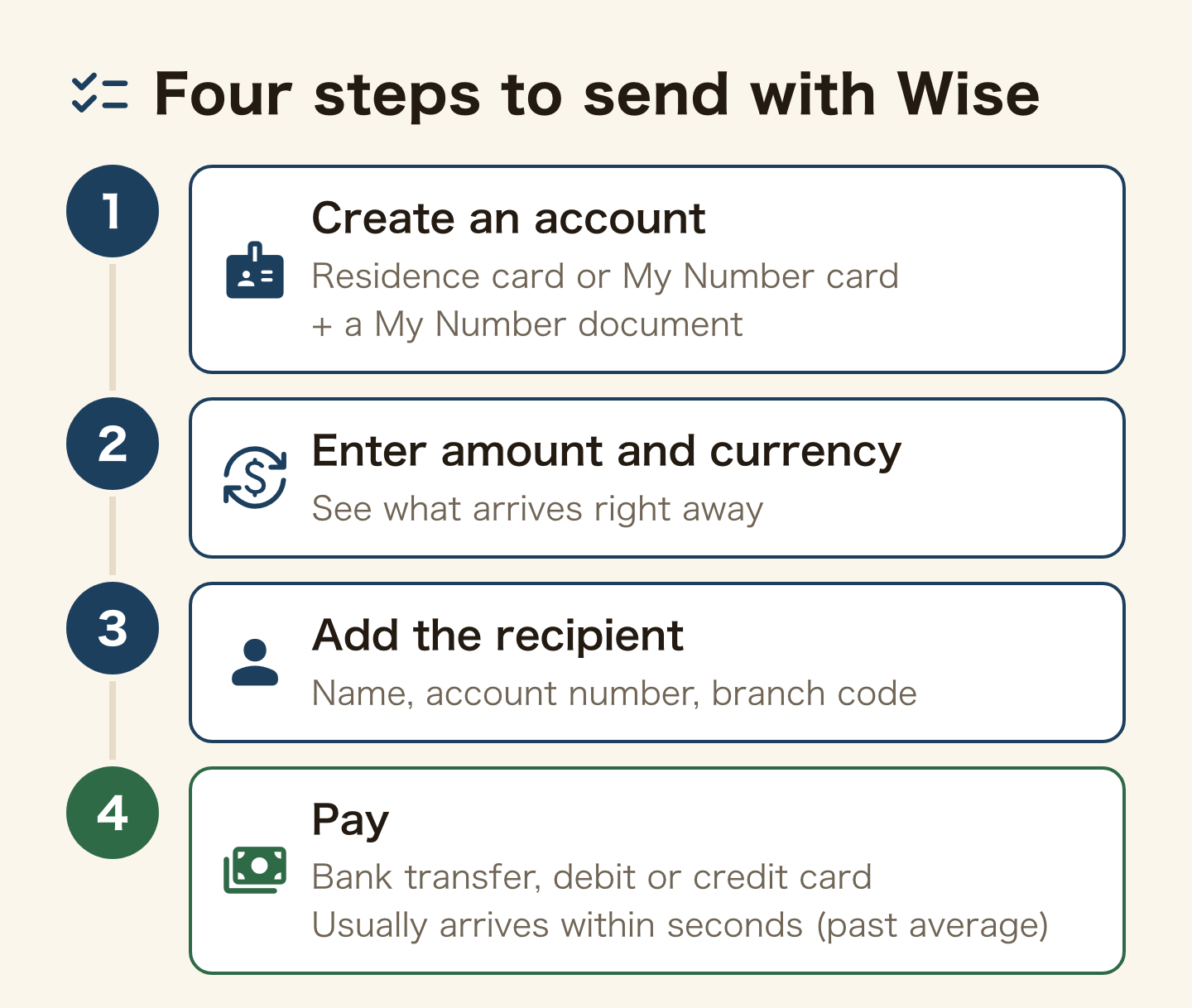
- Create an account: sign up free on the website or app and verify your identity. If you live in Japan, you submit your residence card (在留カード) or My Number card, plus a document showing your My Number, such as a juminhyo (not needed if you verified with your My Number card) (Wise Help Centre).
- Enter the amount and currency: JPY to Nepalese rupees or Sri Lankan rupees. The amount your family will receive appears right away.
- Add the recipient: your family member’s name, bank account number and branch code.
- Pay: by Japanese bank transfer, debit card or credit card. It usually arrives within seconds (Wise’s past average).
Traps to avoid
1. Looking only at the fee table and thinking “the bank is cheaper”
Banks show a low fee and add to the exchange rate. Compare the final amount your family receives, not the fee.
2. Using a money app on public Wi-Fi
Free Wi-Fi in cafés and stations is risky. Use money and bank apps on your own mobile line (a budget SIM) or a safe connection at home.
3. Trying to send a large amount without knowing the limit
How much Wise lets you send depends on how you pay. Sending from your Wise balance is capped at 1,000,000 yen per transfer. Paying by bank transfer or another method lets you send up to 150,000,000 yen per transfer (Wise Help Centre). Before sending a large amount, check the current limit in the Help Centre.
Official sources: MUFG Bank foreign exchange fees (Japanese) / Wise: sending money to Nepal (Japanese) / Wise: sending money to Sri Lanka (Japanese) / Wise: getting verified in Japan / Wise: large transfers if you live in Japan / Ministry of Internal Affairs and Communications: safe use of Wi-Fi (Japanese) (checked 18 October 2026)
Frequently asked questions
Do I need a credit card to send money home?
No. You can send from a Japanese bank account or with a debit card.
Can I use Wise if my period of stay is short?
Wise’s Help Centre sets no minimum length of stay. If you live in Japan, you verify with your residence card or My Number card plus a document showing your My Number (Wise Help Centre). Requirements can change, so check on screen when you register.
Which banks in Nepal and Sri Lanka can I send to?
The money goes into your family’s local bank account. Check on screen that their bank is available when you add the recipient.
My family has no bank account and wants cash. What should I use?
Use a method with cash pickup, such as IME, Prabhu or Western Union. Your family collects the cash at a shop near them. Wise requires a bank account on the receiving side.
Is there tax on money I send home?
Sending money to your family is not taxed on your side. But the income you earn in Japan is taxable – see our guide on income tax for part-time workers.
Moving money the other way, from your own account at home to Japan, depends on whether you are within your first five years here. If you earned interest or dividends at home that year, the transfer is counted as that income first and becomes taxable in Japan. How the count works is in Japan tax on foreign income for non-permanent residents.
The other direction is different: money your family sends to you can be subject to gift tax, which the receiver pays. The 1,100,000 yen line and the living-cost exception are in our gift tax guide.
How long does it take to arrive?
With Wise, usually within seconds (Wise’s past average). Depending on how you pay, it can take longer. For a bank transfer, the time depends on the bank and country.
What is the cheapest way to send money home from Japan?
It depends on the amount and the currency, so compare before you send. What is documented is the bank side: sending 100,000 yen with MUFG Bank costs 5,500 yen in published fees online and 9,500-12,500 yen at a branch counter. The cost of converting yen into local currency comes on top of this.
Why do banks deliver less?
Banks add a mark-up inside the exchange rate, on top of the fee you see. Wise uses the real rate and shows its fee as a number before you send.
Summary: compare what arrives, just once
If your family can receive into a bank account, start with a Wise quote. You see what will arrive before you send, so you can compare it directly with other methods. If they need cash, use IME or Prabhu.
You do not have to switch anything today. The next time you send money, check what will arrive on two services before you pay, and use the one that delivers more. That single habit is worth more than any advice in this article.
Signing up is free, and you can use it just to check how much would arrive. Compare it with your current method once. For a monthly transfer, the difference adds up to tens of thousands of yen a year.
Related guides
If this helped, send it to someone who sends money home every month. Most people who never compare keep paying the same fee every time.
Found this useful? Share it
Send it to a friend who lives in Japan.
WHO WROTE THIS

mori
Japanese. I read the ministries’ own notices, orders and Q&As in the original, and I start from what my Nepalese and Sri Lankan friends in Japan actually ran into. I do not write about what I have not checked or been told.
What this site can and cannot do →Looking for something else?
You may use the figures in this article, including commercially, if you credit this site with a link. How to use our figures