Last updated: July 2026
Figures, prices and terms were checked against NTA Taxanswer No.1199 (basic deduction) and No.1410 (employment income deduction) on 6 16 September 2026 (income-tax wall corrected to 1.78M via NTA No. 1199); August 2026. They change – check the current terms yourself before you sign up or file anything.
In short
- There are only two taxes that matter for a student worker: income tax (national) and resident tax (local).
- Income tax is withheld automatically from your paycheck – but if you earn little, most of it comes back later. It is not money lost.
- For 2026, the walls are: resident tax starts around 1.1 million yen a year, income tax starts around 1.78 million yen a year (raised by the 2025 and 2026 tax reforms; the 1.78 million figure takes effect on 1 December 2026 and is applied in the December year-end adjustment).
- Students get an extra deduction worth 270,000 yen that pushes the income tax wall higher – most English guides do not mention this.
- One job: your employer settles everything automatically. Two or more jobs: you must file your own tax return (February 16 to March 15).
- Ignoring a resident tax bill can affect your visa renewal.
Japanese tax sounds complicated, but for a student with a part-time job, it comes down to two things and how to get your money back when you overpay. This guide covers both, plus a deduction almost nobody explains in English.
- The only two taxes you need to know
- Income tax: withheld automatically from every paycheck
- How much can you earn before tax kicks in – the 2026 walls
- What is the income tax rate in Japan?
- If you are paid after leaving Japan (non-residents)
- Getting overpaid tax back: year-end adjustment and tax returns
- Working two jobs? A tax return is not optional
- Never ignore a resident tax bill
- Taxes and your visa are more connected than people think
- Frequently asked questions
- Q. I only make 50,000 yen a month. Do I still pay tax?
- Q. When does resident tax start applying to me?
- Q. What is the Working Student Deduction?
- Q. Is filing a tax return difficult? Is there English support?
- Q. I have two jobs. Does year-end adjustment at one of them cover everything?
- Q. Does unpaid tax affect my visa?
- Summary
- Related guides
The only two taxes you need to know
Income tax (shotokuzei) goes to the national government and is taken out of your paycheck automatically. Resident tax (juminzei) goes to your city and arrives as a bill the following year, based on what you earned.
- Income tax: national, deducted monthly from your salary before you ever see it
- Resident tax: local, calculated on last year’s income and billed to you afterward
Once you understand how each one is charged and how each one is refunded, there is nothing left to lose money on.
Income tax: withheld automatically from every paycheck
Withholding (gensen choshu) means your employer takes the tax out before paying you, so what lands in your account is already after-tax. The trigger point is a monthly salary of 88,000 yen – below that, nothing is withheld.
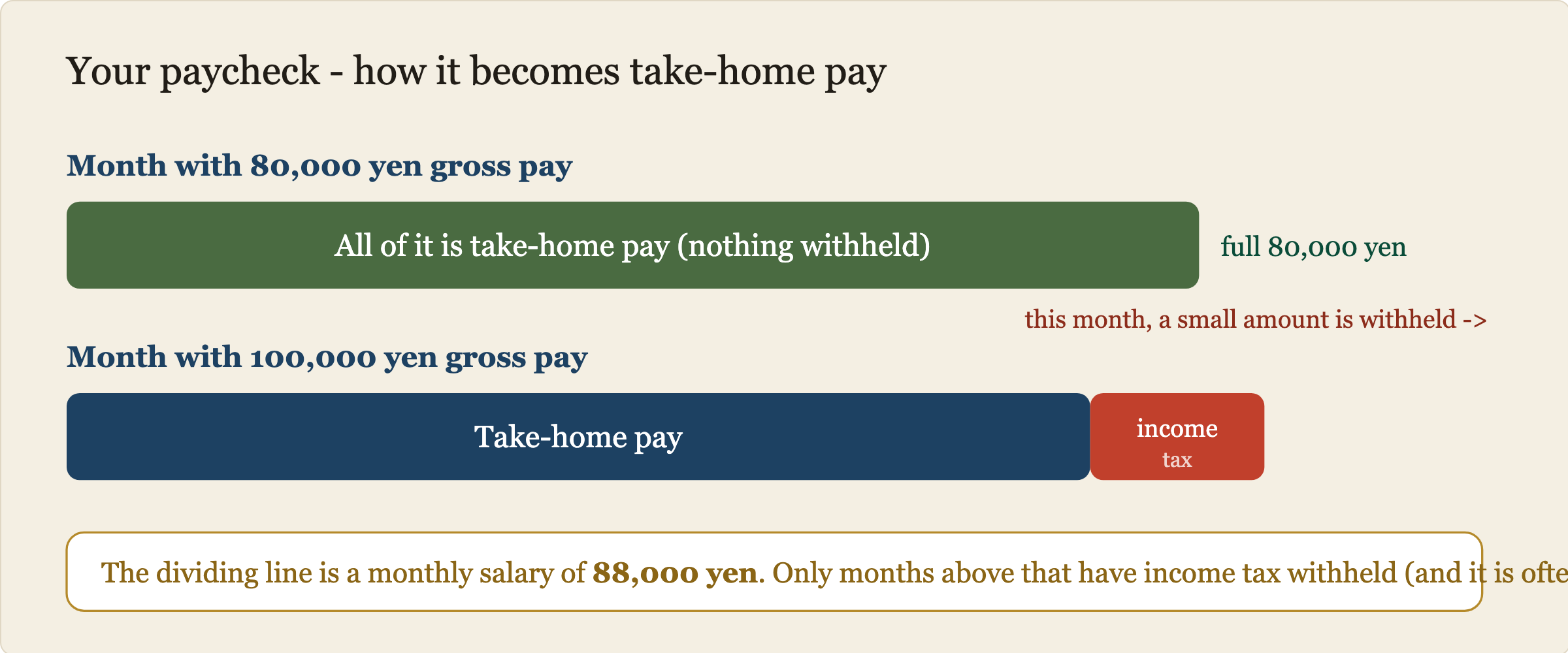
This withheld amount is only a provisional estimate. Your real tax for the year is calculated at year-end, so if too much was withheld, you get it back – covered in the next section.
How much can you earn before tax kicks in – the 2026 walls
A “wall” is the income level where a new tax starts to apply. The 2025 tax reform pushed these walls higher than before. For a student in 2026, two walls matter.
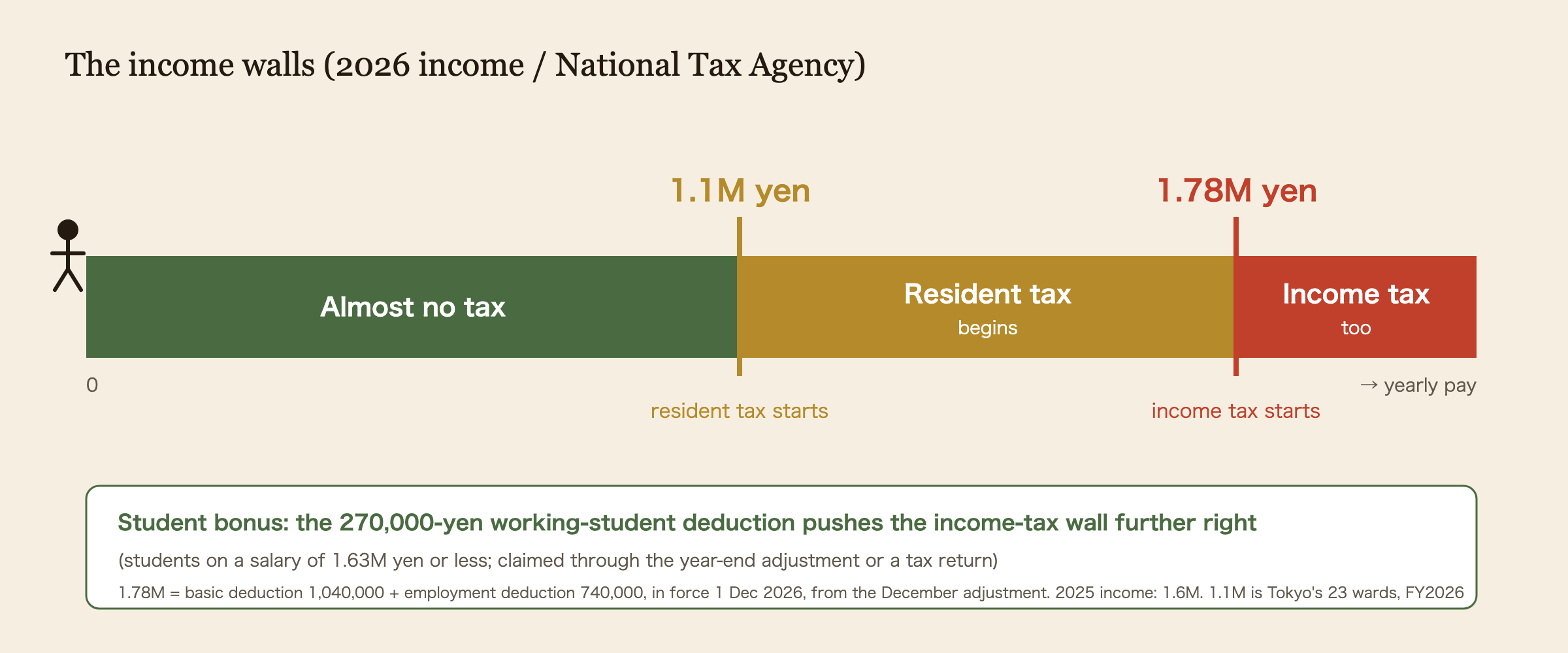
The numbers, for a student earning only salary income in 2026:
- Resident tax wall: about 1.1 million yen a year – go over this and resident tax applies the following year (the exact line varies slightly by city)
- Income tax wall: 1.78 million yen for 2026 income (basic deduction 1,040,000 + employment income deduction 740,000) – enacted in the FY2026 tax reform, in force from 1 December 2026 and applied in the December year-end adjustment (NTA No. 1199, checked September 2026). 2025 income stays at 1.6 million (950,000 + 650,000). The August version of this article called 1.78 million a proposal; it is now law
- Working Student Deduction: 270,000 yen – an extra deduction only students can claim, on top of the regular allowances, for anyone with yearly salary income under 1.5 million yen
There is also a “dependent wall” that matters if your parent is enrolled in Japanese health insurance and taxes, but for most students who came to Japan alone, that does not apply – the two walls above are what matter. Tax rules change often, so check the current figures on the National Tax Agency (NTA) official site.
What is the income tax rate in Japan?
The question everyone actually wants answered. Japanese income tax is progressive – the more you earn the higher the rate – running from 5% to 45% across seven brackets.
| Taxable income | Rate | Deduction |
|---|---|---|
| 1,000 – 1,949,000 yen | 5% | 0 yen |
| 1,950,000 – 3,299,000 yen | 10% | 97,500 yen |
| 3,300,000 – 6,949,000 yen | 20% | 427,500 yen |
| 6,950,000 – 8,999,000 yen | 23% | 636,000 yen |
| 9,000,000 – 17,999,000 yen | 33% | 1,536,000 yen |
| 18,000,000 – 39,999,000 yen | 40% | 2,796,000 yen |
| 40,000,000 yen and above | 45% | 4,796,000 yen |
The important part: “taxable income” in that table is not your salary. It is what remains after the employment income deduction and the basic deduction are taken off.
Which means almost every student working part-time sits in the top row, at 5%. When you hear “they take 45%”, that applies to people earning over 40 million yen a year.
One more item people forget: the special reconstruction income tax, an extra 2.1% of your income tax amount, running through 2037. At the 5% bracket your real rate is 5.105%. Small, but it explains sums that do not quite add up.
If you are paid after leaving Japan (non-residents)
Getting this wrong costs money. Becoming a non-resident changes the rate entirely.
Salary paid to a non-resident is taxed at a flat 20.42% at source (20% income tax plus 0.42% reconstruction tax). No brackets, no deductions. Someone who was paying 5% jumps to 20.42%.
If a final salary or bonus lands after you have flown home, this can catch you. The checklist for leaving Japan explains why the timing of that payment is worth checking.
Getting overpaid tax back: year-end adjustment and tax returns
Because monthly withholding is only an estimate, most student workers have paid in more than they actually owe. Getting that money back is called a refund (kanpu-kin), and it happens through one of two processes.
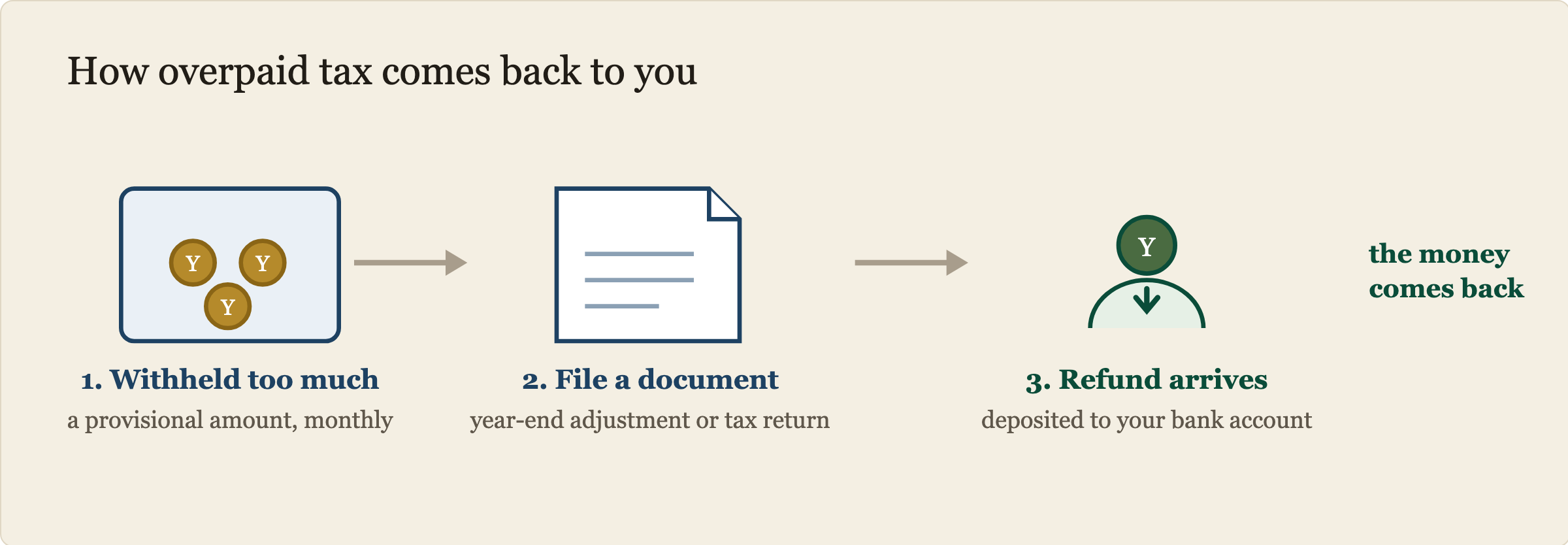
Which process applies depends on how many jobs you have.
| Your situation | What to do | Effort |
|---|---|---|
| One part-time job | Year-end adjustment (your employer handles it) | Sign one form |
| Two or more jobs at once | File your own tax return | February 16 to March 15 |
| Quit partway through the year, or graduated | Filing your own return usually gets money back | Need your withholding statement |
Working two jobs? A tax return is not optional
If you work two or more part-time jobs, year-end adjustment at one of them is not enough to settle your full tax bill. You are required to file your own tax return (kakutei shinkoku).
- When: roughly February 16 to March 15 each year
- What you need: a withholding statement (gensen choshu-hyo) from every job, your residence card, and a bank account for the refund
- How: the NTA’s online filing tool walks you through it with simple questions and can be done from your phone
Skipping this is not just missing out on a refund – it can lead to a late-payment penalty if you actually owed more. Filing is both how you get money back and how you stay out of trouble. For the full rules on how many hours you can legally work, see our guide to working and earning in Japan.
Never ignore a resident tax bill
Unlike income tax, resident tax is not withheld in advance for a new arrival – your city calculates it from last year’s income and mails you a bill the following year. That bill can arrive after you have quit a job, or even after you have already left Japan.
You can pay it at a convenience store, by bank transfer, or with a mobile payment app. If reading Japanese mail is stressful, ask at your city office window when you go to handle other paperwork such as your residence registration – it is the most reliable way to be sure you understood the notice correctly.
Taxes and your visa are more connected than people think
Whether you have paid your taxes on time is checked during visa renewal reviews. Unpaid income tax, resident tax, or national health insurance premiums can lead to a shorter renewal period or, in serious cases, a denial.
Do not let a bill sit unpaid because the amount feels small or you are planning to leave soon anyway – see our national health insurance guide for the same rule applied to insurance premiums. A clean payment record also supports a future permanent residency application.
Declaring your income is not only about tax. The National Health Insurance reduction also cannot be judged until the city office knows your income. Without a declaration you are billed the full amount.
Frequently asked questions
Q. I only make 50,000 yen a month. Do I still pay tax?
If your monthly salary is under 88,000 yen, income tax is not withheld in the first place. And if your yearly income stays under the walls (1.1 million yen for resident tax, 1.78 million yen for income tax), any amount that was withheld comes back through year-end adjustment or a tax return.
Q. When does resident tax start applying to me?
It is based on where you lived on January 1 and how much you earned the year before. If your prior year income was above roughly 1.1 million yen, resident tax applies the following year. Your very first year in Japan, you generally owe nothing because there is no prior-year income to tax.
Q. What is the Working Student Deduction?
It is an extra income deduction for students who work while studying, worth 270,000 yen off income tax (260,000 yen off resident tax). It applies if your yearly salary income is under 1.5 million yen, and you must claim it through year-end adjustment or your own tax return – it is not automatic.
Q. Is filing a tax return difficult? Is there English support?
The NTA’s online filing tool (kakutei shinkoku sho tosaku corner) just asks you to answer on-screen questions step by step. In-person tax office staff do not always have strong English support, so if your Japanese is limited, ask a teacher or friend to come with you.
Q. I have two jobs. Does year-end adjustment at one of them cover everything?
No. With two or more jobs, year-end adjustment alone is incomplete. Collect the withholding statement from every job and file your own tax return.
Q. Does unpaid tax affect my visa?
Yes. Your tax payment record is checked when your residence status is renewed. Unpaid tax can make renewal harder, so always pay by the deadline.
Summary
- Only two taxes matter for a student worker: income tax (national) and resident tax (local)
- Income tax is withheld monthly, but if your income is low, most of it is refunded
- 2026 walls: 1.1 million yen for resident tax, 1.78 million yen for income tax (income tax from the December adjustment), plus a 270,000 yen student deduction
- One job means year-end adjustment; two or more jobs means filing your own tax return (Feb 16 to Mar 15)
- Resident tax bills connect directly to your visa renewal – never ignore one
Related guides
Found this useful? Share it
Send it to a friend who lives in Japan.
WHO WROTE THIS

mori
Japanese. I read the ministries’ own notices, orders and Q&As in the original, and I start from what my Nepalese and Sri Lankan friends in Japan actually ran into. I do not write about what I have not checked or been told.
What this site can and cannot do →Looking for something else?