Figures, prices and terms were checked against published rent-guarantor company fee ranges on 6 August 2026. They change — check the current terms yourself before you sign up or file anything.
This article contains affiliate links.
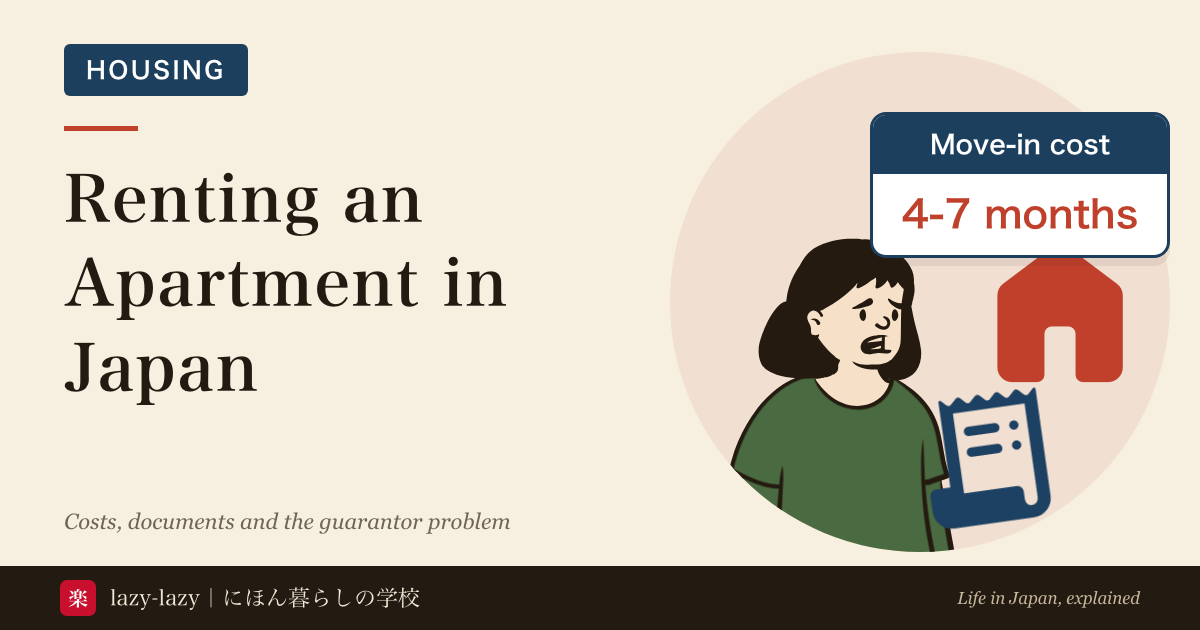
Renting an apartment in Japan is not like renting anywhere else. The rent itself is usually reasonable. The problem is the day you move in – you may need to pay four to seven months of rent at once.
This guide explains where that money goes, what documents you need, and how to rent without a Japanese guarantor.
In short
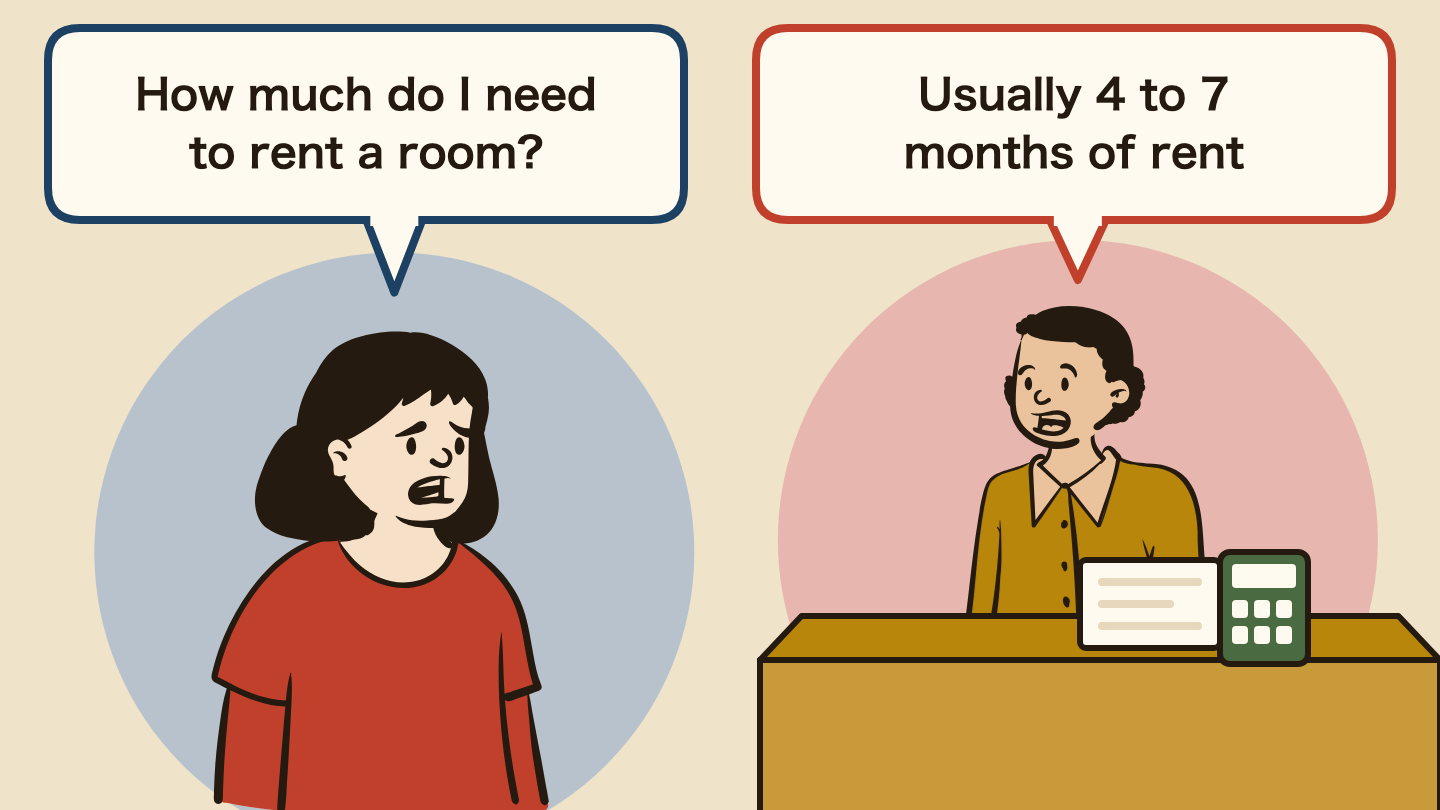
- Move-in cost is high: usually 4 to 7 months of rent (deposit, key money, agency fee, first rent, insurance), according to the MLIT apartment-hunting guidebook (PDF, Japanese). With rent of ¥50,000, that is ¥200,000-350,000.
- No Japanese guarantor? You can still rent by using a guarantor company. The same guidebook says the most common fee is about 30-60% of one month’s rent, paid up front to cover two years. Plans and renewal fees differ by company, so check before you sign.
- Documents: residence card, passport, student ID, and proof of income or a family allowance.
- Contracts usually run 2 years. Give notice usually 1-2 months before you leave, as your contract says.
- To save money, look for rooms with no deposit or key money, or try a share house.
Once this is clear, the 4-to-7-months bill stops being a shock and becomes a number you can plan for – and no guarantor is no longer a wall.
The real cost of moving in
You save up one month’s rent plus a small deposit and start viewing rooms. Where you come from, that may be enough to get the keys. In Japan, you pay several months’ worth up front before you move in, and part of it, like key money, is never returned. Budget for one month and you will be short on the day you sign.
A rental contract (賃貸契約 / chintai keiyaku) is the agreement between the landlord, who owns the room, and you, the tenant. What surprises people most is the lump sum due at move-in: one month’s rent will not get you the keys.
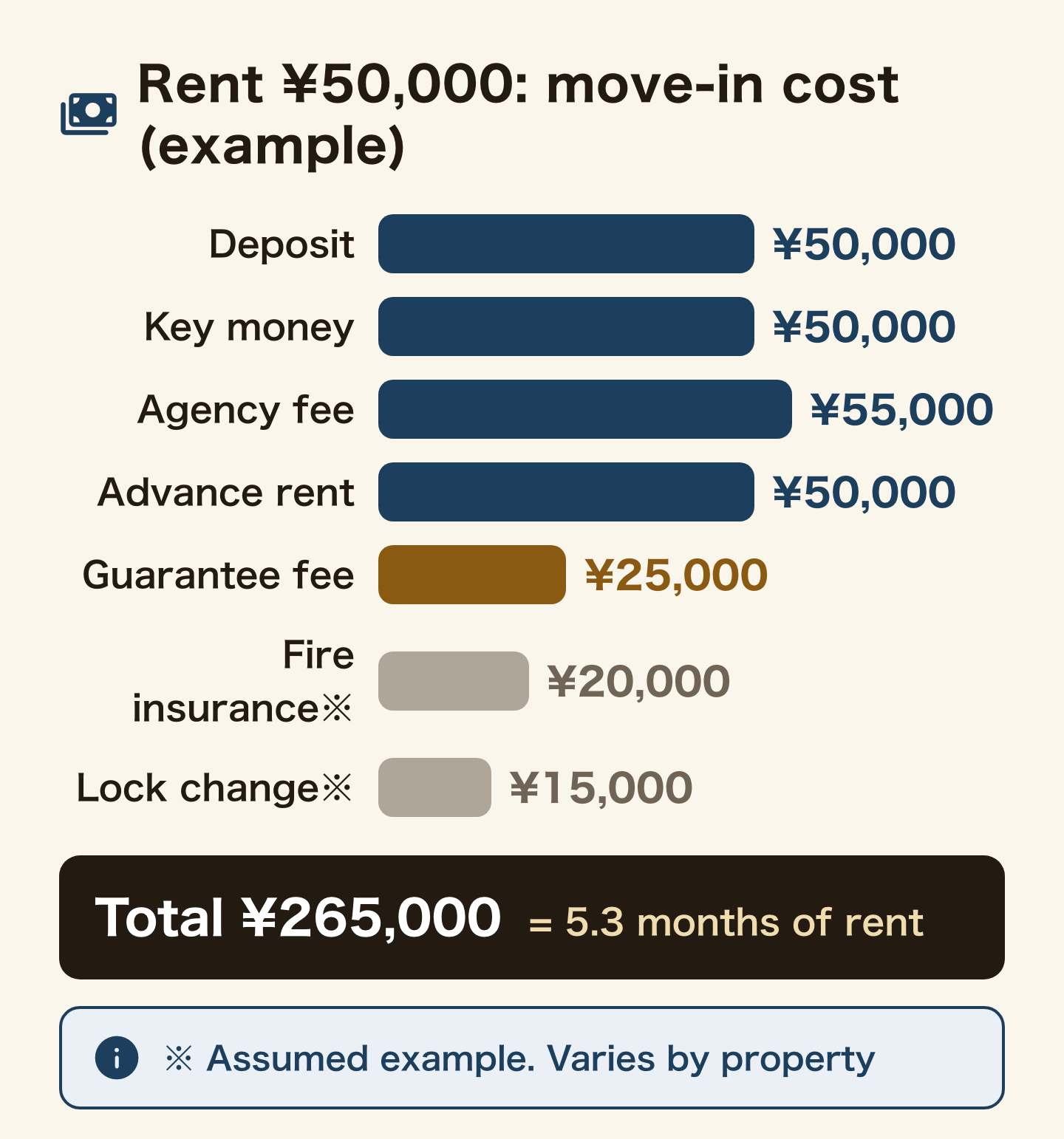
For an apartment with ¥50,000 monthly rent, expect roughly ¥200,000-¥350,000 before you get the keys: 4 to 7 months of rent, the range in the MLIT guidebook for foreign residents (PDF). Here is what makes up that number.
| Cost | What it is | Typical amount | Returned? |
|---|---|---|---|
| Deposit 敷金 / shikikin |
Held against unpaid rent and repairs when you leave. | 1-2 months’ rent (guidebook, p.16) | Yes, whatever is left |
| Key money 礼金 / reikin |
Money paid to the landlord at signing. Common in the Kanto area; some rooms now charge none. | 1-2 months’ rent (guidebook, p.18) | Never |
| Agency fee 仲介手数料 / chūkai tesūryō |
Paid to the real estate agency. | Up to 1 month’s rent + tax. Unless you agreed to more in advance, the agency can charge you only up to 0.5 month + tax | No |
| Advance rent 前家賃 / mae yachin |
Rent for your first month, paid in advance (rent in Japan is always paid ahead). | 1 month’s rent (sometimes 2) | – |
| Guarantee fee 保証料 / hoshōryō |
Paid to the guarantee company (explained below). | 30-60% of one month’s rent, covering 2 years (guidebook, p.18) | No |
| Fire insurance 火災保険料 |
Usually required by the contract. Covers fire and water damage. | Varies by property and insurer (ask the agency for the exact amount) | No |
| Lock change 鍵交換代 |
New locks for the new tenant. | Varies by property and insurer (ask the agency for the exact amount) | No |
A worked example with rent of ¥50,000: deposit, key money and advance rent at one month each (¥50,000 each), the agency fee at its 1-month + tax maximum (¥55,000), a guarantee fee of 50% of rent (¥25,000), and, as an assumed example, fire insurance of ¥20,000 and a lock change of ¥15,000. The total is ¥265,000, or 5.3 months of rent. That is one example inside the 4-to-7-month range; real amounts differ by property.
You will also pay a maintenance fee (共益費 / kyōekihi) every month on top of rent, for lighting and cleaning shared areas such as stairs and corridors. It is normally paid together with the next month’s rent.
If you are sending the initial cost from home, use a low-fee way to send money, and a credit card makes paying easier.
“Zero deposit, zero key money” apartments
You will see properties advertised as 敷金・礼金ゼロ (zero-zero). These are popular and they genuinely reduce your upfront cost.
But be careful: with no deposit held, some landlords bill you for cleaning and repairs when you move out instead. You may simply be paying later rather than paying less. Read the move-out terms before you sign – and see our guide on reducing move-out costs.
Public rental housing works differently. UR housing charges no key money, agency fee or renewal fee and needs no guarantor, and foreign residents can apply for UR and for city-run public housing if they meet the status and income rules.
The guarantor problem – and the solution
Most landlords require a guarantor (保証人 / hoshōnin): someone in Japan who will pay your rent if you cannot.
If you have just arrived, you almost certainly do not have one. This stops many people from renting – but it should not.
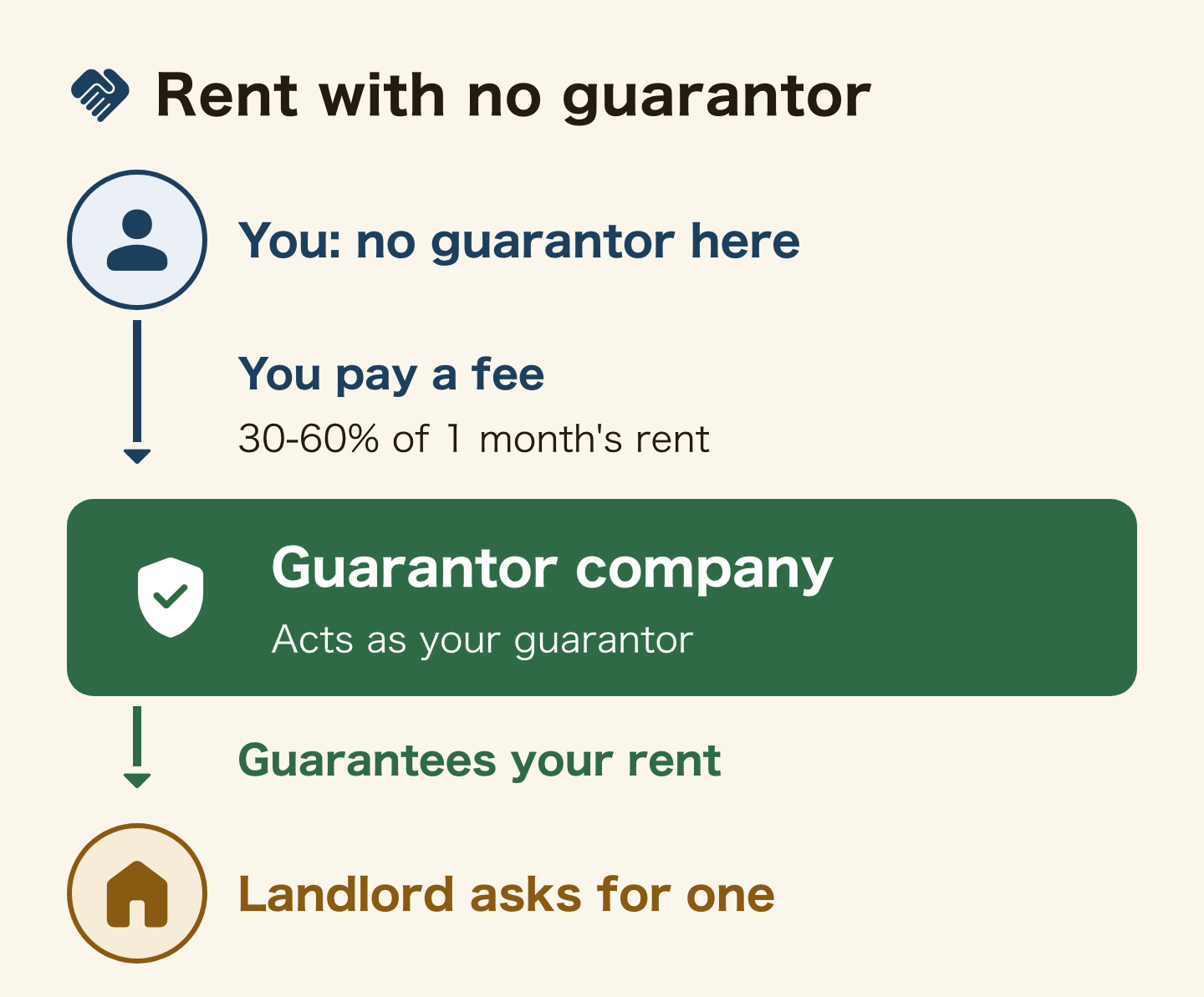
The standard solution is a guarantee company (保証会社 / hoshō gaisha). The company acts as your guarantor for a fee.
- Cost: usually about 30-60% of one month’s rent, paid up front to cover two years (MLIT guidebook, p.18). With rent of ¥50,000, that is ¥15,000-30,000. Renewal terms and how you pay differ by company, so check before you sign
- Nearly all foreign residents use this route – it is completely normal
- The agency will arrange it for you; you fill in an application form
If an agency tells you that you cannot rent because you have no guarantor, ask directly: 「保証会社は使えますか?」 (“Can I use a guarantee company?”)
Documents you need
- Residence card (在留カード / zairyū kādo) – proof of identity
- Passport – usually a copy
- Student ID or admission letter (学生証 / 入学許可書) – proof that you are a student
- Proof of income (収入証明) – payslips from your part-time job, or proof of money sent from family
- Guarantee company application – provided by the agency
Foreign applicants are often asked for more documents than Japanese applicants. This is frustrating but common. Having everything ready speeds up the screening a lot.
How the process works
- Tell the agency what you are looking for (area, budget, size)
- View properties
- Submit an application form (申込書)
- Provide your documents
- Screening (審査 / shinsa) – the guarantee company and landlord check whether you can pay
- Sign and seal the contract (賃貸借契約書)
- Pay the initial costs
- Receive the keys
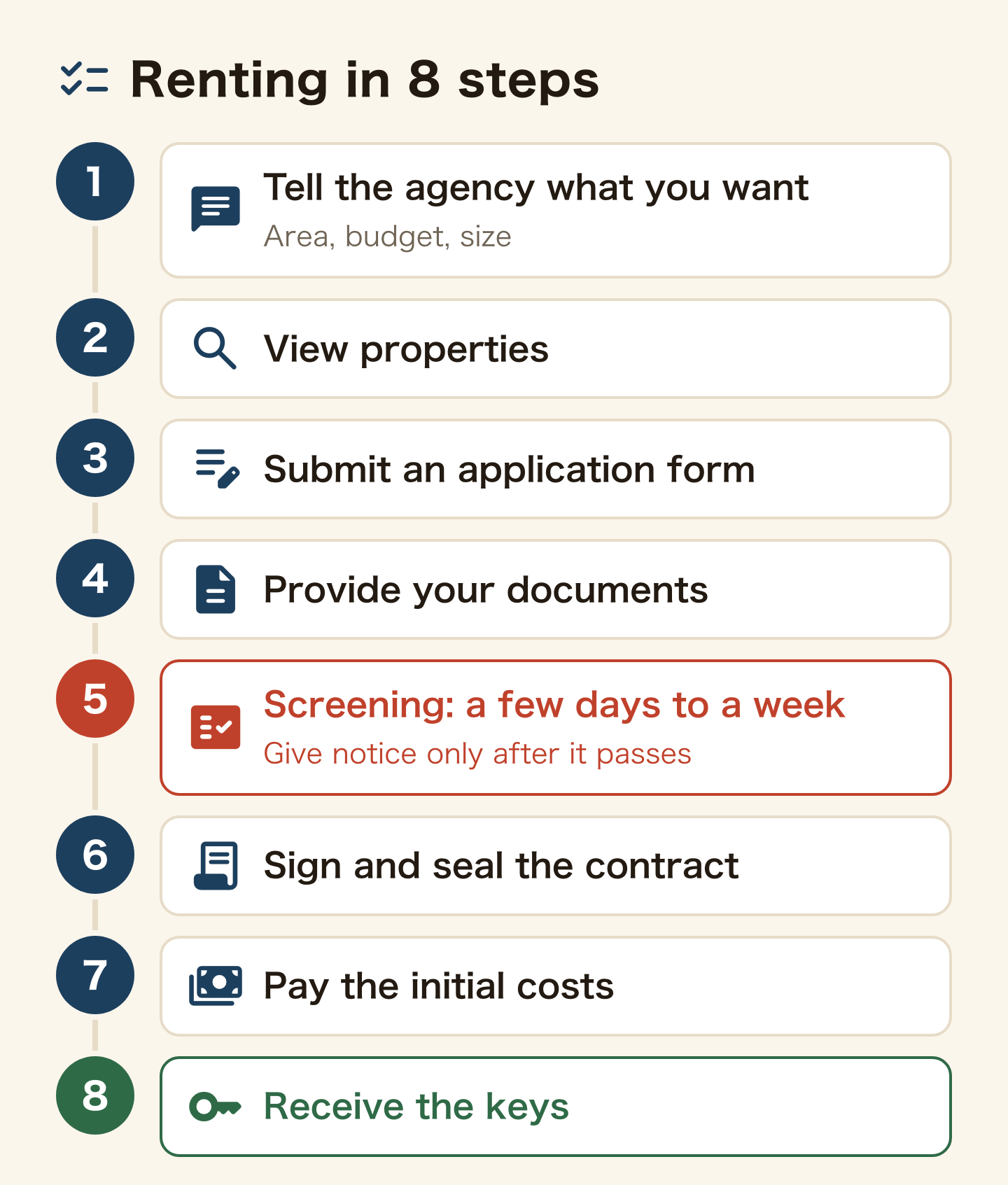
Screening usually takes a few days to a week. Do not give notice on your current place until screening has passed. While you wait, ask whether the flat uses city gas or propane: on propane you cannot change the gas company after moving in, so get the price list before you sign.
After you move in, within 14 days you must register your new address at the city office (moving-in notification).
What is in the contract
The contract (賃貸借契約書 / chintaishaku keiyakusho) will state:
- Monthly rent and maintenance fee
- Contract length – normally 2 years
- Renewal fee (更新料 / kōshinryō) – the amount and timing are set by your lease, so check it before you sign. No law creates the fee; you owe it only if your lease says so, and the guarantor company and fire insurance may come up for renewal at the same time.
- Deposit and key money
- Prohibited things – pets, musical instruments, subletting, extra residents
- Equipment that comes with the flat, such as the air conditioner and water heater – if listed equipment breaks from age, the landlord pays to fix it, so contact the management company first
Take the “prohibited” section seriously. Letting a friend live with you unregistered can break your contract.
Five things that catch people out
1. You must give notice 1-2 months before leaving
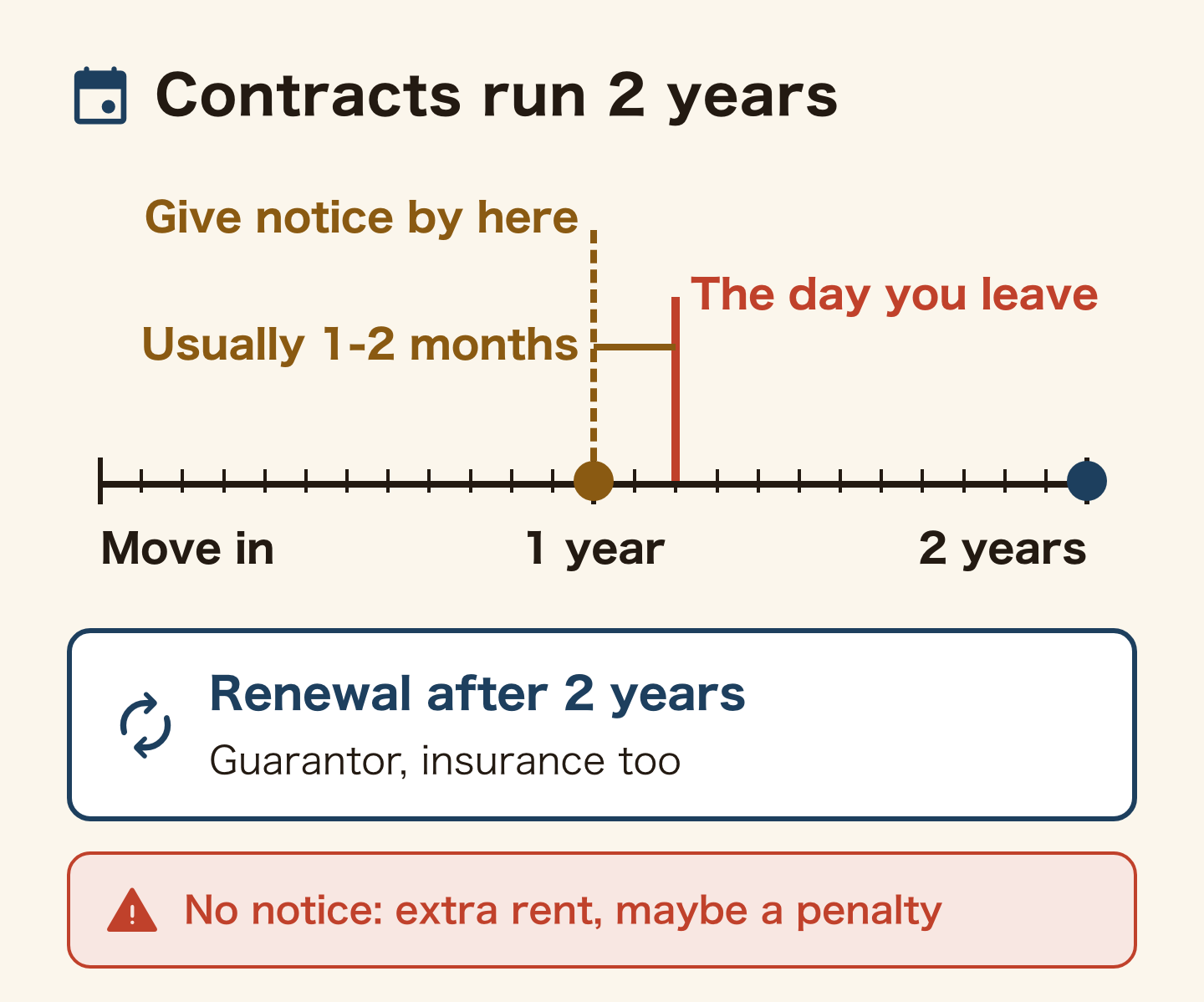
To end a contract you must give notice (解約予告 / kaiyaku yokoku), usually 1-2 months before you leave, as your contract says. Leave without notice and you pay extra rent, and moving out suddenly can also mean a cancellation penalty. If you might move for a job or a new school, count backwards from that date now. If you only need a place for a short time, a share house suits you better.
2. Apartments come empty
Most Japanese apartments include no refrigerator, no washing machine, no bed, no curtains, and sometimes no light fixtures. Add this to your moving budget (second-hand shops and city reuse furniture keep it low, and the guide also covers the recycling fee for getting rid of a fridge), or choose a furnished option – see our guide to share houses, which also cuts the move-in cost.
3. Garbage rules are strict and local
Rubbish must be separated into categories and put out on specific mornings, in specific bags, at a specific spot. Rules differ between neighbouring cities. Getting this wrong easily leads to trouble with neighbours. Ask for the garbage calendar (ゴミカレンダー) when you move in. Larger cities such as Shinjuku, Osaka and Yokohama also publish sorting guides in English and other languages – where to find your city’s garbage rules shows how.
4. The contract will be in Japanese
You are signing a legally binding document, usually with no English version. It also lists what you may not do in the flat, such as playing a TV or piano at high volume, and how noise complaints can end a lease shows why that list matters. Do not sign anything you do not understand. Options:
- Ask the agency to explain in easy Japanese: 「やさしい日本語で説明してください」
- Bring a friend or senior who reads Japanese well
- Ask your school’s international student office to check it
5. Rent increases
A landlord cannot simply raise your rent whenever they want, and you have the right to negotiate. If this happens to you, read our guide on what to do when your rent goes up.
Cheaper ways to start
If four to seven months of rent upfront is impossible right now, you have options:
- Share houses – low or no deposit, furnished, utilities often included, and you meet people
- Zero-zero properties – but check move-out terms carefully
- Furnished apartment services – higher monthly rent, much lower starting cost
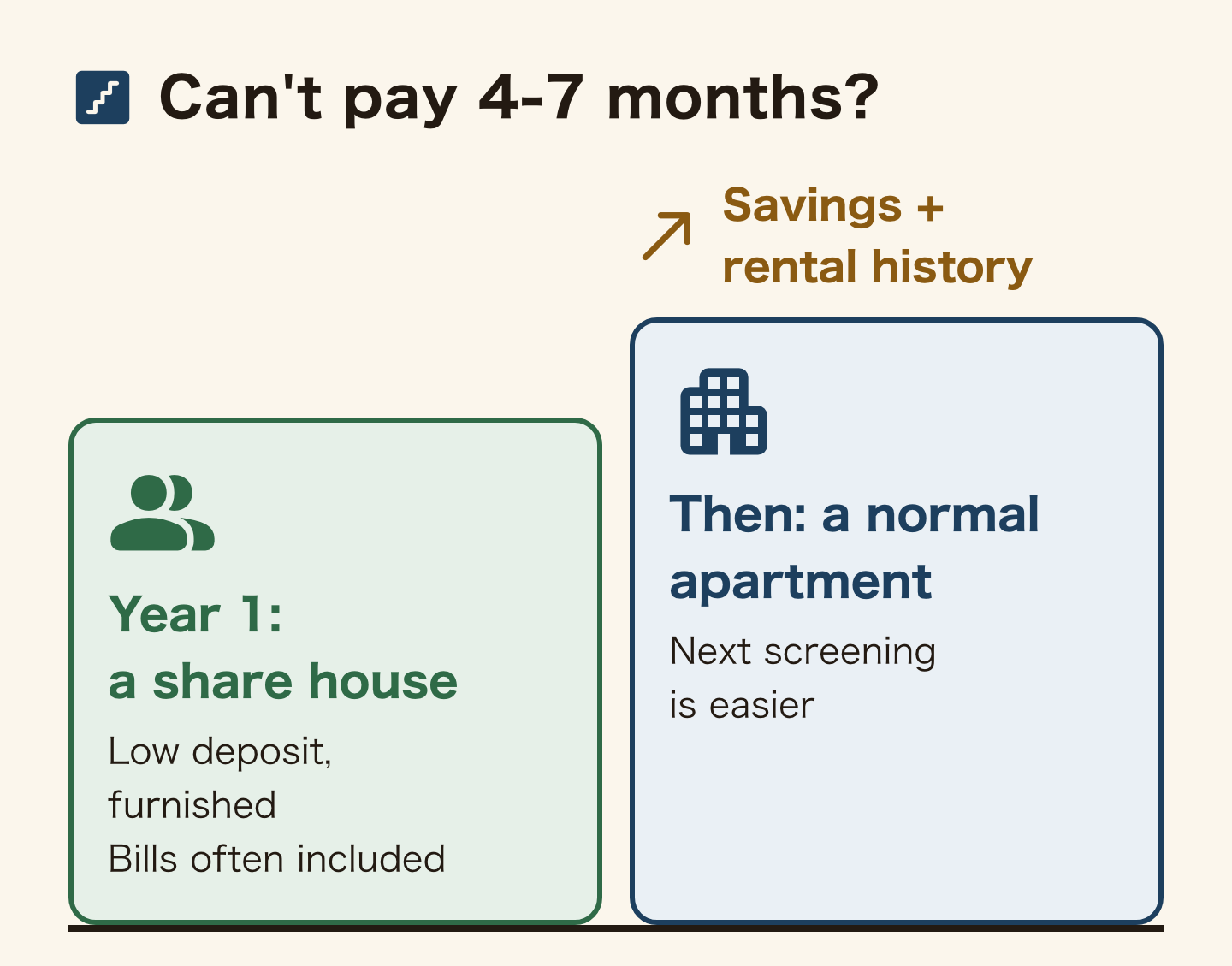
Many people start in a share house for the first year and move to a normal apartment once they have savings and a Japanese rental history. A rental history in Japan makes the next screening much easier.
If you want a furnished room without visiting a shop, Leopalace21 (furnished apartments, English page) has an English site and says viewing, contract and key handover can all be done without coming to a store (as of October 2026). Fees and screening for foreign residents are not listed there, so ask before you apply.
Quick summary
- Budget 4-7 months of rent to move in. Know the parts: deposit, key money, agency fee, advance rent, guarantee fee, insurance, lock change
- Key money is never returned; the deposit may be partly returned
- No guarantor? Use a guarantee company – this is normal
- Documents: residence card, passport, student ID, proof of income or family allowance
- Contracts run 2 years and may carry a renewal fee. Give notice usually 1-2 months before leaving, as your contract says
- Apartments are empty – budget for appliances. Watch the garbage rules and the prohibited list
- Never sign a contract you do not understand
- To start cheaper, consider zero-zero rooms or a share house
Related guides
If this helped, please send it to someone who is about to look for an apartment. The initial cost is the part nobody warns you about.
Frequently asked questions
How much does it cost to move into an apartment in Japan?
Usually 4 to 7 months of rent up front: deposit, key money, agent fee, insurance and advance rent (MLIT guidebook, checked September 2026). With rent of ¥50,000, that is roughly ¥200,000-350,000. Zero-zero rooms or a share house cut this a lot, and foreign residents can apply for UR housing, with no key money, agency fee or renewal fee, and for public housing for low-income households if they meet the conditions.
Can I rent without a Japanese guarantor?
Yes. Most landlords accept a guarantor company. The most common fee is about 30-60% of one month’s rent, paid up front to cover two years (MLIT guidebook; it differs by company), and the company guarantees your rent. Many students rent this way.
Can a landlord refuse me because I am a foreigner?
Some do, but many agencies handle foreigner-friendly rooms. Ask for foreigner-friendly listings and bring proof of income or scholarship to raise your chances.
Will I get my deposit back?
The deposit is money held for you, so what is left after repair costs at move-out comes back. If you lived normally, much of it may return. Key money, the agency fee and the guarantee fee are not returned.
Can I move out before the contract ends?
Yes, but you usually have to give notice 1-2 months before you leave, as your contract says. Late notice means extra rent. Check the notice (解約予告) clause in your contract.
Do apartments come with furniture and appliances?
Ordinary apartments do not. You provide your own fridge, washing machine and bed. To keep both the move-in cost and furniture cost low, a furnished share house is an option.
If the 4-to-7-month wall is impossible right now
Furnished share houses and shared apartments skip most move-in costs. One example is X-House (Cross House) in Tokyo:
- Initial fee: a flat 30,000 yen – no deposit, no key money, no agency fee. The first month’s rent and fees come on top (X-House official prices)
- Rent from 24,800 yen (dormitory; private rooms from 40,000 yen) plus a flat 15,000 yen common fee covering water, electricity and gas, with free Wi-Fi
- No guarantor needed, stays from 1 month, apply online (X-House official site)
- The website is also in English, Nepali, Sinhala and other languages
- More in our share house guide
See Tokyo rooms from 30,000 yen (Japanese site)
Moving to Osaka? Furnished one-rooms from about 50,000 yen →
Official sources: MLIT: agency fee limits for rentals (Japanese) / e-Gov: Civil Code, Article 622-2 on deposits (Japanese) / e-Gov: Basic Resident Registration Act, Article 22 on moving-in notification (Japanese) / UR rental housing: no key money, agency fee, renewal fee or guarantor (Japanese) / MLIT restoration guideline (Japanese) / MLIT apartment-hunting guidebook (PDF, Japanese; move-in cost p.8, notice, maintenance fee, deposit and contract length p.16, key money and guarantee fee p.18) (checked 26 September 2026; move-in cost and guarantee fee checked 27 September 2026; agency fee, notice, maintenance fee, deposit and key money amounts checked 18 October 2026)
Found this useful? Share it
Send it to a friend who lives in Japan.
There is a way to live here where deposit, key money and agency fee are all zero.
Share House in Japan →WHO WROTE THIS

mori
Japanese. I read the ministries’ own notices, orders and Q&As in the original, and I start from what my Nepalese and Sri Lankan friends in Japan actually ran into. I do not write about what I have not checked or been told.
What this site can and cannot do →Looking for something else?
You may use the figures in this article, including commercially, if you credit this site with a link. How to use our figures