Checked on 23 September 2026 against the Cabinet Order fixing the start date, the text of the ESD Act as it will stand from 1 April 2027 (e-Gov), the Immigration Services Agency’s “Outline of the Employment for Skill Development Program” (revised July 2026) and its official Q&A, and the Ministry of Health, Labour and Welfare.
In short
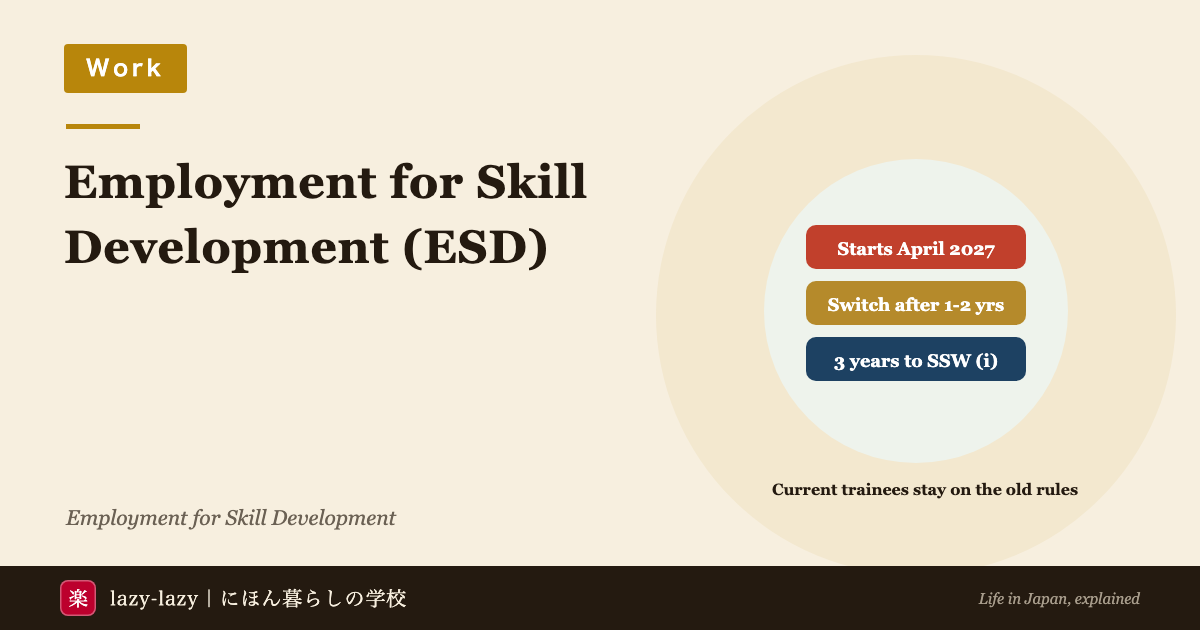
- Employment for Skill Development (ESD, ikusei shuro) replaces Technical Intern Training. It trains foreign workers for three years in labour-shortage fields and keeps them as workforce. It starts on 1 April 2027, a date fixed by Cabinet Order.
- You will be able to change employer by your own choice. Only within the same job category, only after 1 or 2 years depending on the field, and only after passing a skills test and a Japanese test.
- Japanese: A1 (about JLPT N5) before you start work, A2 (about N4) by the end of three years. Passing a test before entry is not required.
- Moving on to Specified Skilled Worker (i) requires passing the skills and Japanese tests. There is no exemption like the one for trainees who complete TITP (ii) in good standing.
- Technical intern trainees already in Japan stay on Technical Intern Training. They cannot switch to ESD part-way.
Knowing this, you can separate what is decided from what is not, and work out yourself which test to take next and when you could change employer. You will not be pushed around by rumours that the new system lets you quit tomorrow.
A younger trainee in your dorm shows you a post on his phone: “Technical intern training is ending. From next year we can change jobs freely.” You ask a Japanese colleague. He says, “Really?” and that is the end of it. No Japanese person has ever held a technical intern status, so they know the name, not the rules. It is your contract and your status of residence, and nobody near you can give a straight answer. Search online and old articles about “proposals” and “plans” come up next to the final rules.
- What is Employment for Skill Development (ESD) in Japan?
- When does the ESD system start?
- ESD vs Technical Intern Training: what changes?
- Can I change employers on ESD?
- What Japanese level does ESD require?
- How do I move from ESD to Specified Skilled Worker?
- What happens to current technical intern trainees?
- How much does ESD cost?
- What are supervising and support organisations and the ESD Organization?
- What if the rules are broken, or you need help?
- What has not been decided yet?
- Which one are you?
- FAQ
- Summary
- Related reading
What is Employment for Skill Development (ESD) in Japan?
ESD is a status that lets a foreign national work in Japan for three years in a labour-shortage field, reach the skill level of Specified Skilled Worker (i) on the job, and stay in that field as part of its workforce. The legal basis is the Act on the Proper Implementation of Employment for Skill Development of Foreign Nationals and the Protection of Foreign Workers under ESD, the ESD Act. It is the current Technical Intern Training Act, amended and renamed.
The biggest change is the purpose. Technical intern training was meant as international cooperation: skills you learn here go back home. ESD says openly that it exists to develop and secure human resources in Japan’s labour-shortage fields (ESD Act, Article 1). Because you are treated as a worker, there is more protection built in, and changing employer by your own choice is the headline.
There are 17 ESD fields (as of July 2026). Of the 19 Specified Skilled Worker fields, motor transport and aviation are not in ESD. You cannot work across fields; “farming in summer, fishing in winter” is not allowed. Dispatch work is allowed only in agriculture and fisheries.
When does the ESD system start?
ESD starts on 1 April 2027. This is not a proposal. The amending Act (Act No. 60 of 2024) was promulgated on 21 June 2024, and a Cabinet Order sets its enforcement date as 1 April 2027.
Where each piece stands:
- The Act: promulgated 21 June 2024, in force from 1 April 2027
- The start date: fixed by Cabinet Order
- Field-specific operation policies (the fields and the change-restriction periods): Cabinet decision on 23 January 2026
- Ministerial ordinances, field notices and operation guidelines: being published one by one (forestry and logistics warehousing were added at the end of August 2026)
- Early applications: supervising and support organisation licences from 15 April 2026, ESD plans from 1 September 2026
So nobody can actually work on ESD status before 1 April 2027. “From next year you can change jobs freely” is wrong on both the date and the content.
ESD vs Technical Intern Training: what changes?
| Technical Intern Training (now) | ESD (from April 2027) | |
|---|---|---|
| Purpose | International cooperation through skills transfer | Developing and securing workers in shortage fields |
| Length | Stages (i), (ii), (iii) | Three years in principle, one plan approved at the start |
| Changing employer by choice | Not allowed | Allowed, with conditions |
| Prior-job and return-home job requirements | Yes | No |
| Moving to SSW (i) | Tests exempt after completing (ii) in good standing | Must pass the skills and Japanese tests |
| Bringing family | No | No, in principle |
An ESD plan is approved only if your pay is at least what a Japanese worker would get for the same work (ESD Act, Article 9(9)). The minimum wage is also the same regardless of nationality; you can find your prefecture’s rate in the minimum wage list for all 47 prefectures. Family is still off the table on ESD, as on technical intern training; you can bring a spouse and children only after moving to a status named in the Dependent rules, such as SSW (ii).
Can I change employers on ESD?
Yes, but not “any time, anywhere.” There are two kinds of transfer:
- A transfer for unavoidable circumstances: if you suffer violence, power harassment or another human rights violation. This carries over from technical intern training.
- A voluntary change of employer: new with ESD. You must meet every condition below.
According to the ISA Q&A, a voluntary change requires that:
- The new job is in the same job category as now
- You have worked at your first employer beyond the change-restriction period set for your field (1 or 2 years)
- You have passed a skills test (the same level as the one-year test) and a Japanese test (A2.1 in most fields, A2.2 in care work)
- You did not use a private job placement agency
- The new employer is recognised as an “excellent” implementing organisation and stays within its cap on transferred workers
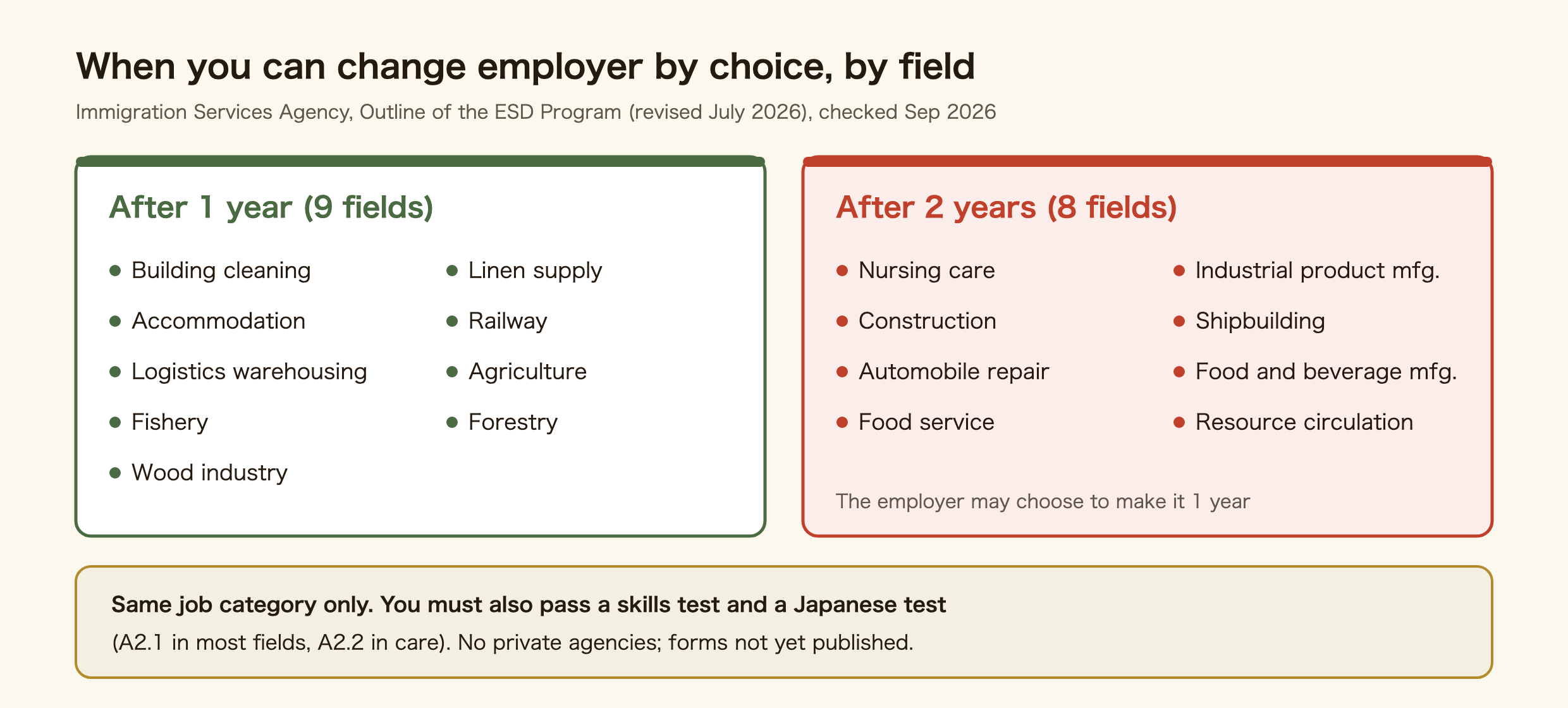
The Act says the restriction period is set by ordinance “within the range of one to two years,” and each field’s number is in its operation policy. In a two-year field, your employer may choose to make it one year. An employer that keeps it above one year must provide the pay and conditions improvements set for that field. If you change once and want to change again, the restriction period applies again.
You apply in writing. You can hand it to your current employer, your supervising and support organisation, or the government (the Commissioner of the Immigration Services Agency and the Minister of Health, Labour and Welfare) (ESD Act, Article 8-2). The actual forms and steps have not been published yet; the ISA says they “will be announced once decided.” Hello Work is also set to support transfers together with the supervising and support organisations and the ESD Organization.
What Japanese level does ESD require?
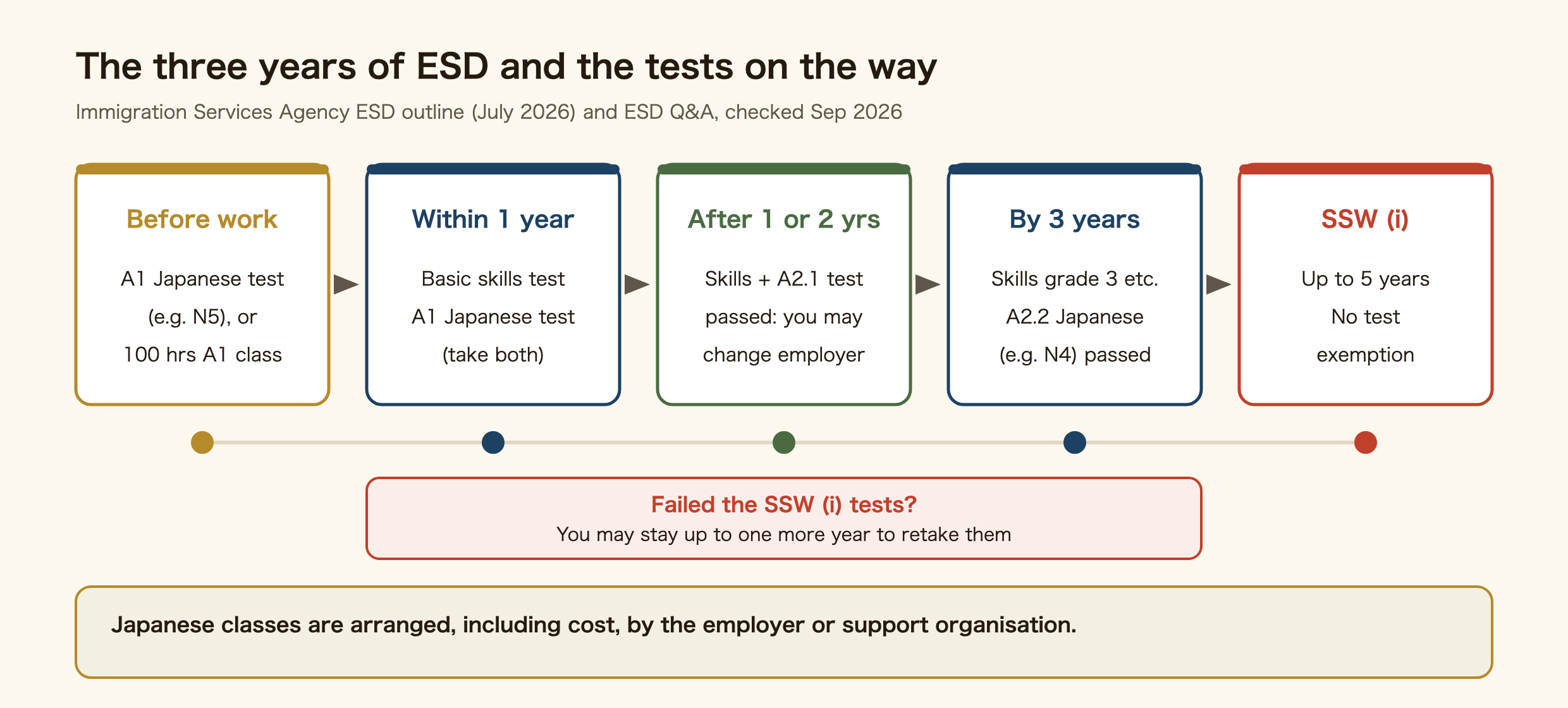
The levels come from the Japanese government’s Reference Framework for Japanese Language Education, which runs A1, A2, B1 and upwards. The ISA outline gives JLPT N5 as an example of an A1 test and N4 as an example of A2.
- Before starting work: pass an A1 test, or take at least 100 hours of A1 classes on a “work” course at an accredited Japanese language institution
- Within one year: take an A1 Japanese test (and a skills test)
- For a voluntary change of employer: A2.1 in most fields (A2.2 in care)
- By the end of three years: pass an A2 test (the same level as SSW (i))
You will not be refused entry just for not having passed a test yet. Your employer or supervising and support organisation arranges the classes, including the cost. Over the three years your employer must also give you the chance to take at least 100 hours of A2 classes, though it is not required to count that class time as working hours.
The JLPT is not held on demand: it runs twice a year, in July and December in 2026. Check the fee and application period in how to register for the JLPT in Japan, and count back from the date you want to change employer or move on.
How do I move from ESD to Specified Skilled Worker?
ESD is built as the step before SSW (i). Within three years, pass a skills test such as Trade Skill Test grade 3 or the SSW (i) evaluation test, plus a Japanese test at A2 or above (JLPT N4, for example), and you can move to SSW (i), which allows up to five years in total.
This is different from technical intern training. Today, completing TITP (ii) in good standing exempts you from the SSW (i) tests. People moving from ESD to SSW (i) get no such exemption.
If you fail, you may stay up to one more year to retake the tests. The Act itself allows a plan to be extended to four years where an ordinance recognises a good reason. Moving to SSW (i) part-way through the three years is described in the ISA Q&A only as a “policy,” and the detailed conditions have not been set out.
Once you hold SSW (i), there is no change-restriction period. SSW was designed from the start as a status you can change employers on, though what you change decides the paperwork and you must notify Immigration within 14 days. The order of steps is in how to change jobs on an SSW visa.
What happens to current technical intern trainees?
If you are in Japan doing technical intern training on 1 April 2027, you carry on. The technical intern rules keep applying to you, and you cannot switch to ESD part-way.
| On 1 April 2027 you are… | What happens |
|---|---|
| On TITP (i) | You can move to (ii) with an approved plan |
| On TITP (ii), and have been on (ii) for a year or more | You can move to (iii) |
| On TITP (ii), for less than a year | You cannot move to (iii) |
| Not yet in Japan, plan application filed by 31 March | You may enter as a trainee if training starts by 30 June in principle |
| Already finished and gone home | You cannot return as a trainee; ESD may be possible |
For the time being, trainees who complete TITP (ii) in good standing can still move to SSW (i) in related work after ESD begins. On the other hand, someone who did two years or more of technical intern training basically cannot start ESD again in a different field.
How much does ESD cost?
| Item | Who pays, how much |
|---|---|
| Fees to the sending organisation at home | You pay at most two months of your base monthly pay. Anything above is paid by the employer or the supervising and support organisation |
| Japanese classes | Arranged, including cost, by the employer or supervising and support organisation |
| Voluntary change of employer | The new employer pays the old one a set amount. The notice fixing it has not been issued yet |
| Seasonal trips home (agriculture, fisheries) | The supervising and support organisation (or the employer, for the individual-enterprise type) |
The ISA describes this cap as a way to stop the fees foreign workers pay sending organisations from becoming unreasonably high. An ESD plan is not approved if what you paid the sending organisation fails the standard (ESD Act, Article 9(11)). Before you sign, get the amount and the breakdown in writing.
What are supervising and support organisations and the ESD Organization?
A supervising and support organisation is the ESD version of today’s supervising organisation (kanri dantai). It matches workers with employers, audits whether training follows the plan, and supports and protects the workers. When you ask to change employer, it coordinates between the parties. It needs a licence, and existing supervising organisations must apply again; they do not carry over. The standards are stricter, adding an external auditor and at least two full-time staff, among other things.
The Employment-for-Skill-Development Organization (ESDO) takes the place of today’s Organization for Technical Intern Training (OTIT). It approves each worker’s ESD plan and inspects workplaces. For now, OTIT handles the early applications.
What if the rules are broken, or you need help?
A voluntary change only exists once you meet the conditions and the new employer’s plan is approved. Leaving your workplace and working somewhere else without that is not a transfer. Under technical intern training today, disappearing from the workplace is a leading route to losing status: of the 1,446 statuses cancelled in 2025, 973 were technical interns. The numbers and the process are in what triggers visa cancellation in Japan.
If you face violence, power harassment or another human rights violation, you do not have to wait out any period. That is the “unavoidable circumstances” route. Technical intern trainees can use OTIT’s native-language consultation by phone, email or letter. Unpaid wages and working hours can also go to Japan’s free labour consultation offices.
What has not been decided yet?
- The forms and steps for asking to change employer (“will be announced once decided”)
- The amount the new employer pays the old one (the notice is “to be issued”)
- The conditions for moving to SSW (i) before three years are up (still a “policy”)
- When the new fields of linen supply, logistics warehousing and resource circulation actually start accepting workers (once their notices are in force and preparations are complete)
When these are decided, the ISA’s ESD page and its Q&A are updated.
Which one are you?
- A technical intern trainee in Japan now — you stay on technical intern training. Check your stage on your residence card, and if you are on (ii), count whether you will have a full year on (ii) by 1 April 2027.
- Coming to Japan on ESD from April 2027 — check that the sending organisation is asking for no more than two months’ pay, and look up the dates for JLPT N5 or JFT-Basic.
- On ESD and wanting to change employer later — find your field’s restriction period (1 or 2 years) in the chart above, and plan to sit the A2.1 Japanese test and the skills test before that date.
- Facing violence, harassment or unpaid wages at work — do not wait for any period; contact the native-language consultation or a labour consultation office today.
FAQ
Q. When does Employment for Skill Development start in Japan?
On 1 April 2027. The date is fixed by Cabinet Order. Early applications from employers and supervising and support organisations began in 2026.
Q. What is the difference between ESD and Technical Intern Training?
The purpose. Technical intern training is international cooperation through skills transfer; ESD is about developing and securing workers in labour-shortage fields. ESD allows a voluntary change of employer under conditions.
Q. After how long can I change employer on ESD?
One or two years, depending on the field. Nine fields, including agriculture, fishery and accommodation, are one year; eight, including nursing care, construction and food service, are two. The move must stay in the same job category, and you must pass a skills test and a Japanese test.
Q. What Japanese level do I need for ESD?
A1 (JLPT N5, for example) before you start work, and A2 (N4, for example) by the end of three years. If you have not passed an A1 test, 100 hours of A1 classes also let you start.
Q. Will current technical intern trainees be switched to ESD?
No. Anyone in technical intern training on 1 April 2027 continues under the technical intern rules. Stage (i) can move to (ii), and those with a year or more on (ii) can move to (iii).
Q. Can I move from ESD to Specified Skilled Worker (i)?
Yes. You need to pass a skills test and a Japanese test at A2 or above, such as JLPT N4. There is no test exemption like the one for technical interns who complete stage (ii) in good standing.
Summary
ESD replaces technical intern training on 1 April 2027. Its purpose is to develop and secure workers in labour-shortage fields, and it runs for three years in principle. You can change employer by your own choice within the same job category, after 1 or 2 years depending on the field, once you pass the tests.
Japanese is A1 before work and A2 by the end. SSW (i) comes by passing tests. Current trainees stay on technical intern training with no switch. Some details, like the transfer procedure and the amounts, are still open. Check the ISA Q&A updates rather than rumours.
Official sources: Immigration Services Agency, “Employment for Skill Development” / ISA, “Outline of Employment for Skill Development Program” (revised July 2026, English) / ISA, ESD Q&A (Japanese) / ISA, laws and Cabinet Orders for ESD (Japanese) / Ministry of Health, Labour and Welfare, ESD (Japanese) / e-Gov, the ESD Act (Japanese). Checked on 23 September 2026. For the fine print in your own field, also ask your employer or supervising and support organisation.
Related reading
Found this useful? Share it
Send it to a friend who lives in Japan.
WHO WROTE THIS

mori
Japanese. I read the ministries’ own notices, orders and Q&As in the original, and I start from what my Nepalese and Sri Lankan friends in Japan actually ran into. I do not write about what I have not checked or been told.
What this site can and cannot do →Looking for something else?