Checked on 23 September 2026 against the Immigration Services Agency’s Specified Skilled Worker pages, its system explanation material (updated July 2026), the SSW Q&A, the page on the cumulative period of stay, the food service notices, and the Japan Foundation’s official JFT-Basic site.
In short
- Specified Skilled Worker (SSW) is a status of residence for working in set fields with labour shortages, using skills proven by a test. No degree is required.
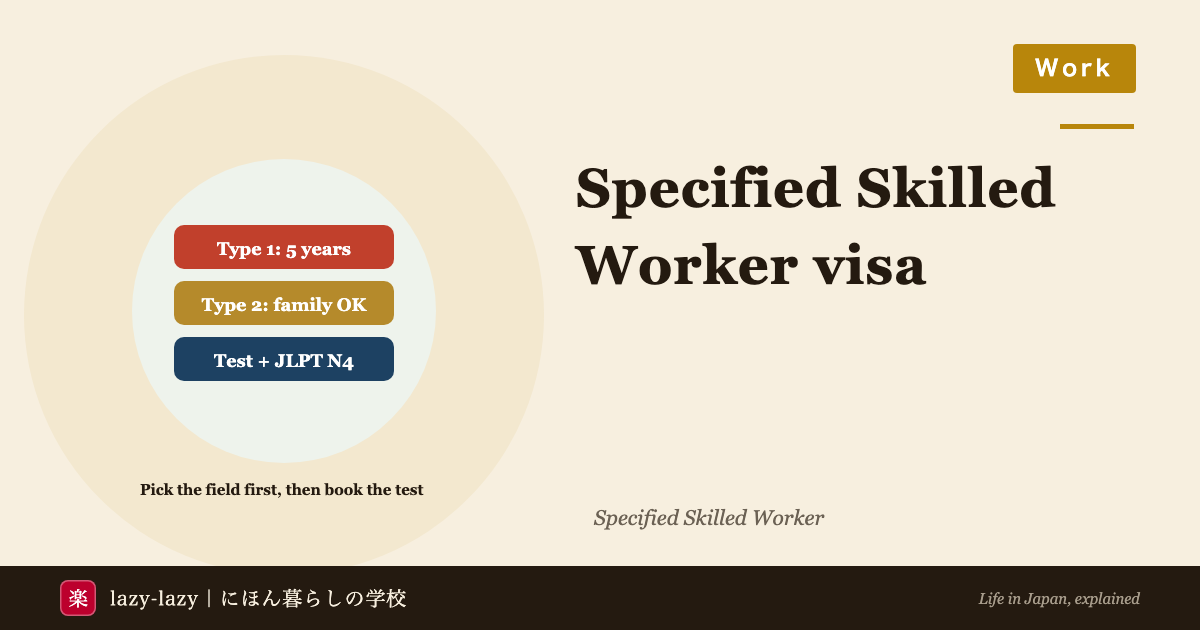
- Type 1: 19 fields, five years in total, family basically not allowed. Type 2: 11 fields, no cap, spouse and children allowed.
- Type 1 requires a skills test for the field and a Japanese test (JFT-Basic or JLPT N4 or above). Completing Technical Intern Training (ii) in good standing waives them.
- You can take the tests inside Japan if you hold a status of residence. JFT-Basic costs 10,000 yen in Japan.
- Food service: since 13 April 2026, changes from Student and other statuses are refused as a rule. Check the Immigration notices before you pick a field.
Knowing this, you can decide today which field, which test and by when. Moving to type 2 in five years, and what happens with your family, can go into the plan from day one.
Graduation is close and you want to stay and work. You have no university degree, so someone told you the standard work visa is out. A senior student says “just do tokutei ginou”. You ask a Japanese friend what that is, and they have no idea. Japanese citizens never deal with residence statuses, so most of them have never heard the term.
- What is the Specified Skilled Worker visa?
- SSW type 1 vs type 2: what is the difference?
- Which fields can you work in? The 19 SSW categories
- SSW visa Japan requirements: age, tests and Japanese level
- Can I take the SSW test in Japan?
- Are the tests waived after Technical Intern Training?
- Switching from a Student visa: steps and documents
- How much does it cost?
- What is the support plan, and what is a registered support organisation?
- How is the five-year limit counted, and what happens after?
- Can SSW bring family to Japan?
- How do you move from SSW type 1 to type 2?
- What if you break the rules or run out of time?
- Which one are you?
- FAQ
- Summary
- Related reading
What is the Specified Skilled Worker visa?
Specified Skilled Worker is a status of residence for foreign nationals who work with a certain level of skill in set industrial fields where Japan cannot find enough workers. It started in April 2019. People call it the SSW visa or “tokutei ginou”; on your residence card it is the status “Specified Skilled Worker”.
There are two types. Type 1 (i) is for work needing “a considerable degree of knowledge or experience”, type 2 (ii) for “proficient skills”. Because skills are tested, there is no education requirement (Immigration Q&A). You must be 18 or older.
At the end of March 2026 (preliminary figures), 404,527 people held type 1 and 12,420 held type 2. Almost everyone starts on type 1.
SSW type 1 vs type 2: what is the difference?
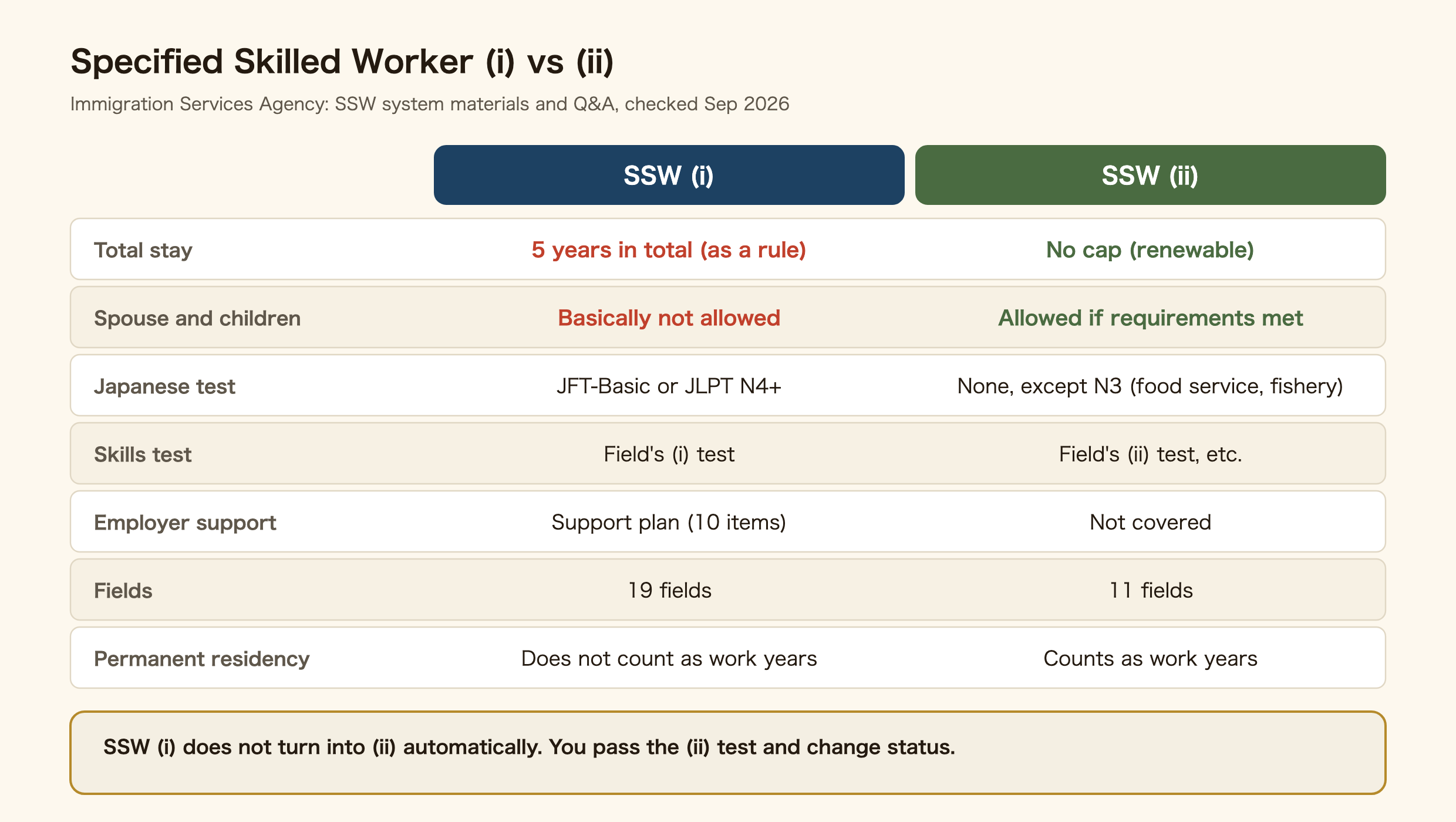
The two big differences are time and family. Type 1 is granted for up to three years at a time and is capped at five years in total, as a rule. Type 2 is renewed every three years, two years, one year or six months, with no limit on renewals.
Family is basically not allowed on type 1. On type 2, a spouse and children can join you on the Dependent status if you meet the requirements. If you want your family with you in Japan, moving up to type 2 matters more than the pay rise.
Permanent residency differs too. One condition is five or more continuous years on a work status, and according to the Immigration Q&A, type 1 years do not count towards it. Type 2 years do. The full conditions are in the permanent residency requirements.
Which fields can you work in? The 19 SSW categories
Immigration’s page for foreign nationals says, as of September 2026, that type 1 covers 19 fields and type 2 covers 11. The 19 are:
| Field | Type 2 |
|---|---|
| Nursing care | No (type 1 only) |
| Building cleaning management | Yes |
| Industrial product manufacturing | Yes (three job categories only) |
| Construction | Yes |
| Shipbuilding and ship machinery | Yes |
| Automobile repair and maintenance | Yes |
| Aviation | Yes |
| Accommodation | Yes |
| Agriculture | Yes |
| Fishery and aquaculture | Yes |
| Food and beverage manufacturing | Yes |
| Food service | Yes |
| Automobile transportation | No |
| Railway | No |
| Forestry | No |
| Wood industry | No |
| Linen supply (added 2026) | No |
| Warehousing (added 2026) | No |
| Resource circulation (added 2026) | No |
The last three were added by a Cabinet decision on 23 January 2026. Immigration’s material says acceptance starts “once preparations are completed” after the related notices take effect. Linen supply appears on Immigration’s list of fields open for acceptance (as of 1 June 2026). Warehousing and resource circulation were still missing from both the test page and the document checklists on 23 September. If you are aiming at either, confirm on Immigration’s field pages that acceptance has started before you plan around it.
Food service has a different problem. Its type 1 numbers were about to pass the cap of 50,000, so from 13 April 2026 Immigration suspended Certificates of Eligibility for the field. Applications received from that date to change from Student or any other status into food service type 1 are refused as a rule (Immigration notice on the food service cap). Job changes within food service and renewals are examined as usual.
Dispatch work is allowed only in agriculture and fishery; everywhere else you are hired directly. To see where SSW sits among the ways to work without a degree, compare the three routes to work in Japan without a degree.
SSW visa Japan requirements: age, tests and Japanese level
Immigration’s material lists these requirements for the person:
- 18 or older
- A pass in the field’s skills test and a Japanese test (waived for Technical Intern Training (ii) completed in good standing)
- Not already five years in total on type 1
- No deposit taken from you and no contract with a penalty for leaving
The Japanese test is the Japan Foundation Test for Basic Japanese (JFT-Basic) or JLPT N4 or above. There are exceptions. Taxi and bus drivers and railway transport staff need N3 or above. Nursing care also needs the Nursing Care Japanese Language Evaluation Test (Immigration Q&A).
The employer has conditions as well, and salary is the one to know. Your pay must be equal to or above what a Japanese worker gets for the same job (Q&A). There is no fixed yen figure. You also cannot take a side job at another company on SSW.
Can I take the SSW test in Japan?
Yes. The government’s test policy says anyone with a status of residence may sit the tests inside Japan. Prometric, which runs JFT-Basic bookings, adds that Temporary Visitors can take it too. The minimum age for the tests is basically 17.
JFT-Basic is a 60-minute computer test of about 50 questions.
- Fee in Japan: 10,000 yen
- Book on the Prometric site after creating an ID, up to three business days before the test (four if the test falls on a weekend or holiday)
- Your score appears on screen at the end, and the result notice follows within five business days. It never expires
- 200 or more is A2.2, the level for SSW type 1. At 199 or below you can retake after 45 days
The JLPT runs twice a year for 7,500 yen, and results take about two months. Dates and deadlines are in the JLPT registration dates and pass marks. In a hurry, take JFT-Basic; if you already hold N4, you do not need either again.
Skills tests are run by a different body for each field. Immigration’s test page lists the bodies and a schedule. Fees in Japan include 7,700 yen for accommodation and 8,000 yen for agriculture and for food and beverage manufacturing (Prometric fee table). A pass alone does not guarantee the status.
Are the tests waived after Technical Intern Training?
If you completed Technical Intern Training (ii) in good standing (two years and ten months or more, on plan), both tests are waived when your new job relates to your training occupation. Moving to an unrelated field, you take that field’s skills test. In fields that require N4, the Japanese test is waived whatever your training occupation was (Immigration Q&A).
You cannot work once the training plan ends. On its food service status page, Immigration asks trainees to apply for the change at least two months before the planned start date.
Switching from a Student visa: steps and documents
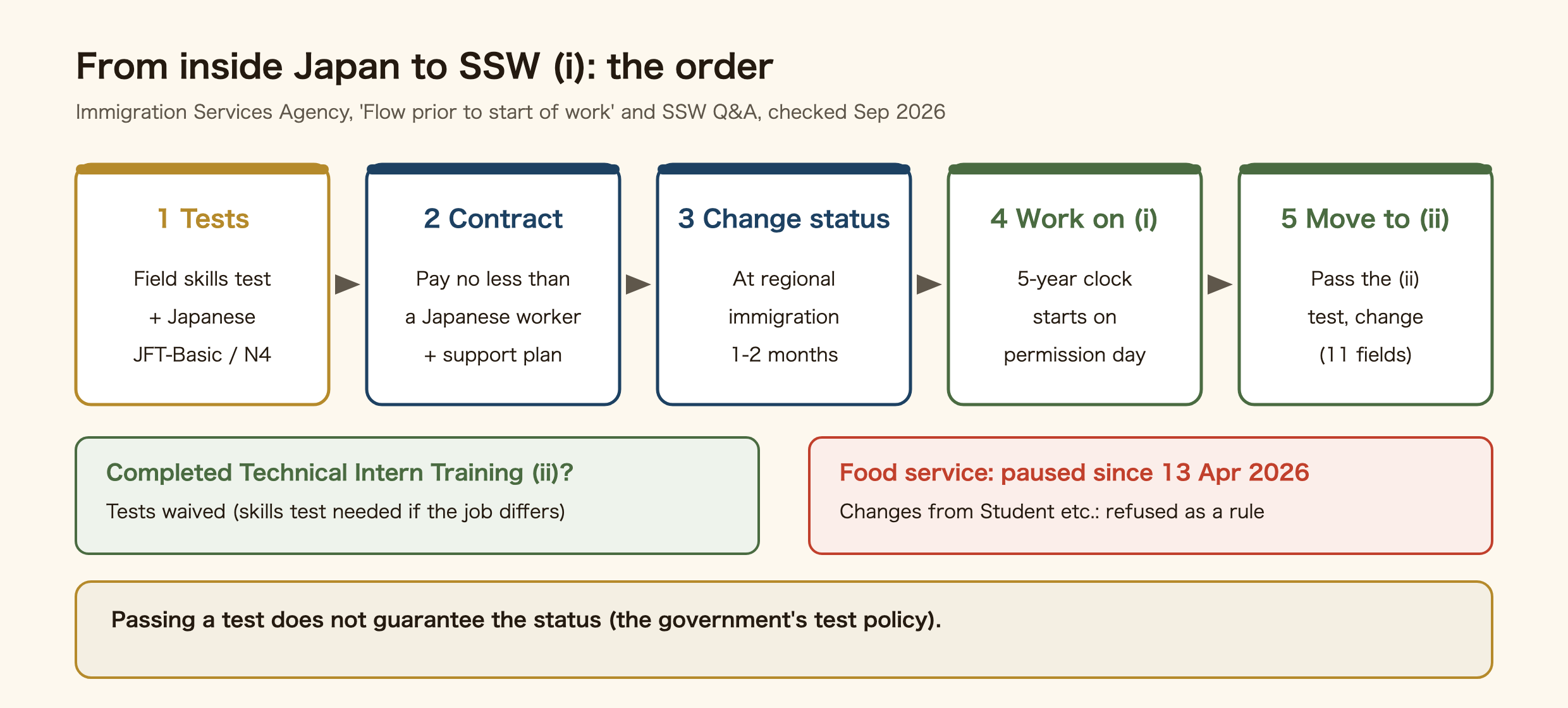
From inside Japan the order is: tests, employment contract, then an application to change your status of residence. You normally file it yourself at a regional immigration office, and the standard processing time is one to two months.
Immigration’s checklist (revised 20 August 2026) asks for these about you:
- The change of status application form and a 4 cm × 3 cm photo
- Proof of your test passes (set in each field’s sheet)
- Copies of the employment contract and working conditions, signed by you and written in a language you understand
- A medical examination form
- Residence tax certificates (assessment and payment) and a copy of your withholding slip
- National Health Insurance payment certificate and your National Pension record (24 months)
- The type 1 support plan, drawn up by the employer and signed by you
The tax and insurance papers are there to show you have paid. Residence tax certificates come from your city office (how residence tax works). If you have gaps in pension payments, check whether a National Pension exemption can still be applied backwards before you file.
Sometimes the tests are passed but the paperwork will not be ready before your current status expires. Then you can change to Designated Activities (six months, work allowed) and work for your future employer while you prepare. It can be extended once, only for unavoidable reasons, and the time counts towards your five years.
How much does it cost?
| What | Cost |
|---|---|
| JFT-Basic (in Japan) | 10,000 yen |
| JLPT | 7,500 yen |
| Skills test (in Japan) | Varies by field (e.g. accommodation 7,700 yen, agriculture 8,000 yen) |
| Change of status permission (received by 30 Sep) | 6,000 yen at the counter, 5,500 yen online |
| Change of status permission (applied from 1 Oct) | Set by the period granted; 1 year is 33,000 yen at the counter, 27,000 yen online |
From 1 October 2026 the fee depends on the period of stay granted. Every band is in the residence permit fee increase.
Some costs belong to the employer. The cost of the legally required support, such as airport pick-up and help finding housing, may not be charged to you (Q&A). A deposit or a penalty contract stands in the way of the SSW permission itself.
What is the support plan, and what is a registered support organisation?
An employer hiring someone on type 1 must draw up a support plan for work and daily life and follow it. Immigration lists ten kinds of support:
- A briefing before you start, airport pick-up and drop-off, help with housing and everyday contracts
- A life orientation, company at city office procedures, chances to study Japanese
- Handling consultations and complaints, help meeting Japanese people
- Job-change support if the employer ends your contract, and a meeting at least once every three months
The employer can hand all or part of this to a “registered support organisation” registered with Immigration. Your contact person may be at that organisation rather than the company, so check the names in your support plan. Type 2 is not covered by support.
You can change jobs, but a new employer means a new change of status application. The steps and the 14-day notifications are in how to change jobs on SSW.
How is the five-year limit counted, and what happens after?
The five years run from the day you were granted type 1. Immigration’s page on the cumulative period and its Q&A treat time like this:
- Counted: time on type 1 without working, time abroad on a re-entry permit, time on the Designated Activities status while preparing to move to type 1
- Not counted: maternity and childcare leave, sick or injury leave (over one continuous month, up to one year as a rule), time you could not re-enter for unavoidable reasons
Changing employer does not reset the clock. When the five years are up you cannot stay on type 1. You move to type 2, change to another status, or go home.
One exception: if you failed the type 2 test but scored at least 80% of the pass mark, and your employer will keep you on, a sixth year may be allowed. Apply before the five years end, about three months ahead.
Can SSW bring family to Japan?
Not on type 1. On type 2, a spouse and children can come (Q&A). The steps and who counts as family are in how to bring your family to Japan.
Students should know one exception. If you change from Student to type 1 while your spouse or children are already in Japan on Dependent status, they may be allowed to change to Designated Activities on humanitarian grounds (Q&A 9). If your family is here with you, talk to Immigration before you apply.
How do you move from SSW type 1 to type 2?
Not automatically. You pass the field’s type 2 evaluation test (or its equivalent) and change status. Immigration’s English material says type 2 needs no Japanese test except in fishery and food service (JLPT N3). Some fields also ask for proof of practical experience on site.
Immigration’s Japanese material adds that an ordinance checking type 2 Japanese by a test at B1 level is scheduled to take effect on 1 April 2027. If type 2 is your goal, keep building your Japanese while you are still on type 1.
You can also get type 2 without ever holding type 1, if a test confirms your skills (Q&A 12).
What if you break the rules or run out of time?
- A side job at another company: not allowed on SSW. Unauthorised work is illegal work
- A long gap without work: three months or more without SSW work and without good reason makes your status liable to cancellation
- Cheating on a test: a ban, a cancelled pass, or a set period barred from testing (test policy)
- Failing a test: JFT-Basic can be retaken after 45 days. Immigration’s policy sets no limit on attempts for skills tests (check with each field)
- Papers not ready before your status expires: use the six-month Designated Activities route above. Acting after the expiry date is the worst option
Which one are you?
- You are a student thinking of SSW after graduation — pick one field and check its skills test dates on Immigration’s test page. If you do not hold N4, create a Prometric ID today and book JFT-Basic.
- You are finishing (or have finished) Technical Intern Training (ii) — confirm with the employer whether the new job relates to your training occupation. Start collecting papers today so you can apply at least two months before the start date.
- You are on type 1 and near five years — count the months left from your permission date. Look up the type 2 test dates and tell your employer that 80% of the pass mark opens a sixth year.
- You want your family in Japan — type 1 cannot bring them, so check in the list whether your field has type 2. If it does not, decide today whether to switch fields.
- You were planning food service type 1 — open Immigration’s food service status page and see whether your application would qualify. If not, look for a test in another field.
FAQ
Q. What is the Specified Skilled Worker visa in Japan?
It is a status of residence for working in set fields with labour shortages, using skills proven by a test. There are two types, no degree is required, and you must be 18 or older.
Q. What is the difference between SSW type 1 and type 2?
Type 1 covers 19 fields, lasts five years in total, and does not basically allow family. Type 2 covers 11 fields, has no cap, and allows a spouse and children if requirements are met. You reach type 2 by passing its test and changing status.
Q. How many SSW fields are there?
As of September 2026, 19 fields for type 1 and 11 for type 2. Linen supply, warehousing and resource circulation were added in January 2026. Check Immigration’s pages for when warehousing and resource circulation start accepting.
Q. What Japanese level does SSW need?
Type 1 needs JFT-Basic (200 or more) or JLPT N4 or above. Taxi, bus and railway transport staff need N3 or above, and nursing care also needs its own Japanese test. Completing Technical Intern Training (ii) in good standing waives it.
Q. What happens when the five years on SSW type 1 end?
You cannot stay on type 1. You move to type 2, change to another status, or go home. If you scored 80% or more of the pass mark on the type 2 test, a sixth year may be allowed.
Q. Can SSW bring family to Japan?
Type 1 basically cannot. Type 2 can bring a spouse and children. If you change from Student to type 1 while your spouse or children are already here on Dependent status, they may be allowed to change to Designated Activities.
Summary
Specified Skilled Worker is a status you enter by passing tests, not by holding a degree. Type 1 covers 19 fields for five years in total; type 2 covers 11 with no cap. The Japanese requirement is JFT-Basic or N4, and you can sit the tests inside Japan.
The real decision is the field you start in. Does it have type 2? Is there a path to bring your family? Is acceptance open, unlike food service right now? Work back from where you want to be in five years, choose the field, then book the test.
Official sources: Immigration Services Agency, Specified Skilled Worker system / the same, for foreign nationals / the same, English system material (revised July 2026) / the same, SSW Q&A / the same, cumulative period of stay / the same, food service acceptance cap / the same, tests / Japan Foundation, JFT-Basic. Checked on 23 September 2026. Detailed conditions differ by field, so check Immigration’s page for yours.
Related reading
Found this useful? Share it
Send it to a friend who lives in Japan.
WHO WROTE THIS

mori
Japanese. I read the ministries’ own notices, orders and Q&As in the original, and I start from what my Nepalese and Sri Lankan friends in Japan actually ran into. I do not write about what I have not checked or been told.
What this site can and cannot do →Looking for something else?