Checked on 24 September 2026 against the Japan Student Services Organization (JASSO) EJU pages, the 2026 EJU guidelines, the 2026 test guide for candidates in Japan and JASSO’s EJU FAQ, and the Immigration Services Agency’s page on the Japanese ability needed for higher education.
The short answer
- The EJU measures the Japanese and academic skills of international students who want to enter a Japanese university. Universities use it to select. There is no pass or fail — you get scores.
- The November 2026 exam is on Sunday 8 November, and registration closed on 30 July. The next exam you can apply for is in 2027; JASSO normally announces those dates around November.
- The subjects are Japanese, Science, Japan and the World, and Mathematics. Your university decides which ones you take. Everything except Japanese can be taken in English.
- In Japan the fee is 12,000 yen for one subject, 23,000 yen for two or more (raised for 2026). It is never refunded.
- Scores are valid for two years (four sessions), but each university decides which sessions it accepts. Tick the scholarship box when you apply and a top score can reserve a 48,000 yen monthly JASSO scholarship before you enrol.
Knowing this, you can work backwards from what your university requires — subjects, language, session — and get the next application right first time. You will also know how to read the scores when they arrive.
It is break time at your language school. Classmates in the university-prep class are asking each other how many EJU subjects they signed up for. You want to go to university too, but you are not sure what the EJU is or when you are meant to apply. Asking a Japanese friend does not help. The EJU is a test for people who want to enter a Japanese university as international students.
- What is the EJU exam in Japan?
- EJU 2026 dates: 8 November, registration already closed
- Sitting the exam on 8 November: ticket and ID
- What are the EJU subjects, and can I take them in English?
- How much is the EJU exam fee in Japan?
- How does EJU registration work?
- How do EJU scores work?
- How long is an EJU score valid?
- EJU vs JLPT: what is the difference?
- EJU and the JASSO scholarship: reserve it when you apply
- Missed the deadline? Check your university’s rules before the next session
- What happens if I break the exam rules?
- Which one are you?
- FAQ
- Summary
- Related reading
What is the EJU exam in Japan?
The Examination for Japanese University Admission for International Students (EJU) is run by JASSO. Its purpose is to assess whether international students who want to enter a Japanese university, mainly at undergraduate level, have the Japanese and the basic academic ability they will need there.
It has been held twice a year, in June and November, in Japan and abroad since 2002. It replaced two tests that many universities used to require: the JLPT and the old General Examination for Foreign Students.
There are no entry requirements, and anyone can sit it. To enter a Japanese university, though, you normally need 12 years of formal schooling. There is no limit on how many times you take the EJU.
Universities use EJU scores to select. Some decide on EJU scores plus high-school grades alone, so students can be admitted before they come to Japan (pre-arrival admission). Others do not use the EJU at all. Check your target university’s admission guide first to see whether it needs the EJU. JASSO publishes a list of schools that use it.
EJU 2026 dates: 8 November, registration already closed
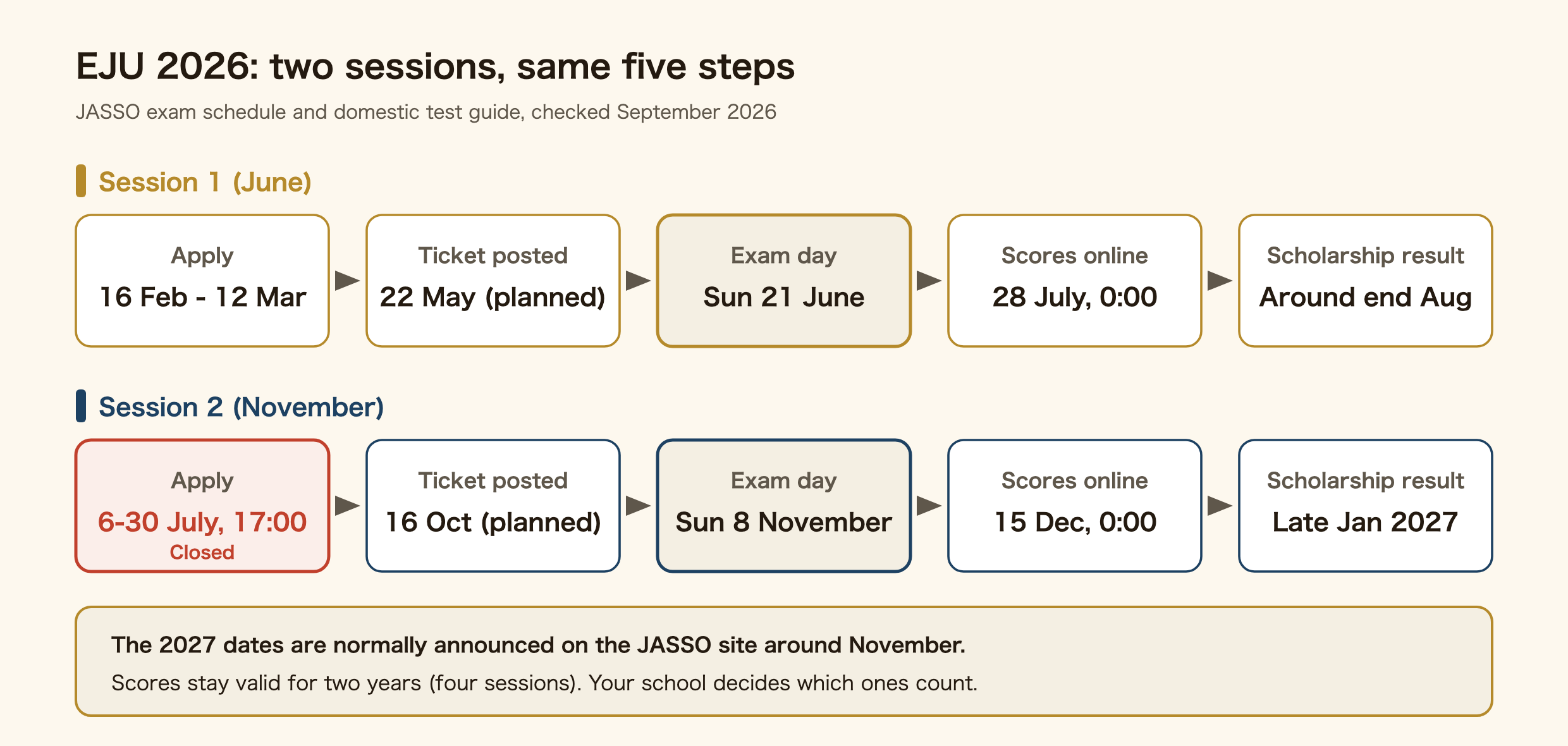
| 2026 | Session 1 (June) | Session 2 (November) |
|---|---|---|
| Applications (in Japan) | 16 Feb – 12 Mar, 17:00 | 6 – 30 July, 17:00 (closed) |
| Admission ticket posted | 22 May (planned) | 16 October (planned) |
| Exam day | Sunday 21 June | Sunday 8 November |
| Scores released | 28 July, 0:00 | 15 December, 0:00 (planned) |
Registration for the November 2026 exam closed on 30 July. Late applications are not accepted for any reason, so there is no EJU you can apply for right now.
The next exams are in the 2027 academic year. JASSO says it announces the following year’s dates on its website around November. For reference, applications for the June 2026 exam ran from 16 February to 12 March.
In June 2026, 30,804 people applied and 26,888 sat the exam in Japan and abroad; 19,482 of them sat it in Japan.
Sitting the exam on 8 November: ticket and ID
Admission tickets for candidates in Japan are due to go out on 16 October by registered post, which needs a signature. Put your name in the Latin alphabet on your mailbox or door so the post can reach you.
If nothing has arrived ten days after the posting date, print a provisional ticket from the “check/change application” page on EJU Online. Take it to the provisional ticket desk at the venue on the day.
You need the original of a valid residence card, passport or My Number card. Copies and photos are refused, and if you forget it you cannot sit the exam. If you applied for a visa renewal online, bring the “renewal application in progress” certificate from Immigration with your card.
Japanese runs from 9:30 to 12:00, Science and Japan and the World from 13:30 to 15:00, and Mathematics from 15:40 to 17:10. You cannot enter the Japanese exam after 9:40, or any other subject more than 20 minutes after it starts.
What are the EJU subjects, and can I take them in English?
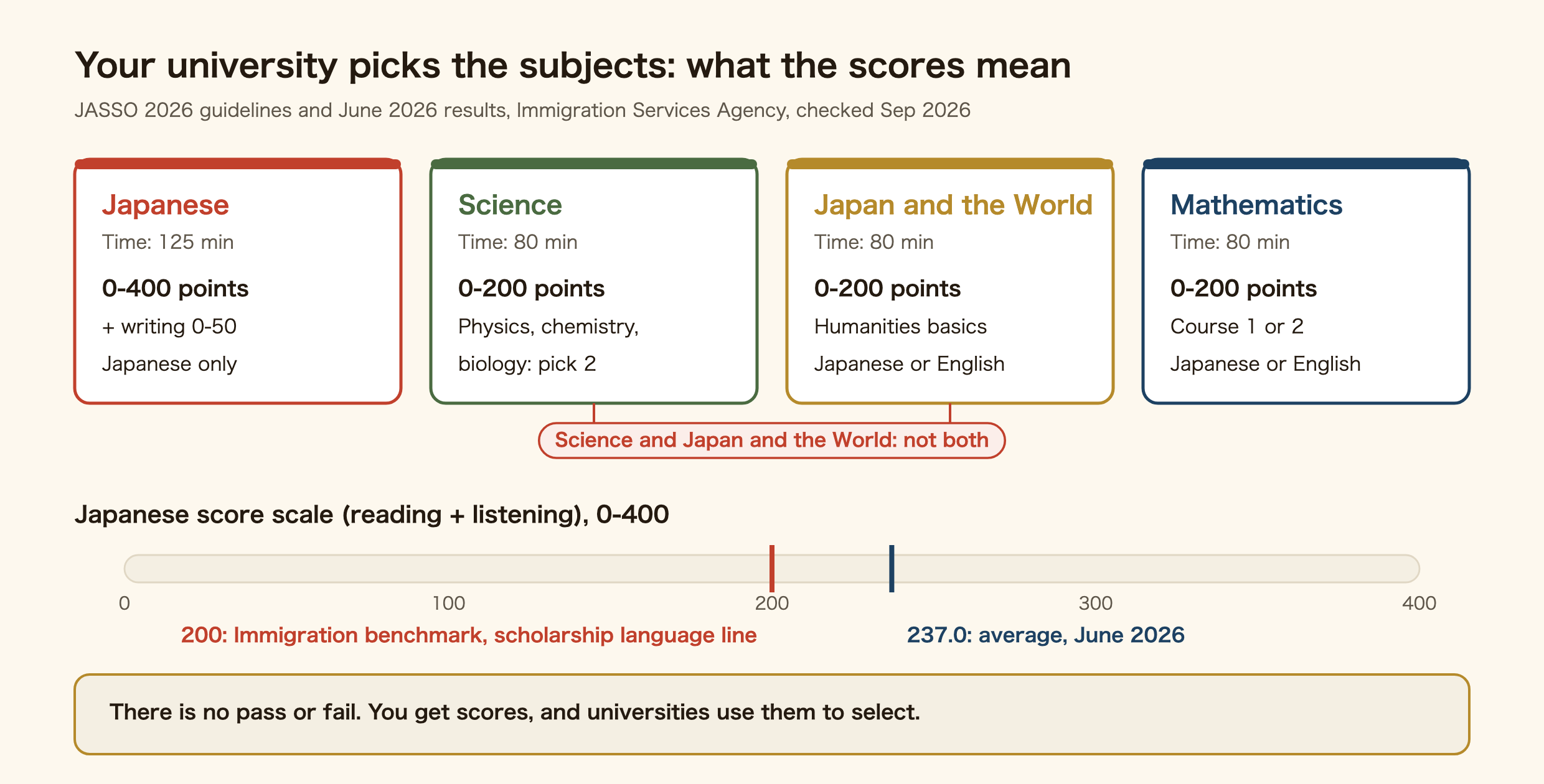
| Subject | What it measures | Time | Score |
|---|---|---|---|
| Japanese as a Foreign Language | Japanese for university study (“academic Japanese”) | 125 min | Reading + listening 0–400; writing 0–50 |
| Science | Physics, chemistry and biology basics for science faculties | 80 min | 0–200 |
| Japan and the World | Humanities basics, especially reasoning and logic | 80 min | 0–200 |
| Mathematics | Basic maths for university | 80 min | 0–200 |
You do not take everything. You pick the subjects your target university names, within a few rules.
- You cannot take both Science and Japan and the World.
- For Science you choose two of physics, chemistry and biology on the day. Choose only one and Science is not scored.
- For Mathematics you choose Course 1 (humanities and less maths-heavy science faculties) or Course 2 (maths-heavy faculties) on the day.
You choose Japanese or English as the exam language when you apply. The Japanese subject is only set in Japanese, and fewer venues offer English papers. Some universities specify the language too — for example, “Japan and the World and Mathematics in Japanese” — so check that along with the subjects.
How much is the EJU exam fee in Japan?
| Taking it in Japan | 2026 | 2025 |
|---|---|---|
| One subject | 12,000 yen | 10,000 yen |
| Two or more (two or three) | 23,000 yen | 19,000 yen |
The fee includes tax and the postage for your ticket, and it went up for 2026. If you take Japanese plus another subject, you pay 23,000 yen. You can pay by credit card, at a convenience store, or by bank transfer (ATM or online banking).
Once paid, the fee is never refunded, not even if you are ill on the day. It cannot be moved to a later session either.
Adding subjects costs more than you might expect. If you paid 12,000 yen for one subject and then switch to two or more, you pay the full 23,000 yen again — you cannot just top up the 11,000 yen difference.
How does EJU registration work?
Candidates in Japan apply on EJU Online in four steps: get a My Page ID, enter your application details, pay, then check on My Page that it says “paid” and the details are right.
- A face photo taken within six months of applying: no hat, plain background, facing forward
- Your name exactly as on your passport or residence card
- If you are at a language school, the school may apply for everyone as a group. Ask your school how to apply before doing it yourself
You can change details on My Page until the deadline. After the deadline, you cannot change your subjects, exam language or test site at all. Only mistakes in your name, date of birth and similar details can be fixed after the exam, in a correction window (9–19 November for Session 2), for 3,000 yen.
How do EJU scores work?
The EJU has no pass or fail. You get scores, and universities use them to select.
Apart from the writing section, the scores are not the number of questions you got right. They are scaled scores on a common scale, adjusted so that different papers — different sessions, different countries — can be compared fairly. A university can put a June score next to a November score and compare them directly.
Writing asks you to argue your own view on a set task with reasons, and it is marked separately, in bands: 50 (level S), 45 (A), 40 or 35 (B), 30 or 25 (C), 20 or 10 (D), or 0. Universities receive a copy of your written answer along with the score.
Two numbers help you read your score.
- 200 in Japanese (reading plus listening): Immigration lists this, alongside JLPT N2 or above, as one benchmark for the Japanese needed to study at university in Japanese. The same 200 appears in the language condition for JASSO’s Honors Scholarship
- The June 2026 averages: Japanese (reading plus listening) 237.0, writing 33.1, Japan and the World 122.5, Mathematics Course 1 97.3 and Course 2 108.5, and in Science physics 53.8, chemistry 52.4 and biology 63.8 (each out of 100)
The score you need for a particular university is up to that university. JASSO does not publish pass marks for schools, so look at your target university’s admission guide and past admission data.
Scores appear on EJU Online at 0:00 on release day. The “score confirmation” you can print is only for your own reference, not proof of your score, and JASSO no longer issues score certificates. You write your examinee number on the university application, and the university requests your score from JASSO directly.
How long is an EJU score valid?
EJU scores are valid for two years, which is the last four sessions. But a university may name which years or sessions it accepts, so all four are not always usable.
If you sat the exam more than once, you can choose your best session within the range your university accepts. You cannot mix subjects from different sessions — “Japanese from June, Mathematics from November” is not allowed. You give one session’s examinee number.
EJU vs JLPT: what is the difference?
| EJU | JLPT | |
|---|---|---|
| Measures | Japanese for university study, plus academic basics | General Japanese ability |
| Result | Scores only, no pass or fail | Pass or fail |
| Format | Has a writing task; no vocabulary or grammar section | Has vocabulary and grammar; no writing |
| Fee in Japan | 12,000 / 23,000 yen | 7,500 yen |
Which one is harder, or what EJU score equals N1? JASSO’s answer is that they cannot be compared, because they measure different things.
A common mistake is thinking N1 or N2 means you can skip the EJU. If your university requires the EJU Japanese subject, you must take it even with N1. For Specified Skilled Worker or Highly Skilled Professional points, Immigration’s pages name the JLPT, not the EJU, so check the JLPT dates, fee and pass marks too when you plan which test to take and when.
EJU and the JASSO scholarship: reserve it when you apply
The EJU comes with a scholarship reservation scheme. Through JASSO’s reservation programme, candidates with excellent EJU scores can reserve the Monbukagakusho Honors Scholarship for Privately Financed International Students — 48,000 yen a month — before they enrol.
- How to apply: choose “apply” in the scholarship section of your EJU application. You cannot change it afterwards
- Who: privately financed students entering an undergraduate programme, junior college, college of technology (year 3 or above) or vocational college as new regular students. Research students, auditors and graduate school entrants are excluded
- How they choose: the top scorers in each of eight subject combinations
- For the November 2026 exam: results on EJU Online from late January 2027. Enter between November 2026 and April 2027 and you receive it from April 2027 to March 2028
- Conditions to receive it: Student status, money from home of 90,000 yen a month or less on average, a supporter in Japan earning under 5 million yen a year, signing the monthly enrolment register at school, and others
A reservation does not pay out by itself. You report your new school to JASSO, give the school a copy of your reservation notice after you enrol, and the school nominates you. This works even if your new school does not use the EJU to select.
If you missed the reservation, you can still be nominated through your school after you enrol, and language schools are eligible for 30,000 yen a month. How the JASSO scholarship works for students already in Japan can change your living-cost sums for the year you move up.
Missed the deadline? Check your university’s rules before the next session
If you missed the November registration, there are three things you can do now.
- Check your target university’s admission guide for which EJU years and sessions it accepts. Some accept June scores or scores from the previous year
- Look for universities, faculties or vocational colleges that do not use the EJU. Each school decides for itself
- Watch the JASSO EJU page around November for the 2027 dates. If you applied on EJU Online within the last two years, your existing My Page ID still works
If you are not sure university is the right road after language school, lining up the four roads after Japanese language school will tell you whether you need the EJU at all.
What happens if I break the exam rules?
Having a phone or smartwatch on you during the exam, or letting one make a sound, is misconduct. Even having it switched on counts. Misconduct means none of your subjects are scored, and the fee is not refunded.
Serious cases, such as someone sitting the exam for you, are reported to the police, and the candidate can be barred from the next two years (four sessions). JASSO may also tell universities that the scores are void.
Which one are you?
- Sitting the exam on 8 November — if your ticket has not arrived by 26 October, print a provisional one on EJU Online. Check the expiry date on your residence card today.
- Missed the November registration — check today which EJU sessions your target university accepts. Put a reminder in your calendar to check the JASSO page for the 2027 dates in November.
- Not sure what to take — narrow down to two or three universities and list, today, the subjects, language and sessions each one requires.
- Worried about money — decide now that you will tick the scholarship reservation on your next EJU application. Ask your school office today which scholarships you can apply for where you are.
FAQ
Q. What is the EJU exam?
The Examination for Japanese University Admission for International Students, run by JASSO. It measures the Japanese and basic academic ability of international students who want to enter a Japanese university. It is held in June and November, universities use it to select, and there is no pass or fail — only scores.
Q. Can I still register for the November 2026 EJU?
No. Registration for the 8 November 2026 exam closed on 30 July at 17:00, and late applications are not accepted. JASSO normally announces the 2027 dates on its website around November.
Q. How much is the EJU exam fee in Japan?
For 2026, 12,000 yen for one subject and 23,000 yen for two or more, including tax. The fee is not refunded for any reason and cannot be moved to a later session.
Q. How long are EJU scores valid?
Two years, which covers the last four sessions. Universities may specify which years or sessions they accept. If you sat it more than once you can choose your best session within that range, but you cannot combine subjects from different sessions.
Q. Do I need the EJU if I already have JLPT N1?
Yes, if your university requires the EJU Japanese subject. The EJU measures Japanese for university study and the JLPT measures general Japanese ability, and JASSO says the two scores cannot be compared.
Q. Can the EJU get me a scholarship?
Yes, through JASSO’s reservation scheme. Choose to apply when you register for the EJU, and top scorers can reserve the 48,000 yen monthly Honors Scholarship before enrolling. It covers new regular students entering an undergraduate programme, junior college, college of technology (year 3 or above) or vocational college, not graduate school.
Summary
The EJU is how Japanese universities select international students. There is no pass or fail, and your scores stay usable for two years (four sessions). Your university, not you, decides which subjects you take and which sessions count.
Registration for the November 2026 exam closed on 30 July. What you can do now for the next session is check your university’s subjects, language and accepted sessions. Tick the scholarship reservation when you apply. The fee is 12,000 yen for one subject or 23,000 yen for two or more, and it does not come back.
Official sources: JASSO, What is EJU? / JASSO, 2026 EJU guidelines (Japanese) / JASSO, EJU schedule / JASSO, EJU test guide / JASSO, score release / JASSO, EJU FAQ (Japanese) / JASSO, scholarship reservation for the November 2026 EJU / Immigration Services Agency, Japanese ability for entering higher education (Japanese). Checked on 24 September 2026. Always confirm subjects and sessions in your university’s admission guide.
Related reading
Found this useful? Share it
Send it to a friend who lives in Japan.
WHO WROTE THIS

mori
Japanese. I read the ministries’ own notices, orders and Q&As in the original, and I start from what my Nepalese and Sri Lankan friends in Japan actually ran into. I do not write about what I have not checked or been told.
What this site can and cannot do →Looking for something else?