Last updated: 25 August 2026
Summary
- International students in Japan spend 170,000 yen a month on average. In Tokyo it is 199,000 yen. Those are national survey figures, not estimates (JASSO 2023 living conditions survey, Table 7-3 (Japanese PDF)).
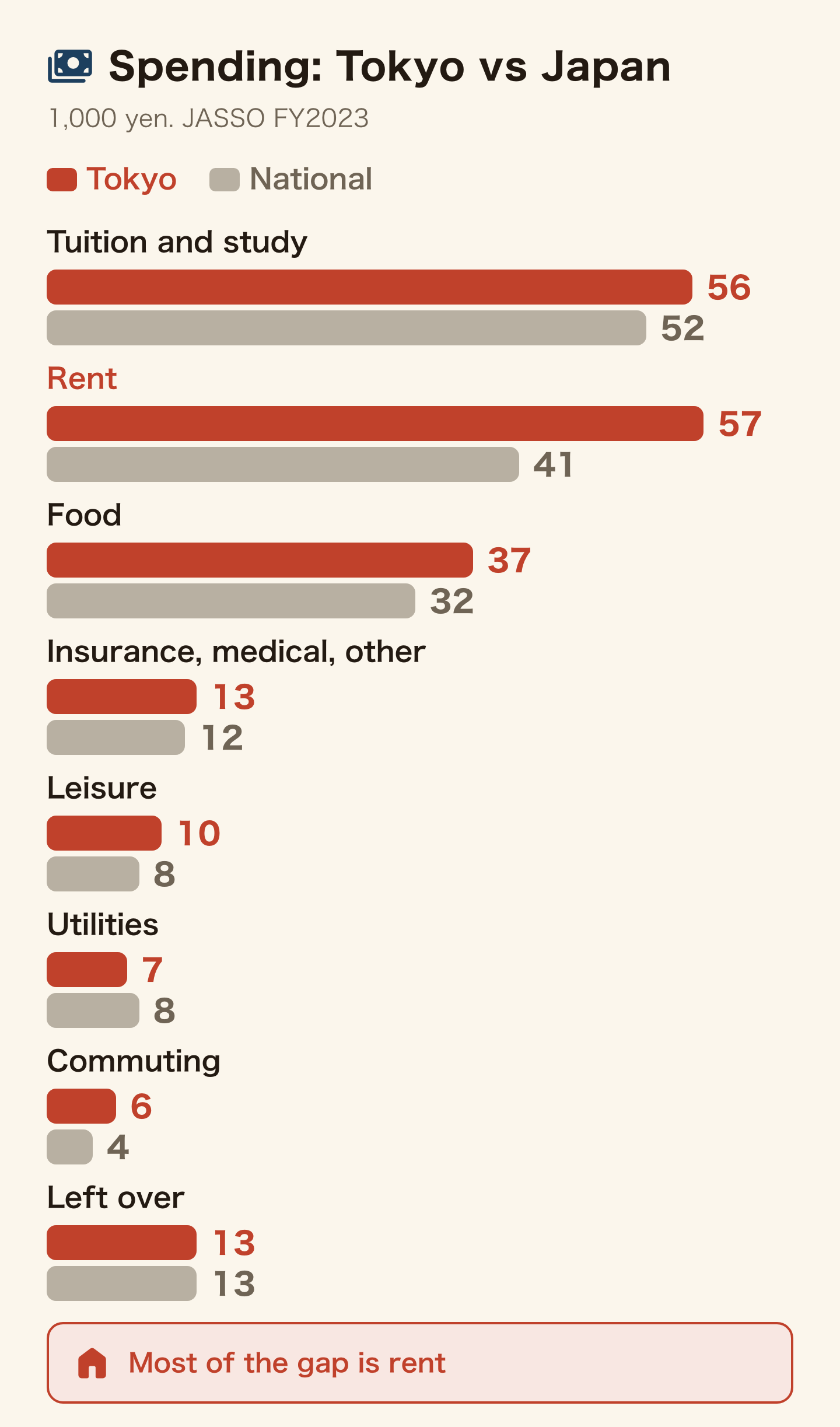
- Rent is the number that moves. 41,000 yen nationally, 57,000 yen in Tokyo – almost the entire gap between the two.
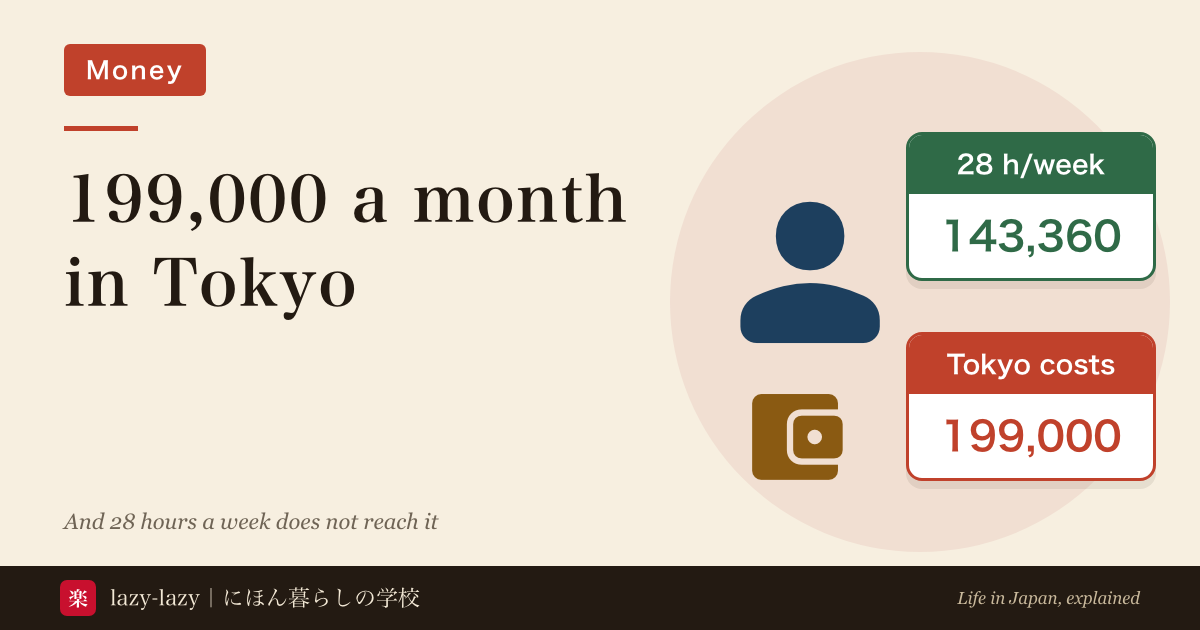
- 28 hours a week at Tokyo minimum wage earns you 143,360 yen. Against Tokyo’s 199,000 yen that leaves a hole of 55,640 yen every month.
- Which is why the survey lists family support alongside part-time work as the main sources of income. Working the legal maximum does not close it by itself.
- “Prices are high” was the single most common difficulty reported, at 71.4%. If it feels impossible, that is the structure, not you.
Once you see the numbers, you stop blaming your own budgeting and start deciding where the missing 60,000 yen a month will come from.
The figures on this page come from the Japan Student Services Organization’s FY2023 survey of privately financed international students, which collected 7,867 valid responses (JASSO, FY2023 Survey of Privately Financed International Students, full report (PDF, Japanese)). Nepal, Vietnam and Sri Lanka are all among the larger groups in it, so these are numbers from people in the same situation as you rather than a general Japanese average.
How much does living in Japan cost per month?
170,000 yen a month across the country. 199,000 yen in Tokyo. The median is lower than the average at 150,000 yen (JASSO survey, Table 7-1), which tells you a smaller number of high spenders pull the average up.
Those totals include tuition. Take that out and the picture changes, so the breakdown matters more than the headline.
| Per month | Tokyo | National average |
|---|---|---|
| Tuition and study costs | 56,000 yen | 52,000 yen |
| Rent | 57,000 yen | 41,000 yen |
| Food | 37,000 yen | 32,000 yen |
| Electricity, gas, water | 7,000 yen | 8,000 yen |
| Commuting | 6,000 yen | 4,000 yen |
| Leisure | 10,000 yen | 8,000 yen |
| Insurance, medical, other | 13,000 yen | 12,000 yen |
| Left over | 13,000 yen | 13,000 yen |
| Total | 199,000 yen | 170,000 yen |
Two things stand out. Rent accounts for almost the whole Tokyo premium – 16,000 of the 29,000 yen difference. And whatever city you are in, only 13,000 yen is left over. Not 13,000 saved: 13,000 unaccounted for at the end of the month.
Commuting (6,000 yen a month in Tokyo) is one line you can cut: if your course is designated by JR, a student commuter pass bought with your school’s certificate costs less than a regular one.
How much is tuition, separately?
Tuition sits inside that 52,000 yen study figure and varies enormously by institution. To turn a spending breakdown into the seven lessons of a classic money parable, see The Richest Man in Babylon, 7 Lessons for Japan 2026 (5 Skills).
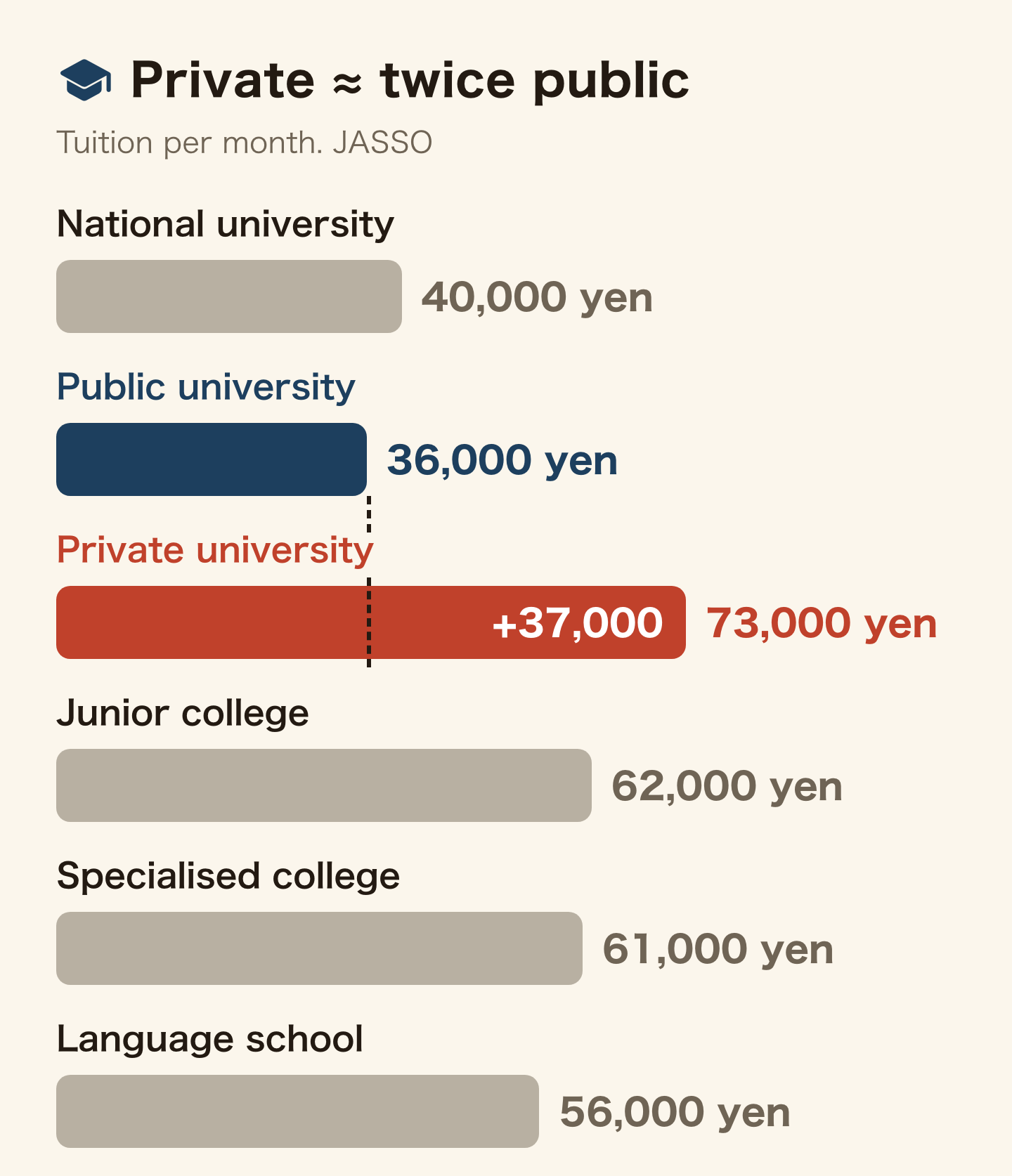
| Type of school | Tuition per month |
|---|---|
| National university | 40,000 yen |
| Public university | 36,000 yen |
| Private university | 73,000 yen |
| Junior college | 62,000 yen |
| Specialised training college | 61,000 yen |
| Japanese language school | 56,000 yen |
A private university costs nearly twice a public one. If you are still choosing where to apply, that difference is 37,000 yen every month for the length of your course – larger than any economy you could make elsewhere. What a Japanese language school costs covers that end in detail.
Can you cover this working 28 hours a week?
Here is where the numbers stop being reassuring.
Before you came, the plan was simple: if money runs short, work more hours. Where you are from, a student may get to decide that alone. In Japan, a student’s working hours have a ceiling, so adding hours was never a way out.
A student visa permits 28 hours of work a week. (Immigration Services Agency, permission for part-time work on a Student status (Japanese)) Tokyo’s minimum wage is 1,280 yen an hour, in force since 1 October 2026 (published in the official gazette by the Tokyo Labour Bureau on 1 September; Tokyo Labour Bureau, Tokyo minimum wage raised to 1,280 yen (Japanese)). Until 30 September it was 1,226 yen. Twenty-eight hours across four weeks is 112 hours.
112 hours at 1,280 yen is 143,360 yen a month. That is the ceiling, working every permitted hour, every week, without a single day off sick.
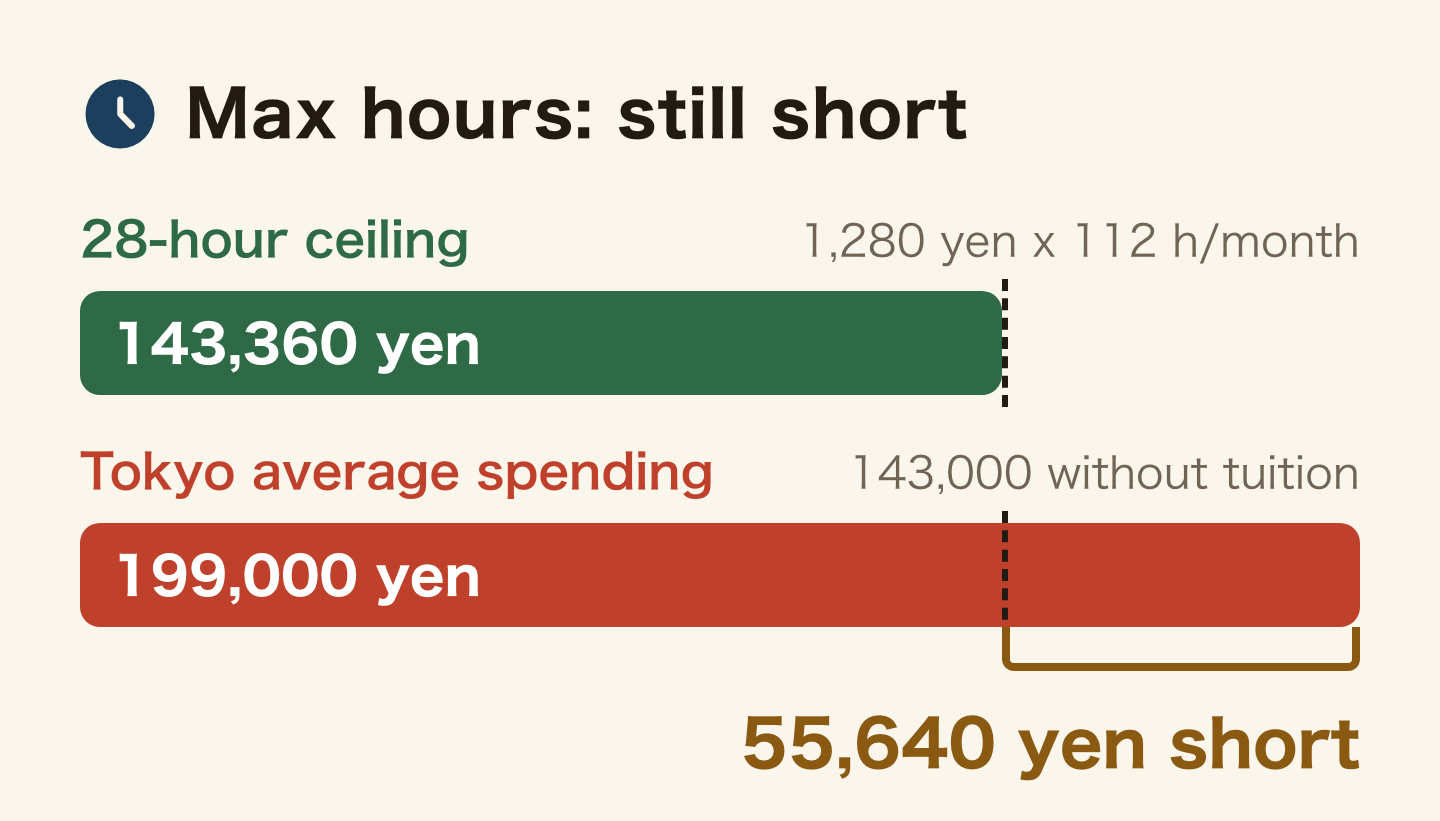
Against Tokyo’s 199,000 yen, that leaves 55,640 yen a month (199,000 – 143,360) unaccounted for.
Strip out tuition entirely – say it is paid annually from savings – and Tokyo runs at 143,000 yen. That is almost exactly the 143,360 yen ceiling, with next to nothing left over. You only reach it by working every permitted hour, every week.
This is not a failure of budgeting. The survey itself lists family support alongside part-time work as the main sources of student income, and only 65.2% of students work at all. The most common working week reported was 20 to 25 hours, not the full 28.
So if you have been wondering what you are doing wrong, the answer may be nothing. “Prices are high” was the most common difficulty in the entire survey, reported by 71.4% of respondents.
What can you actually change?
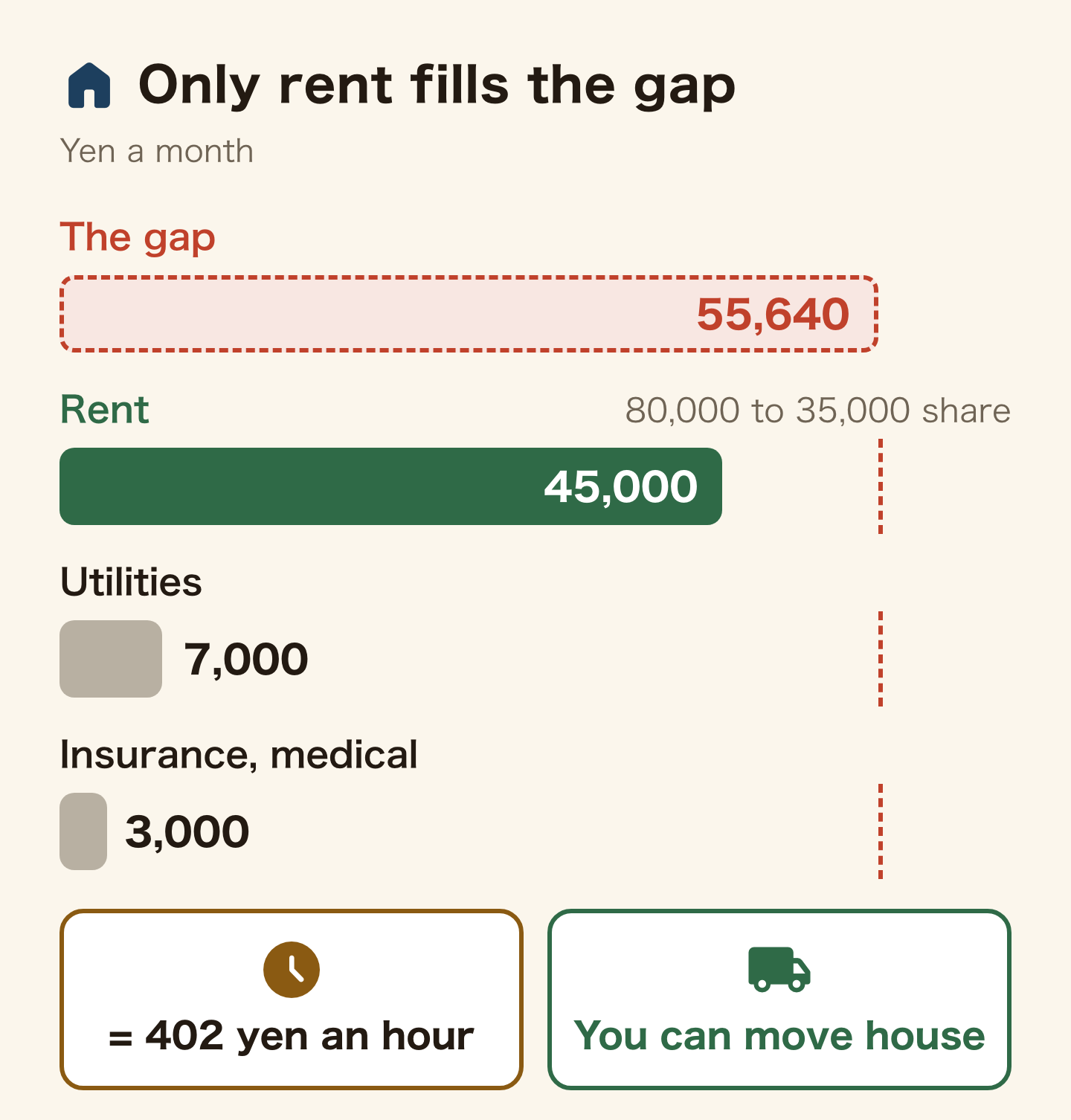
Look at the breakdown again and most rows barely move. Utilities are 7,000 yen. Insurance and medical costs are 3,000. Cutting those hard might find you a few thousand yen. The one utility that jumps is winter electricity, and how the bill is calculated and what setting to heat at is worth knowing before December.
Rent is different. It is the largest controllable number on the list and the one with the widest range – 41,000 yen nationally against 57,000 in Tokyo, and share houses start well below either. Moving from an 80,000 yen flat to a share house dormitory, where Oak House puts the average rent at 35,000 yen (Oak House official cost page), frees 45,000 yen a month, which is most of that 55,640 yen hole.
Put that in hourly terms. 45,000 yen over 112 hours is 402 yen an hour. To match it by finding better work, you would need to move from 1,280 yen to 1,682 yen (1,280 + 402). Nobody negotiates that. You can move house.
There is also money that comes in without any work. The Monbukagakusho Honors Scholarship pays 30,000 yen a month even at a Japanese language school, and 48,000 yen a month at a university or vocational school (JASSO, Monbukagakusho Honors Scholarship for Privately-Financed International Students). You do not pay it back. 30,000 yen is about 23 hours of work at 1,280 yen an hour (30,000 / 1,280 = 23.4), roughly 21% of the 112 hours a month the 28-hour weekly limit allows. You cannot apply on your own. Your school recommends you, so nothing starts until you ask the school office.
Two more fixed costs are worth checking because students routinely pay them without knowing there is an alternative.
- The National Pension is 17,920 yen a month (Japan Pension Service, National Pension premiums (Japanese)), and students who cannot pay can have it deferred rather than falling into arrears – see the student deferral
- National Health Insurance has a reduction scheme for low incomes – how the premiums are set
- A major carrier’s unlimited plan is 8,448 yen a month before discounts (docomo MAX, official price), against 1,078 yen for up to 3GB on a budget SIM (Rakuten Mobile, official price)
One number the survey buries
Among the housing questions sits a figure worth knowing before you go flat hunting. 48.7% of students – 3,829 of them – were asked for a guarantor when arranging accommodation.
Nearly half. If it happens to you, it is not because of anything about you, and there are three routes through it.
All spending and income figures come from the Japan Student Services Organization’s FY2023 Survey of Privately Financed International Students, checked on 25 August 2026. Wage figures are from the Tokyo Labour Bureau (checked 1 October 2026). Source: JASSO, Survey of Privately Financed International Students / JASSO, FY2023 Survey of Privately Financed International Students, full report (PDF, Japanese) / Tokyo Labour Bureau, Tokyo minimum wage raised to 1,280 yen (Japanese) / Immigration Services Agency, permission for part-time work on a Student status (Japanese) / JASSO, Monbukagakusho Honors Scholarship for Privately-Financed International Students / Japan Pension Service, National Pension premiums (Japanese) / Tokyo Labour Bureau, Tokyo minimum wage raised to 1,280 yen (Japanese) (checked 26 September 2026)
Before you cut a fixed cost, there is something faster to check: the National Health Insurance reduction. In Tokyo it takes 65,200 yen a year down to 19,560. No negotiating and no switching, just a declaration at the city office.
Shops and offices close from around 29 December to 3 January, and spending changes shape; what closes at New Year and what people eat is its own guide.
Frequently asked questions
Q. How much does it cost to live in Japan as an international student per month?
170,000 yen a month on average nationally, and 199,000 yen in Tokyo, including tuition (JASSO survey, Tables 7-1 and 7-3). The median is 150,000 yen. Rent is the largest variable, at 41,000 yen nationally against 57,000 in Tokyo.
Q. Can I cover my living costs working 28 hours a week?
Not in Tokyo on minimum wage. 28 hours a week is 112 hours a month, which at 1,280 yen (Tokyo Labour Bureau, minimum wage from 1 October 2026) comes to 143,360 yen against average Tokyo spending of 199,000 yen. The survey lists family support alongside part-time work as the main income sources for exactly this reason.
Q. How much is rent for international students?
41,000 yen a month on average nationally and 57,000 yen in Tokyo (JASSO survey, Table 7-4). Share houses start considerably lower, and 70.1% of students live in private flats rather than dormitories.
Q. How much is tuition per month?
40,000 yen at a national university, 36,000 at a public one, 73,000 at a private one, 61,000 at a specialised training college and 56,000 at a Japanese language school.
Q. What is the biggest thing I can cut?
Rent, by a wide margin. Utilities are 7,000 yen a month and medical costs 3,000, so there is little to find there. Moving from an 80,000 yen flat to a share house dormitory at Oak House’s average rent of 35,000 yen frees 45,000 yen, equivalent to a 402 yen hourly raise.
Q. Is it normal to find Japan expensive?
Yes. “Prices are high” was the most commonly reported difficulty in the survey, cited by 71.4% of the 7,867 students who responded.
In short
- 170,000 yen a month nationally, 199,000 in Tokyo, tuition included
- Rent is the Tokyo premium – 57,000 against 41,000 yen
- 28 hours a week caps you at 143,360 yen, leaving a 55,640 yen gap in Tokyo
- Only 13,000 yen is left over at the end of the month, wherever you live
- Rent is the one row that really moves – 45,000 yen saved equals a 402 yen raise
- 71.4% said prices are high. The difficulty is structural
Related guides
Found this useful? Share it
Send it to a friend who lives in Japan.
The fastest monthly cost to cut is your phone bill. Here are the plans you can sign up for without a credit card.
Best SIM in Japan for Foreigners →WHO WROTE THIS

mori
Japanese. I read the ministries’ own notices, orders and Q&As in the original, and I start from what my Nepalese and Sri Lankan friends in Japan actually ran into. I do not write about what I have not checked or been told.
What this site can and cannot do →Looking for something else?
You may use the figures in this article, including commercially, if you credit this site with a link. How to use our figures