New Year closure dates and what stays open were checked against the Act on Holidays of Administrative Organs, the Local Autonomy Act, the Fukuoka City ordinance on city holidays, the Banking Act enforcement order, Seven Bank\’s guidance, the Fukuoka Prefectural Police 110 leaflet in English, the FDMA White Paper and Fukuoka City\’s year-end medical care notice on 18 October 2026. They change – check the current information yourself before you file anything.
This article contains affiliate links.
Last updated: October 2026
In short
- Osechi ryori is the traditional food Japanese people eat at New Year. It is packed into jubako, square tiered boxes.
- Every dish carries a wish for the year. For example: black beans for health, shrimp for long life, sweet chestnut for money.
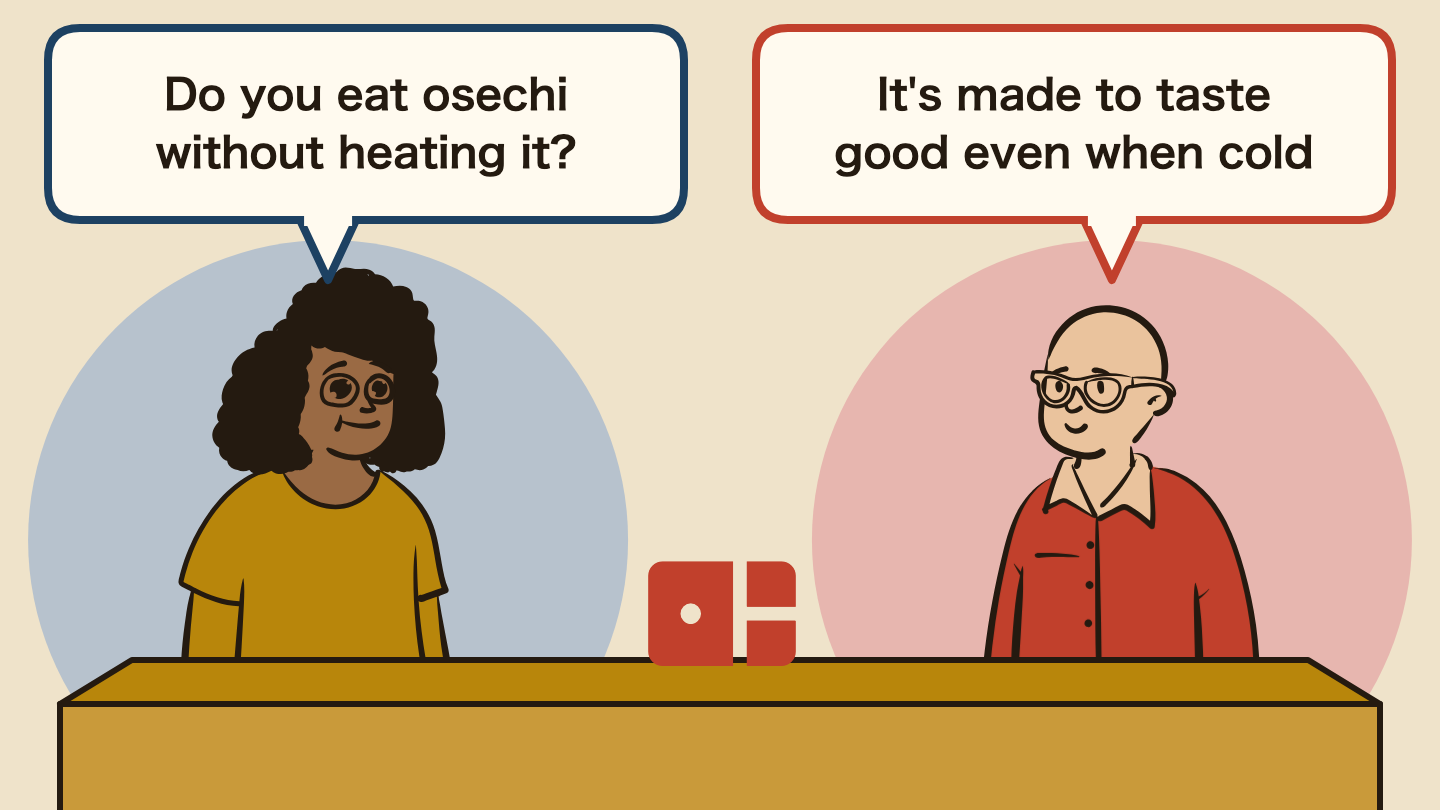
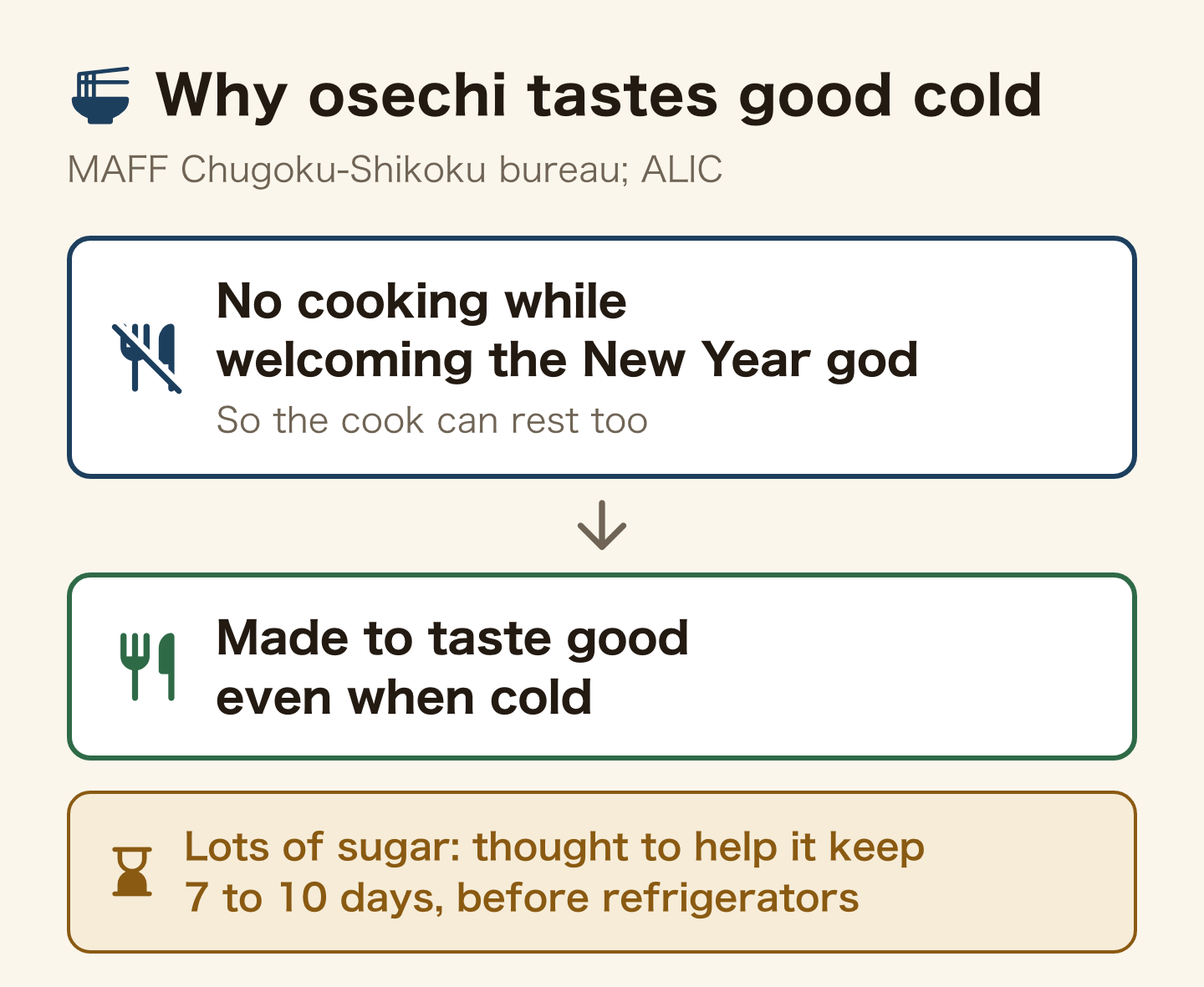
- Cooking was avoided while welcoming the New Year god, so the cook could rest too, and the dishes are made to taste good even when cold.
- There are three ways to try it: cook, order online, or buy single items. You do not need a family or a kitchen.
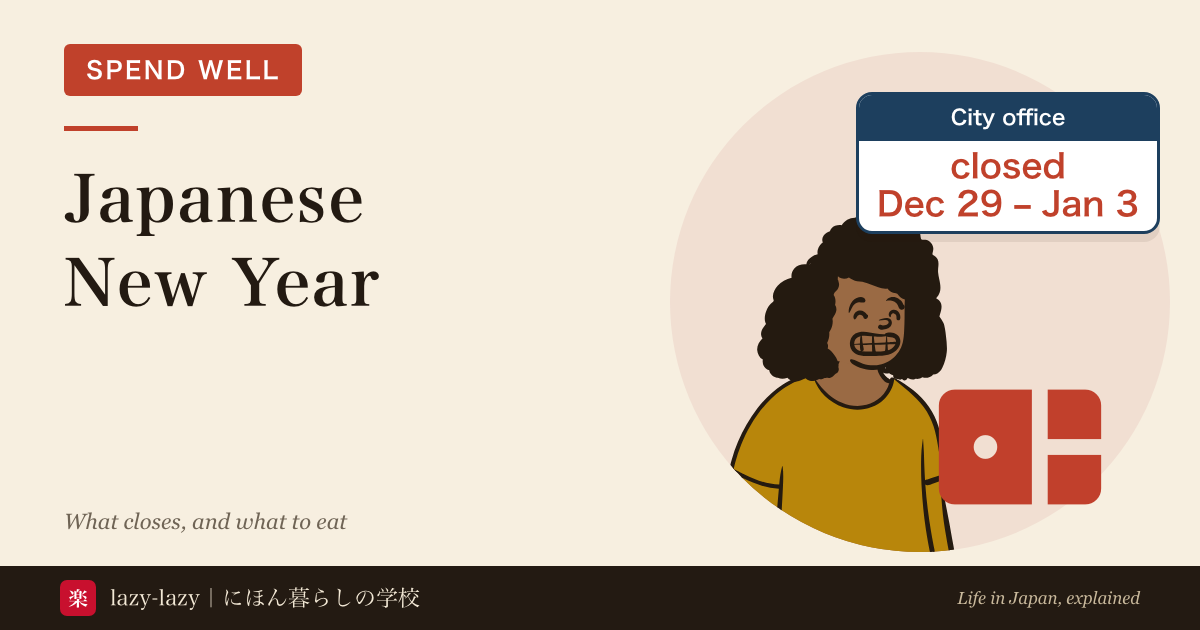
- New Year is when Japan stops. National government offices close December 29 to January 3, and bank counters December 31 to January 3. City offices follow local ordinances (Fukuoka City uses the same dates).
- Finish city office errands by December 28. Seven Bank ATMs work in principle 365 days, and 110 and 119 take calls 24 hours a day, 365 days a year.
Knowing this, you understand what each dish in the box is wishing for, and you are not the person standing outside a closed city office on 30 December. New Year becomes something you take part in, not watch.
- What is osechi? A New Year meal where every dish is a wish
- Why osechi tastes good cold, and why it comes in stacked boxes
- Why osechi is worth trying while you live here
- Three ways to actually try it
- What closes over New Year, and for how long
- The one thing to do before December 29
- Frequently asked questions
- Summary
- Related guides
What is osechi? A New Year meal where every dish is a wish
Osechi ryori is the special food eaten in Japan at New Year. Colourful dishes are packed neatly into jubako, square boxes. What makes it more than a meal is that each item carries a wish for the coming year (Ministry of Agriculture, Forestry and Fisheries: what each osechi dish wishes for, in Japanese). Once you know them, the box reads like a list of new year wishes.
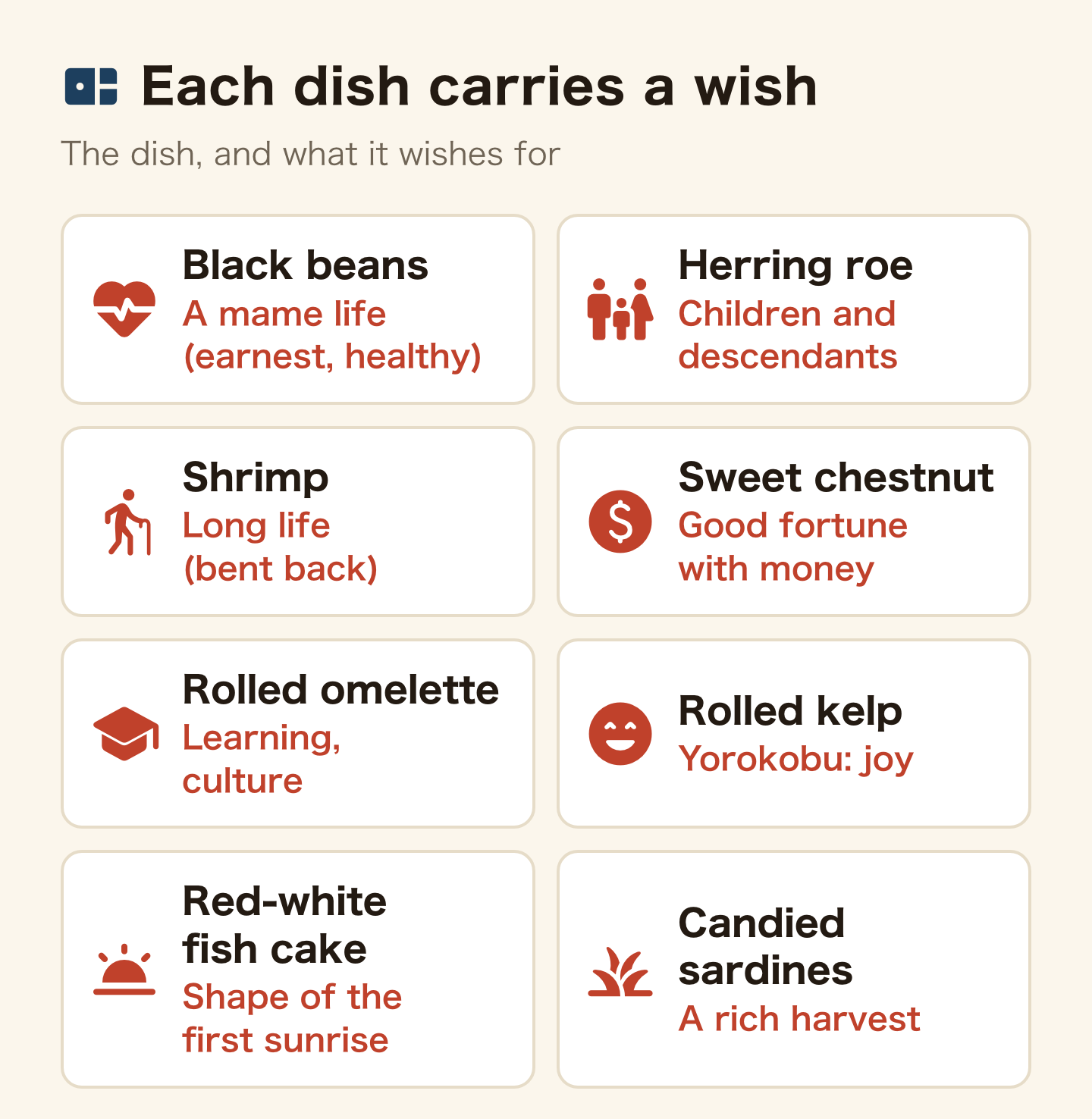
The Chugoku-Shikoku bureau of the Ministry of Agriculture, Forestry and Fisheries lists what each dish wishes for. Black beans wish for a mame life, meaning earnest and healthy. Herring roe comes from a fish that lays many eggs, so it stands for children and descendants. Shrimp, with long whiskers and a bent back, stands for long life. Kinton means a golden dumpling, so sweet chestnut kinton wishes for good fortune with money. Rolled omelette looks like a scroll, so the bureau says it stands for culture and learning; a separate ministry feature says instead that its pattern looks like kimono fabric, so it wishes you will never be short of clothes (Ministry of Agriculture, Forestry and Fisheries: what each osechi dish wishes for, in Japanese). Rolled kelp is a pun on yorokobu, joy. Red and white fish cake is used because its shape resembles the first sunrise of the year. Candied sardines were once used to fertilise rice fields that gave good harvests, so they wish for a rich harvest (MAFF Chugoku-Shikoku bureau: the meanings of osechi, in Japanese).
The kelp one is a good example of how the logic works. The Japanese word for kelp is kobu, which sits inside yorokobu, the verb for being glad. Eating it is a small pun for a joyful year (Ministry of Agriculture, Forestry and Fisheries: what each osechi dish wishes for, in Japanese). Several of the dishes work this way, which makes osechi a Japanese lesson too.
Why osechi tastes good cold, and why it comes in stacked boxes
Osechi originally meant the food made for seasonal festival days. Cooking was avoided while welcoming the New Year god, and the person who cooks was meant to get a rest, so the dishes are made to taste good even when cold (MAFF Chugoku-Shikoku bureau: the meanings of osechi, in Japanese). The large amount of sugar is thought to be a way to make the food keep for seven to ten days, from the time before refrigerators (Agriculture and Livestock Industries Corporation: osechi and sugar, in Japanese).
Packing the food into jubako has a meaning too. The boxes stack, and the stacking stands for good fortune and happiness piling up in the year ahead (Ministry of Agriculture, Forestry and Fisheries: osechi and the wishes packed into it, in Japanese). Contents vary by region and by family, so every household has its own version.
Why osechi is worth trying while you live here
- You take part in a seasonal event: osechi is at the centre of New Year, the most important time of the Japanese year
- You learn Japanese without trying: the dish names and the wish words (long life, prosperity, a good harvest) are the vocabulary of Japanese culture itself
- You connect with people: sharing a box with friends or a host family makes a memory that stays
- You get a story for home: send the photos with the meanings, and it becomes the best introduction to Japan you can give
Three ways to actually try it
You do not need a family or a kitchen to experience osechi. The three routes are making a couple of dishes yourself, ordering a full box online, or buying a few single items at a supermarket or department store food hall.
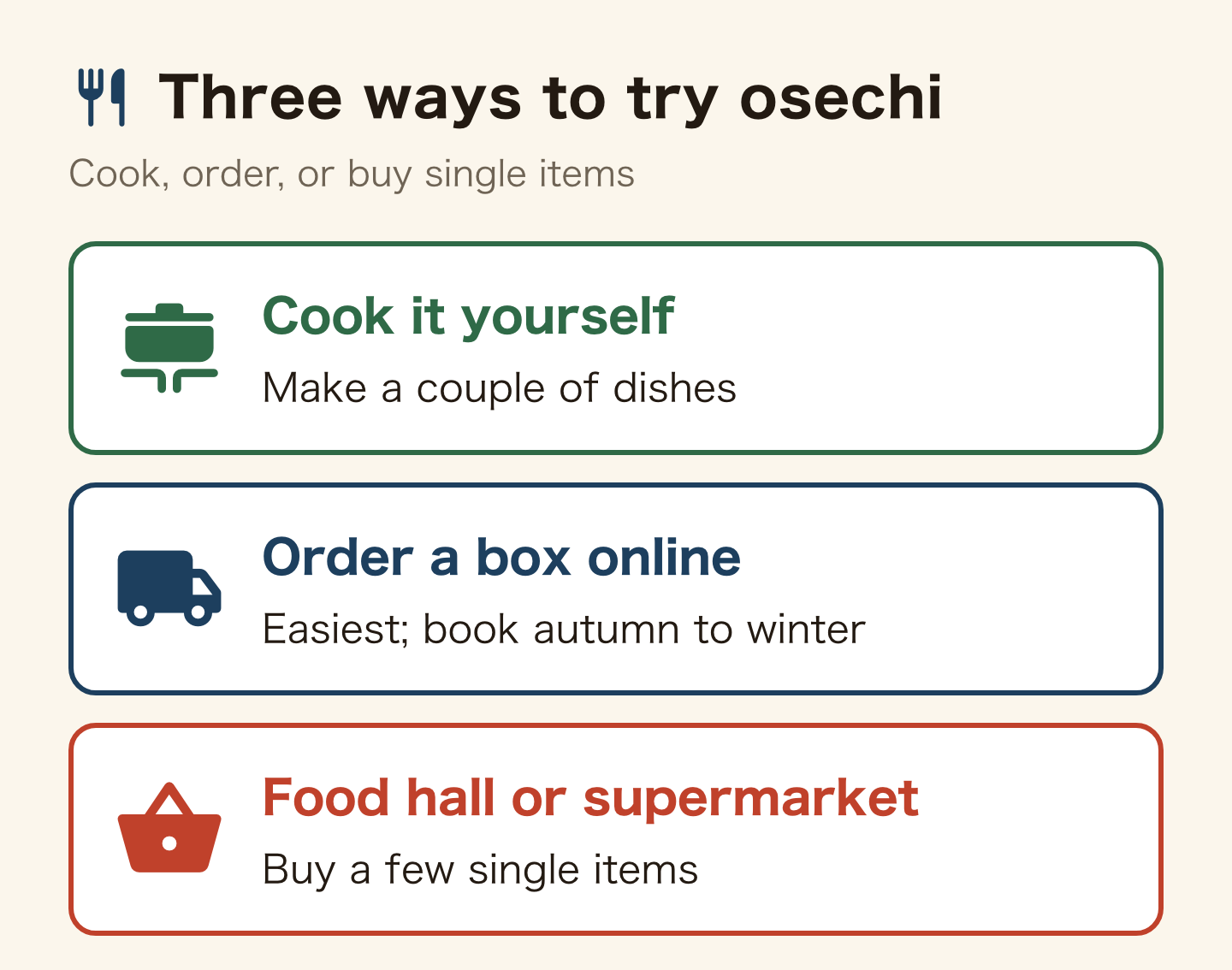
The easiest route by far is ordering online: a box made by a restaurant or shop arrives at your door, already packed in its jubako, with nothing to prepare. Popular boxes sell out, so early-booking discounts from autumn into winter are the best deal. Splitting one with friends brings the per-person cost down and matches how osechi is meant to be eaten – shared.
Check booking dates and early-booking deadlines on the product page
What closes over New Year, and for how long
Your first New Year in Japan comes with a surprise that nobody warns you about: the country stops. Not “quieter than usual” – the city office is locked, the bank counter is dark, and fewer clinics are open.
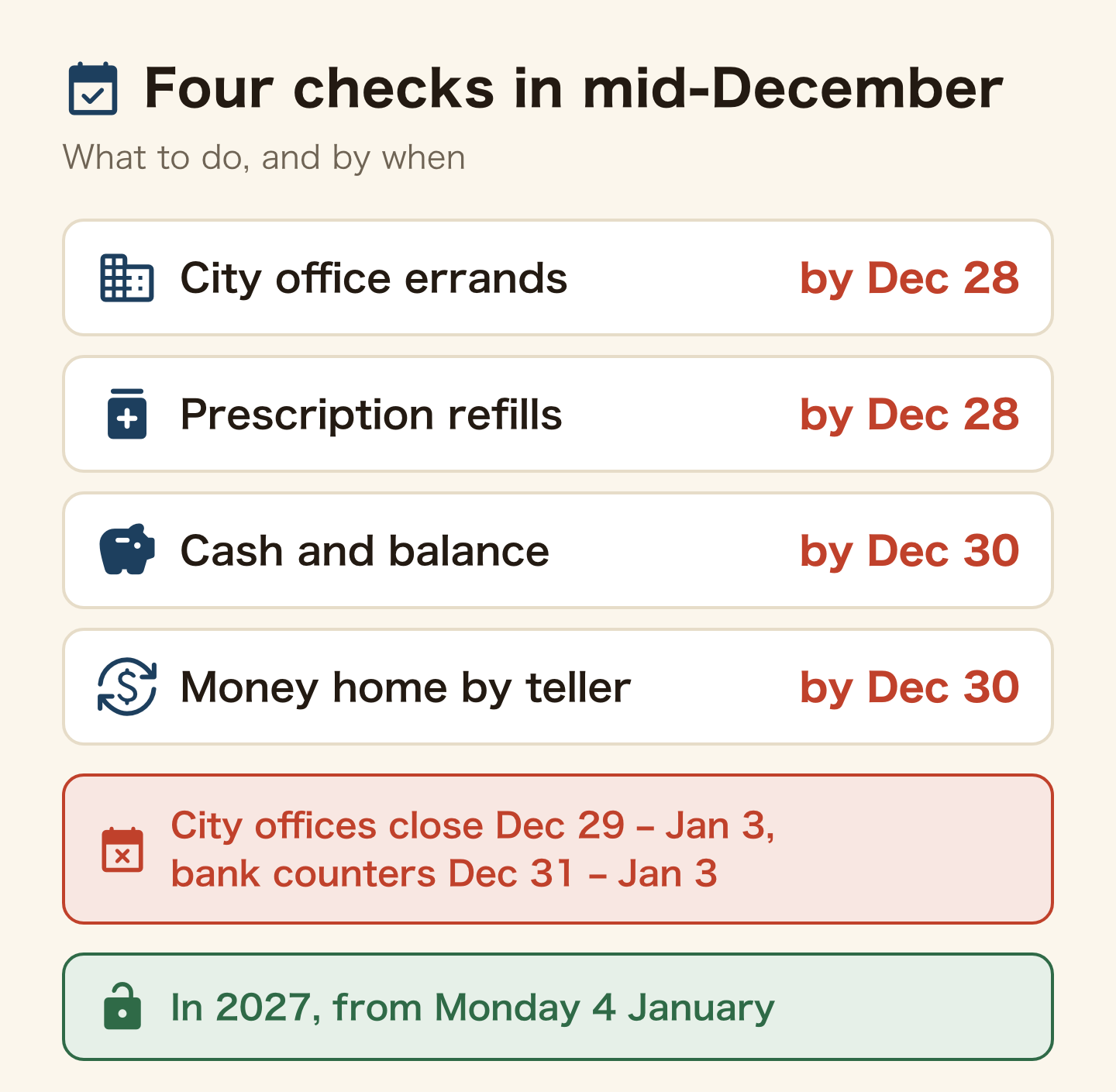
National government offices close December 29 to January 3. City offices follow local ordinances (Fukuoka City uses the same dates) (Act on Holidays of Administrative Organs, Article 1, on e-Gov, in Japanese; Local Autonomy Act, Article 4-2, on e-Gov, in Japanese; Fukuoka City ordinance on city holidays, in Japanese). Banks are closed from December 31 to January 3 (Order for Enforcement of the Banking Act, Article 5, on e-Gov, in Japanese).
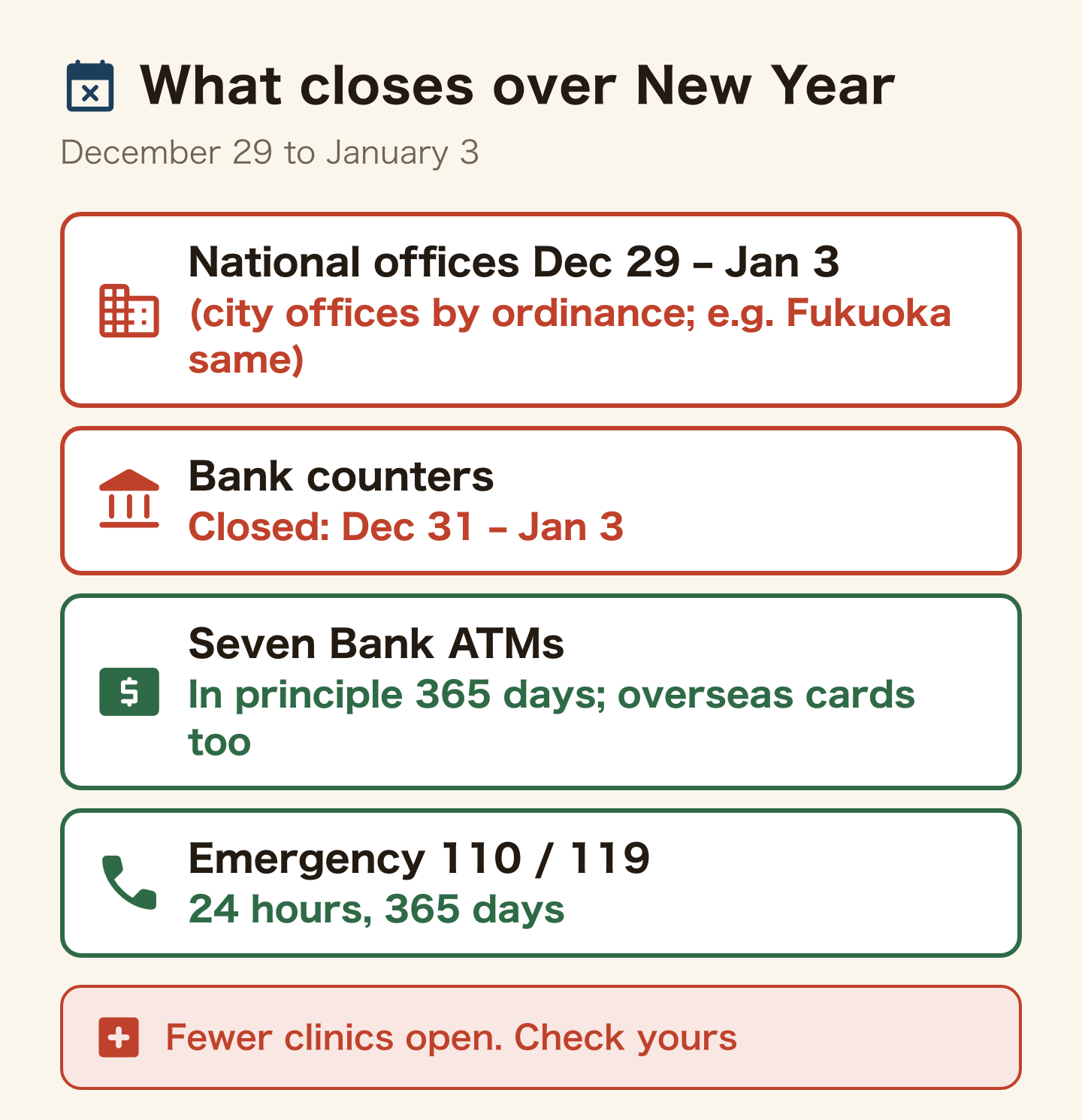
The practical consequences for a resident, in order of how much trouble they cause:
- City office paperwork stops. Moving-in and moving-out notices, certificates of residence, national health insurance changes – all of it waits until January 4 (in 2027, from Monday 4 January). If you have a deadline in early January, handle it in December
- Fewer clinics are open, so a minor illness becomes awkward (Fukuoka City: year-end medical care notice, in Japanese). 110 (crime, accidents) and 119 (sudden illness, injury, fire) take calls 24 hours a day, 365 days a year (Fukuoka Prefectural Police 110 leaflet, in English; FDMA White Paper 2019, in Japanese). See our guide to seeing a doctor for how the system works
- Bank counters close, but ATMs do not. Seven Bank ATMs work in principle 365 days and take overseas-issued cards such as Visa and Mastercard, although some cards with the same logo are not accepted (Seven Bank: overseas-issued cards and service hours, in Japanese). What you cannot do is anything needing a teller, like an international transfer at the counter
- If rent or other bills come out of your account in early January, make sure the balance is there before the counters close
The one thing to do before December 29
Take ten minutes in mid-December to check four things. Whether you need anything from the city office. Whether your account has enough for early-January payments. Whether you have any medicine you are going to run out of. Whether you need to send money home. That is the entire preparation, and skipping it is the only way New Year in Japan actually causes a problem.
| Check | Why it matters | Deadline |
|---|---|---|
| City office errands | Certificates and insurance changes stop entirely | December 28 |
| Cash and account balance | Be ready for early-January payments before the counters close | December 30 |
| Prescription refills | Fewer clinics are open | December 28 |
| Money home | Transfers at the bank counter stop | December 30 |
If sending money home is on that list, you can also use an online transfer service instead of a counter – see the cheapest way to send money home for a comparison.
Official sources: MAFF: what each osechi dish wishes for (Japanese) / MAFF Chugoku-Shikoku bureau: the meanings of osechi (Japanese) / MAFF: osechi and the wishes packed into it (Japanese) / ALIC: osechi and sugar (Japanese) (checked 26 September 2026) / Act on Holidays of Administrative Organs (e-Gov, Japanese) / Local Autonomy Act (e-Gov, Japanese) / Fukuoka City ordinance on city holidays (Japanese) / Order for Enforcement of the Banking Act (e-Gov, Japanese) / Seven Bank: overseas-issued cards and service hours (Japanese) / Fukuoka Prefectural Police 110 leaflet (English) / FDMA White Paper 2019 (Japanese) / Fukuoka City: year-end medical care notice (Japanese) (checked 18 October 2026)
Frequently asked questions
Q. When do people eat osechi?
At New Year. The day people start eating it differs by region and by family. Because it is made to taste good cold, the same box can be eaten across several meals.
Q. Do I have to eat all of it?
No. There is no rule. Trying a few easy items such as black beans, shrimp and sweet chestnut, and learning what they mean, is a completely normal way to take part.
Q. Is it worth it if I live alone?
Yes. Online shops also sell boxes for one person or a small group. Splitting a larger box with friends is cheaper per person, and buying a few single items at a food hall or supermarket is easy too.
Q. Are there halal or vegetarian options?
It depends on the product. Check the ingredient list on the product page before ordering. Fish stock is sometimes used even in vegetable dishes. It helps to know how pork and alcohol are written on Japanese labels.
Q. What is actually open on January 1?
Seven Bank ATMs (in principle 365 days) and the emergency numbers 110 and 119 (24 hours, 365 days). City offices and bank counters are closed, and fewer clinics are open.
Summary
- Osechi is the traditional New Year food, packed with wishes
- Black beans for health, shrimp for long life, sweet chestnut for money – knowing the meanings makes it taste better
- It is made to taste good cold, and the stacked boxes mean stacked happiness
- Three ways to try it: cook, order online, or buy single items. Online, early booking from autumn to winter is the best deal
- National government offices close December 29 to January 3; bank counters December 31 to January 3. City offices follow local ordinances (Fukuoka City uses the same dates). Finish city office errands by December 28
- Seven Bank ATMs work in principle 365 days, and 110 and 119 take calls 24 hours a day, 365 days a year
Related guides
Found this useful? Share it
Send it to a friend who lives in Japan.
WHO WROTE THIS
mori
Japanese. I read the ministries’ own notices, orders and Q&As in the original, and I start from what my Nepalese and Sri Lankan friends in Japan actually ran into. I do not write about what I have not checked or been told.
What this site can and cannot do →Looking for something else?
You may use the figures in this article, including commercially, if you credit this site with a link. How to use our figures