This article was checked on 6 November 2026 against the Financial Services Agency’s asset-building basics, the Statistics Bureau’s Family Income and Expenditure Survey, JASSO’s survey of international students, the residence tax pages of the Ministry of Internal Affairs and Communications and the Tokyo tax bureau, the Local Tax Act, the Immigration Services Agency’s pages on fees, work permission and residence reviews, the Japan Pension Service and a Ministry of Land casebook. Worked examples, the savings share, the tracking period and categories, the way of reading take-home pay and the order for reviewing fixed costs are this site’s own. Amounts and rules change, so check the official page on the day you use them.
In short
- Managing a household budget means knowing what comes in and goes out, staying in surplus and saving the surplus. The Financial Services Agency gives these three as the basics.
- You can start in 4 steps. Know your take-home pay, track spending for 1 month, list the costs that hit once or twice a year (irregular costs), then set what you can spend each month.
- Foreigners have many irregular costs. They include the residence fee (33,000 yen at the counter for a 1-year permit), residence tax from June of the year after you arrive, the national pension, a flight home and a lease renewal fee.
- Your monthly spending line is take-home pay − irregular-cost savings − savings. Aim to save 10% of take-home pay. That is this site’s rule of thumb, not an official rule. If you are in deficit, end the deficit first.
- Do not fill a gap by passing the work limit or by borrowing. Students on work permission can work up to 28 hours a week (8 hours a day during a long break set in school rules). This site basically does not recommend debt that carries interest or fees.
Knowing this, you can answer “how much can I spend this month?” with your own numbers. A June residence tax bill or a visa fee will no longer catch you out.
Three weeks after payday, your account holds less than you expected. You cannot remember where it went. Your visa expires next month, and that costs money too. Ask a Japanese friend, and you only get half an answer, because their household budget has no residence fee and no flight home. Living alone in Japan looks similar on the surface, but as a foreigner you have more lines to add.
- What is a household budget? How foreigners in Japan can start in 4 steps
- Step 1: What is your take-home pay? Use what reaches your account
- Step 2: Is 1 month of tracking enough? Use 6 categories, with money sent home on its own line
- Step 3: What irregular costs hit once or twice a year? Visa, residence tax, pension, flights, renewal
- Step 4: How much can you spend a month? Take the rest off first
- Where does money sent home go in your budget?
- Overspending or in deficit? Fix fixed costs first, and do not fill the gap with hours or debt
- What if you cannot pay an irregular cost, or you forget it?
- Which one are you?
- Frequently asked questions
- Summary
- Related reading
What is a household budget? How foreigners in Japan can start in 4 steps
Managing a household budget means knowing your income and spending, staying in surplus and saving the surplus. The Financial Services Agency’s basics page (Japanese) gives these three as the basics of household money management. A household account book (kakeibo) is the record you use for this. Keeping the book is not the goal.
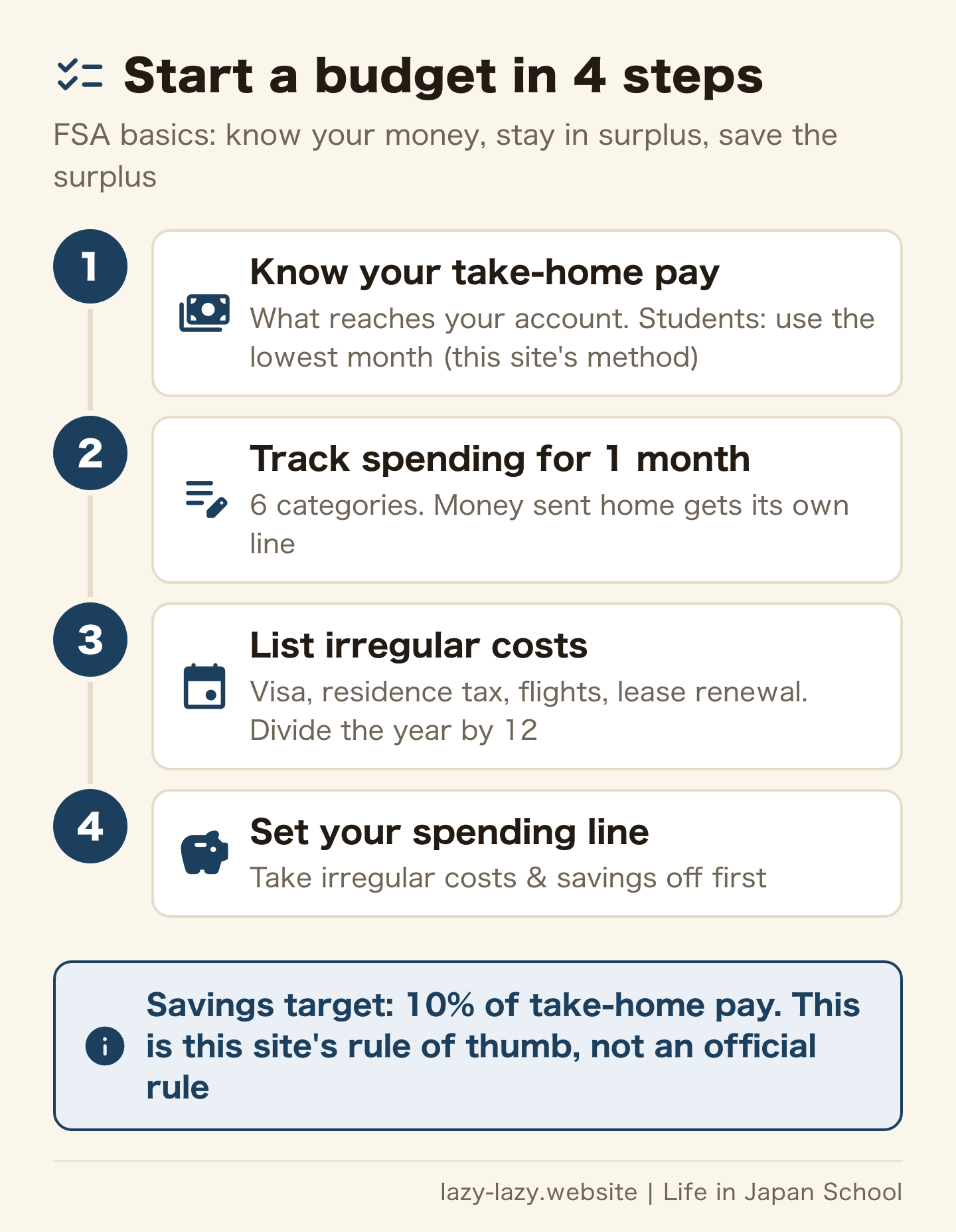
The order matters. Without your take-home pay, you cannot tell whether you are overspending. One month of records will not show a cost that comes once a year. So you list irregular costs separately, and set the monthly number last.
Step 1: What is your take-home pay? Use what reaches your account
Take-home pay is your total pay after tax and social insurance come off. On a payslip it is the line called sashihiki shikyugaku (Shiruporuto, Japanese). Do not work from the salary in a job ad or from hourly pay. Look at what reached your account. To read each line, use our guide to Japanese payslips and take-home pay.
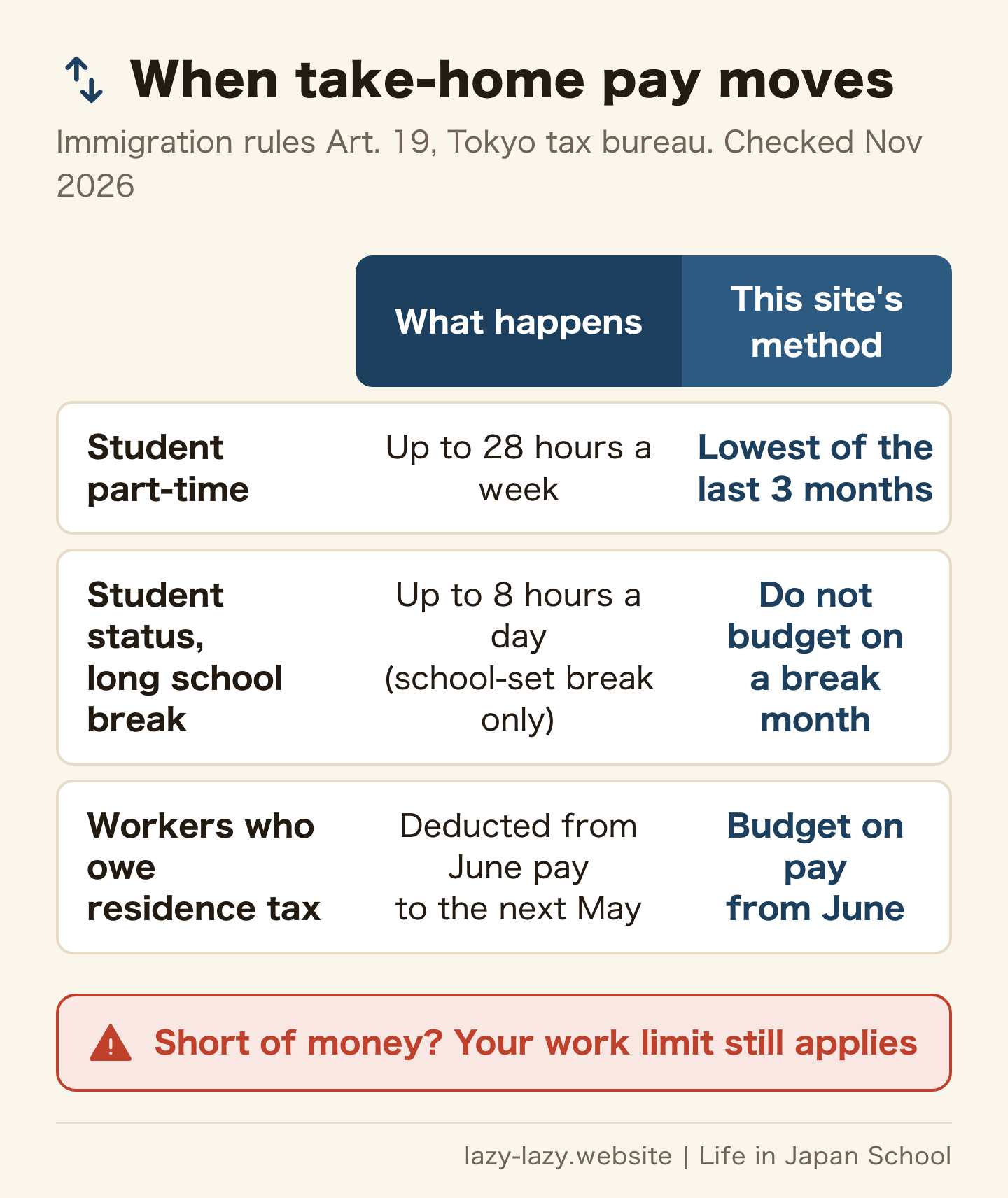
Students add up all the money that comes in each month: part-time take-home pay, money from home and scholarships. If the amount moves from month to month, use the lowest of the last 3 months. A budget built on a good month runs short in a bad one. That is this site’s method, not an official rule.
Short this month? Add more shifts. Where you come from, that may be normal. In Japan, students and others working under blanket work permission are limited to 28 hours a week. People with student status may work up to 8 hours a day only during a long break set in the school’s rules. Do not use the extra pay from a break month in your monthly budget.
So your income has a ceiling. At Tokyo’s minimum wage of 1,280 yen, 28 hours a week for 4 weeks is 1,280 × 28 × 4 = 143,360 yen. That is before tax and other deductions. Real amounts are worth seeing too. In JASSO’s FY2023 survey (PDF, Japanese), students with part-time income averaged 81,000 yen a month at universities and other higher education, and 106,000 yen at Japanese language institutes. Our guide to the 28-hour rule covers how to count hours and how to find work.
Workers should check one more thing. When residence tax starts coming out of your pay, take-home pay falls even though your salary has not changed.
Step 2: Is 1 month of tracking enough? Use 6 categories, with money sent home on its own line
One month is enough for your first record. The aim is to see how your money flows now, not to save yet. While you track, do not change how you spend.
- Pick a start date. Payday to payday works, and so does the 1st to the end of the month.
- Use only 6 categories: housing, food, utilities and phone, transport, money sent home, and other.
- Once a week, add up your receipts and your bank and card statements.
- For e-money and code payments, write the spending on the day you use it, not the day you top up. Writing both counts it twice.
- At the end of the month, check the total against the change in your bank balance. Put any gap under “other”.
Paper, a phone note, a spreadsheet or a budgeting app all work. This site does not recommend any particular app. If an app connects to your bank or card, read about the company and its terms before you decide.
When the month ends, compare your numbers with the averages. An average is not a target. It is a ruler for finding your biggest line.
| Per month | Privately financed international students, national average | All one-person households, average (average age 58.6) |
|---|---|---|
| Housing | 41,000 yen | 21,667 yen |
| Food | 32,000 yen | 49,321 yen |
| Utilities and water | 8,000 yen | 13,333 yen |
| Transport and communication | 4,000 yen (school commute only) | 19,334 yen |
| Hobbies and leisure | 8,000 yen | 21,173 yen |
| Total spending | 170,000 yen (includes 52,000 yen for study costs and 13,000 yen left over) | 173,042 yen |
The left column is JASSO’s FY2023 survey (PDF, Japanese), tables 7-1 and 7-4. The right column is the Statistics Bureau’s Family Income and Expenditure Survey, 2025 average (PDF, Japanese), for all one-person households, not only working people (average age 58.6). It is an average that includes households with no spending on an item, so households paying no rent are in it. The categories in the two surveys do not match exactly. For regional numbers, including Tokyo, see our breakdown of international students’ living costs.
Step 3: What irregular costs hit once or twice a year? Visa, residence tax, pension, flights, renewal
Irregular costs are money that does not go out every month but comes in one lump, once or twice a year or once every few years. They do not appear in a one-month record. That is how someone who thought they were in surplus runs short in a single month.
Tax comes off your pay, and that is the end of it. Where you come from, that may be normal. In Japan, you pay residence tax on the previous year’s income, starting in June of the next year. No bill comes in your year of arrival, so it does not appear in a budget from that year.
| What | When | How much | Who and conditions |
|---|---|---|---|
| Residence fee | When a renewal or change is approved | 33,000 yen at the counter, 27,000 yen online, for a 1-year permit | For applications accepted on or after 1 October 2026 (the old fee applies to those accepted by 30 September). 10,000 to 75,000 yen at the counter, depending on the period granted. Online has a separate payment charge (Immigration, PDF) |
| Residence tax | By bill: June, August, October and January as the basic pattern. From pay: June to the next May | Set by the previous year’s income. Check your notice | People with an address in Japan on 1 January who are not exempt (Tokyo tax bureau, Japanese) |
| National pension | Monthly (due by the end of the next month) | 17,920 yen a month (FY2026). 215,040 yen for 12 months | People aged 20 to 59 (Japanese) living in Japan who are not in a company’s employees’ pension (Japan Pension Service, Japanese). Dependent spouses of employees’ pension members (Category 3) do not pay themselves. Students at eligible schools can apply for a special deferral |
| Flight home | You decide | Look up your own route today | There is no official market price. Families pay per person |
| Lease renewal fee | Renewal date in your contract | See your contract | Only if your contract says so. No law sets it and it is not a nationwide custom, but it is valid unless, for example, it is excessively high |
| New Year | December to January | Set it from your own plans | Travel, gifts and so on. Bank holidays run from 31 December to 3 January. Check what stops in our New Year closures guide |
| Tuition | School’s billing date | See your bill | Students who pay it themselves |
Some people add other items, such as a passport renewal. Add them to your own list.
People say residence tax starts “in your second year”, but 1 January is what really decides it. For example, someone who came to Japan in April 2026 and worked has an address in Japan on 1 January 2027. Unless exempt, they pay from June 2027 on their 2026 income. The basic rate is 10% of income (Japanese), plus a flat amount. In Tokyo’s 23 wards, a person with no spouse or dependants in the same household pays neither the income-based nor the flat part if the previous year’s total income (gokei shotoku kingaku) is 450,000 yen or less (Japanese). For worked examples and what happens when you leave Japan, see our residence tax guide.
If you pay by bill, Article 320 of the Local Tax Act (Japanese) has your city set the dates by ordinance within June, August, October and January. Special circumstances can mean other dates. Check the real dates on the notice you receive. Part-time pay can also have the tax taken off, so check your payslip or notice.
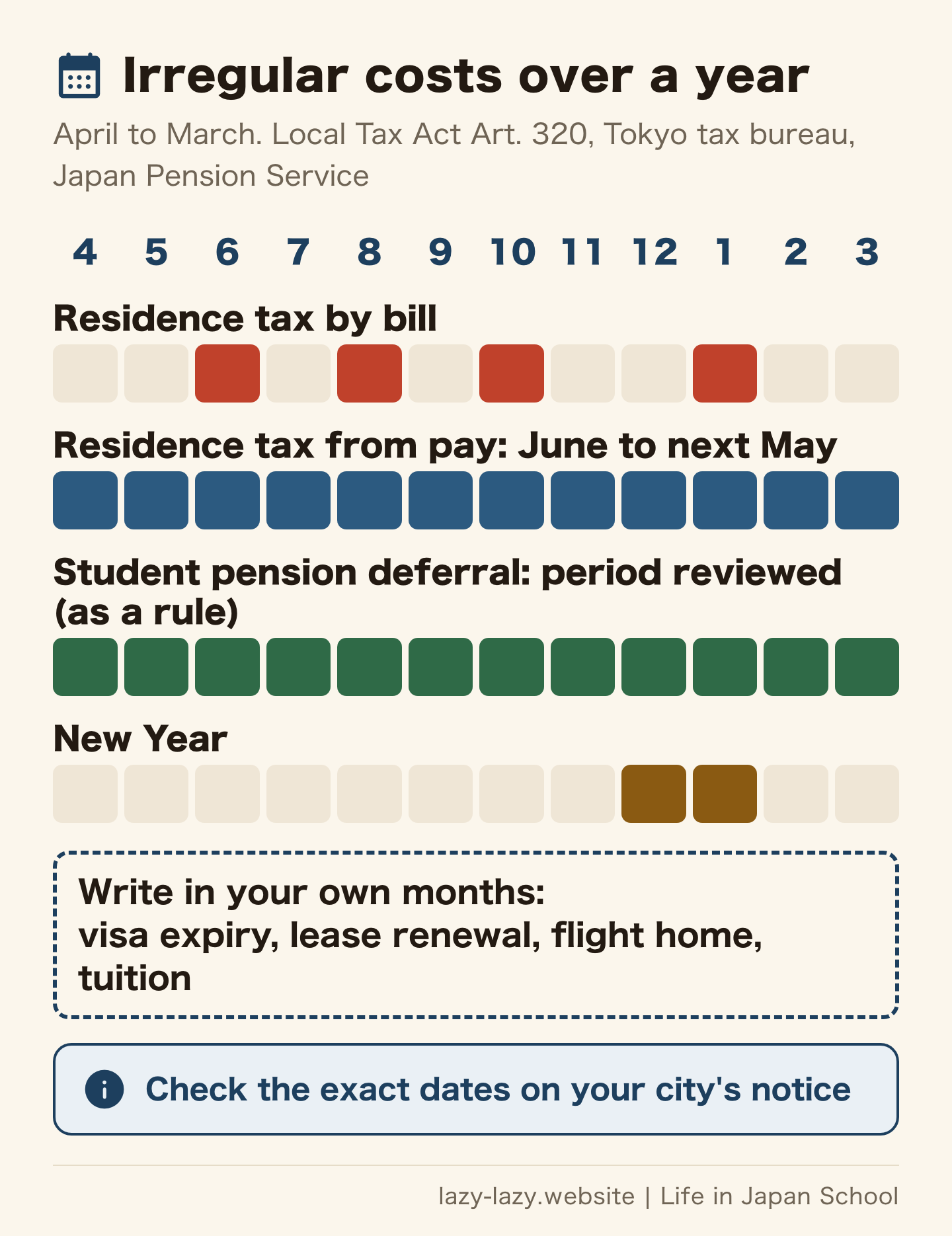
The national pension is a monthly cost, but it is here because it changes a student’s budget so much. The student deferral (Japanese) is open to students at eligible schools whose previous-year income is at or below a set level. Miscellaneous schools (kakushu gakko) have conditions such as a course of 1 year or more, so check the list of eligible schools. It defers payment. It is not an exemption. Each review covers April to the next March as a rule. Without approval, the premium applies. Steps are in our student pension guide. Fee bands are in our visa fee guide, and renewal fees in our renewal fee guide.
Here are two worked examples. All amounts are examples, except the residence fee, which is the official amount.
| One year (example) | Student example | Worker example |
|---|---|---|
| Residence fee (1-year permit, counter) | 33,000 yen | 33,000 yen |
| Residence tax (paid by bill) | 30,000 yen (assumed) | 0 yen (taken from pay) |
| National pension | 0 yen (if the deferral is approved) | 0 yen (employees’ pension taken from pay) |
| Return flight at 120,000 yen (assumed) | 60,000 yen (once in 2 years) | 120,000 yen (every year) |
| Renewal fee (example: 1 month’s rent, once in 2 years) | 22,500 yen (rent 45,000 yen) | 35,000 yen (rent 70,000 yen) |
| New Year (assumed) | 20,000 yen | 40,000 yen |
| Total for the year | 165,500 yen | 228,000 yen |
| Divided by 12 (rounded up to the nearest 1,000) | 14,000 yen a month | 19,000 yen a month |
The student example does not include tuition. For a student without an approved deferral, add the national pension’s 215,040 yen. If your permit runs longer than 1 year, divide that fee by the number of years.
Move this monthly amount to a separate account on the day your pay arrives. The Financial Services Agency (Japanese) also recommends putting savings aside first, for example with an automatic transfer on payday.
Step 4: How much can you spend a month? Take the rest off first
Set your spending first. Do not wait to see what is left. There are two lines.
- No-deficit line = take-home pay − irregular-cost savings
- Saving line = take-home pay − irregular-cost savings − savings
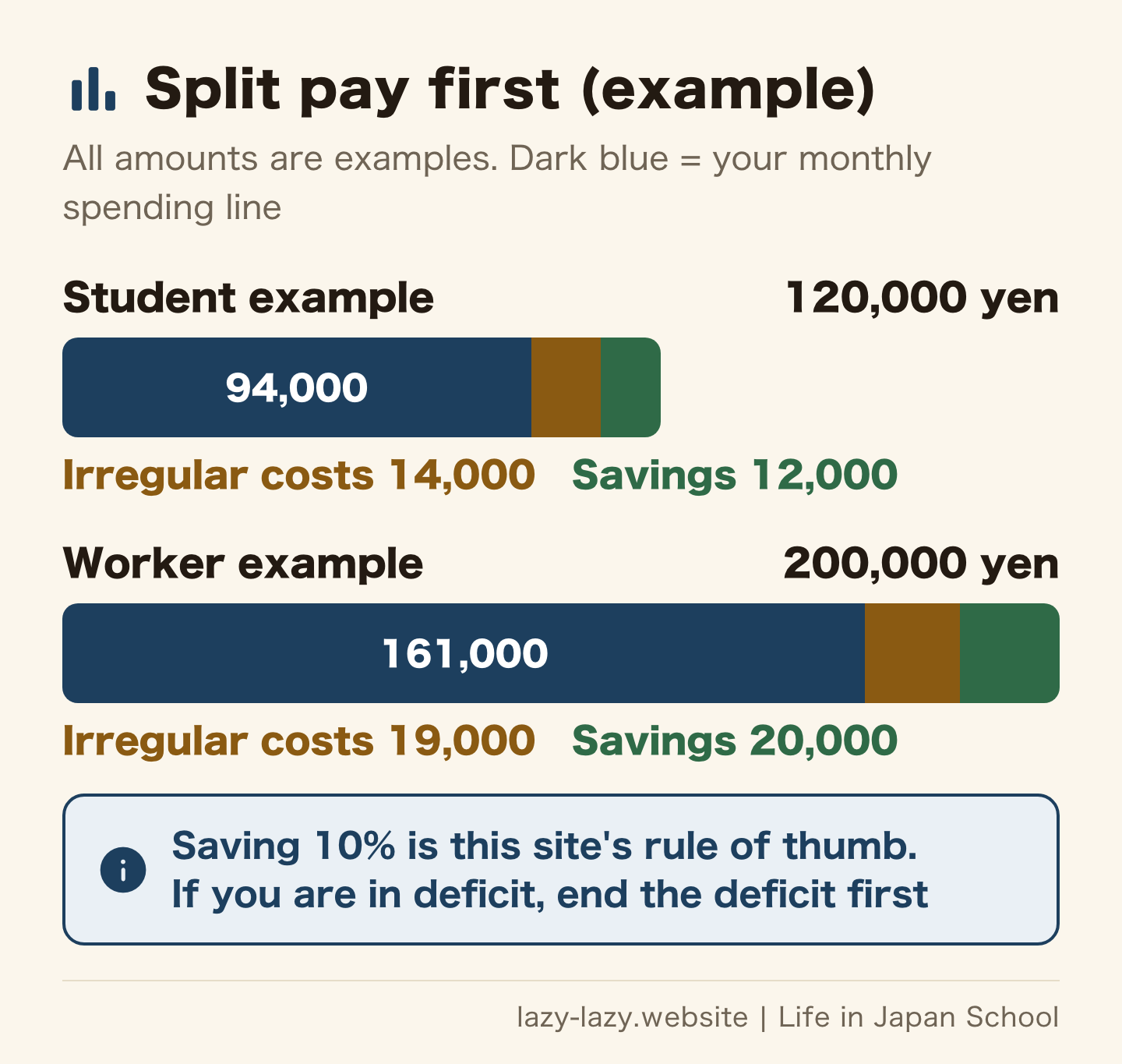
Aim to save 10% of take-home pay. No law or official rule sets this. The 10% is this site’s rule of thumb, so lower it in a hard month. Protect the no-deficit line first.
| One month (example) | Student example | Worker example |
|---|---|---|
| Take-home pay (example) | 120,000 yen | 200,000 yen |
| Irregular-cost savings | 14,000 yen | 19,000 yen |
| No-deficit line | 106,000 yen | 181,000 yen |
| Savings (10% of take-home pay, this site’s rule of thumb) | 12,000 yen | 20,000 yen |
| Saving line | 94,000 yen | 161,000 yen |
The student example’s 120,000 yen is an assumed total of part-time pay and money from home. The worker example’s take-home pay is after residence tax has come off.
Compare the student example with the average. JASSO’s national average of 170,000 yen, minus 52,000 yen for study costs and 13,000 yen left over, is 105,000 yen. That fits inside the 106,000 yen no-deficit line. It is 11,000 yen over the 94,000 yen saving line. So even at average spending, the student example does not reach savings. That does not mean you are bad with money. In that case, you can start small, for example with 1,000 yen a month.
As your savings grow, the next job is to work out your emergency fund. Irregular-cost savings are money you plan to spend. An emergency fund is for when income stops. Keep the two apart.
Where does money sent home go in your budget?
Do not bury it under “other”. Your wages arrive in yen, and your family receives another currency. The same yen can deliver a different amount, depending on the exchange rate and fees.
If you send money every month, keep it inside your spending line. In the worker example, with 20,000 yen sent home each month (example), the 161,000 yen saving line leaves 141,000 yen for your own living costs.
Set the amount in yen, not in the other currency. That is this site’s view. If you fix it in the other currency, your cost in yen rises in a month when the yen is weak. Talk to your family about the amount before your take-home pay drops in June, so you do not have to cut it later. To compare fees and what arrives, see our comparison of ways to send money home.
Overspending or in deficit? Fix fixed costs first, and do not fill the gap with hours or debt
When you find a deficit, do not start with food. Shiruporuto (Japanese) also says the first thing to review is fixed costs. Lower one once, and it keeps working every month.
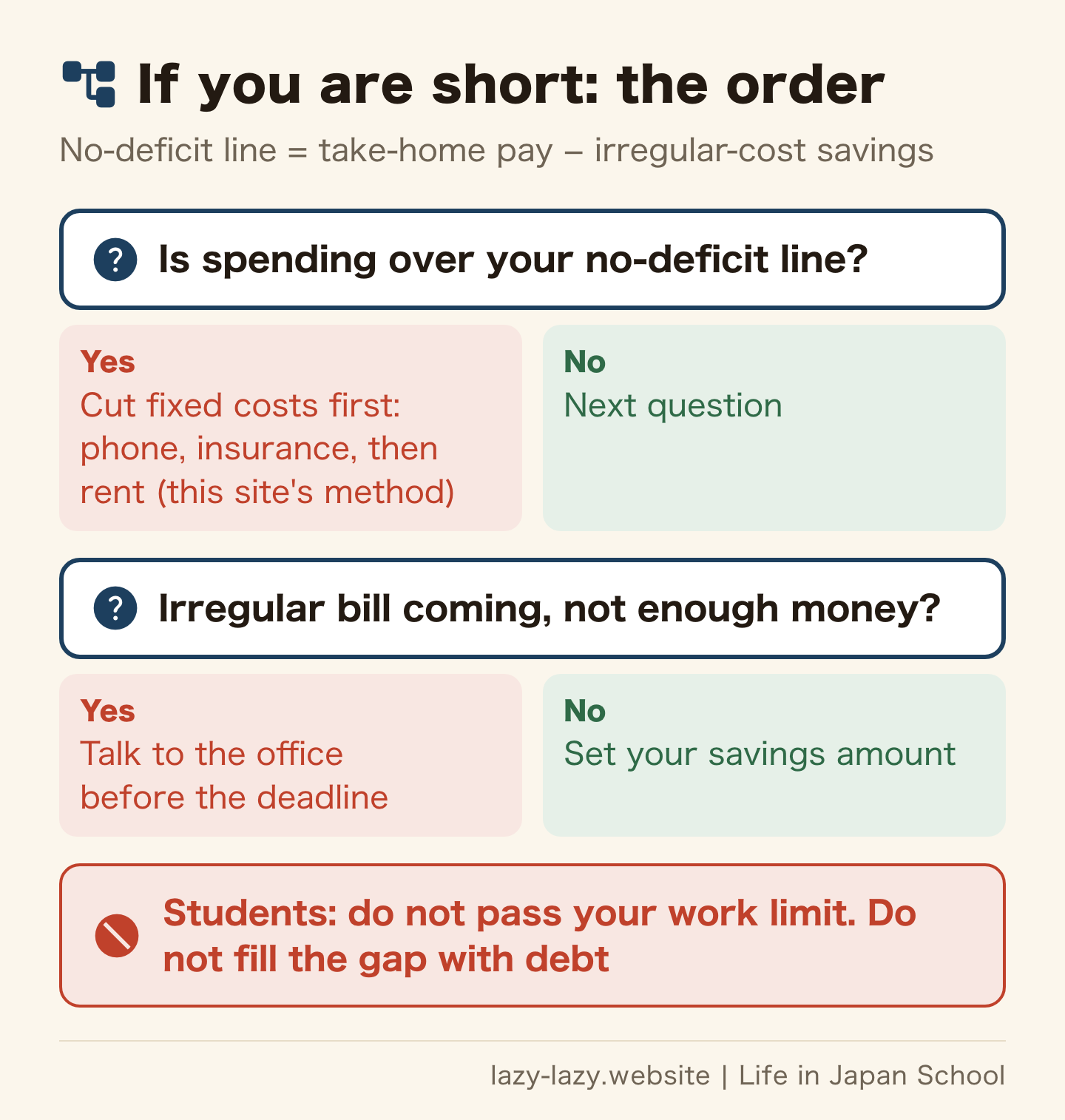
- Look at your phone bill and insurance. Cancel what you do not use, and move to a lower plan.
- If rent is large, include moving in your sums before the renewal date. Moving costs money too, so work out how many months the saving takes to pay it back.
- Then look at food and leisure.
This order is this site’s method.
To raise income, first check money you may be able to receive. Ask your school’s international office about scholarships and tuition reductions. A student’s limit (28 hours a week, or 8 hours a day during a long break set in school rules) cannot be passed, even when you are short.
This site basically does not recommend debt that carries interest or fees. Instalment or revolving plans with fees make this month’s payment smaller, but the fees lower next month’s line. If you are already short, read how to fill a gap without borrowing first.
What if you cannot pay an irregular cost, or you forget it?
Acting before the deadline changes what you can choose.
- Residence tax: if you do not pay by the deadline, the Local Tax Act (Japanese) has a demand letter sent within 20 days after it. If you have not paid in full by 10 days after the letter’s issue date, your assets can be seized.
- Late charges: Setagaya City’s page gives 2.8% a year for 2026 up to 1 month after the deadline, then 9.1% a year (Japanese).
- Residence reviews: under Immigration’s guidelines (Japanese), not meeting tax duties counts against you in a renewal or change. Serious cases of large or long-unpaid amounts are treated the same way. The same goes for national health insurance premiums and similar payments.
- National pension: if you cannot pay, do not leave it unpaid. Apply for an exemption or deferral (Japanese). For students, that is the student deferral.
If a bill is in your hand and the deadline is close, go to your city’s tax counter before the deadline. Some cities, such as Setagaya (Japanese), have a tax consultation desk. The worst choice is to stay away because the date has passed. For each stage of non-payment, see our guide to unpaid residence tax.
The residence fee is due when you receive your permission. The amount depends on the period granted. Do not assume the 33,000 yen for a 1-year permit at the counter is enough. Look at the bands in Immigration’s table (PDF).
Which one are you?
- You do not know your take-home pay — today, open your latest payslip or bank deposits and write down the last 3 months.
- You do not know where your money went — start this month’s record. Today, write the 6 categories in a note.
- You are fine most months but run short when a big bill comes — make your irregular-cost list. Today, copy your residence card expiry date and your lease renewal date.
- June of the year after you arrived is coming — add residence tax to your budget. Today, check whether you had an address in Japan on 1 January, and your income for the previous year.
- You are in deficit month after month — start with fixed costs. Today, open your phone bill and insurance statements. If you have a bill you cannot pay, call the office before the deadline.
Frequently asked questions
Q. Do I have to keep a household account book forever?
A. Once you have done the first month, you do not need to continue every day. That is this site’s view. Track one more month when your take-home pay changes, when you move, and before each June, then redraw your lines.
Q. Which budgeting app is best in Japan?
A. This site does not recommend any particular app. Paper or a phone note can do the same job. If an app connects to your bank or card, read about the company and its terms before you decide.
Q. What share of take-home pay should I save?
A. No law or official rule sets this. This site’s rule of thumb is 10% of take-home pay. If you are in deficit, end the deficit first. You can start small, for example with 1,000 yen a month.
Q. How much should I allow for irregular costs in a year?
A. It differs by person, so work it out on your own list. In this article’s worked examples, the student example came to 165,500 yen and the worker example to 228,000 yen. Apart from the residence fee, these are example or assumed amounts, and the student example has no tuition in it.
Q. When do I add residence tax to my budget?
A. If you had an address in Japan on 1 January, had income the year before and are not exempt, add it from June of that year. By bill, June, August, October and January are the basic pattern. From pay, it runs from June to the next May. Check the real amount and dates on your notice.
Q. Does money sent home count as spending?
A. Yes. If you send it every month, give it its own line and keep it inside your spending line. In the worker example, the 161,000 yen saving line minus the example 20,000 yen sent home left 141,000 yen for your own living costs.
Summary
You can start a household budget in 4 steps: know your take-home pay, track 1 month, list irregular costs, and set what you can spend. The Financial Services Agency’s basics are to know your money, stay in surplus and save the surplus. You do not have to get it perfect at the start.
The costs foreigners most easily miss in a budget are the residence fee, residence tax on the previous year’s income, the national pension, a flight home and a lease renewal fee. Divide the yearly amount by 12 and set it aside the day your pay arrives. Saving 10% is this site’s rule of thumb, and if you are in deficit, end the deficit first. Do not fill a gap by passing your work-permission limit or by borrowing.
Sources (official, mostly in Japanese): Financial Services Agency asset-building basics / Statistics Bureau Family Income and Expenditure Survey, 2025 average / JASSO FY2023 survey of privately financed international students / Ministry of Internal Affairs and Communications residence tax / Tokyo tax bureau residence tax / e-Gov Local Tax Act, Immigration Act enforcement rules, Banking Act enforcement order / Setagaya City late charges, tax consultation / Immigration Services Agency fee revision, work permission, residence review guidelines / Japan Pension Service national pension premium, student deferral, exemption and deferral / Ministry of Land, Infrastructure, Transport and Tourism private rental casebook / Shiruporuto living alone (take-home pay), living alone (fixed costs) (all checked 6 November 2026). Worked examples, the savings share, the tracking period and categories, the way of reading take-home pay and the order for reviewing fixed costs are this site’s own.
Related reading
Found this useful? Share it
Send it to a friend who lives in Japan.
READ THIS NEXT
Sending Money Home from Japan →How to send money from Japan to Nepal or Sri Lanka, and how to compare what actually arrives.WHO WROTE THIS

mori
Japanese. I read the ministries’ own notices, orders and Q&As in the original, and I start from what my Nepalese and Sri Lankan friends in Japan actually ran into. I do not write about what I have not checked or been told.
What this site can and cannot do →Looking for something else?
You may use the figures in this article, including commercially, if you credit this site with a link. How to use our figures