Checked on 24 October 2026 against official pages: JR Central’s route search and ticket rules, the JR Central and JR West announcement of 16 October 2026, JR West’s Seishun 18 Ticket page, JR East’s student discount guidance, Smart EX, West JR Bus’s fare table and the official Japan Rail Pass site. Fares and sale periods change, so check the official page on the day you buy.
The short answer
- Tokyo to Shin-Osaka one way costs 13,870 yen in a non-reserved seat on the Nozomi shinkansen (about 2.5 hours), or 9,020 yen on local and rapid trains only (over 9 hours). The standard 4-row night bus fare is 3,300–12,500 yen depending on the day (checked 24 October 2026).
- Gakuwari, the JR student discount, takes 20% off the fare for students of JR-designated schools on trips over 100 km. You need a certificate from your school; a student ID alone is not enough. A non-reserved Nozomi seat then costs 12,080 yen.
- The Seishun 18 Ticket costs 10,000 yen for 3 days in a row. In winter 2026–27 it is valid from 11 December 2026 to 11 January 2027. If you ride on one day only, it can cost more than a normal ticket.
- If you live in Japan with a residence card, you cannot use the Japan Rail Pass. It is for visitors who came as “Temporary Visitor”.
- Happy to travel overnight: night bus. Want to arrive fast in the daytime: shinkansen with gakuwari. Riding JR around for several days in the winter holiday: Seishun 18 Ticket.
Knowing this, you can compare the options for your holiday trip by price and time, pick one, and book without losing money on gakuwari or the Seishun 18 Ticket.
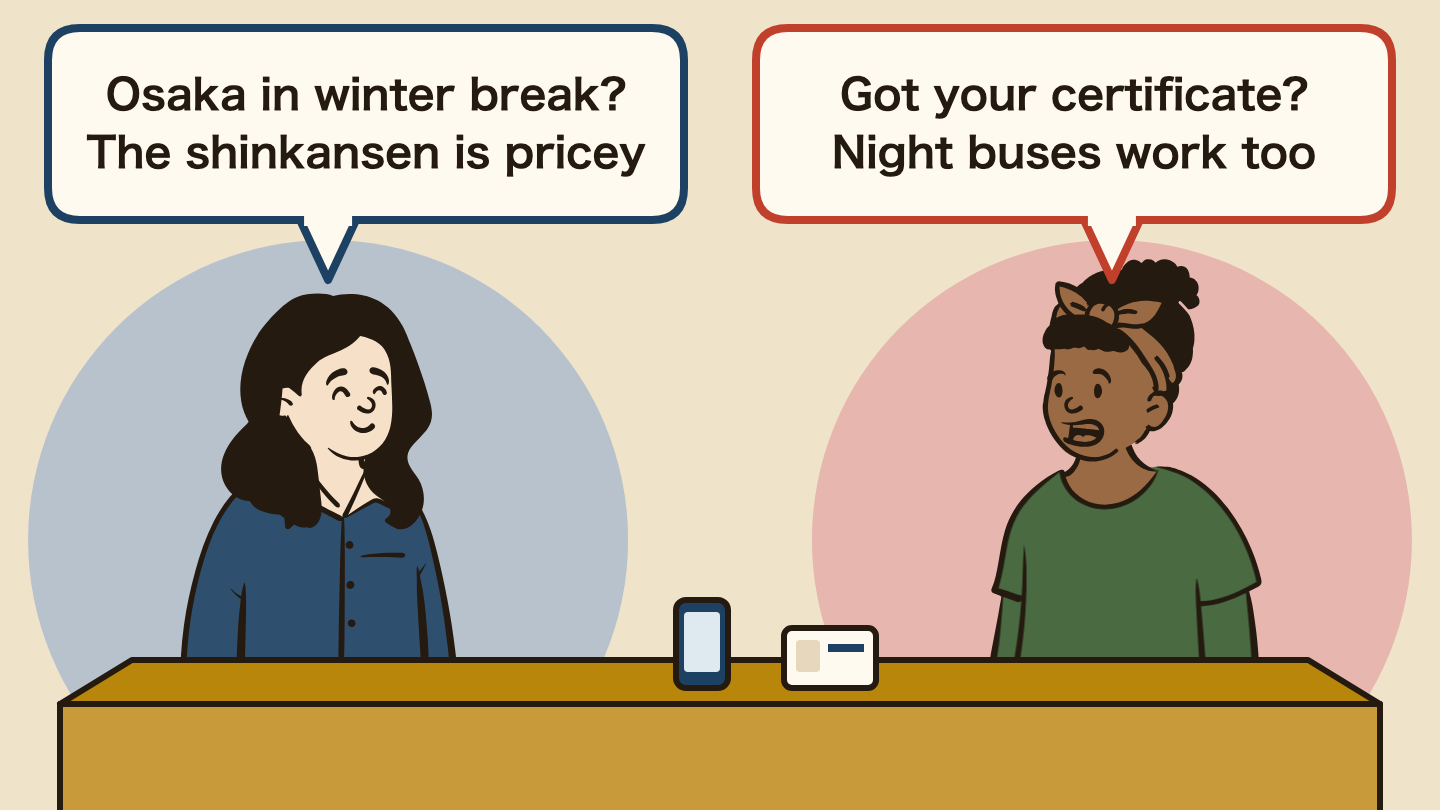
The evening after your last December class. You and a friend decide to spend the winter break in Osaka. But you have heard the shinkansen is expensive. A Japanese friend says, “The Seishun 18 Ticket is cheap.” Another says, “Just show your student ID and you get the student discount.” Both are half right, and used the wrong way, each can end up costing you more.
- How can you travel cheaply in Japan? Night buses, the Seishun 18 Ticket and gakuwari
- What is the cheapest way from Tokyo to Osaka? Six options, one way
- Which should you choose? Time, money and comfort
- How do you use gakuwari on the shinkansen? Get the certificate, buy at the counter
- What are the Seishun 18 Ticket rules? Winter 2026 starts 11 December, 3 or 5 days in a row
- How do you avoid losing money on the Seishun 18 Ticket? One day only, shinkansen, Suica
- How do you use night buses safely? Women-only seats, student fares, fares you cannot change
- Are low-cost airlines cheaper? Bags and changes add up
- Can residents use the Japan Rail Pass? No
- How else can you cut the cost? Avoid peak days and book early
- Which one are you?
- FAQ
- Summary
- Related reading
How can you travel cheaply in Japan? Night buses, the Seishun 18 Ticket and gakuwari
There are four main ways to get around Japan for less.
- Night bus: leaves in the evening and arrives in the morning. The price changes with the day you travel.
- Seishun 18 Ticket: unlimited rides on JR local and rapid trains for 3 or 5 days in a row. JR West says anyone can use it, whatever their age.
- Gakuwari (student discount ticket): students of JR-designated schools get 20% off the fare for trips over 100 km (JR East, discount tickets). It works on the shinkansen too.
- LCC (low-cost airline): Peach’s cheapest fare charges extra for checked bags and seat selection.
If you are 18 to 22, you can also use the shinkansen’s “EX U22” fare. Only the Smart EX member who has linked their own My Number Card in the app can buy it (Smart EX, EX U22). It runs from 1 October 2026 to 31 March 2027, and seats at this price are limited.
What is the cheapest way from Tokyo to Osaka? Six options, one way
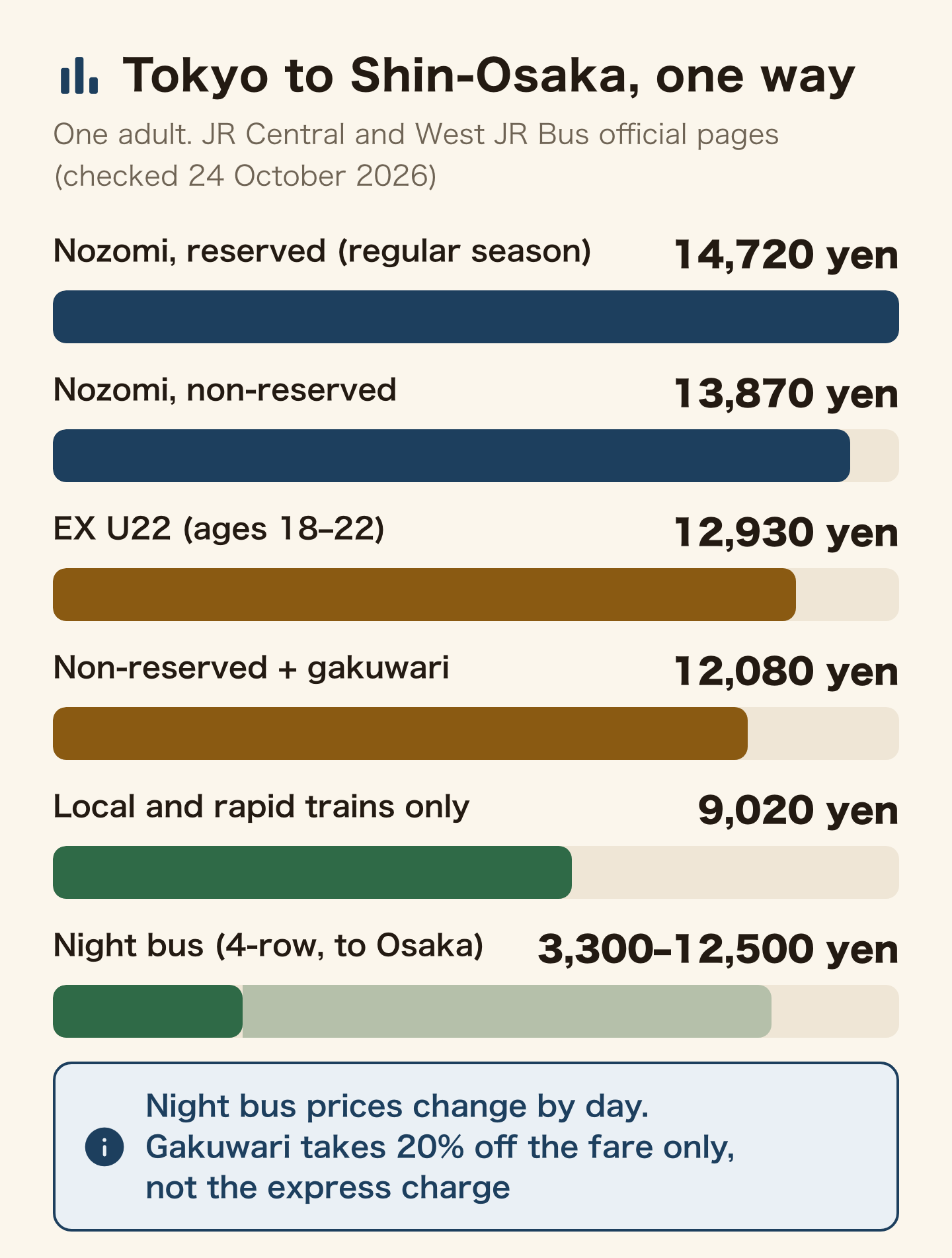
We searched Tokyo to Shin-Osaka on JR Central’s route search on 24 October 2026. A non-reserved seat on the Nozomi costs 13,870 yen. That is the 8,910 yen fare plus the 4,960 yen express charge, leaving at 7:00 and arriving at 9:27. Without the shinkansen or limited expresses, on local and rapid trains only, the fare is 9,020 yen. That route left at 7:01, arrived at 16:08 and needed five changes.
| Option (Tokyo to Shin-Osaka, one way) | Price | Time / condition |
|---|---|---|
| Nozomi, reserved (regular season) | 14,720 yen | About 2.5 hours |
| Nozomi, non-reserved | 13,870 yen | 2 hours 27 minutes |
| EX U22 (Nozomi reserved, regular season) | 12,930 yen | Ages 18–22 only |
| Nozomi non-reserved + gakuwari | 12,080 yen | Designated-school students only |
| Local and rapid trains only | 9,020 yen | 9 hours 7 minutes, 5 changes |
| Night bus (4-row, to Osaka, standard fare) | 3,300–12,500 yen | Leaves at night, arrives in the morning |
A reserved Nozomi seat costs 14,720 yen in the regular season. JR Central and JR West have announced it will rise to 15,420 yen for tickets bought from 1 July 2027 (JR Central and JR West, 16 October 2026). The non-reserved express charge is not changing.
The gakuwari price of 12,080 yen is the 8,910 yen fare with 20% off, plus the 4,960 yen express charge. 8,910 × 0.8 = 7,128 yen, rounded down to the nearest 10 yen gives 7,120 yen (JR Central, student discount tickets). 7,120 + 4,960 = 12,080 yen. The EX U22 price of 12,930 yen is the regular-season figure in Smart EX’s fare table (EX U22 fares).
Night bus prices come from West JR Bus’s fare table for its Kansai–Tokyo line (West JR Bus fare table). The 4-row Seishun Eco Dream’s standard fare from Tokyo or Shinjuku to Osaka is 3,300–12,500 yen. The student fare is 2,200–11,500 yen, and the “Chotokuwari” discount fare is 2,500–2,900 yen. The fare depends on the day you travel, and the 3-row Gran Dream costs 5,000–14,500 yen.
Which should you choose? Time, money and comfort
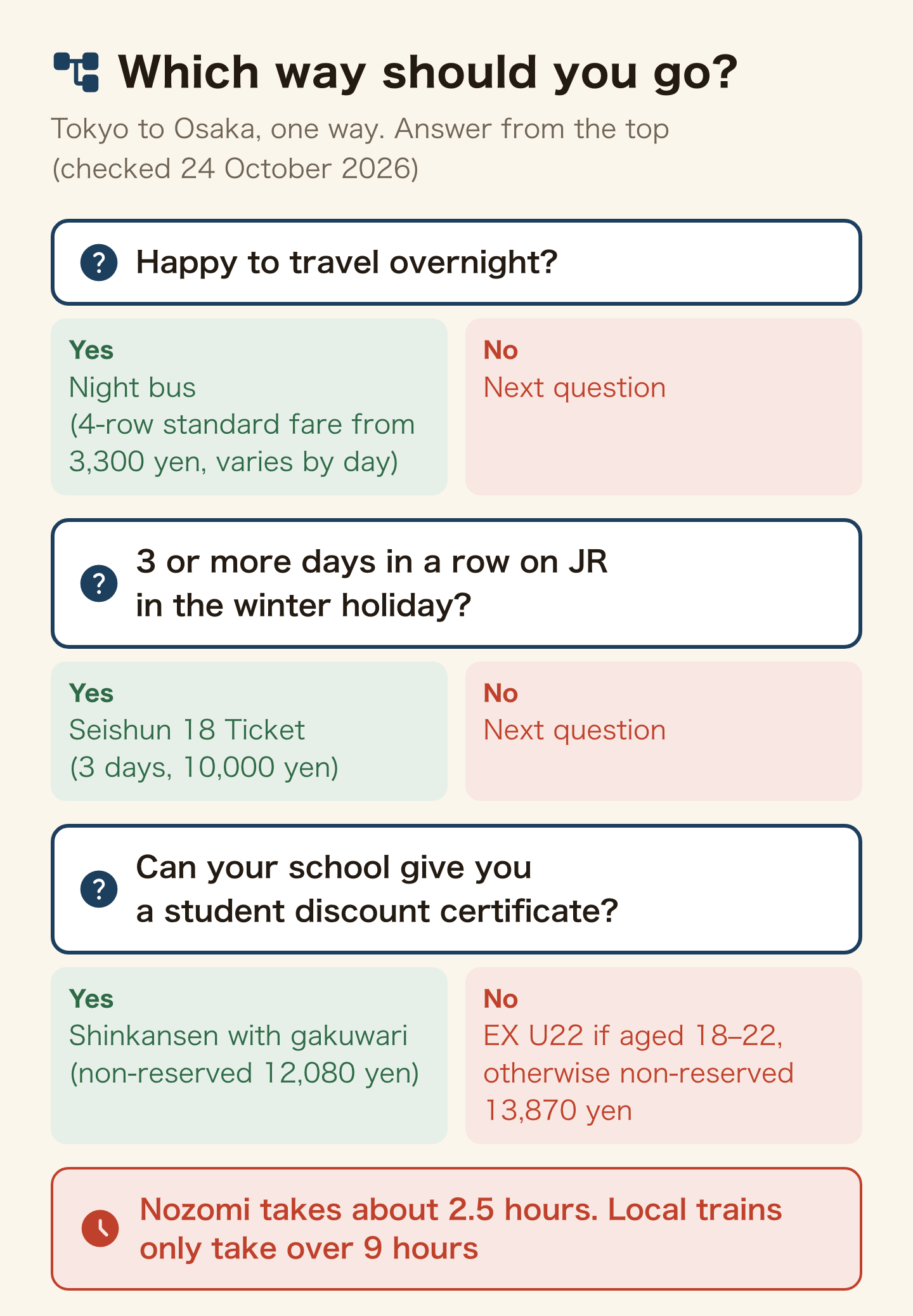
If you are not sure, answer three questions from the top.
- Happy to travel overnight: on cheap days the night bus is the cheapest, from 3,300 yen. On busy days it goes up to 12,500 yen, more than the 9,020 yen local-train fare. You spend the night on the bus.
- Riding JR around for 3 or more days in a row in the winter holiday: take the Seishun 18 Ticket. That is about 3,333 yen a day (10,000 ÷ 3).
- A student who can get a gakuwari certificate and wants to arrive fast: use gakuwari with a non-reserved shinkansen seat.
- None of these: EX U22 if you are 18 to 22, otherwise a non-reserved seat.
Local trains alone take over 9 hours from Tokyo to Osaka. On some trips, buying time at your destination is worth more than half a day on a train. Decide by how many days off you have. If you work, how to take paid leave is in paid leave in Japan: 10 days after 6 months, part-timers too.
How do you use gakuwari on the shinkansen? Get the certificate, buy at the counter
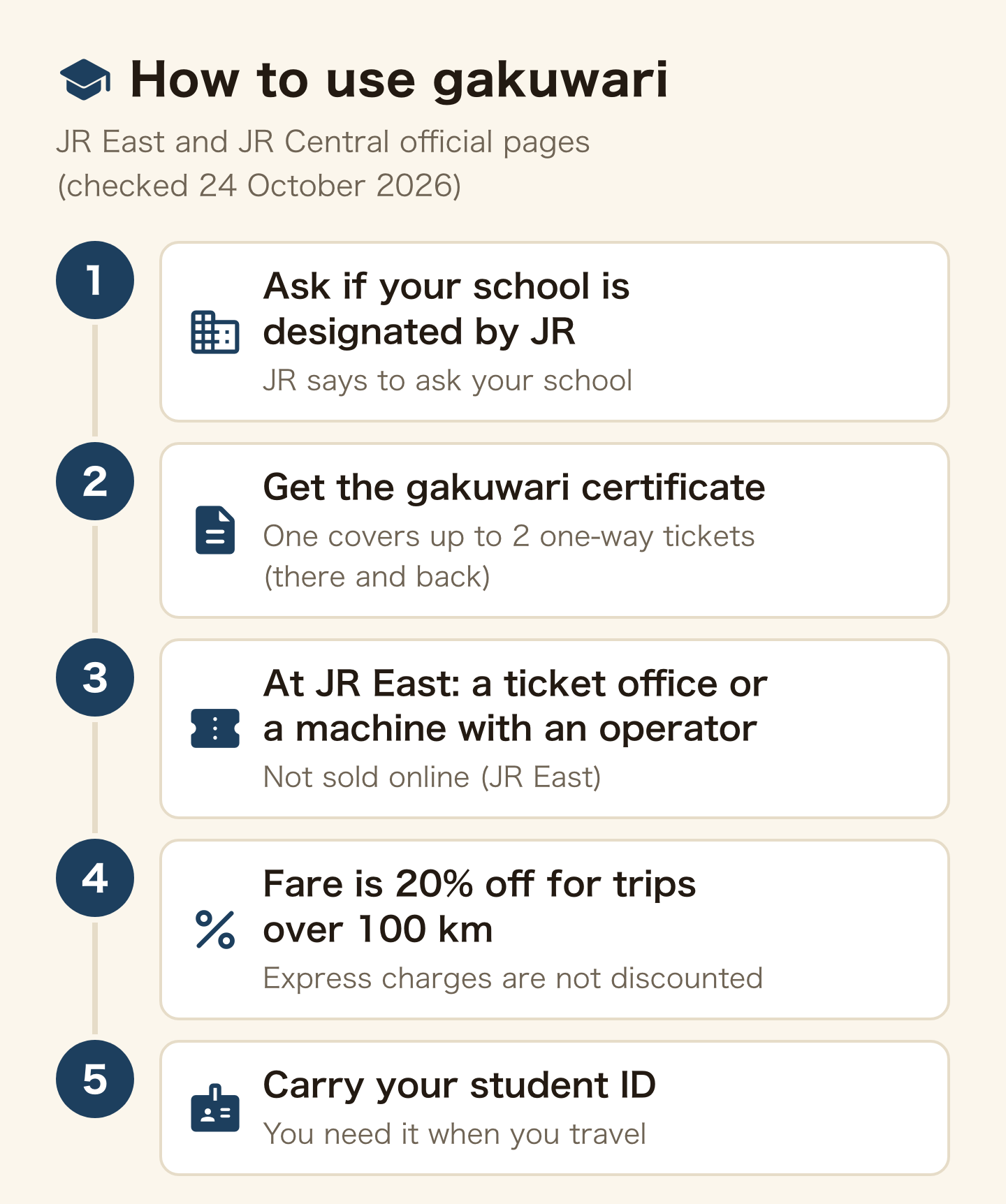
Show your student ID at the ticket counter and you get the student price. Where you come from, that may be normal. In Japan, a student ID is not enough for JR’s student discount. You hand in a certificate issued by your school, the “student fare discount certificate” (gakuwari-sho), when you buy the ticket (JR East FAQ on the student discount).
- Ask your school office whether your school is designated by JR. JR East tells students to ask their school. If you are at a Japanese language school, ask the school too.
- Get the certificate from your school. Since 14 March 2026, one certificate lets you buy up to two one-way tickets at the same time (JR Group on ending round-trip tickets). Round-trip tickets stopped being sold on 13 March 2026, so buy two one-way tickets for there and back.
- At JR East stations, buy at a ticket office (midori-no-madoguchi) or call the operator on a ticket machine with video support. JR East says student discount tickets are not sold online (JR East, how to buy student discount tickets). Someone else can buy them for you.
- Only the fare (the basic ticket) gets 20% off. The shinkansen express ticket is not discounted.
- Carry your student ID when you travel. You do not have to show it when you buy.
If you refund a gakuwari ticket, you do not get the certificate back. Buy once your plans are fixed. Gakuwari cannot be used with special tickets such as the Seishun 18 Ticket. Whether you can use gakuwari depends on the same “designated school” rule as student commuter passes. How to buy a commuter pass is in Suica and PASMO for foreigners, including student commuter passes.
What are the Seishun 18 Ticket rules? Winter 2026 starts 11 December, 3 or 5 days in a row
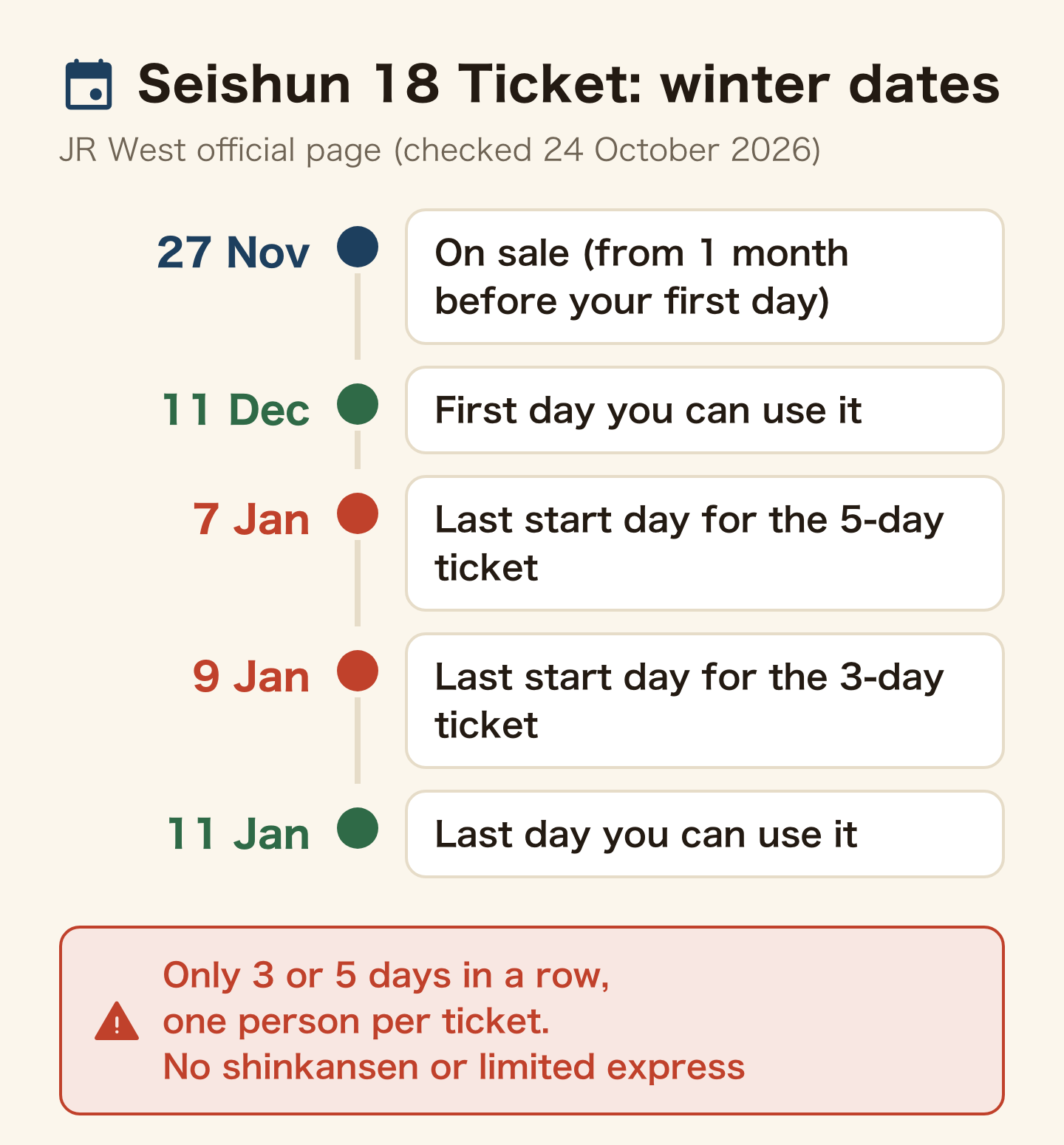
The Seishun 18 Ticket gives unlimited rides in the non-reserved cars of all JR local and rapid trains for 3 or 5 days in a row (JR West, Seishun 18 Ticket). The 3-day ticket costs 10,000 yen and the 5-day ticket 12,050 yen. Adults and children pay the same.
- For winter 2026–27, it goes on sale on 27 November 2026 and is valid from 11 December 2026 to 11 January 2027.
- You can buy it from one month before your first day up to that day. You choose the first day when you buy.
- The last start day is 9 January for the 3-day ticket and 7 January for the 5-day ticket.
- One ticket is for one person. Two people cannot share it.
- You cannot ride the shinkansen or limited express trains. Reserved seats on local trains need a separate seat ticket.
- Buy it at JR ticket offices or reserved-seat ticket machines. It works in automatic ticket gates.
If you lose it, you have to buy a new one. There is no refund even if you find it later, and no reissue. If trains stop or run late, the ticket is not extended. You can change the first day once, before you start using it.
How do you avoid losing money on the Seishun 18 Ticket? One day only, shinkansen, Suica
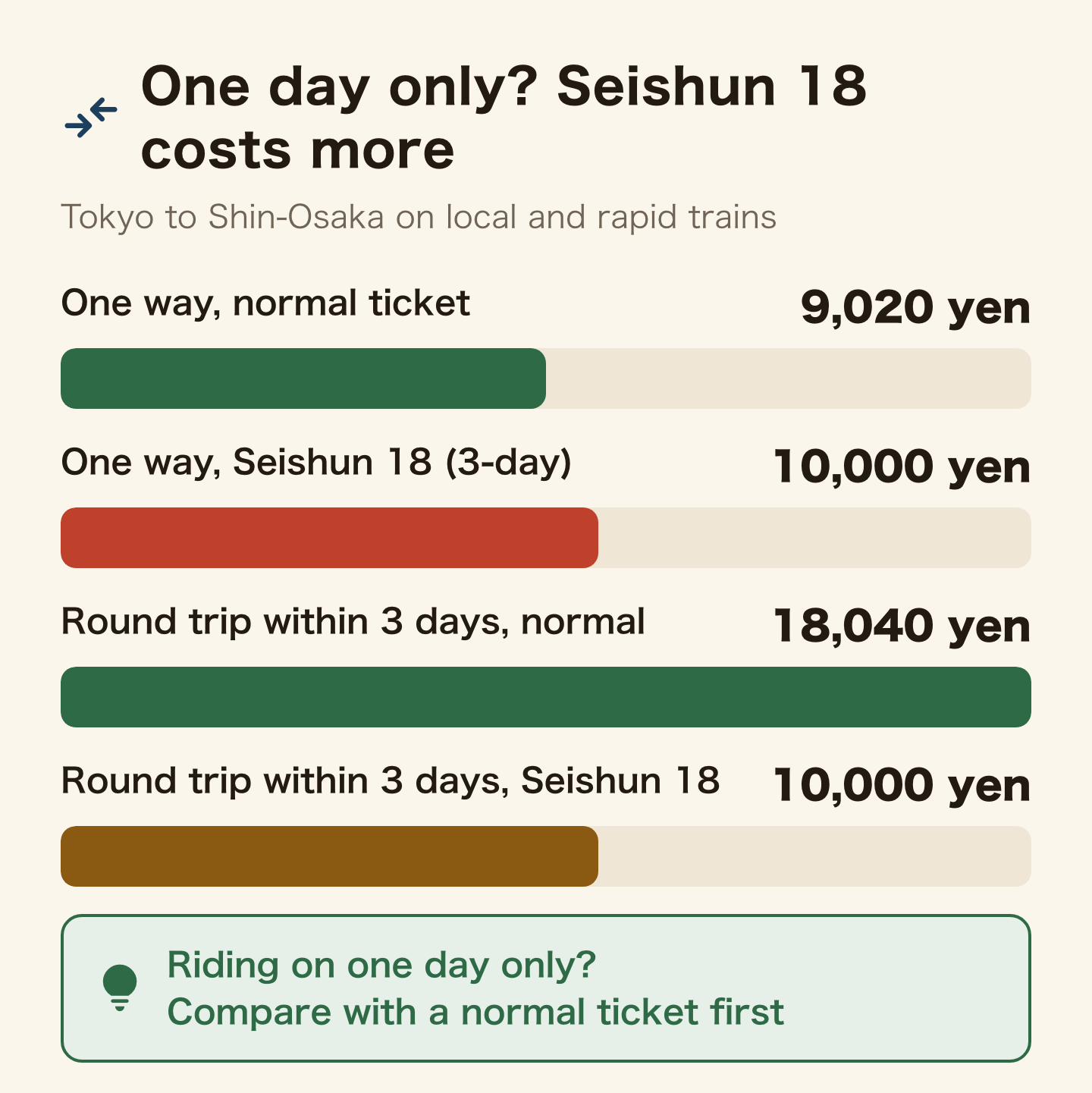
Going from Tokyo to Shin-Osaka one way on local trains costs 9,020 yen with a normal ticket. The 3-day Seishun 18 Ticket costs 10,000 yen, so it is 980 yen more. For a round trip within 3 days, normal tickets cost 9,020 × 2 = 18,040 yen. The Seishun 18 Ticket covers it for 10,000 yen.
Since winter 2024, the Seishun 18 Ticket has been sold for “3 days in a row” or “5 days in a row” (JR Group announcement, 24 October 2024). You cannot skip days. If you come back four days later, one 3-day ticket will not get you home. Fix your dates first, then choose the 3-day or 5-day ticket.
On a long local-train journey, do not just keep riding on Suica or ICOCA. JR East says IC cards such as Suica cannot be used across different areas (JR East FAQ on where Suica works). Tokyo to Osaka crosses from the Suica area into the TOICA area, so buy a ticket before you set off.
How do you use night buses safely? Women-only seats, student fares, fares you cannot change
Night bus prices depend on the seat layout. On West JR Bus’s Tokyo line, 4-row seats are the cheapest and roomier 3-row seats cost more. Check four things before you book.
- Women-only seats: West JR Bus offers women-only seats on night services only, and not on every service (West JR Bus seat types). WILLER has a women-only area on its listed routes so that women sit next to women. It may not apply when the bus is full or for group bookings, and a man may sit across the aisle (WILLER TRAVEL, for women travellers).
- Student fares: West JR Bus checks your student ID when you board on a student fare (West JR Bus user guide). Some days have no student fare.
- Fares you cannot change: with “Tokuwari” and “Chotokuwari” you cannot change your bus after buying. If your plans may change, take the normal fare.
- How prices are set: the same route costs different amounts on different days. Compare your day with the days before and after, then buy.
Are low-cost airlines cheaper? Bags and changes add up
LCC flights look cheap if you compare the headline fare only. Peach’s cheapest “Minimum” fare charges for seat selection and checked bags (Peach fare types). It also has a booking fee, and you cannot change the flight or get a refund. On every fare type, you can carry on 2 pieces up to 7 kg in total.
If you check a suitcase, add that charge before you compare with the shinkansen or a night bus. The train fare to the airport also depends on where you start.
Can residents use the Japan Rail Pass? No
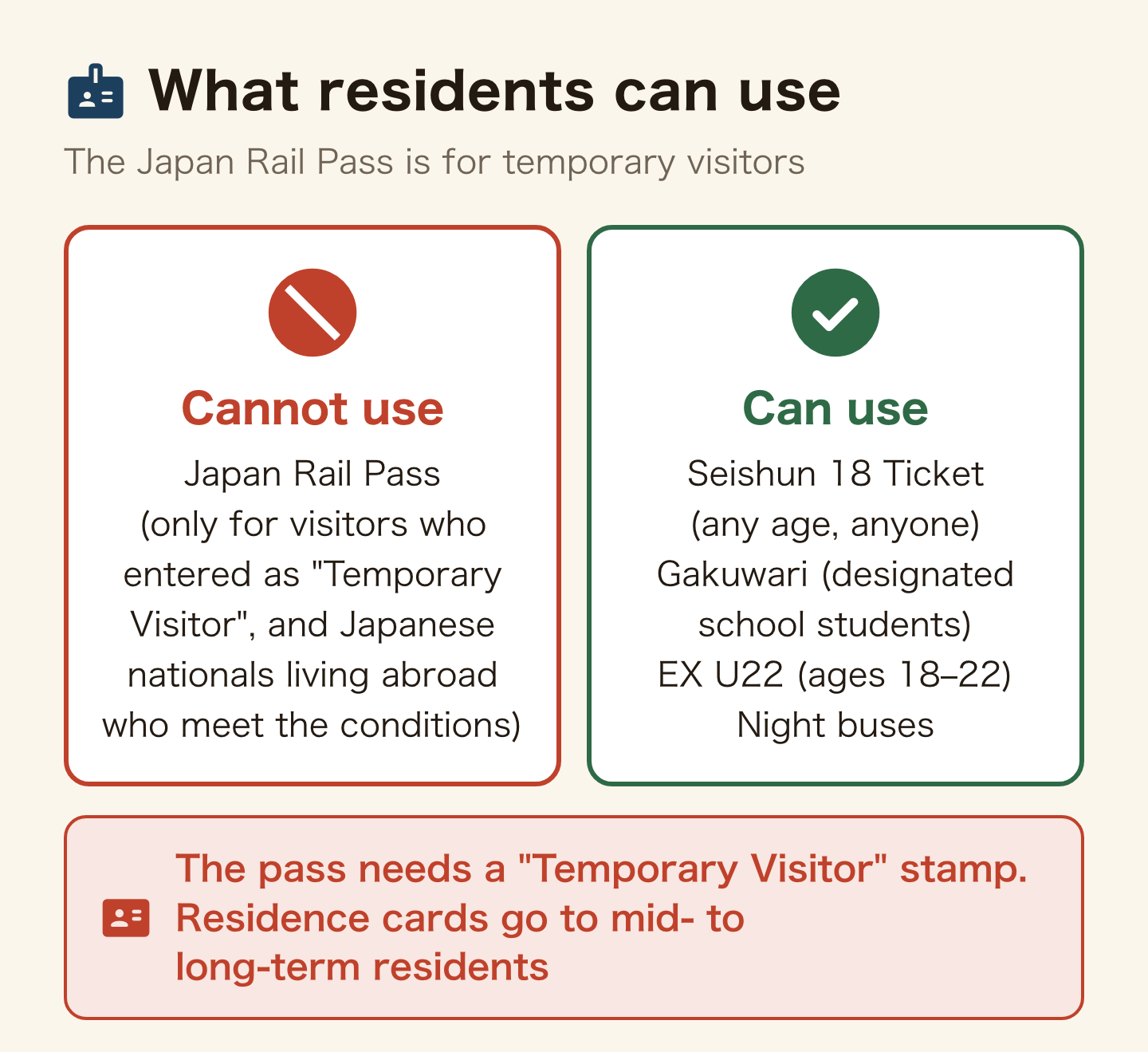
Only two groups can use the Japan Rail Pass (official Japan Rail Pass site, eligibility).
- Foreign tourists visiting Japan for sightseeing with the status “Temporary Visitor”. You need a “Temporary Visitor” stamp or sticker in your passport.
- Japanese nationals living abroad who meet the conditions. They can only buy it overseas.
Anyone who meets neither condition cannot buy an exchange order or exchange it for a pass. Residence cards are issued to people staying in Japan for the mid to long term (Immigration Services Agency, what is a residence card). If you live here on a student or work status, you are not a “Temporary Visitor”, so the pass is not for you. Cheaper options open to people living in Japan include the Seishun 18 Ticket, gakuwari, EX U22 and night buses.
How else can you cut the cost? Avoid peak days and book early
The same journey costs different amounts on different days. Reserved shinkansen seats cost 400 yen more in the busiest season and 200 yen more in the busy season, and 200 yen less in the quiet season (JR Central, seasonal reserved-seat charges). Non-reserved charges are the same all year.
At the busiest times, such as New Year, the Nozomi has no non-reserved seats. In fiscal 2026 the all-reserved periods include 21–23 November, 25 December to 5 January 2027 and 9–11 January (JR Central, all-reserved Nozomi). The Hikari and Kodama still have non-reserved cars then. Reserved seats go on sale at 10 a.m. one month before the travel day, so book on that day once your dates are fixed. With Smart EX you can reserve up to one year ahead (some fares excluded) (JR Central, all-reserved Nozomi).
Travel money comes out of what is left of your monthly budget. What international students in Tokyo spend each month is in living costs in Japan for international students (199,000 yen a month in Tokyo). Work out what will be left that month before you choose where to go.
Which one are you?
- Riding JR around for 3 or more days in a row in the winter holiday — get the 3-day or 5-day Seishun 18 Ticket. Today, write your first and last day in your calendar and decide which day after 27 November you will buy it.
- A student at a JR-designated school taking the shinkansen — use gakuwari. Today, ask your school office for a certificate and how many days it takes.
- Aged 18 to 22 with a My Number Card — consider EX U22. Today, link your card in the Smart EX app and compare the price for your day with gakuwari.
- Fine with travelling at night and able to go on a cheap day — take a night bus. Today, compare the fare for your day with the days before and after it, and pick a day below the 9,020 yen local-train fare. If you are a woman, choose a service with women-only seats.
- Travelling on the Nozomi over New Year — there are no non-reserved seats then. Today, put the date one month before your trip in your calendar and book at 10 a.m. that day. With Smart EX you can reserve up to one year ahead (some fares excluded).
Once your ticket or bus seat is booked, this decision is done. All that is left is to check service information the day before you go.
FAQ
Q. What is the cheapest way from Tokyo to Osaka?
It depends on the day. West JR Bus’s 4-row seats cost 3,300–12,500 yen (checked 24 October 2026), so on cheap days the night bus is cheapest. On expensive days, local and rapid trains at 9,020 yen (over 9 hours) cost less.
Q. Can Japanese language school students use gakuwari?
Yes, if the school is designated by JR. JR’s student discount is for students of junior high schools, high schools, universities, vocational schools and miscellaneous schools designated by JR. Ask your school whether it is designated.
Q. Can I ride the shinkansen with the Seishun 18 Ticket?
No. It covers the non-reserved cars of JR local and rapid trains. You cannot ride limited express trains either, except on a few special sections.
Q. Can I buy a Japan Rail Pass if I have a residence card?
No. The pass is for visitors who came as “Temporary Visitor” and for Japanese nationals living abroad who meet the conditions. People living in Japan use the Seishun 18 Ticket or gakuwari instead.
Q. Can I buy a student discount ticket online?
JR East says no. Buy it at a JR ticket office or at a ticket machine with operator support, handing in your certificate. JR East says you can book just the express ticket on Ekinet first and use it with a gakuwari basic ticket.
Q. Can I go from Tokyo to Osaka on local trains with Suica?
No. IC cards such as Suica cannot be used across areas. The route from Tokyo to Osaka changes area on the way, so buy a ticket first or use the Seishun 18 Ticket.
Summary
Tokyo to Shin-Osaka one way costs 13,870 yen in a non-reserved Nozomi seat, 12,080 yen with gakuwari, and 9,020 yen on local and rapid trains only. A night bus (4-row, standard fare) costs 3,300–12,500 yen depending on the day, and on some days it is the cheapest. Gakuwari needs a certificate from your school; a student ID alone will not do.
The Seishun 18 Ticket costs 10,000 yen for 3 days in a row. In winter 2026–27 it is valid from 11 December 2026 to 11 January 2027, but if you ride on one day only, compare it with a normal ticket first. Residence card holders cannot use the Japan Rail Pass. Avoid peak days and book one month ahead, and the same trip costs you less.
Official sources: JR Central route search / JR Central and JR West on Nozomi reserved-seat and Green Car charges (16 October 2026) / JR Central ticket rules: student discount, seasonal charges, shinkansen express charges / JR Central, all-reserved Nozomi / JR East discount tickets, FAQ (student discount), FAQ (Suica areas), how to buy student discount tickets / JR Group on ending round-trip tickets / JR West, Seishun 18 Ticket, JR Group, 24 October 2024 / Smart EX, EX U22, fares / West JR Bus: fare table (Kansai–Tokyo), seat types, user guide / WILLER TRAVEL / Peach fare types / Japan Rail Pass eligibility / Immigration Services Agency, residence card (all checked 24 October 2026). Fares and sale periods change, so check the official page on the day you buy.
Related reading
Found this useful? Share it
Send it to a friend who lives in Japan.
WHO WROTE THIS

mori
Japanese. I read the ministries’ own notices, orders and Q&As in the original, and I start from what my Nepalese and Sri Lankan friends in Japan actually ran into. I do not write about what I have not checked or been told.
What this site can and cannot do →Looking for something else?
You may use the figures in this article, including commercially, if you credit this site with a link. How to use our figures