Checked on 15 November 2026 against the Family Income and Expenditure Survey (2025, one-person households) from the Statistics Bureau, the JASSO survey of international students, the National Tax Agency's consumption tax pages, and official pages from the Ministry of Agriculture, Forestry and Fisheries (date labels, food loss, animal and plant quarantine, food banks) and the Ministry of Health, Labour and Welfare.
The short answer
- Food is a variable cost. Unlike rent or your phone bill, what you spend on it changes month to month with how you eat.
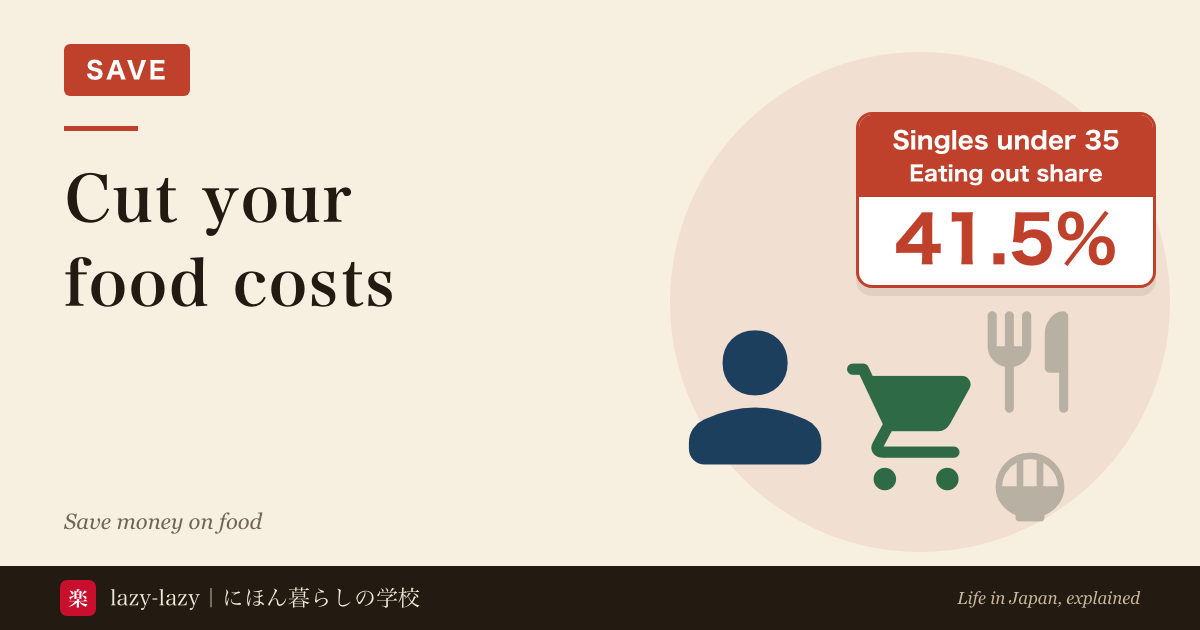
- People living alone aged 34 and under spend 41,992 yen a month on food, and 41.5% of it goes on eating out. Add bento and deli food, and it reaches 60% (Family Income and Expenditure Survey, 2025; 67 households, a rough guide).
- The same bento is taxed at 8% to take away and 10% to eat in. A bill to cut food to 1% from April 2027 is before the House of Councillors and is not law yet.
- There is no national rule for when supermarkets discount. It differs by shop. For food you will eat today, take the one at the front with the nearer date.
- Meat products from home cannot be posted or carried in. Without a certificate from the exporting country's government, not even as a gift.
Knowing this, you can cut your food bill from eating out and from what you throw away, without cutting so hard that your health suffers. One month of receipts tells you the one thing to change next month.
You pick something up at the supermarket, look at the price, and put it back. Many people do that more often after moving to Japan. In JASSO's survey, the biggest hardship international students named after arriving was high prices, at 71.4% (JASSO FY2023 survey of privately financed international students, Japanese). Ask a Japanese friend how they keep food costs down, and you may hear: wait for the half-price stickers. Ask what time the stickers go on, and every friend gives a different answer.
- How to save money on food in Japan: start with eating out and ready meals
- What is the average food cost in Japan per month for a single person?
- Is cooking cheaper than eating out or the konbini? Takeaway is taxed at 8%
- What time do Japanese supermarkets discount? No fixed time: read the dates
- Does buying in bulk save money? Not if you throw it away
- How do you get food from home? Meat products cannot be sent
- Can you use school canteens, staff canteens and staff meals?
- What counts as food spending? Eating out, snacks, drinks and alcohol too
- What if you cannot afford food? Get help before you borrow
- Which one are you?
- FAQ
- Summary
- Related reading
How to save money on food in Japan: start with eating out and ready meals
Start by splitting your food spending into parts. In the government's Family Income and Expenditure Survey, people living alone aged 34 and under spend 17,430 yen a month on eating out, the largest single item (Statistics Bureau, one-person households, Table 2, 2025, Japanese).
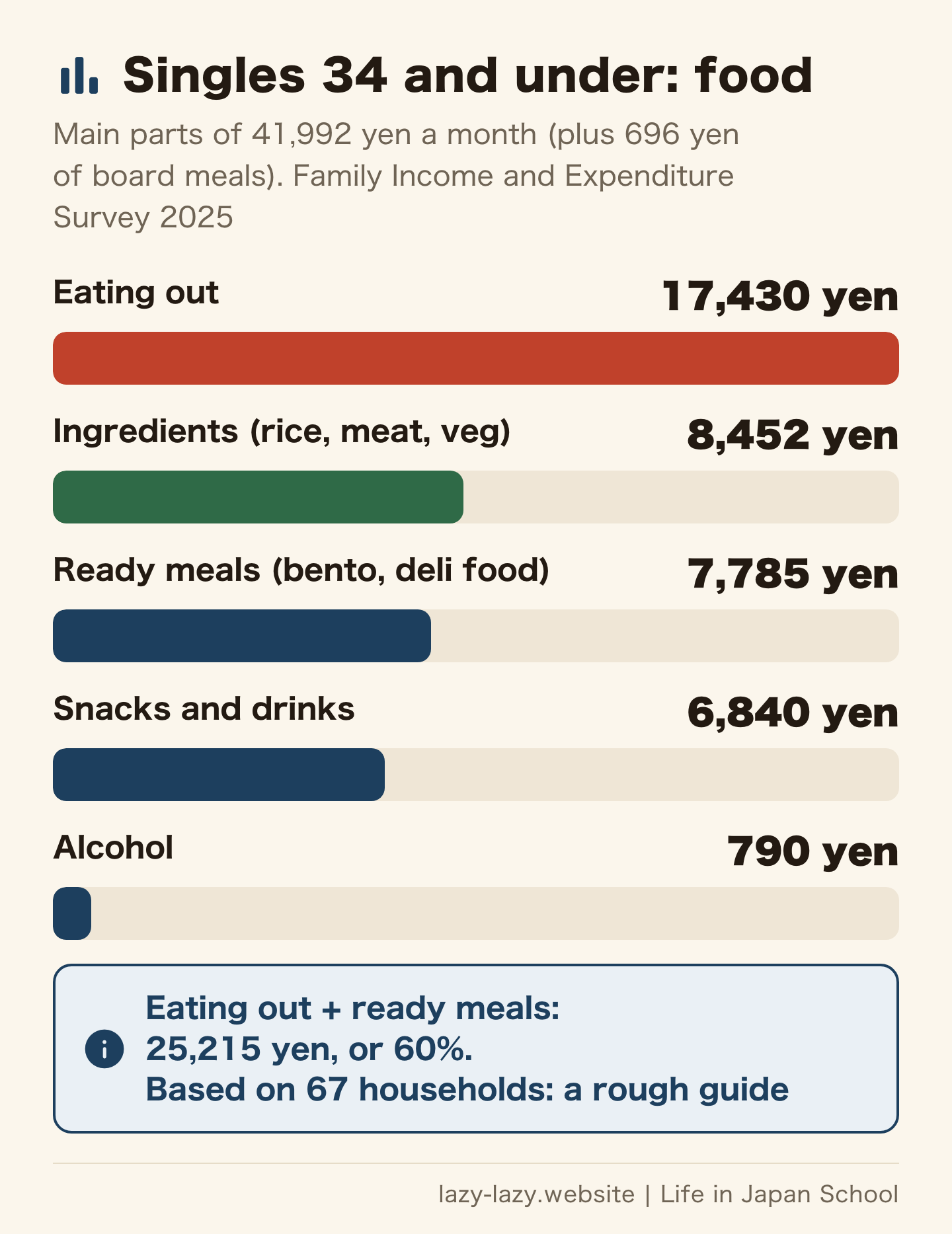
Add ready meals such as bento and deli food, 7,785 yen, and you get 25,215 yen. That is 60% of food spending on meals nobody at home cooked. Ingredients such as rice, meat, vegetables and seasoning came to 8,452 yen together. Board meals, such as in a dormitory, added another 696 yen.
So eating out and ready meals come first. With eating out at 17,430 yen a month and ingredients at 8,452 yen, eating out one time fewer each week moves the total more than comparing ingredient prices 10 yen at a time. The figures for under-35s come from 67 households, so treat them as a rough guide.
Cut food too far and your health, studies and work feel it. If you have not yet looked at contracts such as your phone plan and rent, check the order for cutting fixed costs first. How much you can afford to spend on food is worked out from take-home pay in setting a monthly budget in Japan.
What is the average food cost in Japan per month for a single person?
| Food per month | Amount | Source |
|---|---|---|
| Living alone, aged 34 and under (average 27.4) | 41,992 yen (eating out 17,430 yen) | Family Income and Expenditure Survey 2025 |
| Living alone, all ages (average 58.6) | 44,659 yen (eating out 9,761 yen) | Family Income and Expenditure Survey 2025 |
| Privately financed international students, national average | 32,000 yen | JASSO FY2023 |
| Privately financed international students, Tokyo | 37,000 yen | JASSO FY2023 |
The household survey counts food people ate themselves, not food given to other households. The student figures are from Table 7-4 of the JASSO survey. The two surveys ask different people in different ways.
An average is not a target. Whether you are above or below it, use it to see whether your spending leans towards eating out. The full picture for students is in living costs for international students.
Is cooking cheaper than eating out or the konbini? Takeaway is taxed at 8%
The price of a meal depends on what you buy, so neither side always wins. What is clear is the tax.
According to the National Tax Agency, food and drink is taxed at a reduced 8%. Dining out is excluded and taxed at 10% (NTA No.6102, Japanese). Alcohol is not counted as food and drink, so it is 10% too. A 1,000-yen bento before tax is 1,080 yen to take away and 1,100 yen to eat in.
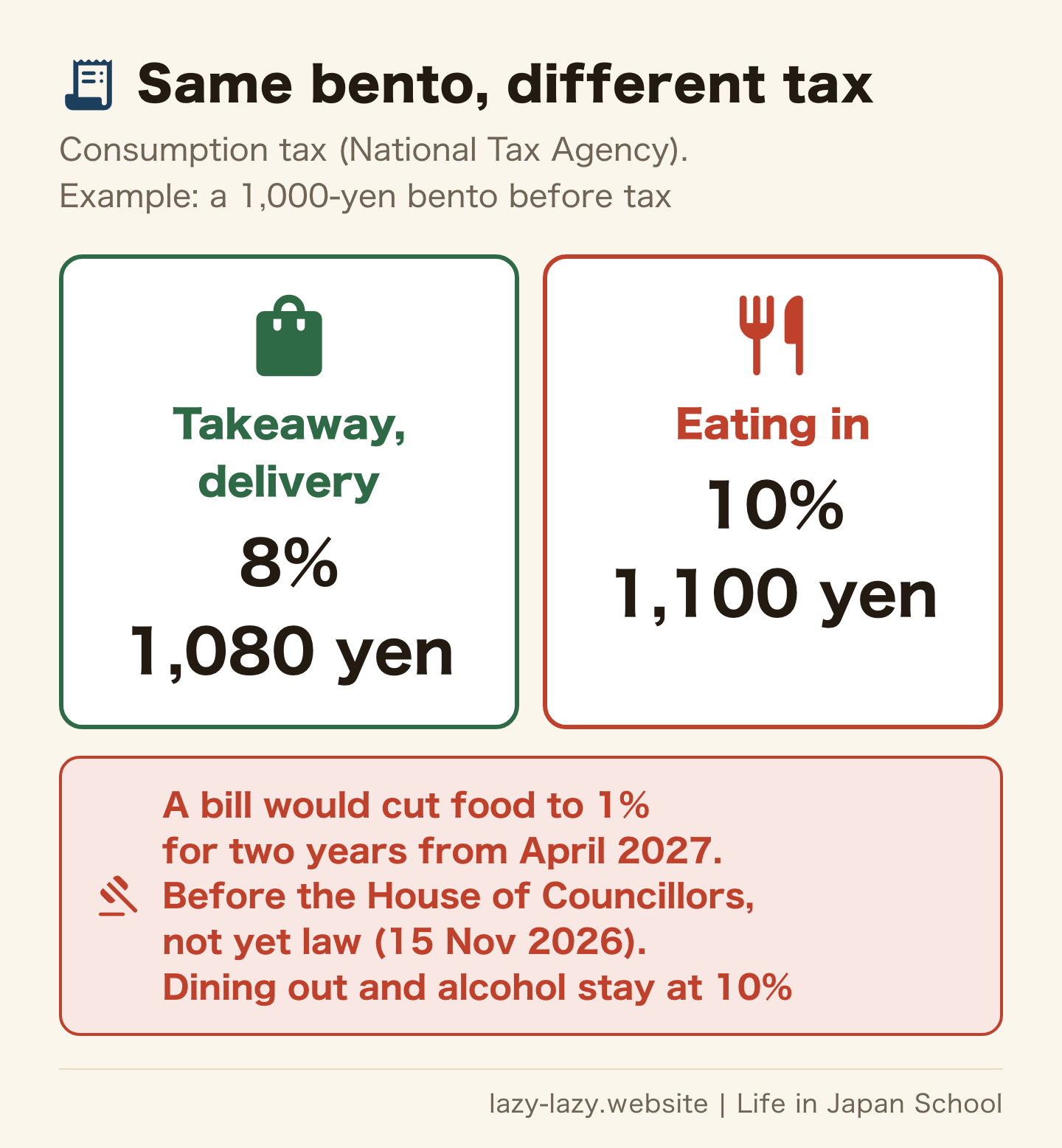
Food you buy at a konbini, supermarket or bento shop and take home, and food delivered to you, is 8% (NTA Q&A on the reduced tax rate, Japanese). Eat the same thing at the shop's tables and it becomes 10%. Price tags in Japan must show the tax-inclusive price (NTA No.6902, Japanese).
One thing is still undecided. Under a plan approved by the Cabinet on 15 September 2026, food and drink would be taxed at 1% for two years from 1 April 2027. Dining out and alcohol would stay at 10%. The bill went to the Diet on 9 October 2026 and passed the House of Representatives on 6 November. According to the House of Councillors bill information (as of 13 November, Japanese), it is being examined by a special committee there and has not been voted on. The National Tax Agency's special site on the tax cut (Japanese) also says the content applies only if the bill is passed and enacted. As of 15 November 2026, it is not decided.
If the bill goes through, the gap between eating in and taking away grows. Either way, swapping some meals out for takeaway or home cooking also works in your favour on tax. How fast prices themselves are rising is in preparing for a weak yen and inflation.
What time do Japanese supermarkets discount? No fixed time: read the dates
We found no national public rule on what time supermarket discount stickers go on, or how big the discount is. It changes by shop, by day of the week and by how much is left. "Half price from a certain hour" is true of one shop, not of Japan.
Our approach is to pick the one shop you use most, look in at the same time two or three times, and note when the stickers appeared and how big the discount was. If that time fits your way home, use it. If not, do not chase it. A detour for discounts can cost more in time and fares than it saves.
Most discounted items are close to their date. So before you buy discounts, learn the date labels.
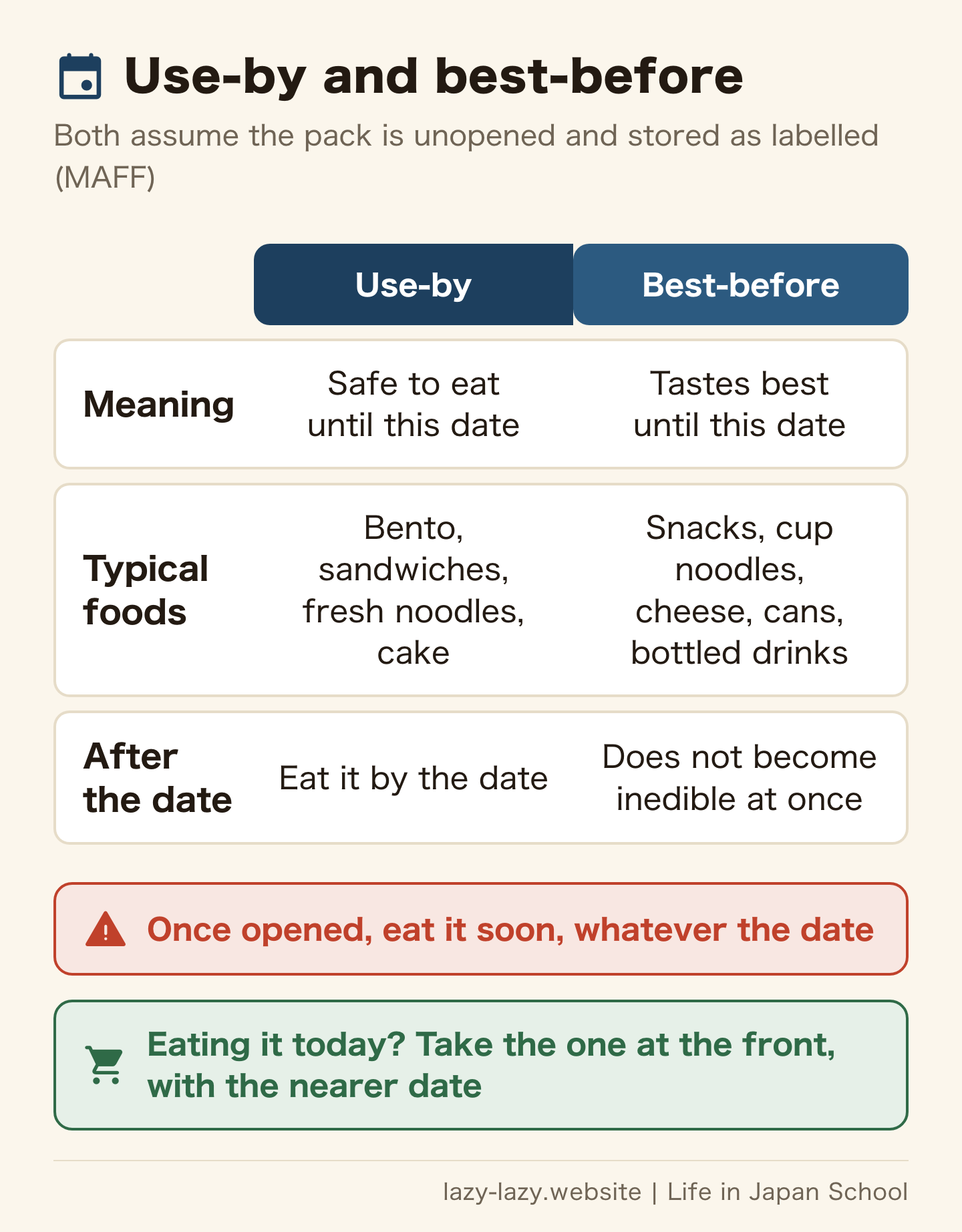
The Ministry of Agriculture explains that a use-by date (shohi kigen) is the date until which food is safe to eat, used on food that spoils quickly, such as bento, sandwiches, fresh noodles and cake. A best-before date (shomi kigen) is the date until which it tastes best, and food does not become inedible the moment it passes (MAFF, use-by and best-before, Japanese). Both assume the pack is unopened and stored as labelled. Once opened, eat it soon, whatever the date.
A discounted bento with today's use-by date is a good deal if you eat it today. Saved for tomorrow's breakfast, it is not. The government also asks shoppers who will eat something straight away to take items from the front of the shelf, where the dates are nearer. This is called temaedori (MAFF, CAA and MOE, 29 September 2026, Japanese).
Does buying in bulk save money? Not if you throw it away
A big pack of meat or vegetables looks cheaper per gram. But whatever you throw away is money you paid for food you never ate. Whether bulk buying saves money depends on finishing it.
Households in Japan threw away 2.24 million tonnes of food that could still be eaten, according to the estimate for FY2024 (MAFF, current state of food loss, Japanese). With shops and factories included, the total was 4.61 million tonnes, about 37 kg per person a year.
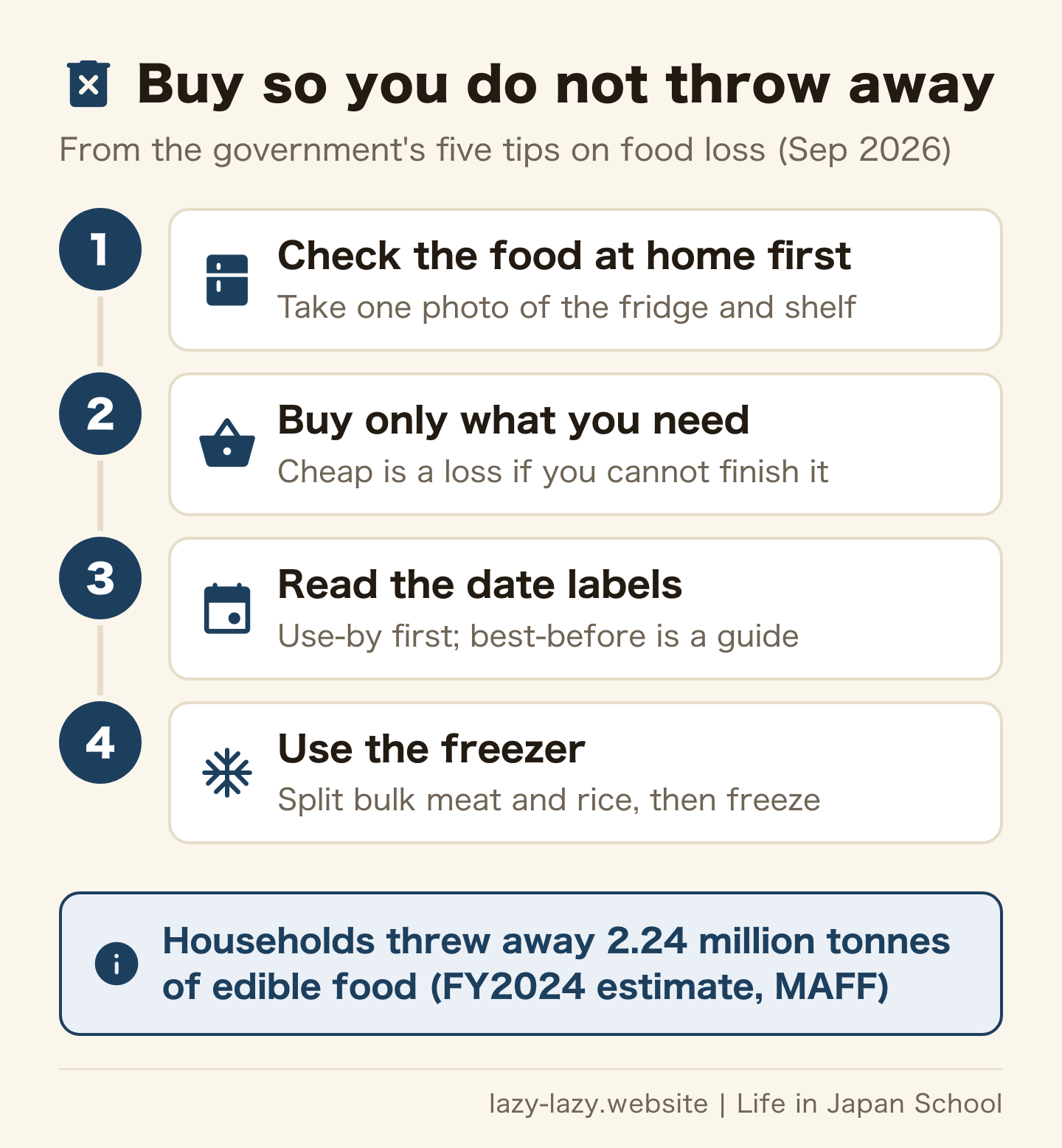
The government's five tips on food loss run in this order: check what is at home before shopping, buy only what you need, understand the date labels, and use the freezer well (release of 29 September 2026, Japanese). None of them costs anything.
If you buy in bulk, split and freeze it on the day you get home. Left in the fridge, it is still there at the end of the week. Write down everything you throw away for one week, and you will see what you overbuy.
How do you get food from home? Meat products cannot be sent
A friend comes back from a trip home with dried meat or sausages from their family in the suitcase. Your family packs a box and posts it. Where you come from, that may be normal. In Japan, meat products cannot be brought in without an inspection certificate from the exporting country's government, even as a gift or for your own use.
The Animal Quarantine Service says most meat products and animal-derived products cannot be brought into Japan. Eggs, including shells, are covered too, and dairy products are covered when sent by post or similar (not in hand luggage). Sending them by international post is restricted too (Animal Quarantine Service, meat products as souvenirs, Japanese). Bringing them in illegally can mean a fine of up to 3 million yen for an individual, or imprisonment of up to 3 years.
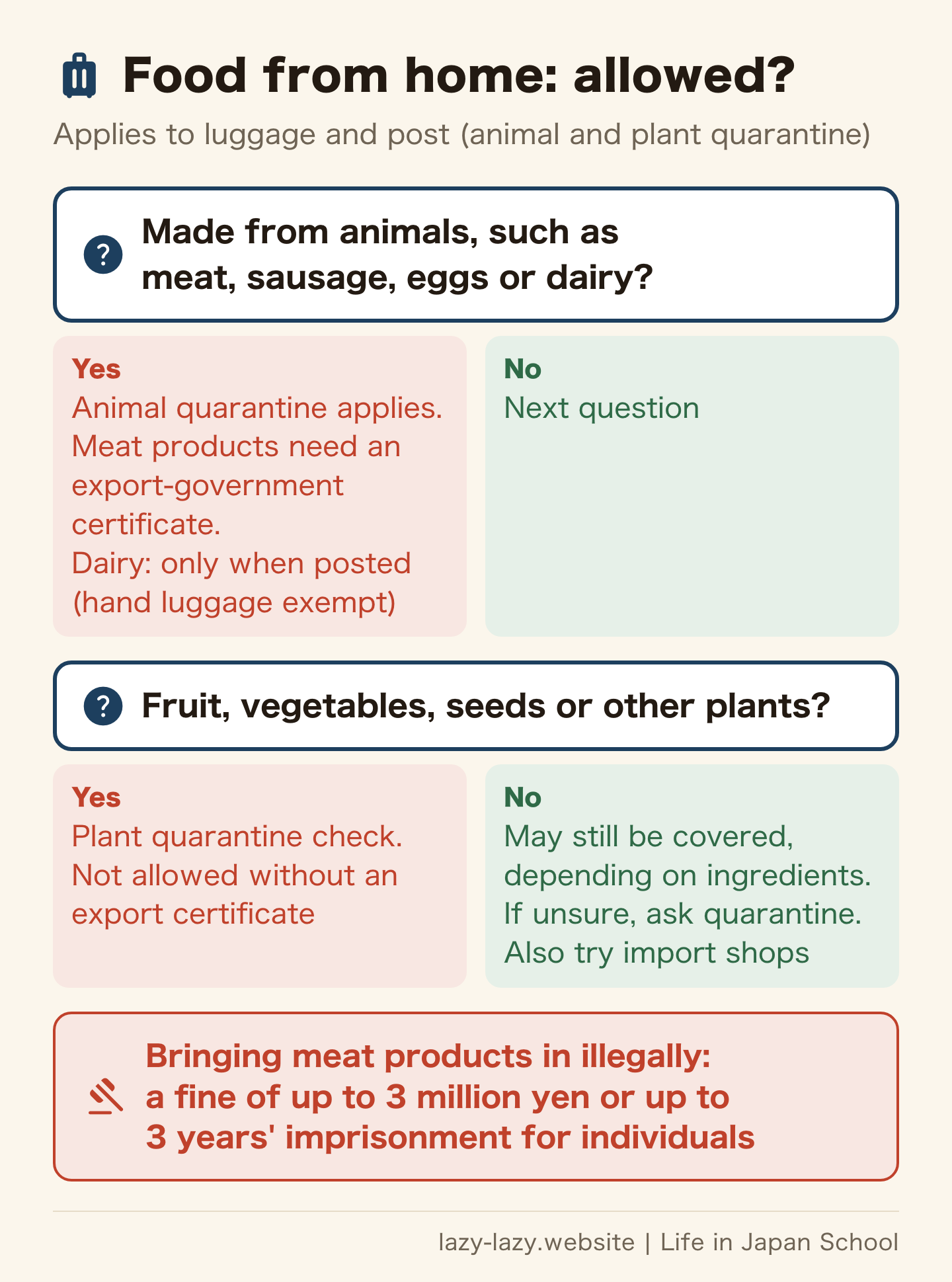
Fruit, vegetables, seeds and other plants are checked too. In your luggage, they go through the plant quarantine counter at the airport, and they cannot come in without a phytosanitary certificate from the exporting country. Plants sent by post are inspected after they arrive in Japan (Plant Protection Station, Japanese).
Spices, dried goods and sauces from home are sometimes sold in import food shops and online in Japan. Before paying postage, look for them nearby once. If you choose ingredients for religious reasons or because you cannot eat certain things, finding halal food in Japan explains how to read ingredient labels.
Can you use school canteens, staff canteens and staff meals?
If your university or vocational school has a canteen, compare the price of a meal with shops outside. Prices differ by school, so check your own.
Staff canteens, bento allowances and staff meals at part-time jobs have a tax rule. According to the National Tax Agency, meals an employer provides are not taxed as salary if you pay at least half the price and the employer's share is 7,500 yen a month or less, before tax (NTA No.2594, Japanese). If you are given cash for meals instead, the whole amount is taxed as salary, except for things like late-night meal money.
If your workplace has a canteen or meal support, use it first. Put what you pay per meal next to what eating out would cost, and deciding whether to keep using it becomes easy.
What counts as food spending? Eating out, snacks, drinks and alcohol too
If you count differently each month, you will not see your cuts working. The household survey's food figure includes eating out, bento, snacks, drinks and alcohol, not just supermarket ingredients. Count yours the same way.
- Konbini coffee and vending machine drinks count as food. People living alone aged 34 and under spent 6,840 yen a month on snacks and drinks.
- Meals and drinking parties with friends count too.
- Add up receipts at the tax-inclusive total. Price tags show tax-inclusive prices as a rule, so they add up as they are.
- Divide the monthly total by 30 for a daily figure. 41,992 yen is about 1,400 yen a day.
One month of counting is enough. Use just four groups: eating out, ready meals (bento and deli food), ingredients, and snacks, drinks and alcohol. The biggest one will be obvious.
What if you cannot afford food? Get help before you borrow
If you have cut food and it is still not enough, or you cannot afford to buy food at all, this is no longer about saving money. Do not put up with it alone. Ask for help first.
The Ministry of Health, Labour and Welfare asks anyone with worries about daily life to start with the local self-reliance support office. A support worker listens and works out with you what help you need (MHLW, Self-Reliance Support for the Needy, Japanese). There are also food banks, which collect food that is still edible and give it free to welfare facilities and others (MAFF, food banks, Japanese).
Paying for food with revolving credit or a cash advance makes the next month harder by the amount of the fees. This site does not recommend borrowing for food. Ways to fill the gap without borrowing are in don't borrow money in Japan, and the country's last safety net is in welfare for foreigners in Japan. If you are a student, talk to your school's international student office today as well.
Which one are you?
- You eat out and use the konbini a lot: sort one week of receipts into eating out, bento and deli food, and ingredients. Today, choose one weekday lunch a week to swap for takeaway or home cooking.
- You cook, but the total does not fall: write down everything you throw away for a week. Before you shop today, take one photo of your fridge.
- You often buy discounted food: check the date and buy discounted only what you will eat today. Starting today, note the discount time at your usual shop three times.
- You miss food from home: tell your family today not to post meat products. Look for the same ingredients in a nearby import shop or online.
- You cannot afford food: before borrowing, contact the self-reliance support office or your school's international student office today.
FAQ
Q. What is the average monthly food cost for a single person in Japan?
In the Family Income and Expenditure Survey (2025), people living alone aged 34 and under spent 41,992 yen a month. Eating out was 17,430 yen of that. In JASSO's FY2023 survey, privately financed international students spent 32,000 yen a month on food on average nationally, and 37,000 yen in Tokyo.
Q. Where should I start to save money on food in Japan?
Start with eating out and bento or deli food. For people living alone aged 34 and under, the two make up 60% of food spending. Eating out one time fewer a week moves the total more than comparing ingredient prices.
Q. What time do Japanese supermarkets discount food?
There is no fixed national time. It varies by shop and by day. The reliable way is to check your usual shop at the same time two or three times and note when the stickers go on.
Q. Is cooking cheaper than the konbini or eating out?
The price of a meal depends on what you buy, so there is no single answer. But the same item is taxed at 8% to take away and 10% to eat in. A bill to cut food to 1% from April 2027 was before the House of Councillors as of 15 November 2026 and is not law yet.
Q. Can I eat food past its best-before date?
The Ministry of Agriculture says best-before is the date until which food tastes best, and food does not become inedible the moment it passes. Use-by is the date until which food is safe to eat, so eat it by then. Both dates assume the pack is unopened.
Q. Can my family post food from home to me in Japan?
Meat products cannot come in, by post or in luggage, without an inspection certificate from the exporting country's government. Eggs, and dairy sent by post, are also under animal quarantine. Fruit, vegetables, seeds and other plants also need a certificate and an inspection in Japan. Bringing meat products in illegally can lead to a fine of up to 3 million yen for an individual.
Summary
People living alone aged 34 and under spend 41,992 yen a month on food, and eating out plus bento and deli food make up 60% of it. Cut the number of meals out before you compare ingredient prices. The same item is taxed at 8% to take away, less than eating in.
Buy discounted food only for today, after checking the date. Bulk buying pays only if you freeze it and nothing goes in the bin. Do not have meat products sent from home; look for ingredients in Japan instead. And if you cannot afford food, go to a support office before you borrow.
Official sources (Japanese): Statistics Bureau, Family Income and Expenditure Survey, one-person households, Table 2, 2025 / JASSO, FY2023 survey of privately financed international students / NTA No.6102, reduced tax rate / NTA, Q&A on the reduced tax rate / NTA, special site on the tax cut / House of Councillors, bill information / NTA No.6902, tax-inclusive price display / NTA No.2594, meals provided by employers / MAFF, use-by and best-before / MAFF, food loss month release / MAFF, current state of food loss / Animal Quarantine Service / Plant Protection Station / MAFF, food banks / MHLW, Self-Reliance Support for the Needy (all checked 15 November 2026).
Related reading
Found this useful? Share it
Send it to a friend who lives in Japan.
WHO WROTE THIS

mori
Japanese. I read the ministries’ own notices, orders and Q&As in the original, and I start from what my Nepalese and Sri Lankan friends in Japan actually ran into. I do not write about what I have not checked or been told.
What this site can and cannot do →Looking for something else?
You may use the figures in this article, including commercially, if you credit this site with a link. How to use our figures