This article was checked on 5 November 2026 against the Financial Services Agency’s Basic Financial Guide and deposit insurance page, Shiruporuto, the Immigration Services Agency’s pages on cancellation, its Q&A and its fees, the Ministry of Health, Labour and Welfare’s employment insurance Q&A and high-cost medical materials, the Japan Health Insurance Association, the Tokyo Council of Social Welfare, the Bank of Japan, JASSO and a Ministry of Land survey. Worked examples are our own calculations. Fees and rules change, so check the official page on the day you need it. Most sources are in Japanese.
In short
- An emergency fund is money that lets you live without borrowing when your income stops or a sudden cost hits. It sits apart from your everyday money.
- There is no single right amount. The formula is monthly spending × months + one-off costs. You put in your own numbers.
- No law sets the number of months. The Financial Services Agency’s guide shows emergency money as 3 months to 1 year. Here we use 3 months for students and single workers, and 6 months for people supporting a family. That is this site’s rule of thumb, not an official standard.
- As a foreigner, always add the one-off costs. A one-way flight home, your residence application fee (33,000 yen at the counter for a 1-year permit) and one month of the medical cap.
- Keep it in a yen savings account. Separate it from your everyday account. Do not invest it.
Knowing this, you can see in your own numbers how much it takes to still have choices if your job disappears. Even with little saved, you can decide what to save first.
Your contract ends next month. The shop where you work part-time is closing. The rent is not the only thing on your mind. How long is your status safe? What does a flight home cost? Ask a Japanese friend and you will not get an answer, because a Japanese citizen has no residence deadline and no flight home to pay for. Saving looks the same, but a foreigner in Japan has more items to add.
- What is an emergency fund, and how is it different from savings?
- How much emergency fund do you need? Monthly spending × months + one-off costs
- Is “3 months” or “6 months” an official standard? No law, only guides with a wide range
- What happens if your job ends? The 3-month line on your status
- How much are the one-off costs? Visa fees, flight home, medical, moving
- How far do unemployment benefit, sick pay and the medical cap go? The gaps in 3 systems
- What changes for students, workers and families?
- Where should you keep an emergency fund? A separate yen savings account
- Savings or investing first? The emergency fund comes first
- What if you cannot save, or the money runs short? Do not plan on borrowing
- Which one are you?
- FAQ
- Summary
- Related reading
What is an emergency fund, and how is it different from savings?
An emergency fund is money for when your income stops, such as losing a job or falling ill. Shiruporuto describes it the same way: money for emergencies like unemployment or sick leave.
The difference from savings is that its use is decided in advance. Money for a holiday, or the account your monthly bills come out of, does not count. You touch it only when income stops or a cost cannot be avoided.
How much emergency fund do you need? Monthly spending × months + one-off costs
It takes three steps.
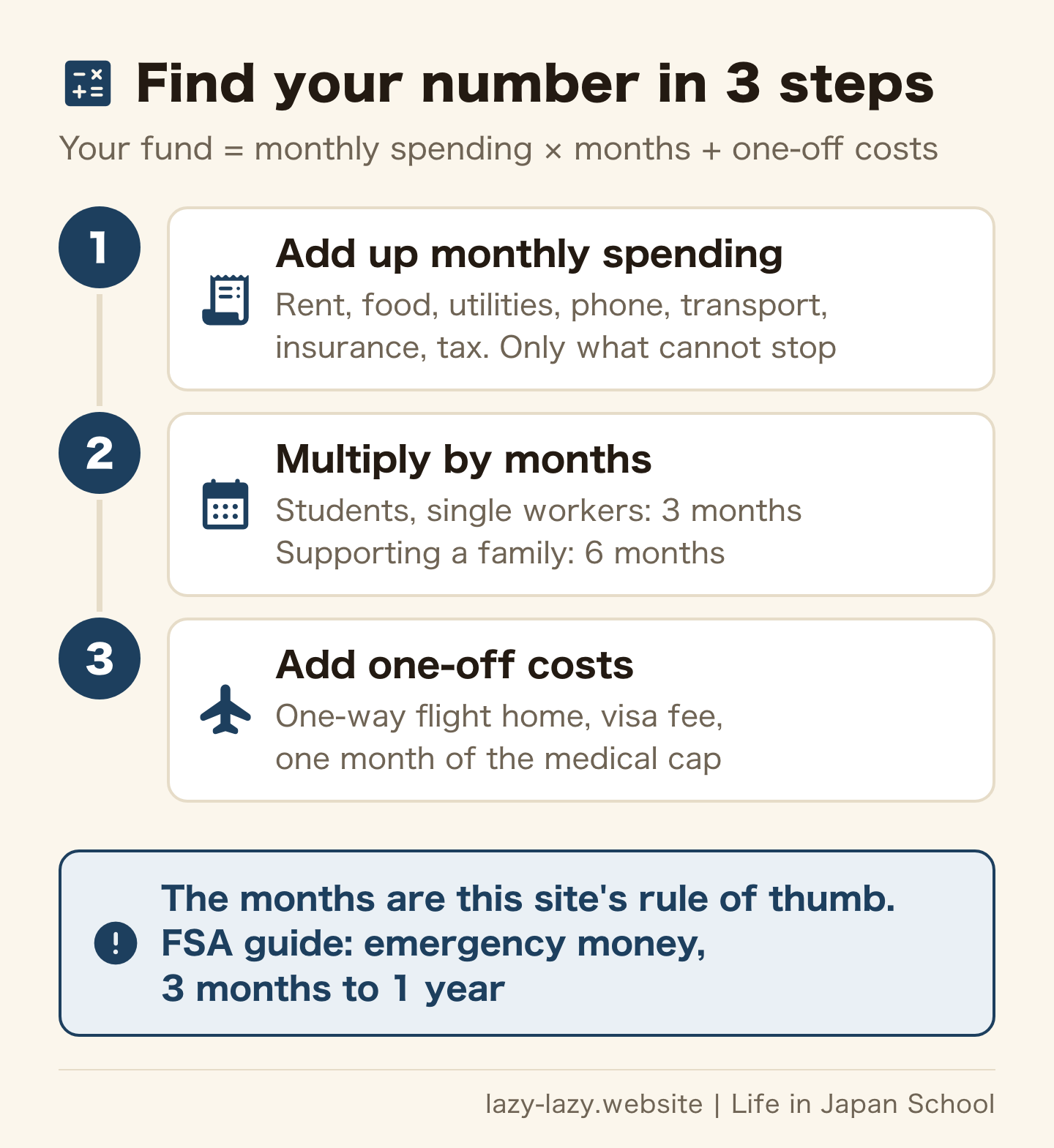
- Add up monthly spending. Open the last 3 months of bank and card statements and add only what cannot stop: rent, food, utilities, phone, transport, insurance, tax and monthly repayments. Leave out fun and saving.
- Multiply by months. Students and single workers start with 3 months. People supporting a family start with 6.
- Add one-off costs: a one-way flight home, your residence application fee and one month of the medical cap. Students also add the next tuition payment.
If some income continues even without a job, such as a scholarship, you can subtract it from monthly spending. Do not subtract money from home, because that can stop too.
Workers add one more thing. Insurance and tax that came out of your pay become yours to pay when you leave. The National Pension premium is 17,920 yen a month in fiscal 2026. National Health Insurance depends on your city and last year’s income, so ask at the city office. Resident tax is calculated on the previous year’s income, so the bill still comes in the year your income stops.
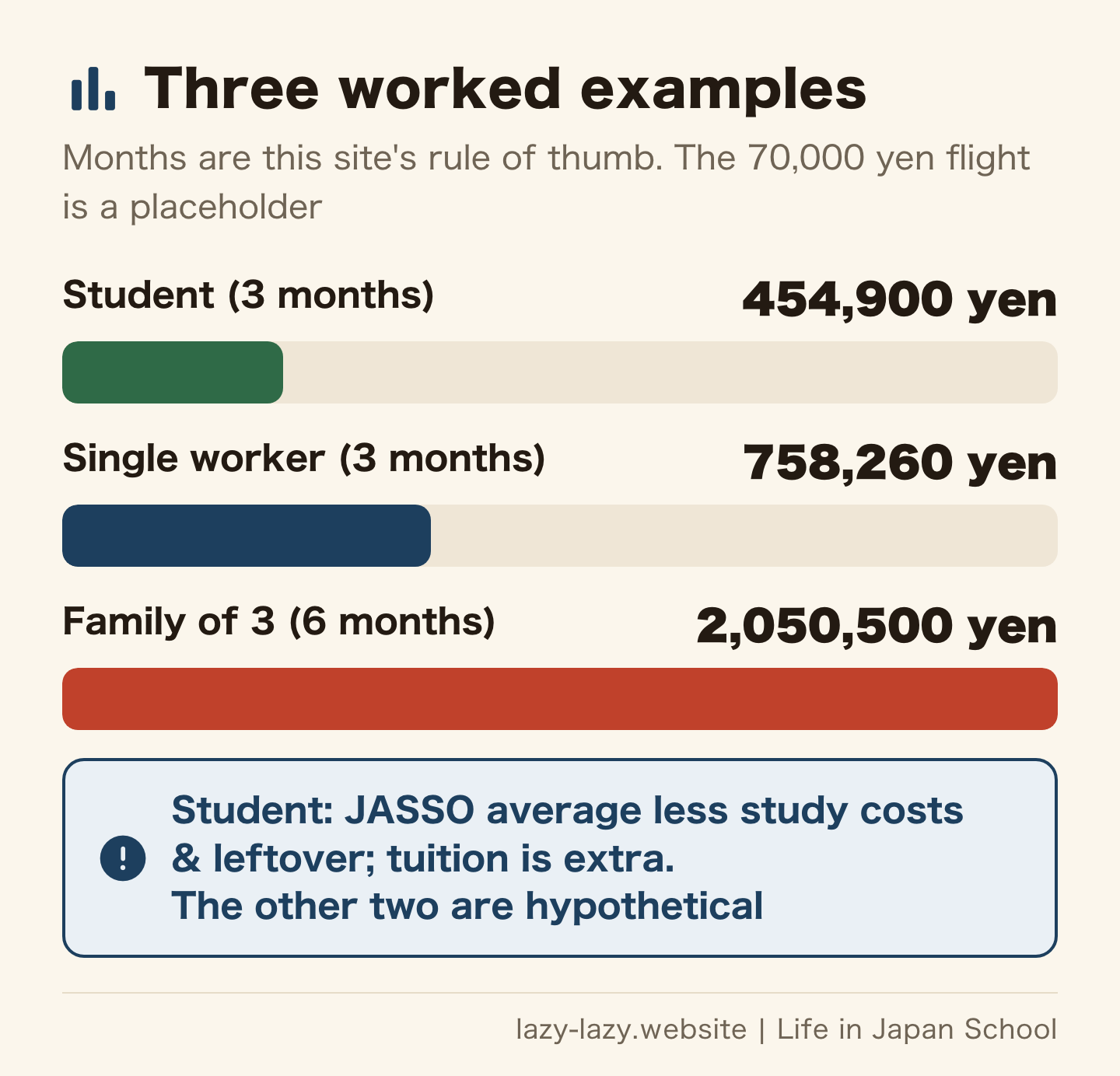
Here are three worked examples. The months are this site’s rule of thumb. The 70,000 yen flight is a placeholder for the calculation. Replace it with the real one-way price to your country.
| Student | Single worker | Family of 3 | |
|---|---|---|---|
| Monthly spending | 105,000 yen | 197,920 yen | 280,000 yen |
| Months | 3 | 3 | 6 |
| Living costs | 315,000 yen | 593,760 yen | 1,680,000 yen |
| One-way flight (placeholder) | 70,000 yen | 70,000 yen | 210,000 yen (3 people) |
| Residence fee (1 year, counter) | 33,000 yen | 33,000 yen | 99,000 yen (3 people) |
| Medical cap (1 month) | 36,900 yen | 61,500 yen | 61,500 yen |
| Total | 454,900 yen | 758,260 yen | 2,050,500 yen |
The student’s 105,000 yen is the national average in JASSO’s fiscal 2023 survey (170,000 yen a month) minus study costs of 52,000 yen and money left over of 13,000 yen. Tuition is not included. It still includes 8,000 yen of hobby and leisure costs, so leave those out of your own figure. The other two spending figures are hypothetical. For the single worker we added the 17,920 yen pension premium to 180,000 yen a month. National Health Insurance and resident tax are not in this example, so add your own. The medical cap assumes the student is exempt from resident tax and the other two earn up to about 3.7 million yen. Rent changes with where you live, so compare the breakdown of student living costs with your own statements, and you may find something to cut.
Is “3 months” or “6 months” an official standard? No law, only guides with a wide range
No law sets an amount. A search of Japan’s e-Gov law database for the Japanese term for an emergency fund (生活防衛資金) returned no results on 5 November 2026.
Public bodies do give guides, but the numbers vary (Shiruporuto is the archived site of the Central Council for Financial Services Information).
- Financial Services Agency, Basic Financial Guide: emergency money of 3 months to 1 year
- Shiruporuto, guide to living alone: 3 months to 1 year of living costs
- Shiruporuto, guide for new adults: at least 3 months of living costs, ideally 1 year or more
- Shiruporuto, guide for adults: sometimes said to be 1 to 2 years of what you need to live each month, but only as a guide
The “3 months” and “6 months” in this article are this site’s rule of thumb, placed inside that range. We chose 3 months because it is the low end of the FSA’s guide. The other reason is that study and work statuses have their own 3-month line. Asking someone with little money to hold a full year means they never start. When you can, move up the range.
What happens if your job ends? The 3-month line on your status
You quit a job, rest for a while, then look for the next one. Where you come from, that may be normal. In Japan, on some statuses, that “while” has a limit.
If you hold a study or work status and do not do that activity for 3 months or more in a row, your status can be cancelled, unless you have a good reason. For “Spouse or Child of Japanese National” and “Spouse or Child of Permanent Resident”, the line is 6 months without activity as a spouse (children and some others are excluded), again unless you have a good reason. Permanent residents are not covered by these two rules.
The immigration Q&A gives one example of a good reason: after leaving a job, you are actively job hunting, such as visiting companies. Each case is judged separately. So if you may pass 3 months, ask immigration instead of deciding yourself. How the months are counted and what happens before cancellation are in our article on visa cancellation.
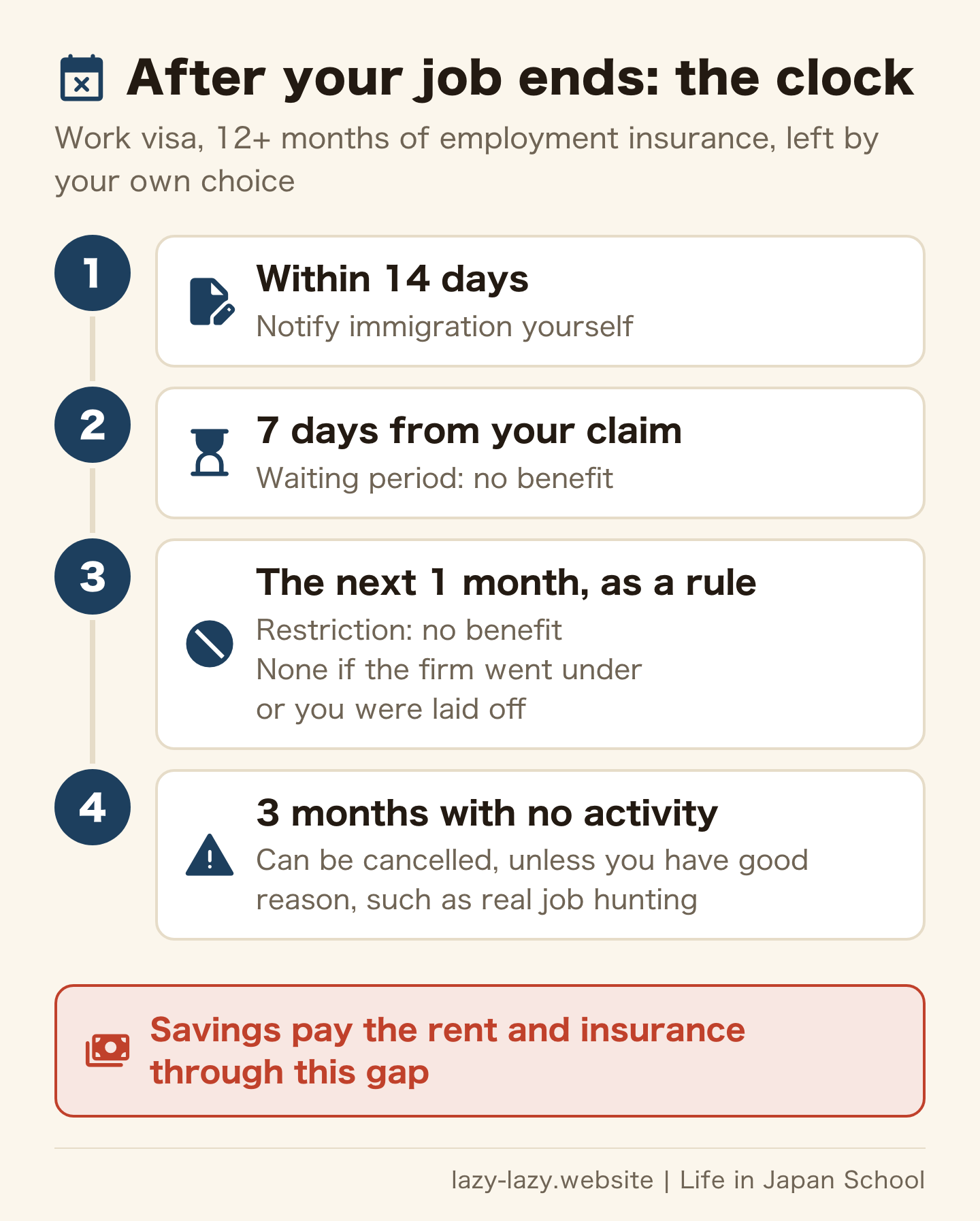
There is a second deadline. If you hold a study or work status, when your link with your school or employer ends through leaving or graduating, you must notify immigration yourself within 14 days (activity organization notice / contract organization notice; your status decides which). The steps are in our article on leaving a job.
If your status is cancelled on the 3-month ground, you get a set period of up to 30 days to leave (immigration page). You need money for the flight within that period. That is why the one-way flight goes in the formula.
How much are the one-off costs? Visa fees, flight home, medical, moving
| For | How much | Conditions |
|---|---|---|
| Extension or change of status | 1-year permit: 33,000 yen at the counter, 27,000 yen online | The fee follows the period granted. Counter fees run from 10,000 to 75,000 yen. Online adds a payment charge (immigration fee table) |
| One-way flight home | Look it up yourself today | There is no public price level. Families pay per person |
| Medical | 36,900 yen a month if exempt from resident tax; 61,500 yen a month up to an income of about 3.7 million yen | Under 70, treatment from August 2026 to July 2027 (Ministry of Health, Labour and Welfare). Counted per calendar month, per hospital or clinic, with inpatient and outpatient counted separately |
| Moving | Check your contract for how many months of rent | Using the survey below, add deposit, key money and agent fee |
| Tuition (students) | What your school charges | The next single payment |
Fees rose sharply on 1 October 2026, so do not use old numbers. Each band and how to pay are in our article on visa fees. If you graduate from a university or similar school and keep job hunting, the immigration Q&A describes a change to “Designated Activities” with a 6-month period, if you meet the conditions. A 6-month permit costs 18,000 yen at the counter or 15,000 yen online.
Moving costs vary by room. In the Ministry of Land’s fiscal 2025 survey of households that moved into private rentals in the three big metropolitan areas between April 2024 and March 2025, 51.9% paid a deposit or guarantee money, 43.1% paid key money and 48.0% paid an agent fee. Among those who paid, exactly 1 month was the most common answer for all three. If the rent is 60,000 yen and all three are 1 month, that is 60,000 × 3 = 180,000 yen. Moving costs and the first rent come on top. To estimate leaving your current room, see our article on move-out costs.
If you go home you need the flight. If you stay and change rooms you need moving money. It will be one or the other, so add the larger one. The three examples above use the flight.
How far do unemployment benefit, sick pay and the medical cap go? The gaps in 3 systems
Public systems are strong. But some people are not covered, and there are gaps before the money arrives.
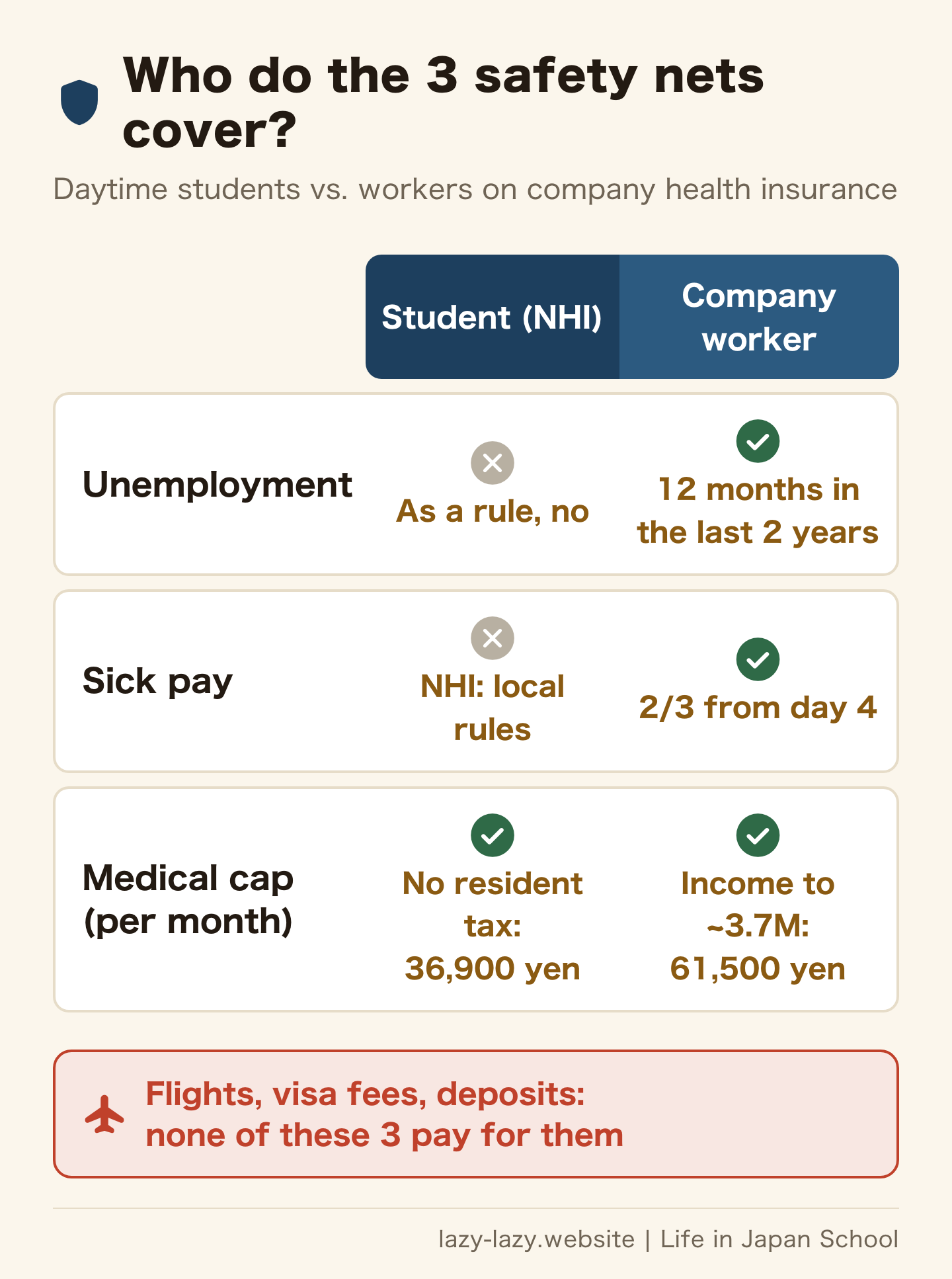
Unemployment benefit: you need at least 12 months of employment insurance in total in the 2 years before leaving (Hello Work). If you were dismissed, your firm went under, or similar (specific eligible recipients), or your contract was not renewed, or similar (specific reason recipients), 6 months in the year before leaving is enough. It does not start at once. The first 7 days from your claim are a waiting period. If you left by your own choice, there is then, as a rule, 1 month with no benefit (ministry Q&A, for people who left on or after 1 April 2025). It is 3 months if you have had benefit eligibility decided 2 or more times in the past 5 years after leaving by your own choice. It is also 3 months if you were dismissed for serious fault of your own. The daily amount is roughly 50 to 80% of your daily wage, with a ceiling. Under age 30 the ceiling was 7,450 yen a day as of 1 August 2026, so 4 weeks pays at most 7,450 × 28 = 208,600 yen. Check the conditions and days in our article on unemployment benefits.
Sick pay: this is for people on company health insurance who cannot work because of an illness or injury outside work. From day 4, after 3 days off in a row, you get 2/3 of a daily amount based on your standard monthly remuneration, for up to 1 year and 6 months in total from the start. It is not paid for days you receive salary (if the salary is lower, you get the difference) (Japan Health Insurance Association). In National Health Insurance it depends on local rules, so students on it should count it as zero. The conditions are in our article on sick pay.
High-cost medical expense benefit: this caps what you pay for treatment in a month, and it works for students on National Health Insurance too. It counts from the 1st to the last day of the month, and hospital meals and private-room charges are outside it (Tokyo Metropolitan Government). A hospital stay across two months means two months of cap. To pay only up to the cap at the counter, you need your My Number health card or a limit certificate. If you have not declared income for National Health Insurance, you may land in a higher band, so check yours in our article on the medical cap.
Flights, residence fees and deposits are outside all three. Only savings fill that gap. Insurance is for large losses that savings cannot pay. Count public benefits first, then use our article on life insurance to decide what you need.
What changes for students, workers and families?
Students living alone
Students at daytime schools are, as a rule, outside employment insurance (Employment Insurance Act, Article 6). If your part-time job ends, count on no unemployment benefit. You cannot make it up by working more either. The limit for work outside your status is 28 hours a week (8 hours a day during your school’s long breaks). University guidance, such as the University of Tokyo’s, says you cannot work during a leave of absence, so read our article on leave of absence first. The same goes after graduation: blanket permission to work is valid only while you are enrolled (immigration Q&A).
So before 3 months of living costs, a student secures the next tuition payment and the flight home.
Single workers
If you have 12 months or more of employment insurance in the 2 years before leaving, and you register at Hello Work and look for work, you can be covered by unemployment benefit. If you joined less than 12 months ago, or work under 20 hours a week, calculate as if it is not. Article 6 of the same act excludes people with under 20 scheduled hours a week. In that case it is safer to go above 3 months.
People supporting a family
If one adult’s income supports the family, every person’s living costs fall short at once when it stops. The Dependent visa is for a spouse or child who is supported. If the supporter’s job ends, check with immigration what that means for the family’s status too. A dependent needs permission to work part-time, and the limit is 28 hours a week. In the calculation, multiply the flight and the residence fee by the number of people. Children’s fares differ, so use real prices.
Where should you keep an emergency fund? A separate yen savings account
The answer is a yen savings account at a bank in Japan, separate from your everyday account. You do not know the day you will need it, so it has to be quick to take out and must not shrink. Shiruporuto also says money you need for living is generally held in deposits, because they are safe and easy to turn into cash.
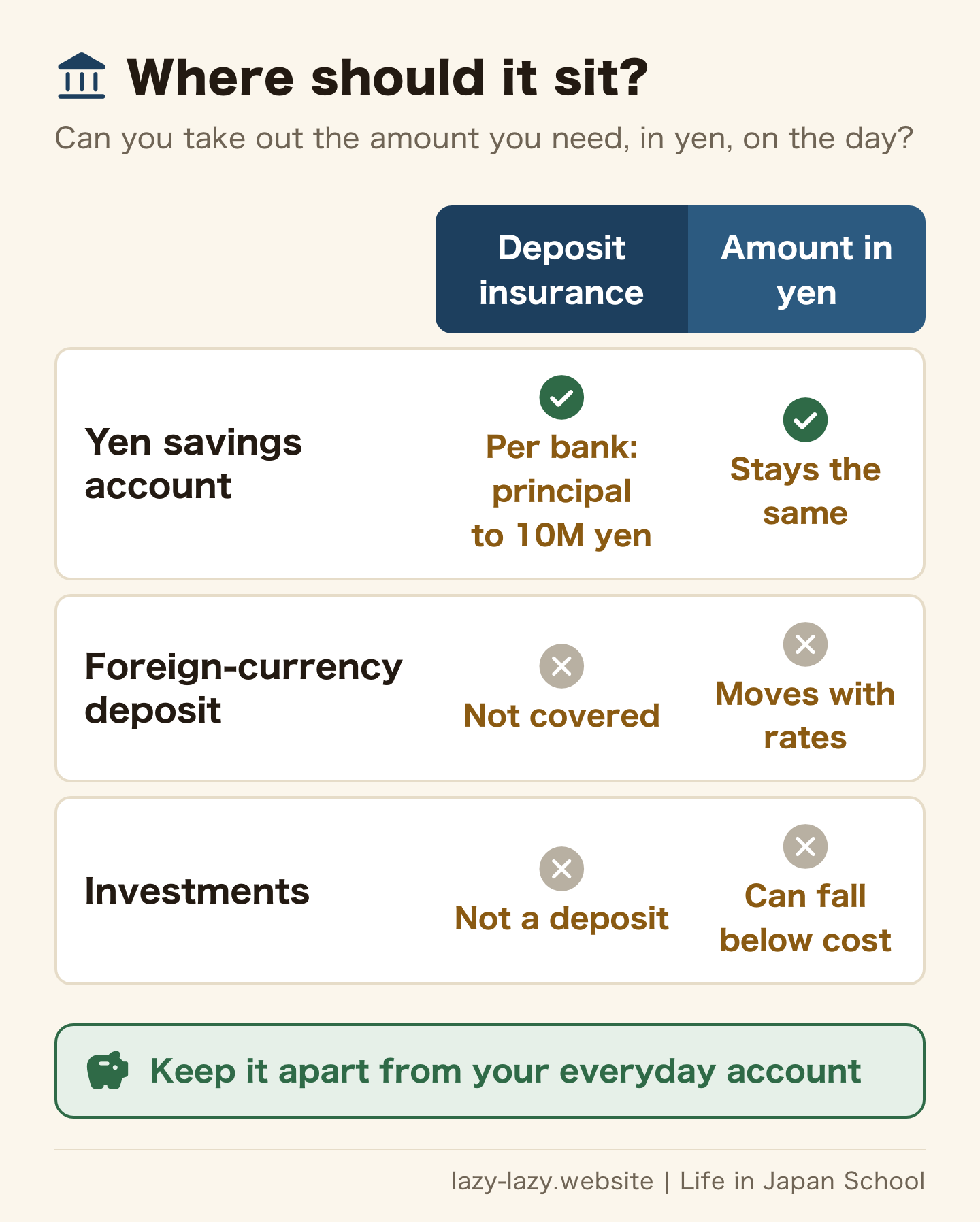
- Yen savings account: interest-bearing savings accounts are protected per depositor, added up per financial institution, up to 10 million yen of principal plus interest to the date of failure (Financial Services Agency).
- Time deposits: protected the same way, but the interest gap is small. Bank of Japan averages for October 2026 were 0.331% a year for ordinary savings and 0.486% for 1-year time deposits under 3 million yen. On 300,000 yen, that is 300,000 × 0.155% = 465 yen a year before tax.
- Foreign-currency deposits: outside deposit insurance. Rent and fees are paid in yen, so money whose yen value moves with exchange rates does not suit this job.
- Investments: the Financial Services Agency says to invest with spare money separate from living funds. If prices are down when you lose your job, you may have to sell at a loss.
Some people keep money in a bank back home. To use it in Japan, you need time and a fee to send it. Keep what you will spend in Japan in a Japanese account.
Savings or investing first? The emergency fund comes first
Think of stairs. Finish one step before the next.
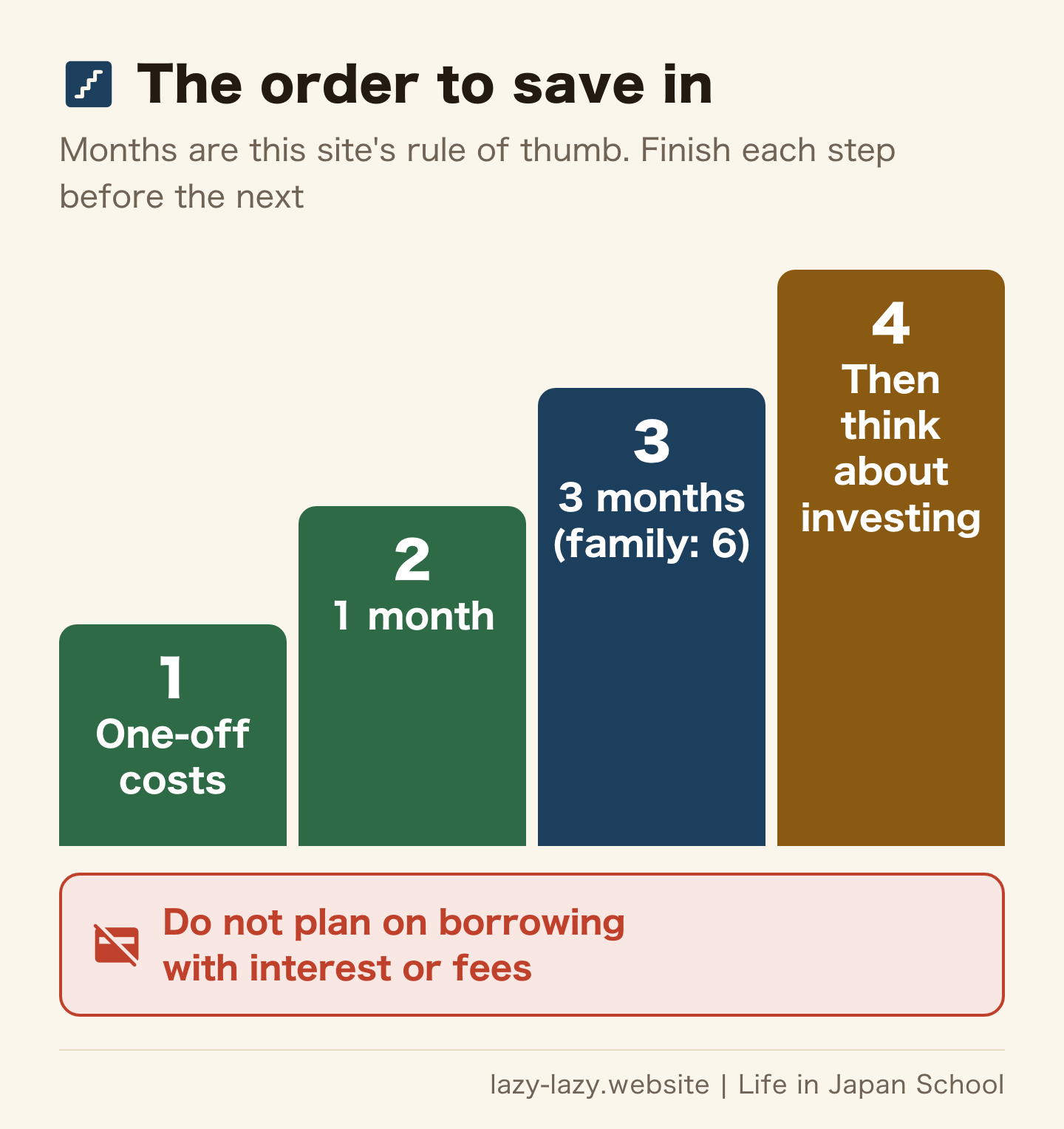
The one-off costs come first because the amount is small and, for a foreigner, nothing else fills it. In the student example that is 139,900 yen before tuition. At 10,000 yen a month, 139,900 ÷ 10,000 takes about 14 months. Move the money to a separate account on the day your pay arrives, so it is set aside before you spend it.
Once you reach your target, you can think about investing what is above it. Our article on why foreigners might invest explains why deposits alone may not be enough. What you buy is your own decision. This article recommends no product.
If you use the fund, save it back in the same order. Using it is not a failure. That is what it is there for.
What if you cannot save, or the money runs short? Do not plan on borrowing
This site basically does not recommend borrowing that carries interest or fees. “I’ll borrow if it runs out” does not replace an emergency fund.
- Legal maximum interest on loans such as card loans is 15 to 20% a year (Financial Services Agency). The average ordinary savings rate is 0.331%. Because of that gap, if you have a revolving balance, look at how to bring it down at the same time.
- With moneylenders, you cannot take a new loan once your total balance is over one third of your annual income. The lower your income, the less you can borrow.
- The Emergency Small Fund is a public interest-free loan, but it has status conditions. In the Tokyo Council of Social Welfare’s guide, foreign nationals must be permanent residents, spouses of permanent residents, spouses of Japanese nationals, long-term residents, spouses of long-term residents or special permanent residents, must have lived at their address for 6 months or more, and must be expected to stay in Japan permanently. In Tokyo, study and work statuses are not on the list. Elsewhere, ask your local council of social welfare.
If you are short right now, cut what you have to pay before you borrow. For tuition, ask your school’s international office about instalments or fee reductions. National Pension has exemptions and deferrals, and students have a student payment special measure. National Health Insurance has a reduction for people who left through dismissal, bankruptcy or similar. For rent, people within 2 years of leaving a job, among others, may qualify for the housing security benefit. There are income and asset conditions, and you must look for work. Apply through a self-reliance support office. The full order is in our article on getting by without borrowing.
Which one are you?
- A student with almost nothing saved — aim for the one-off costs only. Today, look up the one-way price to your country and write it down with your next tuition amount.
- Working, without 3 months saved — work out your monthly spending and set a monthly amount. Today, open your last 3 months of statements and add up what cannot stop.
- Supporting a family — calculate 6 months plus costs per person. Today, list everyone’s residence deadline and the total of the next fees.
- You already have your target — stop there and keep it in a separate account. Today, check it is apart from your everyday account, then decide whether to think about investing next.
- Short of money right now — cut payments before you borrow. Today, call your school’s international office or your city office.
FAQ
Q. How much should my emergency fund be?
A. There is no single amount. Calculate monthly spending × months + one-off costs. The Financial Services Agency’s guide shows emergency money as 3 months to 1 year. This site’s rule of thumb is 3 months for students and single workers, and 6 months for people supporting a family. It is not an official standard.
Q. How is an emergency fund different from savings?
A. By its use. You touch an emergency fund only when income stops or a cost cannot be avoided. Holiday money and your everyday account do not count.
Q. Do some people not need an emergency fund?
A. The amount can be small, but it rarely reaches zero. Foreigners in Japan have costs public systems do not pay, such as a one-way flight home and residence fees. Hold at least the one-off costs.
Q. Do I need 1 million yen?
A. Some people do, some do not. In this article’s examples, a student came to 454,900 yen, a single worker to 758,260 yen and a family of 3 to 2,050,500 yen. Spending figures are examples, the flight is a placeholder and the months are this site’s rule of thumb. The student example leaves out tuition, and the worker example leaves out National Health Insurance and resident tax. Use your own numbers.
Q. Where should I keep it? Can it go in NISA?
A. Keep it in a yen savings account at a bank in Japan, separate from your everyday account. Do not invest it. The Financial Services Agency says to invest with spare money separate from living funds.
Q. Can an international student get unemployment benefit after losing a job?
A. Students at daytime schools are, as a rule, outside employment insurance. If your part-time job ends, count on nothing. The limit on outside work is 28 hours a week (8 hours a day during your school’s long breaks).
Summary
Nobody else can set your emergency fund. Put your own numbers into monthly spending × months + one-off costs. The months are a guide, not a law. The Financial Services Agency’s guide shows emergency money as 3 months to 1 year. Here we used 3 months for students and single workers, and 6 months for people supporting a family.
What is special for foreigners is the 3-month line on your status, the flight home and the fees. Unemployment benefit, sick pay and the medical cap leave some people out and leave gaps. Save the one-off costs first, in a separate yen savings account. Then add months, and think about investing after that.
Official sources (in Japanese): Financial Services Agency Basic Financial Guide, deposit insurance, Money Lending Act basics / Deposit Insurance Corporation of Japan scope of protection / Shiruporuto living alone, new adults, adults / Immigration Services Agency cancellation, Q&A, fees, Dependent / Ministry of Health, Labour and Welfare employment insurance Q&A, high-cost medical materials, housing security benefit / Hello Work / Japan Health Insurance Association / Tokyo Council of Social Welfare / JASSO / Ministry of Land / University of Tokyo / Japan Pension Service (all checked 5 November 2026). Worked examples are our own calculations.
Related reading
Found this useful? Share it
Send it to a friend who lives in Japan.
WHO WROTE THIS

mori
Japanese. I read the ministries’ own notices, orders and Q&As in the original, and I start from what my Nepalese and Sri Lankan friends in Japan actually ran into. I do not write about what I have not checked or been told.
What this site can and cannot do →Looking for something else?
You may use the figures in this article, including commercially, if you credit this site with a link. How to use our figures