Checked on 23 November 2026. We used the Tokyo Sento Association’s guides, the bath fee limits set by Tokyo and Osaka, the health ministry’s hygiene guideline for public baths, the Japan Tourism Agency’s notice on tattoos, the environment ministry’s onsen notice rules, and the Consumer Affairs Agency’s bath safety warning.
The short answer
- A sento is a public bathhouse that local people use for their daily bath. Each prefecture sets the highest fee it can charge.
- Wash your body before you get in. Keep your towel and long hair out of the water. No swimsuit, no underwear.
- Tattoo rules differ by facility. Check the website before you go. If it says nothing, call and ask.
- A Tokyo sento costs 600 yen for adults from 1 August 2026. Primary school children pay 200 yen. Younger children pay 100 yen.
- A small towel is all you need to bring. If you forget it, most sento sell towels and small shampoo.
Knowing this, you can enjoy your first sento or onsen without being told off or turned away at the door. When the hot water stops at home, you can walk to a sento and bathe calmly.
One night, the hot water in your flat stops working. You decide to try the sento down the street. You take off your shoes at the door, and then you are lost. Can your towel go in the bath? Is the tattoo on your arm a problem? You ask a Japanese friend. “Just go in like normal,” they say. What is a rule, and what changes from place to place? The bathhouse association and the government have written the answers down.
- What is onsen and sento etiquette in Japan? Public bath rules in one line
- How to use a sento: 6 steps for your first visit
- What to wear in a Japanese public bath: nothing
- Onsen and sento with tattoos: rules differ, so check first
- Sento price in Tokyo: 600 yen, with limits set by each prefecture
- What to bring to a sento: one small towel
- Until what age can a child use the opposite-sex bath? Age 7 in Tokyo
- How to use an onsen safely: read the notice, skip it after alcohol
- Bathing in winter: big temperature gaps and long soaks
- What happens if you break the rules? You may be warned or refused
- Which one are you?
- Frequently asked questions
- Summary
- Related reading
What is onsen and sento etiquette in Japan? Public bath rules in one line
At a sento or onsen, you share the water with strangers. So the main rule is simple: keep the water clean.
The Tokyo Sento Association explains this on its how-to page (in Japanese). It names two things other bathers dislike. Long hair touching the water. A towel dipped in the water. It calls both unclean.
The government asks the same of bathhouses. The health ministry’s hygiene guideline for public baths tells them to remind bathers to wash with soap first. It also tells them not to let people wash in the tub or do laundry in the bathroom.
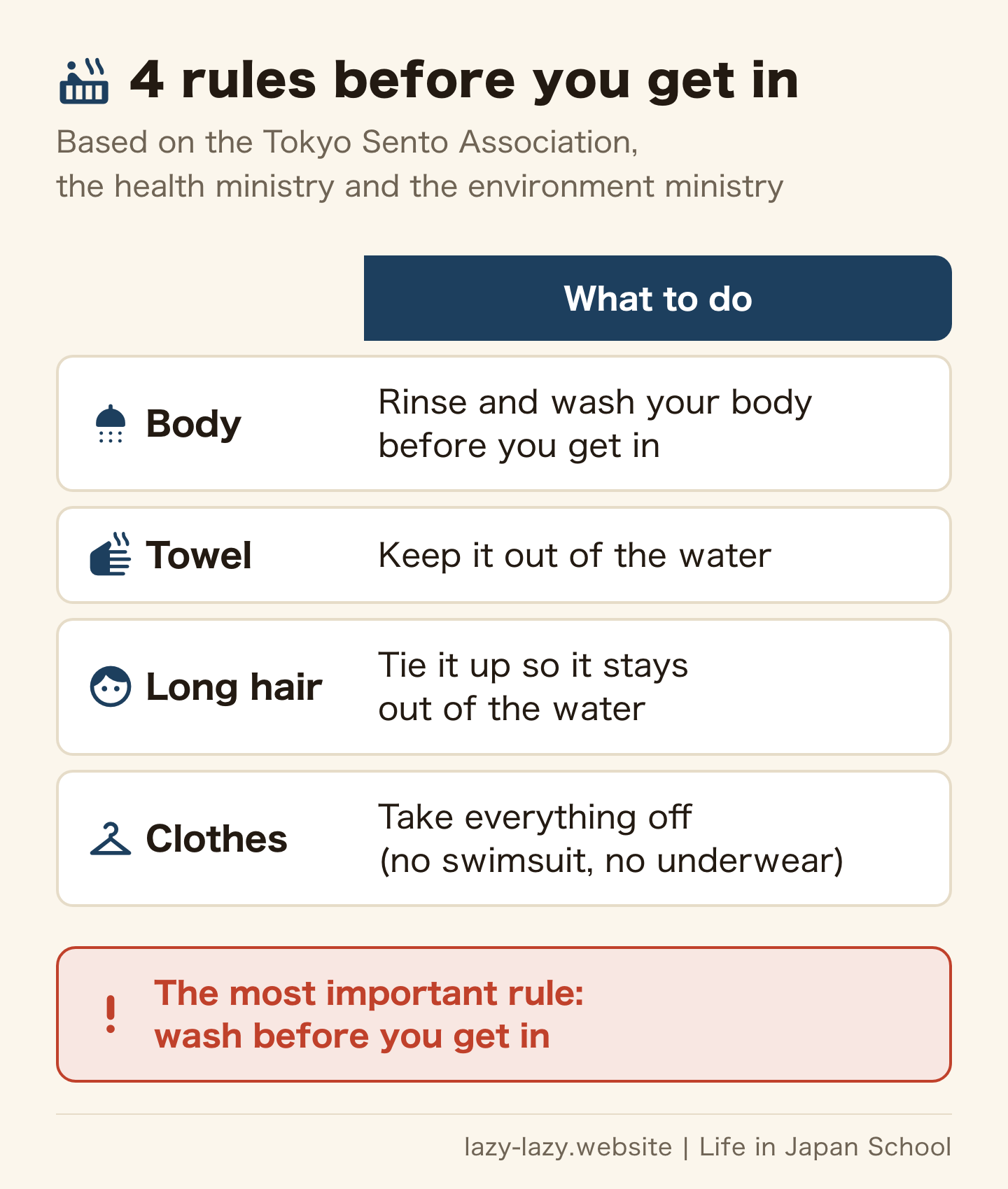
Onsen follow the same idea. The environment ministry’s onsen notice rules (2014) say to pour hot water over yourself first, starting from your hands and feet. They also say not to put towels in the bath. Pouring water over yourself like this is called kakeyu.
If your hair is long, tie it up with a band or towel so it stays out of the water. While you soak, leave your washing towel outside the bath.
How to use a sento: 6 steps for your first visit
First-timers usually get stuck at the entrance and in the changing room. Where do you pay? Where do your clothes go? Here are the steps, based on the Tokyo Sento Association’s guide.
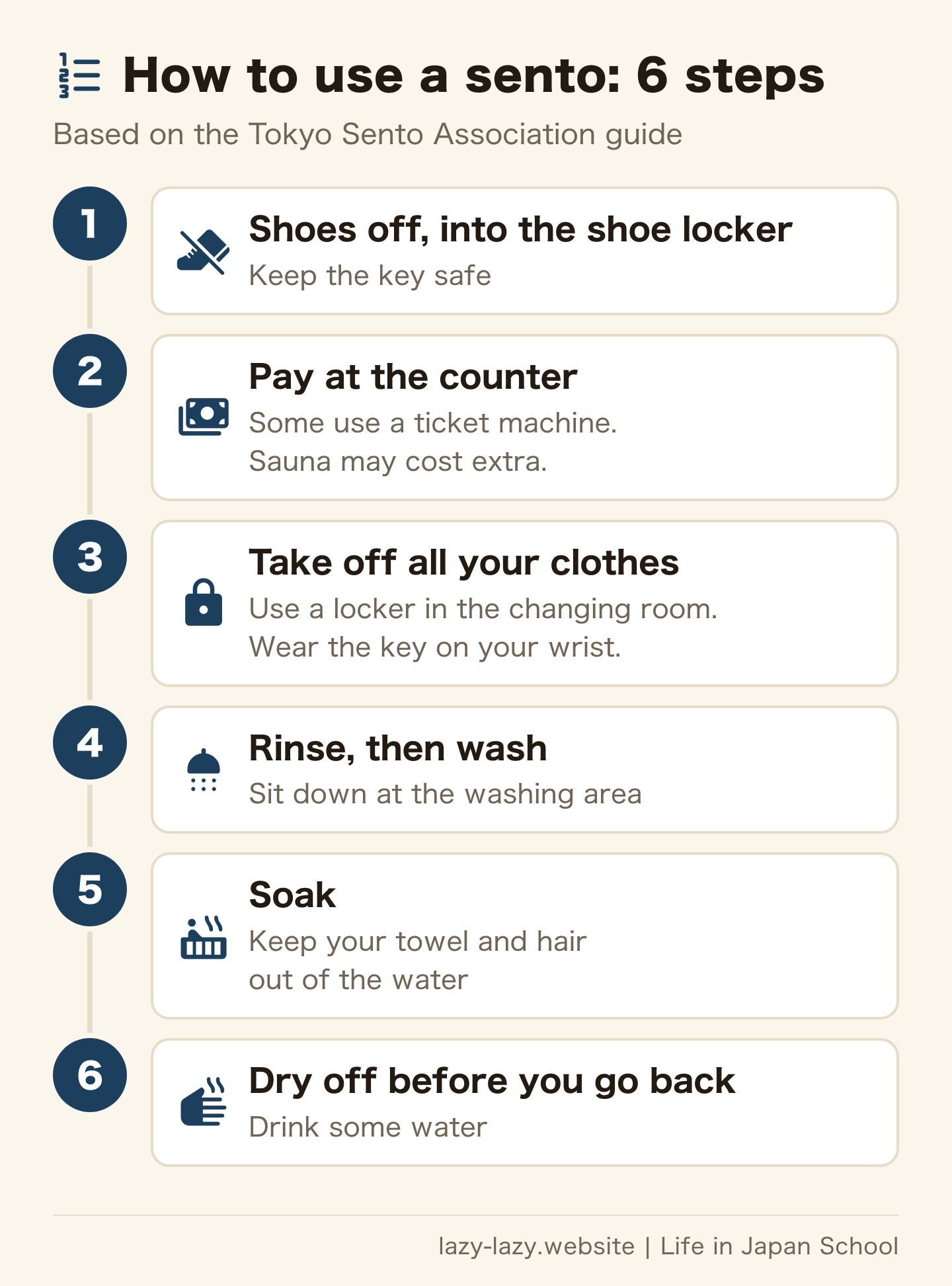
- Take off your shoes and put them in the shoe locker. Take the key with you.
- Pay at the counter. Some sento use a ticket machine instead.
- Take off all your clothes in the changing room. Lock your locker and wear the key on your wrist.
- In the bathroom, rinse yourself first. Sit down at the washing area and wash.
- Get in the bath. Keep your towel and hair out of the water.
- Dry yourself before you go back to the changing room. This keeps the floor dry.
Some sento have a bandai, a raised counter for paying the fee. At most of these, the entrance itself is split by gender. Check the 男 (men) and 女 (women) signs on the curtain or door.
If the bath is too hot, do not add cold water on your own. The association says to ask the people in the bath first. Leaving a shower running can also get you a warning (sento Q&A, in Japanese).
What to wear in a Japanese public bath: nothing
In a shared bath, you wear a swimsuit. In your home country, that may be normal. In Japan, you bathe at a sento with no swimsuit. No underwear either.
The Tokyo Sento Association’s English guide says swimsuits and underwear cannot be worn. Its Japanese page says going in with your underpants on is not allowed. Put all your clothes in the locker. Take one small towel into the bathroom.
Men and women bathe separately. The English guide says to bring the small towel for washing. That towel stays out of the water too.
Onsen and sento with tattoos: rules differ, so check first
Each facility decides whether people with tattoos can bathe. Some facilities turn away people with tattoos. Before your first visit, check the facility’s website for its tattoo rule. If it says nothing, call or email and ask.
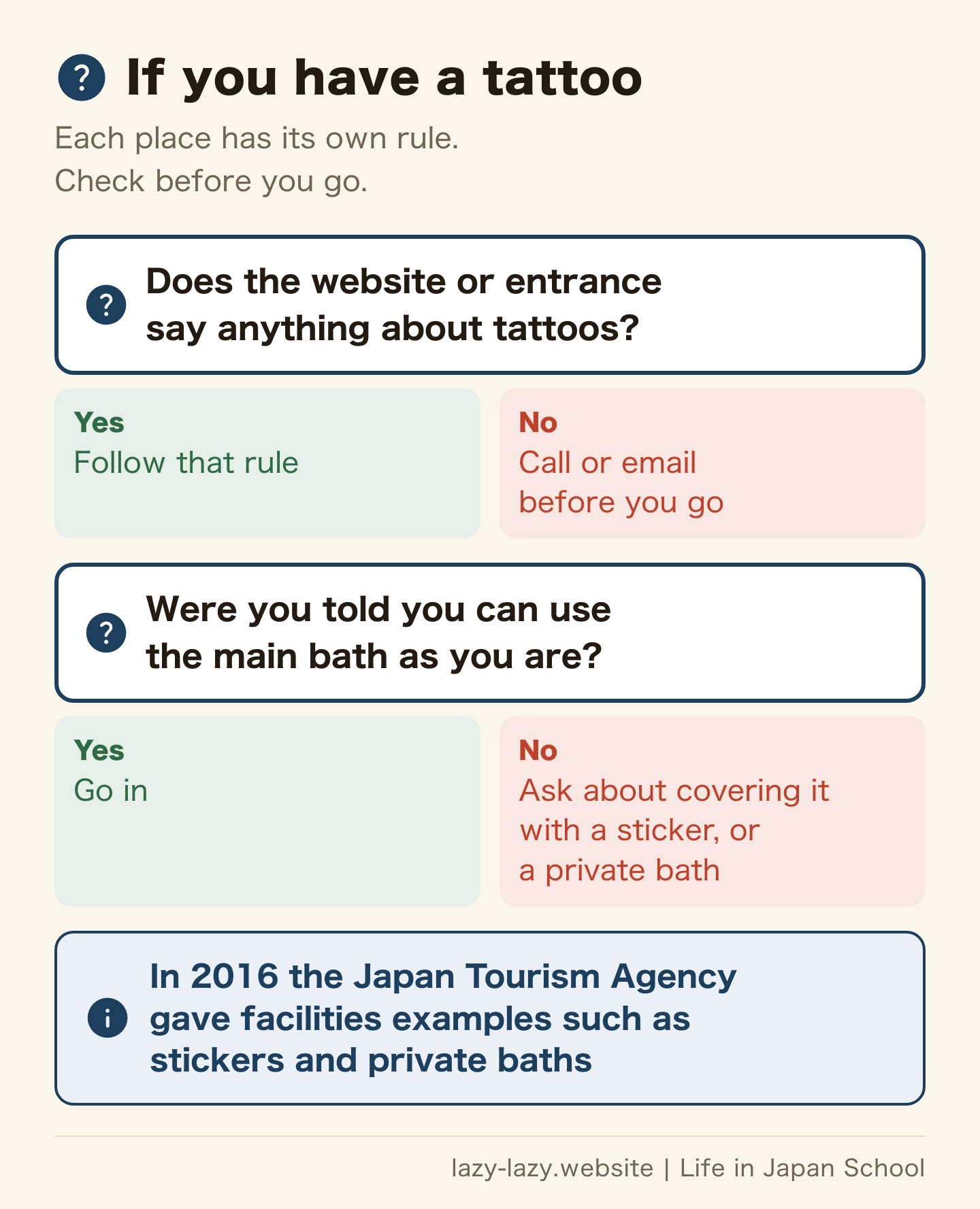
The government has a view on this. In March 2016, the Japan Tourism Agency sent an office notice to hotel, ryokan and onsen associations (in Japanese). It says refusing someone only because of a tattoo is not appropriate. The health ministry asked local governments to pass this on to bathhouses.
But the notice is about foreign tourists. It asks facilities to think about how to respond. It is not a promise that you can get in. Each facility still makes its own rule. The agency gave these examples:
- Cover the tattoo with a sticker so others cannot see it (a clean bathing garment is another idea)
- No special step for a tattoo if it is small (palm-sized, for example) and does not intimidate others
- Bathe at quieter times, with fewer families
- Use a private bath, or a hotel room with its own bath
Whether covering it is enough is also up to the facility. Do not cover it with tape on your own, then walk in; ask first (this is our advice). If you are told no, do not argue. Ask if there is another way. Two questions are enough: “Can I go in if I cover it with a sticker?” and “Do you have a private bath?” For an onsen hotel, check its website before you book.
Sento price in Tokyo: 600 yen, with limits set by each prefecture
Sento fees have an upper limit. Under a price control law, each prefectural governor sets it (sento Q&A). Each sento sets its actual fee within that limit (Osaka Prefecture).
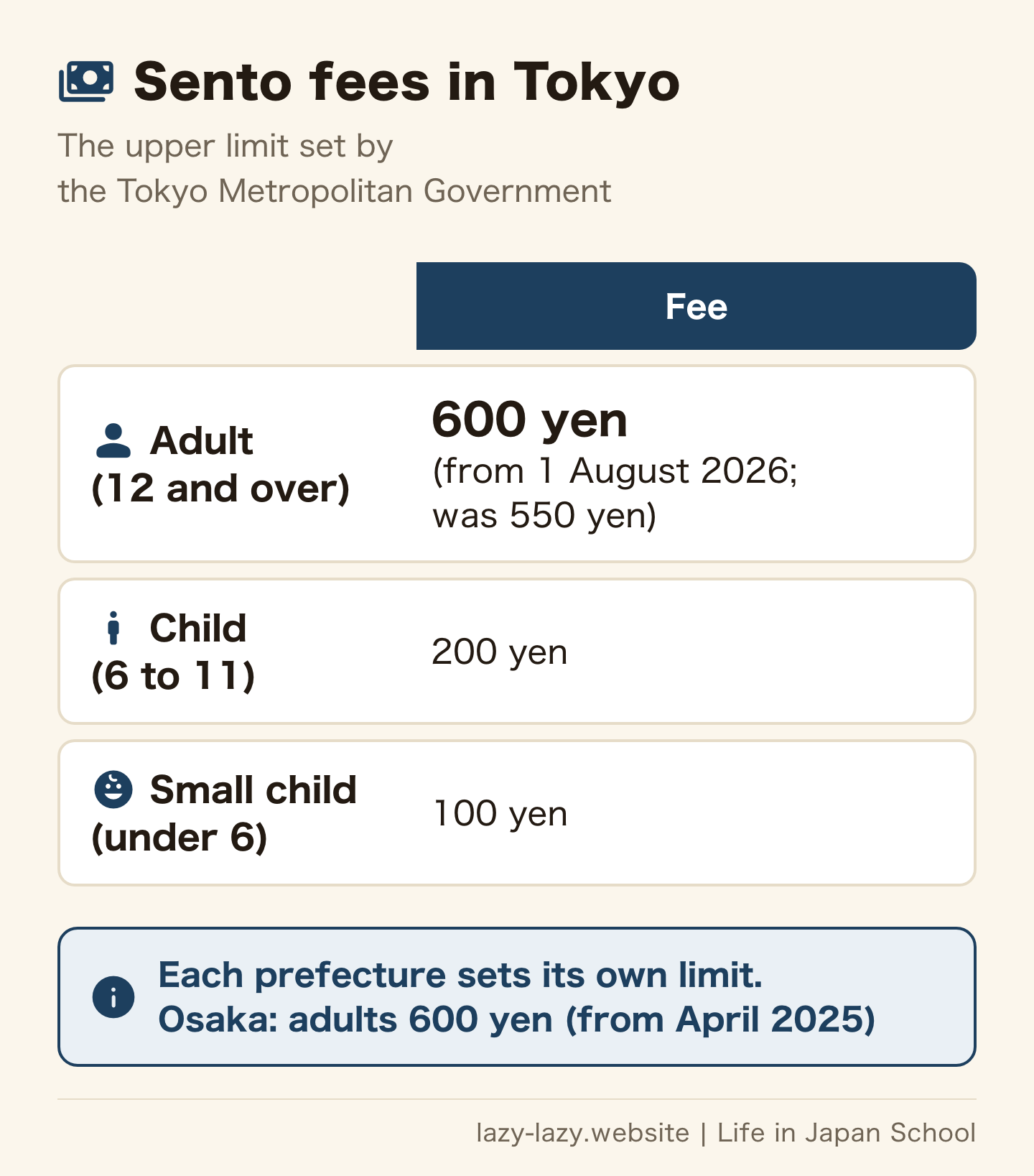
Tokyo set a new limit on 21 July 2026 (Tokyo Kurashi WEB, in Japanese). From 1 August 2026, a Tokyo sento costs:
- Adult (12 and over): 600 yen (was 550 yen)
- Child (6 to under 12): 200 yen
- Small child (under 6): 100 yen
Watch how age is counted. At 12, you pay the adult fee. The association’s fee notice calls the child band “primary school children”. The small child band is children not yet in school.
Other prefectures set different amounts. Osaka Prefecture raised its adult limit to 600 yen on 1 April 2025. For your area, check your prefecture’s page or the sign at the entrance.
Some sento charge extra for the sauna. Some let preschool children in free. If unsure, ask when you pay. The limit covers sento under the price control law (Tokyo Kurashi WEB). Super sento and day-use onsen are outside it. Their prices differ by facility.
If you are using a sento because your water heater broke, find out who pays for the repair first. Our guide on who pays when the AC or water heater breaks also covers your rent while you wait.
What to bring to a sento: one small towel
The Tokyo Sento Association suggests packing what you use in your bath at home. A bath towel, a small towel, soap, shampoo and conditioner.
You can also go with nothing. Most sento sell small soap, small shampoo and towels. Some now offer shampoo and body soap for free. For a first visit, one small towel for washing is enough.
Do not bring valuables or a lot of cash. Where there are baskets instead of lockers, leave valuables at the counter. With a locker, keep the key on your wrist.
Drink some water afterwards. The association says to drink water both before and after your bath.
Until what age can a child use the opposite-sex bath? Age 7 in Tokyo
If you bring a young child, there is an age limit for using the bath of a parent of the other sex. The national guide is the health ministry’s hygiene guideline, revised in December 2020. It says “roughly age 7 and over” should not bathe with the opposite sex.
The real age comes from local ordinances. Tokyo’s ordinance does not cover the 23 wards, Hachioji or Machida. They have their own. From 1 January 2022, Tokyo’s ordinance bans mixed bathing from age 7. Before, the age was 10. For all sento in Tokyo, the Tokyo Sento Association says children aged 7 and over cannot use the opposite-sex bath (sento Q&A).
For example, in Tokyo a 7-year-old boy cannot go into the women’s bath with his mother. Other prefectures may use a different age. Tokyo itself used age 10 until 2021. In some areas, you may share the bath with a primary-school child of the other sex. When you travel, ask at the counter before you go in.
How to use an onsen safely: read the notice, skip it after alcohol
Onsen facilities post a notice on how to bathe safely. The hot spring law requires this notice. The environment ministry’s notice rules include these points:
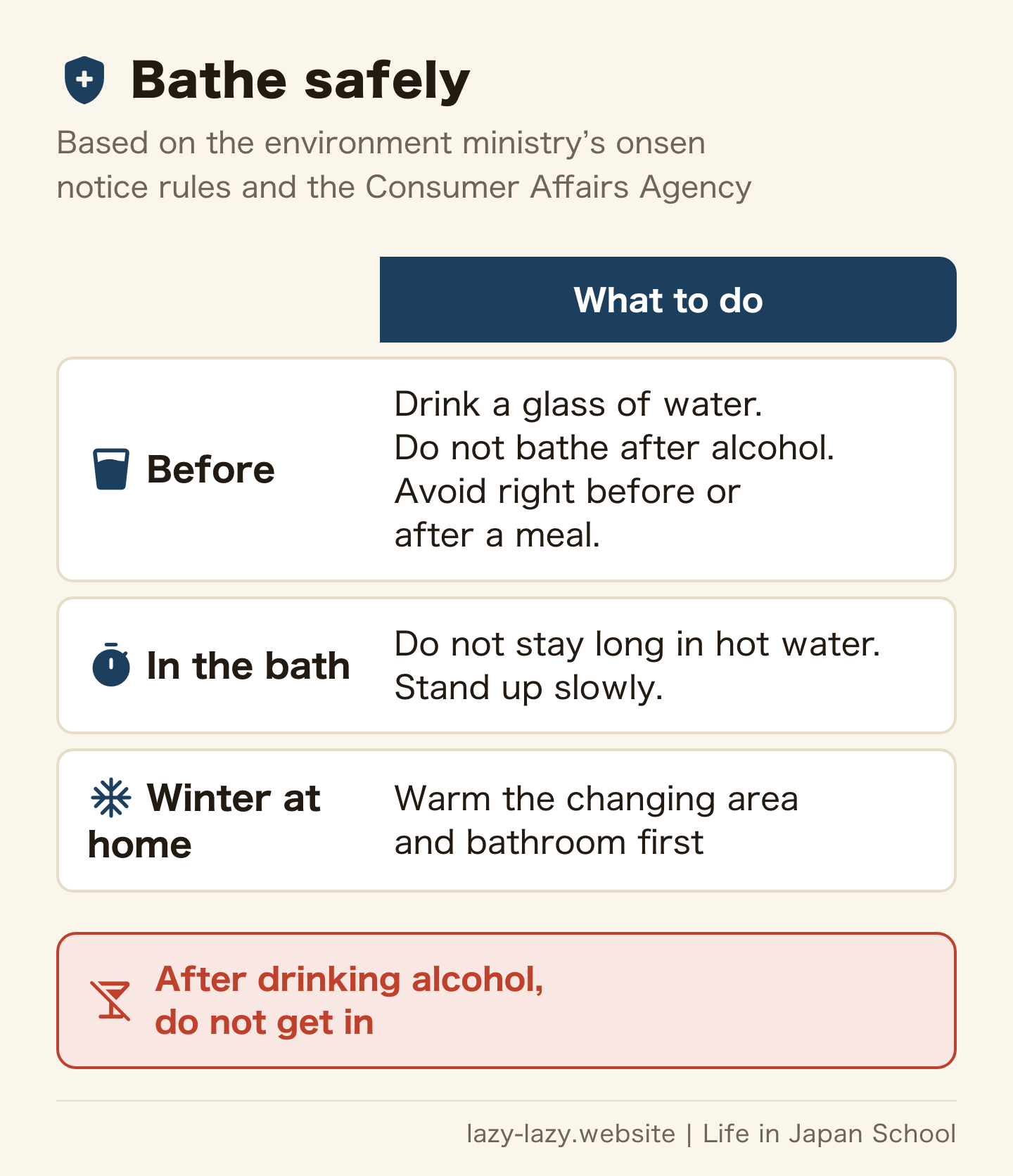
- Do not bathe right before or after a meal, or after drinking alcohol. Never bathe drunk.
- Drink about a glass of water before you get in.
- At first, stay in for 3 to 10 minutes, depending on the water temperature.
- Get out slowly, so you do not feel faint.
- If you feel dizzy or sick, ask someone nearby for help. Keep your head low, get out slowly and lie down.
The same idea applies at a sento. The Tokyo Sento Association suggests 5 to 10 minutes in a hot bath and about 20 minutes in a warm one. The health ministry’s guideline tells bathhouses not to let heavily drunk people bathe. If you are very drunk, you may be turned away at the door.
Planning an onsen trip with friends? A night bus or the Seishun 18 ticket can cut the travel cost. Compare the options in our guide to cheap travel in Japan.
Bathing in winter: big temperature gaps and long soaks
In winter, temperature gaps make bath accidents more likely. The Consumer Affairs Agency published a warning in December 2025 (in Japanese). In 2024, 7,776 people drowned in a bathtub. Of them, 7,363 were 65 or older, about 95%.
The agency gives two causes. Moving from a warm room to a cold changing area makes blood pressure change fast. A long soak in hot water raises body temperature and can make you lose focus.
The warning is for older people. Still, anyone can follow three points: no bath after alcohol, no long soaks in hot water, and stand up slowly. At home, warm the changing area and bathroom before you bathe. For heating tips and costs, see our guide to winter electricity bills.
What happens if you break the rules? You may be warned or refused
What if you dip your towel or skip the wash? The association’s guide says staff or other bathers may tell you (sento Q&A). If that happens, just fix it then and there.
A facility can refuse you entry. The health ministry’s guideline tells bathhouses not to let in heavily drunk people. The same goes for people with an infection that can spread to others through the bath, or with diarrhoea. You also need to follow each facility’s tattoo rule.
If someone corrects you and you do not understand, say: “Sumimasen, hajimete desu. Dou sureba ii desu ka?” (Sorry, it is my first time. What should I do?). For manners on trains and buses, see train and bus etiquette in Japan.
Which one are you?
- Going to a sento for the first time: today, pick the sento and put one small towel in your bag.
- You have a tattoo: today, check the tattoo rule on the sento or onsen website. If it says nothing, call or email.
- Your hair is long: today, put a hair band in your bag with the towel.
- Bringing a primary-school-age child: today, compare your child’s age with the local age limit. Decide which bath they will use.
Frequently asked questions
Q. Do I need to bring a towel to a sento?
One small towel for washing is enough. If you forget it, most sento sell them. Keep the towel out of the water.
Q. Can I wear a swimsuit in a sento?
No. The Tokyo Sento Association says swimsuits and underwear cannot be worn. Put all your clothes in the locker.
Q. Can I use a sento or onsen with a tattoo?
It depends on the facility. Check its website before you go, and call if it says nothing. If you are told no, ask about covering it with a sticker or using a private bath.
Q. How much is a sento in Tokyo?
From 1 August 2026: adults (12 and over) 600 yen, primary school children 200 yen, under 6 100 yen. This is Tokyo’s upper limit. Some sento charge extra for the sauna.
Q. Until what age can a child use the opposite-sex bath?
For sento in Tokyo, the Tokyo Sento Association says children aged 7 and over cannot. Tokyo’s ordinance (outside the 23 wards, Hachioji and Machida) also uses age 7. The national guide says “roughly age 7 and over”. Other prefectures may differ, so ask at the counter.
Q. Can I bathe after drinking alcohol?
No. The environment ministry’s onsen notice rules say to avoid bathing after alcohol. Facilities may also refuse people who are very drunk.
Summary
At a sento or onsen, wash before you get in. Keep your towel and long hair out of the water, and wear nothing. Tattoo rules differ by facility, so check the website first. A Tokyo sento costs 600 yen for adults from 1 August 2026. For sento in Tokyo, the association says children aged 7 and over cannot use the opposite-sex bath. Do not bathe after alcohol.
That is all there is to it. Today, check your sento’s tattoo rule online and put a small towel in your bag. If you plan to visit an onsen further away, read our guide to cheap travel in Japan next. It makes the trip easier to plan.
Official sources: Tokyo Sento Association, how to use a sento (Japanese) / Tokyo Sento Association, sento Q&A (Japanese) / Tokyo Sento Association, fee notice (Japanese) / Tokyo Sento Association, How to enjoy Sento / Tokyo Kurashi WEB, bath fee upper limit (21 July 2026) / Osaka Prefecture, bath fee upper limit / Tokyo Metropolitan Government, mixed bathing age from 1 January 2022 / Ministry of Health, Labour and Welfare, revision of the public bath hygiene guideline (2020) / Ministry of Health, Labour and Welfare and Japan Tourism Agency, bathing by foreign tourists with tattoos (2016) / Ministry of the Environment, onsen notice standard (2014) / Consumer Affairs Agency, accidents among older people at year end (2025) (all checked on 23 November 2026).
Related reading
Found this useful? Share it
Send it to a friend who lives in Japan.
WHO WROTE THIS
mori
Japanese. I read the ministries’ own notices, orders and Q&As in the original, and I start from what my Nepalese and Sri Lankan friends in Japan actually ran into. I do not write about what I have not checked or been told.
What this site can and cannot do →Looking for something else?
You may use the figures in this article, including commercially, if you credit this site with a link. How to use our figures