This article contains affiliate links.
Last updated: July 2026 (covers the 2026 rule changes)
In short
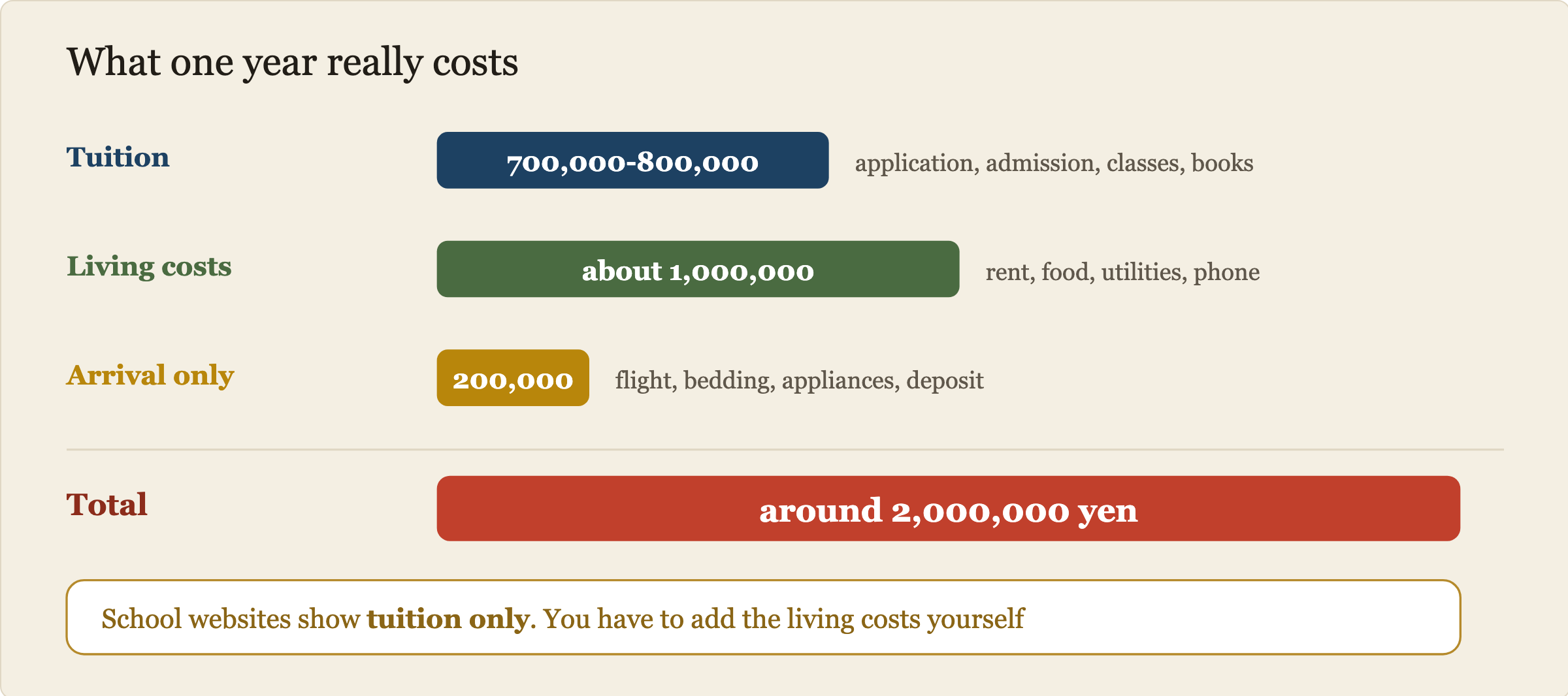
- One year at a Japanese language school costs about 2,000,000 yen once you add living costs. Tuition alone is only 700,000 to 800,000.
- Having the money is not enough. Immigration looks at how you saved it. This is where applications fail.
- From 2026 you must prove Japanese ability. New applicants are covered from the October 2026 intake.
- Since April 2026 your part-time work is reported through your school – employer name, duties and daily hours, every three months.
- Attendance below 80 percent in a month triggers formal guidance, and poor attendance can cost you your visa renewal.
A Japanese language school (nihongo gakko) is an accredited institution for learning Japanese, and studying at one is what the Student visa is for. This guide is written for people who have not arrived yet: what it really costs, and what changed in 2026.
What one year actually costs
Tuition runs around 700,000 to 800,000 yen a year. Total cost, once you include living expenses, lands near 2,000,000 yen. Living costs are roughly the same size as tuition, which is the part school websites do not show you.
Short courses are a different question. A four week course costs around 100,000 yen including admission, classes and materials. That is a reasonable way to see Japan before committing. Be aware that short courses usually do not come with a Student visa, which means you cannot work part time.
Applications fail on where the money came from, not the amount
This is the part almost nobody explains. Immigration does not just check a number in a bank account. They check where that money came from, and whether it will keep coming.
To get a Student visa you first need a Certificate of Eligibility, usually called the COE. Your school applies for it at the Immigration Services Agency in Japan. Only after the COE is issued do you apply for the visa itself at the embassy.
With that application you submit a statement of financial support and a bank balance certificate from whoever is paying, usually a parent. There is no published figure that applies to everyone. The standard is whether the balance covers the tuition and living costs written in your own study plan. So the honest answer to “how much do I need” depends on how long you plan to study.
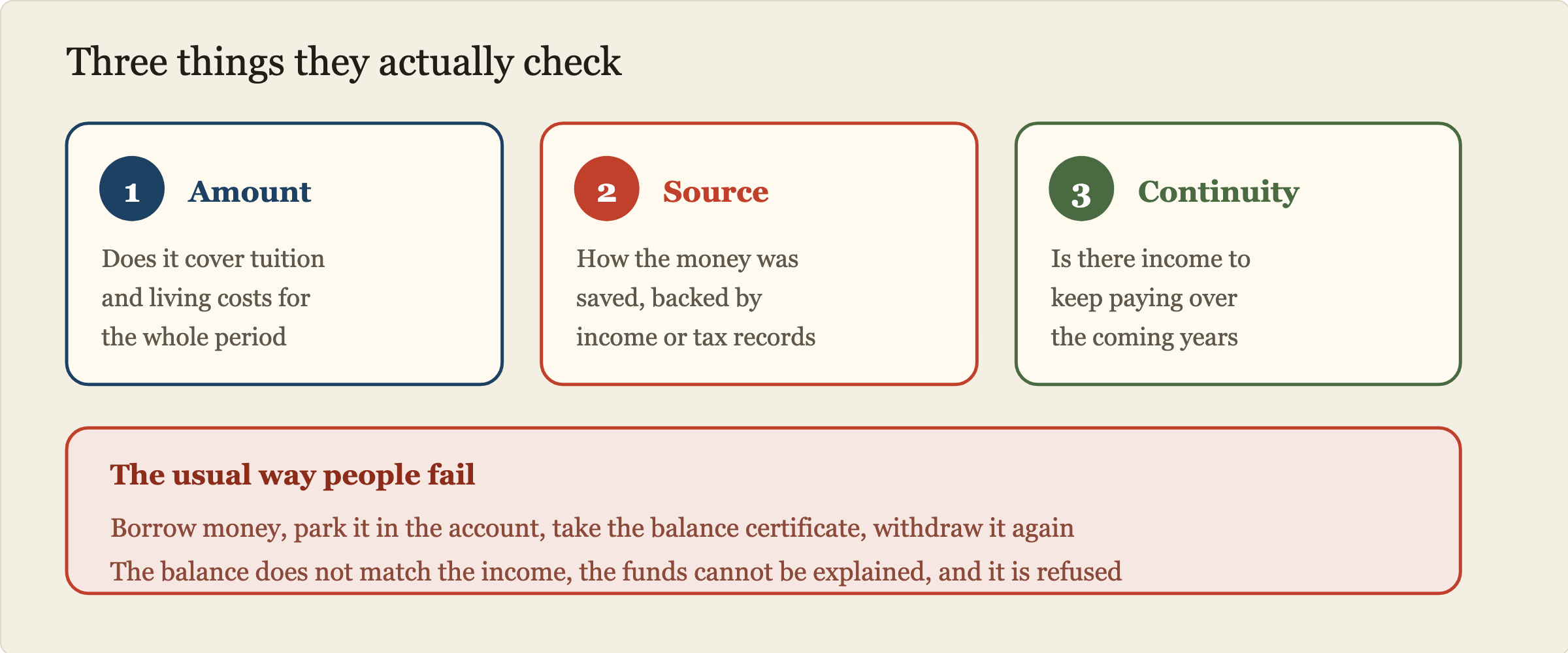
In other words, a borrowed balance does not work. Money parked in an account just long enough to print a certificate stops making sense the moment it is compared against income and tax records. Preparing is not about producing a number. It is about being able to explain the number.
Two things changed in 2026
If you are reading guides written before this year, you are missing these. Two significant changes landed in 2026.
1. You now have to prove Japanese ability
People entering a Japanese language school must demonstrate Japanese language ability when applying. The start dates differ by application type, so read this carefully.
- Coming from abroad (COE application): from the October 2026 intake
- Already in Japan (change or renewal): from 1 July 2026
There is an exception: graduates of a foreign university do not need to prove it, as before. The requirement is aimed at applicants starting from zero.
2. Your part-time work is now reported through your school
Since April 2026, schools report on students’ part-time work in a defined way. Every three months you declare the employer name, what the work is, and your daily hours.
The 28-hour weekly limit is not new. What is new is visibility. Two jobs adding up to more than 28 hours now surfaces far sooner than it used to. Our guide to part-time work and the 28-hour rule covers how the limit is counted.
The 80 percent attendance rule is really a money problem
If your monthly attendance falls below 80 percent, your school is expected to give you formal guidance. This is not just an internal school matter. Sustained poor attendance can lead to your visa renewal being refused.
Here is how it connects to money. Students take on more shifts to cover tuition and rent, then start missing class. The work that was supposed to fund the study replaces the study, and the visa goes last. Getting the 2,000,000 yen figure right before you come is what prevents that sequence.
What costs money the week you arrive
Beyond the flight and tuition, some costs land immediately. Miss these and your first month is painful.
- Housing deposits: key money, deposit and guarantor fees typically total three to five months of rent (how renting works in Japan)
- A phone number: in Japan you cannot open a bank account or apply for a part-time job without one
- Money from home: if your family will send funds, decide the method before you fly
Get the transfer method wrong and you lose a few thousand yen every single time. Over a year of regular transfers that adds up to real money. Services like Wise that use the real exchange rate compare very differently to bank wires, and we put the actual numbers side by side in our money transfer comparison. Decide this with your family before departure.
For the phone, the trick is choosing a carrier that does not require a Japanese credit card. New arrivals cannot get one yet, and this is where people get stuck. Conditions for Rakuten Mobile and the other options are in our SIM comparison.
Frequently asked questions
Q. How much do I need in the bank?
A. There is no published figure that applies to everyone. The test is whether the balance covers tuition and living costs for your whole study period. For one year, around 2,000,000 yen is a working reference, but it moves with the school and the city, so confirm with the school you are applying to.
Q. Is a parent’s balance certificate enough on its own?
A. Often not. Alongside the balance you may be asked for a year of income records or tax certificates showing how the money was accumulated. Rather than rushing to produce a balance certificate, check first that the balance is consistent with the income behind it.
Q. Can I study here with no Japanese at all?
A. From the October 2026 intake you must prove Japanese ability. Graduates of a foreign university are exempt. Ask your school which category you fall into.
Q. Can I pay tuition with part-time work?
A. Not realistically. Students are capped at 28 hours a week, which at 1,100 yen an hour is around 120,000 yen a month, and living costs absorb almost all of it. Do not build a plan where part-time work pays the tuition. That plan is what pushes attendance down and puts the visa at risk.
Q. Is a short course a cheap way to try?
A. Four week courses run around 100,000 yen. But they usually do not carry a Student visa, so you cannot work. If you intend to switch to a long course anyway, applying for the long one from the start means less paperwork.
Summary
A year at a Japanese language school costs around 2,000,000 yen once living costs are included. The figure on the school website is tuition only. Add the rest yourself.
What the application really turns on is not the size of the balance but whether it can be explained. Borrowed money placed in an account temporarily does not pass. Build the funds slowly, in a way that matches the income behind them.
2026 brought two changes: proof of Japanese ability and reported part-time work. Preparing from last year’s information will leave you short at the application stage. Ask your school for the current document list.
Related guides
Found this useful? Share it
Send it to a friend who lives in Japan.
Beyond tuition, the laptop is the item where the price swings most.
Buying a Laptop in Japan →WHO WROTE THIS

mori
Japanese. I read the ministries’ own notices, orders and Q&As in the original, and I start from what my Nepalese and Sri Lankan friends in Japan actually ran into. I do not write about what I have not checked or been told.
What this site can and cannot do →Looking for something else?