Checked on 24 September 2026 against the Japan Pension Service pages on adding dependents, family living overseas and the new rule for ages 19 to 22, Kyokai Kenpo’s guidance, the Ministry of Health, Labour and Welfare’s notice, and the Health Insurance Act and National Pension Act on e-Gov.
The short answer
- If you are on your company’s health insurance, family members you support can join it as your dependents and pay no premium. Nationality is not a condition.
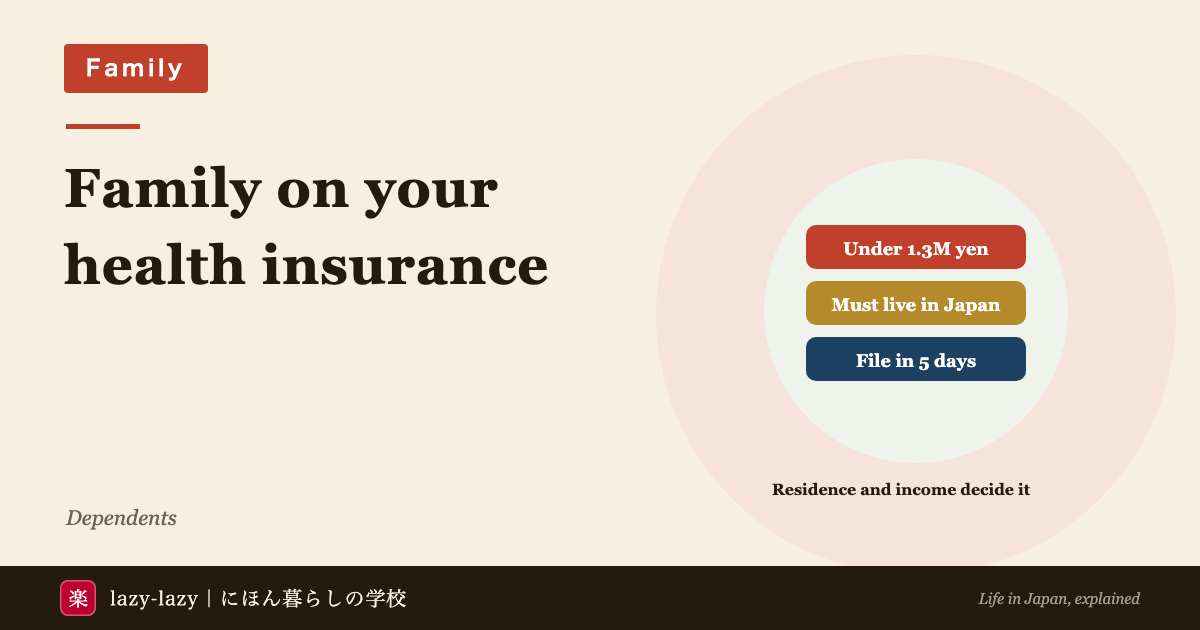
- Three conditions: they are registered as living in Japan; their yearly income is under 1.3 million yen (1.5 million at ages 19-22, 1.8 million at 60+); and it is under half of yours if you live together, or less than you send them if you live apart.
- Family who live in your home country cannot, as a rule, be added — since April 2020. This is where it differs from the tax dependent.
- File through your employer within 5 days. A spouse aged 20-59 also becomes a Category 3 member of the National Pension on the same form, and pays no pension premium.
- A spouse on a Dependent visa who works the full 28 hours a week goes over 1.3 million yen at most wages. 28 hours is the immigration line; the dependent line is about income.
Knowing this, you can fill in the dependent form your employer hands you and know on the spot who can go on it and who cannot. Before your spouse starts a part-time job, you can also work out how much a month they can earn and stay on.
Your first week at a new job. HR hands you a form: “Will you be adding family as dependents?” Your wife is here with you on a Dependent visa. Your parents are back home, and you send them money every month. Can you write them down too? A Japanese colleague says, “Under 1.3 million yen, it’s fine.” But nobody knows what happens when the parents live abroad. A Japanese employee’s family usually lives in Japan.
- What is dependent health insurance in Japan?
- Who qualifies as a dependent? The 1.3 million yen rule
- Ages 19 to 22: under 1.5 million yen since October 2025
- Can family living abroad be on my health insurance?
- Dependent visa and health insurance: what if my spouse works 28 hours?
- How do I add a dependent? Through your employer, within 5 days
- What is a Category 3 insured person in Japan?
- How is this different from the tax dependent?
- How much does it cost?
- What if I file late, or forget to take someone off?
- What if income goes over 1.3 million yen for a short time?
- Which one are you?
- FAQ
- Summary
- Related reading
What is dependent health insurance in Japan?
Company health insurance (Kyokai Kenpo or a company health insurance society) has a slot for people other than you: hifuyōsha, “dependents”. Being supported by someone is fuyō in Japanese, which is why people call it “being on your fuyō”. Article 3(7) of the Health Insurance Act sets it up: family members who live mainly on your income can join your insurance.
Adding them does not raise the health insurance taken from your pay. Your premium is a rate multiplied by your pay band (standard monthly remuneration), not by the number of people covered. You can check that line on your own numbers with how to read a Japanese payslip.
“Dependent” here covers two things: a health insurance dependent, and, for a spouse only, a Category 3 member of the National Pension. The two go on one form.
One catch: only company health insurance has dependents. National Health Insurance covers every registered resident individually, and the head of the household pays for everyone (National Health Insurance Act, Articles 5 and 76). If you are a student on National Health Insurance, there is no dependent slot to put your family in.
Who qualifies as a dependent? The 1.3 million yen rule
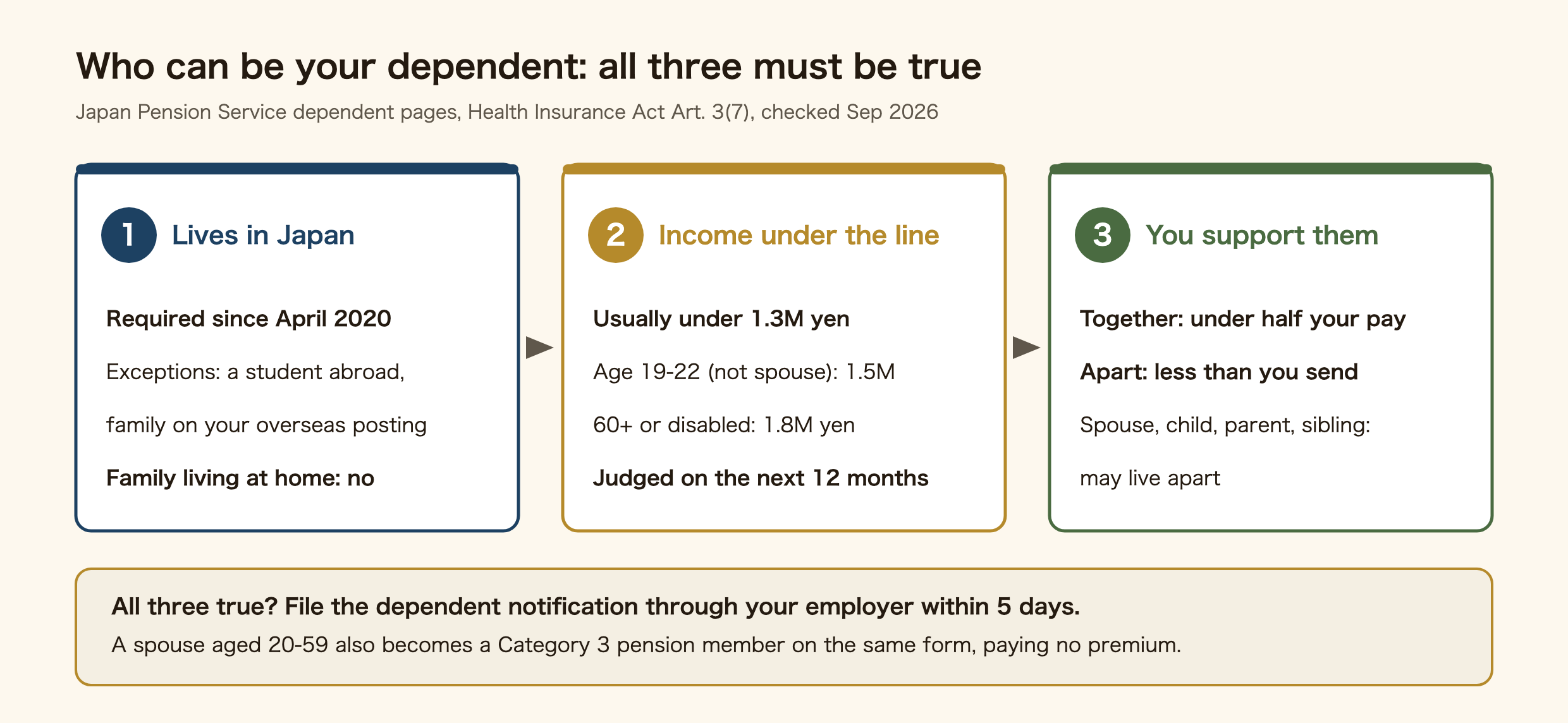
The Japan Pension Service sets out the conditions: a resident registration in Japan, living mainly on your income, and this income line.
| Family member | Yearly income must be |
|---|---|
| Most people | Under 1.3 million yen |
| Aged 19 to 22 (not a spouse) | Under 1.5 million yen (from October 2025) |
| Aged 60 or over, or with a disability | Under 1.8 million yen |
On top of that line comes a comparison with you. If you live together, their income must be under half of yours. If you live apart, it must be less than what you send them. “Disability” here means, in the ministry’s notice, roughly the level that would qualify for a disability employees’ pension.
The trap is the word “yearly”. It is not last year’s income. It is what they are expected to earn over the 12 months from the day they become your dependent. From pay alone, that means about 108,333 yen a month or less; from unemployment benefit, 3,611 yen a day or less. Unemployment benefit, public pensions, sickness allowance and maternity allowance all count as income.
Since April 2026, a family member whose only income is a salary can be judged on the wage written in their employment contract, including allowances and bonuses. This does not work if the contract is shorter than a year, only says “shift-based”, or says “commuting allowance paid” without an amount.
Who can be added is fixed too. A spouse, child, grandchild, sibling, parent or grandparent can be added even if they live apart from you. Other relatives within the third degree (uncles, aunts, nephews, nieces) must live with you. If both parents work, the children go on the insurance of whoever earns more.
Ages 19 to 22: under 1.5 million yen since October 2025
From 1 October 2025, the line for family members aged 19 to 22 rose from 1.3 million to 1.5 million yen. The health ministry set this in a notice dated 4 July 2025, and it has applied since 1 October.
- Age is taken on 31 December of the year they become your dependent. If they turn 19 that year, the 1.5 million line applies for the whole year
- They do not have to be a student. Age alone decides it
- Spouses are excluded. A 19-year-old spouse still has the 1.3 million line
- From the year after they turn 22, the line goes back to 1.3 million
So a 20-year-old child living with you on a Dependent visa, expected to earn 1.4 million yen from a part-time job, can still be your dependent if the other conditions are met. The change follows a tax reform, but the tax dependent counts income differently.
Can family living abroad be on my health insurance?
Since 1 April 2020, a dependent must have an address in Japan (Health Insurance Act, Article 3(7)). The test is whether they have a Japanese resident registration.
Parents or siblings who live in your home country cannot go on your health insurance, even if you support them. The 1.8 million yen line for people over 60 is about parents registered as living in Japan.
There are five exceptions, all for people whose life is still based in Japan.
- A student studying abroad (for example, a child who lived with you in Japan and went to school overseas)
- Family going with you on an overseas posting
- Family abroad temporarily for sightseeing, rest or volunteering — not for work
- Someone who became your family (by marriage or birth) while you were posted abroad
- Anyone else judged to have their life based in Japan (case by case)
For an exception, attach a copy of the visa, a certificate of enrolment or similar. Documents in a foreign language need a Japanese translation signed by the translator.
Parents visiting on a short-term visa cannot be added either. Short-term visitors get no residence card and so no resident registration (Immigration Control Act Art. 19-3; Basic Resident Registration Act Art. 30-45). A baby born in Japan, on the other hand, is registered and can be added. Tell your employer alongside the other steps after having a baby in Japan.
Dependent visa and health insurance: what if my spouse works 28 hours?
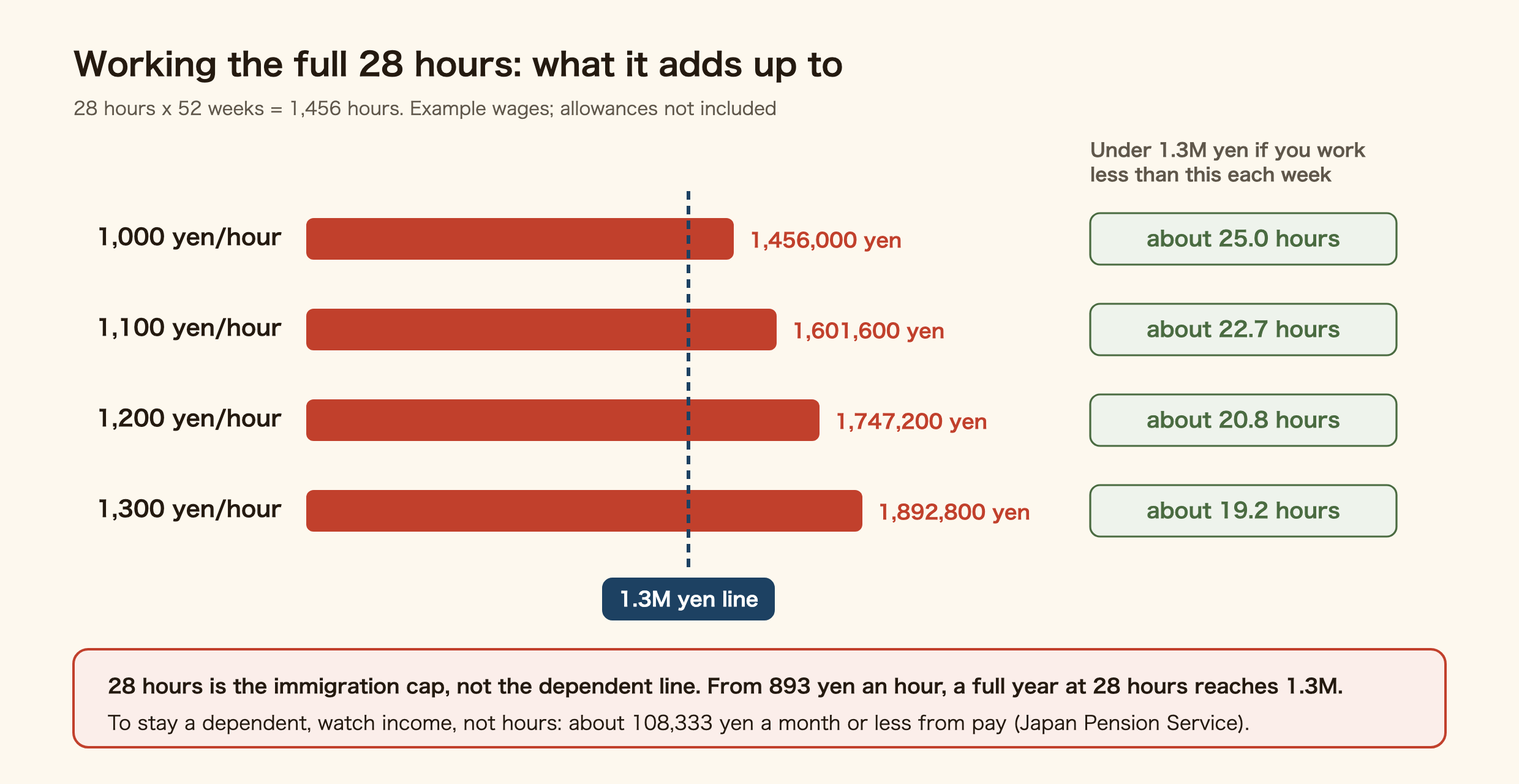
With a work permit, someone on a Dependent visa can work up to 28 hours a week. That 28 is an immigration rule. The dependent line is set by income, so the two have to be checked separately.
Run the numbers. 28 hours for 52 weeks is 1,456 hours. At 893 yen an hour or more, that alone reaches 1.3 million yen. At 1,100 yen it passes 1.6 million. If your spouse wants to stay your dependent, plan shifts that keep pay at about 108,333 yen a month or less, instead of filling all 28 hours. At 1,100 yen an hour, that means roughly 22 hours a week at most.
There is a second line. Working on a contract of 20 hours a week or more at a larger employer (51 or more insured staff, among others) means your spouse joins that employer’s health insurance and employees’ pension in their own right, and leaves your dependent status. There is also a condition of 88,000 yen a month or more, which the Japan Pension Service says is scheduled to be removed in October 2026.
How the 28 hours are counted, and what happens if they are exceeded, is in working on a Dependent visa in Japan.
If you are the student and your family came on a Dependent visa, none of this applies. Students are on National Health Insurance, which has no dependents. Each family member joins National Health Insurance individually.
How do I add a dependent? Through your employer, within 5 days
The form is the “Health Insurance Dependent (Change) Notification” (hifuyōsha idō todoke). You give it to your employer, who sends it to the Japan Pension Service (or to the health insurance society). The deadline is 5 days from the day you started supporting the person (Enforcement Regulations of the Health Insurance Act, Article 38): the day you joined the company, married, had a baby, or the day a family member stopped working.
For Kyokai Kenpo, attach:
- Proof of relationship: a Japanese family register, or a copy of your resident record if you are head of the household and live together (issued within 90 days)
- Proof of income: if they are also your dependent for income tax, your employer’s confirmation is enough. Otherwise a tax (non-)assessment certificate, a certificate of leaving a job, a pension notice and so on
- Family living apart: records of what you send them (bank transfer pages, etc.). Not needed for children under 16 or students
- Family under an overseas exception: a copy of the visa, certificate of enrolment, etc.
Foreign nationals have no Japanese family register, so if the resident record route does not fit you, ask your employer what to submit instead. When a foreign spouse becomes Category 3, a separate form giving their name in Roman letters goes in with it. Companies with their own health insurance society may use different papers and steps.
What is a Category 3 insured person in Japan?
A spouse aged 20 to 59 who becomes your health insurance dependent also becomes a Category 3 insured person of the National Pension on the same form. The Japan Pension Service says Category 3 premiums are covered collectively by everyone in the employees’ pension, so your spouse pays nothing individually.
Only a spouse can be Category 3 — not children or parents. The spouse must live in Japan, with exceptions such as going with you on an overseas posting. Even under 1.3 million yen, a spouse whose own job puts them in the employees’ pension is not Category 3. How the employees’ pension works, and what you get back when you leave Japan, is in Japan’s employees’ pension for foreigners.
How is this different from the tax dependent?
Your employer will also give you a “dependent deduction declaration” for year-end tax adjustment. That is the income tax dependent — a separate system from health insurance.
| Health insurance dependent | Income tax dependent | |
|---|---|---|
| What you gain | Family covered with no premium | Lower income tax and residence tax for you |
| Family living abroad | As a rule, no | Yes, with remittance records and other papers |
| How income is counted | Expected over the next 12 months | That calendar year (January to December) |
| Form | Dependent (change) notification | Dependent deduction declaration |
Parents at home who cannot go on your health insurance may still count for tax. There are rules, such as sending money to each person separately. The conditions and documents are in claiming overseas family as tax dependents.
How much does it cost?
A dependent’s health insurance premium is zero. A spouse’s National Pension premium is also zero while they are Category 3.
That changes when they come off. According to the health ministry, once income reaches 1.3 million yen and they leave your dependent status, National Health Insurance and National Pension premiums start. Unless they join an employer’s scheme, they register for both at the city office. National Health Insurance has a 14-day deadline; typical premiums are in the National Health Insurance guide.
What if I file late, or forget to take someone off?
You can still file after 5 days. But if the start date is 60 days or more before the office receives the form, you will be asked for extra papers showing that you were supporting the person. File the day you notice.
Your family member may need a doctor while the paperwork is going through. If they had no way to use their insurance and paid the full cost, they can apply to Kyokai Kenpo for a refund afterwards (ryōyōhi). Keep the receipts.
The opposite happens too: income rises past the line and no one tells the employer. A dependent has to be reported when they stop qualifying, not only when they start (Enforcement Regulations, Article 38(2)). Kyokai Kenpo checks every year, focusing on dependents whose taxable income was over 1.3 million yen (1.8 million at 60+). File the removal with your employer as soon as you know.
What if income goes over 1.3 million yen for a short time?
Staff shortages sometimes push hours up for a while, and yearly income goes over 1.3 million yen. If the employer certifies that the rise is temporary, the person can, as a rule, stay a dependent up to two times in a row (Kyokai Kenpo). The same applies at the 1.5 million and 1.8 million lines. Talk to the employer who would sign the certificate before the extra hours start.
Which one are you?
- Your spouse and children live with you in Japan — estimate each person’s income for the next 12 months and check it is under 1.3 million yen (1.5 million for a child aged 19-22). Ask your employer for the dependent form and hand it in within 5 days.
- You wanted to add your parents back home — drop the health insurance idea and look at the tax deduction for overseas relatives. Send money to each person separately and keep the records.
- Your spouse on a Dependent visa is starting a part-time job — decide first: stay your dependent, or get their own insurance. To stay, work out from the hourly wage the shifts that keep pay at 108,333 yen a month or less, and tell the employer.
- A dependent’s income has gone up — redo the 12-month estimate. If it crosses the line, file the removal with your employer and move them to an employer’s scheme or National Health Insurance.
FAQ
Q. Can my foreign spouse be a dependent on my company health insurance?
Yes. Nationality is not a condition. If your spouse is registered as living in Japan, earns under 1.3 million yen a year, and earns under half of what you do (or less than you send, if you live apart), they qualify. Aged 20-59, they also become Category 3 in the National Pension.
Q. Can my parents living in my home country be on my health insurance?
As a rule, no. Since April 2020, a dependent must have an address (resident registration) in Japan. Exceptions are for people whose life is based in Japan, such as a student studying abroad or family on your overseas posting. The tax dependent is a separate system.
Q. What is the income limit for a dependent child aged 19 to 22?
Under 1.5 million yen since 1 October 2025. Age is taken on 31 December of that year, and they do not have to be a student. Spouses are excluded and stay at 1.3 million.
Q. What is the deadline for adding a dependent?
File the dependent notification through your employer within 5 days of starting to support the person. You can still file late, but going back 60 days or more means extra documents.
Q. If my spouse on a Dependent visa works 28 hours a week, do they lose dependent status?
At 893 yen an hour or more for a full year, income reaches 1.3 million yen, so yes. 28 hours is the immigration cap; dependent status depends on income. From pay alone, about 108,333 yen a month or less keeps them under. Working 20 hours or more at a larger employer can also put them on that employer’s insurance.
Q. Does adding dependents raise my health insurance premium?
No. Your premium is a rate times your pay band. A dependent pays no health insurance premium, and a Category 3 spouse pays no National Pension premium.
Summary
Company health insurance lets family who live in Japan join as your dependents with no premium. The line is income under 1.3 million yen a year (1.5 million at 19-22, 1.8 million at 60+), and under half of yours if you live together or less than you send if you live apart. Family living in your home country cannot be added, as a rule, since April 2020.
File through your employer within 5 days; a spouse becomes Category 3 on the same form. If your spouse on a Dependent visa starts working, plan around the income line, not the 28 hours. Parents at home can still count on the tax side.
Official sources (Japanese): Japan Pension Service, adding family as dependents / same, family living overseas / same, new income line for ages 19-22 / same, judging income by employment contract / MHLW notice on dependents aged 19-22 / Kyokai Kenpo glossary / Kyokai Kenpo, special rules for dependents / Health Insurance Act (e-Gov). Checked on 24 September 2026. If your company has its own health insurance society, confirm the forms with your HR team.
Related reading
Found this useful? Share it
Send it to a friend who lives in Japan.
READ THIS NEXT
Japanese New Year 2026-27 →City offices close December 29 to January 3 and bank counters December 31 to January 3.WHO WROTE THIS

mori
Japanese. I read the ministries’ own notices, orders and Q&As in the original, and I start from what my Nepalese and Sri Lankan friends in Japan actually ran into. I do not write about what I have not checked or been told.
What this site can and cannot do →Looking for something else?