Checked on 23 September 2026 against the National Tax Agency’s Tax Answer pages (No.1120, 1122, 1124, 1126, 1128, 1129, 1100, 1935, 2030, 2026, 2260 and 1410), its Q&A cases and its FY2026 tax guide for households, and Yokohama City’s FAQ on the medical expense deduction.
The short answer
- The medical expense deduction (iryohi kojo) lowers your tax when the medical costs you paid in a calendar year go over 100,000 yen. Anyone living in Japan can use it, whatever their nationality.
- If your income is under 2 million yen, the threshold is 5% of your income instead of 100,000 yen, so it can work even when your costs are below 100,000 yen.
- Subtract anything paid back to you first, such as the high-cost medical expense benefit or an insurance payout. What you get back is tax, not the bill: roughly the deduction times your income tax rate, plus 10% off next year’s resident tax.
- You can include family members who share your household budget, as long as you paid. The National Tax Agency says relatives living apart still count if you regularly send them living costs.
- Your employer’s year-end adjustment does not cover it, so you file a tax return yourself. You can claim up to five years back from 1 January of the following year. Keep receipts for five years.
Knowing this, you can sort the clinic and pharmacy receipts in your wallet into “claim this year” or “not worth it” before you throw them away. You will also know whether last year’s or the year before’s costs can still be claimed.
Three trips to the paediatrician when your child had a fever. A run of dental appointments. One short hospital stay of your own. In December you add up the bag of receipts and it comes to just over 120,000 yen. You ask a Japanese colleague whether foreigners can claim the medical expense deduction. “Over 100,000 yen, I think you can.” Then you ask about the operation you paid for your mother back home, and the conversation stops. Most Japanese people’s families live in Japan.
- What is the medical expense deduction in Japan, and can foreigners use it?
- How much do medical expenses need to be? 100,000 yen, or 5% of income
- How much tax will I get back?
- Do I subtract the high-cost medical expense benefit and insurance payouts?
- What counts as a medical expense in Japan, and what does not?
- Can I include my family’s medical costs, even family living abroad?
- Self-medication tax system or the normal deduction: which is better?
- How to claim the medical expense deduction: the statement and the tax return
- Can I claim medical expenses from past years? Up to five years back
- Does the medical expense deduction lower resident tax too?
- What if I make a mistake?
- What if I cannot pay the hospital bill now?
- Which one are you?
- FAQ
- Summary
- Related reading
What is the medical expense deduction in Japan, and can foreigners use it?
It is an income deduction. When the medical costs you paid for yourself and your family in a year go over a set amount, the excess is taken off your income. Lower income means lower income tax and lower resident tax.
There is no nationality condition. What matters is whether you live in Japan. The National Tax Agency says non-residents, people with no address in Japan, can use only three income deductions: casualty losses, donations and the basic deduction. The medical expense deduction is not one of them.
In the year you arrive or leave, count only what you paid while living here. For people who return from working overseas, the National Tax Agency says the deduction is calculated on amounts paid during the period of residence. The same logic applies to the year you moved to Japan.
Employees claim it themselves with a tax return. The National Tax Agency even publishes a filled-in sample return for “a person who received the year-end adjustment and claims the medical expense deduction”.
How much do medical expenses need to be? 100,000 yen, or 5% of income
The National Tax Agency’s formula is:
(Medical costs paid in the year − amounts reimbursed) − 100,000 yen = your deduction (maximum 2 million yen)
If your total income for the year is under 2 million yen, the 100,000 yen becomes 5% of your income. The lower your income, the sooner the deduction starts.
“Income” here is not your salary. For someone with only a salary, it is employment income: salary minus the employment income deduction, shown on your withholding slip (gensen choshuhyo) as the amount after the employment income deduction. For 2026 the minimum employment income deduction is 740,000 yen. So a part-timer earning 1.5 million yen has income of 760,000 yen, and 5% of that is 38,000 yen. Anything above 38,000 yen in medical costs counts.
For 2026, a salary of about 2.97 million yen gives an income of exactly 2 million yen. If you earn less than that, work the numbers out even if your costs are under 100,000 yen.
What counts is the date you paid, not the date you were treated. Costs paid between 1 January and 31 December belong to that year, and unpaid bills belong to the year you actually pay them. If treatment runs across two years, split it by what you paid in each year.
How much tax will I get back?
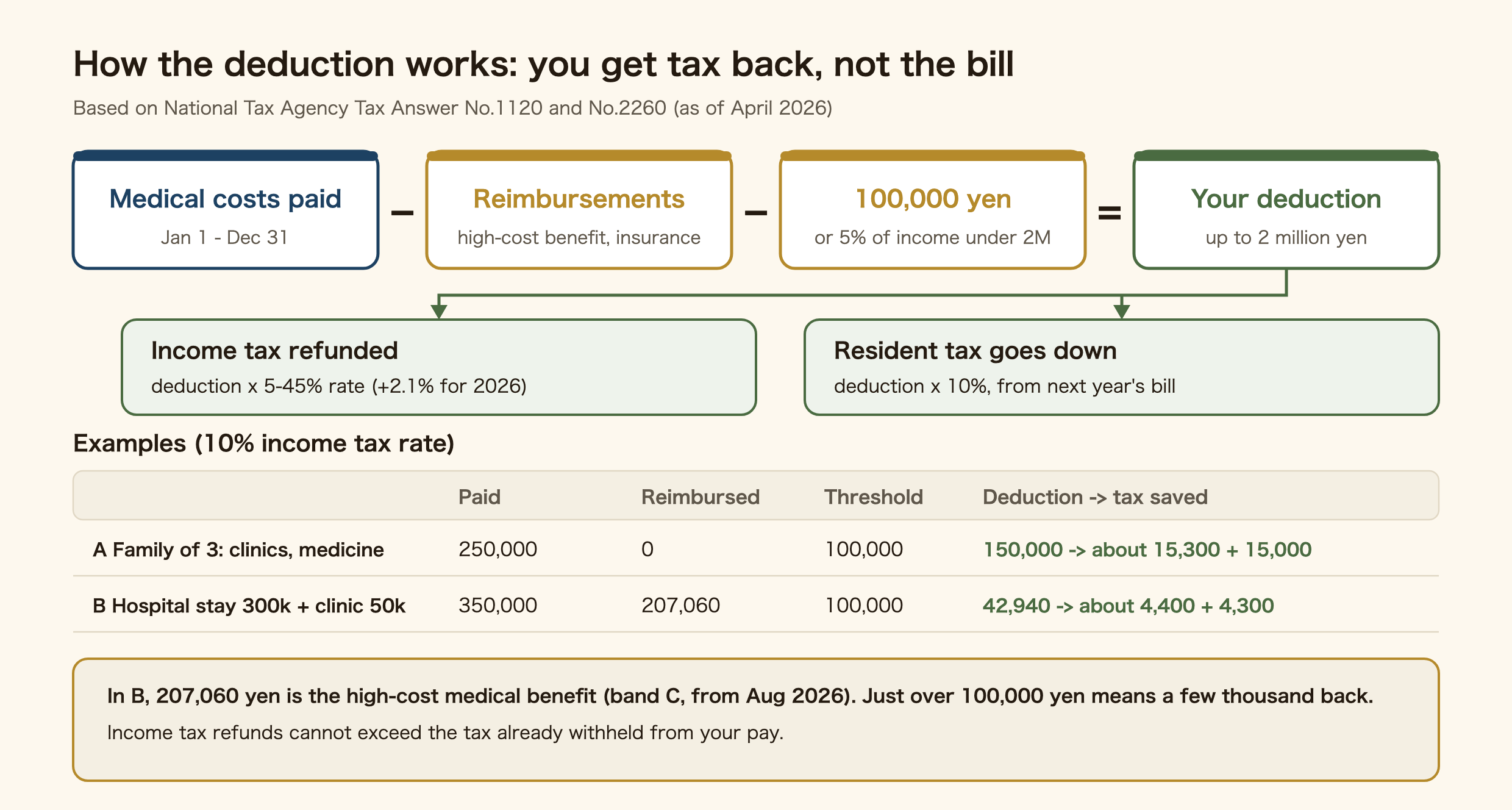
You do not get the medical bill back. You get back the tax on the deduction. Yokohama City puts it plainly: this is not a system that refunds the medical costs you paid.
| Income tax rate (taxable income) | Income tax per 100,000 yen of deduction | Resident tax |
|---|---|---|
| 5% (under 1.95 million yen) | about 5,100 yen | about 10,000 yen |
| 10% (1.95 to under 3.3 million yen) | about 10,200 yen | about 10,000 yen |
| 20% (3.3 to under 6.95 million yen) | about 20,400 yen | about 10,000 yen |
The income tax figures include the 2.1% reconstruction surtax for 2026. Resident tax on income is 10%, so a tenth of the deduction comes off next year’s resident tax bill.
Is it worth it if you are only just over 100,000 yen? At 110,000 yen the deduction is 10,000 yen. At a 5% rate that is about 510 yen of income tax and 1,000 yen of resident tax. Small. But if you are filing anyway, say for a refund after leaving a job mid-year or for furusato nozei donations, adding your medical costs to the same return takes little extra effort.
Some people get nothing back. Income tax is refunded only if tax was withheld from your pay; if the withheld amount on your slip is zero, there is no refund. And if you pay no resident tax on income, Yokohama City says the deduction has no effect and you need not declare it.
Do I subtract the high-cost medical expense benefit and insurance payouts?
Yes. Anything paid to you to cover medical costs is subtracted from what you paid. The National Tax Agency’s examples:
- From health insurance: the high-cost medical expense benefit, family medical benefits, and the childbirth lump-sum grant
- Hospitalisation benefits and similar payouts from life or medical insurance
- Compensation paid to cover medical costs, for example after a traffic accident
Say surgery and a hospital stay cost you 300,000 yen at the counter. If you are under 70 and in band C, treatment from August 2026 brings 207,060 yen back through the high-cost medical expense benefit. Only the remaining 92,940 yen goes into your medical expense deduction, along with the year’s other clinic and pharmacy costs.
An insurance payout for a hospital stay is subtracted only up to the cost of that stay. If the payout is larger, you do not subtract the rest from other medical costs. Maternity allowance paid while you are off work is not for medical costs, so it is not subtracted.
If the high-cost benefit for a December stay has not been decided when you file, subtract an estimate. If the final amount differs, correct it later: an amended return if you got too much back, or a request for correction if you got too little.
| High-cost medical expense benefit | Medical expense deduction | |
|---|---|---|
| Period counted | One month | One year (January to December) |
| What you get back | Medical costs above the monthly cap | Tax (income tax and resident tax) |
| Where to claim | City office (National Health Insurance), or Kyokai Kenpo or your health insurance society | Tax office (tax return) |
| Deadline | Two years from the 1st of the month after treatment | Five years from 1 January of the next year (refund return) |
| Hospital meals | Not covered | Covered |
What counts as a medical expense in Japan, and what does not?
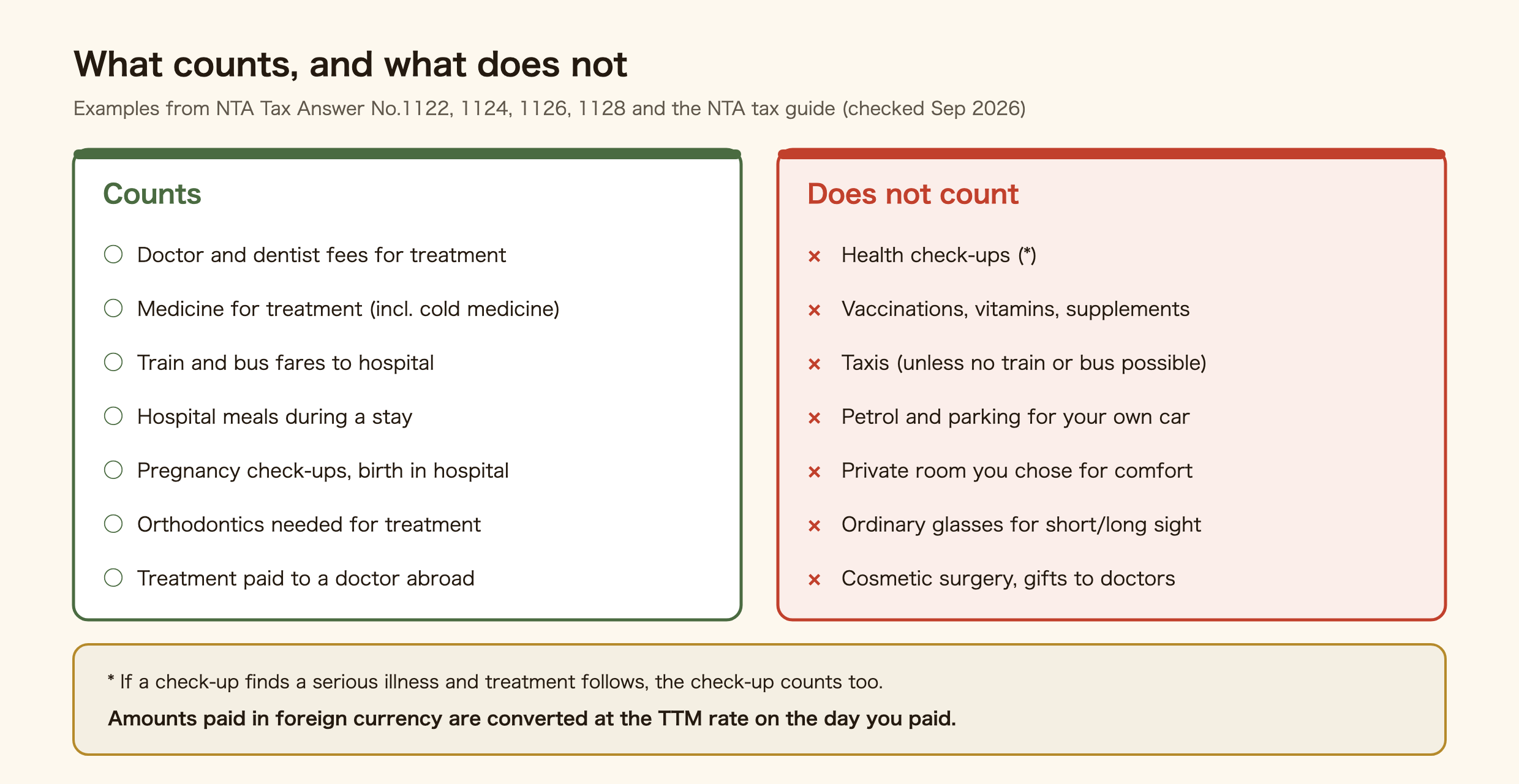
The test is whether it was for treatment. Cold medicine you bought at a pharmacy because you had a cold counts. Vitamins, supplements and vaccinations for prevention or general health do not.
The National Tax Agency’s answers on the common grey areas:
- Health check-ups: not covered, unless the check-up finds a serious illness and treatment follows
- Eyes: ordinary glasses for short or long sight are not covered; LASIK surgery is
- Teeth: treatment with gold or porcelain is covered; orthodontics for appearance is not
- Hospital stays: hospital meals are covered; takeaway food, pyjamas, toiletries and thank-you gifts to doctors or nurses are not
- Pregnancy and birth: check-ups, tests, travel to appointments and the hospital stay for the birth are covered; travel home to give birth near family is not
Train and bus fares rarely come with receipts. The National Tax Agency asks you to note the date and amount, for example in a household account book. A note on your phone does the job.
Treatment abroad counts too. The National Tax Agency says medical costs paid to a doctor in another country qualify. If you paid in a foreign currency, convert it at the TTM rate (the midpoint between the bank’s buying and selling rates) on the day you paid.
Can I include my family’s medical costs, even family living abroad?
You can include family. The deduction covers medical costs you paid for yourself or for a spouse or other relative “who shares your household budget” (seikei wo itsu ni suru). It does not matter whether they are your tax dependants. Relatives means blood relatives within six degrees, your spouse, and in-laws within three degrees.
Sharing a household budget does not mean living in the same home. Citing its basic circular, the National Tax Agency explains that relatives who live apart share your budget if you regularly send them living costs, school fees or medical costs. Its own example is a child who supports a mother living alone in their home town.
What about family in your home country? We could not find a National Tax Agency page that names medical costs for family living abroad. Two official explanations point the way:
- Sharing a household budget is judged by whether you regularly send living costs, not by living together
- Medical costs paid to a doctor abroad qualify for the deduction
If you regularly support a relative back home and you paid for their treatment, your case follows both explanations. But the deduction belongs to whoever actually paid. Treatment your family paid for with their own money is not yours to claim. Keep the record of paying the hospital, or of sending money for the treatment, together with the receipts and your regular remittance records. If you are unsure whether you qualify, ask the tax office before you file.
Claiming family abroad as tax dependants is a separate process, with its own relationship and remittance documents. That is covered in claiming overseas family as dependents.
The same rule applies to couples who both work: each person’s medical costs go on the return of whoever actually paid them.
Self-medication tax system or the normal deduction: which is better?
The self-medication tax system is a special version of the medical expense deduction. If you spend more than 12,000 yen in a year on certain over-the-counter medicines (switch OTC drugs and similar), you can deduct the excess, up to 88,000 yen. Qualifying products are marked as such on the receipt.
You must yourself have done a qualifying health activity that year, such as a health check-up or a vaccination. A workplace check-up or a flu jab counts. A vaccination your family member had does not count for you.
You can use only one: the normal deduction or the self-medication system. Once you have chosen and filed, you cannot switch later.
Work out both and take the larger. Say you paid 80,000 yen at clinics and 30,000 yen on qualifying pharmacy medicines. The normal deduction is 110,000 − 100,000 = 10,000 yen. The self-medication deduction is 30,000 − 12,000 = 18,000 yen, so self-medication wins. In a year with a hospital stay or major dental work well over 100,000 yen, the normal deduction usually wins.
How to claim the medical expense deduction: the statement and the tax return
You do not attach the receipts themselves. You attach a “statement of medical expenses” (iryohi kojo no meisaisho).
- Collect the receipts and total them by person and by hospital or pharmacy. With many receipts, the National Tax Agency’s Excel medical expense form can be loaded into its online return tool
- If your health insurer sends you a medical cost notice (iryohi no oshirase), attaching it simplifies the statement
- Make the return and statement in the National Tax Agency’s online return tool (kakutei shinkokusho to sakusei corner). Linking it to Mynaportal pulls in medical cost data for payments from September 2021
- Add what the data does not include by hand: treatment abroad, travel to appointments, and pharmacy medicines
- Submit by e-Tax, by post or at the tax office. Refunds are paid into a Japanese bank account
Bring your withholding slip, the medical receipts (or the insurer’s notice), any high-cost benefit or insurance payout notices, and your bank details for the refund. For ID, your My Number Card alone is enough; without it, you need a document showing your number, such as the notification card, plus photo ID such as your passport.
You can file from 1 January of the following year. A return that only claims a refund does not have to wait for the 16 February to 15 March filing season. If you must file anyway, for example with side income over 200,000 yen, the deadline is 15 March. The whole process is in the guide to filing a tax return in Japan.
Keep the receipts after you file. The National Tax Agency may ask to see them for up to five years from the filing deadline to check the statement.
Can I claim medical expenses from past years? Up to five years back
Yes. A refund return can be filed for five years from 1 January of the following year. During 2026 you can still file for 2021, and the last day for 2021 is 31 December 2026.
Two conditions: income tax was withheld from your pay that year, and that year’s costs went over that year’s 100,000 yen or 5% threshold. Each year is calculated separately, so you cannot add five years together into one claim.
Older years take more work. The medical cost data you can import through Mynaportal starts with payments from September 2021. Before that, use your own receipts or your insurer’s medical cost notices.
If you already filed a return for that year, you do not file again; you submit a request for correction (kosei no seikyu). After a refund return, the limit is five years from the day you filed it. If you were required to file, it is in principle five years from the filing deadline.
Does the medical expense deduction lower resident tax too?
Yes. Resident tax uses the same formula, and a tenth of the deduction comes off the next fiscal year’s resident tax on income. Resident tax is based on the previous year’s income, so medical costs you paid in 2026 lower your resident tax for fiscal 2027.
One filing covers both. Yokohama City says that filing an income tax return counts as filing your resident tax declaration.
Some people pay resident tax but have no income tax withheld. They can also declare the deduction at the tax desk of their city or ward office with a resident tax declaration and the statement of medical expenses. In Yokohama that is the ward office tax section. How resident tax works is explained in the resident tax guide.
If you claim a past year, ask your city’s tax section how that year’s resident tax will be adjusted.
What if I make a mistake?
You included something that does not count, or forgot to subtract the high-cost benefit. If you got too much back, file an amended return and pay the difference. According to the National Tax Agency, if you file the amended return yourself before the tax office notifies you of an audit, there is no understatement penalty. After a notice it is 5%, after an audit 10%, plus late-payment interest for the days that passed.
If you left something out and got too little back, a request for correction gets you the difference.
Costs without a receipt cannot be claimed. Yokohama City says the payment cannot be confirmed without one. Ask the clinic or pharmacy to reissue it, or use your insurer’s medical cost notice as proof if the payment is listed there.
What if I cannot pay the hospital bill now?
The deduction pays out only after you file the following year. It will not help with this month’s bill.
- For a hospital stay or surgery, use the high-cost medical expense benefit first. With a My Number health card, the counter stops charging at your monthly cap
- On Kyokai Kenpo, the high-cost medical expense loan lends 80% of the expected refund in advance, interest-free
- Ask the hospital cashier about paying in instalments. The free or low-cost medical care scheme for people in hardship is in the guide to seeing a doctor in Japan
Instalments count in the year each one is paid. If payments cross into a new year, split them by year.
Which one are you?
- Your family’s costs add up to more than 100,000 yen (or 5% of income under 2 million yen) — make the statement in the online tool and file a refund return from January. Today: put every family member’s receipts in one envelope.
- You were in hospital and received the high-cost benefit — check whether you are still over the threshold after subtracting it. Today: find the benefit decision notice and note the amount.
- You paid for treatment for family back home — gather proof that you paid and your regular remittance records, and ask the tax office whether you qualify. Today: save your remittance app history by year.
- You had high costs last year or earlier and never claimed — within five years, a refund return gets it back. Today: check that year’s withholding slip for a withheld tax amount above zero.
- You pay neither income tax nor resident tax — filing brings nothing back. Today: check your high-cost medical expense band instead.
FAQ
Q. Can foreigners claim the medical expense deduction in Japan?
Yes. There is no nationality condition; residents with an address in Japan can use it. Non-residents with no address in Japan cannot.
Q. How much do medical expenses have to be before I can claim?
The deduction is what is left after subtracting reimbursements and then 100,000 yen from the medical costs you paid in the year. If your income that year is under 2 million yen, subtract 5% of your income instead of 100,000 yen.
Q. How much tax do I get back?
The deduction times your income tax rate comes back as income tax, and next year’s resident tax falls by 10% of the deduction. For every 100,000 yen of deduction at a 5% rate, that is about 5,100 yen of income tax and 10,000 yen of resident tax. The medical costs themselves are not refunded.
Q. Can I include medical costs for family living abroad?
The National Tax Agency says relatives living apart share your household budget if you regularly send them living costs, and that medical costs paid to doctors abroad qualify. Only the person who actually paid can claim, so keep proof of payment and your remittance records, and ask the tax office whether your case qualifies.
Q. What do I do with the high-cost medical expense benefit?
Subtract it from the medical costs you paid. If the amount is not decided when you file, subtract an estimate and correct it later with an amended return or a request for correction.
Q. Can I claim the medical expense deduction for past years?
A refund return can be filed for five years from 1 January of the following year. During 2026 you can file back to 2021, provided income tax was withheld that year.
Summary
The medical expense deduction lowers income tax and resident tax when the medical costs you paid in a year go over 100,000 yen, or 5% of income under 2 million yen. Foreign residents use it exactly as Japanese residents do. Subtract the high-cost benefit and insurance payouts first. What comes back is tax on the deduction, not the bill itself.
Family costs can be added if the relative shares your household budget and you paid. For family back home, keep the records and check with the tax office that your case fits the official explanations. Employees file on their own, from 1 January for up to five years, and keep receipts for five years.
Official sources: National Tax Agency, Tax Answer No.1120, medical expense deduction (Japanese) / No.1122, qualifying medical expenses / No.1122 Q&A, including treatment paid abroad / No.1129, self-medication tax system / No.2030, refund returns / NTA Q&A case, medical costs for a parent living apart / NTA household tax guide, paying medical expenses / Yokohama City, medical expense deduction FAQ. All in Japanese, checked on 23 September 2026. If you are unsure whether you qualify, ask the tax office before you file.
Related reading
Found this useful? Share it
Send it to a friend who lives in Japan.
WHO WROTE THIS

mori
Japanese. I read the ministries’ own notices, orders and Q&As in the original, and I start from what my Nepalese and Sri Lankan friends in Japan actually ran into. I do not write about what I have not checked or been told.
What this site can and cannot do →Looking for something else?