This article contains affiliate links.
Last updated: August 2026
In short
- For kanji, use the drill books Japanese children use. Start at grade 1 and work up. You do not need a course built for foreigners.
- Six years of elementary school covers 1,026 kanji. JLPT N2 needs around 1,000. It is almost the same set.
- The cheapest way is to print them. Search in Japanese for “小学1年生 ドリル” and print the free worksheets. Free with a printer, about 10 to 20 yen a sheet at a convenience store.
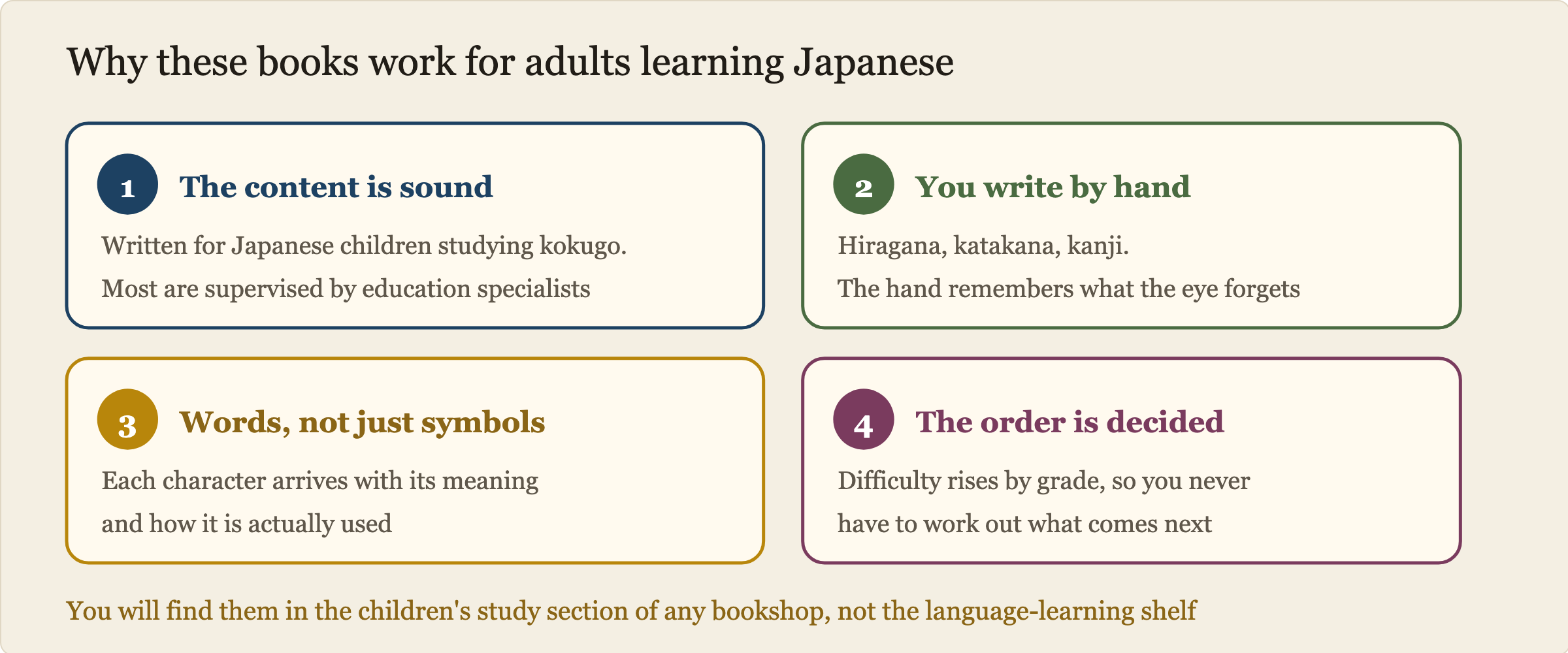
- These drills are made for Japanese children studying kokugo, their own language, and most are supervised by universities or education specialists. The content is sound.
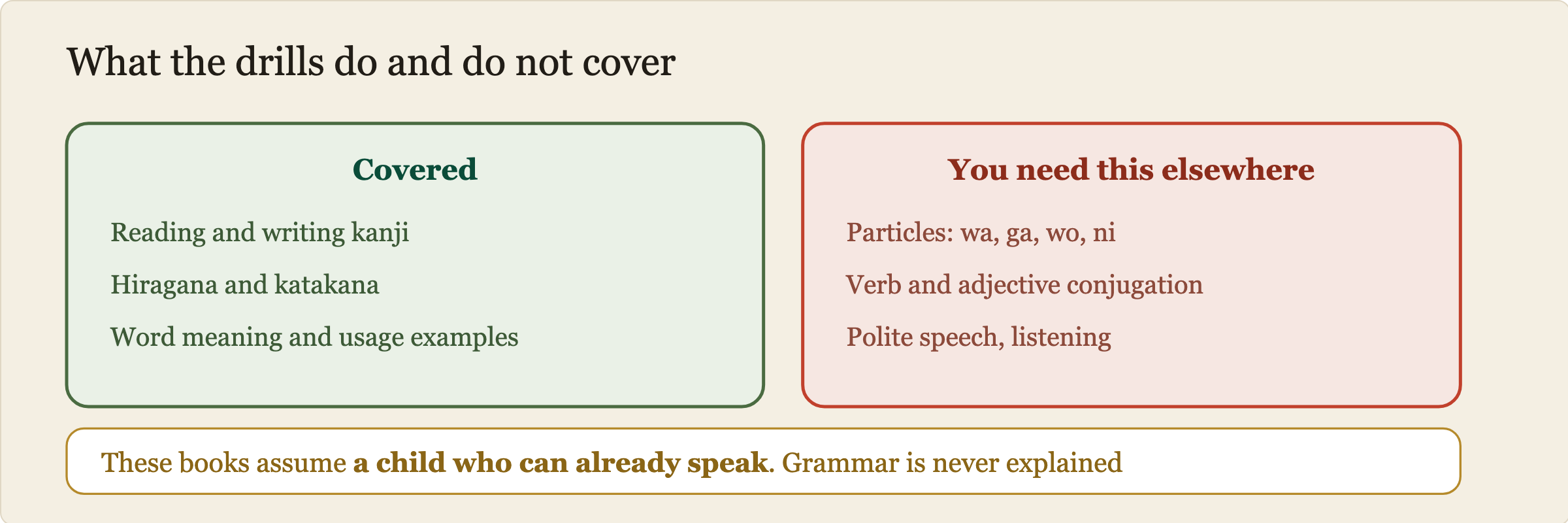
- Grammar is not explained. Particles and verb conjugation you will have to cover separately. Read that part before you start.
This guide is for people already living in Japan. You can get by when speaking, but the letter from the city office, the insurance notice, the rental contract, the printout your child brings home from school are still a wall. This is the cheapest way through it.
The method: children’s drill books, grade 1 upward
Every bookshop in Japan stocks kokugo and kanji drill books for elementary school children, separated by grade, 1 through 6. Work through them in order. That is the whole method.
It sounds like a compromise. Look at what these books actually give you and it stops sounding like one.
Six grades gets you to roughly N2 kanji
Japanese elementary school teaches 1,026 kanji across six years. These are called the kyoiku kanji. JLPT N2 asks for around 1,000. The two sets are nearly the same size.
So finishing grades 1 to 6 puts you at roughly N2 level for kanji. Do not mistake “for children” for “easy”. The 1,026 characters a Japanese person knows by age twelve are the same ones they use as adults.
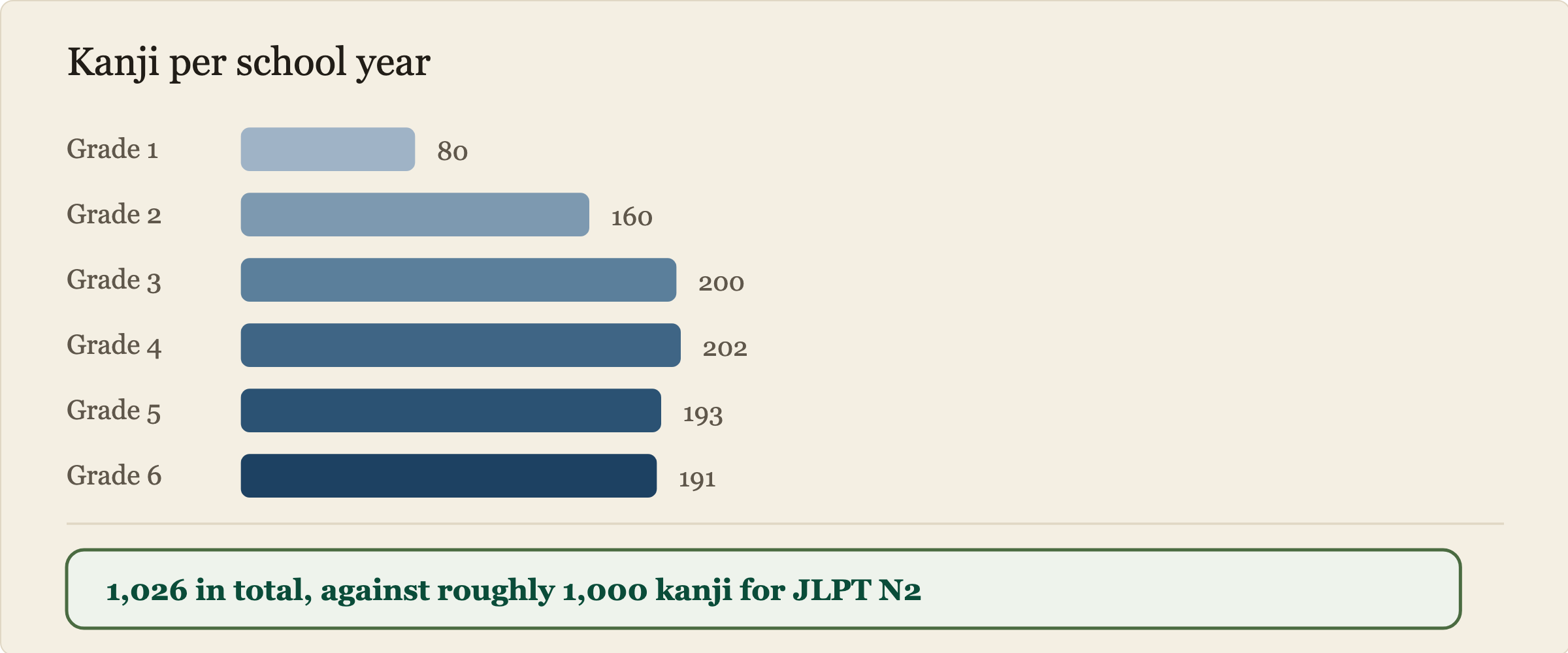
Notice the shape of it. Grades 1 and 2 are gentle, then grade 3 jumps. The first two books go faster than you expect, which is exactly what you want at the start.
The cheapest way is to print, not to buy
You can buy the books. But there is a cheaper route: search in Japanese for “小学1年生 ドリル” and print the free worksheets that come up.
Japan has a number of long-running sites that publish elementary school worksheets free, sorted by grade and topic. Three that are worth your time:
- Chibimusu Drill – all six grades, and crucially it separates practice sheets from test sheets. Write to learn, then check yourself. No sign-up needed
- Kanji Print 1006 – over a thousand sheets, published free for more than ten years. The layout is plain, which means less ink and cheaper convenience store printing
- Sukiruma Drill – another grade-by-grade set, useful if the first one does not suit you
The sites are in Japanese, but you only need to find the grade number and the download button. Your browser can translate the rest.
- With a computer and printer: you pay for paper and ink only. Effectively free
- With only a phone: save the file and print it at a convenience store, roughly 10 to 20 yen a sheet
The real advantage of printing is that failing costs nothing. Try one sheet. If it does not suit you, try a different site. Far better than discovering it after buying a book.
Print it on paper rather than reading on screen. Kanji does not stick without the hand moving. A character you can recognise on a screen is often one you cannot write.
Being straight with you: grammar is not in here
These drills do not explain grammar. Know that before you start.
The reason is simple. Japanese children already speak Japanese before they start school. The books are built for someone who already talks, so they never explain particles – wa, ga, wo, ni – or how verbs conjugate. None of that needs saying to the intended reader.
Word meanings and usage do appear. But that is examples of how a word is used, not an explanation of why the language works that way. For a foreign learner, that gap is real.
For polite speech, our guide to casual speech and keigo covers what the drills will not.
But the kokugo drills do build reading and writing
There is a distinction worth knowing. Kanji drills and kokugo drills are different things.
Alongside kanji, the same series publish bunshou dokkai (reading comprehension) and sakubun (composition). Reading comprehension is working through a whole passage and extracting the meaning. Composition is building sentences yourself.
Neither explains grammar either. But you are actually reading and actually writing, which beats kanji drills alone by a distance. Reading a notice from the city office and writing a short reply are exactly these two skills.
Kanji for the characters, reading comprehension for input, composition for output. Run the three together and drills alone will take you a long way.
If you decide to buy the books
If printing has kept you going for a month, buying is worth it. A book gives you a finish line, and that helps more than it sounds.
To cover all the kanji in one volume. All 1,026 characters, grades 1 to 6, in a single book. No buying six. It is laid out as worksheets, so you can photocopy and repeat.
To do five minutes a day. This one is per grade. Two characters a page, with example sentences, and the pages tear out so you can carry just today’s. Start with grade 1.
To build reading. Once a few kanji have stuck, this is the next step. Read a whole passage and pull the meaning out of it – the closest practice there is to reading a city office notice or a contract.
To build writing. Composition. Building your own sentences is the hardest of the three and the one that pays most. A message to your employer, a reply to your child’s school, the blank boxes on a government form – writing comes for you eventually.
To check what actually stuck. Finish a grade, test yourself, then move up. It stops gaps carrying forward.
You do not need all of these. Print for free for a month, and buy only if you are still going. If you buy one, make it the kanji.
Where to start
If you can write hiragana and katakana, start at grade 1. It will feel too easy. Do not skip it. Those first 80 characters are day, month, year, water, fire, school, mountain, river – the ones on signs you walk past every day.
Skip ahead to grade 3 and the unknown characters pile up fast enough to stop you. Grades 1 and 2 are only 240 characters together. They go quickly.
If hiragana or katakana are still shaky, there are drills for those too. Search “ひらがな ドリル”.
What changes when you can read
Reading kanji stops you losing money and time in Japan. Concretely, these documents:
- The move-out invoice – you can check what you are actually being charged for (move-out costs and restoration)
- Your rental contract – renewal fees and restoration terms are written in there (how renting works)
- Health insurance letters – reduction schemes are sometimes announced in them (National Health Insurance)
- Envelopes from the city office – some of them have deadlines
This site exists to tell you what those documents say. But the real destination is you reading them yourself, and drills are the cheapest tool for getting there.
When you need someone to explain: italki
Drills teach you the characters. They do not explain why a particle works the way it does. Thirty minutes with a person, at the point where you are stuck, is often what keeps you moving.
- Over 2,000 Japanese teachers on a platform used by learners worldwide
- Pay per lesson, not monthly. If you stop, you stop – nothing is wasted
- From around 800 yen a lesson – each teacher sets their own price
- Honest note: price and quality vary a lot between teachers. Use a trial lesson to find one who suits you
Find a Japanese teacher on italki (site opens in Japanese; use the language switcher)
Frequently asked questions
Q. Is there any point in an adult using children’s material?
A. Yes. The 1,026 characters taught in elementary school are the ones Japanese adults use every day. What is childlike is the wording of the instructions, not the kanji.
Q. Does this help with the JLPT?
A. By volume, yes, you reach roughly N2. But the order is different. JLPT runs N5 to N1; the drills run by school grade. If you have an exam date, JLPT-specific material will get you there faster. Drills suit people without a deadline.
Q. Free printouts or buy the book?
A. Until you know it will stick, printing is the safer bet. Nothing is lost if it does not suit you. Buy once you know.
Q. How much should I do a day?
A. One sheet is enough. Grade 1 is only 80 characters, so one a day finishes it in a few months. Not stopping matters more than volume.
Q. What do I do about grammar?
A. Cover it separately – the drills do not contain it. Particles and verb conjugation are the first wall. For polite speech, see our keigo guide.
Official source:MEXT: the national curriculum, including the kanji list by school year
Summary
For kanji, work through Japanese elementary school drills from grade 1. Six grades is 1,026 characters, almost exactly the JLPT N2 set.
You do not have to buy anything to start. Search “小学1年生 ドリル” and print. Free with a printer, cheap at a convenience store, and nothing lost if you stop.
Just remember that grammar is not in there. Cover particles and conjugation elsewhere. Know that, and these are very good tools.
Related guides
Found this useful? Share it
Send it to a friend who lives in Japan.
READ THIS NEXT
Keigo vs Casual Japanese →You can work a Japanese part-time job with only desu and masu plus eight set phrases.WHO WROTE THIS

mori
Japanese. I read the ministries’ own notices, orders and Q&As in the original, and I start from what my Nepalese and Sri Lankan friends in Japan actually ran into. I do not write about what I have not checked or been told.
What this site can and cannot do →Looking for something else?