Checked on 22 October 2026 against the official pages of docomo, ahamo, au (KDDI), SoftBank, Rakuten Mobile, Apple and Paidy, and pages from the credit bureau CIC, the Japan Consumer Credit Association, the Ministry of Internal Affairs and Communications and the Consumer Affairs Agency. Rules change, so always confirm at the shop before you sign.
The short answer
- A phone installment plan is a credit contract: the carrier pays for the phone up front and you pay the carrier back every month. Foreigners can apply, but there is always a credit check.
- Non-Japanese applicants face one extra condition: how long is left on the residence card. au requires 26 months or more counting the current month, and SoftBank’s online shop requires more than 26 months.
- This site does not recommend the device installment plans of docomo, au and SoftBank (including ahamo). They come with residence-period limits, stay on your CIC credit file for years, keep running after you cancel the line, and must be cleared before you leave Japan.
- The first choice is to pay in full, for a new phone or a used or SIM-free one, and pair it with a cheap SIM.
- If you really need to split the cost, use Paidy’s Apple-only plan at Apple. It is interest-free by bank debit or bank transfer and has nothing to do with your phone line. It is still a credit contract recorded with CIC, so borrow only what you can repay on time.
Knowing this, you can decide before you go to the shop whether an installment plan will work, or whether paying in full or buying used is better, and you will not be scrambling to pay the rest on the day you leave.
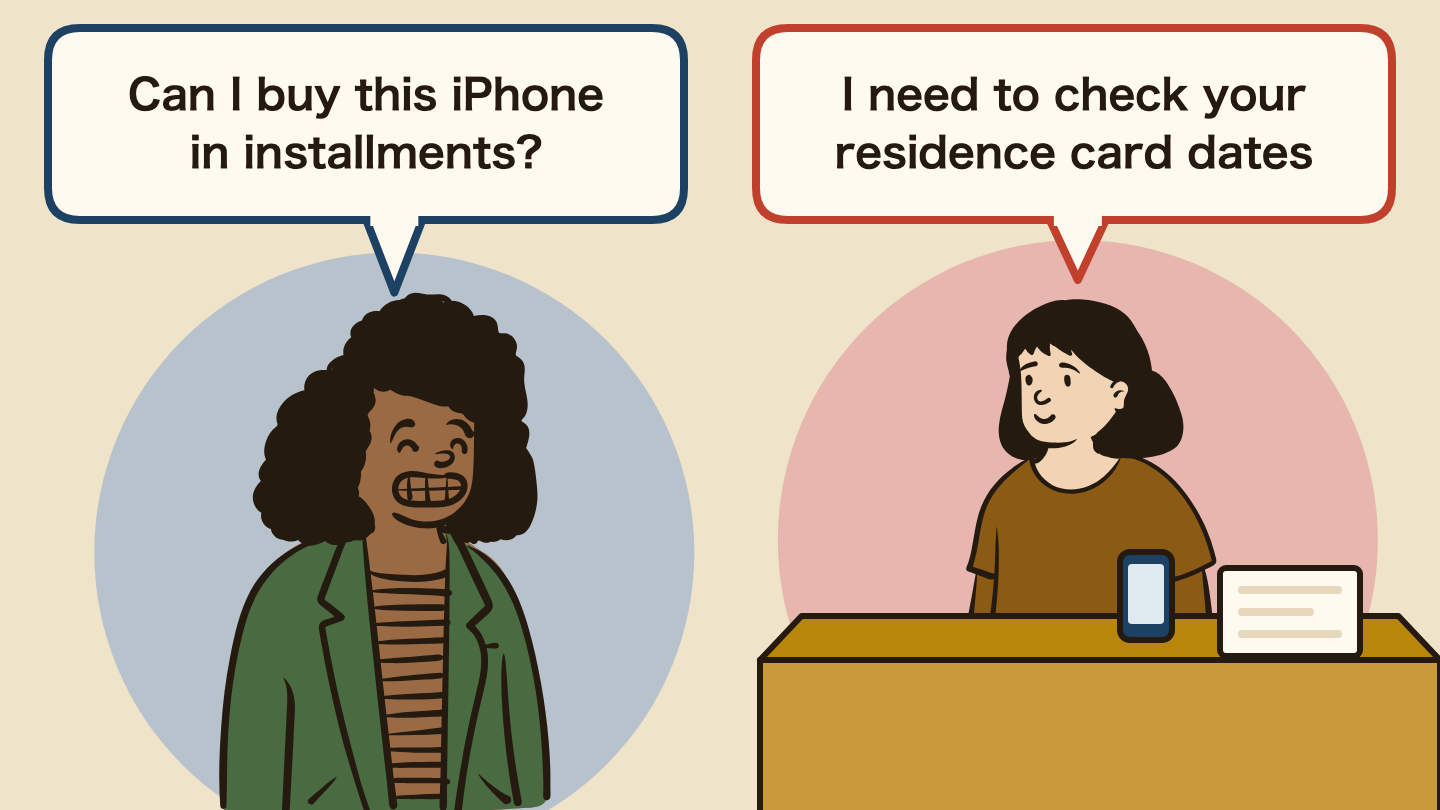
Autumn of your first year in Japan. You want the new iPhone on a 48-month plan, so you hand your residence card over at the phone shop. The clerk looks at the expiry date and says, “We can’t do installments, so it will have to be paid in full.” Your Japanese friend is puzzled: “I just did installments, no problem.” Your friend has no residence card, so there is no expiry date to check. This wall stands only in front of non-Japanese customers.
- Can foreigners get a phone on installments in Japan? What the contract really is
- What does the installment credit check look at? Your credit file and the “affordable amount”
- Too little time on your residence card? Each carrier’s rule
- Pay in full, used or Paidy? Why we do not recommend carrier installments
- If you really need to split the cost: Paidy’s Apple-only plan
- Before you sign: documents and 5 things to check
- How do phone installments show on your credit file? Every monthly payment becomes a record
- Refused an installment plan? CIC cannot tell you why either
- Can’t pay, or already late? Losing the installment right, and 188
- Leaving Japan with phone installments left: what to do before you go
- Which one are you?
- FAQ
- Summary
- Related reading
Can foreigners get a phone on installments in Japan? What the contract really is
Yes, non-Japanese residents can apply for a phone installment plan. docomo asks foreign residents for a residence card and a passport issued abroad (docomo, buying a phone in installments, Japanese). Permanent residents do not need the passport.
But an installment plan is not just “paying later”. The carrier pays the shop for your phone, and you repay the carrier in parts. The legal name is “individual credit purchase intermediation” (個別信用購入あっせん), and docomo’s page uses it. The credit bureau CIC also describes installments for a phone as a kind of credit contract (CIC, when you are refused a phone installment plan, Japanese).
That is why there is no “installment plan with no credit check”. docomo states that an application needs ID and a credit check. If you do not want to be checked, the option is to pay in full.
What does the installment credit check look at? Your credit file and the “affordable amount”
Under the Installment Sales Act, credit companies must investigate the “amount you can be expected to pay”. For that check, they must use information from a credit bureau designated by the government (CIC, the designated credit bureau system, Japanese). CIC is one of those bureaus.
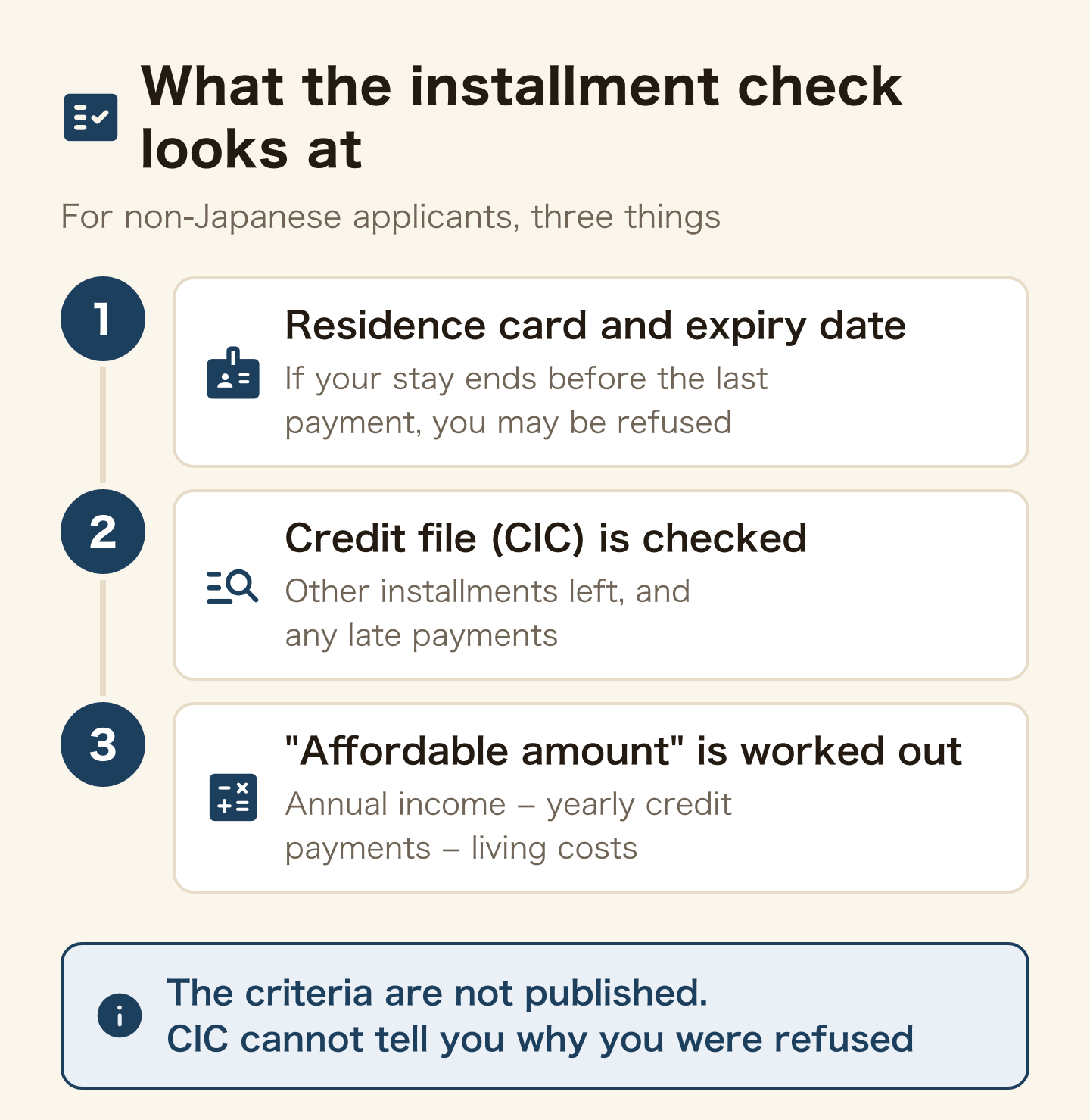
The formula is in the rules of the industry body, the Japan Consumer Credit Association (JCA self-regulatory rules on individual credit, Article 16, Japanese).
Affordable amount = annual income − yearly amount due on credit purchases − living costs
The yearly amount due includes installments with other companies. If you are already paying off a phone or a laptop, the room for a new plan is smaller by that much. The items checked are income, savings, your payment history, borrowing and the price of what you are buying (Article 6).
docomo’s ahamo brand is more specific about its check. It looks at how you have paid your phone bills, the result of the credit bureau check, how many installment contracts you have, your residence card’s expiry date and your payment method (ahamo FAQ, “I can’t choose installments”, Japanese). It says no contact point will explain the criteria themselves.
Too little time on your residence card? Each carrier’s rule
These are the rules that apply if a shop offers you an installment plan. The condition only non-Japanese customers face is the expiry date on the residence card. For people whose stay ends before the last payment, docomo, au and SoftBank each set their own rule. These rules are one of the reasons this site does not recommend carrier installments.
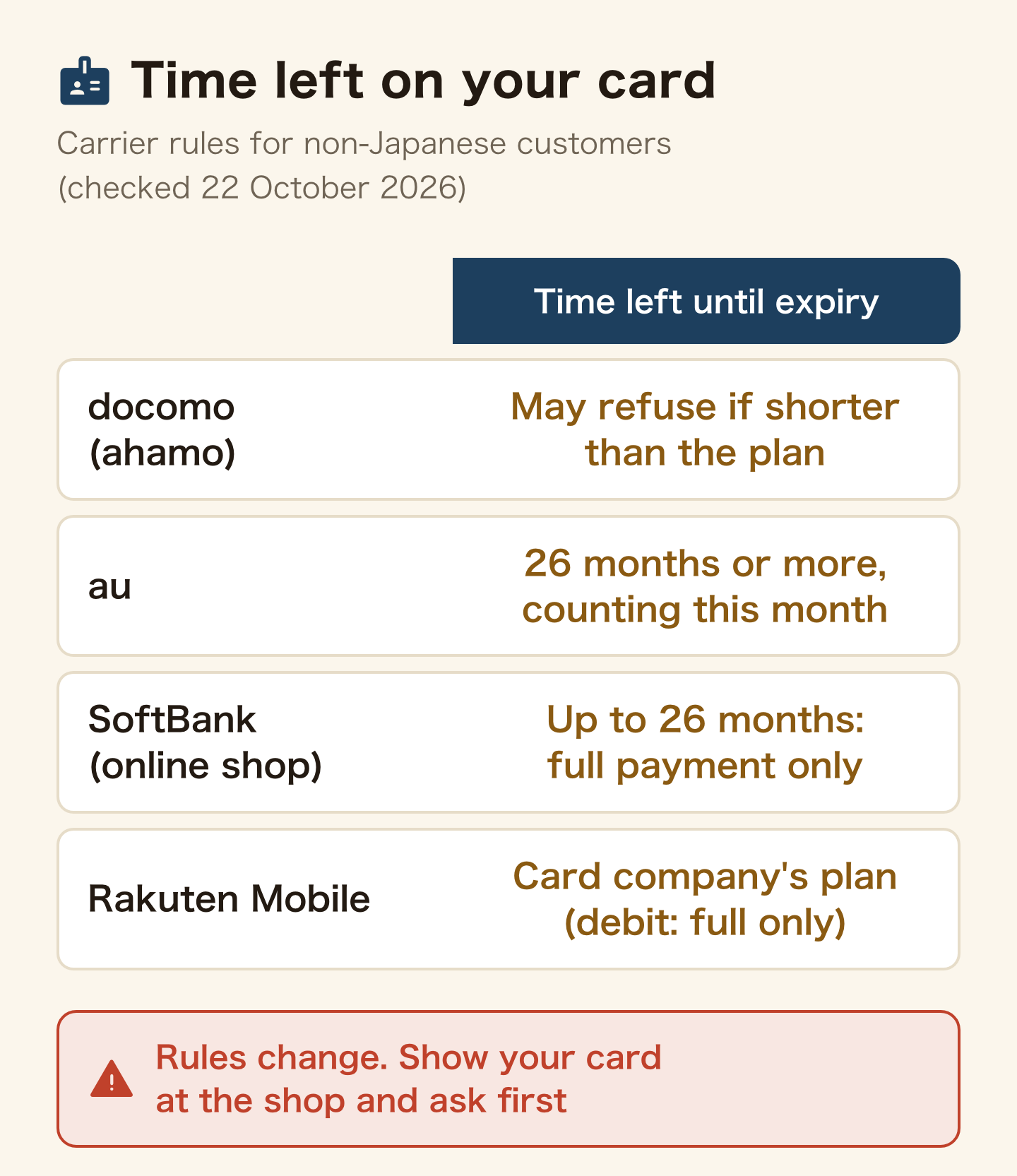
- docomo (including ahamo): may refuse if the period of stay on your residence card is shorter than the installment contract. Plans are 12, 24 or 36 payments, with no installment fee.
- au: you can apply only if your period of stay is 26 months or more, counting the current month. Foreign residents cannot use the 60- or 72-payment plans (au, new contract guide, as of December 2025, Japanese).
- SoftBank: according to its online shop notes, if your stay ends within 26 months of the application date, installments are not possible and you pay in full. With less than 90 days left, you cannot apply at all (SoftBank, notes on iPhone contracts, Japanese).
- Rakuten Mobile: the installment plan is the credit card company’s, not Rakuten Mobile’s. With a Rakuten Card you can choose 24 or 48 payments, with other cards 24, and with a debit card only full payment (Rakuten Mobile FAQ, buying an iPhone in installments, Japanese).
- Apple Store: with Visa or Mastercard, purchases of 30,000 yen or more can be split into up to 24 card payments. Paidy’s “Apple-only” plan is interest-free when you pay by bank debit or bank transfer, and Apple’s page says the online ID check uses a My Number Card or a driving licence (Apple, payment methods, Japanese).
For Rakuten Mobile and Apple’s card plans, it is the card company that takes on the installments. Without a credit card, this route is closed. What makes a card easier to get as a foreigner is in credit cards for foreigners in Japan.
SoftBank’s online shop page still names the old “alien registration card” as the ID. Ask at the shop whether the same applies to today’s residence card. Once your period of stay is renewed and you have the new card, you can ask again with the new date.
Pay in full, used or Paidy? Why we do not recommend carrier installments
The order this site recommends: pay in full; if not, a cheaper or used phone paid in full; and only if you really need to split the cost, Paidy. We do not recommend the device installment plans of docomo, au and SoftBank (including ahamo).
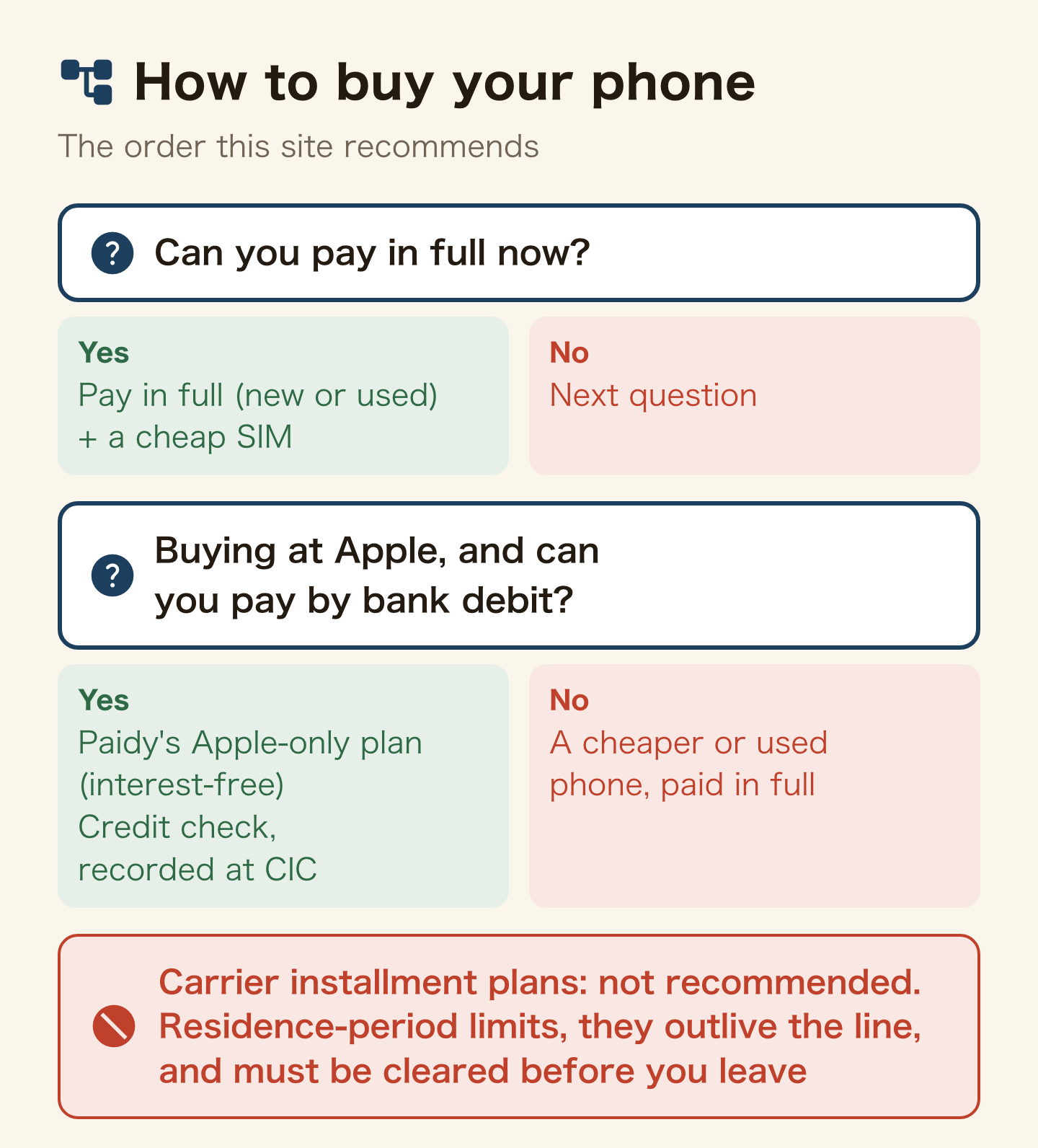
The reasons are in the facts checked for this article:
- Residence-period limits: au needs 26 months or more counting this month, and SoftBank’s online shop more than 26 months.
- A credit check and a long record: the contract and monthly payments stay with CIC during the contract and for 5 years after, and late payments for 5 years after paying off (according to au).
- They keep running after you cancel the line: the phone plan is a separate contract.
- They must be cleared before you leave: close your bank account and the debit fails, which counts as late.
- The phone can be restricted until it is paid off: docomo marks phones on installments with “△” and may block phones with unpaid installments from the network.
Here are round numbers. Say you buy a 120,000 yen phone on an interest-free plan. Each month is 120,000 yen ÷ 24 = 5,000 yen, or 120,000 yen ÷ 48 = 2,500 yen. The 48-month plan looks easier, but the total is the same 120,000 yen.
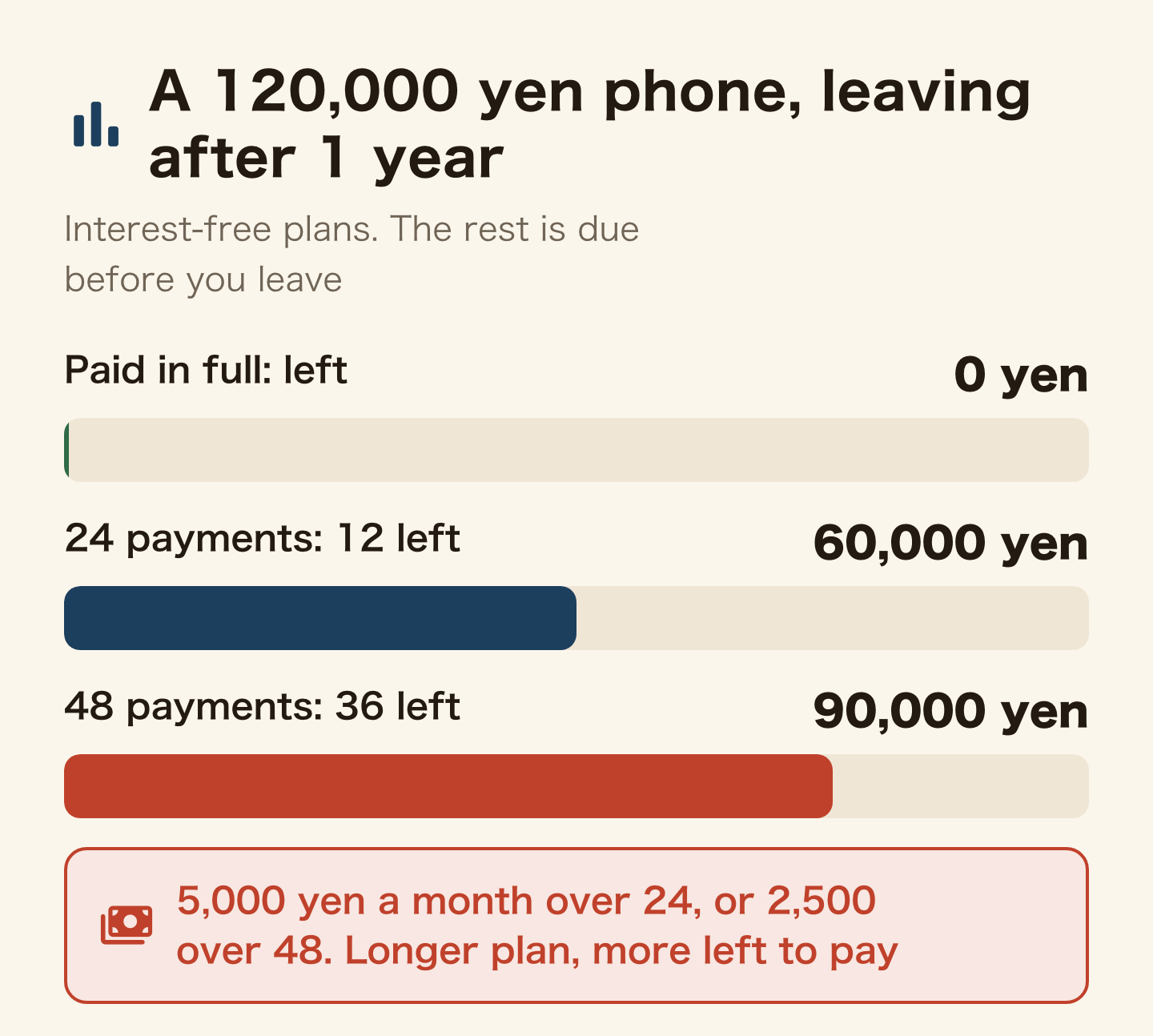
The difference shows when you leave Japan partway. If you go home after one year (12 payments), the 24-month plan leaves 5,000 yen × 12 = 60,000 yen. The 48-month plan leaves 2,500 yen × 36 = 90,000 yen. The smaller you make each month, the more money you need ready before you leave.
Rakuten Card’s 48-payment plan has a scheme where, if you switch to another eligible phone and hand this one back, payments from month 25 are waived (the Rakuten Mobile upgrade program). Handing it back costs a 3,300 yen handling fee, plus repair costs depending on the phone’s condition.
Choose in this order:
- Pay in full (our first choice): no installment check, and no installment record on your credit file. Nothing to sort out on the day you leave. The downside is the cash you part with now.
- A used, older or SIM-free model, paid in full: you do not need to find 120,000 yen. Phones released from October 2021 on must, in principle, be sold without a SIM lock (Ministry of Internal Affairs and Communications, mobile portal Q3, Japanese).
When buying used, check the points the ministry lists first. Look up the serial number to make sure the phone is not network-blocked (for example after theft), and check the SIM lock, the factory reset, the warranty and the SIM size (ministry, tips for buying a used phone, Japanese). A phone bought on a docomo installment plan shows “△” on docomo’s checking site while the plan is running (docomo, network restriction notice, Japanese). If the payments stop, that phone can be blocked from the network.
To lower the monthly bill, think about the line separately from the phone. How to choose a SIM-only plan is in the best SIM in Japan for foreigners.
If you really need to split the cost: Paidy’s Apple-only plan
If you cannot pay in full but need a new iPhone, this site recommends Paidy. It works on Apple’s website and at Apple Store shops, and it is interest-free when you pay by bank debit or bank transfer. Up to 36 payments are possible, depending on the product (Paidy, Apple-only plan, Japanese). It cannot be used at shops other than Apple.
Paidy’s official page lists these conditions for applying:
- 18 or older
- A mobile number issued in Japan, and an email address
- ID: a driving licence or My Number Card for Japanese nationals; a residence card or special permanent resident certificate for foreign nationals
- Living in Japan (or, if not, a valid Japanese address)
However, the FAQ on the same page and Apple’s page (Japanese) also say the ID check uses a My Number Card or a driving licence. Check in the Paidy app’s application screen whether you can go ahead with a residence card. The page states no condition on time left until your residence card expires.
The difference from carrier installments is that it is separate from your phone line. You can choose any SIM, and changing your line does not affect the payment contract. There is no application, monthly or annual fee; each payment is free by bank debit, and up to 390 yen at a convenience store.
The limits, honestly. Paidy is also a credit contract with a credit check. The application and the contract are checked against and reported to CIC; the contract record stays during the contract and for 5 years after, and so does any late payment (Paidy, consent on personal information, Japanese). A late payment costs a 250 yen late fee plus late-payment damages of up to 14.6% a year (Article 16), and if you still do not pay within a period of 20 days or more set in a demand, the whole rest becomes due at once (terms of Paidy’s Apple-only plan, Article 15, Japanese). You also need to pay it off before you leave Japan. Set up bank debit, and borrow only what you can repay every month.
Before you sign: documents and 5 things to check
If you still apply for a carrier plan at a shop, the documents are your residence card and a passport issued abroad (docomo). au pairs the residence card with a passport issued abroad (the health insurance eligibility certificate, 資格確認書, is accepted only for under-18s). With less than 90 days until your card expires, au accepts monthly charges only by a credit card in your own name. docomo takes installment payments only by bank debit or credit card.
Then ask these 5 things at the shop before you sign:
- How many months are left until your card expires, and does that meet this carrier’s rule?
- The number of payments, the monthly amount and any fee. What is the total?
- The payment method: bank debit or credit card?
- How much is left on any other installment plans you are paying?
- If you cancel or leave Japan partway, how do you pay the rest?
The fifth matters most. Even if you change your mind after signing, the purchase of the phone often cannot be cancelled. For the line itself, there is “initial contract cancellation”, which lets you cancel within 8 days of receiving the contract document. The three big carriers and some others use a “confirmation measure” system instead (ministry, mobile portal Q5, Japanese). The phone is still a separate matter. How the 8-day rules work is explained in the cooling-off period in Japan.
How do phone installments show on your credit file? Every monthly payment becomes a record
When you sign an installment plan, the contract and each month’s payment are registered with CIC. That includes the balance left, the amount billed, the amount paid and whether you were late. For installment contracts, the yearly amount due is recorded too (CIC, the credit information it holds, Japanese).
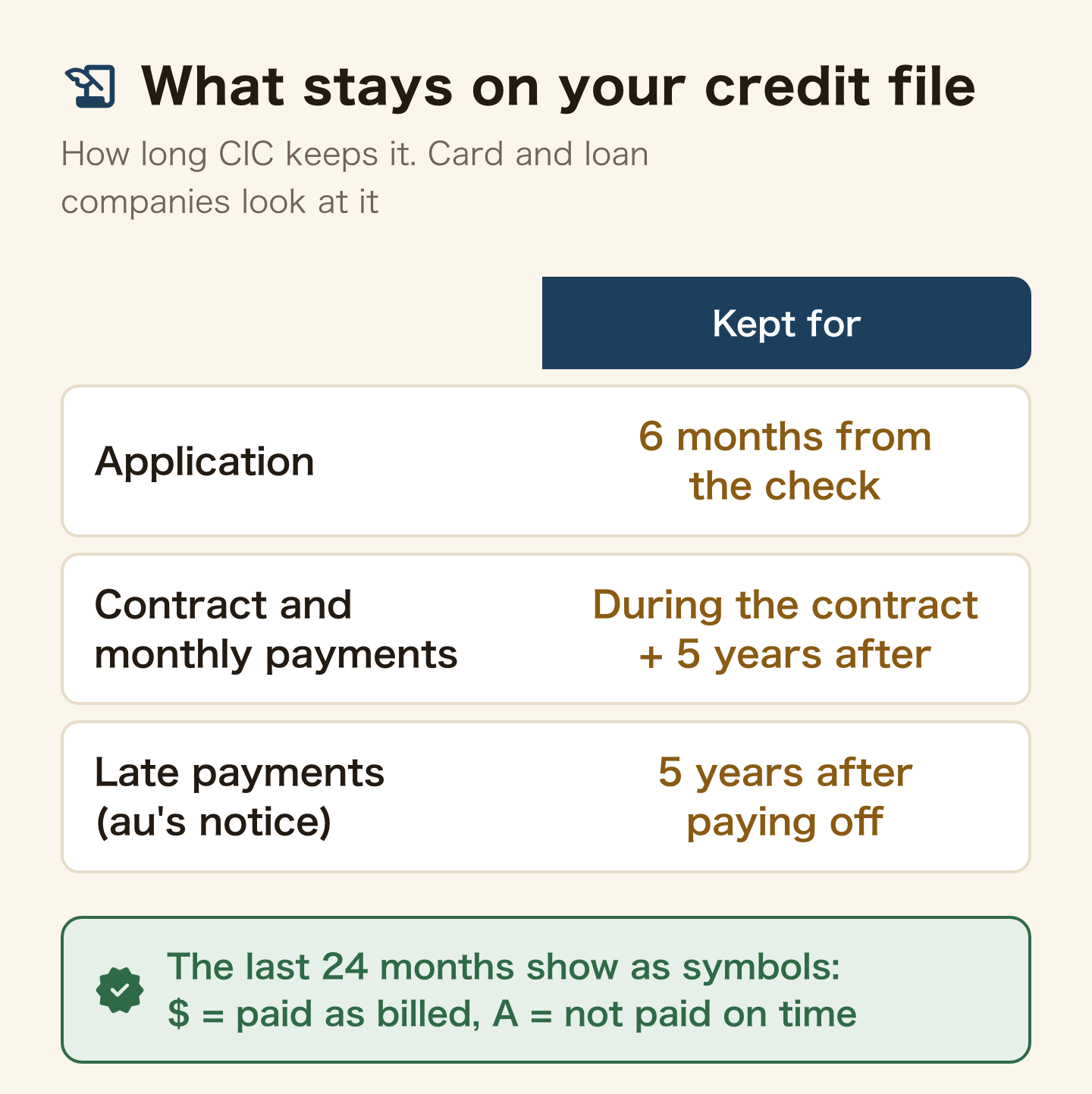
- The application: 6 months from the date of the check
- The contract and monthly payments: during the contract and for 5 years after it ends
- Late payments: au says the record stays for 5 years after you pay off (KDDI, notes on installment contracts, Japanese)
On the disclosure report, your payments appear as symbols for the last 24 months. “$” means you paid as billed, and “A” means no payment arrived on the due date for your own reasons (CIC FAQ, Japanese).
Other companies read this record. docomo warns that late-payment information can lead to credit card or loan applications being refused. CIC says that after clearing any arrears, paying steadily for a while may improve your situation (CIC, Japanese). Paying on time, every month, becomes material for the next time you apply for a card in Japan.
Utility bills such as electricity paid straight from a bank account are not credit contracts, so CIC does not register them. Bills paid by credit card are registered (CIC FAQ, Japanese). You can see your own file for a 500 yen fee through online disclosure (CIC FAQ on the online disclosure fee, Japanese). There is no English report, but CIC provides an English guide to reading it (CIC FAQ on an English report, Japanese).
Refused an installment plan? CIC cannot tell you why either
If the check turns you down, CIC cannot give you the reason, because CIC does not do the screening (CIC FAQ on refused phone installment plans, Japanese). What you can do is request your own file and see what is registered.
Hold off on applying straight away somewhere else. The application stays on record for 6 months from the date of the check. CIC says recent applications are among the things a check looks at (CIC, Japanese).
There are three next steps. Renew your period of stay and apply again. Choose a cheaper model or a used phone you can pay for in full. Or pay for the phone in full and take a SIM-only plan. Even without a credit card you can pay for a phone, for example cash on delivery. The ways to pay are in how to pay in Japan without a credit card.
Can’t pay, or already late? Losing the installment right, and 188
If you know a debit will fail, contact the carrier before the due date. Saying nothing and paying late is the worst option. Under au’s terms, if you miss a payment and still do not pay within a period of 20 days or more set in a written demand, you lose the right to pay in installments (Article 10). In Japanese this is “losing the benefit of time” (期限の利益の喪失), and the whole remaining balance becomes due at once. Late amounts also carry late-payment damages at the statutory interest rate (Article 11).
A phone that is not paid for can also be blocked from the network. docomo includes phones with unpaid installments in its network restriction.
If you are billed differently from what the shop told you, or the problem gets tangled, call the consumer hotline 188. It connects you to a local consumer affairs centre, and the advice is free (Consumer Affairs Agency, consumer hotline, Japanese). You pay for the call.
Leaving Japan with phone installments left: what to do before you go
You are leaving, so you cancel your phone line, and that is the end of your phone bills. Where you come from, that may be normal. In Japan, the phone installments are a separate contract from the line. au states that even after you cancel the service, the installments must be paid until the full amount is paid off.
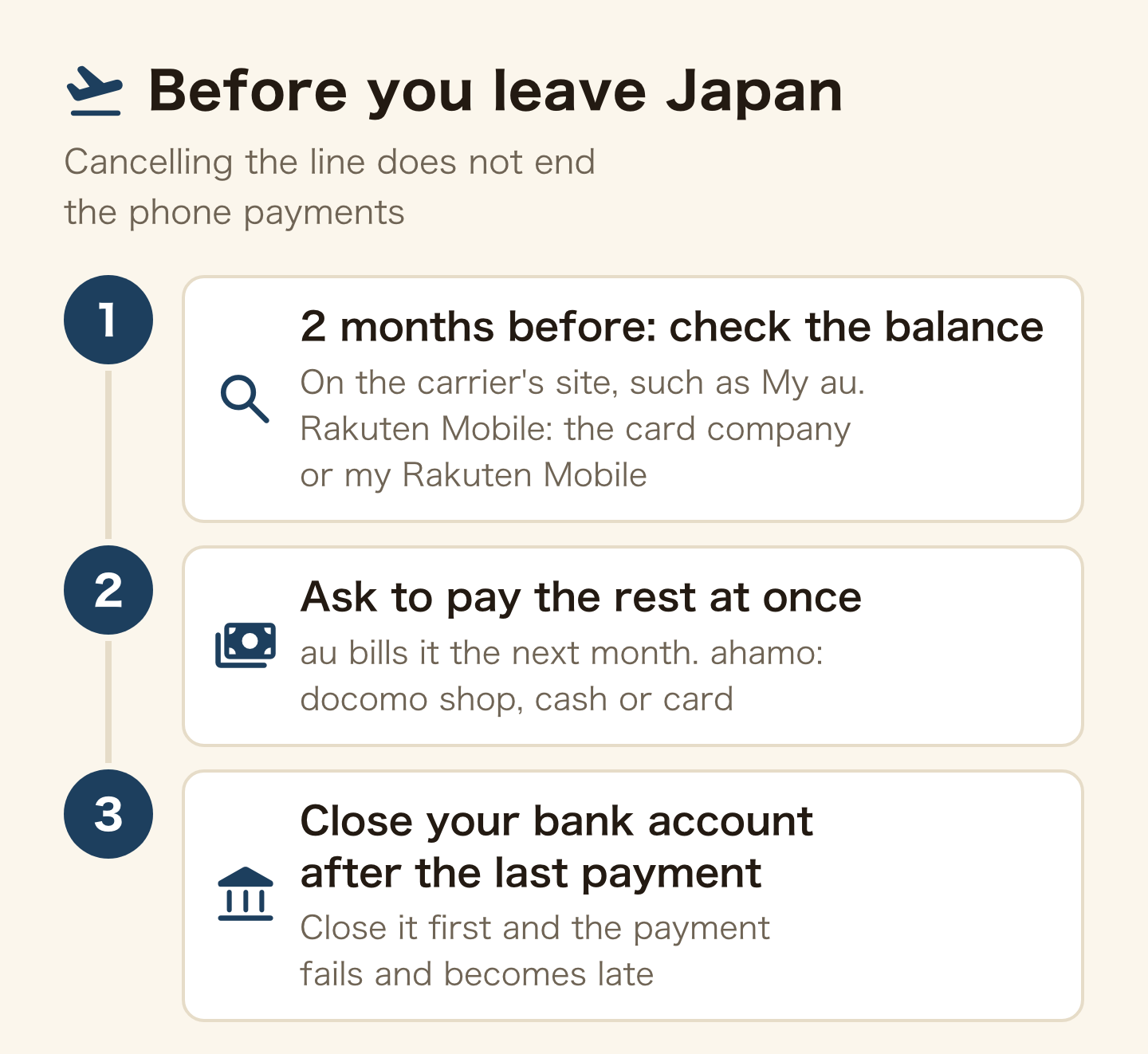
Unless you ask to pay it all at once, the rest keeps being billed every month by the same method you chose at signing (au FAQ, installments after cancellation, Japanese). If you close your Japanese bank account and leave, that debit cannot go through. It counts as not paying, and it is recorded as late.
How to finish with each company, as far as could be confirmed:
- au: apply to pay the rest at once in My au, before or after cancelling. It is billed the following month by your current payment method. If you apply in the last two days of a month, it may be the month after that, and it cannot be undone (au FAQ, paying off after cancellation, Japanese).
- ahamo: installments continue after cancellation. Paying it all at once can only be done at a docomo shop, not by phone or online, in cash or by credit card (ahamo FAQ, paying off the balance; ahamo FAQ, the balance when you cancel, Japanese).
- Rakuten Mobile: the plan belongs to the card company, so ask the card company how many payments and how much are left; for the 48-payment upgrade program, check in my Rakuten Mobile instead (Rakuten Mobile FAQ, Japanese).
- docomo, SoftBank and others: confirm where and when to do it with the company you signed with.
- If you bought with Paidy: the bank debits continue, so pay it off before you close your Japanese account. You can pay the rest at once if you ask in the way Paidy sets and Paidy agrees (terms, Article 6(8), Japanese). Your payment schedule is shown in the Paidy app.
The order is: check the balance, pay it off, watch the last debit go through, then close the account. Some companies, like au, bill the following month or the one after, so start two months before your flight. When to close your account, and what else to wrap up, is in the leaving Japan checklist.
Which one are you?
- You can pay in full: skip carrier installments. Today, choose the phone you will buy outright (new, used or SIM-free) and the cheap SIM to go with it.
- You cannot pay in full but need a new iPhone: use Paidy, not a carrier plan. Today, check the conditions and accepted ID in the Paidy app, and set up bank debit.
- Refused an installment plan: do not apply elsewhere straight away. Today, look at your own file through CIC’s online disclosure (500 yen).
- Leaving Japan partway through a plan: cancelling the line will not end it. Today, check the balance and ask the carrier how to pay the rest at once.
Once the phone is paid off, all your credit file says is that you paid it off. That is where this worry ends.
FAQ
Q. Can foreigners buy a phone on installments in Japan?
Yes. There is a credit check, and the time left on your residence card is a condition. docomo may refuse if your period of stay is shorter than the installment contract, and au requires 26 months or more counting the current month. This site does not recommend carrier installments; pay in full, or if you need to split the cost, use Paidy at Apple.
Q. I only have one year left on my residence card. Can I still get installments?
Under au’s rule and SoftBank’s online shop rule, one year is short of 26 months, so you would pay in full. Paidy’s Apple-only plan states no residence-period condition on its official page, so check on its application screen.
Q. Is there a phone installment plan with no credit check?
No. A phone installment plan is a kind of credit contract, and docomo states that an application needs a credit check. If you do not want to be checked, pay in full, or buy a cheaper or used phone outright.
Q. Will they tell me why I was refused?
Carriers do not publish their criteria, and CIC does not do the screening, so it cannot give a reason. Through CIC’s disclosure you can see what is registered on your own file.
Q. What happens to my phone installments when I leave Japan?
Cancelling your line does not end the installments. Unless you ask to pay them all at once, they keep being billed every month by the same method. Pay the rest before you leave, and close your Japanese bank account only after the last debit.
Q. What happens if I pay a phone installment late?
The late payment is registered with the credit bureau, and according to au it stays for 5 years after you pay off. It can lead to card or loan applications being refused. If you know you cannot pay on time, contact the carrier before the due date.
Summary
A phone installment plan is a credit contract in which the carrier pays for the phone up front. Foreigners can apply, but if there is not enough time left on the residence card, it becomes full payment. The check looks at your CIC file and the affordable amount, and no one will tell you why you were refused.
This site does not recommend the device installment plans of docomo, au and SoftBank (including ahamo). Residence-period limits, a record that lasts years, payments that outlive the line and the need to clear them before leaving weigh heavily on non-Japanese residents. Paying in full and pairing the phone with a cheap SIM is best. If you really need to split the cost, use Paidy at Apple by bank debit, for no more than you can repay every month. If you are already on a carrier plan, start paying off the rest two months before you leave.
Official sources (Japanese): docomo, buying a phone in installments / docomo, network restriction notice / ahamo FAQ (installment check), (balance on cancellation), (paying off) / au new contract guide / KDDI installment contract notes and terms / au FAQ (installments after cancellation), (paying off) / SoftBank, notes on iPhone contracts / Rakuten Mobile FAQ (installments), (remaining payments) / Apple, payment methods / Paidy, Apple-only plan, its terms, consent on personal information / CIC, credit information held, designated credit bureau system, refused phone installments, FAQ, (utility bills), (disclosure fee), (English guide) / Japan Consumer Credit Association, self-regulatory rules / Ministry of Internal Affairs and Communications, mobile portal Q3, Q4, Q5 / Consumer Affairs Agency, consumer hotline 188 (all checked 22 October 2026). Installment rules vary by company, time and shop, so always confirm at the shop before you apply.
Related reading
Found this useful? Share it
Send it to a friend who lives in Japan.
WHO WROTE THIS

mori
Japanese. I read the ministries’ own notices, orders and Q&As in the original, and I start from what my Nepalese and Sri Lankan friends in Japan actually ran into. I do not write about what I have not checked or been told.
What this site can and cannot do →Looking for something else?
You may use the figures in this article, including commercially, if you credit this site with a link. How to use our figures