Checked on 23 September 2026 against the text of the Act on General Rules for National Taxes, the Income Tax Act and the Local Tax Act (e-Gov), National Tax Agency Tax Answer No. 1923 and its procedure page, the Japan Pension Service lump-sum claim form, the Ministry of Internal Affairs page on resident tax for foreign nationals, and guidance from Yokohama, Kyoto and Kobe.
The short answer
- A tax representative (nozei kanrinin) receives your Japanese tax papers, pays, files and collects refunds for you after you leave. Anyone with an address in Japan can do it, including a friend or a company.
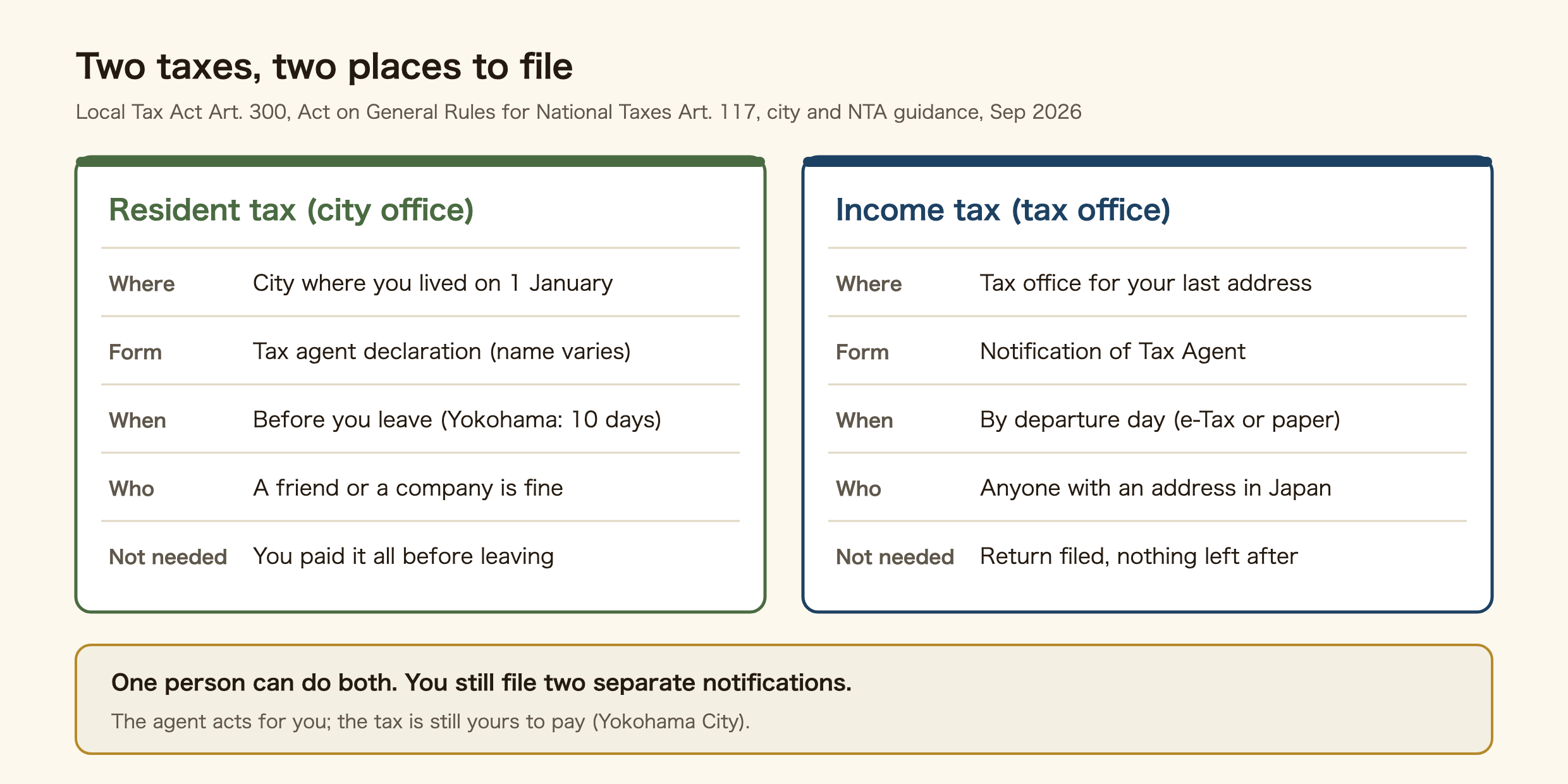
- There are two places to file. Resident tax goes to the city where you lived on 1 January; income tax goes to the tax office for your last address. File both before you leave.
- If you had an address in Japan on 1 January, you owe that year’s resident tax. The bill comes around June. Leave before then, and you either appoint a representative or ask the city to let you pay before departure.
- The Employees’ Pension lump-sum has 20.42% withheld. Your representative can file to get it back; in the National Tax Agency’s own example, all of it comes back. The National Pension lump-sum has no tax withheld.
- Already gone? It is not too late. For the pension refund, the notification can be filed together with the return (Japan Pension Service).
Knowing this, you can settle who, where and what in one go before your flight, so the June resident-tax bill and the tax taken from your pension lump-sum do not slip through the cracks once you are home.
You have booked your flight home for March. Someone at work says, “The resident tax bill comes in June, so sort out a tax representative.” You ask a Japanese friend if they could be yours. They look worried: “What is that? Would I have to pay your taxes?” They do not know either. People who stay in Japan for life rarely ever need one.
- What is a tax representative in Japan?
- Do I need a tax representative for resident tax when leaving Japan?
- Do I need one for income tax, or can I file before I leave?
- Who can be my tax representative in Japan?
- How do I file the tax representative notification?
- How does a tax representative get my pension refund tax back?
- How much does it cost?
- What happens if I leave Japan without a tax representative?
- I already left without appointing one. What now?
- Can I file on e-Tax myself after leaving Japan?
- Which one are you?
- FAQ
- Summary
- Related reading
What is a tax representative in Japan?
Japanese tax papers go to your Japanese address. When you leave, that address is gone. The city cannot send you the bill, you cannot pay it from where you are, and any refund has nowhere to land. The tax representative fills that gap.
The National Tax Agency’s guide to the notification form lists three things a representative does:
- prepare and submit returns, applications and notifications for you
- receive documents from the tax office
- pay tax and receive refunds
Resident tax works the same way. Yokohama describes the representative as an agent who “receives the tax notice, pays the tax and receives refunds” on your behalf.
Your friend’s question has an answer from Yokohama too: the representative does not take on your tax liability. If the tax goes unpaid, collection action is taken against you, not them. Your friend handles the paperwork with your money.
Do I need a tax representative for resident tax when leaving Japan?
Resident tax is charged to people who had an address in Japan on 1 January. The amount is based on your pay and other income from January to December of the previous year. The Ministry of Internal Affairs says this still applies if you leave on 2 January or later (the assessment date is set by Local Tax Act Article 318).
How it plays out depends on when you leave:
- Leaving in March 2027: you were in Japan on 1 January 2027, so you owe FY2027 resident tax, on your 2026 income. The bill comes around June, after you have gone. Appoint a representative, or ask the city to let you pay before departure — Kobe says it will issue a payment slip for that.
- Leaving in October 2027: you started paying FY2027 in June. Pay off the rest before you go, or have your representative pay it.
- Either way, if you have no address in Japan on 1 January 2028, there is no FY2028 resident tax.
Kyoto’s guidance matches. If you move abroad between 2 January and the June bill, you need a representative. If you leave after the bill arrives, pay it all before you go or appoint one.
Employees can sometimes have the rest of the current year’s tax taken from their final pay in one sum. Which months make that automatic is set out month by month in the leaving-Japan section of our resident tax guide. But if you leave between January and May, next year’s amount is decided around June and is still separate. Settle that one with a representative or an advance payment.
Do I need one for income tax, or can I file before I leave?
Income tax is a national tax, handled by a different office. The National Tax Agency says a non-resident needs a representative when they must “file a return, receive documents from the tax office, pay tax or receive a refund” (No. 1923).
Put the other way round: if nothing is left to handle in Japan, you do not need one.
- Your employer does a year-end adjustment before you leave: Tokyo Regional Taxation Bureau guidance says someone with one employer, whose tax is settled by that adjustment at departure, needs no further procedure
- You must file a return: file and pay by the time you leave, and no representative is needed (Income Tax Act Article 127). A refund return can also be filed before departure
- Something must be filed in Japan after you leave: you need a representative. The pension lump-sum refund is the classic case
If you quit mid-year without a year-end adjustment, you are likely owed income tax back. Whether to file it yourself before you fly or leave it to a representative is covered in the “leaving Japan” part of our tax return guide.
Who can be my tax representative in Japan?
There is essentially one condition: the person must have an address (or residence) in Japan.
- Income tax: Article 117 of the Act on General Rules for National Taxes says the representative is chosen from people with an address or residence in Japan. The National Tax Agency says it can be an individual or a corporation
- The pension refund: the Japan Pension Service says there is no qualification for the representative other than an address or residence in Japan
- Resident tax: Yokohama says it does not need to be a relative; a friend or a company is fine
One catch for resident tax. Under Local Tax Act Article 300, if your representative lives outside the area the city sets by ordinance, you do not simply declare them — you apply and the city approves. Kyoto uses an “application for approval” for anyone living outside Kyoto City. If your friend lives in another city, ask which form to use.
The same person can handle both taxes. Before you ask, agree on three things: how they will tell you about letters that arrive, how you will give them the money to pay, and how they will send you any refund.
How do I file the tax representative notification?
| Resident tax | Income tax | |
|---|---|---|
| Where | Tax section of the city where you lived on 1 January | Tax office for your last address in Japan |
| Form | Tax agent declaration (approval application if they live outside the city); name and layout vary by city | Notification of appointment/dismissal of tax agent for income tax and consumption tax |
| With it | ID (shown at the counter, a copy by post) | Your My Number and ID (no ID needed on e-Tax) |
| How | Counter or post (Yokohama also takes eLTAX) | e-Tax, or paper in person or by post |
| Deadline | Before you leave (Yokohama: 10 days before departure) | When you appoint them, or by your departure day |
Get your representative’s agreement first; both forms ask for their name and address. Then file with the city and the tax office separately. If you do it on the day you file your moving-out notice, it is one trip. For where this sits among your resident record, insurance and pension, see the leaving-Japan checklist.
Yokohama’s 10-day rule is Yokohama’s. Check your own city’s deadline.
How does a tax representative get my pension refund tax back?
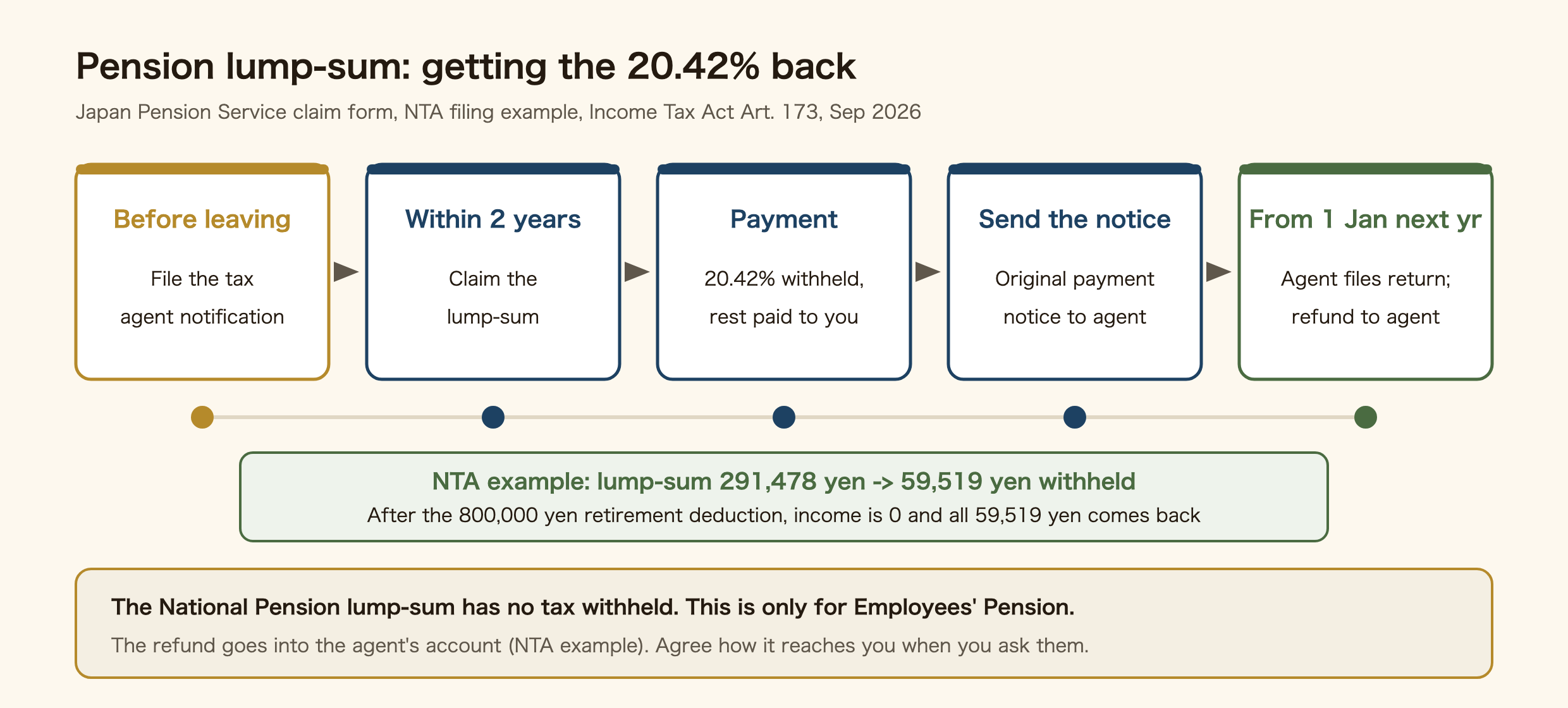
This is where a representative earns their keep. If you paid into Employees’ Pension (kosei nenkin), 20.42% income tax is withheld when the lump-sum withdrawal payment is made (Japan Pension Service). The National Pension lump-sum has nothing withheld.
The withheld tax may be refunded if a “Tax Return for Refund Due to Taxation on Retirement Income at the Taxpayer’s Option” is filed with the tax office. The Japan Pension Service claim form sets out the steps:
- Before you leave, file the tax agent notification with the tax office for your last address in Japan
- After you leave, claim the lump-sum within two years of losing your Japanese address (how much you get back is in our lump-sum guide)
- Send the original “Notice of Lump-sum Withdrawal Payment Determination”, which arrives with the payment, to your representative
- Your representative prepares the return and files it with the same tax office
By law the return can be filed from 1 January of the year after payment, or earlier if the total was fixed before then (Income Tax Act Article 173). In the National Tax Agency example, the return is made out for the year the payment was decided.
That example also shows the size of the refund. A lump-sum of 291,478 yen had 59,519 yen withheld. After the 800,000 yen retirement income deduction, taxable income is zero, so the whole 59,519 yen comes back. The bank account on the example return is the representative’s.
How much does it cost?
- The notification itself: neither the National Tax Agency procedure page nor Yokohama’s page lists a fee
- The tax you owe: resident tax is your tax. Do not let your representative pay it out of their own pocket; give them the money first, or set up a debit from your Japanese account before you leave (Kyoto and Kobe both offer account debit)
- Money coming back: the pension refund goes into your representative’s account, and sending it abroad costs a transfer fee
- Paying a person or company to act for you: prices vary and there is no official benchmark
What happens if I leave Japan without a tax representative?
For resident tax, Local Tax Act Article 302 lets a city set, by ordinance, a non-penal fine of up to 100,000 yen for failing to declare a representative without good reason. The tax itself does not disappear either. Unpaid tax builds late-payment charges, and collection action is taken against you. The Ministry of Internal Affairs also warns that unpaid resident tax can lead to an application such as a residence-period renewal being refused.
For income tax, if you had to file but left without a representative and without filing and paying, additional tax and late-payment interest may apply (Tokyo Regional Taxation Bureau). The same guidance says that unpaid tax can bring demands and inquiries from both the Japanese tax authority and the one in your new country.
Since January 2022 the tax office can also act. If no notification is filed, it can ask you in writing to file by a set date, up to 60 days ahead. If you still do not, it can designate someone — such as an adult relative who shares your household finances — as your representative (Article 117). If family stays behind in Japan, they may be the ones chosen.
I already left without appointing one. What now?
There is still a way:
- Pension refund: the Japan Pension Service says that if you left without filing the notification, submit it together with the return. Ask someone in Japan and you can start now
- Resident tax: contact the tax section of the city where you lived on 1 January. Kobe offers debit from a Japanese account, online payment using the slip’s numbers or its eL-QR code, and, where possible, sending the slip to an overseas address
- Income tax still to file: contact the tax office for your last address and ask how to file the notification and the return
The worst choice is to let it go because you are already home. Late charges on resident tax grow with time, and a refund you never file for pays nothing.
Can I file on e-Tax myself after leaving Japan?
You may be thinking, “Skip the representative and file on e-Tax from home.” There is an obstacle.
Keeping a My Number Card after moving abroad is only for Japanese nationals (My Number Card portal, from 27 May 2024). Yokohama tells foreign residents moving abroad to hand their card in. Assume e-Tax with a My Number Card is not available to you once you have left.
We could not find official guidance confirming any other way for a foreign national to file from abroad. Ask at the tax office before you leave: “Can I file myself from overseas?” If there is no clear answer, appoint a representative. The representative notification itself can be filed on e-Tax before you go (National Tax Agency).
Which one are you?
- Leaving between January and May (before the resident tax bill) — someone must receive the June bill, or you pay in advance. Today, ask the person you have in mind, or ask the city where you lived on 1 January whether you can pay before departure.
- You were in Employees’ Pension and will claim the lump-sum — getting the 20.42% back needs a return. Today, print the tax office notification and get your representative’s name and address.
- National Pension only, and you can clear your resident tax before leaving — no tax is withheld from your lump-sum and nothing will be left. Today, ask the city what you owe, including next year’s amount; if it is zero, leave without appointing anyone.
- You already left without one — it is not too late. Today, message a friend in Japan who might help, and email or call the city tax section to ask how to pay.
FAQ
Q. What is a tax representative (nozei kanrinin) in Japan?
Someone who, after you leave Japan, receives your tax papers, pays your tax, and files returns and collects refunds for you. You notify the city for resident tax and the tax office for income tax, separately.
Q. Who can be my tax representative?
Anyone with an address (or residence) in Japan. They do not need to be a relative; a friend or a company can do it. For resident tax, if they live outside the city, you apply and the city approves.
Q. Will my friend have to pay my taxes if they become my representative?
Yokohama says the representative does not take on the tax liability, and collection action is taken against the taxpayer. Your friend handles the paperwork with your money.
Q. When do I file the resident tax representative notification?
Before you leave. Yokohama asks for it 10 days before departure. Deadlines differ by city, so check with the city where you lived on 1 January.
Q. Do I need a tax representative to get the pension refund tax back?
For the Employees’ Pension lump-sum, yes. 20.42% is withheld at payment and the refund return is filed after you have left, so a representative in Japan files it. The National Pension lump-sum has no tax withheld, so there is nothing to reclaim.
Q. I left Japan without appointing a tax representative. What can I do?
For the pension refund, file the notification together with the return (Japan Pension Service). For resident tax, contact the tax section of the city where you lived on 1 January and ask about appointing a representative and how to pay.
Summary
A tax representative handles your Japanese tax papers after you go home: receiving them, paying and filing. Anyone with an address in Japan can do it, a friend or a company included. Resident tax is filed with the city where you lived on 1 January, income tax with the tax office for your last address — two separate notifications.
Resident tax for a year in which you were here on 1 January does not vanish when you leave. The 20.42% withheld from the Employees’ Pension lump-sum can come back with a return, and in the National Tax Agency’s example all of it does. Choose your person, file in two places, then fly. If you have already gone, you can still start today.
Official sources: National Tax Agency, Tax Answer No. 1923 (Japanese) / NTA, tax agent notification procedure (Japanese) / NTA, filing example for retirement income at the taxpayer’s option (PDF, Japanese) / Japan Pension Service, Lump-sum Withdrawal Payments / Ministry of Internal Affairs, resident tax for foreign nationals (Japanese) / Yokohama City, tax agent procedures (Japanese) / Kyoto City, resident tax when moving abroad (Japanese) / My Number Card portal, using the card abroad (Japanese). Statutes: Act on General Rules for National Taxes Art. 117, Income Tax Act Arts. 127 and 173, Local Tax Act Arts. 300 and 302 (e-Gov). Checked on 23 September 2026.
Related reading
Found this useful? Share it
Send it to a friend who lives in Japan.
WHO WROTE THIS

mori
Japanese. I read the ministries’ own notices, orders and Q&As in the original, and I start from what my Nepalese and Sri Lankan friends in Japan actually ran into. I do not write about what I have not checked or been told.
What this site can and cannot do →Looking for something else?