Checked on 15 November 2026 against the National Tax Agency’s Tax Answers (No.1907, No.1490, No.1900 and No.1903), the Consumer Affairs Agency’s report on point sites, the National Consumer Affairs Center’s warnings on subscription traps, and the credit bureau CIC. This article does not recommend any point service or card.
The short answer
- Poikatsu means collecting points as a goal in itself — shopping, signing up, answering surveys or opening apps for the points. Points are fine. Chasing them is where it goes wrong.
- Take the points that come with things you already buy. Points a shop gives you for a purchase are treated like a discount, so no tax return is needed (National Tax Agency).
- Skip four things: buying what you don’t need, opening too many cards and accounts, spending too much time, and handing over too much personal data.
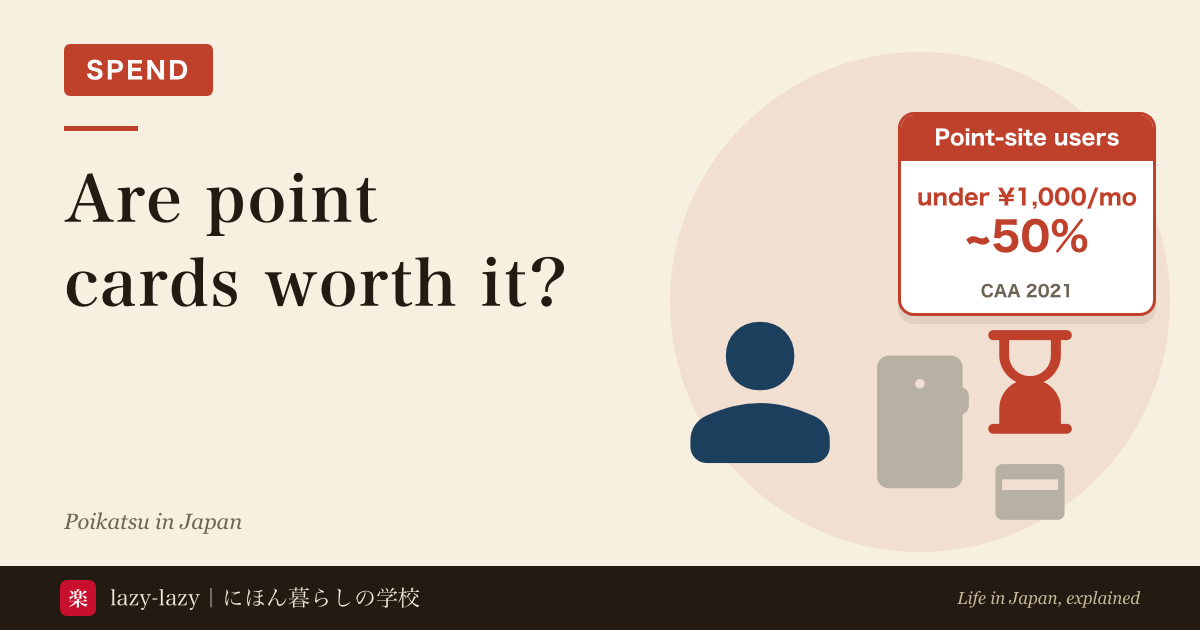
- In a Consumer Affairs Agency survey, about half of point-site users (49.8%) earned under 1,000 yen of points a month. 14.8% had lost points to expiry.
- Points won in a draw count as occasional income when you use them. At CIC, a card application stays on record for six months from the inquiry date.
Knowing this, you can decide for yourself whether a “you get points” offer is worth it before you sign up. The money and time you were putting into points can go somewhere else.
At the convenience store till, the cashier asks, “Pointo kādo wa omochi desu ka?” — do you have a point card? You say no, and it feels like you just lost something. A classmate tells you an app gives 500 yen just for registering, and a credit card gives 5,000 points. You ask a Japanese friend whether you should do all of it, and the answer is “everyone does it.” Nobody tells you at what point a good deal turns into a loss.
- Are point cards worth it in Japan? Do not spend money, time, cards or data on points
- Is poikatsu pointless? About half of point-site users earn under 1,000 yen a month
- Is poikatsu a waste of time? Count it as an hourly wage
- Is buying for points a good deal? “Deals” can turn into subscriptions
- What happens if you open too many credit cards? At CIC, applications stay on record for six months
- Do you pay tax on points in Japan? Shopping points no, prize points yes
- Do points expire in Japan? Don’t shop just to beat the deadline
- How much personal data should you give? Read the terms and the privacy policy first
- Which points should you take? Only the ones that come with normal spending
- Want to quit, or stuck? Check your balance first, call 188 if you need help
- Which one are you?
- FAQ
- Summary
- Related reading
Are point cards worth it in Japan? Do not spend money, time, cards or data on points
You don’t need to give up points. What to give up is doing things you didn’t need, just because points are attached.
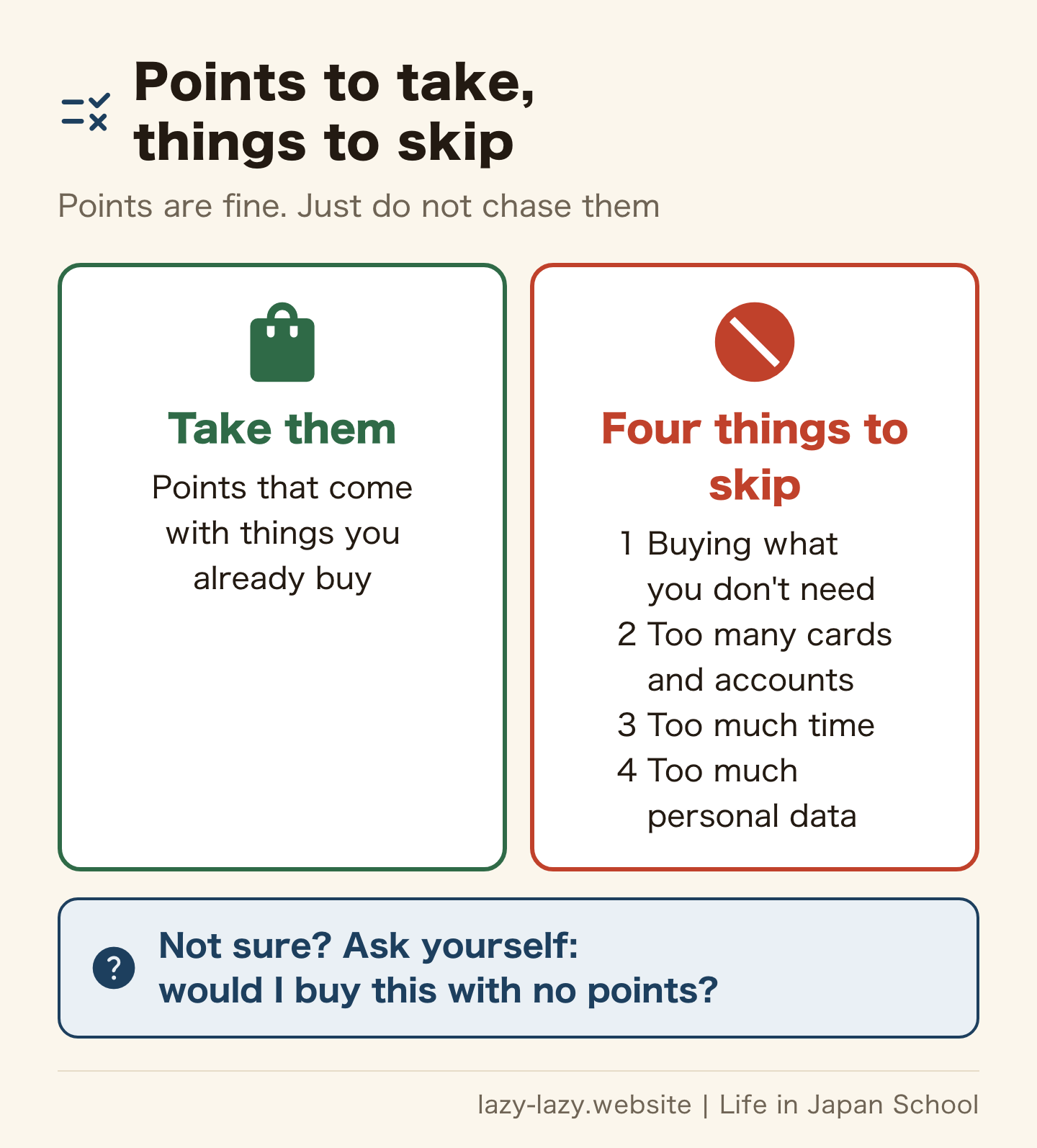
One question is enough: would I do this if there were no points? If yes, take the points as a bonus. If no, you are paying for the points with your money or your time.
Is poikatsu pointless? About half of point-site users earn under 1,000 yen a month
Where do the points come from? According to the Consumer Affairs Agency’s report on point sites (March 2021, Japanese), point-site points are paid out of the performance-based fees that advertisers pay. Sign-ups, brochure requests, new cards and surveys are all actions an advertiser wants from you.
The same report surveyed 520 current point-site users aged 20 and over. 49.8% earned under 1,000 yen of points a month (converted to yen). 22.9% earned 1,000–2,999 yen, 7.5% earned 3,000–4,999 yen, 5.6% earned 5,000–9,999 yen, and only 1.5% earned 10,000 yen or more. 12.7% did not know.
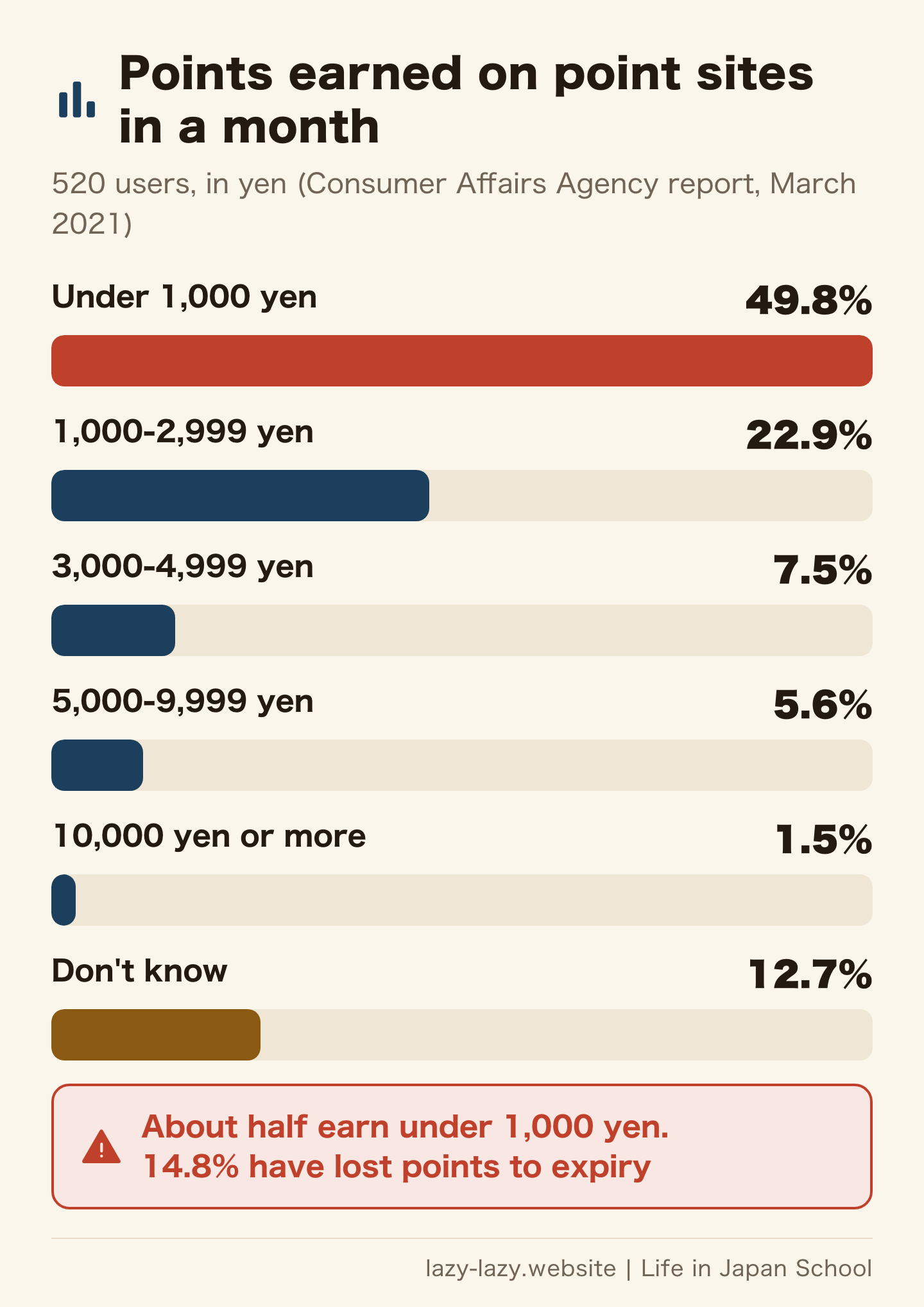
44.8% had run into some problem. The most common were points not being credited (17.9%), points expiring (14.8%) and the points not being worth the effort (13.1%). The survey is from 2021; we found no newer public survey.
Is poikatsu a waste of time? Count it as an hourly wage
Poikatsu costs more than money. Try pricing your time as if you had worked it.
Here is an example. Fifteen minutes a day for 30 days is 7.5 hours. Tokyo’s minimum wage is 1,280 yen an hour from 1 October 2026 (Tokyo Labour Bureau, Japanese), so 7.5 hours is 9,600 yen. If those 7.5 hours earn 1,000 yen of points, you are working for about 133 yen an hour.
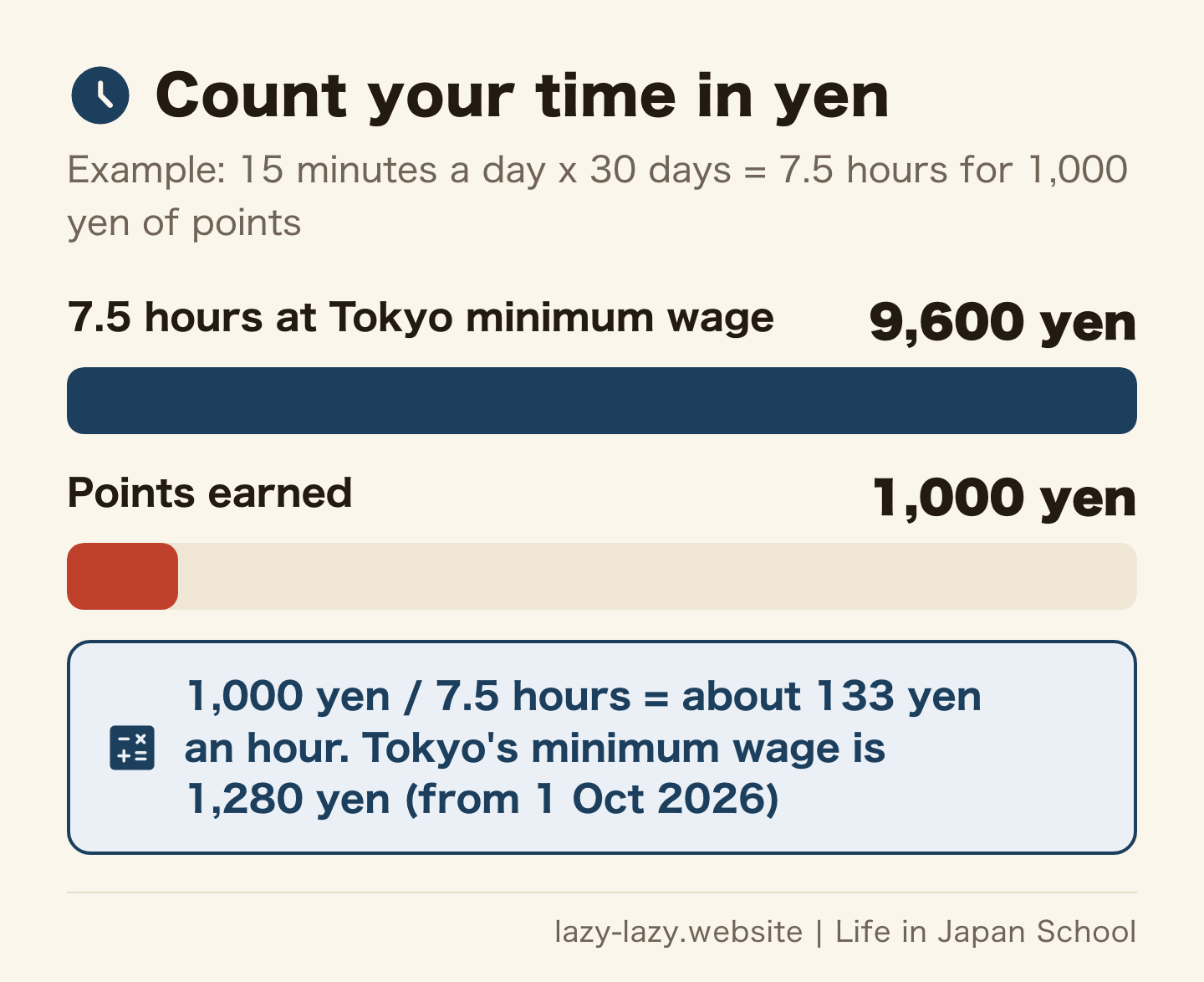
These numbers are only an example; yours will differ. Put in your own. For anything that takes a few minutes a day, judge it by how many hours it adds up to in a month.
Is buying for points a good deal? “Deals” can turn into subscriptions
“10x points.” “Half price, first order only.” Points and discounts give you a reason to buy that comes from outside. In the Consumer Affairs Agency survey, 5.3% of users who bought things through point sites said they had bought or signed up for something they didn’t need.
Online, complaints keep coming in from people who thought they bought once and found themselves in a subscription. The National Consumer Affairs Center (April 2026, Japanese) warns that an order can be a subscription even when the ad says “no commitment”. In some cases, a “special coupon” that popped up mid-order switched people to a plan with a minimum number of deliveries.
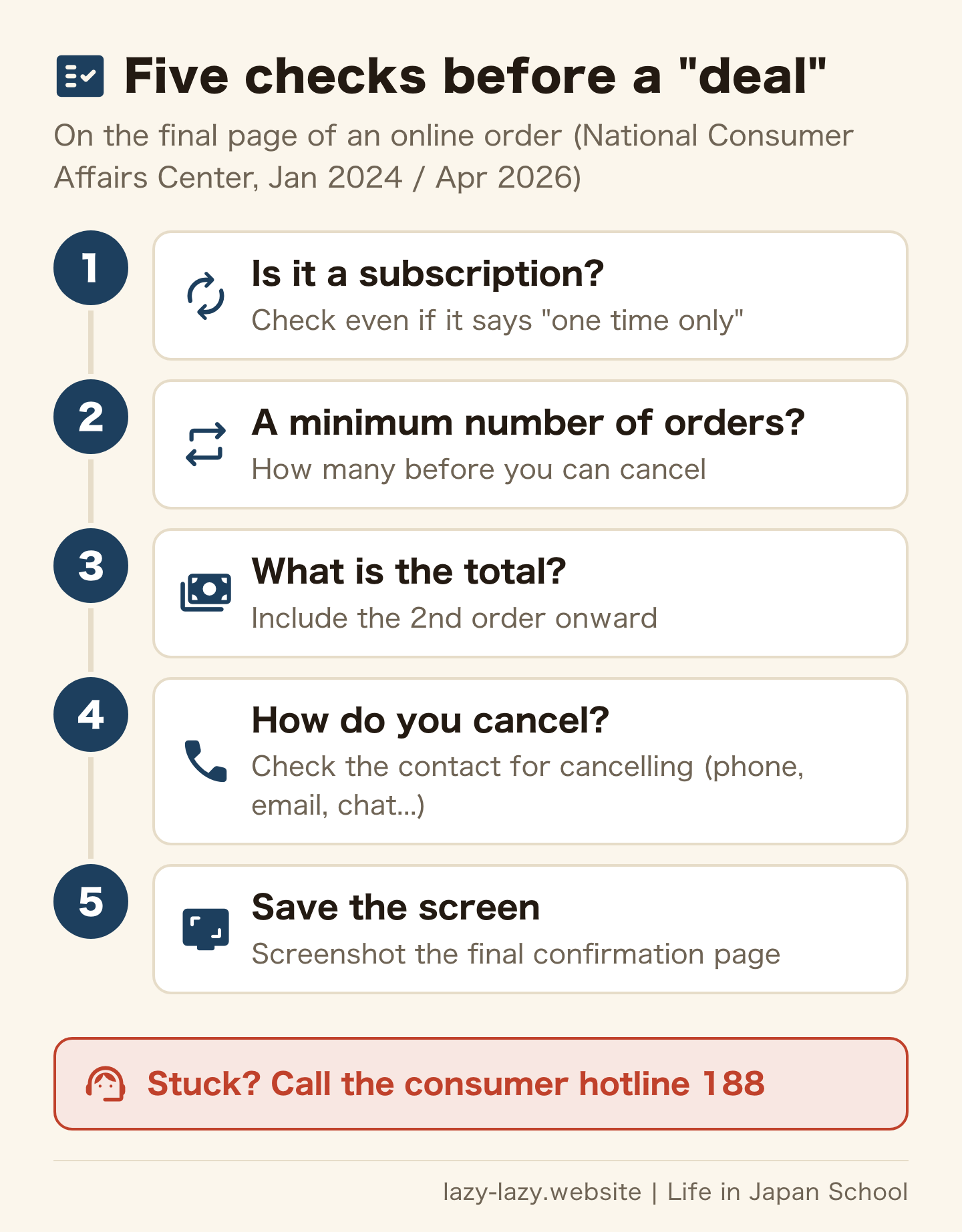
The Center’s advice is not to be swayed by “deal” or “today only”, and to think about whether you really need that product, that quantity and that plan. Before you order, check the final confirmation page for a subscription condition, a minimum number of orders, the price from the second order and the cancellation terms (checklist, January 2024, Japanese). Save that page as a screenshot. To stop subscriptions you no longer use, see how to cut fixed costs in Japan.
What happens if you open too many credit cards? At CIC, applications stay on record for six months
“Get 5,000 points for a new card.” In the Consumer Affairs Agency survey, 27.9% of point-site users had earned points by getting a card or opening a bank account.
When you apply for a card, the application is recorded by a credit bureau. At CIC (Japanese), application information stays for six months from the date the company checked it. Once you have a contract, credit information stays for the life of the contract and five years after it ends.
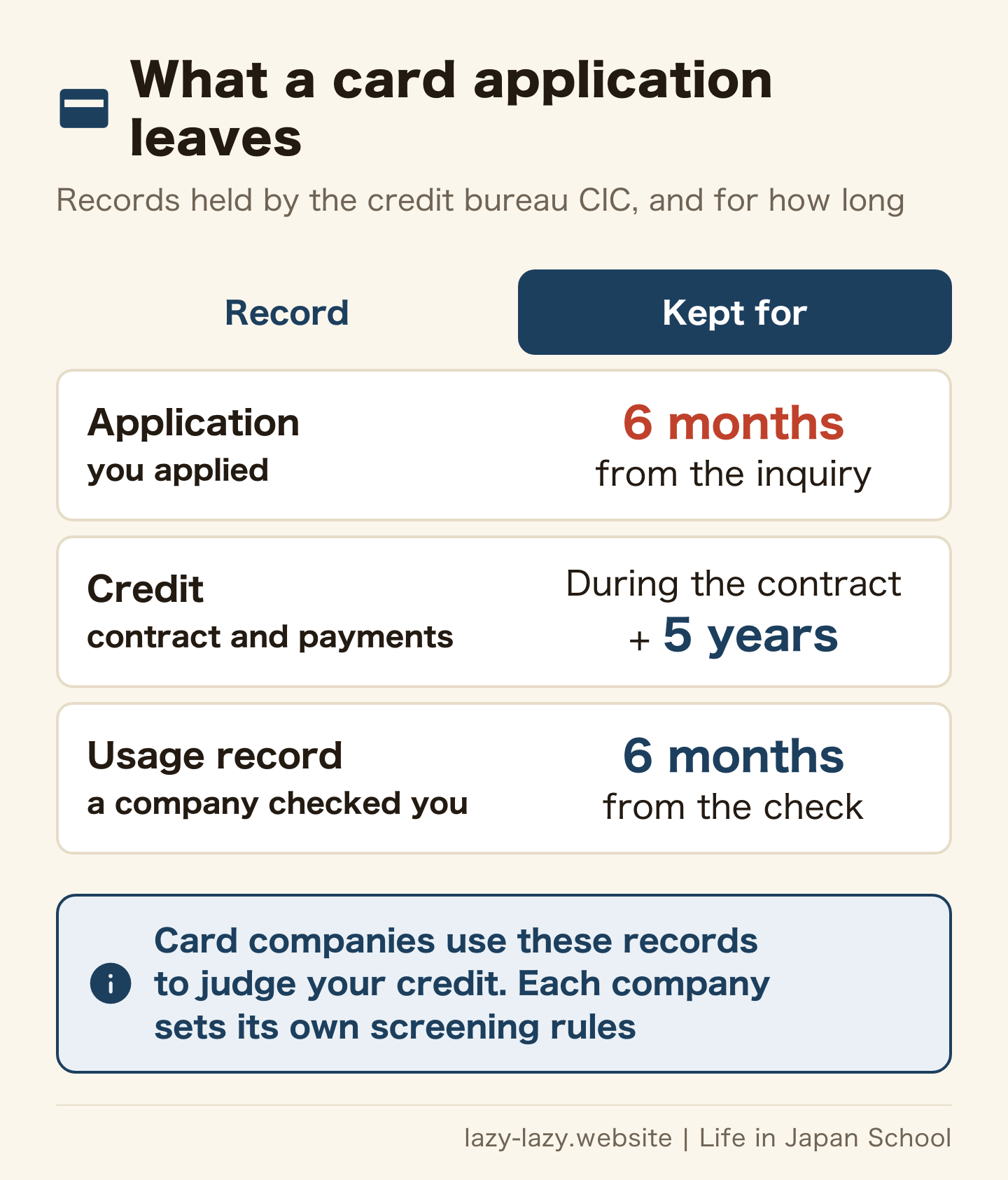
Card companies use these records as reference material for judging your creditworthiness. There is no official number of applications that counts against you; each company decides how it screens. But when you apply for the one card you actually need, the records from cards you opened for points are there too.
More cards also means more annual fees and statements to watch. How to clear out cards you don’t use is in tidying up bank accounts and cards, and what to check before your first card is in credit cards for foreigners in Japan.
Do you pay tax on points in Japan? Shopping points no, prize points yes
You win points in a draw and just spend them. Where you come from, that may be normal. In Japan, how points are taxed depends on how you got them.
The National Tax Agency’s Tax Answer No.1907 (Japanese) says points a shop gives you in line with what you paid are the same as an ordinary discount. Getting them and using them needs no tax return.
These points, on the other hand, are not treated as a discount:
- Points you got by chance, such as winning a point draw run by the company that issues them
- Points granted by the company that runs a shared points program
If you use these, the amount you use counts as income for that year, such as occasional income (ichiji shotoku).
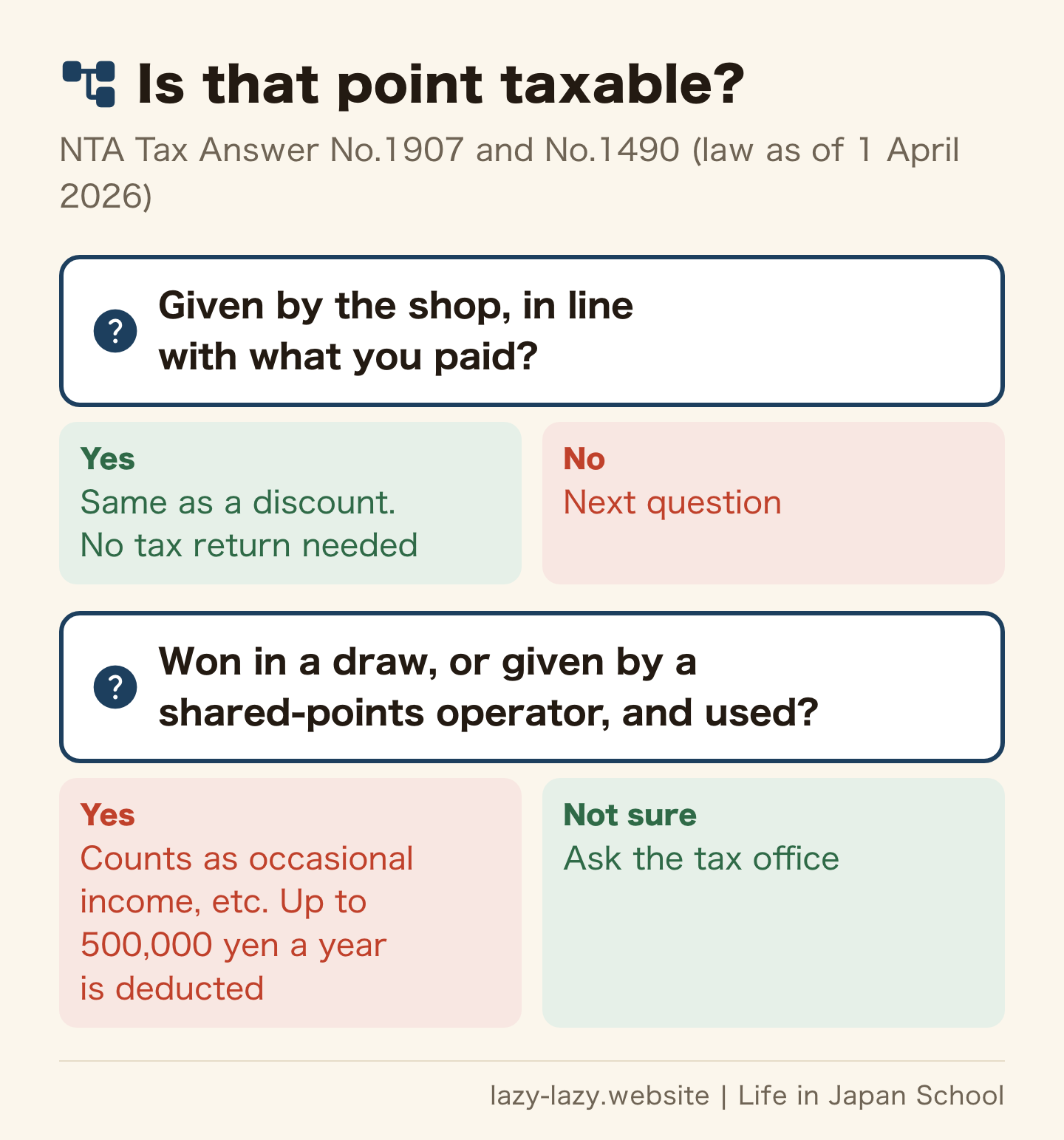
Occasional income has a special deduction of up to 500,000 yen (NTA No.1490, Japanese). You take the amount received, subtract what you spent to get it and the special deduction, and what is left is your occasional income. If your occasional income for the year totals 500,000 yen or less, what is left is zero.
If you are an employee, there is one more line. If your annual salary is 20 million yen or less, you are paid by one employer and all of that pay has tax withheld, you do not need to file a return as long as your income other than employment and retirement income totals 200,000 yen or less (NTA No.1900, Japanese). If your only income besides salary is occasional income, the amount compared with 200,000 yen is half of what is left after the special deduction (NTA No.1903, Japanese). If you can’t tell which kind your points are, ask a tax office consultation desk. Who must file and who need not is covered in kakutei shinkoku for foreigners.
Do points expire in Japan? Don’t shop just to beat the deadline
Some points have an expiry date, and the rules differ from service to service. Among the things users should watch, the Consumer Affairs Agency report lists checking expiry dates regularly so points don’t lapse without you noticing.
A near deadline is still no reason to buy something you don’t need. At one point per yen, spending 1,000 yen to use 100 points means 900 yen leaves your pocket. What you spend to save the points can be more than the points were worth.
If a text or email says “your points are about to expire”, don’t open the link. Check in the official app or a bookmark you already use. How to spot fake messages, and what to do if you tapped one, is in phishing SMS in Japan.
How much personal data should you give? Read the terms and the privacy policy first
Surveys and sign-ups pay points because your data and your actions are worth something. In the Consumer Affairs Agency survey, only around one in ten users in each age group checked the terms of use or the personal data policy. 8.5% said they started getting a lot of email.
Before signing up, look at who runs the service and its personal data policy. A separate email address for points keeps the flood out of your everyday inbox. Don’t reuse passwords; the report lists this too. How to manage them is in passwords and 2FA in Japan.
“Earn with points” or “get paid for introducing friends” can turn into a scheme that recruits people and makes them pay. If you are invited into one, use the questions in is MLM legal in Japan.
Which points should you take? Only the ones that come with normal spending
Take the points you get when you would buy the same thing at the same shop anyway. A point card offered at the till is fine at a shop you go to often. At a shop you won’t return to, skipping it loses you nothing.
Choose how you pay by what suits your life, not by points. Ways to pay without a card are in how to pay in Japan without a credit card.
Want to quit, or stuck? Check your balance first, call 188 if you need help
Once you decide to stop, list the services you use. Look at each balance and expiry date, use what you can on normal shopping, then close the account. Subscriptions and repeat orders you kept for points won’t stop until you cancel them.
Can’t close an account, points never arrived, can’t cancel a subscription? Contact the service’s support first. If that doesn’t work, the consumer hotline 188 connects you to a nearby consumer affairs centre (National Consumer Affairs Center). Have the order screens and emails ready; it goes faster.
Which one are you?
- You only get points on normal shopping — you’re fine. Open the app once today and check for points close to expiring.
- You open point sites or survey apps every day — add up last month’s time and points and work out your hourly rate. If it isn’t worth it, delete one app today.
- You opened cards or accounts for campaigns — list the cards you don’t use and check their annual fees and statements. Stop new applications for six months, starting today.
- You’re stuck with a subscription or can’t leave a service — save the order screens and emails, and call 188 today.
FAQ
Q. Should I stop poikatsu?
You don’t need to stop collecting points. Stop buying things you don’t need for points, opening too many cards and accounts, spending too much time, and handing over too much personal data. Points that come with your normal spending are fine to take.
Q. How much do people actually earn from points?
In a 2021 Consumer Affairs Agency survey of 520 point-site users, 49.8% earned under 1,000 yen of points a month. Only 1.5% earned 10,000 yen or more.
Q. Do I pay tax on points in Japan?
Points a shop gives you in line with what you paid are treated as a discount, and no tax return is needed. If you use points won in a draw, or points granted by a shared points program’s operator, the amount used counts as occasional income or similar. Occasional income has a special deduction of up to 500,000 yen.
Q. What happens if I open too many credit cards?
Each application is kept by the credit bureau CIC for six months from the date the company checked it. There is no official number that counts against you; each company sets its own screening. Don’t open cards just for points.
Q. My points are about to expire. Should I buy something?
Not if you don’t need it. At one point per yen, spending 1,000 yen to use 100 points means 900 yen leaves your pocket. If a text or email says your points will expire, check in the official app instead of tapping the link.
Q. Where can I get help with a point site problem?
Contact the service’s support first. If that doesn’t solve it, call the consumer hotline 188 to reach a nearby consumer affairs centre.
Summary
Points are best taken as a bonus on shopping you were doing anyway. They are funded by advertising fees, and about half of point-site users earned under 1,000 yen of points a month. Priced as an hourly wage, the time often isn’t worth it.
The test is simple: would I do this with no points? Skip the unneeded buying, the extra cards and accounts, and the time and data you would otherwise give away, and points can’t cost you. Remember too that prize points count as occasional income, and that at CIC a card application stays on record for six months from the inquiry date.
Official sources (Japanese): National Tax Agency No.1907 (points issued by companies) / No.1490 (occasional income) / No.1900 (employees who must file) / No.1903 (employees with occasional income) / Consumer Affairs Agency, point site trends (March 2021) / National Consumer Affairs Center, subscription traps (April 2026) / same, final confirmation checklist (January 2024) / CIC, credit information held / Tokyo Labour Bureau (Tokyo minimum wage). All checked on 15 November 2026.
Related reading
Found this useful? Share it
Send it to a friend who lives in Japan.
WHO WROTE THIS

mori
Japanese. I read the ministries’ own notices, orders and Q&As in the original, and I start from what my Nepalese and Sri Lankan friends in Japan actually ran into. I do not write about what I have not checked or been told.
What this site can and cannot do →Looking for something else?
You may use the figures in this article, including commercially, if you credit this site with a link. How to use our figures