We checked this article on 14 November 2026 against the Statistics Bureau of Japan’s consumer price index (September 2026 and the 2025 average), the Bank of Japan’s exchange rate and effective exchange rate data, and official pages of the Bank of Japan, the Financial Services Agency and the Deposit Insurance Corporation of Japan. It does not forecast exchange rates or prices, and it does not recommend any product.
The short answer
- A weak yen means 1 yen buys less of other currencies. If you earn in yen and spend in your home currency, it hits you like a price rise.
- Foreigners have two yardsticks. Money you spend in Japan is hit by prices (the consumer price index). Money you send home, or will spend there, is hit by the exchange rate.
- Prices in September 2026 were 2.1% higher than a year earlier. Food excluding fresh food rose 2.9%. 100,000 yen bought about $950 in October 2020, and about $633 in October 2026.
- You can prepare without forecasting the yen. Keep what you pay in Japan in yen, set money sent home in yen, and cut fixed costs first.
- This site does not recommend foreign-currency deposits or FX as protection. Foreign-currency deposits are outside deposit insurance. FX dealers must be registered, and unregistered dealing is illegal.
Knowing this, you can tell which of your money a “weak yen” headline actually touches. You can decide what to do this month, without rushing into a currency exchange or a get-rich offer.
It is payday evening, and you open the app to send money to your family. You are sending the same yen as last month. Yet the amount your family will receive has gone down a little. Ask a Japanese friend, and the answer may just be “it’s the weak yen.” Your friend earns in yen and spends in yen, so they have never watched the amount arriving shrink.
- What does a weak yen mean, and how is it linked to inflation? Two yardsticks for foreigners
- How high is inflation in Japan in 2026? Reading the consumer price index
- How does a weak yen affect money sent home? What 100,000 yen buys
- How do you read exchange rates and inflation figures? One division and “year on year”
- How much more will you pay each month? Work it out from your own spending
- Which currency will you live on? Your answer changes what to watch
- How can you protect yourself from a weak yen and inflation? 5 steps without a forecast
- Why keep your emergency fund in yen? Hold the currency you pay in
- Should you use foreign-currency deposits or FX against a weak yen? This site says no
- Not enough to send home, or to live on? Do not fill the gap with debt
- Which one are you?
- FAQ
- Summary
- Related reading
What does a weak yen mean, and how is it linked to inflation? Two yardsticks for foreigners
A weak yen means the yen is worth less against other currencies. The Bank of Japan describes it as a state where 1 yen can be exchanged for relatively fewer units of another currency (Japanese). At 1 dollar = 100 yen, 10,000 yen is $100. At 1 dollar = 125 yen, the same 10,000 yen is $80.
In this article, “inflation” means prices rising across the board. The number that tracks prices is the Statistics Bureau’s consumer price index. If you earn in yen and spend in yen, it is mostly prices that affect you.
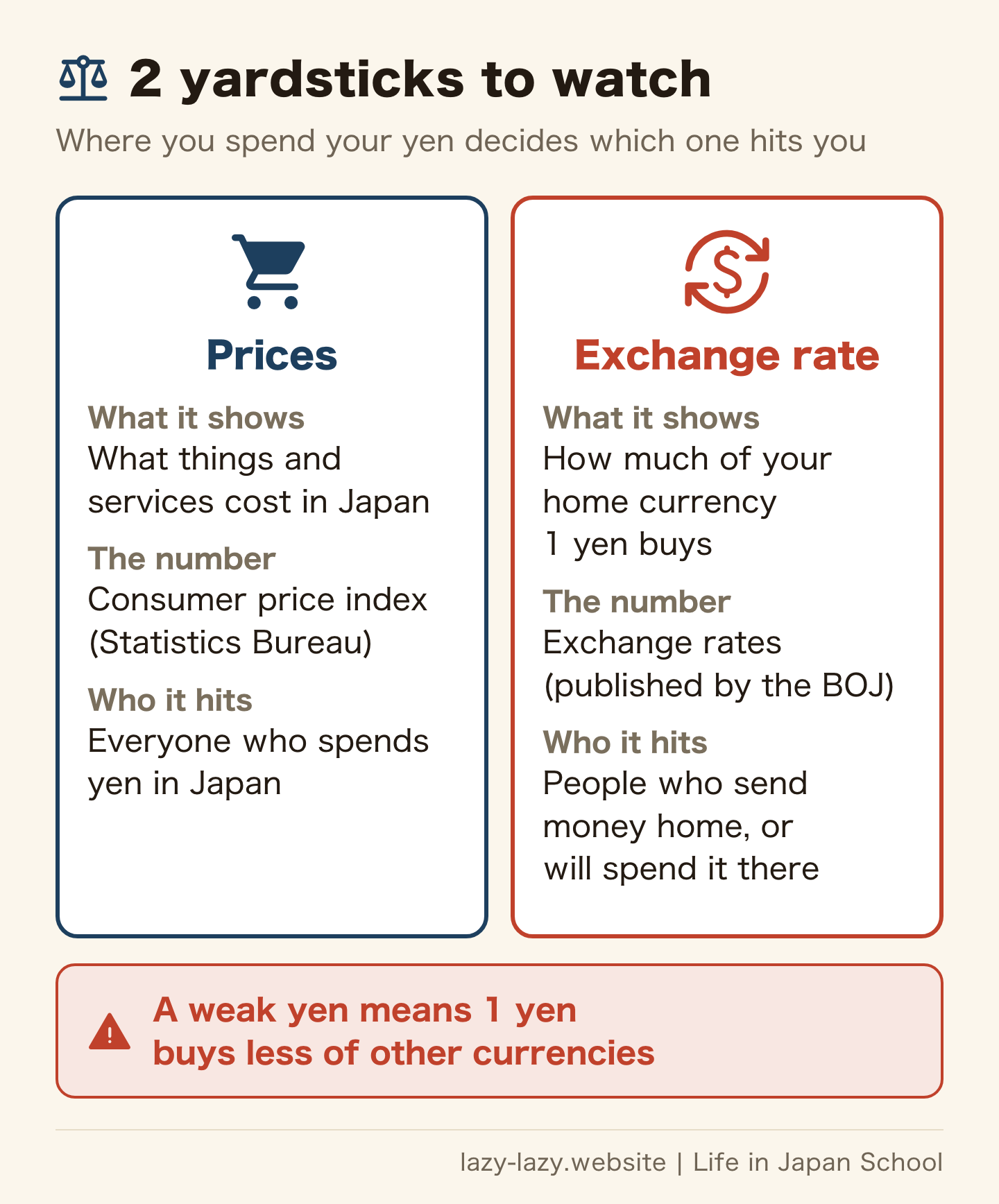
Foreigners have one more yardstick: the yen-to-home-currency exchange rate. Money you send home now and savings you plan to spend back home one day both depend directly on the exchange rate. How much each yardstick matters depends on where you spend your money.
How high is inflation in Japan in 2026? Reading the consumer price index
The consumer price index measures, in one number, how the prices of the things and services households across Japan buy are changing. The Statistics Bureau explains that it fixes a basket of purchases and shows how its cost changes with prices (Japanese). It covers 589 items. Income and residence taxes, social insurance and money sent to family are not included.
The latest figures are for September 2026 (Japanese). Overall prices were 2.1% higher than in the same month a year earlier. Food excluding fresh food rose 2.9%, and furniture and household goods rose 6.5%. Fuel, light and water rose only 0.8%.
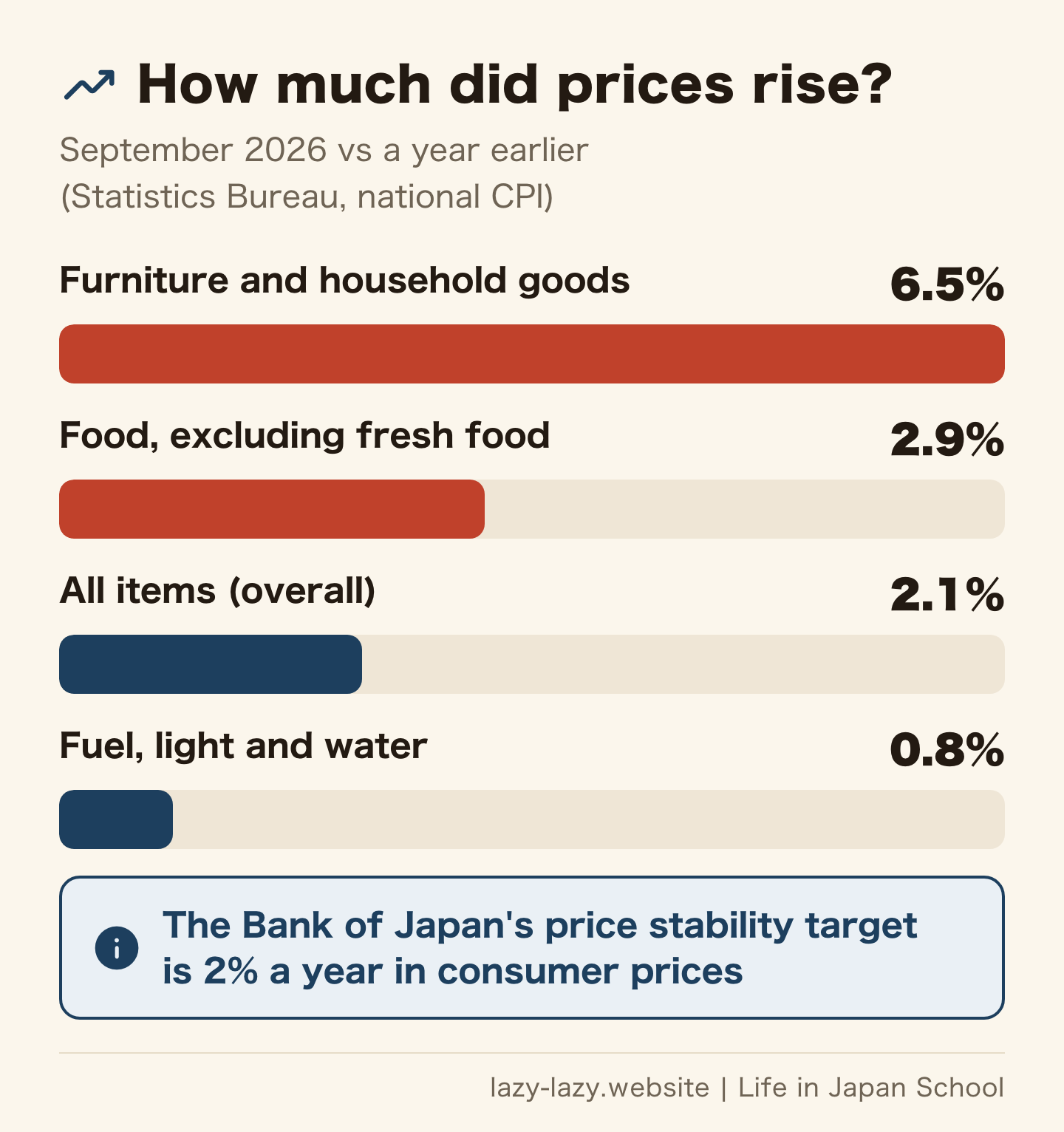
A longer view shows the climb more clearly. With 2020 set at 100, the overall index averaged 111.9 in 2025 (Japanese). The 2025 average was 3.2% higher than the 2024 average. In January 2013, the Bank of Japan set a price stability target of 2% a year in consumer prices.
Interest on savings has not kept up. In Bank of Japan data, the average posted interest rate on ordinary deposits (Japanese) was 0.331% a year in October 2026. What that gap means for your savings is worked through in why foreigners in Japan should think about investing.
How does a weak yen affect money sent home? What 100,000 yen buys
You see the exchange rate at work when you convert the same yen into another currency. Home currencies differ, so this example uses the dollar, which the Bank of Japan publishes. The Tokyo market monthly average (Japanese) was 105.21 yen to the dollar in October 2020 and 157.89 yen in October 2026.
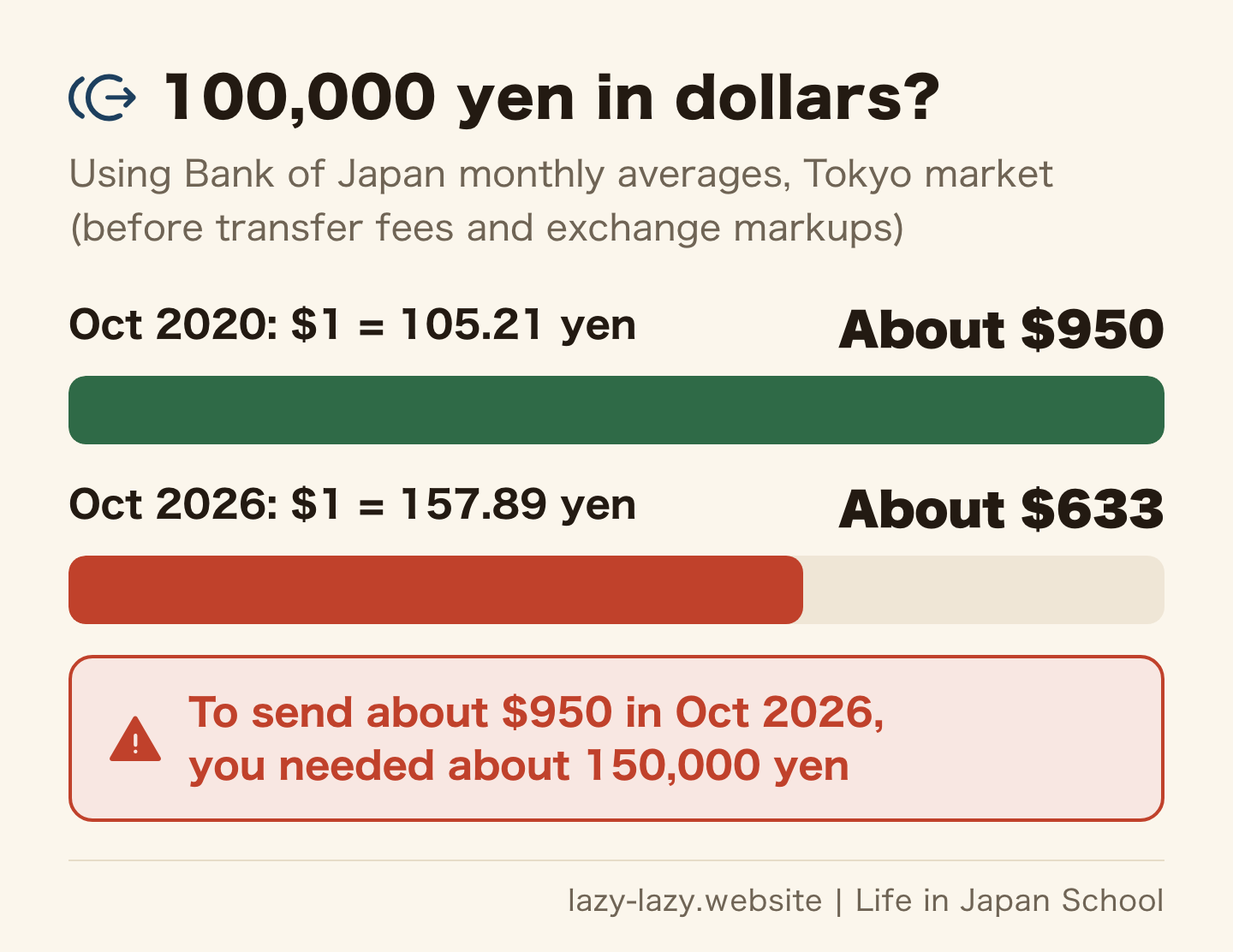
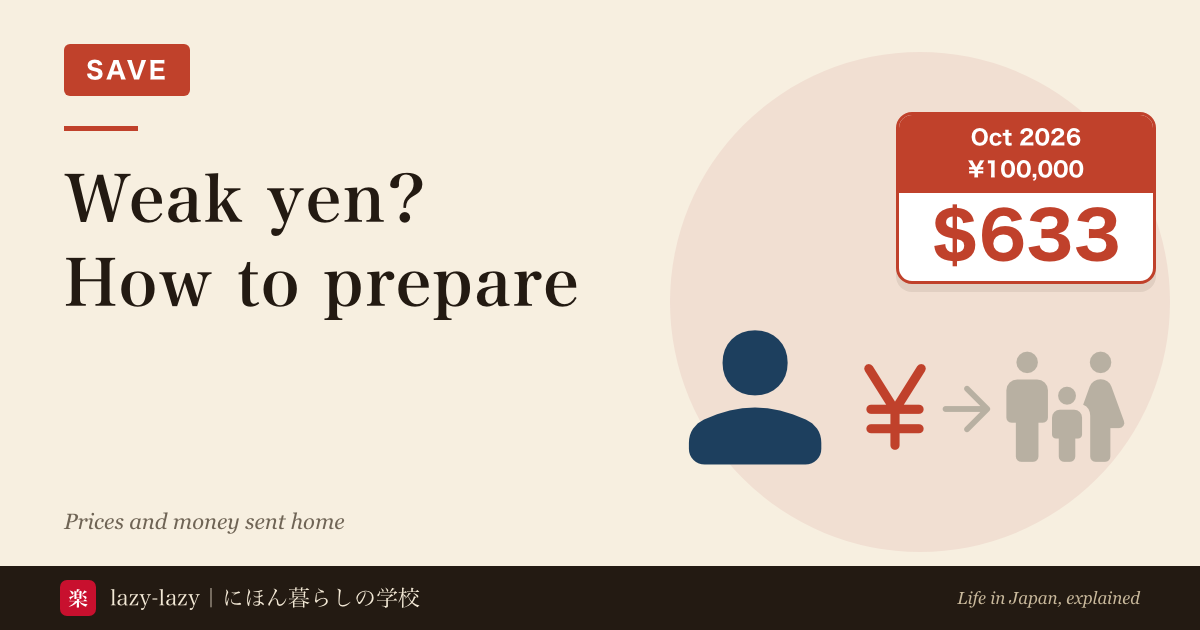
100,000 yen bought about $950 in October 2020. In October 2026, it bought about $633. To send the same $950 in October 2026, you would have needed about 150,000 yen. Even if you send the same yen, for your family it is as if the money shrank by about one third.
The yen has not weakened only against the dollar. The Bank of Japan publishes a nominal effective exchange rate, which combines the yen’s value against the currencies of about 65 countries and regions. With 2020 at 100, it stood at 69.49 in September 2026 (Japanese). That does not mean your home currency moved by the same amount. Check your own currency’s rate in your transfer app or at your bank.
How do you read exchange rates and inflation figures? One division and “year on year”
Two reading skills turn the numbers in the news into your own money.
- Exchange rate: at “1 dollar = 157.89 yen”, divide the yen amount by 157.89 to get dollars. 100,000 yen ÷ 157.89 is about $633. The bigger the number, the weaker the yen.
- Year on year: “up 2.1%” compares with the same month a year earlier, not with the previous month. The September 2026 index of 102.2 is measured against the 2025 average set at 100.
The rate in the news is not the rate you get when you send money. Transfer services add a markup to the rate or charge a fee. The calculation above leaves those out, so treat it as a guide. How to compare what actually arrives, fees and markups included, is in our comparison of ways to send money home.
How much more will you pay each month? Work it out from your own spending
Multiply the price rise by your own monthly spending, and it becomes real. If you spend 150,000 yen a month (example) and your costs rise by the overall 2.1%, the same life costs you 3,150 yen more a month. If food is 40,000 yen (example), the 2.9% rise in food excluding fresh food adds 1,160 yen a month.
In practice, your rise depends on what you buy most. If rent is most of your spending, your rise may be smaller than the index. If food and daily goods are most of it, it may be larger. With one month of budget records, you can multiply category by category. How to keep one is in starting a monthly budget in Japan.
Which currency will you live on? Your answer changes what to watch
Preparing for a weak yen and rising prices looks different for different people. What splits them is where you will spend your money from now on.
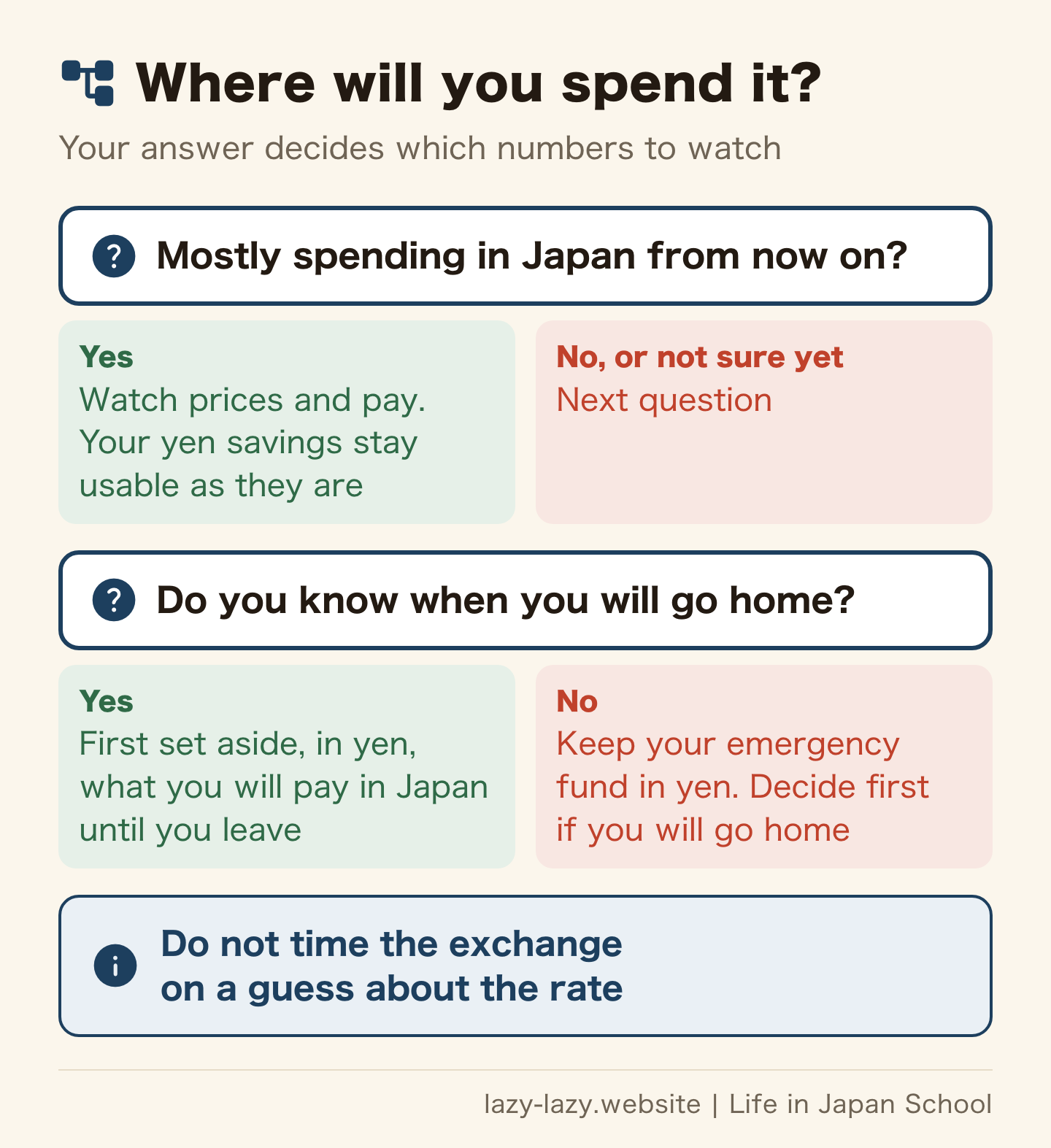
- You will stay in Japan for good: watch prices and your own pay. Yen savings can be spent in Japan whatever the exchange rate does.
- You know when you will go home: first set aside, in yen, what you will pay in Japan until you leave and the cost of moving home. The rest of your yen becomes home currency at the rate on the day you exchange it.
- You send money to family every month: the exchange rate changes what arrives each month. How to set the amount is in the next section.
- You have not decided yet: first keep what you need for life in Japan in yen. Once you decide whether to go home, you will know which numbers to watch.
One thing applies to everyone: do not choose when to convert yen into your home currency based on a guess about the rate. This site makes no forecast about which way the yen will move. Government currency intervention, too, is carried out under the Minister of Finance’s authority to curb sharp swings. Decide when to exchange from the day you leave or the day your family needs the money.
How can you protect yourself from a weak yen and inflation? 5 steps without a forecast
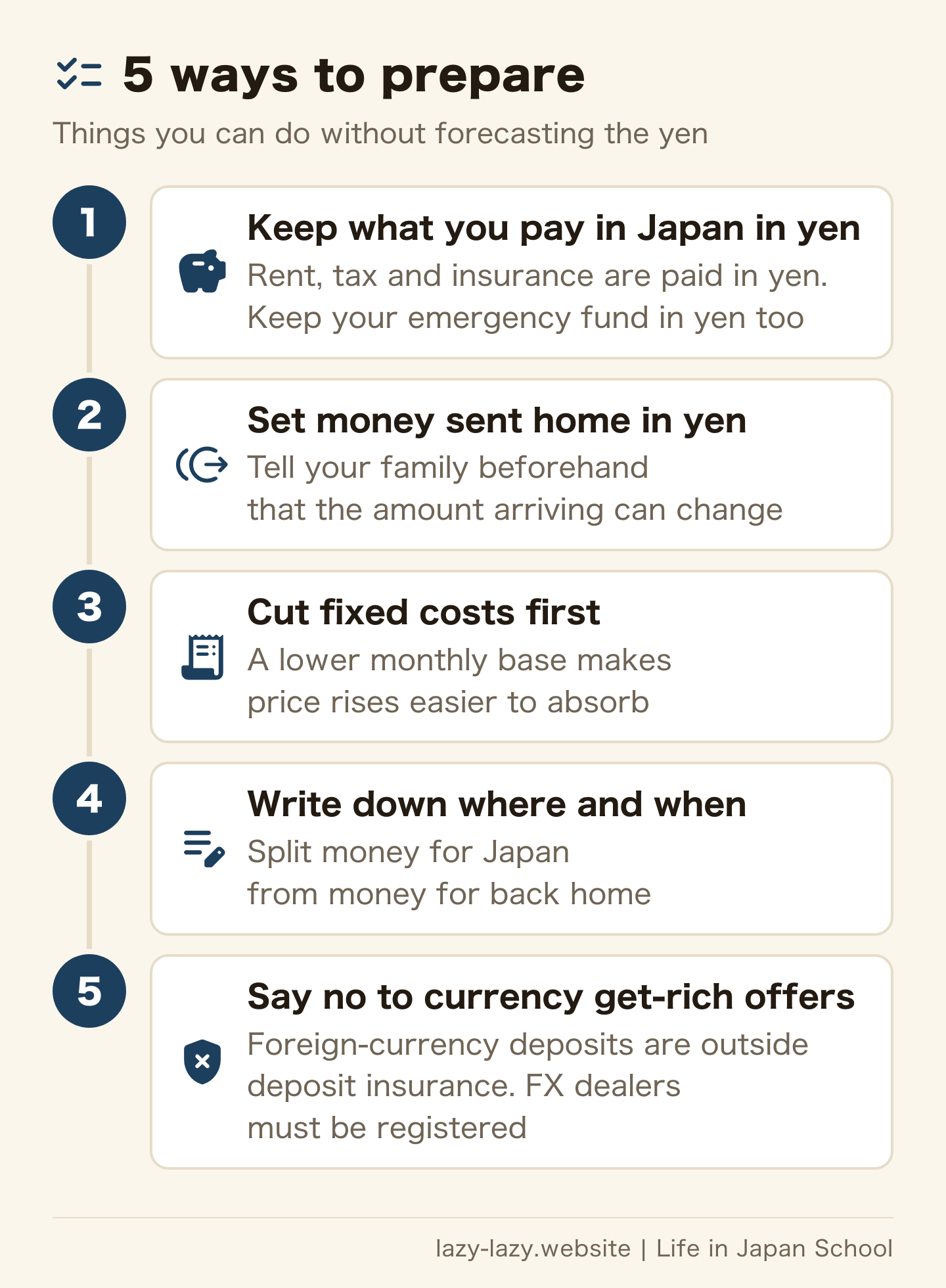
None of these steps needs you to predict the yen or prices. They are all things you decide yourself.
- Keep what you pay in Japan in yen. Rent, tax and insurance are all paid in yen. How much to keep for sudden costs can be worked out from your monthly spending with our emergency fund calculation.
- Set money sent home in yen. That is this site’s view. If you fix the amount in the other currency, your cost in yen rises in the months the yen is weak. Tell your family beforehand that what arrives will vary from month to month.
- Cut fixed costs first. With a lower monthly base, price rises are easier to absorb. The order to go through, starting with things like your phone and insurance, is in cutting fixed costs in Japan.
- Write down where and when you will spend. Split, on paper, the money you will use in Japan from the money you will use back home. Once it is split, you know which yardstick to watch.
- Say no to currency get-rich offers. The next sections explain why.
Why keep your emergency fund in yen? Hold the currency you pay in
Your pay comes in, and you change it straight into your home currency to save. Where you come from, that may be normal. In Japan, rent, residence tax and insurance all arrive as bills in yen. If your savings are in your home currency, every sudden bill means converting back, with the hassle and the fees. If you have to convert back while the yen is weak, you may get fewer yen than you expected.
Yen deposits are also protected by deposit insurance. According to the Deposit Insurance Corporation of Japan (Japanese), interest-bearing ordinary and time deposits at banks and similar institutions headquartered in Japan are protected up to 10 million yen of principal per person at each institution, plus interest up to the day it fails. Foreign-currency deposits, and Japanese branches of foreign banks, are not covered. Which banks are covered is explained in what happens to your deposits if a bank fails. Money you expect to use in Japan is best kept in yen, where you can withdraw it at once. Where to keep it is covered in the second half of our emergency fund guide.
Should you use foreign-currency deposits or FX against a weak yen? This site says no
When the weak yen is in the news, talk of “hold dollars to stay safe” or “win it back with FX” grows. This site does not recommend foreign-currency deposits or FX as a way to prepare. There are three reasons.
- Foreign-currency deposits are outside deposit insurance. When you change them back, the rate on that day decides how many yen you get.
- The Financial Services Agency explains that no financial product is strong on safety, return and liquidity all at once (Japanese). Anything that might grow can also shrink.
- FX is trading where profit and loss depend on forecasting exchange rates. That is the opposite of preparing without a forecast.
FX or currency get-rich offers may also reach you through social media or acquaintances. Anyone offering FX to residents of Japan must be registered with the Financial Services Agency, and dealing without registration is illegal (Japanese). The FSA receives many reports of unregistered dealers refusing withdrawals or suddenly going silent. If someone approaches you, check the list of registered dealers before you send any money. Scams that target foreigners in Japan, including investment scams, are covered in scams in Japan.
This article does not cover how to think about investing itself. The order to think it through is in why foreigners in Japan should think about investing.
Not enough to send home, or to live on? Do not fill the gap with debt
When a weak yen shrinks what arrives, you may want to send more yen. When prices rise, your own living costs go up too. When both happen at once, your monthly budget can fall short.
- Talk the amount over with your family again. Show them the exchange rate figures to explain why less arrives. If you reset the amount in yen, you will know your cost from next month.
- Cut fixed costs first. Review the money that goes out every month before cutting food in a hurry. To lower food spending without cutting too hard, start from eating out and waste, as in how to save money on food in Japan.
- Do not fill the gap with debt. Keeping up payments home with revolving credit or card cash advances makes the shortfall grow by the interest. This site does not recommend borrowing to cover living costs. Help you can use without borrowing is in how to avoid borrowing money in Japan.
Which one are you?
- You send money to family every month: today, set the amount in yen and tell your family that what arrives will vary.
- You plan to stay in Japan for good: today, multiply one month’s spending by 2.1% to see how much more prices cost you.
- You know when you will go home: today, list what you will pay in Japan until you leave and the cost of moving home, and decide how much to keep in yen.
- You have nothing set aside for sudden costs: today, add up your monthly spending and set a target for your emergency fund.
- Someone is offering you an FX or currency deal: today, before sending any money, check whether the dealer is registered with the Financial Services Agency.
FAQ
Q. What does a weak yen mean, in simple terms?
It means 1 yen buys less of other currencies. At 1 dollar = 100 yen, 10,000 yen is $100, but at 1 dollar = 125 yen it is $80. If you earn in yen and spend in your home currency, it hits you like a price rise.
Q. How does a weak yen affect foreigners living in Japan?
It hits money you send home or will spend back home. 100,000 yen bought about $950 in October 2020 and about $633 in October 2026 (Bank of Japan monthly averages, before fees). For money you spend in Japan, it is rising prices that matter.
Q. How are a weak yen and inflation linked?
They are different yardsticks. Inflation is prices in Japan rising across the board. A weak yen is about the rate between the yen and other currencies. Prices in Japan were 2.1% higher in September 2026 than a year earlier. Depending on where you spend, both can affect you.
Q. Is the yen going to recover?
This site does not forecast exchange rates. Currency intervention is carried out under the Minister of Finance’s authority to curb sharp swings. Instead of relying on a forecast, start with steps you control: keep what you pay in Japan in yen, set money sent home in yen, and cut fixed costs.
Q. Should I open a foreign-currency deposit to protect myself from a weak yen and inflation?
This site does not recommend it. Foreign-currency deposits are outside deposit insurance, and when you change them back, the rate on that day decides how many yen you get. Keep money you expect to use in Japan in a yen deposit.
Q. What is Japan’s consumer price index (CPI)?
It is one number that measures how the prices of the things and services households across Japan buy are changing. The Statistics Bureau publishes it every month. It fixes a basket of purchases and shows how its cost changes. In September 2026, it was up 2.1% year on year.
Summary
Foreigners who earn in yen have two yardsticks: prices and the exchange rate. Prices hit money you spend in Japan. The exchange rate hits money you send home or will spend there. Prices in September 2026 were 2.1% higher than a year earlier, and 100,000 yen bought about one third fewer dollars: about $950 in October 2020, and about $633 in October 2026.
This site does not forecast where the yen will go. Without a forecast, you can still keep what you pay in Japan in yen, set money sent home in yen, and cut fixed costs. One thing to do today: split your money on paper into what you will spend in Japan and what you will spend back home.
Official sources: Statistics Bureau of Japan, Consumer Price Index, September 2026 / 2025 average / Outline of the 2025-base CPI / Bank of Japan, What are a strong yen and a weak yen? (Japanese) / Exchange rates (monthly) / Effective exchange rates (monthly) / Average posted deposit interest rates (monthly) / Explanation of effective exchange rates / The price stability target of 2% / What is foreign exchange intervention? / Deposit Insurance Corporation of Japan, Scope of protection / Basics of deposit insurance / Financial Services Agency, Basics of asset building / Beware of unregistered dealers (all checked on 14 November 2026)
Related reading
Found this useful? Share it
Send it to a friend who lives in Japan.
WHO WROTE THIS

mori
Japanese. I read the ministries’ own notices, orders and Q&As in the original, and I start from what my Nepalese and Sri Lankan friends in Japan actually ran into. I do not write about what I have not checked or been told.
What this site can and cannot do →Looking for something else?
You may use the figures in this article, including commercially, if you credit this site with a link. How to use our figures